lock CADILLAC ATS 2013 1.G Owners Manual
[x] Cancel search | Manufacturer: CADILLAC, Model Year: 2013, Model line: ATS, Model: CADILLAC ATS 2013 1.GPages: 450, PDF Size: 6.98 MB
Page 315 of 450
Black plate (21,1)Cadillac ATS Owner Manual - 2013 - CRC - 10/5/12
Vehicle Care 10-21
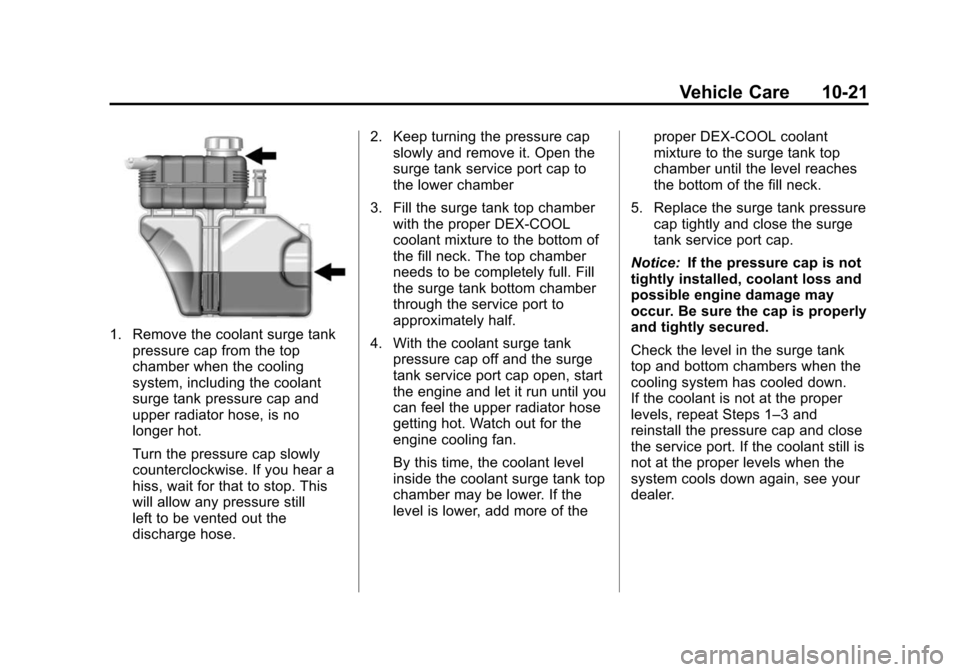
1. Remove the coolant surge tankpressure cap from the top
chamber when the cooling
system, including the coolant
surge tank pressure cap and
upper radiator hose, is no
longer hot.
Turn the pressure cap slowly
counterclockwise. If you hear a
hiss, wait for that to stop. This
will allow any pressure still
left to be vented out the
discharge hose. 2. Keep turning the pressure cap
slowly and remove it. Open the
surge tank service port cap to
the lower chamber
3. Fill the surge tank top chamber with the proper DEX-COOL
coolant mixture to the bottom of
the fill neck. The top chamber
needs to be completely full. Fill
the surge tank bottom chamber
through the service port to
approximately half.
4. With the coolant surge tank pressure cap off and the surge
tank service port cap open, start
the engine and let it run until you
can feel the upper radiator hose
getting hot. Watch out for the
engine cooling fan.
By this time, the coolant level
inside the coolant surge tank top
chamber may be lower. If the
level is lower, add more of the proper DEX-COOL coolant
mixture to the surge tank top
chamber until the level reaches
the bottom of the fill neck.
5. Replace the surge tank pressure cap tightly and close the surge
tank service port cap.
Notice: If the pressure cap is not
tightly installed, coolant loss and
possible engine damage may
occur. Be sure the cap is properly
and tightly secured.
Check the level in the surge tank
top and bottom chambers when the
cooling system has cooled down.
If the coolant is not at the proper
levels, repeat Steps 1–3 and
reinstall the pressure cap and close
the service port. If the coolant still is
not at the proper levels when the
system cools down again, see your
dealer.
Page 320 of 450
Black plate (26,1)Cadillac ATS Owner Manual - 2013 - CRC - 10/5/12
10-26 Vehicle Care
Always clean the brake/clutch fluid
reservoir cap and the area around
the cap before removing it. This
helps keep dirt from entering the
reservoir.
{WARNING
With the wrong kind of fluid in the
brake/clutch hydraulic system, the
brakes might not work well. This
could cause a crash. Always use
the proper brake/clutch fluid.
Notice
.Using the wrong fluid can
badly damage brake/clutch
hydraulic system parts. For
example, just a few drops of
mineral-based oil, such as
engine oil, in the brake
hydraulic system can
damage brake hydraulic
system parts so badly that
they will have to be replaced.
Do not let someone put in
the wrong kind of fluid.
.If brake fluid is spilled on the
vehicle's painted surfaces,
the paint finish can be
damaged. Be careful not to
spill brake fluid on the
vehicle. If you do, wash it off
immediately.
Battery
The battery is in the trunk, beneath
the trim panel, on the driver
side of the vehicle. Refer to the
replacement number shown on the
original battery label when a new
battery is needed.
{WARNING
Battery posts, terminals, and
related accessories contain lead
and lead compounds, chemicals
known to the State of California to
cause cancer and reproductive
harm. Wash hands after handling. After a power loss, such as
disconnecting the battery or
removing the maxi fuses in the
power distribution fuse block, the
following steps must be performed
to calibrate the electronic throttle
control. If this is not done, the
engine will not run properly.
1. Turn the ignition on but do not
start the engine.
2. Leave the ignition on for at least three minutes so that the
electronic throttle control will
cycle and relearn its home
position.
3. Turn the ignition off.
4. Start and run the engine for at least 30 seconds.
Page 323 of 450
Black plate (29,1)Cadillac ATS Owner Manual - 2013 - CRC - 10/5/12
Vehicle Care 10-29
Automatic Transmission
Shift Lock Control
Function Check
{WARNING
When you are doing this
inspection, the vehicle could
move suddenly. If the vehicle
moves, you or others could be
injured.
1. Before starting this check, be sure there is enough room
around the vehicle. It should be
parked on a level surface.
2. Firmly apply the parking brake. See Parking Brake (Electric) on
page 9‑30 orParking Brake
(Manual) on page 9‑33.
Be ready to apply the regular
brake immediately if the vehicle
begins to move. 3. With the engine off, turn the
ignition on, but do not start the
engine. Without applying the
regular brake, try to move the
shift lever out of P (Park) with
normal effort. If the shift lever
moves out of P (Park), contact
your dealer for service.
Ignition Transmission
Lock Check
While parked, and with the parking
brake set, try to turn the ignition to
LOCK/OFF in each shift lever
position.
.The ignition should turn to
LOCK/OFF only when the shift
lever is in P (Park).
.With the key access ignition
system, the ignition key should
come out only in LOCK/OFF.
See Ignition Positions on
page 9‑16.
Contact your dealer if service is
required.
Park Brake and P (Park)
Mechanism Check
{WARNING
When you are doing this check,
the vehicle could begin to move.
You or others could be injured
and property could be damaged.
Make sure there is room in front
of the vehicle in case it begins to
roll. Be ready to apply the regular
brake at once should the vehicle
begin to move.
Park on a fairly steep hill, with the
vehicle facing downhill. Keeping
your foot on the regular brake, set
the parking brake.
.To check the parking brake's
holding ability: With the engine
running and the transmission in
N (Neutral), slowly remove foot
pressure from the regular brake
pedal. Do this until the vehicle is
held by the parking brake only.
Page 326 of 450
Black plate (32,1)Cadillac ATS Owner Manual - 2013 - CRC - 10/5/12
10-32 Vehicle Care
Back-Up Lamps
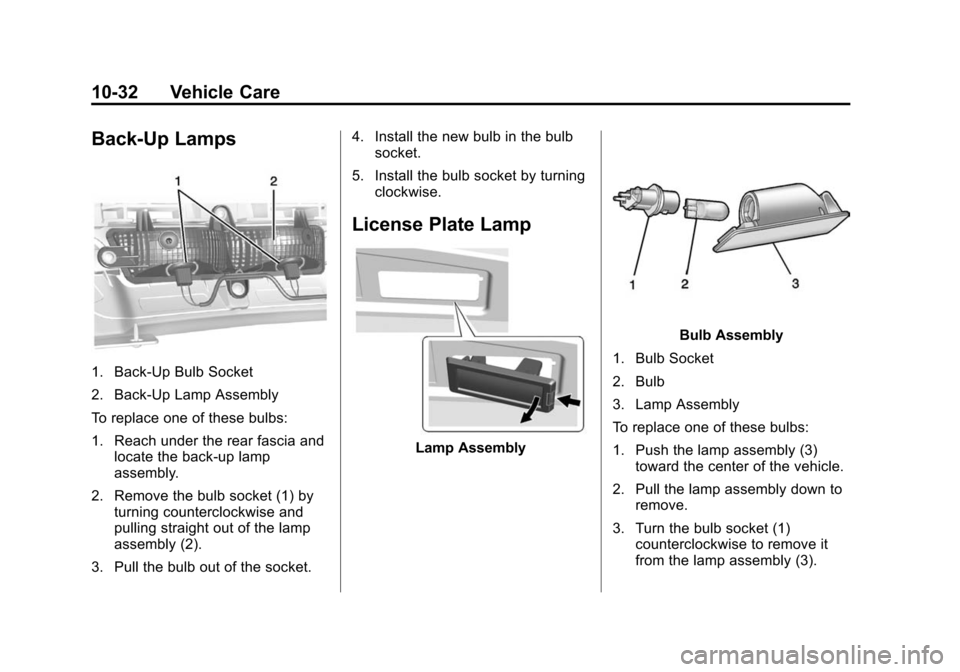
1. Back-Up Bulb Socket
2. Back-Up Lamp Assembly
To replace one of these bulbs:
1. Reach under the rear fascia andlocate the back-up lamp
assembly.
2. Remove the bulb socket (1) by turning counterclockwise and
pulling straight out of the lamp
assembly (2).
3. Pull the bulb out of the socket. 4. Install the new bulb in the bulb
socket.
5. Install the bulb socket by turning clockwise.
License Plate Lamp
Lamp Assembly
Bulb Assembly
1. Bulb Socket
2. Bulb
3. Lamp Assembly
To replace one of these bulbs:
1. Push the lamp assembly (3) toward the center of the vehicle.
2. Pull the lamp assembly down to remove.
3. Turn the bulb socket (1) counterclockwise to remove it
from the lamp assembly (3).
Page 327 of 450
Black plate (33,1)Cadillac ATS Owner Manual - 2013 - CRC - 10/5/12
Vehicle Care 10-33
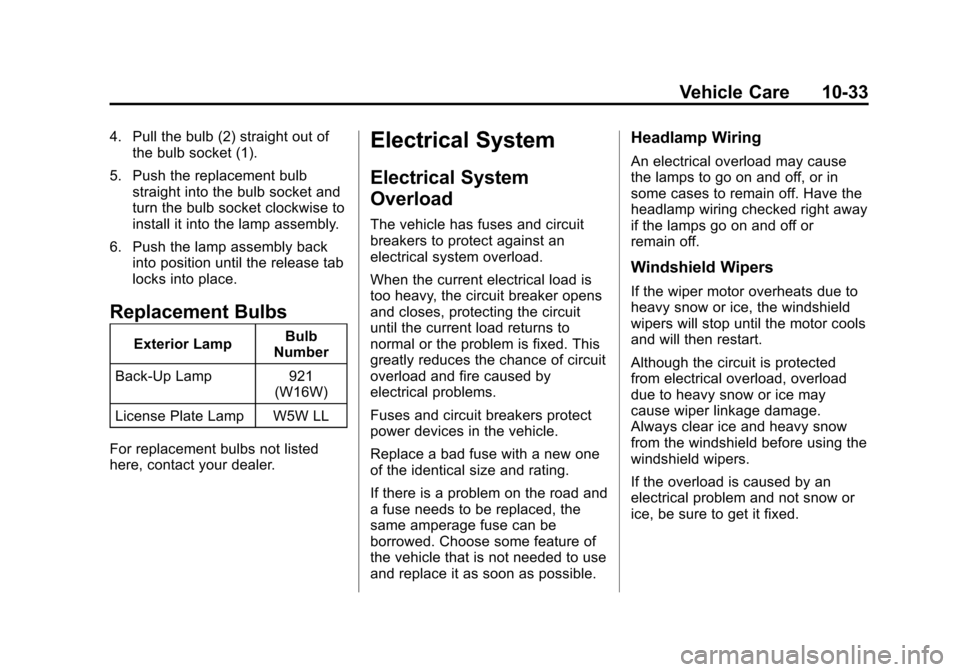
4. Pull the bulb (2) straight out ofthe bulb socket (1).
5. Push the replacement bulb straight into the bulb socket and
turn the bulb socket clockwise to
install it into the lamp assembly.
6. Push the lamp assembly back into position until the release tab
locks into place.
Replacement Bulbs
Exterior Lamp Bulb
Number
Back-Up Lamp 921 (W16W)
License Plate Lamp W5W LL
For replacement bulbs not listed
here, contact your dealer.
Electrical System
Electrical System
Overload
The vehicle has fuses and circuit
breakers to protect against an
electrical system overload.
When the current electrical load is
too heavy, the circuit breaker opens
and closes, protecting the circuit
until the current load returns to
normal or the problem is fixed. This
greatly reduces the chance of circuit
overload and fire caused by
electrical problems.
Fuses and circuit breakers protect
power devices in the vehicle.
Replace a bad fuse with a new one
of the identical size and rating.
If there is a problem on the road and
a fuse needs to be replaced, the
same amperage fuse can be
borrowed. Choose some feature of
the vehicle that is not needed to use
and replace it as soon as possible.
Headlamp Wiring
An electrical overload may cause
the lamps to go on and off, or in
some cases to remain off. Have the
headlamp wiring checked right away
if the lamps go on and off or
remain off.
Windshield Wipers
If the wiper motor overheats due to
heavy snow or ice, the windshield
wipers will stop until the motor cools
and will then restart.
Although the circuit is protected
from electrical overload, overload
due to heavy snow or ice may
cause wiper linkage damage.
Always clear ice and heavy snow
from the windshield before using the
windshield wipers.
If the overload is caused by an
electrical problem and not snow or
ice, be sure to get it fixed.
Page 328 of 450
Black plate (34,1)Cadillac ATS Owner Manual - 2013 - CRC - 10/5/12
10-34 Vehicle Care
Fuses and Circuit
Breakers
The wiring circuits in the vehicle are
protected from short circuits by a
combination of fuses and circuit
breakers. This greatly reduces the
chance of damage caused by
electrical problems.
To check a fuse, look at the
silver-colored band inside the fuse.
If the band is broken or melted,
replace the fuse. Be sure to replace
a bad fuse with a new one of the
identical size and rating.
Fuses of the same amperage can
be temporarily borrowed from
another fuse location, if a fuse goes
out. Replace the fuse as soon as
possible.
To identify and check fuses, circuit
breakers, and relays, seeEngine
Compartment Fuse Block on
page 10‑34, Instrument Panel Fuse
Block on page 10‑37, and Rear
Compartment Fuse Block on
page 10‑40.
Engine Compartment
Fuse Block
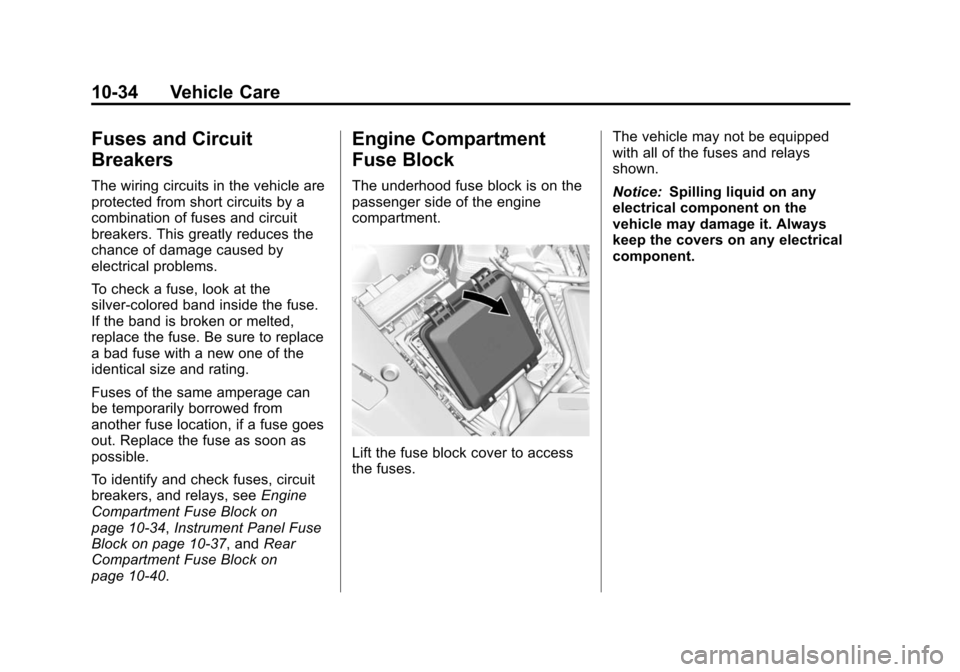
The underhood fuse block is on the
passenger side of the engine
compartment.
Lift the fuse block cover to access
the fuses. The vehicle may not be equipped
with all of the fuses and relays
shown.
Notice:
Spilling liquid on any
electrical component on the
vehicle may damage it. Always
keep the covers on any electrical
component.
Page 330 of 450
Black plate (36,1)Cadillac ATS Owner Manual - 2013 - CRC - 10/5/12
10-36 Vehicle Care
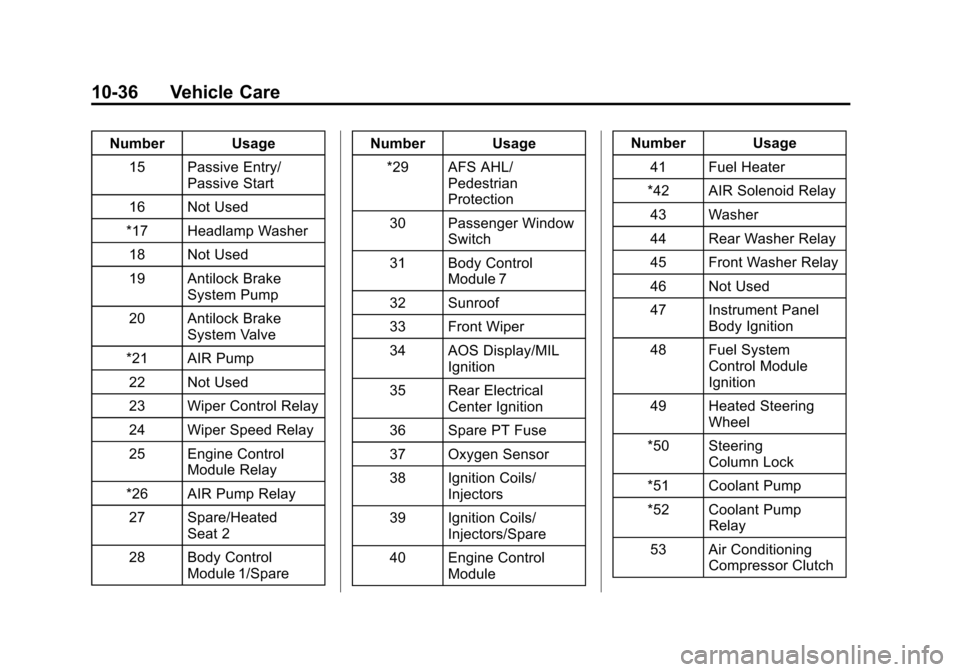
Number Usage15 Passive Entry/ Passive Start
16 Not Used
*17 Headlamp Washer 18 Not Used
19 Antilock Brake System Pump
20 Antilock Brake System Valve
*21 AIR Pump 22 Not Used
23 Wiper Control Relay
24 Wiper Speed Relay
25 Engine Control Module Relay
*26 AIR Pump Relay
27 Spare/Heated Seat 2
28 Body Control Module 1/Spare Number Usage
*29 AFS AHL/ Pedestrian
Protection
30 Passenger Window Switch
31 Body Control Module 7
32 Sunroof
33 Front Wiper
34 AOS Display/MIL Ignition
35 Rear Electrical Center Ignition
36 Spare PT Fuse
37 Oxygen Sensor
38 Ignition Coils/ Injectors
39 Ignition Coils/ Injectors/Spare
40 Engine Control Module Number Usage
41 Fuel Heater
*42 AIR Solenoid Relay
43 Washer
44 Rear Washer Relay
45 Front Washer Relay
46 Not Used
47 Instrument Panel Body Ignition
48 Fuel System Control Module
Ignition
49 Heated Steering Wheel
*50 Steering Column Lock
*51 Coolant Pump
*52 Coolant Pump Relay
53 Air Conditioning Compressor Clutch
Page 331 of 450
Black plate (37,1)Cadillac ATS Owner Manual - 2013 - CRC - 10/5/12
Vehicle Care 10-37
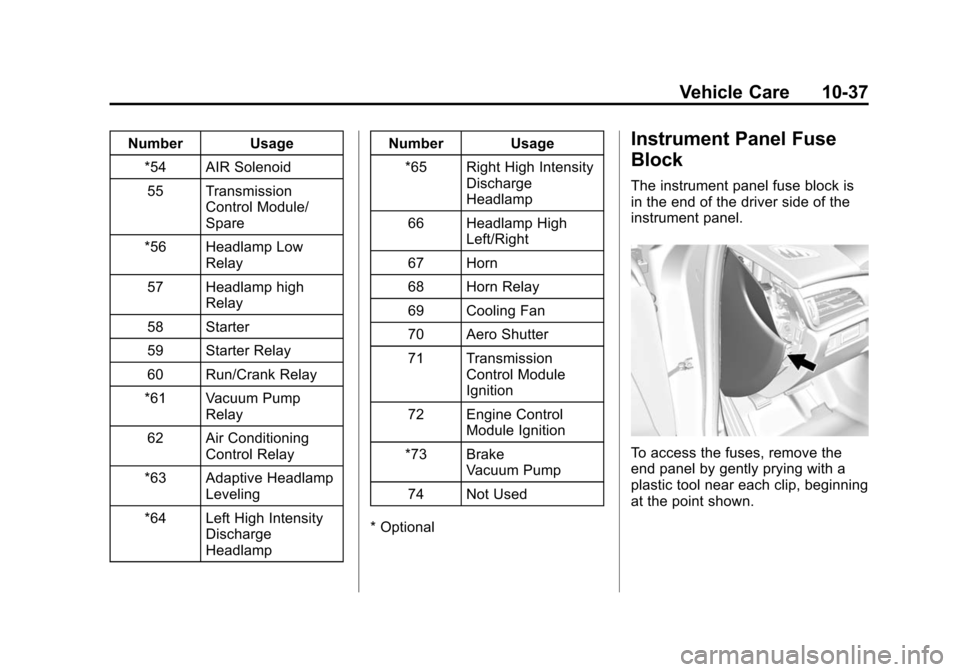
Number Usage*54 AIR Solenoid55 Transmission Control Module/
Spare
*56 Headlamp Low Relay
57 Headlamp high Relay
58 Starter
59 Starter Relay
60 Run/Crank Relay
*61 Vacuum Pump Relay
62 Air Conditioning Control Relay
*63 Adaptive Headlamp Leveling
*64 Left High Intensity Discharge
Headlamp Number Usage
*65 Right High Intensity Discharge
Headlamp
66 Headlamp High Left/Right
67 Horn
68 Horn Relay
69 Cooling Fan
70 Aero Shutter
71 Transmission Control Module
Ignition
72 Engine Control Module Ignition
*73 Brake Vacuum Pump
74 Not Used
* OptionalInstrument Panel Fuse
Block
The instrument panel fuse block is
in the end of the driver side of the
instrument panel.
To access the fuses, remove the
end panel by gently prying with a
plastic tool near each clip, beginning
at the point shown.
Page 333 of 450

Black plate (39,1)Cadillac ATS Owner Manual - 2013 - CRC - 10/5/12
Vehicle Care 10-39
Number Usage1 Not Used
2 Data Link Connector
3 Not Used
4 Not Used
5 Heater, Ventilation, and Air Conditioning
Control
6 Electric Steering Column Lock
8 Battery
9 Heated Steering Wheel
10 Not Used 11 Logistics Shunt 1
12 SDM/AOS
13 Cluster/HUD/ICS/ Steering Wheel
Controls Number Usage
14 Radio/Heater, Ventilation, and Air
Conditioning
16 Not Used
17 Accessory Power Outlet 1
18 Accessory Power Outlet 2
19 Steering Wheel Controls
20 Not Used
21 Not Used
22 Logistics Shunt 2
23 Not Used
24 Not Used
25 Not Used
27 RAP Relay Number Usage
28 Front Heater, Ventilation, and Air
Conditioning Blower
29 Power Steering Column
30 Not Used
Circuit
Breakers Usage
CB7 Not Used
CB26 Not Used
Relays Usage K10 RAP/Accessory
K605 Logistics
K609 Not Used
Page 334 of 450
Black plate (40,1)Cadillac ATS Owner Manual - 2013 - CRC - 10/5/12
10-40 Vehicle Care
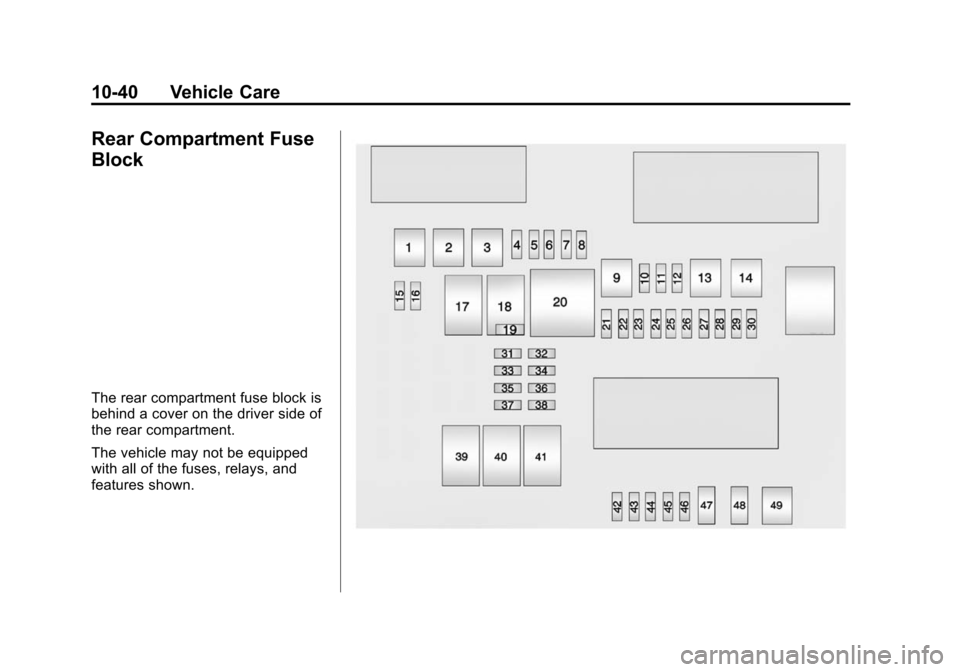
Rear Compartment Fuse
Block
The rear compartment fuse block is
behind a cover on the driver side of
the rear compartment.
The vehicle may not be equipped
with all of the fuses, relays, and
features shown.