ABS CADILLAC ATS 2016 1.G User Guide
[x] Cancel search | Manufacturer: CADILLAC, Model Year: 2016, Model line: ATS, Model: CADILLAC ATS 2016 1.GPages: 348, PDF Size: 3.38 MB
Page 205 of 348
Cadillac ATS/ATS-V Owner Manual (GMNA-Localizing-MidEast-9369639) -
2016 - crc - 12/9/15
204 Driving and Operating
If the EPB fails to apply, the rear
wheels should be blocked to
prevent vehicle movement.
EPB Release
To release the EPB:1. Place the ignition in the ACC/ ACCESSORY or ON/RUN
position.
2. Apply and hold the brake pedal.
3. Push down momentarily on the EPB switch.
The EPB is released when the red
parking brake status light is off.
If the amber parking brake warning
light is on, release the EPB by
pushing down on the EPB switch
and holding it down. Continue to
hold the switch until the red parking
brake status light is off. If either light
stays on after release is attempted,
see your dealer.
Caution
Driving with the parking brake on
can overheat the brake system
and cause premature wear or
damage to brake system parts.
Make sure that the parking brake
is fully released and the brake
warning light is off before driving.
Automatic EPB Release
The EPB will automatically release if
the vehicle is running, placed into
gear, and an attempt is made to
drive away. Avoid rapid acceleration
when the EPB is applied, to
preserve parking brake lining life.
If parking on a hill, or if the vehicle
is pulling a trailer, see Driving
Characteristics and Towing
Tips 0238.
Brake Assist
This vehicle has a brake assist
feature designed to assist the driver
in stopping or decreasing vehicle
speed in emergency driving
conditions. This feature uses the stability system hydraulic brake
control module to supplement the
power brake system under
conditions where the driver has
quickly and forcefully applied the
brake pedal in an attempt to quickly
stop or slow down the vehicle. The
stability system hydraulic brake
control module increases brake
pressure at each corner of the
vehicle until the ABS activates.
Minor brake pedal pulsation or
pedal movement during this time is
normal and the driver should
continue to apply the brake pedal as
the driving situation dictates. The
brake assist feature will
automatically disengage when the
brake pedal is released or brake
pedal pressure is quickly
decreased.
Hill Start Assist (HSA)
This vehicle has an HSA feature,
which may be useful when the
vehicle is stopped on a grade
sufficient enough to activate HSA.
This feature is designed to prevent
the vehicle from rolling, either
forward or rearward, during vehicle
Page 242 of 348
Cadillac ATS/ATS-V Owner Manual (GMNA-Localizing-MidEast-9369639) -
2016 - crc - 12/9/15
Driving and Operating 241
2. Have someone place chocksunder the trailer wheels.
3. When the wheel chocks are in place, release the regular
brakes until the chocks absorb
the load.
4. Reapply the brake pedal. Then apply the parking brake and
shift into P (Park).
5. Release the brake pedal.
Leaving After Parking on a Hill
1. Apply and hold the brake pedal.
2. Start the engine.
3. Shift into a gear.
4. Release the parking brake.
5. Let up on the brake pedal.
6. Drive slowly until the trailer is clear of the chocks.
7. Stop and have someone pick up and store the chocks.
Maintenance when Trailer
Towing
The vehicle needs service more
often when pulling a trailer. See
Maintenance Schedule 0323.
Things that are especially important
in trailer operation are automatic
transmission fluid, engine oil, axle
lubricant, belts, cooling system, and
brake system. It is a good idea to
inspect these before and during
the trip.
Check periodically to see that all
hitch nuts and bolts are tight.
Trailer Towing (Coupe
and V-Series)
The vehicle is neither designed nor
intended to tow a trailer.
Trailer Towing (Sedan
With V6 Engine)
Before pulling a trailer, there are
three important considerations that
have to do with weight:
. The weight of the trailer.
. The weight of the trailer tongue. .
The total weight on your
vehicle's tires.
Weight of the Trailer
How heavy can a trailer safely be?
It should never weigh more than
454 kg (1,000 lb). But even that can
be too heavy.
It depends on how the rig is used.
For example, speed, altitude, road
grades, outside temperature, and
how much the vehicle is used to pull
a trailer are all important. It can
depend on any special equipment
on the vehicle, and the amount of
tongue weight the vehicle can carry.
See “Weight of the Trailer Tongue”
later in this section.
Maximum trailer weight is calculated
assuming only the driver is in the
tow vehicle and it has all the
required trailering equipment. The
weight of additional optional
equipment, passengers, and cargo
in the tow vehicle must be
subtracted from the maximum trailer
weight.
Ask your dealer for trailering
information or advice.
Page 269 of 348
Cadillac ATS/ATS-V Owner Manual (GMNA-Localizing-MidEast-9369639) -
2016 - crc - 12/9/15
268 Vehicle Care
There are only two reasons why the
brake fluid level in the reservoir may
go down:
.Normal brake lining wear. When
new linings are installed, the
fluid level goes back up.
. A fluid leak in the brake
hydraulic system. Have the
brake hydraulic system fixed.
With a leak, the brakes will not
work well.
Always clean the brake fluid
reservoir cap and the area around
the cap before removing it.
Do not top off the brake fluid.
Adding fluid does not correct a leak.
If fluid is added when the linings are
worn, there will be too much fluid
when new brake linings are
installed. Add or remove fluid, as
necessary, only when work is done
on the brake hydraulic system.{Warning
If too much brake fluid is added, it
can spill on the engine and burn,
if the engine is hot enough. You
or others could be burned, and
the vehicle could be damaged.
Add brake fluid only when work is
done on the brake hydraulic
system.
When the brake fluid falls to a low
level, the brake warning light comes
on. See Brake System Warning
Light 0120.
Brake fluid absorbs water over time
which degrades the effectiveness of
the brake fluid. Replace brake fluid
at the specified intervals to prevent
increased stopping distance. See
Maintenance Schedule 0323.
What to Add
Use only GM approved DOT 3
brake fluid from a clean, sealed
container. See Recommended
Fluids and Lubricants 0327.
{Warning
The wrong or contaminated brake
fluid could result in damage to the
brake system. This could result in
the loss of braking leading to a
possible injury. Always use the
proper GM approved brake fluid.
Caution
If brake fluid is spilled on the
vehicle's painted surfaces, the
paint finish can be damaged.
Immediately wash off any painted
surface.
Battery
The original equipment battery is
maintenance free. Do not remove
the cap and do not add fluid.
The battery is in the trunk, behind
the trim panel, on the driver side of
the vehicle. Refer to the
Page 278 of 348
Cadillac ATS/ATS-V Owner Manual (GMNA-Localizing-MidEast-9369639) -
2016 - crc - 12/9/15
Vehicle Care 277
Number Usage1 –
2 –
3 Passenger motorized
safety belt
4 –
5 –
6 Driver power seat
7 –
8 Headlamp washer relay
9 –
10 –
11 –
12 –
13 Passenger power seat
14 –
15 Passive entry/ Passive start
16 –
17 Headlamp washer Number Usage
18 –
19 ABS pump
20 ABS valve
21 –
22 Driver motorized safety belt
23 Wiper control relay
24 Wiper speed relay
25 Engine control module relay
26 –
27 –/Heated seat 2
28 –/Reverse lockout
29 AFS AHL/ Pedestrian
protection
30 –
31 Passenger window switch
32 –
33 Sunroof
34 Front wiper Number Usage
35 Steering column lock
36 Rear electrical center/Ignition
37 –/MIL/Ignition
38 –/PT fuse
39 O2 sensor
40 Ignition coils/ Injectors
41 Ignition coils/ Injectors/–
42 Engine control module
43 –
44 –
45 Washer
46 –
47 Front washer relay
48 Instrument panel body/Ignition
49 Fuel system control module/Ignition
Page 280 of 348
Cadillac ATS/ATS-V Owner Manual (GMNA-Localizing-MidEast-9369639) -
2016 - crc - 12/9/15
Vehicle Care 279
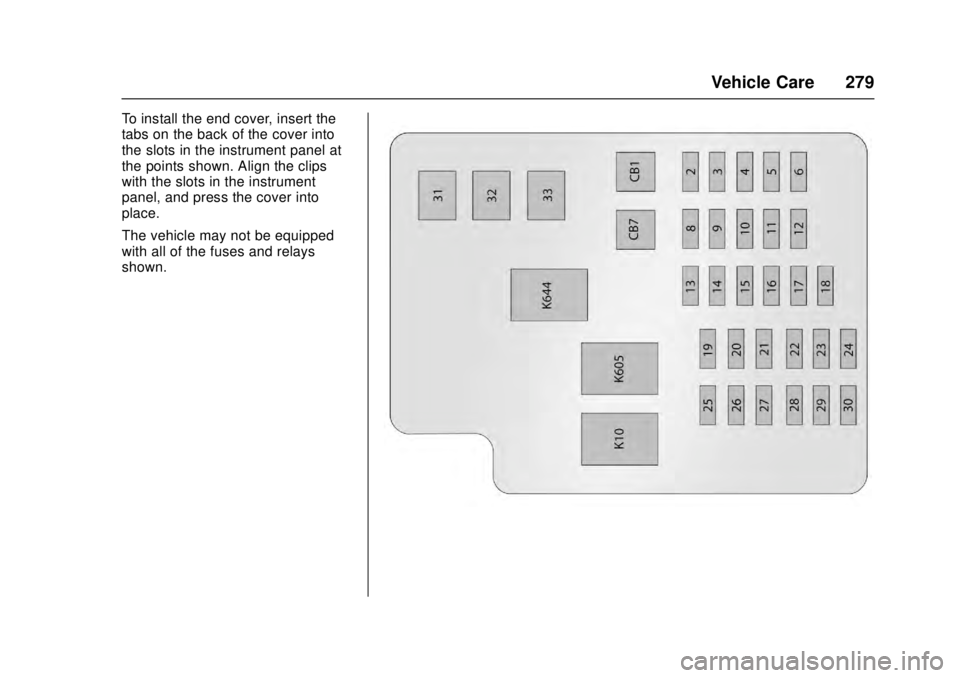
To install the end cover, insert the
tabs on the back of the cover into
the slots in the instrument panel at
the points shown. Align the clips
with the slots in the instrument
panel, and press the cover into
place.
The vehicle may not be equipped
with all of the fuses and relays
shown.
Page 314 of 348
Cadillac ATS/ATS-V Owner Manual (GMNA-Localizing-MidEast-9369639) -
2016 - crc - 12/9/15
Vehicle Care 313
Appearance Care
Exterior Care
Locks
Locks are lubricated at the factory.
Use a de-icing agent only when
absolutely necessary, and have the
locks greased after using. See
Recommended Fluids and
Lubricants0327.
Washing the Vehicle
To preserve the vehicle's finish,
wash it often and out of direct
sunlight.
Caution
Do not use petroleum-based,
acidic, or abrasive cleaning
agents as they can damage the
vehicle's paint, metal, or plastic
parts. If damage occurs, it would
not be covered by the vehicle
warranty. Approved cleaning
products can be obtained from
(Continued)
Caution (Continued)
your dealer. Follow all
manufacturer directions regarding
correct product usage, necessary
safety precautions, and
appropriate disposal of any
vehicle care product.
Caution
Avoid using high-pressure
washes closer than 30 cm (12 in)
to the surface of the vehicle. Use
of power washers exceeding
8,274 kPa (1,200 psi) can result
in damage or removal of paint
and decals.
Caution
Do not power wash any
component under the hood that
has this
esymbol.
(Continued)
Caution (Continued)
This could cause damage that
would not be covered by the
vehicle warranty.
If using an automatic car wash,
follow the car wash instructions. The
windshield wiper and rear window
wiper, if equipped, must be off.
Remove any accessories that may
be damaged or interfere with the car
wash equipment.
Rinse the vehicle well, before
washing and after, to remove all
cleaning agents completely. If they
are allowed to dry on the surface,
they could stain.
Dry the finish with a soft, clean
chamois or an all-cotton towel to
avoid surface scratches and water
spotting.
Finish Care
Application of aftermarket clearcoat
sealant/wax materials is not
recommended. If painted surfaces
are damaged, see your dealer to
Page 339 of 348

Cadillac ATS/ATS-V Owner Manual (GMNA-Localizing-MidEast-9369639) -
2016 - crc - 12/9/15
338 Index
IndexA
Accessories andModifications . . . . . . . . . . . . . . . . . . 245
Accessory Power . . . . . . . . . . . . . . . 195
Adaptive Cruise Control . . . . . . . . 214
Adaptive Forward Lighting (AFL) . . . . . . . . . . . . . . . . . 154
Adaptive Forward Lighting (AFL) Light . . . . . . . . . . . . . . . . . . . . 125
Add-On Electrical Equipment . . . 243
Adjustments
Lumbar, Front Seats . . . . . . . . . . . . 56
Thigh Support . . . . . . . . . . . . . . . . . . 56
Air Cleaner/Filter, Engine . . . . . . . 258
Air Filter, Passenger
Compartment . . . . . . . . . . . . . . . . . 174
Air Vents . . . . . . . . . . . . . . . . . . . . . . . 173
Airbag System Check . . . . . . . . . . . . . . . . . . . . . . . . . . 82
How Does an Airbag
Restrain? . . . . . . . . . . . . . . . . . . . . . 75
Passenger Sensing System . . . . 76
What Makes an Airbag Inflate? . . . . . . . . . . . . . . . . . . . . . . . . 75
What Will You See after an Airbag Inflates? . . . . . . . . . . . . . . . 75
When Should an Airbag Inflate? . . . . . . . . . . . . . . . . . . . . . . . . 73 Airbag System (cont'd)
Where Are the Airbags? . . . . . . . . 72
Airbags Adding Equipment to the
Vehicle . . . . . . . . . . . . . . . . . . . . . . . . 81
Passenger Status Indicator . . . .117
Readiness Light . . . . . . . . . . . . . . .116
Servicing Airbag-Equipped Vehicles . . . . . . . . . . . . . . . . . . . . . . . 81
System Check . . . . . . . . . . . . . . . . . . 70
Alarm Vehicle Security . . . . . . . . . . . . . . . . 41
Alert Lane Change . . . . . . . . . . . . . . . . . 230
Side Blind Zone (SBZA) . . . . . . 230
All-Season Tires . . . . . . . . . . . . . . . . 284
Antilock Brake System (ABS) . . . 201 Warning Light . . . . . . . . . . . . . . . . . 121
Appearance Care Exterior . . . . . . . . . . . . . . . . . . . . . . . 313
Interior . . . . . . . . . . . . . . . . . . . . . . . . 317
Armrest Storage . . . . . . . . . . . . . . . . 101
Assistance Systems for Driving . . . . . . . . . . . . . . . . . . . . . . . . 226
Assistance Systems for Parking and Backing . . . . . . . . . . 222
Automatic Door Locks . . . . . . . . . . . . . . . . . . . . . 37
Page 344 of 348

Cadillac ATS/ATS-V Owner Manual (GMNA-Localizing-MidEast-9369639) -
2016 - crc - 12/9/15
Index 343
LightAdaptive Forward Lighting
(AFL) Light . . . . . . . . . . . . . . . . . . 125
Parking Brake . . . . . . . . . . . . . . . . 120
Lighting Adaptive Forward . . . . . . . . . . . . . 154
Entry . . . . . . . . . . . . . . . . . . . . . . . . . 157
Exit . . . . . . . . . . . . . . . . . . . . . . . . . . . 157
Illumination Control . . . . . . . . . . . 155
LED . . . . . . . . . . . . . . . . . . . . . . . . . . 272
Lights . . . . . . . . . . . . . . . . . . . . . . . . . . . 121
Airbag Readiness . . . . . . . . . . . . . .116
Antilock Brake System(ABS) Warning . . . . . . . . . . . . . . 121
Brake System Warning . . . . . . . 120
Charging System . . . . . . . . . . . . . .117
Cruise Control . . . . . . . . . . . . . . . . 126
Engine Coolant Temperature Warning . . . . . . . 123
Engine Oil Pressure . . . . . . . . . . 124
Flash-to-Pass . . . . . . . . . . . . . . . . . 152
High-Beam On . . . . . . . . . . . . . . . . 125
High/Low Beam Changer . . . . . 152
Low Fuel Warning . . . . . . . . . . . . 124
Safety Belt Reminders . . . . . . . . .116
Security . . . . . . . . . . . . . . . . . . . . . . 125
Service Electric Parking Brake . . . . . . . . . . . . . . . . . . . . . . . 121 Lights (cont'd)
StabiliTrak®OFF . . . . . . . . . . . . . 122
Tire Pressure . . . . . . . . . . . . . . . . . 123
Traction Control System (TCS)/StabiliTrak
®. . . . . . . . . . 123
Traction Off . . . . . . . . . . . . . . . . . . . 122
Limited-Slip Rear Axle . . . . . . . . . . 211
Locks Automatic Door . . . . . . . . . . . . . . . . . 37
Delayed Locking . . . . . . . . . . . . . . . . 37
Door . . . . . . . . . . . . . . . . . . . . . . . . . . . . 35
Lockout Protection . . . . . . . . . . . . . . 37
Power Door . . . . . . . . . . . . . . . . . . . . . 37
Safety . . . . . . . . . . . . . . . . . . . . . . . . . . 38
Loss of Control . . . . . . . . . . . . . . . . . 179
Low Fuel Warning Light . . . . . . . . . 124
Lower Anchors and Tethers for Children (LATCH
System) . . . . . . . . . . . . . . . . . . . . . . . . 89
Lumbar Adjustment . . . . . . . . . . . . . . 56 Front Seats . . . . . . . . . . . . . . . . . . . . . 56
M
MaintenanceRecords . . . . . . . . . . . . . . . . . . . . . . 330
Maintenance Schedule . . . . . . . . . 323 Recommended Fluids and
Lubricants . . . . . . . . . . . . . . . . . . . 327
Malfunction Indicator Lamp . . . . . 118
Manual Mode . . . . . . . . . . . . . . . . . . . 200
Memory Features . . . . . . . . . . . . . . . . 14
Memory Seats . . . . . . . . . . . . . . . . . . . 58
Messages Airbag System . . . . . . . . . . . . . . . . 139
Battery Voltage andCharging . . . . . . . . . . . . . . . . . . . . 132
Brake System . . . . . . . . . . . . . . . . 132
Door Ajar . . . . . . . . . . . . . . . . . . . . . 133
Engine Cooling System . . . . . . . 134
Engine Oil . . . . . . . . . . . . . . . . . . . . 134
Engine Power . . . . . . . . . . . . . . . . 135
Fuel System . . . . . . . . . . . . . . . . . . 135
Key and Lock . . . . . . . . . . . . . . . . . 135
Lamp . . . . . . . . . . . . . . . . . . . . . . . . . 136
Object Detection System . . . . . 136
Ride Control System . . . . . . . . . . 139
Safety Belt . . . . . . . . . . . . . . . . . . . . 139
Security . . . . . . . . . . . . . . . . . . . . . . 139
Service Vehicle . . . . . . . . . . . . . . . 139
Starting the Vehicle . . . . . . . . . . . 140