airbag CADILLAC CT4 2021 Owner's Manual
[x] Cancel search | Manufacturer: CADILLAC, Model Year: 2021, Model line: CT4, Model: CADILLAC CT4 2021Pages: 434, PDF Size: 8.3 MB
Page 3 of 434
Cadillac CT4 Owner Manual (GMNA-Localizing-U.S./Canada-14584335) -
2021 - CRC - 11/23/20
2 INTRODUCTION
Using this Manual
To quickly locate information about
the vehicle, use the Index in the back
of the manual. It is an alphabetical
list of what is in the manual and the
page number where it can be found.
Danger, Warning, and
Caution
Warning messages found on vehicle
labels and in this manual describe
hazards and what to do to avoid or
reduce them.
{Danger
Danger indicates a hazard with a
high level of risk which will result
in serious injury or death.
{Warning
Warning indicates a hazard that
could result in injury or death.
Caution
Caution indicates a hazard that
could result in property or vehicle
damage.
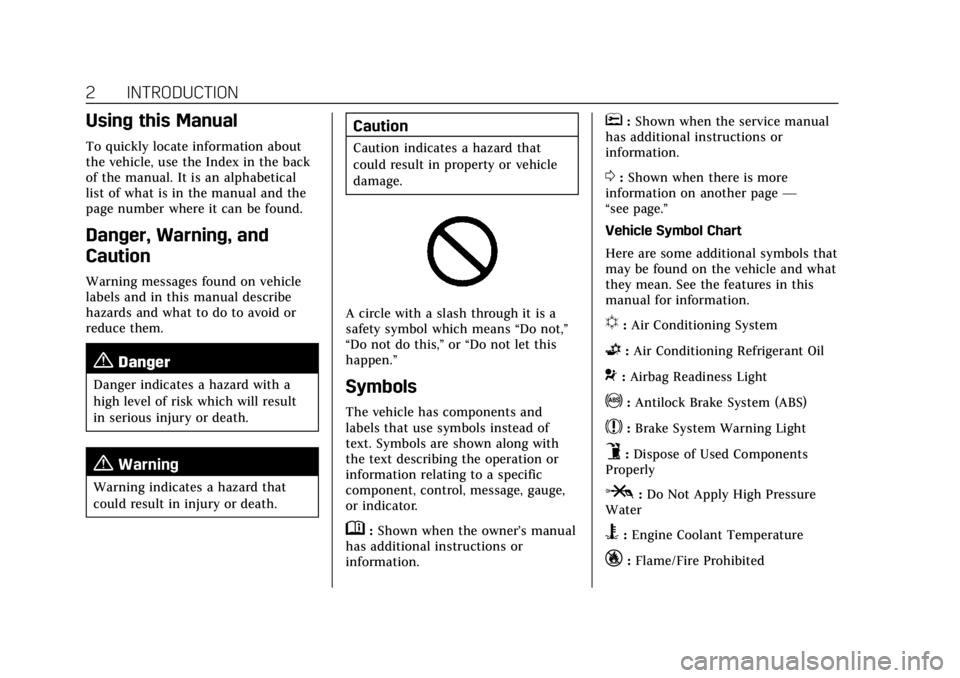
A circle with a slash through it is a
safety symbol which means“Do not,”
“Do not do this,” or“Do not let this
happen.”
Symbols
The vehicle has components and
labels that use symbols instead of
text. Symbols are shown along with
the text describing the operation or
information relating to a specific
component, control, message, gauge,
or indicator.
M: Shown when the owner’s manual
has additional instructions or
information.
*: Shown when the service manual
has additional instructions or
information.
0: Shown when there is more
information on another page —
“see page.”
Vehicle Symbol Chart
Here are some additional symbols that
may be found on the vehicle and what
they mean. See the features in this
manual for information.
u: Air Conditioning System
G:Air Conditioning Refrigerant Oil
9:Airbag Readiness Light
!:Antilock Brake System (ABS)
$:Brake System Warning Light
9:Dispose of Used Components
Properly
P: Do Not Apply High Pressure
Water
B: Engine Coolant Temperature
_:Flame/Fire Prohibited
Page 31 of 434
Cadillac CT4 Owner Manual (GMNA-Localizing-U.S./Canada-14584335) -
2021 - CRC - 11/23/20
30 SEATS AND RESTRAINTS
Seats and Restraints
Head Restraints
Head Restraints . . . . . . . . . . . . . . . . . . . . 31
Front Seats
Power Seat Adjustment . . . . . . . . . . . 32
Lumbar Adjustment . . . . . . . . . . . . . . . 32
Thigh Support Adjustment . . . . . . . . 33
Reclining Seatbacks . . . . . . . . . . . . . . . 33
Memory Seats . . . . . . . . . . . . . . . . . . . . . . 34
Heated and Ventilated FrontSeats . . . . . . . . . . . . . . . . . . . . . . . . . . . . . . 37
Massage . . . . . . . . . . . . . . . . . . . . . . . . . . . . 38
Rear Seats
Rear Seats . . . . . . . . . . . . . . . . . . . . . . . . . . 38
Seat Belts
Seat Belts . . . . . . . . . . . . . . . . . . . . . . . . . . . 40
Buckle To Drive . . . . . . . . . . . . . . . . . . . . 41
How to Wear Seat Belts Properly . . . . . . . . . . . . . . . . . . . . . . . . . . . 42
Lap-Shoulder Belt . . . . . . . . . . . . . . . . . . 44
Seat Belt Use During Pregnancy . . . . . . . . . . . . . . . . . . . . . . . . . 46 Seat Belt Extender . . . . . . . . . . . . . . . . . 46
Safety System Check . . . . . . . . . . . . . . 47
Seat Belt Care . . . . . . . . . . . . . . . . . . . . . . 47
Replacing Seat Belt System Parts
after a Crash . . . . . . . . . . . . . . . . . . . . . . 47
Airbag System
Airbag System . . . . . . . . . . . . . . . . . . . . . 48
Where Are the Airbags? . . . . . . . . . . . 49
When Should an Airbag
Inflate? . . . . . . . . . . . . . . . . . . . . . . . . . . . 51
What Makes an Airbag Inflate? . . . 52
How Does an Airbag Restrain? . . . 52
What Will You See after an Airbag Inflates? . . . . . . . . . . . . . . . . . . . . . . . . . . 52
Passenger Sensing System . . . . . . . . 53
Servicing the Airbag-Equipped Vehicle . . . . . . . . . . . . . . . . . . . . . . . . . . . . 57
Adding Equipment to the Airbag-Equipped Vehicle . . . . . . . . 58
Airbag System Check . . . . . . . . . . . . . . 58
Replacing Airbag System Parts after a Crash . . . . . . . . . . . . . . . . . . . . . . 59
Child Restraints
Older Children . . . . . . . . . . . . . . . . . . . . . 59
Infants and Young Children . . . . . . 60
Child Restraint Systems . . . . . . . . . . . 63
Where to Put the Restraint . . . . . . . 64
Lower Anchors and Tethers forChildren (LATCH System) . . . . . . . 65
Replacing LATCH System Parts After a Crash . . . . . . . . . . . . . . . . . . . . . 72
Securing Child Restraints (With the Seat Belt in the
Rear Seat) . . . . . . . . . . . . . . . . . . . . . . . . 72
Securing Child Restraints (With the Seat Belt in the
Front Seat) . . . . . . . . . . . . . . . . . . . . . . . 74
Page 42 of 434
Cadillac CT4 Owner Manual (GMNA-Localizing-U.S./Canada-14584335) -
2021 - CRC - 11/23/20
SEATS AND RESTRAINTS 41
This vehicle has indicators as a
reminder to buckle the seat belts. See
Seat Belt Reminders095.
Why Seat Belts Work
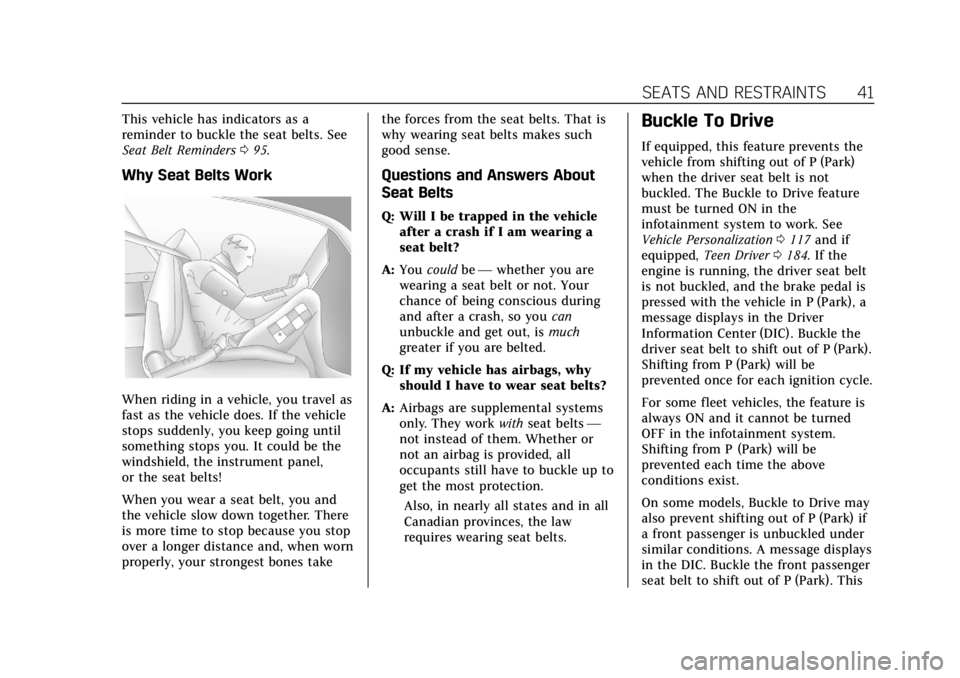
When riding in a vehicle, you travel as
fast as the vehicle does. If the vehicle
stops suddenly, you keep going until
something stops you. It could be the
windshield, the instrument panel,
or the seat belts!
When you wear a seat belt, you and
the vehicle slow down together. There
is more time to stop because you stop
over a longer distance and, when worn
properly, your strongest bones take the forces from the seat belts. That is
why wearing seat belts makes such
good sense.
Questions and Answers About
Seat Belts
Q: Will I be trapped in the vehicle
after a crash if I am wearing a
seat belt?
A: You could be— whether you are
wearing a seat belt or not. Your
chance of being conscious during
and after a crash, so you can
unbuckle and get out, is much
greater if you are belted.
Q: If my vehicle has airbags, why should I have to wear seat belts?
A: Airbags are supplemental systems
only. They work withseat belts —
not instead of them. Whether or
not an airbag is provided, all
occupants still have to buckle up to
get the most protection.
Also, in nearly all states and in all
Canadian provinces, the law
requires wearing seat belts.
Buckle To Drive
If equipped, this feature prevents the
vehicle from shifting out of P (Park)
when the driver seat belt is not
buckled. The Buckle to Drive feature
must be turned ON in the
infotainment system to work. See
Vehicle Personalization 0117 and if
equipped, Teen Driver 0184. If the
engine is running, the driver seat belt
is not buckled, and the brake pedal is
pressed with the vehicle in P (Park), a
message displays in the Driver
Information Center (DIC). Buckle the
driver seat belt to shift out of P (Park).
Shifting from P (Park) will be
prevented once for each ignition cycle.
For some fleet vehicles, the feature is
always ON and it cannot be turned
OFF in the infotainment system.
Shifting from P (Park) will be
prevented each time the above
conditions exist.
On some models, Buckle to Drive may
also prevent shifting out of P (Park) if
a front passenger is unbuckled under
similar conditions. A message displays
in the DIC. Buckle the front passenger
seat belt to shift out of P (Park). This
Page 43 of 434
Cadillac CT4 Owner Manual (GMNA-Localizing-U.S./Canada-14584335) -
2021 - CRC - 11/23/20
42 SEATS AND RESTRAINTS
feature may not allow the vehicle to
shift out of P (Park) if an object, such
as a briefcase, handbag, grocery bag,
laptop, or other electronic device, is
on the front passenger seat. If this
happens, remove the object from the
seat or buckle the seat belt to shift
out of P (Park).
If the driver, or on some vehicles, the
present front passenger remains
unbuckled, the DIC message will turn
off after several seconds and the
vehicle can be shifted out of P (Park).
See“Seat Belts” and“Child Restraints”
in the Index for information about the
importance of proper restraint use.
If the driver seat belt, and in some
vehicles the front passenger seat belt,
is unbuckled when driving, the seat
belt reminder chime and light(s) will
come on. See Seat Belt Reminders 095.
This feature may not function
properly if the airbag readiness light is
on. See Airbag Readiness Light 096.
How to Wear Seat Belts
Properly
Follow these rules for everyone's
protection. There are additional things to know
about seat belts and children,
including smaller children and infants.
If a child will be riding in the vehicle,
see
Older Children 059 or
Infants and Young Children 060.
Review and follow the rules for
children in addition to the following
rules.
It is very important for all occupants
to buckle up. Statistics show that
unbelted people are hurt more often
in crashes than those who are wearing
seat belts.
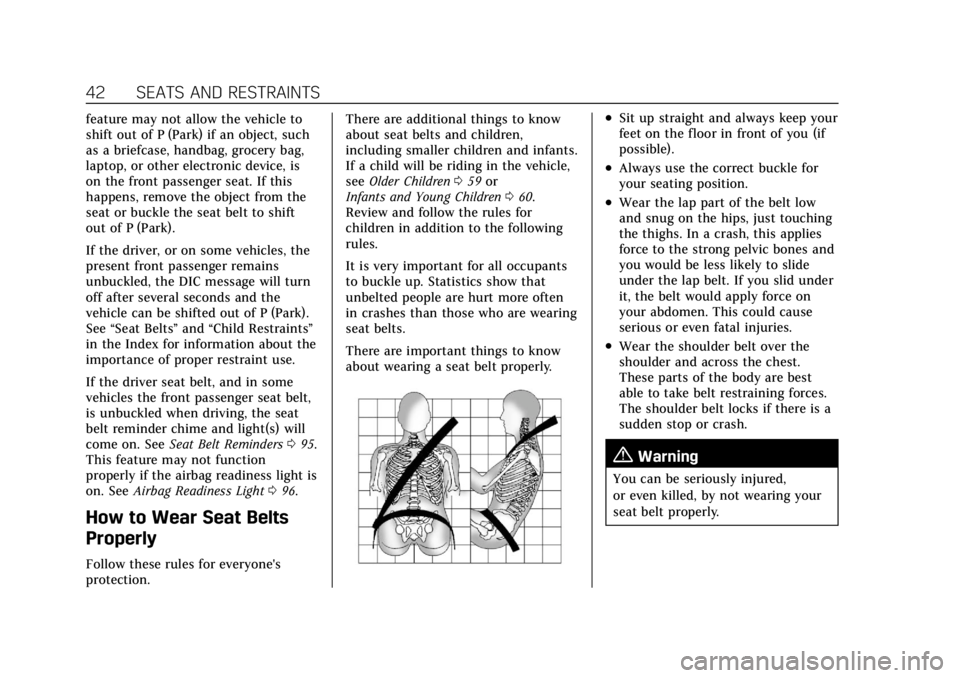
There are important things to know
about wearing a seat belt properly.
.Sit up straight and always keep your
feet on the floor in front of you (if
possible).
.Always use the correct buckle for
your seating position.
.Wear the lap part of the belt low
and snug on the hips, just touching
the thighs. In a crash, this applies
force to the strong pelvic bones and
you would be less likely to slide
under the lap belt. If you slid under
it, the belt would apply force on
your abdomen. This could cause
serious or even fatal injuries.
.Wear the shoulder belt over the
shoulder and across the chest.
These parts of the body are best
able to take belt restraining forces.
The shoulder belt locks if there is a
sudden stop or crash.
{Warning
You can be seriously injured,
or even killed, by not wearing your
seat belt properly.
Page 45 of 434
Cadillac CT4 Owner Manual (GMNA-Localizing-U.S./Canada-14584335) -
2021 - CRC - 11/23/20
44 SEATS AND RESTRAINTS
{Warning
The seat belt can be pinched if it is
routed under plastic trim on the
seat, such as trim around the rear
seatback folding handle or side
airbag. In a crash, pinched seat
belts might not be able to provide
adequate protection. Never allow
seat belts to be routed under plastic
trim pieces.
Lap-Shoulder Belt
All seating positions in the vehicle
have a lap-shoulder belt.
If you are using a rear seating position
with a detachable seat belt and the
seat belt is not attached, seeRear
Seats 038 for instructions on
reconnecting the seat belt to the
mini-buckle.
The following instructions explain
how to wear a lap-shoulder belt
properly.
1. If the seat has a seat belt guide, the seat belt must be routed through
the guide to properly position the
shoulder belt. If the seat belt is not routed through the guide, slide the
edge of the belt webbing through
the opening on the guide. Be sure
the belt is not twisted.
2. Adjust the seat, if the seat is adjustable, so you can sit up
straight. To see how, see “Seats”in
the Index.
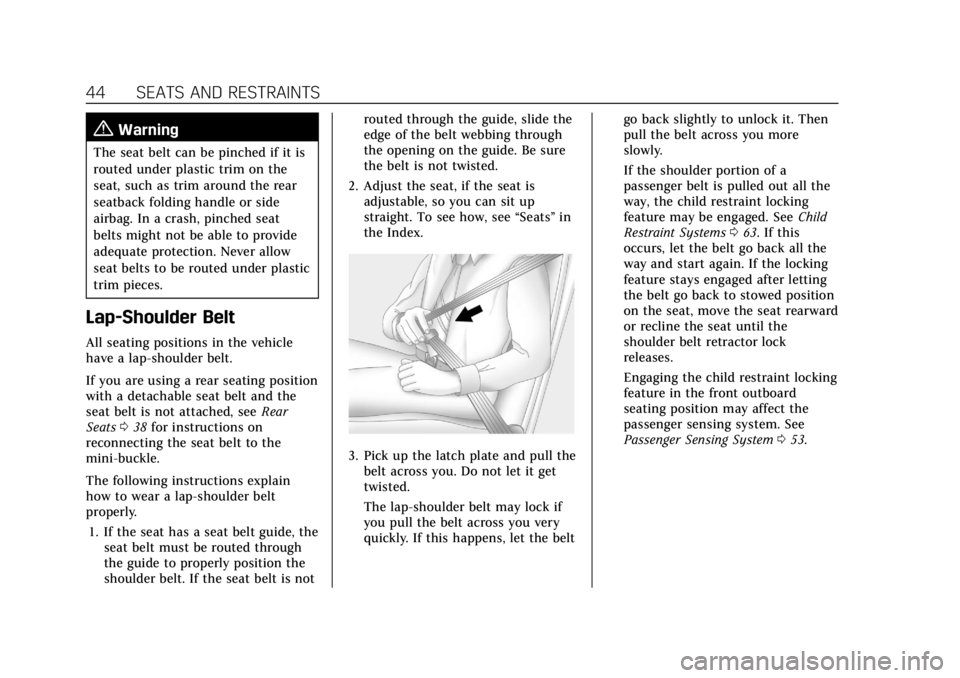
3. Pick up the latch plate and pull the belt across you. Do not let it get
twisted.
The lap-shoulder belt may lock if
you pull the belt across you very
quickly. If this happens, let the belt go back slightly to unlock it. Then
pull the belt across you more
slowly.
If the shoulder portion of a
passenger belt is pulled out all the
way, the child restraint locking
feature may be engaged. See
Child
Restraint Systems 063. If this
occurs, let the belt go back all the
way and start again. If the locking
feature stays engaged after letting
the belt go back to stowed position
on the seat, move the seat rearward
or recline the seat until the
shoulder belt retractor lock
releases.
Engaging the child restraint locking
feature in the front outboard
seating position may affect the
passenger sensing system. See
Passenger Sensing System 053.
Page 49 of 434
Cadillac CT4 Owner Manual (GMNA-Localizing-U.S./Canada-14584335) -
2021 - CRC - 11/23/20
48 SEATS AND RESTRAINTS
After a minor crash, replacement of
seat belts may not be necessary. But
the seat belt assemblies that were
used during any crash may have been
stressed or damaged. See your dealer
to have the seat belt assemblies
inspected or replaced.
New parts and repairs may be
necessary even if the seat belt system
was not being used at the time of the
crash.
Have the seat belt pretensioners
checked if the vehicle has been in a
crash, or if the airbag readiness light
stays on after you start the vehicle or
while you are driving. SeeAirbag
Readiness Light 096.
Airbag System
The vehicle has the following airbags:
.A frontal airbag for the driver
.A frontal airbag for the front
outboard passenger
.A knee airbag for the driver.
.A knee airbag for the front outboard
passenger.
.A seat-mounted side impact airbag
for the driver
.A seat-mounted side impact airbag
for the front outboard passenger
.A roof-rail airbag for the driver and
the passenger seated directly behind
the driver
.A roof-rail airbag for the front
outboard passenger and the
passenger seated directly behind the
front outboard passenger
All vehicle airbags have the word
AIRBAG on the trim or on a label near
the deployment opening.
For frontal airbags, the word AIRBAG
is on the center of the steering wheel
for the driver and on the instrument
panel for the front outboard
passenger.
For knee airbags, the word AIRBAG is
on the lower part of the instrument
panel.
For seat-mounted side impact airbags,
the word AIRBAG is on the side of the
seatback or side of the seat closest to
the door.
For roof-rail airbags, the word AIRBAG
is on the ceiling or trim. Airbags are designed to supplement
the protection provided by seat belts.
Even though today's airbags are also
designed to help reduce the risk of
injury from the force of an inflating
bag, all airbags must inflate very
quickly to do their job.
Here are the most important things to
know about the airbag system:
{Warning
You can be severely injured or
killed in a crash if you are not
wearing your seat belt, even with
airbags. Airbags are designed to
work with seat belts, not replace
them. Also, airbags are not designed
to inflate in every crash. In some
crashes seat belts are the only
restraint. See
When Should an
Airbag Inflate? 051.
Wearing your seat belt during a
crash helps reduce your chance of
hitting things inside the vehicle or
being ejected from it. Airbags are
“supplemental restraints” to the
seat belts. Everyone in the vehicle (Continued)
Page 50 of 434
Cadillac CT4 Owner Manual (GMNA-Localizing-U.S./Canada-14584335) -
2021 - CRC - 11/23/20
SEATS AND RESTRAINTS 49
Warning (Continued)
should wear a seat belt properly,
whether or not there is an airbag
for that person.
{Warning
Because airbags inflate with great
force and faster than the blink of an
eye, anyone who is up against,
or very close to, any airbag when it
inflates can be seriously injured or
killed. Do not sit unnecessarily
close to any airbag, as you would be
if sitting on the edge of the seat or
leaning forward. Seat belts help
keep you in position before and
during a crash. Always wear a seat
belt, even with airbags. The driver
should sit as far back as possible
while still maintaining control of
the vehicle. The seat belts and the
front outboard passenger airbags
are most effective when you are
sitting well back and upright in the
seat with both feet on the floor.(Continued)
Warning (Continued)
Occupants should not lean on or
sleep against the door or side
windows in seating positions with
seat-mounted side impact airbags
and/or roof-rail airbags.
{Warning
Children who are up against,
or very close to, any airbag when it
inflates can be seriously injured or
killed. Always secure children
properly in the vehicle. To read
how, seeOlder Children 059 or
Infants and Young Children 060.
There is an airbag readiness light on
the instrument cluster, which shows
the airbag symbol. The system checks the airbag
electrical system for malfunctions.
The light tells you if there is an
electrical problem. See
Airbag
Readiness Light 096.
Where Are the Airbags?
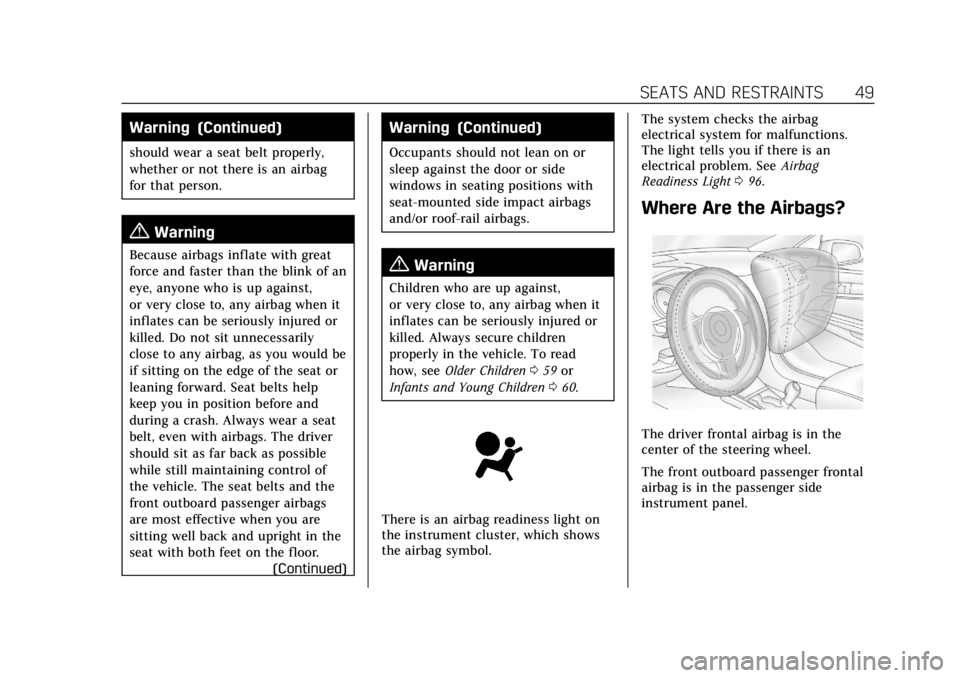
The driver frontal airbag is in the
center of the steering wheel.
The front outboard passenger frontal
airbag is in the passenger side
instrument panel.
Page 51 of 434
Cadillac CT4 Owner Manual (GMNA-Localizing-U.S./Canada-14584335) -
2021 - CRC - 11/23/20
50 SEATS AND RESTRAINTS
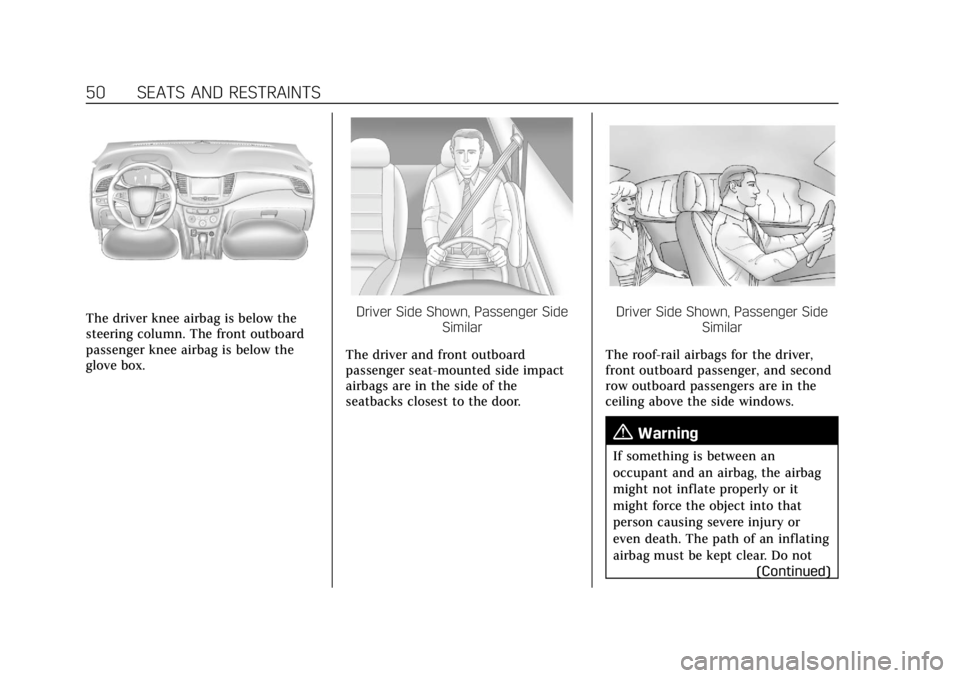
The driver knee airbag is below the
steering column. The front outboard
passenger knee airbag is below the
glove box.Driver Side Shown, Passenger SideSimilar
The driver and front outboard
passenger seat-mounted side impact
airbags are in the side of the
seatbacks closest to the door.Driver Side Shown, Passenger Side Similar
The roof-rail airbags for the driver,
front outboard passenger, and second
row outboard passengers are in the
ceiling above the side windows.
{Warning
If something is between an
occupant and an airbag, the airbag
might not inflate properly or it
might force the object into that
person causing severe injury or
even death. The path of an inflating
airbag must be kept clear. Do not (Continued)
Page 52 of 434
Cadillac CT4 Owner Manual (GMNA-Localizing-U.S./Canada-14584335) -
2021 - CRC - 11/23/20
SEATS AND RESTRAINTS 51
Warning (Continued)
put anything between an occupant
and an airbag, and do not attach or
put anything on the steering wheel
hub or on or near any other airbag
covering.
Do not use seat accessories that
block the inflation path of a
seat-mounted side impact airbag.
Never secure anything to the roof of
a vehicle with roof-rail airbags by
routing a rope or tie‐down through
any door or window opening. If you
do, the path of an inflating roof-rail
airbag will be blocked.
When Should an Airbag
Inflate?
This vehicle is equipped with airbags.
SeeAirbag System 048. Airbags are
designed to inflate if the impact
exceeds the specific airbag system's
deployment threshold. Deployment
thresholds are used to predict how
severe a crash is likely to be in time
for the airbags to inflate and help restrain the occupants. The vehicle
has electronic sensors that help the
airbag system determine the severity
of the impact. Deployment thresholds
can vary with specific vehicle design.
Frontal airbags are designed to inflate
in moderate to severe frontal, or near
frontal, crashes to help reduce the
potential for severe injuries, mainly to
the driver's or front outboard
passenger's head and chest.
Whether the frontal airbags will or
should inflate is not based primarily
on how fast the vehicle is traveling.
It depends on what is hit, the
direction of the impact, and how
quickly the vehicle slows down.
Frontal airbags may inflate at
different crash speeds depending on
whether the vehicle hits an object
straight on or at an angle, and
whether the object is fixed or moving,
rigid or deformable, narrow or wide.
Frontal airbags are not intended to
inflate during vehicle rollovers, in rear
impacts, or in many side impacts.
In addition, the vehicle has advanced
technology frontal airbags. Advanced
technology frontal airbags adjust the
restraint according to crash severity.
Knee airbags are designed to inflate in
moderate to severe frontal or near
frontal impacts. Knee airbags are not
designed to inflate during vehicle
rollovers, in rear impacts, or in many
side impacts.
Seat-mounted side impact airbags are
designed to inflate in moderate to
severe side crashes depending on the
location of the impact. Seat-mounted
side impact airbags are not designed
to inflate in frontal impacts, near
frontal impacts, rollovers, or rear
impacts. A seat-mounted side impact
airbag is designed to inflate on the
side of the vehicle that is struck.
Roof-rail airbags are designed to
inflate in moderate to severe side
crashes depending on the location of
the impact. In addition, these roof-rail
airbags are designed to inflate during
a rollover or in a severe frontal
impact. Roof-rail airbags are not
designed to inflate in rear impacts.
Both roof-rail airbags will inflate when
Page 53 of 434
Cadillac CT4 Owner Manual (GMNA-Localizing-U.S./Canada-14584335) -
2021 - CRC - 11/23/20
52 SEATS AND RESTRAINTS
either side of the vehicle is struck,
if the sensing system predicts that the
vehicle is about to roll over on its
side, or in a severe frontal impact.
In any particular crash, no one can
say whether an airbag should have
inflated simply because of the vehicle
damage or repair costs.
What Makes an Airbag
Inflate?
In a deployment event, the sensing
system sends an electrical signal
triggering a release of gas from the
inflator. Gas from the inflator fills the
airbag causing the bag to break out of
the cover. The inflator, the airbag, and
related hardware are all part of the
airbag module.
For airbag locations, seeWhere Are the
Airbags? 049.
How Does an Airbag
Restrain?
In moderate to severe frontal or near
frontal collisions, even belted
occupants can contact the steering
wheel or the instrument panel. In moderate to severe side collisions,
even belted occupants can contact the
inside of the vehicle.
Airbags supplement the protection
provided by seat belts by distributing
the force of the impact more evenly
over the occupant's body.
Rollover capable roof-rail airbags are
designed to help contain the head and
chest of occupants in the outboard
seating positions in the first and
second rows. The rollover capable
roof-rail airbags are designed to help
reduce the risk of full or partial
ejection in rollover events, although
no system can prevent all such
ejections.
But airbags would not help in many
types of collisions, primarily because
the occupant's motion is not toward
those airbags. See
When Should an
Airbag Inflate? 051.
Airbags should never be regarded as
anything more than a supplement to
seat belts.
What Will You See after an
Airbag Inflates?
After frontal, knee, and seat-mounted
side impact airbags inflate, they
quickly deflate, so quickly that some
people may not even realize the
airbags inflated. Roof-rail airbags may
still be at least partially inflated for
some time after they inflate. Some
components of the airbag module may
be hot for several minutes. For
location of the airbags, see Where Are
the Airbags? 049.
The parts of the airbag that come into
contact with you may be warm, but
not too hot to touch. There may be
some smoke and dust coming from
the vents in the deflated airbags.
Airbag inflation does not prevent the
driver from seeing out of the
windshield or being able to steer the
vehicle, nor does it prevent people
from leaving the vehicle.