cooling CADILLAC CT4 2023 User Guide
[x] Cancel search | Manufacturer: CADILLAC, Model Year: 2023, Model line: CT4, Model: CADILLAC CT4 2023Pages: 524, PDF Size: 6.98 MB
Page 377 of 524

Cadillac CT4 Owner Manual (GMNA-Localizing-U.S./Canada-16500442) -
2023 - CRC - 5/4/22
376 Vehicle Care
1. Windshield Washer FluidReservoir. See Washer
Fluid 0393.
2. Engine Coolant Surge Tank and Pressure Cap. See
Cooling System 0386.
3. Engine Air Cleaner/Filter 0384.
4. Engine Cooling Fan (Out of View). See Cooling System
0386.
5. Engine Oil Fill Cap. See Engine Oil 0378.
6. Cooling System Air Bleeder Cap. See Cooling
System 0386.
7. Engine Oil Dipstick. See Engine Oil 0378.
8. Remote Positive (+) Battery Terminal. See
Jump Starting - North
America 0447.
9. Brake Fluid Reservoir. See Brake Fluid 0398.
10. Remote Negative (-) Battery Terminal. See
Jump Starting - North
America 0447. 11. Engine Compartment Fuse
Block. See Engine
Compartment Fuse Block
0407.
Page 379 of 524

Cadillac CT4 Owner Manual (GMNA-Localizing-U.S./Canada-16500442) -
2023 - CRC - 5/4/22
378 Vehicle Care
1. Windshield Washer FluidReservoir. See Washer
Fluid 0393.
2. Engine Coolant Surge Tank and Pressure Cap. See
Cooling System 0386.
3. Engine Air Cleaner/Filter 0384.
4. Engine Cooling Fan (Out of View). See Cooling System
0386.
5. Engine Oil Fill Cap. See Engine Oil 0378.
6. Engine Oil Dipstick. See Engine Oil 0378.
7. Remote Positive (+) Battery Terminal. See
Jump Starting - North
America 0447.
8. Brake/Clutch Fluid Reservoir. See Brake Fluid
0398.
9. Remote Negative (-) Battery Terminal. See
Jump Starting - North
America 0447. 10. Engine Compartment Fuse
Block. See Engine
Compartment Fuse Block
0407.
Engine Oil
To ensure proper engine
performance and long life,
careful attention must be paid
to engine oil. Following these
simple, but important steps
will help protect your
investment:
.Use engine oil approved to
the proper specification and
of the proper viscosity
grade. See “Selecting the
Right Engine Oil” in this
section.
.Check the engine oil level
regularly and maintain the
proper oil level. See
“Checking Engine Oil” and
“When to Add Engine Oil” in
this section.
.Change the engine oil at the
appropriate time. See Engine
Oil Life System 0381.
.Always dispose of engine oil
properly. See “What to Do
with Used Oil” in this section.
Checking Engine Oil
Check the engine oil level
regularly, every 650 km
(400 mi), especially prior to a
long trip. The engine oil
dipstick handle is a loop. See
Engine Compartment
Overview0373 for the
location.
{Warning
The engine oil dipstick
handle may be hot; it could
burn you. Use a towel or
glove to touch the dipstick
handle.
If a low oil Driver Information
Center (DIC) message displays,
check the oil level.
Page 387 of 524
Cadillac CT4 Owner Manual (GMNA-Localizing-U.S./Canada-16500442) -
2023 - CRC - 5/4/22
386 Vehicle Care
3. Remove the 13 screws (3)on top of the engine air
cleaner/filter cover to gain
access to both air
cleaner/filters.
4. Lift the engine air cleaner/filter cover.
5. Lift and remove one or both engine air
cleaner/filters.
{Warning
If part replacement is
necessary, the part must be
replaced with one of the
same part number or with an
equivalent part. Use of a
replacement part without
the same fit, form, and
function may result in
personal injury or damage to
the vehicle.
6. Inspect or replace one or both engine air cleaner/
filters. 7. Reverse Steps 1–4 to
reinstall the engine air
cleaner/filter cover.
8. If equipped, reset the engine air filter life system
after replacing the engine
air filter. See Engine Air
Filter Life System 0383.
Cooling System
The cooling system allows the
engine to maintain the correct
working temperature.
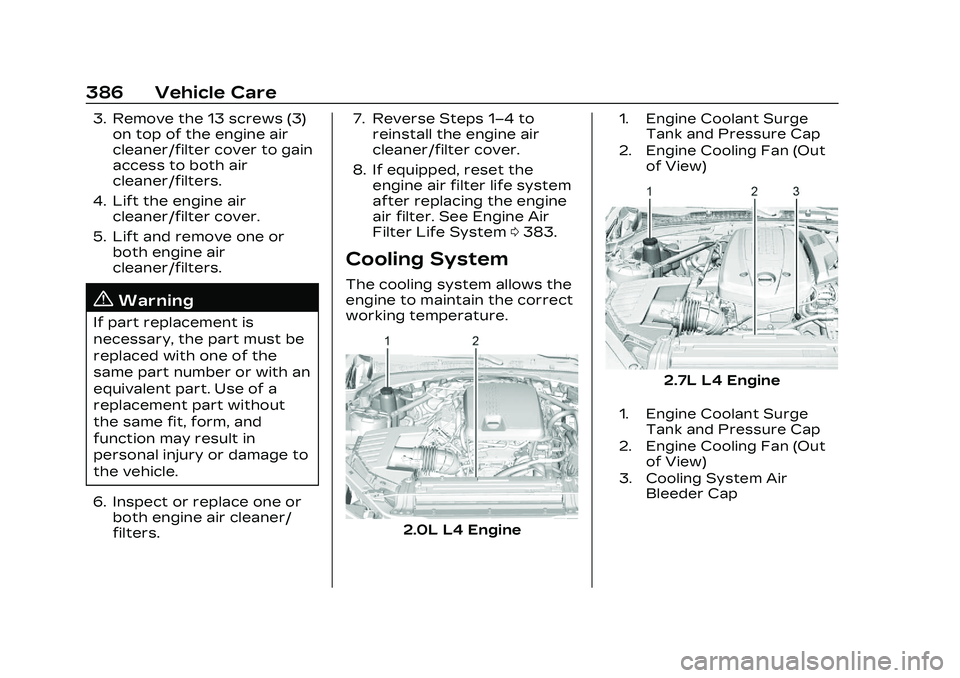
2.0L L4 Engine
1. Engine Coolant Surge
Tank and Pressure Cap
2. Engine Cooling Fan (Out of View)
2.7L L4 Engine
1. Engine Coolant SurgeTank and Pressure Cap
2. Engine Cooling Fan (Out of View)
3. Cooling System Air Bleeder Cap
Page 388 of 524

Cadillac CT4 Owner Manual (GMNA-Localizing-U.S./Canada-16500442) -
2023 - CRC - 5/4/22
Vehicle Care 387
3.6L V6 Engine
1. Engine Coolant SurgeTank and Pressure Cap
2. Engine Cooling Fan (Out of View)
{Warning
An underhood electric fan
can start up even when the
engine is not running and
can cause injury. Keep
hands, clothing, and tools
away from any underhood
electric fan.
{Warning
Do not touch heater or
radiator hoses, or other
engine parts. They can be
very hot and can burn you.
Do not run the engine if
there is a leak; all coolant
could leak out. That could
cause an engine fire and can
burn you. Fix any leak before
driving the vehicle.
Engine Coolant
The cooling system in the
vehicle is filled with
DEX-COOL engine coolant.
See Maintenance Schedule
0469 and
Recommended Fluids and
Lubricants 0474.
The following explains the
cooling system and how to
check and add coolant when it
is low. If there is a problem
with engine overheating, see
Engine Overheating 0391.
What to Use
{Warning
Do not touch heater or
radiator hoses, or other
engine parts. They can be
very hot and can burn you.
Do not run the engine if
there is a leak; all coolant
could leak out. That could
cause an engine fire and can
burn you. Fix any leak before
driving the vehicle.
Use a 50/50 mixture of clean
drinkable water and
DEX-COOL coolant. This
mixture:
.Gives freezing protection
down to −37 °C (−34 °F),
outside temperature.
.Gives boiling protection up
to 129 °C (265 °F), engine
temperature.
.Protects against rust and
corrosion.
.Will not damage aluminum
parts.
Page 389 of 524

Cadillac CT4 Owner Manual (GMNA-Localizing-U.S./Canada-16500442) -
2023 - CRC - 5/4/22
388 Vehicle Care
.Helps keep the proper
engine temperature.
Caution
Do not use anything other
than a mix of DEX-COOL
coolant that meets GM
Standard GMW3420 and
clean, drinkable water.
Anything else can cause
damage to the engine
cooling system and the
vehicle, which would not be
covered by the vehicle
warranty.
Never dispose of engine
coolant by putting it in the
trash, pouring it on the
ground, or into sewers,
streams, or bodies of water.
Have the coolant changed by
an authorized service center,
familiar with legal
requirements regarding used
coolant disposal. This will help
protect the environment and
your health.
Checking Coolant
The vehicle must be on a level
surface when checking the
coolant level.
It is normal to see coolant
moving in the upper coolant
hose return line when the
engine is running. It is also
normal to see bubbles
entering the surge tank
through the small hose.
Check to see if coolant is
visible in the coolant surge
tank. If the coolant inside the
coolant surge tank is boiling,
do not do anything else until it
cools down.
If coolant is visible but the
coolant level is not at or above
the indicated mark, add a
50/50 mixture of clean
drinkable water and
DEX-COOL coolant.
Be sure the cooling system is
cool before this is done.
Page 390 of 524

Cadillac CT4 Owner Manual (GMNA-Localizing-U.S./Canada-16500442) -
2023 - CRC - 5/4/22
Vehicle Care 389
If no coolant is visible in the
coolant surge tank, add
coolant as follows:
How to Add Coolant to the
Coolant Surge Tank
{Warning
Spilling coolant on hot
engine parts can burn you.
Coolant contains ethylene
glycol and it will burn if the
engine parts are hot enough.
{Warning
Plain water, or other liquids
such as alcohol, can boil
before the proper coolant
mixture will. With plain water
or the wrong mixture, the
engine could get too hot but
there would not be an
overheat warning. The
engine could catch fire and
you or others could be
burned.
{Warning
Steam and scalding liquids
from a hot cooling system
are under pressure. Turning
the pressure cap, even a
little, can cause them to
come out at high speed and
you could be burned. Never
turn the cap when the
cooling system, including the
pressure cap, is hot. Wait for
the cooling system and
pressure cap to cool.
Caution
Failure to follow the specific
coolant fill procedure could
cause the engine to
overheat and could cause
system damage. If coolant is
not visible in the surge tank,
contact your dealer.
If no problem is found, check
to see if coolant is visible in
the coolant surge tank.
If coolant is visible but the coolant level is not at or above
the indicated mark, add a
50/50 mixture of clean,
drinkable water and
DEX-COOL coolant at the
coolant surge tank, but be
sure the cooling system,
including the coolant surge
tank pressure cap, is cool
before you do it.2.0L L4 Engine and 3.6L
V6 Engine
Automatic Coolant Service
Fill Instructions
The vehicle is equipped with a
service feature that assists
with filling and removing air
from the cooling system after
service of components or
when coolant is added after
being to low.
Page 391 of 524

Cadillac CT4 Owner Manual (GMNA-Localizing-U.S./Canada-16500442) -
2023 - CRC - 5/4/22
390 Vehicle Care
To use this feature:
1. With a cold system, addcoolant to the indicated
line on the surge tank.
2. Replace the pressure cap on the surge tank.
3. Activate the service feature:
3.1. Connect the vehicle to a battery charger.
3.2.Turn the ignition to Service Mode. See
Ignition Positions 0261.
3.3.Turn off the air conditioning. 3.4.Set the parking brake.
3.5.At the same time, press
the accelerator and the
brake pedal for
two seconds, then
release.
3.6.At the end of the cycle, check the coolant level
in the surge tank and
add coolant if it is
below the indicated
line. Turn the ignition
off, allow the Electronic
Control Module (ECM)
to go to sleep, about
two minutes, and
repeat Steps 3.2 –3.6.
Listen for pump activation and
movement of the control
valves while watching the level
of the coolant in the surge
tank. If the tank empties, turn
the ignition off, carefully
remove the pressure cap, refill
to the indicated line, replace
the pressure cap, and repeat
steps 3.2 –3.6. The fill and air removal
process will run for
approximately 15 minutes.
Caution
If the pressure cap is not
tightly installed, coolant loss
and engine damage may
occur. Be sure the cap is
properly and tightly secured.
2.7L L4 Engine
Automatic Coolant Service
Fill Instructions
The vehicle is equipped with a
service feature that assists
with filling and removing air
from the cooling system after
service of components or
when coolant is added after
being to low.
To use this feature:
1. With a cold system unscrew the cooling
system air bleeder cap.
If coolant can be seen
through the bleeder move
to Step 3.
Page 392 of 524

Cadillac CT4 Owner Manual (GMNA-Localizing-U.S./Canada-16500442) -
2023 - CRC - 5/4/22
Vehicle Care 391
2. Add coolant through thesurge tank until it is visible
through the air bleeder.
3. Replace the cooling system air bleeder cap.
4. Add coolant to the indicated line on the
surge tank.
5. Replace the pressure cap on the surge tank.
6. Activate the service feature:
6.1. Connect the vehicle to a battery charger.
6.2.Turn the ignition to Service Mode. See
Ignition Positions 0261.
6.3.Turn off the air conditioning.
6.4.Set the parking brake.
6.5.At the same time, press the accelerator and the
brake pedal for
two seconds, then
release. 6.6.At the end of the cycle,
check the coolant level
in the surge tank and
add coolant if it is
below the indicated
line. Turn the ignition
off, carefully remove
the pressure cap, refill
to the indicated line,
replace the pressure
cap, and repeat steps
6.2 –6.6.
Listen for pump activation and
movement of the control
valves while watching the level
of the coolant in the surge
tank. If the tank empties, turn
the ignition off, carefully
remove the pressure cap, refill
to the indicated line, replace
the pressure cap, and repeat
steps 6.2 –6.6.
The fill and air removal
process will run for
approximately 15 minutes.Caution
If the pressure cap is not
tightly installed, coolant loss
and engine damage may
occur. Be sure the cap is
properly and tightly secured.
Engine Overheating
The vehicle has an indicator to
warn of the engine
overheating.
If the decision is made not to
lift the hood when this
warning appears, get service
help right away. See Roadside
Assistance Program 0487.
If the decision is made to lift
the hood, make sure the
vehicle is parked on a level
surface.
Then check to see if the
engine cooling fan is running.
If the engine is overheating,
the fan should be running. If it
is not, do not continue to run
the engine. Have the vehicle
serviced.
Page 393 of 524

Cadillac CT4 Owner Manual (GMNA-Localizing-U.S./Canada-16500442) -
2023 - CRC - 5/4/22
392 Vehicle Care
Caution
Do not run the engine if
there is a leak in the engine
cooling system. This can
cause a loss of all coolant
and can damage the system
and vehicle. Have any leaks
fixed right away.
If Steam Is Coming from
the Engine Compartment
{Warning
Steam and scalding liquids
from a hot cooling system
are under pressure. Turning
the pressure cap, even a
little, can cause them to
come out at high speed and
you could be burned. Never
turn the cap when the
cooling system, including the
pressure cap, is hot. Wait for
the cooling system and
pressure cap to cool.
If No Steam Is Coming
from the Engine
Compartment
If an engine overheat warning
is displayed but no steam can
be seen or heard, the problem
may not be too serious.
Sometimes the engine can get
a little too hot when the
vehicle:
.Climbs a long hill on a
hot day.
.Stops after high-speed
driving.
.Idles for long periods in
traffic.
If the overheat warning is
displayed with no sign of
steam: 1. Turn the air conditioning off.
2. Turn the heater on to the highest temperature and
to the highest fan speed.
Open the windows as
necessary. 3. When it is safe to do so,
pull off the road, shift to
P (Park) or N (Neutral) and
let the engine idle.
If the overheat warning no
longer displays, the vehicle
can be driven. Continue to
drive the vehicle slowly for
about 10 minutes. Keep a safe
vehicle distance from the
vehicle in front. If the warning
does not come back on,
continue to drive normally and
have the cooling system
checked for proper fill and
function.
If the warning continues, pull
over, stop, and park the
vehicle right away.
If there is no sign of steam,
idle the engine for
three minutes while parked.
If the warning is still displayed,
turn off the engine until it
cools down.
Page 437 of 524

Cadillac CT4 Owner Manual (GMNA-Localizing-U.S./Canada-16500442) -
2023 - CRC - 5/4/22
436 Vehicle Care
balancing are not necessary
on a regular basis. Consider an
alignment check if there is
unusual tire wear or the
vehicle is significantly pulling
to one side or the other. Some
slight pull to the left or right,
depending on the crown of the
road and/or other road
surface variations such as
troughs or ruts, is normal.
If the vehicle is vibrating when
driving on a smooth road, the
tires and wheels may need to
be rebalanced. See your
dealer for proper diagnosis.
Wheel Replacement
Replace any wheel that is
bent, cracked, or badly rusted
or corroded. If wheel nuts
keep coming loose, the wheel,
wheel bolts, and wheel nuts
should be replaced. If the
wheel leaks air, replace it.
Some aluminum wheels can be
repaired. See your dealer if
any of these conditions exist.
Your dealer will know the kind
of wheel that is needed.Each new wheel should have
the same load-carrying
capacity, diameter, width,
offset, and be mounted the
same way as the one it
replaces.
Replace wheels, wheel bolts,
wheel nuts, or Tire Pressure
Monitor System (TPMS)
sensors with new GM original
equipment parts.
{Warning
Using the wrong
replacement wheels, wheel
bolts, or wheel nuts can be
dangerous. It could affect
the braking and handling of
the vehicle. Tires can lose air
and cause loss of control,
resulting in a crash. Always
use the correct wheel, wheel
bolts, and wheel nuts for
replacement.
{Warning
Replacing a wheel with a
used one is dangerous. How
it has been used or how far
it has been driven may be
unknown. It could fail
suddenly and cause a crash.
When replacing wheels, use
a new GM original
equipment wheel.
Caution
The wrong wheel can also
cause problems with bearing
life, brake cooling,
speedometer or odometer
calibration, headlamp aim,
bumper height, vehicle
ground clearance, and tire or
tire chain clearance to the
body and chassis.