climate control CADILLAC CTS 2008 2.G User Guide
[x] Cancel search | Manufacturer: CADILLAC, Model Year: 2008, Model line: CTS, Model: CADILLAC CTS 2008 2.GPages: 490, PDF Size: 2.59 MB
Page 163 of 490

Reading Lamps
The reading lamps are located on the overhead console.
These lamps come on automatically when any door is
opened.
For manual operation, press the button next to each
lamp to turn it on or off.
If the reading lamps are left on, they automatically shut
off 10 minutes after the ignition has been turned off.
Electric Power Management
The vehicle has Electric Power Management (EPM) that
estimates the battery’s temperature and state of charge.
It then adjusts the voltage for best performance and
extended life of the battery.
When the battery’s state of charge is low, the voltage
is raised slightly to quickly put the charge back in.
When the state of charge is high, the voltage is lowered
slightly to prevent overcharging. If the vehicle has a
voltmeter gage or a voltage display on the Driver
Information Center (DIC), you may see the voltage
move up or down. This is normal. If there is a problem,
an alert will be displayed.The battery can be discharged at idle if the electrical
loads are very high. This is true for all vehicles.
This is because the generator (alternator) may not be
spinning fast enough at idle to produce all the power that
is needed for very high electrical loads.
A high electrical load occurs when several of the
following loads are on: headlamps, high beams, fog
lamps, rear window defogger, climate control fan at
high speed, heated seats, engine cooling fans, trailer
loads, and loads plugged into accessory power outlets.
EPM works to prevent excessive discharge of the
battery. It does this by balancing the generator’s output
and the vehicle’s electrical needs. It can increase
engine idle speed to generate more power, whenever
needed. It can temporarily reduce the power demands of
some accessories.
Normally, these actions occur in steps or levels, without
being noticeable. In rare cases at the highest levels
of corrective action, this action may be noticeable to
the driver. If so, a Driver Information Center (DIC)
message might be displayed, such as Battery Saver
Active or Service Battery Charging System. If this
message is displayed, it is recommended that the
driver reduce the electrical loads as much as possible.
SeeDIC Warnings and Messages on page 3-56.
3-21
Page 164 of 490
Battery Run-Down Protection
Your vehicle has a feature to help prevent battery drain
if accessory lamps are left on or something is left plugged
into the accessory power outlet or cigarette lighter, if the
vehicle has one. If accessory lamps such as the vanity
mirror, cargo, reading, console, or glove box are left on,
they automatically time-out after about 20 minutes.
To reset the battery protection, all of the above lamps
must be turned off or the ignition must be in the ACC/
ACCESSORY position.
Accessory Power Outlet(s)
Accessory power outlets can be used to connect
auxiliary electrical equipment, such as a cellular
telephone or CB radio.
There are three accessory power outlets. There is an
outlet located in the front storage area below the climate
control system, one inside the center console storage
bin, and one on the rear of the center console.
To use an outlet, remove the protective cap. When not
in use, always cover the outlet with the protective cap.
The accessory power outlet is operational at all times.Notice:If electrical devices are left plugged into a
power outlet, the battery may drain causing your
vehicle not to start or damage to the battery.
This would not be covered by the warranty.
Always unplug all electrical devices when turning
off your vehicle.
Certain electrical accessories may not be compatible
with the accessory power outlet and could result
in blown vehicle or adapter fuses. If you experience
a problem see your dealer/retailer for additional
information on accessory power outlets.
Notice:Adding any electrical equipment to the
vehicle can damage it or keep other components
from working as they should. The repairs would
not be covered by the vehicle warranty. Do not use
equipment exceeding maximum amperage rating
of 20 amperes. Check with your dealer/retailer before
adding electrical equipment.
Notice:Improper use of the power outlet can cause
damage not covered by your warranty. Do not
hang any type of accessory or accessory bracket
from the plug because the power outlets are
designed for accessory power plugs only.
3-22
Page 166 of 490
Climate Controls
Dual Climate Control System
The heating, cooling, and ventilation for the vehicle can
be controlled with this system.
O(Power):Press this button to turn the climate control
system on or off. When the climate control system is
turned off the air inlet defaults to outside air.
Automatic Operation
AUTO (Automatic):When this button is pressed and
the temperature is set, the system automatically
controls the inside temperature, the air delivery mode,
the air conditioning compressor, and the fan speed.When the indicator light is on, the system is in full
automatic operation. If the air delivery mode or fan
setting is manually adjusted, the auto indicator turns off
and displays will show the selected settings.
1. Press the AUTO button.
2. Adjust the temperature to a comfortable setting
between 60°F (15.5°C) and 90°F (32.2°C).
Choosing the coldest or warmest temperature setting
will not cause the system to heat or cool any faster.
If the system is set at the warmest temperature
setting, it remains in manual mode at that
temperature and it will not go into automatic mode.
In cold weather, the system starts at reduced fan
speeds to avoid blowing cold air into the vehicle
until warmer air is available. The system begins
blowing air at the oor but may change modes
automatically as the vehicle warms up to maintain
the chosen temperature setting. The length of
time the system needs to warm up depends on the
outside temperature and the length of time that
has elapsed since the vehicle was last driven.
3. Wait for the system to regulate. This may take from
10 to 30 minutes. Then adjust the temperature,
if necessary.
You can switch from English to metric units through the
Driver Information Center (DIC). SeeDIC Vehicle
Customization on page 3-69.
3-24
Page 167 of 490
The air-conditioning system removes moisture from the
air, so a small amount of water might drip underneath
the vehicle while it is idling or after the engine is turned
off is normal.
Do not cover the solar sensor located in the center of
the instrument panel, near the windshield. For more
information on the solar sensor, see “Sensors” later in
this section.
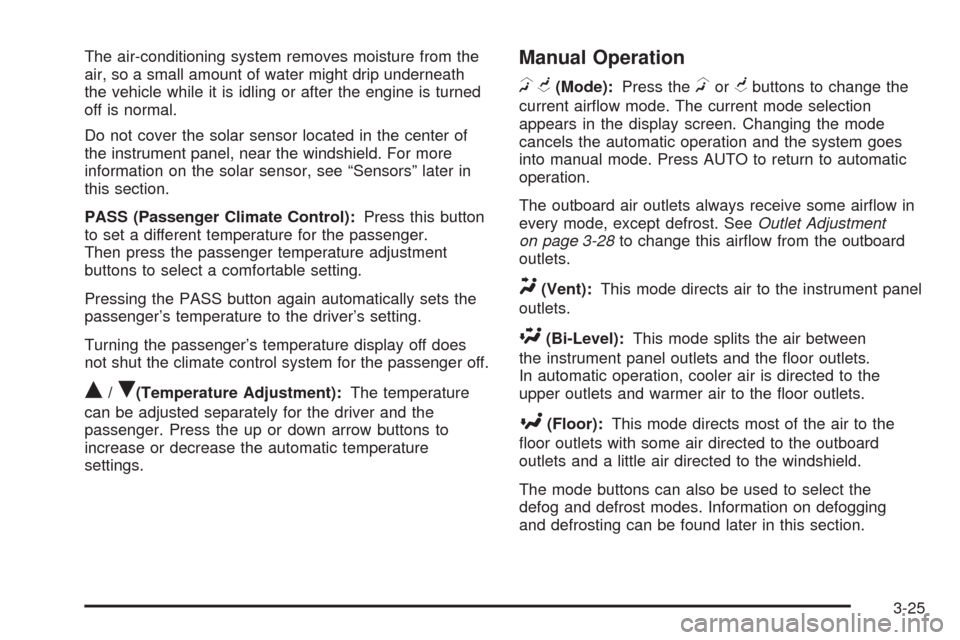
PASS (Passenger Climate Control):Press this button
to set a different temperature for the passenger.
Then press the passenger temperature adjustment
buttons to select a comfortable setting.
Pressing the PASS button again automatically sets the
passenger’s temperature to the driver’s setting.
Turning the passenger’s temperature display off does
not shut the climate control system for the passenger off.
Q/R(Temperature Adjustment):The temperature
can be adjusted separately for the driver and the
passenger. Press the up or down arrow buttons to
increase or decrease the automatic temperature
settings.
Manual Operation
HG(Mode):Press theHorGbuttons to change the
current airow mode. The current mode selection
appears in the display screen. Changing the mode
cancels the automatic operation and the system goes
into manual mode. Press AUTO to return to automatic
operation.
The outboard air outlets always receive some airow in
every mode, except defrost. SeeOutlet Adjustment
on page 3-28to change this airow from the outboard
outlets.
Y(Vent):This mode directs air to the instrument panel
outlets.
\(Bi-Level):This mode splits the air between
the instrument panel outlets and the oor outlets.
In automatic operation, cooler air is directed to the
upper outlets and warmer air to the oor outlets.
[(Floor):This mode directs most of the air to the
oor outlets with some air directed to the outboard
outlets and a little air directed to the windshield.
The mode buttons can also be used to select the
defog and defrost modes. Information on defogging
and defrosting can be found later in this section.
3-25
Page 169 of 490
Defogging and Defrosting
Fog on the inside of windows is a result of high humidity
(moisture) condensing on the cool window glass.
This can be minimized if the climate control system
is used properly. There are two modes to clear fog
from the windshield. Use the defog mode to clear the
windows of fog or moisture and warm the passengers.
Use the defrost mode to remove fog or frost from
the windshield more quickly.
HG(Mode):Press the mode buttons until defog
appears on the display.
-(Defog):This mode directs the air between the
windshield, oor outlets and side windows. When this
mode is selected, the system turns off recirculation and
runs the air-conditioning compressor unless the outside
temperature is at or below freezing. If recirculation mode
is selected while in defog mode, it will be cancelled after
10 minutes.
0(Defrost):Pressing defrost directs most of the air
to the windshield, with some air directed to the side
windows. In this mode, the system automatically turns off
recirculation and runs the air-conditioning compressor,
unless the outside temperature is at or below freezing.
This mode may also cause the fan speed and air
temperature to increase.
Rear Window Defogger
The rear window defogger uses a warming grid to
remove fog or frost from the rear window.
The rear window defogger will only work when the
ignition is in ON/RUN.
=(Rear Window Defogger):Press this button to turn
the rear window defogger on or off. Be sure to clear
as much snow from the rear window as possible.
The rear window defogger turns off about 15 minutes
after the button is rst pressed if the vehicle is moving
at slower speeds. At higher speeds, the rear window
defogger may stay on continuously. With each additional
press, the defogger runs for about 10 minutes.
The defogger can also be turned off by pressing the
button again or by turning off the engine.
The heated outside rearview mirrors will heat to help
clear fog or frost from the surface of the mirror when
the rear window defogger button is on. SeeOutside
Heated Mirrors on page 2-51.
Notice:Do not try to clear frost or other material
from the inside of the front windshield and rear
window with a razor blade or anything else that is
sharp. This may damage the rear window defogger
grid and affect your radio’s ability to pick up
stations clearly. The repairs wouldn’t be covered by
your warranty.
3-27
Page 170 of 490
Sensors
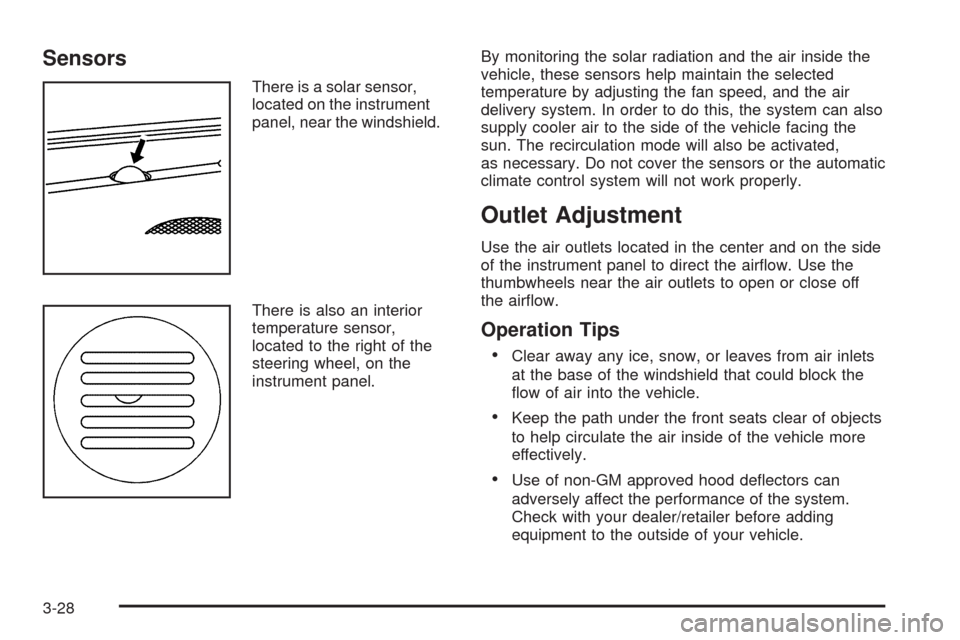
There is a solar sensor,
located on the instrument
panel, near the windshield.
There is also an interior
temperature sensor,
located to the right of the
steering wheel, on the
instrument panel.By monitoring the solar radiation and the air inside the
vehicle, these sensors help maintain the selected
temperature by adjusting the fan speed, and the air
delivery system. In order to do this, the system can also
supply cooler air to the side of the vehicle facing the
sun. The recirculation mode will also be activated,
as necessary. Do not cover the sensors or the automatic
climate control system will not work properly.
Outlet Adjustment
Use the air outlets located in the center and on the side
of the instrument panel to direct the airow. Use the
thumbwheels near the air outlets to open or close off
the airow.
Operation Tips
Clear away any ice, snow, or leaves from air inlets
at the base of the windshield that could block the
ow of air into the vehicle.
Keep the path under the front seats clear of objects
to help circulate the air inside of the vehicle more
effectively.
Use of non-GM approved hood deectors can
adversely affect the performance of the system.
Check with your dealer/retailer before adding
equipment to the outside of your vehicle.
3-28
Page 171 of 490
Passenger Compartment Air Filter
The passenger compartment air lter traps most of
the dust and pollen from the air entering the vehicle.
The lter will need to be changed periodically.
SeeScheduled Maintenance on page 6-4.
Using the climate control system without the passenger
air lter installed could let water or other debris enter
the system. This could cause a water leak or noises.
Make sure to install a new air lter after removing the
old one.
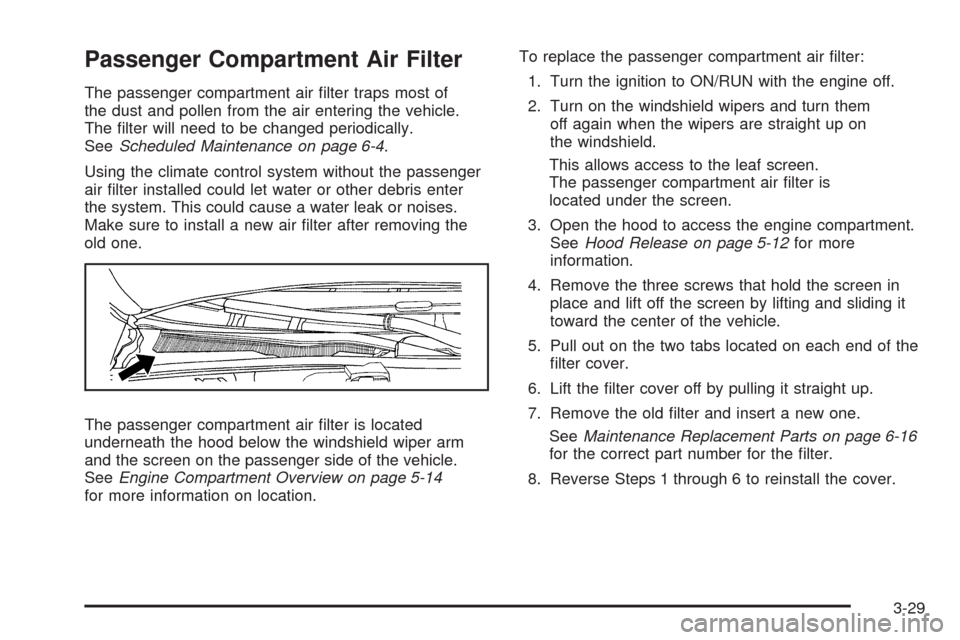
The passenger compartment air lter is located
underneath the hood below the windshield wiper arm
and the screen on the passenger side of the vehicle.
SeeEngine Compartment Overview on page 5-14
for more information on location.To replace the passenger compartment air lter:
1. Turn the ignition to ON/RUN with the engine off.
2. Turn on the windshield wipers and turn them
off again when the wipers are straight up on
the windshield.
This allows access to the leaf screen.
The passenger compartment air lter is
located under the screen.
3. Open the hood to access the engine compartment.
SeeHood Release on page 5-12for more
information.
4. Remove the three screws that hold the screen in
place and lift off the screen by lifting and sliding it
toward the center of the vehicle.
5. Pull out on the two tabs located on each end of the
lter cover.
6. Lift the lter cover off by pulling it straight up.
7. Remove the old lter and insert a new one.
SeeMaintenance Replacement Parts on page 6-16
for the correct part number for the lter.
8. Reverse Steps 1 through 6 to reinstall the cover.
3-29
Page 197 of 490

Compass Calibration
The compass can be manually calibrated. Only calibrate
the compass in a magnetically clean and safe location,
such as an open parking lot, where driving the vehicle
in circles is not a danger. It is suggested to calibrate
away from tall buildings, utility wires, manhole covers, or
other industrial structures, if possible.
If CAL should ever appear in the DIC display, the
compass should be calibrated.
If the DIC display does not show a heading, for example,
N for North, or the heading does not change after
making turns, there may be a strong magnetic eld
interfering with the compass. Such interference may
be caused by a magnetic CB or cell phone antenna
mount, a magnetic emergency light, magnetic note
pad holder, or any other magnetic item. Turn off
the vehicle, move the magnetic item, then turn on
the vehicle and calibrate the compass.To calibrate the compass, use the following procedure:Compass Calibration Procedure
1. Before calibrating the compass, make sure the
compass zone is set to the variance zone in
which the vehicle is located. See “Compass
Variance (Zone) Procedure” earlier in this section.
Do not operate any switches such as window,
sunroof, climate controls, seats, etc. during
the calibration procedure.
2. Press the vehicle information button until
Press
VTo Calibrate Compass displays.
3. Press the set/reset button to start the compass
calibration.
4. The DIC will display Calibrating Drive In Circles.
Drive the vehicle in tight circles at less than
5 mph (8 km/h) to complete the calibration. The DIC
will display Calibration Complete for a few seconds
when the calibration is complete. The DIC display
will then return to Press
VTo Calibrate Compass.
3-55
Page 206 of 490
Rotate Control To Off Position
If your vehicle has the keyless access system,
this message displays when the ignition is in
ACC/ACCESSORY and the shift lever has just been
moved to PARK (P). The message displays as a
reminder to turn the ignition off. To avoid draining the
battery, make sure the ignition is turned off before
leaving the vehicle.
Service Air Bag
This message displays when there is a problem with the
airbag system. Have your vehicle serviced by your
dealer/retailer immediately. SeeAirbag Readiness Light
on page 3-34for more information.
Service A/C System
This message displays when the electronic sensors that
control the air conditioning and heating systems are
no longer working. Have the climate control system
serviced by your dealer/retailer if you notice a drop in
heating and air conditioning efficiency.
Service All Wheel Drive
This message displays if a problem occurs with the
All-Wheel Drive (AWD) system. Your vehicle will run in
2WD. This could be caused by:
An electronics problem
An AWD system oil overheat
Worn out or overheated clutch plates
Various electrical issues
If this message appears, stop as soon as possible and
turn off the ignition for 30 seconds. Restart the
vehicle and check for the message on the DIC display.
If the message is still displayed or appears again
when you begin driving, the system needs service.
See your dealer/retailer right away.
Service Battery Charging System
This message displays when there is a problem with the
generator and battery charging systems. Driving with
this problem could drain the battery. Turn off all
unnecessary accessories. Stop and turn off the vehicle
as soon as it is safe to do so. Have the electrical
system checked by your dealer/retailer. Under certain
conditions, the charging system light may also turn on in
the instrument panel cluster. SeeCharging System
Light on page 3-37for more information.
3-64
Page 339 of 490

If you get the Engine Overheated Idle Engine warning
with no sign of steam, try this for a minute or so:
1. In heavy traffic, let the engine idle in N (Neutral)
while stopped. If it is safe to do so, pull off the
road, shift to P (Park) or N (Neutral) and let
the engine idle.
2. Set the climate controls to the highest heat setting
and fan speed and open the windows, as necessary.
If you no longer have the Engine Overheated Idle
Engine warning, you can drive. Just to be safe, drive
slower for about 10 minutes. If the warning does
not come back on, you can drive normally.
If the warning continues and you have not stopped,
pull over, stop, and park your vehicle right away.
If there is still no sign of steam, you can idle the engine
for three minutes while you are parked. If you still have
the warning,turn off the engine and get everyone out of
the vehicleuntil it cools down.
You may decide not to lift the hood but to get service
help right away.Overheated Engine Protection
Operating Mode
This operating mode allows your vehicle to be driven
to a safe place in an emergency. Should a hot engine
condition exist, an overheat protection mode which
alternates ring groups of cylinders helps prevent engine
damage. In this mode, there is a loss in power and engine
performance. Driving extended miles (km) and/or towing
a trailer in the overheat protection mode should be
avoided.
Notice:After driving in the overheated engine
protection operating mode, to avoid engine damage,
allow the engine to cool before attempting any repair.
The engine oil will be severely degraded. Repair the
cause of coolant loss and change the oil. SeeEngine
Oil on page 5-16.
5-33