fuel cap CADILLAC CTS 2008 2.G User Guide
[x] Cancel search | Manufacturer: CADILLAC, Model Year: 2008, Model line: CTS, Model: CADILLAC CTS 2008 2.GPages: 490, PDF Size: 2.59 MB
Page 317 of 490
The Tighten Gas Cap message in the Driver Information
Center (DIC) will be displayed if the fuel cap is not
properly installed. SeeDIC Warnings and Messages
on page 3-56for more information.
{CAUTION:
If a re starts while you are refueling, do not
remove the nozzle. Shut off the ow of fuel
by shutting off the pump or by notifying the
station attendant. Leave the area immediately.
Notice:If you need a new fuel cap, be sure to get
the right type. Your dealer/retailer can get one
for you. If you get the wrong type, it may not t
properly. This may cause your malfunction indicator
lamp to light and may damage your fuel tank and
emissions system. SeeMalfunction Indicator Lamp
on page 3-41.
Filling a Portable Fuel Container
{CAUTION:
Never ll a portable fuel container while it is in
your vehicle. Static electricity discharge from
the container can ignite the fuel vapor. You can
be badly burned and your vehicle damaged if
this occurs. To help avoid injury to you and
others:
Dispense fuel only into approved
containers.
Do not ll a container while it is inside a
vehicle, in a vehicle’s trunk, pickup bed,
or on any surface other than the ground.
Bring the ll nozzle in contact with the
inside of the ll opening before operating
the nozzle. Contact should be maintained
until the lling is complete.
Do not smoke while pumping fuel.
Do not use a cellular phone while
pumping fuel.
5-11
Page 370 of 490
Cold Tire Pressure:The amount of air pressure
in a tire, measured in pounds per square inch (psi)
or kilopascals (kPa) before a tire has built up heat
from driving. SeeInflation - Tire Pressure on
page 5-66.
Curb Weight
:The weight of a motor vehicle with
standard and optional equipment including the
maximum capacity of fuel, oil, and coolant,
but without passengers and cargo.
DOT Markings
:A code molded into the sidewall
of a tire signifying that the tire is in compliance with
the U.S. Department of Transportation (DOT)
motor vehicle safety standards. The DOT code
includes the Tire Identication Number (TIN), an
alphanumeric designator which can also identify the
tire manufacturer, production plant, brand, and date
of production.
GVWR
:Gross Vehicle Weight Rating.
SeeLoading the Vehicle on page 4-22.
GAWR FRT
:Gross Axle Weight Rating for the
front axle. SeeLoading the Vehicle on page 4-22.
GAWR RR
:Gross Axle Weight Rating for the
rear axle. SeeLoading the Vehicle on page 4-22.
Intended Outboard Sidewall
:The side of an
asymmetrical tire, that must always face outward
when mounted on a vehicle.Kilopascal (kPa)
:The metric unit for air pressure.
Light Truck (LT-Metric) Tire
:A tire used on
light duty trucks and some multipurpose passenger
vehicles.
Load Index
:An assigned number ranging from
1 to 279 that corresponds to the load carrying
capacity of a tire.
Maximum Ination Pressure
:The maximum air
pressure to which a cold tire can be inated. The
maximum air pressure is molded onto the sidewall.
Maximum Load Rating
:The load rating for a tire
at the maximum permissible ination pressure
for that tire.
Maximum Loaded Vehicle Weight
:The sum of
curb weight, accessory weight, vehicle capacity
weight, and production options weight.
Normal Occupant Weight
:The number of
occupants a vehicle is designed to seat multiplied
by 150 lbs (68 kg). SeeLoading the Vehicle on
page 4-22.
Occupant Distribution
:Designated seating
positions.
5-64
Page 372 of 490
Vehicle Placard:A label permanently attached
to a vehicle showing the vehicle’s capacity
weight and the original equipment tire size and
recommended ination pressure. See “Tire
and Loading Information Label” underLoading
the Vehicle on page 4-22.
Ination - Tire Pressure
Tires need the correct amount of air pressure to
operate effectively.
Notice:Do not let anyone tell you that
under-ination or over-ination is all right.
It is not. If your tires do not have enough air
(under-ination), you can get the following:
Too much exing
Too much heat
Tire overloading
Premature or irregular wear
Poor handling
Reduced fuel economyIf your tires have too much air (over-ination),
you can get the following:
Unusual wear
Poor handling
Rough ride
Needless damage from road hazards
A vehicle specic Tire and Loading Information
label is attached to your vehicle. This label lists your
vehicle’s original equipment tires and shows the
correct ination pressures for your tires when they
are cold. The recommended cold tire ination
pressure, shown on the label, is the minimum
amount of air pressure needed to support your
vehicle’s maximum load carrying capacity.
For additional information regarding how much
weight your vehicle can carry, and an example of
the tire and loading information label, seeLoading
the Vehicle on page 4-22. How you load your
vehicle affects vehicle handling and ride comfort.
Never load your vehicle with more weight than it
was designed to carry.
5-66
Page 435 of 490
Capacities and Specications
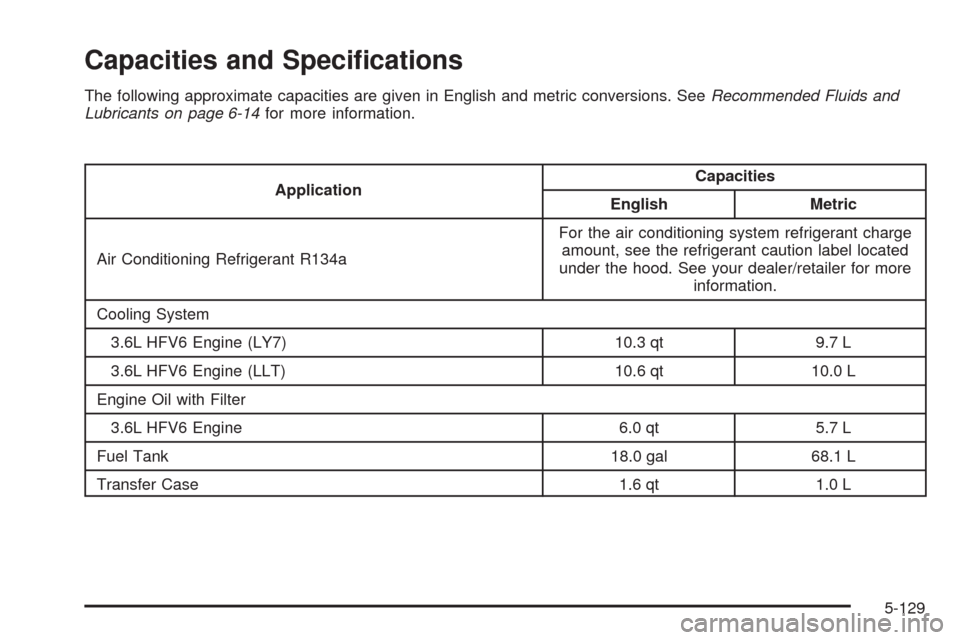
The following approximate capacities are given in English and metric conversions. SeeRecommended Fluids and
Lubricants on page 6-14for more information.
ApplicationCapacities
English Metric
Air Conditioning Refrigerant R134aFor the air conditioning system refrigerant charge
amount, see the refrigerant caution label located
under the hood. See your dealer/retailer for more
information.
Cooling System
3.6L HFV6 Engine (LY7) 10.3 qt 9.7 L
3.6L HFV6 Engine (LLT) 10.6 qt 10.0 L
Engine Oil with Filter
3.6L HFV6 Engine 6.0 qt 5.7 L
Fuel Tank 18.0 gal 68.1 L
Transfer Case 1.6 qt 1.0 L
5-129
Page 478 of 490
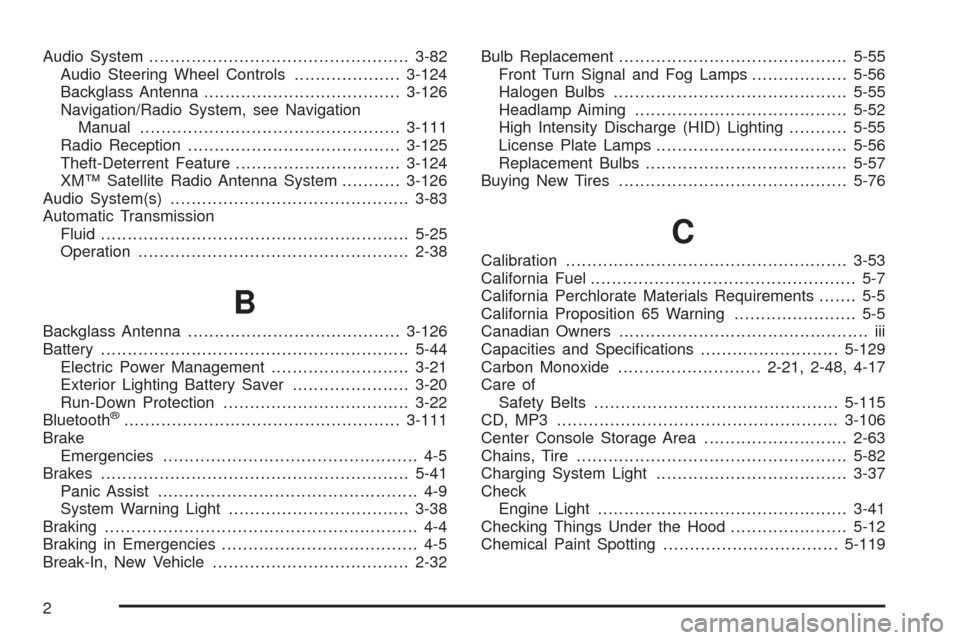
Audio System.................................................3-82
Audio Steering Wheel Controls....................3-124
Backglass Antenna.....................................3-126
Navigation/Radio System, see Navigation
Manual.................................................3-111
Radio Reception........................................3-125
Theft-Deterrent Feature...............................3-124
XM™ Satellite Radio Antenna System...........3-126
Audio System(s).............................................3-83
Automatic Transmission
Fluid..........................................................5-25
Operation...................................................2-38
B
Backglass Antenna........................................3-126
Battery..........................................................5-44
Electric Power Management..........................3-21
Exterior Lighting Battery Saver......................3-20
Run-Down Protection...................................3-22
Bluetooth
®....................................................3-111
Brake
Emergencies................................................ 4-5
Brakes..........................................................5-41
Panic Assist................................................. 4-9
System Warning Light..................................3-38
Braking........................................................... 4-4
Braking in Emergencies..................................... 4-5
Break-In, New Vehicle.....................................2-32Bulb Replacement...........................................5-55
Front Turn Signal and Fog Lamps..................5-56
Halogen Bulbs............................................5-55
Headlamp Aiming........................................5-52
High Intensity Discharge (HID) Lighting...........5-55
License Plate Lamps....................................5-56
Replacement Bulbs......................................5-57
Buying New Tires...........................................5-76
C
Calibration.....................................................3-53
California Fuel.................................................. 5-7
California Perchlorate Materials Requirements....... 5-5
California Proposition 65 Warning....................... 5-5
Canadian Owners............................................... iii
Capacities and Specications..........................5-129
Carbon Monoxide...........................2-21, 2-48, 4-17
Care of
Safety Belts..............................................5-115
CD, MP3 .....................................................3-106
Center Console Storage Area...........................2-63
Chains, Tire...................................................5-82
Charging System Light....................................3-37
Check
Engine Light...............................................3-41
Checking Things Under the Hood......................5-12
Chemical Paint Spotting.................................5-119
2