instrument panel CADILLAC CTS 2008 2.G User Guide
[x] Cancel search | Manufacturer: CADILLAC, Model Year: 2008, Model line: CTS, Model: CADILLAC CTS 2008 2.GPages: 490, PDF Size: 2.59 MB
Page 99 of 490

When you want to open a rear door when the security
lock is on, do the following:
1. Unlock the door using the Remote Keyless Entry
(RKE) or Keyless Access System transmitter, if
the vehicle has one, the power door lock switch,
or the rear door manual lock.
2. Open the door from the outside.
To cancel the rear door security lock, do the following:
1. Unlock the door and open it from the outside.
2. Insert the key into the security lock slot and turn it
so the slot is in the vertical position.
Lockout Protection
If the power door lock switch is pressed when the key
is in the ignition and a door is open, all the doors will lock
and only the driver’s door will unlock. If you close the
doors, they can be locked by using the Remote Keyless
Entry (RKE) transmitter. Be sure to remove the key from
the ignition when locking your vehicle.
This feature can be overridden by pressing the lock
button on the RKE transmitter or by pressing the power
lock switch a second time.
On vehicles with a Keyless Access System, the system
can be programmed to alert you when all the doors
are closed and a transmitter has been left inside of the
vehicle. SeeDIC Vehicle Customization on page 3-69
for more information.
Trunk
{CAUTION:
It can be dangerous to drive with the trunk lid
open because carbon monoxide (CO) gas can
come into your vehicle. You cannot see or
smell CO. It can cause unconsciousness and
even death. If you must drive with the trunk
lid open or if electrical wiring or other cable
connections must pass through the seal
between the body and the trunk lid:
Make sure all other windows are shut.
Turn the fan on your heating or cooling
system to its highest speed and select the
control setting that will force outside air
into your vehicle. See Climate Control
System.
If you have air outlets on or under the
instrument panel, open them all the way.
SeeEngine Exhaust on page 2-48.
2-21
Page 106 of 490
Theft-Deterrent Systems
Vehicle theft is big business, especially in some cities.
This vehicle has theft-deterrent features, however,
they do not make it impossible to steal.
Theft-Deterrent System
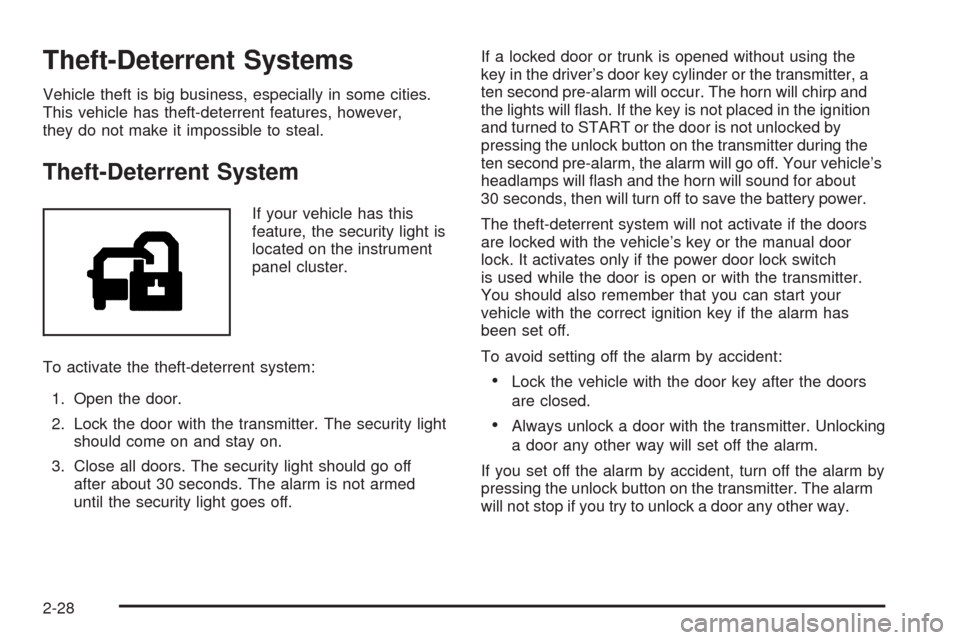
If your vehicle has this
feature, the security light is
located on the instrument
panel cluster.
To activate the theft-deterrent system:
1. Open the door.
2. Lock the door with the transmitter. The security light
should come on and stay on.
3. Close all doors. The security light should go off
after about 30 seconds. The alarm is not armed
until the security light goes off.If a locked door or trunk is opened without using the
key in the driver’s door key cylinder or the transmitter, a
ten second pre-alarm will occur. The horn will chirp and
the lights will ash. If the key is not placed in the ignition
and turned to START or the door is not unlocked by
pressing the unlock button on the transmitter during the
ten second pre-alarm, the alarm will go off. Your vehicle’s
headlamps will ash and the horn will sound for about
30 seconds, then will turn off to save the battery power.
The theft-deterrent system will not activate if the doors
are locked with the vehicle’s key or the manual door
lock. It activates only if the power door lock switch
is used while the door is open or with the transmitter.
You should also remember that you can start your
vehicle with the correct ignition key if the alarm has
been set off.
To avoid setting off the alarm by accident:
Lock the vehicle with the door key after the doors
are closed.
Always unlock a door with the transmitter. Unlocking
a door any other way will set off the alarm.
If you set off the alarm by accident, turn off the alarm by
pressing the unlock button on the transmitter. The alarm
will not stop if you try to unlock a door any other way.
2-28
Page 119 of 490
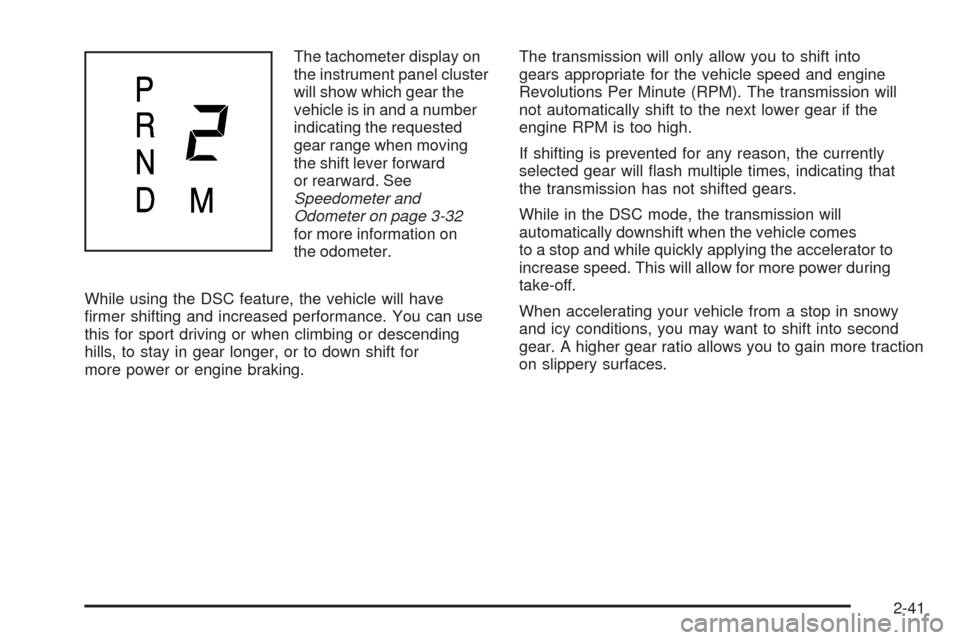
The tachometer display on
the instrument panel cluster
will show which gear the
vehicle is in and a number
indicating the requested
gear range when moving
the shift lever forward
or rearward. See
Speedometer and
Odometer on page 3-32
for more information on
the odometer.
While using the DSC feature, the vehicle will have
rmer shifting and increased performance. You can use
this for sport driving or when climbing or descending
hills, to stay in gear longer, or to down shift for
more power or engine braking.The transmission will only allow you to shift into
gears appropriate for the vehicle speed and engine
Revolutions Per Minute (RPM). The transmission will
not automatically shift to the next lower gear if the
engine RPM is too high.
If shifting is prevented for any reason, the currently
selected gear will ash multiple times, indicating that
the transmission has not shifted gears.
While in the DSC mode, the transmission will
automatically downshift when the vehicle comes
to a stop and while quickly applying the accelerator to
increase speed. This will allow for more power during
take-off.
When accelerating your vehicle from a stop in snowy
and icy conditions, you may want to shift into second
gear. A higher gear ratio allows you to gain more traction
on slippery surfaces.
2-41
Page 121 of 490

Shift Speeds (Manual Transmission)
{CAUTION:
If you skip a gear when you downshift, you
could lose control of your vehicle. You could
injure yourself or others. Do not shift down
more than one gear at a time when you
downshift.
Notice:If you skip more than one gear when you
downshift, or if you race the engine when you
release the clutch pedal while downshifting, you
could damage the engine, clutch, driveshaft or
the transmission. Do not skip gears or race
the engine when downshifting.
If the vehicle speed drops below 20 mph (32 km/h),
or if the engine is not running smoothly, you should
downshift to the next lower gear. You may have
to downshift two or more gears to keep the engine
running smoothly or for good performance.
Up-Shift Light
Vehicles with a manual
transmission may have
an up-shift light on the
instrument panel. This light
will show you when to shift
to the next higher gear for
the best fuel economy.
When this light comes on, you can shift to the next
higher gear if weather, road, and traffic conditions allow.
For the best fuel economy, accelerate slowly and
shift when the light comes on.
While you accelerate, it is normal for the light to go
on and off if you quickly change the position of
the accelerator. Ignore the light when you downshift.
2-43
Page 122 of 490
Parking Brake
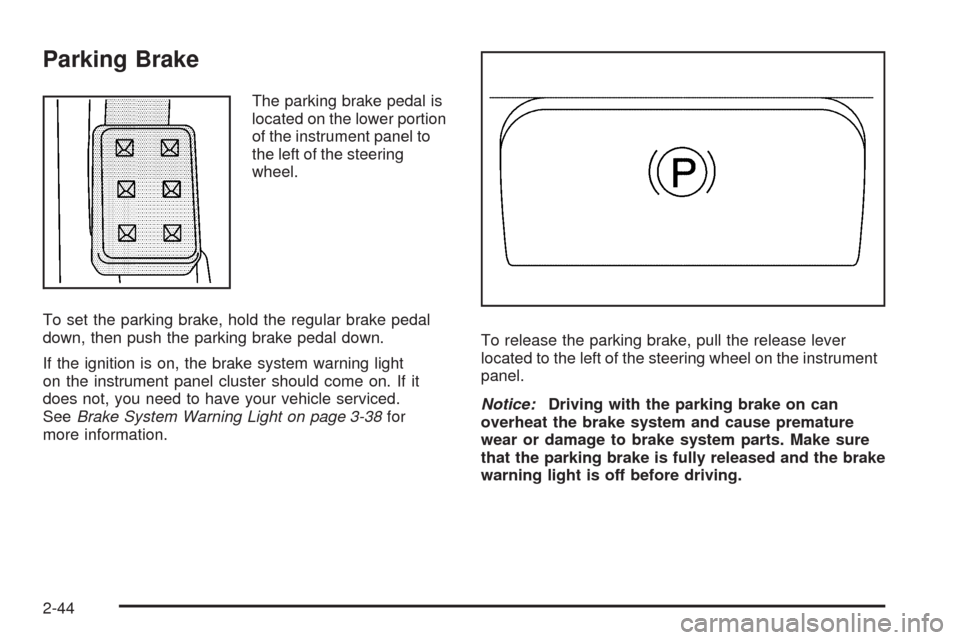
The parking brake pedal is
located on the lower portion
of the instrument panel to
the left of the steering
wheel.
To set the parking brake, hold the regular brake pedal
down, then push the parking brake pedal down.
If the ignition is on, the brake system warning light
on the instrument panel cluster should come on. If it
does not, you need to have your vehicle serviced.
SeeBrake System Warning Light on page 3-38for
more information.To release the parking brake, pull the release lever
located to the left of the steering wheel on the instrument
panel.
Notice:Driving with the parking brake on can
overheat the brake system and cause premature
wear or damage to brake system parts. Make sure
that the parking brake is fully released and the brake
warning light is off before driving.
2-44
Page 141 of 490
Instrument Panel Storage
Your vehicle has a storage area located below the
climate control systems. To access, push on the lid.
Center Console Storage
Your vehicle has a center console with an upper and
lower storage area. To access the upper storage area,
lift the driver side lever on the front of the console
and lift the cover. To access the lower storage area,
lift the passenger side lever on the center console.
There is an additional storage area behind the center
console. To access, push the cover.
Convenience Net
Your vehicle may have a convenience net in the rear of
the vehicle. Put small loads behind the net. It can also be
positioned into an envelope style to hold smaller items.
The net is not for heavier loads. Store them as far forward
as you can.
Sunroof
If your vehicle has a power sunroof it will only operate
when the ignition is turned on, or in ACC/ACCESSORY,
or when Retained Accessory Power (RAP) is active.
SeeRetained Accessory Power (RAP) on page 2-35.
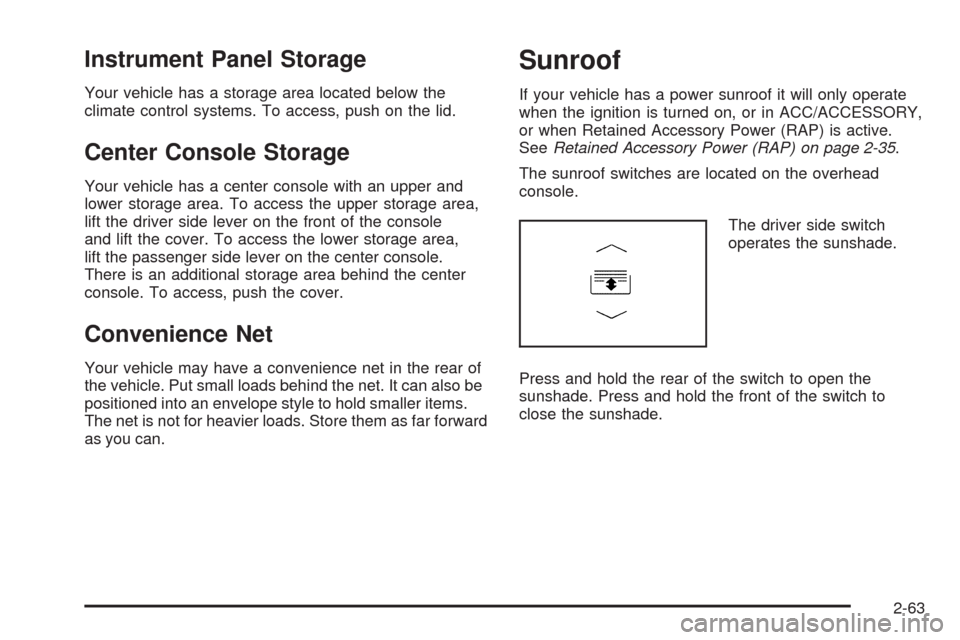
The sunroof switches are located on the overhead
console.
The driver side switch
operates the sunshade.
Press and hold the rear of the switch to open the
sunshade. Press and hold the front of the switch to
close the sunshade.
2-63
Page 143 of 490
Instrument Panel Overview...............................3-4
Hazard Warning Flashers................................3-6
Horn .............................................................3-6
Tilt and Telescopic Steering Wheel...................3-6
Power Tilt Wheel and Telescopic Steering
Column......................................................3-7
Turn Signal/Multifunction Lever.........................3-7
Turn and Lane-Change Signals........................3-8
Headlamp High/Low-Beam Changer..................3-8
Flash-to-Pass.................................................3-9
Windshield Wipers..........................................3-9
Rainsense™ Wipers......................................3-10
Windshield Washer.......................................3-12
Headlamp Washer........................................3-13
Cruise Control..............................................3-14
Headlamps..................................................3-17
Wiper Activated Headlamps............................3-17
Headlamps on Reminder................................3-17
Daytime Running Lamps (DRL).......................3-18
Adaptive Forward Lighting System...................3-19
Fog Lamps ..................................................3-19
Exterior Lighting Battery Saver........................3-20
Instrument Panel Brightness...........................3-20
Entry Lighting...............................................3-20
Parade Dimming...........................................3-20
Reading Lamps............................................3-21
Electric Power Management...........................3-21Battery Run-Down Protection..........................3-22
Accessory Power Outlet(s).............................3-22
Ashtray(s) and Cigarette Lighter......................3-23
Analog Clock...............................................3-23
Climate Controls............................................3-24
Dual Climate Control System..........................3-24
Outlet Adjustment.........................................3-28
Passenger Compartment Air Filter...................3-29
Warning Lights, Gages, and Indicators............3-30
Instrument Panel Cluster................................3-31
Speedometer and Odometer...........................3-32
Trip Odometers............................................3-32
Tachometer.................................................3-32
Engine Speed Limiter....................................3-32
Safety Belt Reminders...................................3-33
Airbag Readiness Light..................................3-34
Passenger Airbag Status Indicator...................3-35
Charging System Light..................................3-37
Up-Shift Light...............................................3-37
Brake System Warning Light..........................3-38
Antilock Brake System (ABS) Warning Light.....3-39
Traction Control System (TCS)/StabiliTrak
®
Warning Light...........................................3-39
Engine Coolant Temperature Warning Light......3-40
Engine Coolant Temperature Gage..................3-40
Tire Pressure Light.......................................3-41
Section 3 Instrument Panel
3-1
Page 144 of 490
Malfunction Indicator Lamp.............................3-41
Oil Pressure Light.........................................3-44
Engine Oil Pressure Gage.............................3-45
Security Light...............................................3-46
Fog Lamp Light............................................3-46
Lights On Reminder......................................3-46
Cruise Control Light......................................3-46
Highbeam On Light.......................................3-47
Fuel Gage...................................................3-47
Driver Information Center (DIC).......................3-48
DIC Operation and Displays...........................3-48
DIC Compass..............................................3-53
DIC Warnings and Messages.........................3-56
DIC Vehicle Customization.............................3-69Audio System(s).............................................3-82
Radio(s)......................................................3-83
Using an MP3............................................3-106
XM Radio Messages...................................3-110
Navigation/Radio System..............................3-111
Bluetooth
®.................................................3-111
Theft-Deterrent Feature................................3-124
Audio Steering Wheel Controls......................3-124
Radio Reception.........................................3-125
Backglass Antenna......................................3-126
XM™ Satellite Radio Antenna System............3-126
Section 3 Instrument Panel
3-2
Page 146 of 490
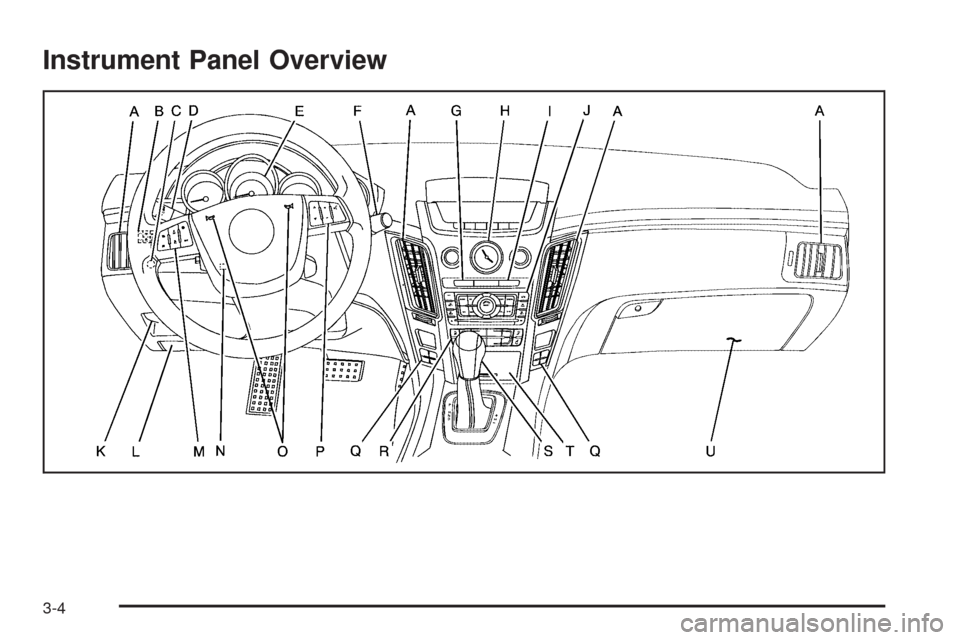
Instrument Panel Overview
3-4
Page 147 of 490
The main components of the instrument panel are the following:
A. Air Outlets. SeeOutlet Adjustment on page 3-28.
B. Driver Information Center (DIC) Buttons. SeeDriver
Information Center (DIC) on page 3-48.
C. Instrument Panel Brightness Control. SeeInstrument
Panel Brightness on page 3-20.
D. Turn Signal/Multifunction Lever. SeeTurn
Signal/Multifunction Lever on page 3-7.
E. Instrument Panel Cluster. SeeInstrument Panel
Cluster on page 3-31.
F. Windshield Wiper Lever. SeeWindshield Wipers
on page 3-9.
G. Traction Control System (TCS) Disable Button.
SeeTraction Control System (TCS) on page 4-6.
H. Analog Clock. SeeAnalog Clock on page 3-23.
I. Hazard Warning Flasher Button. SeeHazard
Warning Flashers on page 3-6.
J. Audio (Base Audio System) or Audio/Navigation
System (If Equipped). SeeAudio System(s)
on page 3-82orNavigation/Radio System on
page 3-111.
K. Parking Brake Release. SeeParking Brake on
page 2-44.L. Hood Release. SeeHood Release on page 5-12.
M. Cruise Control Buttons. SeeCruise Control on
page 3-14.
N. Tilt Wheel Lever. SeeTilt and Telescopic Steering
Wheel on page 3-6orPower Tilt Wheel and
Telescopic Steering Column on page 3-7.
O. Horn. SeeHorn on page 3-6.
P. Audio Steering Wheel Controls. SeeAudio Steering
Wheel Controls on page 3-124.
Q. Heated and Ventilated Seats. SeeHeated and
Ventilated Seats on page 1-6.
R. Dual Climate Control System. SeeDual Climate
Control System on page 3-24.
S. Shift Lever. SeeAutomatic Transmission Operation
on page 2-38orManual Transmission Operation
on page 2-42.
T. Storage Compartment. SeeInstrument Panel
Storage on page 2-63. Accessory Power Outlet.
SeeAccessory Power Outlet(s) on page 3-22.
U. Glove Box. SeeGlove Box on page 2-62.
3-5