trailer CADILLAC CTS 2008 2.G Owner's Manual
[x] Cancel search | Manufacturer: CADILLAC, Model Year: 2008, Model line: CTS, Model: CADILLAC CTS 2008 2.GPages: 490, PDF Size: 2.59 MB
Page 313 of 490
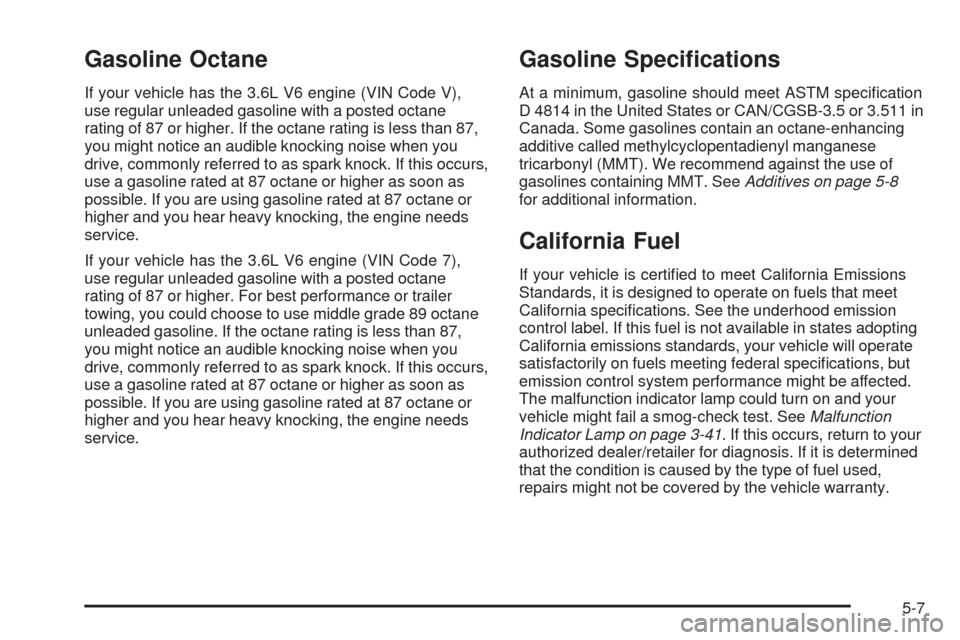
Gasoline Octane
If your vehicle has the 3.6L V6 engine (VIN Code V),
use regular unleaded gasoline with a posted octane
rating of 87 or higher. If the octane rating is less than 87,
you might notice an audible knocking noise when you
drive, commonly referred to as spark knock. If this occurs,
use a gasoline rated at 87 octane or higher as soon as
possible. If you are using gasoline rated at 87 octane or
higher and you hear heavy knocking, the engine needs
service.
If your vehicle has the 3.6L V6 engine (VIN Code 7),
use regular unleaded gasoline with a posted octane
rating of 87 or higher. For best performance or trailer
towing, you could choose to use middle grade 89 octane
unleaded gasoline. If the octane rating is less than 87,
you might notice an audible knocking noise when you
drive, commonly referred to as spark knock. If this occurs,
use a gasoline rated at 87 octane or higher as soon as
possible. If you are using gasoline rated at 87 octane or
higher and you hear heavy knocking, the engine needs
service.
Gasoline Specications
At a minimum, gasoline should meet ASTM specication
D 4814 in the United States or CAN/CGSB-3.5 or 3.511 in
Canada. Some gasolines contain an octane-enhancing
additive called methylcyclopentadienyl manganese
tricarbonyl (MMT). We recommend against the use of
gasolines containing MMT. SeeAdditives on page 5-8
for additional information.
California Fuel
If your vehicle is certied to meet California Emissions
Standards, it is designed to operate on fuels that meet
California specications. See the underhood emission
control label. If this fuel is not available in states adopting
California emissions standards, your vehicle will operate
satisfactorily on fuels meeting federal specications, but
emission control system performance might be affected.
The malfunction indicator lamp could turn on and your
vehicle might fail a smog-check test. SeeMalfunction
Indicator Lamp on page 3-41. If this occurs, return to your
authorized dealer/retailer for diagnosis. If it is determined
that the condition is caused by the type of fuel used,
repairs might not be covered by the vehicle warranty.
5-7
Page 338 of 490

If Steam Is Coming From Your Engine
{CAUTION:
Steam from an overheated engine can burn
you badly, even if you just open the hood.
Stay away from the engine if you see or hear
steam coming from it. Turn it off and get
everyone away from the vehicle until it cools
down. Wait until there is no sign of steam or
coolant before you open the hood.
If you keep driving when the vehicles engine
is overheated, the liquids in it can catch re.
You or others could be badly burned. Stop
your engine if it overheats, and get out of
the vehicle until the engine is cool.
SeeOverheated Engine Protection Operating
Mode on page 5-33for information on driving
to a safe place in an emergency.Notice:If the engine catches re while driving
with no coolant, the vehicle can be badly damaged.
The costly repairs would not be covered by the
vehicle warranty. SeeOverheated Engine Protection
Operating Mode on page 5-33for information on
driving to a safe place in an emergency.If No Steam Is Coming From Your
Engine
An Engine Overheated Idle Engine warning, along with
low coolant, can indicate a serious problem.
If you get an Engine Overheated Idle Engine warning,
but see or hear no steam, the problem may not be
too serious. Sometimes the engine can get a little
too hot when you:
Climb a long hill on a hot day.
Stop after high-speed driving.
Idle for long periods in traffic.
Tow a trailer.
5-32
Page 339 of 490

If you get the Engine Overheated Idle Engine warning
with no sign of steam, try this for a minute or so:
1. In heavy traffic, let the engine idle in N (Neutral)
while stopped. If it is safe to do so, pull off the
road, shift to P (Park) or N (Neutral) and let
the engine idle.
2. Set the climate controls to the highest heat setting
and fan speed and open the windows, as necessary.
If you no longer have the Engine Overheated Idle
Engine warning, you can drive. Just to be safe, drive
slower for about 10 minutes. If the warning does
not come back on, you can drive normally.
If the warning continues and you have not stopped,
pull over, stop, and park your vehicle right away.
If there is still no sign of steam, you can idle the engine
for three minutes while you are parked. If you still have
the warning,turn off the engine and get everyone out of
the vehicleuntil it cools down.
You may decide not to lift the hood but to get service
help right away.Overheated Engine Protection
Operating Mode
This operating mode allows your vehicle to be driven
to a safe place in an emergency. Should a hot engine
condition exist, an overheat protection mode which
alternates ring groups of cylinders helps prevent engine
damage. In this mode, there is a loss in power and engine
performance. Driving extended miles (km) and/or towing
a trailer in the overheat protection mode should be
avoided.
Notice:After driving in the overheated engine
protection operating mode, to avoid engine damage,
allow the engine to cool before attempting any repair.
The engine oil will be severely degraded. Repair the
cause of coolant loss and change the oil. SeeEngine
Oil on page 5-16.
5-33
Page 444 of 490
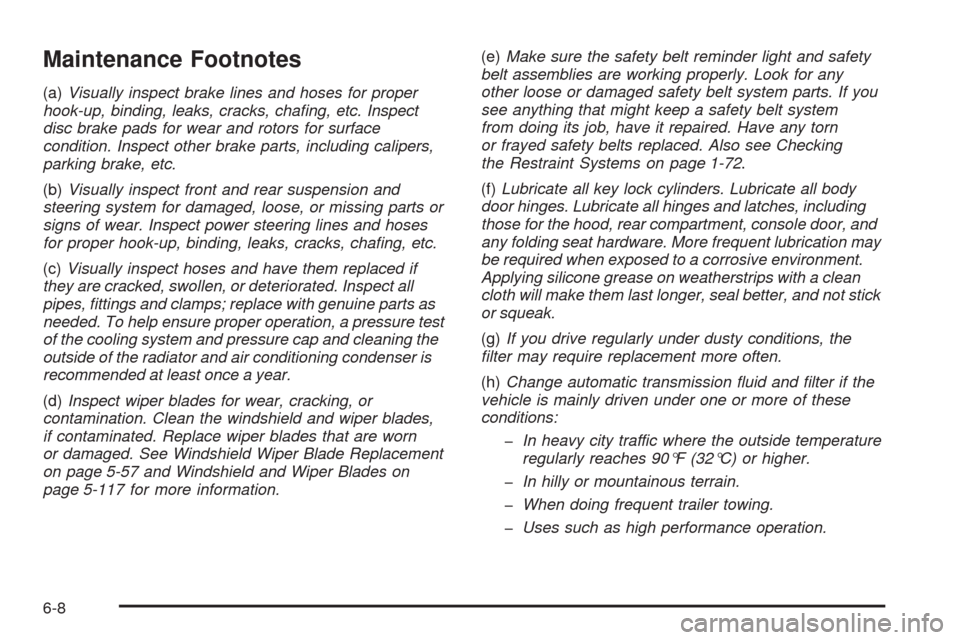
Maintenance Footnotes
(a)Visually inspect brake lines and hoses for proper
hook-up, binding, leaks, cracks, chafing, etc. Inspect
disc brake pads for wear and rotors for surface
condition. Inspect other brake parts, including calipers,
parking brake, etc.
(b)Visually inspect front and rear suspension and
steering system for damaged, loose, or missing parts or
signs of wear. Inspect power steering lines and hoses
for proper hook-up, binding, leaks, cracks, chafing, etc.
(c)Visually inspect hoses and have them replaced if
they are cracked, swollen, or deteriorated. Inspect all
pipes, fittings and clamps; replace with genuine parts as
needed. To help ensure proper operation, a pressure test
of the cooling system and pressure cap and cleaning the
outside of the radiator and air conditioning condenser is
recommended at least once a year.
(d)Inspect wiper blades for wear, cracking, or
contamination. Clean the windshield and wiper blades,
if contaminated. Replace wiper blades that are worn
or damaged. See Windshield Wiper Blade Replacement
on page 5-57 and Windshield and Wiper Blades on
page 5-117 for more information.(e)Make sure the safety belt reminder light and safety
belt assemblies are working properly. Look for any
other loose or damaged safety belt system parts. If you
see anything that might keep a safety belt system
from doing its job, have it repaired. Have any torn
or frayed safety belts replaced. Also see Checking
the Restraint Systems on page 1-72.
(f)Lubricate all key lock cylinders. Lubricate all body
door hinges. Lubricate all hinges and latches, including
those for the hood, rear compartment, console door, and
any folding seat hardware. More frequent lubrication may
be required when exposed to a corrosive environment.
Applying silicone grease on weatherstrips with a clean
cloth will make them last longer, seal better, and not stick
or squeak.
(g)If you drive regularly under dusty conditions, the
filter may require replacement more often.
(h)Change automatic transmission fluid and filter if the
vehicle is mainly driven under one or more of these
conditions:
In heavy city traffic where the outside temperature
regularly reaches 90°F (32°C) or higher.
In hilly or mountainous terrain.
When doing frequent trailer towing.
Uses such as high performance operation.
6-8
Page 445 of 490
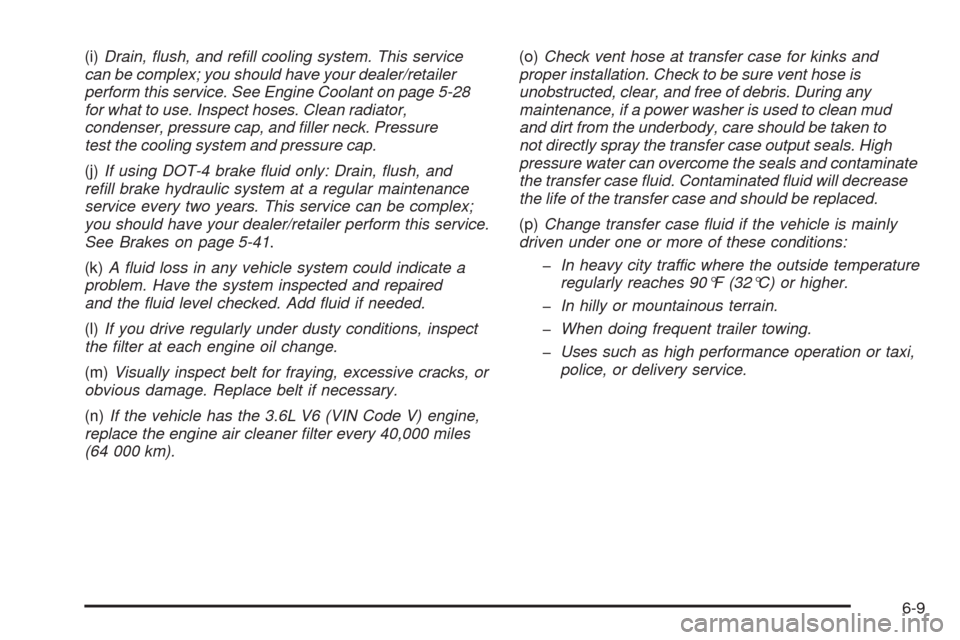
(i)Drain, flush, and refill cooling system. This service
can be complex; you should have your dealer/retailer
perform this service. See Engine Coolant on page 5-28
for what to use. Inspect hoses. Clean radiator,
condenser, pressure cap, and filler neck. Pressure
test the cooling system and pressure cap.
(j)If using DOT-4 brake fluid only: Drain, flush, and
refill brake hydraulic system at a regular maintenance
service every two years. This service can be complex;
you should have your dealer/retailer perform this service.
See Brakes on page 5-41.
(k)A fluid loss in any vehicle system could indicate a
problem. Have the system inspected and repaired
and the fluid level checked. Add fluid if needed.
(l)If you drive regularly under dusty conditions, inspect
the filter at each engine oil change.
(m)Visually inspect belt for fraying, excessive cracks, or
obvious damage. Replace belt if necessary.
(n)If the vehicle has the 3.6L V6 (VIN Code V) engine,
replace the engine air cleaner filter every 40,000 miles
(64 000 km).(o)Check vent hose at transfer case for kinks and
proper installation. Check to be sure vent hose is
unobstructed, clear, and free of debris. During any
maintenance, if a power washer is used to clean mud
and dirt from the underbody, care should be taken to
not directly spray the transfer case output seals. High
pressure water can overcome the seals and contaminate
the transfer case fluid. Contaminated fluid will decrease
the life of the transfer case and should be replaced.
(p)Change transfer case fluid if the vehicle is mainly
driven under one or more of these conditions:
In heavy city traffic where the outside temperature
regularly reaches 90°F (32°C) or higher.
In hilly or mountainous terrain.
When doing frequent trailer towing.
Uses such as high performance operation or taxi,
police, or delivery service.
6-9
Page 488 of 490
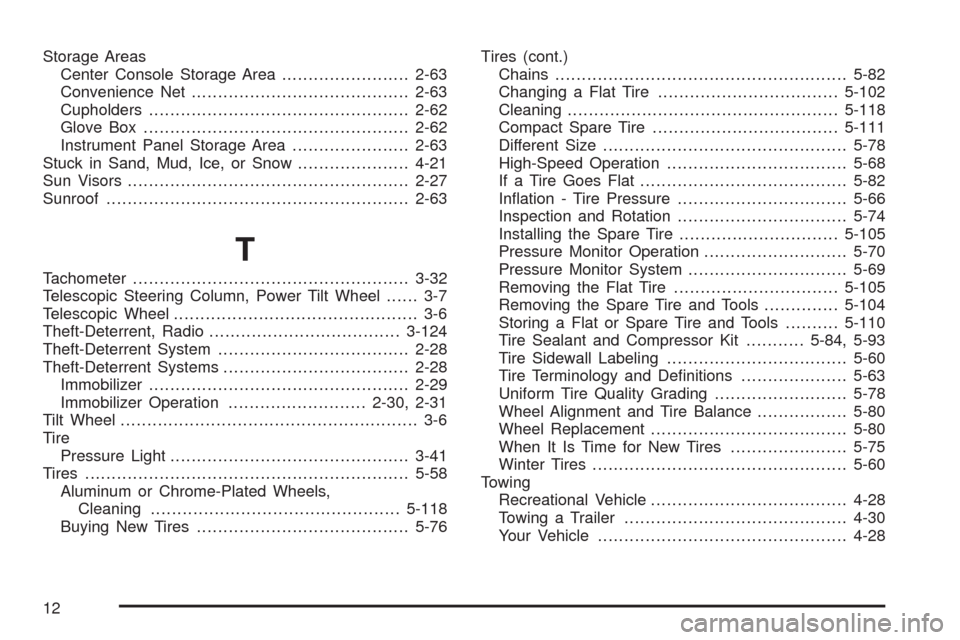
Storage Areas
Center Console Storage Area........................2-63
Convenience Net.........................................2-63
Cupholders.................................................2-62
Glove Box..................................................2-62
Instrument Panel Storage Area......................2-63
Stuck in Sand, Mud, Ice, or Snow.....................4-21
Sun Visors.....................................................2-27
Sunroof.........................................................2-63
T
Tachometer....................................................3-32
Telescopic Steering Column, Power Tilt Wheel...... 3-7
Telescopic Wheel.............................................. 3-6
Theft-Deterrent, Radio....................................3-124
Theft-Deterrent System....................................2-28
Theft-Deterrent Systems...................................2-28
Immobilizer.................................................2-29
Immobilizer Operation..........................2-30, 2-31
Tilt Wheel........................................................ 3-6
Tire
Pressure Light.............................................3-41
Tires.............................................................5-58
Aluminum or Chrome-Plated Wheels,
Cleaning...............................................5-118
Buying New Tires........................................5-76Tires (cont.)
Chains.......................................................5-82
Changing a Flat Tire..................................5-102
Cleaning...................................................5-118
Compact Spare Tire...................................5-111
Different Size..............................................5-78
High-Speed Operation..................................5-68
If a Tire Goes Flat.......................................5-82
Ination - Tire Pressure................................5-66
Inspection and Rotation................................5-74
Installing the Spare Tire..............................5-105
Pressure Monitor Operation...........................5-70
Pressure Monitor System..............................5-69
Removing the Flat Tire...............................5-105
Removing the Spare Tire and Tools..............5-104
Storing a Flat or Spare Tire and Tools..........5-110
Tire Sealant and Compressor Kit...........5-84, 5-93
Tire Sidewall Labeling..................................5-60
Tire Terminology and Denitions....................5-63
Uniform Tire Quality Grading.........................5-78
Wheel Alignment and Tire Balance.................5-80
Wheel Replacement.....................................
5-80
When It Is Time for New Tires......................5-75
Winter Tires................................................5-60
Towing
Recreational Vehicle.....................................4-28
Towing a Trailer..........................................4-30
Your Vehicle...............................................4-28
12