lock CADILLAC CTS 2009 2.G Owners Manual
[x] Cancel search | Manufacturer: CADILLAC, Model Year: 2009, Model line: CTS, Model: CADILLAC CTS 2009 2.GPages: 490, PDF Size: 2.68 MB
Page 310 of 490

Parking on Hills
{CAUTION:
Parking the vehicle on a hill with the trailer
attached can be dangerous. If something goes
wrong, the rig could start to move. People can be
injured, and both the vehicle and the trailer can
be damaged. When possible, always park the rig
on a at surface.
If parking the rig on a hill:
1. Press the brake pedal, but if the vehicle has an
automatic transmission, do not shift into P (Park)
yet. Turn the wheels into the curb if facing downhill
or into traffic if facing uphill.
2. Have someone place chocks under the trailer wheels.
3. When the wheel chocks are in place, release the
regular brakes until the chocks absorb the load.
4. Reapply the brake pedal. For vehicles with an
automatic transmission, apply the parking brake and
shift into P (Park). For vehicles with a manual
transmission, apply the parking brake, place the
transmission in 1 (First) and turn the ignition to
OFF/LOCK.
5. Release the brake pedal.
Leaving After Parking on a Hill
1. Apply and hold the brake pedal while you:
Start the engine
Shift into a gear
Release the parking brake
2. Let up on the brake pedal.
3. Drive slowly until the trailer is clear of the chocks.
4. Stop and have someone pick up and store the
chocks.
Maintenance When Trailer Towing
The vehicle needs service more often when pulling a
trailer. See this manual’s Maintenance Schedule or Index
for more information. Things that are especially important
in trailer operation are automatic transmission uid,
engine oil, axle lubricant, belts, cooling system and brake
system. It is a good idea to inspect these before and
during the trip.
Check periodically to see that all hitch nuts and bolts
are tight.
Engine Cooling When Trailer Towing
The cooling system may temporarily overheat during
severe operating conditions. SeeEngine Overheating on
page 5-37.
4-34
Page 312 of 490
Tire Pressure Monitor Operation.....................5-73
Tire Inspection and Rotation...........................5-76
When It Is Time for New Tires.......................5-77
Buying New Tires.........................................5-78
Different Size Tires and Wheels......................5-80
Uniform Tire Quality Grading..........................5-80
Wheel Alignment and Tire Balance..................5-82
Wheel Replacement......................................5-82
Tire Chains..................................................5-84
If a Tire Goes Flat........................................5-85
Tire Sealant and Compressor Kit....................5-86
Tire Sealant and Compressor Kit Storage.........5-95
Changing a Flat Tire.....................................5-96
Removing the Spare Tire and Tools................5-98
Removing the Flat Tire and Installing the
Spare Tire................................................5-99
Storing a Flat or Spare Tire and Tools...........5-104
Compact Spare Tire....................................5-105
Appearance Care..........................................5-106
Interior Cleaning.........................................5-106
Fabric/Carpet..............................................5-107
Leather......................................................5-108
Instrument Panel, Vinyl, and Other Plastic
Surfaces.................................................5-108
Wood Panels..............................................5-109
Speaker Covers..........................................5-109Care of Safety Belts....................................5-109
Weatherstrips.............................................5-109
Washing Your Vehicle..................................5-110
Cleaning Exterior Lamps/Lenses....................5-110
Finish Care................................................5-110
Windshield and Wiper Blades.......................5-111
Aluminum or Chrome-Plated Wheels
and Trim.................................................5-112
Tires.........................................................5-113
Sheet Metal Damage..................................
.5-113
Finish Damage...........................................5-113
Underbody Maintenance...............................5-113
Chemical Paint Spotting...............................5-113
Vehicle Identication.....................................5-114
Vehicle Identication Number (VIN)................5-114
Service Parts Identication Label...................5-114
Electrical System..........................................5-114
Add-On Electrical Equipment.........................5-114
Windshield Wiper Fuses...............................5-115
Power Windows and Other Power Options......5-115
Fuses and Circuit Breakers..........................5-115
Underhood Fuse Block (CTS).......................5-115
Underhood Fuse Block (CTS-V)....................5-119
Rear Compartment Fuse Block (CTS)..............5-122
Rear Compartment Fuse Block (CTS-V).........5-124
Capacities and Specications........................5-127
Section 5 Service and Appearance Care
5-2
Page 313 of 490

Service
For service and parts needs, visit your dealer/retailer.
You will receive genuine GM parts and GM-trained and
supported service people.
Genuine GM parts have one of these marks:
Accessories and Modications
When non-dealer/non-retailer accessories are added to
the vehicle, they can affect vehicle performance and
safety, including such things as airbags, braking, stability,
ride and handling, emissions systems, aerodynamics,
durability, and electronic systems like antilock brakes,
traction control, and stability control. Some of these
accessories could even cause malfunction or damage
not covered by the vehicle warranty.
GM Accessories are designed to complement and
function with other systems on the vehicle. Your
GM dealer/retailer can accessorize the vehicle using
genuine GM Accessories. When you go to your
GM dealer/retailer and ask for GM Accessories, you will
know that GM-trained and supported service technicians
will perform the work using genuine GM Accessories.
Also, seeAdding Equipment to Your Airbag-Equipped
Vehicle on page 1-73.
5-3
Page 319 of 490
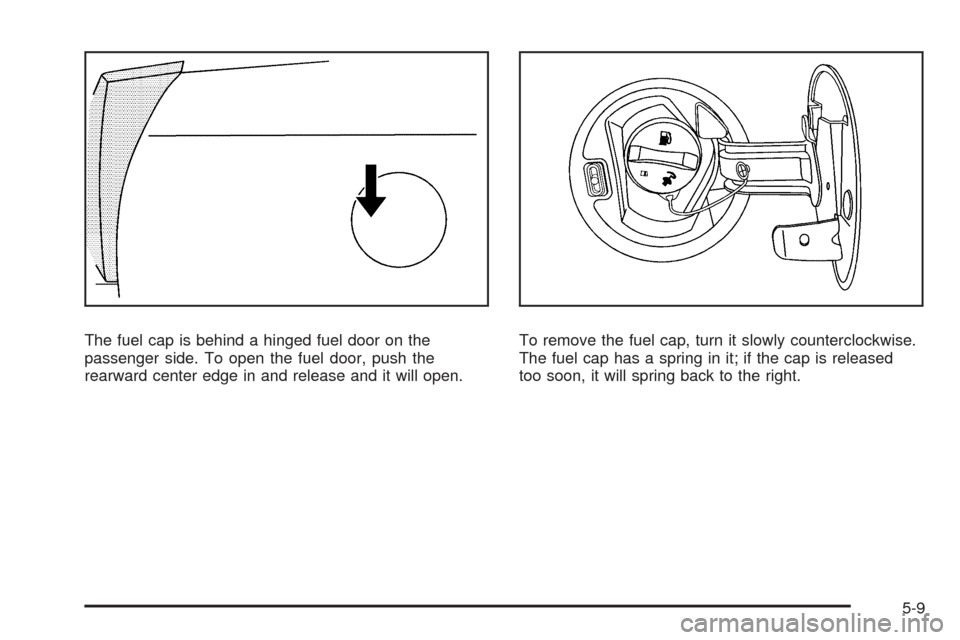
The fuel cap is behind a hinged fuel door on the
passenger side. To open the fuel door, push the
rearward center edge in and release and it will open.To remove the fuel cap, turn it slowly counterclockwise.
The fuel cap has a spring in it; if the cap is released
too soon, it will spring back to the right.
5-9
Page 320 of 490
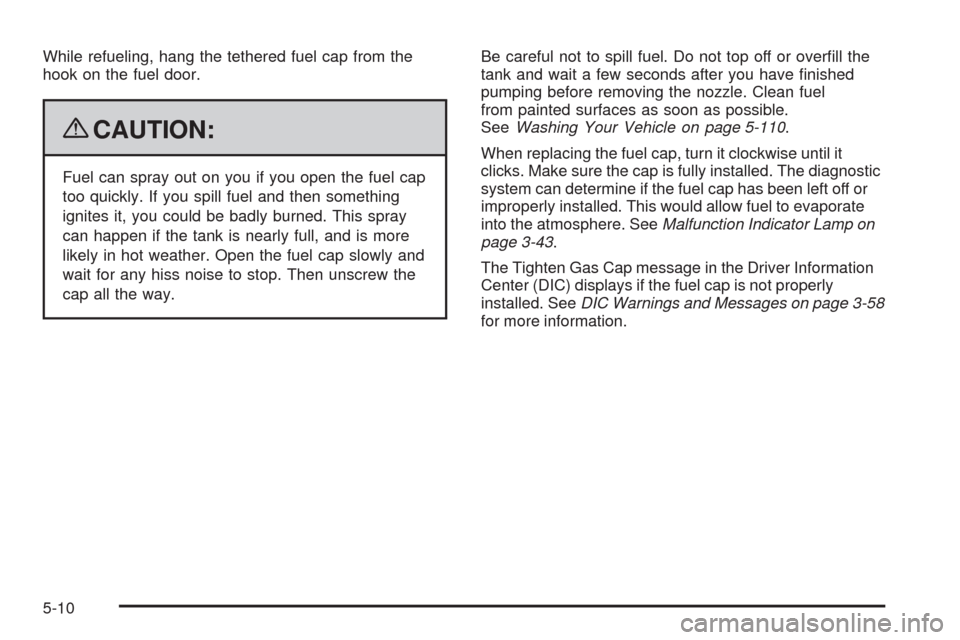
While refueling, hang the tethered fuel cap from the
hook on the fuel door.
{CAUTION:
Fuel can spray out on you if you open the fuel cap
too quickly. If you spill fuel and then something
ignites it, you could be badly burned. This spray
can happen if the tank is nearly full, and is more
likely in hot weather. Open the fuel cap slowly and
wait for any hiss noise to stop. Then unscrew the
cap all the way.Be careful not to spill fuel. Do not top off or overll the
tank and wait a few seconds after you have nished
pumping before removing the nozzle. Clean fuel
from painted surfaces as soon as possible.
SeeWashing Your Vehicle on page 5-110.
When replacing the fuel cap, turn it clockwise until it
clicks. Make sure the cap is fully installed. The diagnostic
system can determine if the fuel cap has been left off or
improperly installed. This would allow fuel to evaporate
into the atmosphere. SeeMalfunction Indicator Lamp on
page 3-43.
The Tighten Gas Cap message in the Driver Information
Center (DIC) displays if the fuel cap is not properly
installed. SeeDIC Warnings and Messages on page 3-58
for more information.
5-10
Page 325 of 490

A. Windshield Washer Fluid Reservoir. See “Adding
Washer Fluid” underWindshield Washer Fluid
on page 5-41.
B.Underhood Fuse Block (CTS) on page 5-115or
Underhood Fuse Block (CTS-V) on page 5-119.
C. Remote Positive (+) Terminal. SeeJump Starting on
page 5-46.
D. Remote Negative (+) Terminal. SeeJump Starting
on page 5-46.
E. Passenger Compartment Air Filter. SeePassenger
Compartment Air Filter on page 3-29.
F. Engine Cooling Fan. SeeCooling System on
page 5-31.G. Power Steering Fluid Reservoir (Under Engine
Cover). SeePower Steering Fluid on page 5-40.
H. Engine Oil Fill Cap. SeeEngine Oil on page 5-18.
I. Engine Oil Dipstick (Out of View). SeeEngine Oil on
page 5-18.
J. Hydraulic Clutch Reservoir (If Equipped) (Not
Shown). See “When to Check and What to Use”
underHydraulic Clutch on page 5-30.
K. Brake Master Cylinder Reservoir (Out of View).
SeeBrakes on page 5-42.
L. Engine Coolant Surge Tank and Pressure Cap.
SeeCooling System on page 5-31.
M.Engine Air Cleaner/Filter on page 5-25.
5-15
Page 327 of 490
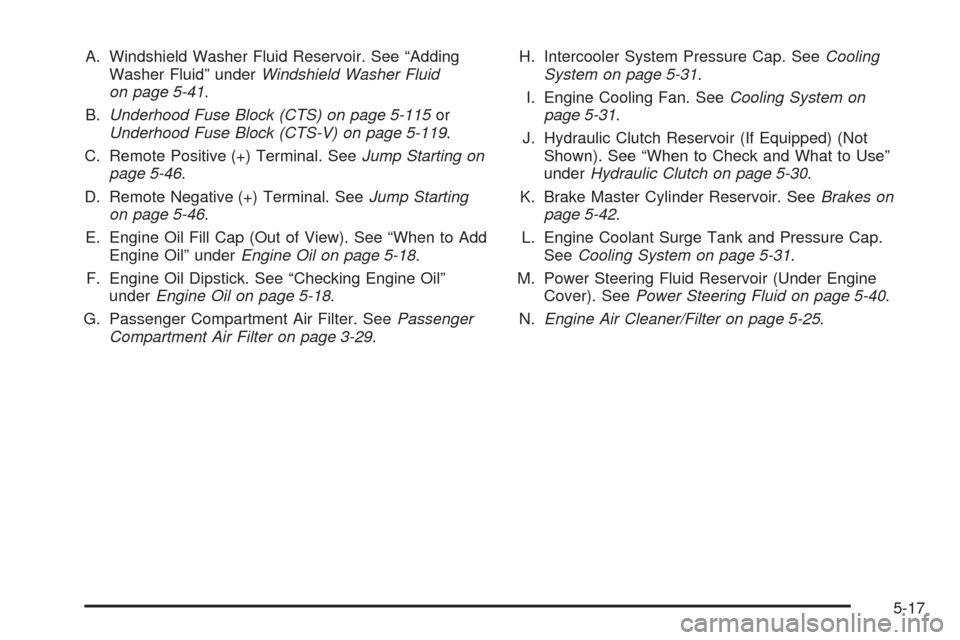
A. Windshield Washer Fluid Reservoir. See “Adding
Washer Fluid” underWindshield Washer Fluid
on page 5-41.
B.Underhood Fuse Block (CTS) on page 5-115or
Underhood Fuse Block (CTS-V) on page 5-119.
C. Remote Positive (+) Terminal. SeeJump Starting on
page 5-46.
D. Remote Negative (+) Terminal. SeeJump Starting
on page 5-46.
E. Engine Oil Fill Cap (Out of View). See “When to Add
Engine Oil” underEngine Oil on page 5-18.
F. Engine Oil Dipstick. See “Checking Engine Oil”
underEngine Oil on page 5-18.
G. Passenger Compartment Air Filter. SeePassenger
Compartment Air Filter on page 3-29.H. Intercooler System Pressure Cap. SeeCooling
System on page 5-31.
I. Engine Cooling Fan. SeeCooling System on
page 5-31.
J. Hydraulic Clutch Reservoir (If Equipped) (Not
Shown). See “When to Check and What to Use”
underHydraulic Clutch on page 5-30.
K. Brake Master Cylinder Reservoir. SeeBrakes on
page 5-42.
L. Engine Coolant Surge Tank and Pressure Cap.
SeeCooling System on page 5-31.
M. Power Steering Fluid Reservoir (Under Engine
Cover). SeePower Steering Fluid on page 5-40.
N.Engine Air Cleaner/Filter on page 5-25.
5-17
Page 344 of 490
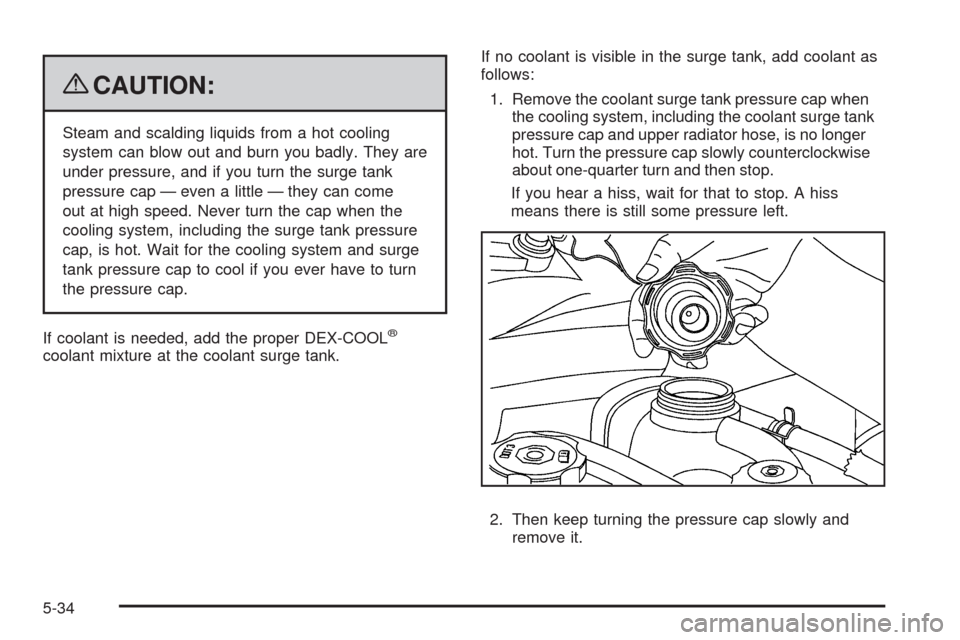
{CAUTION:
Steam and scalding liquids from a hot cooling
system can blow out and burn you badly. They are
under pressure, and if you turn the surge tank
pressure cap — even a little — they can come
out at high speed. Never turn the cap when the
cooling system, including the surge tank pressure
cap, is hot. Wait for the cooling system and surge
tank pressure cap to cool if you ever have to turn
the pressure cap.
If coolant is needed, add the proper DEX-COOL
®
coolant mixture at the coolant surge tank.If no coolant is visible in the surge tank, add coolant as
follows:
1. Remove the coolant surge tank pressure cap when
the cooling system, including the coolant surge tank
pressure cap and upper radiator hose, is no longer
hot. Turn the pressure cap slowly counterclockwise
about one-quarter turn and then stop.
If you hear a hiss, wait for that to stop. A hiss
means there is still some pressure left.
2. Then keep turning the pressure cap slowly and
remove it.
5-34
Page 346 of 490

Checking Coolant in the Intercooler
System (CTS-V)
The vehicle must be on a level surface when checking
the coolant level.
The super charged engine intercooler coolant ll bottle
is located in the engine compartment on the passenger
side of the vehicle. SeeEngine Compartment
Overview on page 5-14.
Check to see if coolant is visible in the coolant ll bottle.
If the coolant inside the coolant ll bottle is boiling, do not
do anything else until it cools down. If coolant is visible
but the coolant level is not at or above the COLD FILL
mark, add a 50/50 mixture of clean, drinkable water and
DEX-COOL
®coolant at the coolant ll bottle, but be sure
the cooling system is cool before this is done.
If the engine is warm or hot, the coolant level should be
at or above the COLD FILL line on the side of the coolant
ll bottle. If the engine is cold, the coolant level should be
near the COLD FILL line on the side of the coolant ll
bottle. If it is not, you could have a leak in the cooling
system.
Adding Coolant to the Intercooler
System Coolant (CTS-V)
1. Remove the intercooler system pressure cap when
the intercooler system hoses are no longer hot.
Turn the pressure cap slowly counterclockwise
about one-quarter of a turn. If you hear a hiss, wait
for that to stop. This allows any pressure still left
to be vented.
2. Then keep turning the pressure cap slowly and
remove it.
5-36
Page 355 of 490

Replacing Brake System Parts
The braking system on a vehicle is complex. Its many
parts have to be of top quality and work well together if
the vehicle is to have really good braking. The vehicle
was designed and tested with top-quality brake parts.
When parts of the braking system are replaced — for
example, when the brake linings wear down and new
ones are installed — be sure to get new approved
replacement parts. If this is not done, the brakes might
not work properly. For example, if someone puts in brake
linings that are wrong for the vehicle, the balance
between the front and rear brakes can change — for the
worse. The braking performance expected can change in
many other ways if the wrong replacement brake parts
are installed.
Battery
This vehicle has a maintenance free battery. It is located
in the trunk, behind the trim panel, on the passenger side
of the vehicle. When it is time for a new battery, see your
dealer/retailer for one that has the replacement number
shown on the original battery’s label.Warning:Battery posts, terminals, and related
accessories contain lead and lead compounds,
chemicals known to the State of California to cause
cancer and reproductive harm. Wash hands after
handling.
After a power loss, such as disconnecting the battery
or removing the maxi fuses in the power distribution
fuse block, the following steps must be performed
to calibrate the electronic throttle control. If this is
not done, the engine will not run properly.
1. Turn the ignition to ON/RUN. Do not start the
engine.
2. Leave the ignition in ON/RUN for at least three
minutes so that the electronic throttle control will
cycle and re-learn its home position.
3. Turn the ignition to LOCK/OFF.
4. Start and run the engine for at least 30 seconds.
5-45