automatic transmission CADILLAC CTS 2009 2.G Owner's Manual
[x] Cancel search | Manufacturer: CADILLAC, Model Year: 2009, Model line: CTS, Model: CADILLAC CTS 2009 2.GPages: 490, PDF Size: 2.68 MB
Page 164 of 490
Reducing Speed While Using Cruise
Control
To reduce the vehicle’s speed while using cruise
control:
Press and hold the SET– button on the steering
wheel until the desired speed is reached, then
release it.
To slow down in very small amounts, press the
SET– button on the steering wheel briey.
Each time this is done, the vehicle goes about
1 mph (1.6 km/h) slower.
Passing Another Vehicle While Using
Cruise Control
Use the accelerator pedal to increase the vehicle’s
speed. When you take your foot off the pedal, the
vehicle slows down to the previously set cruise speed.
Using Cruise Control on Hills
How well the cruise control works on hills depends upon
the vehicle’s speed, load, and the steepness of the
hills. When going up steep hills, you might have to step
on the accelerator pedal to maintain the vehicle’s speed.
When going downhill, you might have to brake or shift
to a lower gear to keep the vehicle’s speed down.
When the brakes are applied the cruise control turns off.
Ending Cruise Control
There are four ways to end cruise control:
Step lightly on the brake pedal
(manual and automatic transmissions).
Press the clutch pedal to the oor
(manual transmissions).
Press[on the steering wheel.
PressIon the steering wheel.
Erasing Speed Memory
The cruise control set speed memory is erased when
the cruise control or the ignition is turned off.
3-16
Page 166 of 490
Daytime Running Lamps (DRL)
Daytime Running Lamps (DRL) can make it easier for
others to see the front of your vehicle during the day.
Fully functional daytime running lamps are required on
all vehicles rst sold in Canada.
The DRL system will make either the reduced intensity
low-beam headlamps or dedicated DRL’s come on
when the following conditions are met:
It is still daylight and the ignition is in ON/RUN
or START.
The exterior lamp control is in off or AUTO and the
headlamps are off.
The automatic transmission is not in P (Park).
When DRL’s are on, only the reduced intensity
low-beam headlamps or dedicated DRL’s will be on.
The other exterior lamps and the instrument panel
cluster will not be on.When the exterior lamp control is in AUTO and it is dark
enough outside, the DRL turns off and the low-beam
headlamps will turn on. When it is bright enough outside,
the low-beam headlamps will go off, and the DRL will
turn back on. If the vehicle is started in a dark garage,
the automatic headlamp system comes on immediately.
Once the vehicle leaves the garage, it takes about
one minute for the automatic headlamp system to
change to DRL if it is light outside. During that delay,
the instrument panel cluster may not be as bright
as usual. Make sure the instrument panel brightness
lever is in the full bright position. SeeInstrument Panel
Brightness on page 3-20.
Turning the exterior lamp control to off or to the
low-beam headlamp position will turn off the DRL.
If the parking lamps or the fog lamps were turned on
instead, the DRL will still turn off.
This will work regardless of gear position and whether
or not the parking brake is set.
3-18
Page 179 of 490

Instrument Panel Cluster
The instrument panel cluster is designed to indicate how the vehicle is running. It shows how fast the vehicle is
going, how much fuel the vehicle has used and many of the other things needed to drive safely and economically.
United States Automatic Transmission Cluster shown, Manual and Canada similar
3-31
Page 180 of 490

United States V–Series Automatic Transmission Cluster shown, Manual and Canada similar
3-32
Page 181 of 490

Speedometer and Odometer
The speedometer shows the vehicle speed in either
miles per hour (mph) or kilometers per hour (km/h).
The odometer shows how far the vehicle has been
driven, in either miles (used in the United States) or
kilometers (used in Canada).
If the vehicle has to have a new odometer installed,
the new one may read the correct mileage. This is
because the vehicle computer has stored the mileage
in memory.
While the Driver Shift Control (DSC) feature is active,
the odometer changes to show the gear range.
SeeAutomatic Transmission Operation on page 2-36
for more information.
Trip Odometers
The trip odometer can record the number of miles or
kilometers traveled for up to two trips.
The trip odometer is part of the Driver Information
Center (DIC), for more information seeDIC Operation
and Displays on page 3-51.
For vehicles that have the navigation system, see your
Navigation System manual for more information.
3-33
Page 182 of 490

Tachometer
The tachometer displays the engine speed in revolutions
per minute (rpm).
Notice:If the engine is operated with the tachometer
in the shaded warning area, the vehicle could be
damaged, and the damages would not be covered by
the vehicle warranty. Do not operate the engine with
the tachometer in the shaded warning area.The CTS-V tachometer has tracer lights that follow the
movement of the tachometer indicator. The tracer lights
can be turned off in the DIC Vehicle Customization.
SeeDIC Vehicle Customization on page 3-72for more
information.
For the CTS-V, the tracer lights also ash when it is
time to up-shift to avoid the engine speed limit.
SeeAutomatic Transmission Operation on page 2-36
orManual Transmission Operation on page 2-40
for more information.
Engine Speed Limiter
This feature prevents the engine speed from reaching
an unsafe level. If the level is too high, the throttle closes
or limits the fuel supply until the engine speed returns
to a safe level. Throttle operation and fuel supply returns
to normal when engine speed is lowered.
For the CTS-V, the tachometer tracer lights ashes prior
to reaching engine speed limit. The tracer lights also
ash on automatic transmission vehicles while in
the DSC or Tap Shift modes. United States and
Canada Automatic,
V-Series Similar
3-34
Page 186 of 490

Charging System Light
This light comes on briey
when the ignition key is
turned to START, but
the engine is not running,
as a check to show it
is working.
If it does not, have the vehicle serviced by your
dealer/retailer.
The light should go out once the engine starts. If it
stays on, or comes on while driving, there could be a
problem with the charging system. A charging system
message in the Driver Information Center (DIC) can also
appear. SeeDIC Warnings and Messages on page 3-58
for more information. This light could indicate that
there are problems with a generator drive belt, or that
there is an electrical problem. Have it checked right
away. If the vehicle must be driven a short distance with
the light on, turn off accessories, such as the radio
and air conditioner.
Up-Shift Light
The vehicle may have an
up-shift light, it shows
when to shift to the next
higher gear for best
fuel economy.
SeeManual Transmission Operation on page 2-40
for more information.
For the CTS-V, the tracer lights function as a
performance up-shift light.
These tracers ash to indicate when to shift to the
next higher gear to avoid the engine speed limit.
SeeAutomatic Transmission Operation on page 2-36
orManual Transmission Operation on page 2-40
for more information.
3-38
Page 204 of 490
DIC Compass
The vehicle may have a compass in the Driver
Information Center (DIC).
Compass Zone
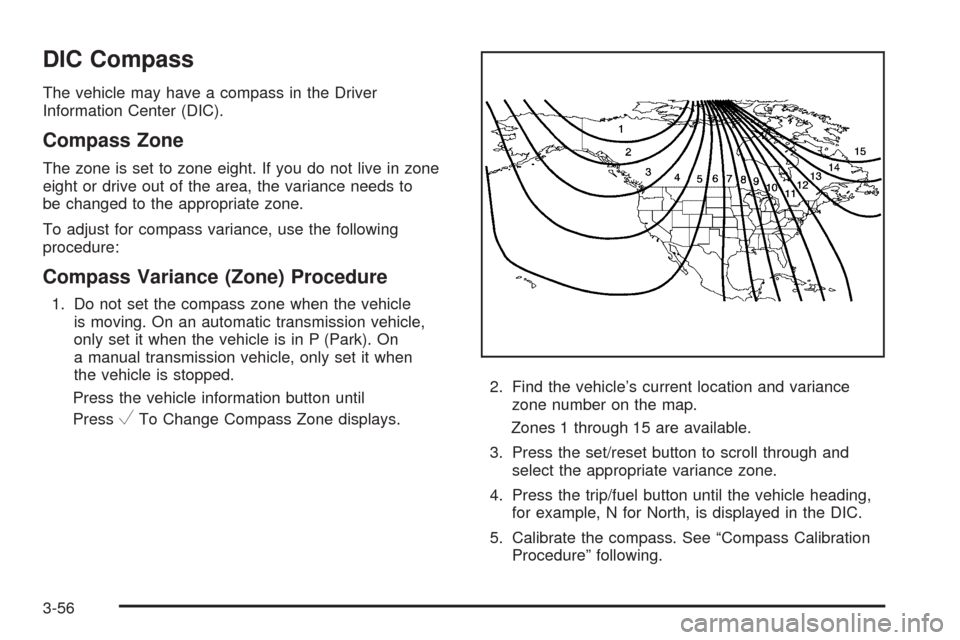
The zone is set to zone eight. If you do not live in zone
eight or drive out of the area, the variance needs to
be changed to the appropriate zone.
To adjust for compass variance, use the following
procedure:
Compass Variance (Zone) Procedure
1. Do not set the compass zone when the vehicle
is moving. On an automatic transmission vehicle,
only set it when the vehicle is in P (Park). On
a manual transmission vehicle, only set it when
the vehicle is stopped.
Press the vehicle information button until
Press
VTo Change Compass Zone displays.2. Find the vehicle’s current location and variance
zone number on the map.
Zones 1 through 15 are available.
3. Press the set/reset button to scroll through and
select the appropriate variance zone.
4. Press the trip/fuel button until the vehicle heading,
for example, N for North, is displayed in the DIC.
5. Calibrate the compass. See “Compass Calibration
Procedure” following.
3-56
Page 213 of 490

Stop the vehicle immediately, as engine damage can
result from driving a vehicle with low oil pressure.
Have the vehicle serviced by your dealer/retailer as
soon as possible when this message is displayed.
Park Brake Released
For vehicles with the Electric Parking Brake, this
message displays when the parking brake has been
released from the set position. SeeElectric Parking
Brake on page 2-44for more information.
Park Brake Set
For vehicles with the Electric Parking Brake, this
message displays when the parking brake has been
applied to the set position. SeeElectric Parking Brake
on page 2-44for more information.
Parking Assist Off
If the vehicle has the Ultrasonic Rear Parking Assist
(URPA) system, after the vehicle has been started, this
message displays to remind the driver that the URPA
system has been turned off. Press the set/reset button to
acknowledge this message and clear it from the DIC
display. To turn the URPA system back on, see “Parking
Assist” underDIC Operation and Displays on page 3-51.
SeeUltrasonic Rear Parking Assist (URPA) on
page 2-54for more information.
Passenger Door Open
This message displays when the passenger side front
door is not closed completely. Make sure that the door
is closed completely.
Press Brake Pedal to Release Park
Brake
For vehicles with the Electric Parking Brake, this
message displays if you try to release the park
brake system without rst pressing the brake pedal.
SeeElectric Parking Brake on page 2-44for more
information.
Press Brake To Start Engine
(Automatic Transmission Only)
If the vehicle has the keyless access system, this
message displays if you try to start the engine without
having the brake pressed. The brake needs to be
pressed when starting the engine. SeeIgnition Positions
(Key Access) on page 2-31orIgnition Positions
(Keyless Access) on page 2-32for more information.
Press Start Control To Learn Keys
If the vehicle has the keyless access system, this
message displays when matching new transmitters to
the vehicle. SeeKeyless Access System Operation
on page 2-8for more information.
3-65
Page 217 of 490

Service Theft Deterrent System
This message displays when there is a problem with the
theft-deterrent system programmed in the key. A fault
has been detected in the system which means that
the system is disabled and it is not protecting the
vehicle. The vehicle usually restarts; however, you may
want to take the vehicle to your dealer/retailer before
turning off the engine. SeeImmobilizer Operation
(Key Access) on page 2-28orImmobilizer Operation
(Keyless Access) on page 2-29for more information.
Service Tire Monitor System
This message displays if a part on the Tire Pressure
Monitor System (TPMS) is not working properly. The tire
pressure light also ashes and then remains on during
the same ignition cycle. SeeTire Pressure Light on
page 3-42. Several conditions may cause this message
to appear. SeeTire Pressure Monitor Operation on
page 5-73for more information. If the warning comes on
and stays on, there may be a problem with the TPMS.
See your dealer/retailer.
Service Traction Control
This message displays when there is a problem with the
Traction Control System (TCS). The TCS/StabiliTrak
warning light on the instrument panel cluster also comes
on. When this message displays, the system will notlimit wheel spin. Adjust your driving accordingly.
See your dealer/retailer for service. SeeTraction
Control System (TCS) on page 4-6for more
information.
Service Transmission
This message displays when there is a problem with the
vehicle’s transmission. Have the vehicle serviced by
your dealer/retailer.
Service Vehicle Soon
This message displays when a non-emissions related
malfunction occurs. Have the vehicle serviced by
your dealer/retailer as soon as possible.
Shift To Park (Automatic
Transmission Only)
If the vehicle has the keyless access system, this
message displays if the vehicle is not in P (Park) while
the engine is being turned off. The vehicle will be in
ACC/ACCESSORY. Once the shift lever is moved
to P (Park), the ignition needs to be turned off. If the
ignition is not turned off, the vehicle will remain in
ACC/ACCESSORY. To avoid draining the battery,
turn the ignition to off before leaving the vehicle.
3-69