key battery CADILLAC CTS 2009 2.G Owners Manual
[x] Cancel search | Manufacturer: CADILLAC, Model Year: 2009, Model line: CTS, Model: CADILLAC CTS 2009 2.GPages: 490, PDF Size: 2.68 MB
Page 87 of 490

Remote Keyless Entry (RKE)
System
If this vehicle has the Remote Keyless Entry (RKE)
system, it operates on a radio frequency subject
to Federal Communications Commission (FCC) Rules
and with Industry Canada.
This device complies with Part 15 of the FCC Rules.
Operation is subject to the following two conditions:
1. This device may not cause interference.
2. This device must accept any interference received,
including interference that may cause undesired
operation of the device.
This device complies with RSS-210 of Industry Canada.
Operation is subject to the following two conditions:
1. This device may not cause interference.
2. This device must accept any interference received,
including interference that may cause undesired
operation of the device.Changes or modications to this system by other than
an authorized service facility could void authorization to
use this equipment.
If there is a decrease in the RKE operating range,
try this:
Check the distance. The transmitter may be too far
from the vehicle. Stand closer during rainy or
snowy weather.
Check the location. Other vehicles or objects may be
blocking the signal. Take a few steps to the left or
right, hold the transmitter higher, and try again.
Check the transmitter’s battery. See “Battery
Replacement” later in this section.
If the transmitter is still not working correctly, see
your dealer/retailer or a qualied technician for
service.
2-5
Page 89 of 490
Programming Transmitters to the
Vehicle
Only RKE transmitters programmed to the vehicle will
work. If a transmitter is lost or stolen, a replacement
can be purchased and programmed through your
dealer/retailer. When the replacement transmitter is
programmed to the vehicle, all remaining transmitters
must also be programmed. Any lost or stolen transmitters
no longer work once the new transmitter is programmed.
Each vehicle can have up to eight transmitters
programmed to it. See “Relearn Remote Key”
underDIC Operation and Displays on page 3-51.
Battery Replacement
Replace the battery if the Replace Battery In Remote
Key message displays in the DIC. See “Replace Battery
In Remote Key” underDIC Warnings and Messages
on page 3-58for additional information.
Notice:When replacing the battery, do not touch
any of the circuitry on the transmitter. Static
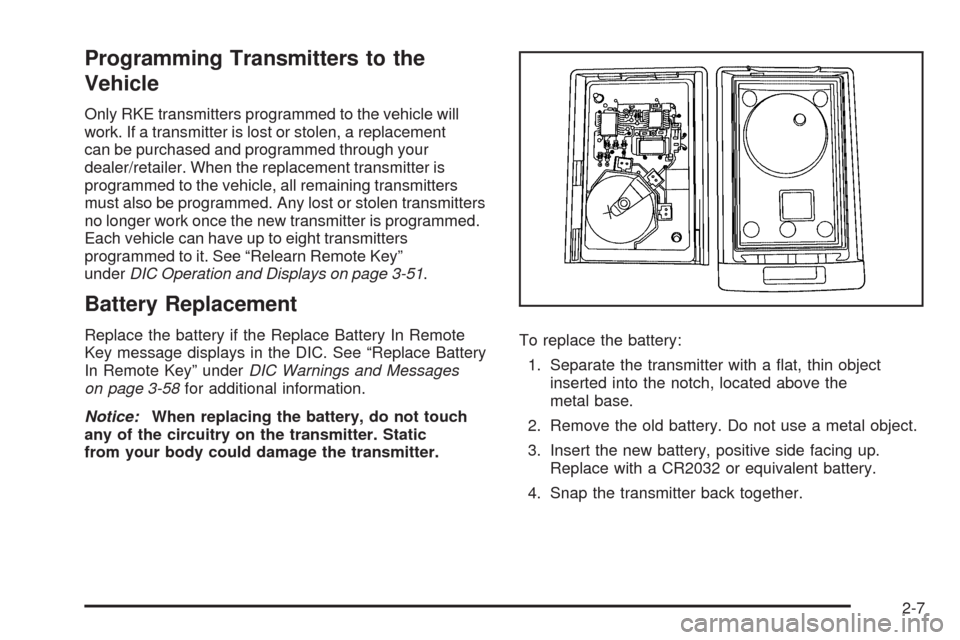
from your body could damage the transmitter.To replace the battery:
1. Separate the transmitter with a at, thin object
inserted into the notch, located above the
metal base.
2. Remove the old battery. Do not use a metal object.
3. Insert the new battery, positive side facing up.
Replace with a CR2032 or equivalent battery.
4. Snap the transmitter back together.
2-7
Page 90 of 490

Keyless Access System
Your vehicle may have a Keyless Access System that
operates on a radio frequency subject to Federal
Communications Commission (FCC) Rules and with
Industry Canada.
This device complies with Part 15 of the FCC Rules.
Operation is subject to the following two conditions:
1. This device may not cause harmful interference.
2. This device must accept any interference received,
including interference that may cause undesired
operation.
This device complies with RSS-210 of Industry Canada.
Operation is subject to the following two conditions:
1. This device may not cause interference.
2. This device must accept any interference received,
including interference that may cause undesired
operation of the device.
Changes or modications to this system by other than
an authorized service facility could void authorization to
use this equipment.If you ever notice a decrease in the keyless access
transmitter range, try doing one of the following:Check the distance. You may be too far from your
vehicle. You may need to stand closer during rainy or
snowy weather.
Check the location. Other vehicles or objects may be
blocking the signal. Take a few steps to the left or
right, hold the transmitter higher, and try again.
Check to determine if battery replacement is
necessary. See “Battery Replacement” under
Keyless Access System Operation on page 2-8.
Check to make sure that an electronic device such
as a cellular phone or lap top computer is not causing
interference.
If you are still having trouble, see your dealer/retailer
or a qualied technician for service.
Keyless Access System Operation
The Keyless Access System transmitter functions
will work up to 195 feet (60 m) away from the vehicle.
The Keyless Access System lets you lock and unlock the
doors and access the trunk without removing the remote
transmitter from your pocket, purse, briefcase, etc. The
keyless access transmitter must be within 3 feet (1 m) of
the door or trunk being opened.
2-8
Page 95 of 490

Starting the Vehicle with a Low
Transmitter Battery
Replace the battery if the Replace Battery In Remote
Key message displays in the DIC. See “Replace Battery
In Remote Key” underDIC Warnings and Messages
on page 3-58for additional information.
If the transmitter battery is weak, the DIC may display
Electronic Key Not Detected when you try to start the
vehicle. To start the vehicle, place the transmitter in the
center console storage area transmitter pocket with the
buttons facing to the front of the vehicle. Then, with the
vehicle in P (Park) or N (Neutral), press the brake pedal
and the ignition control knob. SeeStarting the Engine on
page 2-33, for additional information about the vehicle’s
electronic keyless ignition with push start. Replace the
transmitter battery as soon as possible.
Battery Replacement
Notice:When replacing the battery, do not touch
any of the circuitry on the transmitter. Static
from your body could damage the transmitter.
1. Separate the transmitter with a at, thin object
inserted into the slot on the side or back of the
transmitter.
2. Remove the old battery. Do not use a metal object.
3. Insert the new battery, positive side facing down.
Replace with a CR2032 or equivalent battery.
4. Snap the transmitter back together.
2-13
Page 108 of 490
Theft-Deterrent Systems
Vehicle theft is big business, especially in some cities.
This vehicle has theft-deterrent features, however,
they do not make it impossible to steal.
Theft-Deterrent System
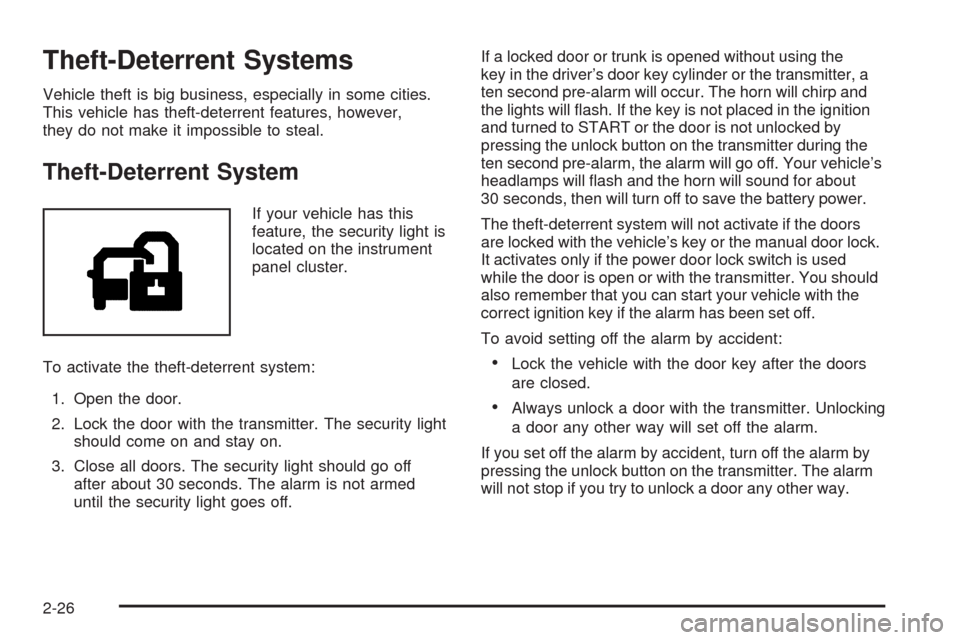
If your vehicle has this
feature, the security light is
located on the instrument
panel cluster.
To activate the theft-deterrent system:
1. Open the door.
2. Lock the door with the transmitter. The security light
should come on and stay on.
3. Close all doors. The security light should go off
after about 30 seconds. The alarm is not armed
until the security light goes off.If a locked door or trunk is opened without using the
key in the driver’s door key cylinder or the transmitter, a
ten second pre-alarm will occur. The horn will chirp and
the lights will ash. If the key is not placed in the ignition
and turned to START or the door is not unlocked by
pressing the unlock button on the transmitter during the
ten second pre-alarm, the alarm will go off. Your vehicle’s
headlamps will ash and the horn will sound for about
30 seconds, then will turn off to save the battery power.
The theft-deterrent system will not activate if the doors
are locked with the vehicle’s key or the manual door lock.
It activates only if the power door lock switch is used
while the door is open or with the transmitter. You should
also remember that you can start your vehicle with the
correct ignition key if the alarm has been set off.
To avoid setting off the alarm by accident:
Lock the vehicle with the door key after the doors
are closed.
Always unlock a door with the transmitter. Unlocking
a door any other way will set off the alarm.
If you set off the alarm by accident, turn off the alarm by
pressing the unlock button on the transmitter. The alarm
will not stop if you try to unlock a door any other way.
2-26
Page 113 of 490

Ignition Positions (Key Access)
The key can be turned to four different positions.
To shift out of P (Park), the ignition must be in the
ON/RUN or ACC/ACCESSORY and the brake pedal
must be applied.
Notice:Using a tool to force the key from its
cylinder could cause damage or break the key. Use
the correct key and turn the key only with your hand.
Make sure the key is all the way in. If it is and you
have a manual transmission vehicle, turn the steering
wheel left and right while you turn the key hard. If
none of this works, then the vehicle needs service.A (LOCK/OFF):This is the only position in which the
key can be inserted or removed. This position locks the
ignition and shifter on automatic transmission vehicles,
and the ignition and steering wheel on manual
transmission vehicles.
B (ACC/ACCESSORY):This position lets you use
things like the radio and the windshield wipers when
the engine is off. This position allows you to turn off
the engine.
C (ON/RUN):This position is for driving. It is the
position the ignition switch returns to after the engine
starts, and the key is released.
To shift the transmission out of P (Park), the ignition
key has to be in ACC/ACCESSORY or ON/RUN.
The battery could be drained if the key is left in the
ACC/ACCESSORY or ON/RUN position with the
engine off. The vehicle might not start if the battery
is allowed to drain for an extended period of time.
D (START):This position starts the engine. When
the engine starts, release the key. The ignition switch
returns to ON/RUN for driving.
A warning tone will sound when the driver door is
opened, the ignition is in ACC/ACCESSORY or
LOCK/OFF and the key is in the ignition.
2-31
Page 114 of 490

Ignition Positions (Keyless Access)
You can turn the ignition control knob to four different
positions.
To shift out of P (Park), ignition must be in the ON/RUN
or ACC/ACCESSORY and the regular brake pedal
must be applied.
Using a tool to force the ignition control knob from its
cylinder could damage it.
Make sure the keyless access transmitter is inside the
vehicle when trying to turn the ignition control knob.A (LOCK/OFF):The ignition control knob cannot be
removed from the vehicle. The keyless access
transmitter must be inside the vehicle to start the
engine. This position locks the ignition and shifter on
automatic transmission vehicles, and the ignition
and steering wheel on manual transmission vehicles.
B (ACC/ACCESSORY):This position allows you to use
things like the radio and the windshield wipers when
the engine is off. This position will allow you to turn off
the engine.
C (ON/RUN):This position is for driving. It is the position
the ignition switch returns to after the engine starts, and
the control knob is released.
If you need to shift the transmission out of P (Park), the
ignition control knob has to be in ACC/ACCESSORY or
ON/RUN.
The battery could be drained if you leave the key in the
ACC/ACCESSORY or ON/RUN position with the engine
off. You may not be able to start your vehicle if the battery
is allowed to drain for an extended period of time.
D (START):This position starts the engine.
2-32
Page 115 of 490
Retained Accessory Power (RAP)
These vehicle accessories can be used for up to
10 minutes after the engine is turned off:
Audio System
Power Windows
Sunroof (if equipped)
Power to the audio system will work up to 10 minutes or
until the driver door is opened. Power to the windows or
sunroof will work up to 10 minutes or until any door is
opened. For an additional 10 minutes of operation, close
all the doors and turn the key to ON/RUN and then back
to LOCK/OFF.
Starting the Engine
Place the transmission in the proper gear.
Automatic Transmission
Move the shift lever to P (Park) or N (Neutral). The
engine will not start in any other position. To restart
the engine when the vehicle is already moving, use
N (Neutral) only.If the vehicle has the keyless access system, put your
foot on the brake pedal and turn the ignition control knob
to the START position. When the engine begins cranking,
let go of the ignition control knob, it will return to the
ON/RUN position.
If the transmitter is not in the vehicle or something is
interfering with the transmitter, the Driver Information
Center (DIC) will display Electronic Key Not Detected.
SeeDIC Warnings and Messages on page 3-58for
more information.
If the battery in the keyless access transmitter needs
replacing, the DIC displays Replace Battery In Remote
Key. The vehicle can still be driven. See “Battery
Replacement” underKeyless Access System Operation
on page 2-8for more information.
Notice:Do not try to shift to P (Park) if the
vehicle is moving. If you do, you could damage
the transmission. Shift to P (Park) only when
the vehicle is stopped.Manual Transmission
The shift lever should be in neutral position and the
parking brake engaged. Hold the clutch pedal down to
the oor and start the engine. The vehicle will not start if
the clutch pedal is not all the way down.
2-33
Page 116 of 490
Starting Procedure
1. With your foot off the accelerator pedal, turn the
ignition key to START. If the vehicle has the keyless
access system, make sure there is a keyless access
transmitter in the vehicle. When the engine starts,
let go of the ignition. The idle speed will go down
as your engine gets warm. Do not race the engine
immediately after starting it. Operate the engine and
transmission gently to allow the oil to warm up and
lubricate all moving parts.
The vehicle has a Computer-Controlled Cranking
System. This feature assists in starting the engine
and protects components. If the ignition key is turned
to the START position, and then released when the
engine begins cranking, the engine will continue
cranking for a few seconds or until the vehicle starts.
If the engine does not start and the key is held in
START for many seconds, cranking will be stopped
after 15 seconds to prevent cranking motor damage.
To prevent gear damage, this system also prevents
cranking if the engine is already running. Engine
cranking can be stopped by turning the ignition
switch to ACC/ACCESSORY or LOCK/OFF.
Notice:Cranking the engine for long periods of
time, by returning the key to the START position
immediately after cranking has ended, can overheatand damage the cranking motor, and drain the
battery. Wait at least 15 seconds between each try,
to let the cranking motor cool down.
2. If the engine does not start after 5-10 seconds,
especially in very cold weather (below 0°F or−18°C),
it could be ooded with too much gasoline. Try
pushing the accelerator pedal all the way to the oor
and holding it there as you hold the key in START
for up to a maximum of 15 seconds. Wait at least
15 seconds between each try, to allow the cranking
motor to cool down. When the engine starts, let go of
the key and accelerator. If the vehicle starts briey
but then stops again, do the same thing. This clears
the extra gasoline from the engine. Do not race the
engine immediately after starting it. Operate the
engine and transmission gently until the oil warms
up and lubricates all moving parts.
Notice:The engine is designed to work with the
electronics in the vehicle. If you add electrical parts
or accessories, you could change the way the engine
operates. Before adding electrical equipment, check
with your dealer/retailer. If you do not, the engine
might not perform properly. Any resulting damage
would not be covered by the vehicle warranty.
2-34
Page 130 of 490

Leaving the Vehicle With the Engine
Running (Automatic Transmission)
{CAUTION:
It can be dangerous to leave the vehicle with the
engine running. The vehicle could move suddenly if
the shift lever is not fully in P (Park) with the parking
brake rmly set. And, if you leave the vehicle with
the engine running, it could overheat and even
catch re. You or others could be injured. Do not
leave the vehicle with the engine running.
If you have to leave the vehicle with the engine running,
the vehicle must be in P (Park) and the parking brake
set. After shifting into P (Park), try to move the shift lever
out without rst pushing the button on the shift lever.
If you can, the shift lever was not fully locked into
P (Park).
Torque Lock (Automatic Transmission)
Torque lock is when the weight of the vehicle puts too
much force on the parking pawl in the transmission.
This happens when parking on a hill and shifting the
transmission into P (Park) is not done properly and then it
is difficult to shift out of P (Park). To prevent torque lock,
set the parking brake and then shift into P (Park). To nd
out how, see″Shifting Into P (Park)″listed previously.
If torque lock does occur, your vehicle may need to be
pushed uphill by another vehicle to relieve the parking
pawl pressure, so you can shift out of P (Park).
Shifting Out of Park
This vehicle is equipped with an electronic shift lock
release system. The shift lock release is designed to:
Prevent ignition key removal unless the shift
lever is in P (Park) with the shift lever button fully
released, for vehicles with key access.
Prevent movement of the shift lever out of P (Park),
unless the ignition is in ON/RUN or
ACC/ACCESSORY and the brake pedal is applied.
The shift lock release is always functional except in the
case of an uncharged or low voltage (less than 9 volt)
battery.
2-48