steering CADILLAC CTS 2011 2.G Workshop Manual
[x] Cancel search | Manufacturer: CADILLAC, Model Year: 2011, Model line: CTS, Model: CADILLAC CTS 2011 2.GPages: 496, PDF Size: 7.71 MB
Page 301 of 496

Black plate (41,1)Cadillac CTS/CTS-V Owner Manual - 2011
Driving and Operating 9-41
I(On/Off):Turns the system on
or off. The indicator light on the
button turns on when cruise control
is on.
+RES (Resume/Accelerate):
Press briefly to make the vehicle
resume to a previously set speed,
or press and hold to accelerate.
−SET (Set/Coast): Press to set the
speed and activate cruise control or
make the vehicle decelerate.
[(Cancel): Press to disengage
cruise control without erasing the
set speed from memory.
Setting Cruise Control
If the cruise button is on when not in
use, it could get bumped and go into
cruise when not desired. Keep the
cruise control switch off when cruise
is not being used. The cruise control light on the
instrument panel cluster comes on
after the cruise control has been set
to the desired speed.
1. Press the
Ibutton.
2. Get up to the desired speed.
3. Press the −SET button and
release it.
4. Take your foot off the accelerator.
Resuming a Set Speed
If the cruise control is set at a
desired speed and then the brakes
are applied, the cruise control is
disengaged without erasing the set
speed from memory.
Once the vehicle is driving at about
40 km/h (25 mph) or more, press the
+RES button on the steering wheel.
The vehicle returns to the previous
set speed and stays there. Increasing Speed While Using
Cruise Control
If the cruise control system is
already activated,.Press and hold the +RES button
on the steering wheel until the
desired speed is reached, then
release it.
.To increase vehicle speed in
small amounts, press the +RES
button. Each time this is done,
the vehicle goes about 1.6 km/h
(1 mph) faster.
Reducing Speed While Using
Cruise Control
If the cruise control system is
already activated,
.Press and hold the −SET button
on the steering wheel until the
desired speed is reached, then
release it.
Page 302 of 496

Black plate (42,1)Cadillac CTS/CTS-V Owner Manual - 2011
9-42 Driving and Operating
.To slow down in small amounts,
press the−SET button on the
steering wheel briefly. Each time
this is done, the vehicle goes
about 1.6 km/h (1 mph) slower.
Passing Another Vehicle While
Using Cruise Control
Use the accelerator pedal to
increase the vehicle's speed. When
you take your foot off the pedal, the
vehicle will slow down to the
previous set cruise speed.
Using Cruise Control on Hills
How well the cruise control works
on hills depends upon the vehicle
speed, load, and the steepness of
the hills. When going up steep hills,
you might have to step on the
accelerator pedal to maintain the
vehicle speed. When going
downhill, you might have to brake or
shift to a lower gear to keep the
vehicle's speed down. When the
brakes are applied the cruise control
is disengaged. Ending Cruise Control
There are four ways to end cruise
control:
.Step lightly on the brake pedal
(manual and automatic
transmissions).
.Press the clutch pedal to the
floor (manual transmissions).
.Press[on the steering wheel.
.To turn off the cruise control,
press
Ion the steering wheel.
Erasing Speed Memory
The cruise control set speed is
erased from memory by pressing
the
Ibutton or if the ignition is
turned off.
Object Detection
Systems
Ultrasonic Parking Assist
For vehicles with the Ultrasonic
Rear Parking Assist (URPA) system,
it assists the driver with parking and
avoiding objects while in
R (Reverse). URPA operates at
speeds less than 8 km/h (5 mph),
and the sensors on the rear bumper
detect objects up to 2.4m (8 ft)
behind the vehicle, and at least
25.4 cm (10 in) off the ground.
Page 314 of 496
Black plate (54,1)Cadillac CTS/CTS-V Owner Manual - 2011
9-54 Driving and Operating
Passing
More passing distance is needed
when towing a trailer. Because the
rig is longer, it is necessary to go
much farther beyond the passed
vehicle before returning to the lane.
Backing Up
Hold the bottom of the steering
wheel with one hand. Then, to move
the trailer to the left, move that hand
to the left. To move the trailer to the
right, move your hand to the right.
Always back up slowly and,
if possible, have someone
guide you.
Making Turns
Notice:Making very sharp turns
while trailering could cause the
trailer to come in contact with the
vehicle. The vehicle could be
damaged. Avoid making very
sharp turns while trailering.
When turning with a trailer, make
wider turns than normal. Do this so
the trailer won't strike soft shoulders, curbs, road signs, trees
or other objects. Avoid jerky or
sudden maneuvers. Signal well in
advance.
Turn Signals When Towing a
Trailer
The arrows on the instrument panel
flash whenever signaling a turn or
lane change. Properly hooked up,
the trailer lamps also flash, telling
other drivers the vehicle is turning,
changing lanes, or stopping.
When towing a trailer, the arrows on
the instrument panel flash for turns
even if the bulbs on the trailer are
burned out. For this reason you may
think other drivers are seeing the
signal when they are not. It is
important to check occasionally to
be sure the trailer bulbs are still
working.
Driving On Grades
Reduce speed and shift to a
lower gear before starting down a
long or steep downgrade. If the
transmission is not shifted down, thebrakes might have to be used so
much that they would get hot and no
longer work well.
Vehicles with an automatic
transmission can tow in D (Drive)
but M (Manual Mode) is
recommended. Shift the
transmission to a lower gear if the
transmission shifts too often under
heavy loads and/or hilly conditions.
For vehicles with a manual
transmission, it is better not to use
the highest gear.
When towing at high altitude on
steep uphill grades, consider the
following: Engine coolant will boil at
a lower temperature than at normal
altitudes. If the engine is turned off
immediately after towing at high
altitude on steep uphill grades, the
vehicle may show signs similar to
engine overheating. To avoid this,
let the engine run while parked,
preferably on level ground, with the
automatic transmission in P (Park)
for a few minutes before turning the
engine off. For vehicles with manual
transmissions, let the engine run
Page 319 of 496
Black plate (1,1)Cadillac CTS/CTS-V Owner Manual - 2011
Vehicle Care 10-1
Vehicle Care
General Information
General Information . . . . . . . . . . 10-3
California Proposition65 Warning . . . . . . . . . . . . . . . . . 10-3
California Perchlorate Materials Requirements . . . . 10-3
Accessories and Modifications . . . . . . . . . . . . . . . 10-4
Vehicle Checks
Doing Your OwnService Work . . . . . . . . . . . . . . . 10-4
Hood . . . . . . . . . . . . . . . . . . . . . . . . 10-5
Engine Compartment Overview . . . . . . . . . . . . . . . . . . . 10-6
Engine Cover . . . . . . . . . . . . . . . 10-10
Engine Oil . . . . . . . . . . . . . . . . . . 10-11
Engine Oil Life System . . . . . 10-14
Automatic Transmission Fluid . . . . . . . . . . . . . . . . . . . . . . 10-15
Manual Transmission Fluid . . . . . . . . . . . . . . . . . . . . . . 10-15 Hydraulic Clutch . . . . . . . . . . . . 10-15
Engine Air Cleaner/Filter . . . . 10-16
Cooling System . . . . . . . . . . . . 10-19
Engine Coolant . . . . . . . . . . . . . 10-19
Engine Overheating . . . . . . . . 10-24
Overheated Engine
Protection
Operating Mode . . . . . . . . . . . 10-25
Power Steering Fluid . . . . . . . 10-26
Washer Fluid . . . . . . . . . . . . . . . 10-26
Brakes . . . . . . . . . . . . . . . . . . . . . 10-27
Brake Fluid . . . . . . . . . . . . . . . . . 10-28
Battery . . . . . . . . . . . . . . . . . . . . . 10-30
All-Wheel Drive . . . . . . . . . . . . . 10-31
Rear Axle . . . . . . . . . . . . . . . . . . 10-31
Starter Switch Check . . . . . . . 10-32
Automatic Transmission Shift Lock Control Function
Check . . . . . . . . . . . . . . . . . . . . . 10-33
Ignition Transmission Lock Check . . . . . . . . . . . . . . . . . . . . . 10-33
Park Brake and P (Park) Mechanism Check . . . . . . . . 10-33
Wiper Blade Replacement . . . . . . . . . . . . . . 10-34
Headlamp Aiming
Headlamp Aiming . . . . . . . . . . 10-35
Bulb Replacement
Bulb Replacement . . . . . . . . . . 10-38
Halogen Bulbs . . . . . . . . . . . . . . 10-38
High Intensity Discharge(HID) Lighting . . . . . . . . . . . . . 10-38
Fog Lamps . . . . . . . . . . . . . . . . . 10-38
License Plate Lamp (Coupe
and Sedan) . . . . . . . . . . . . . . . 10-39
License Plate Lamp (Wagon) . . . . . . . . . . . . . . . . . . 10-39
Replacement Bulbs . . . . . . . . . 10-40
Electrical System
Electrical System Overload . . . . . . . . . . . . . . . . . . 10-40
Fuses and Circuit Breakers . . . . . . . . . . . . . . . . . . 10-42
Engine Compartment Fuse
Block (CTS Coupe and
Sedan) . . . . . . . . . . . . . . . . . . . . 10-42
Engine Compartment Fuse Block (CTS V Coupe and
Sedan) . . . . . . . . . . . . . . . . . . . . 10-46
Engine Compartment Fuse Block (CTS Wagon) . . . . . . . 10-50
Engine Compartment Fuse Block (CTS V Wagon) . . . . . 10-54
Page 325 of 496

Black plate (7,1)Cadillac CTS/CTS-V Owner Manual - 2011
Vehicle Care 10-7
A. Windshield Washer FluidReservoir. See Washer Fluidon
page 10‑26.
B. Engine Compartment Fuse
Block (CTS Coupe and Sedan)
on page 10‑42orEngine
Compartment Fuse Block (CTS
V Coupe and Sedan)
on
page 10‑46or Engine
Compartment Fuse Block (CTS
Wagon)
on page 10‑50or
Engine Compartment Fuse
Block (CTS V Wagon)
on
page 10‑54.
C. Remote Positive (+) Terminal. See Jump Starting
on
page 10‑112. D. Remote Negative (−) Terminal.
See Jump Starting
on
page 10‑112.
E. Passenger Compartment Air Filter. See Passenger
Compartment Air Filter
on
page 8‑6.
F. Engine Cooling Fan (Out of View). See Cooling System
on
page 10‑19.
G. Power Steering Fluid Reservoir (Under Engine Cover). See
Power Steering Fluid
on
page 10‑26.
H. Engine Oil Fill Cap. See Engine
Oil on page 10‑11. I. Engine Oil Dipstick (Out of
View). See Engine Oil
on
page 10‑11.
J. Hydraulic Clutch Reservoir (If Equipped) (Not Shown). See
Hydraulic Clutch on page 10‑15.
K. Brake Master Cylinder Reservoir (Out of View). See
Brakes on page 10‑27.
L. Engine Coolant Surge Tank and Pressure Cap. See Engine
Coolant on page 10‑19.
M. Engine Air Cleaner/Filter
on
page 10‑16.
Page 327 of 496

Black plate (9,1)Cadillac CTS/CTS-V Owner Manual - 2011
Vehicle Care 10-9
A. Windshield Washer FluidReservoir. See Washer Fluidon
page 10‑26.
B. Engine Compartment Fuse
Block (CTS Coupe and Sedan)
on page 10‑42orEngine
Compartment Fuse Block (CTS
V Coupe and Sedan)
on
page 10‑46or Engine
Compartment Fuse Block (CTS
Wagon)
on page 10‑50or
Engine Compartment Fuse
Block (CTS V Wagon)
on
page 10‑54.
C. Remote Positive (+) Terminal. See Jump Starting
on
page 10‑112. D. Remote Negative (−) Terminal.
See Jump Starting
on
page 10‑112.
E. Engine Oil Fill Cap (Out of View). See Engine Oil
on
page 10‑11.
F. Engine Oil Dipstick. See Engine
Oil on page 10‑11.
G. Passenger Compartment Air Filter. See Passenger
Compartment Air Filter
on
page 8‑6.
H. Intercooler System Pressure Cap. See Cooling System
on
page 10‑19.
I. Engine Cooling Fans (Out of View). See Cooling System
on
page 10‑19. J. Hydraulic Clutch Reservoir
(If Equipped) (Not Shown). See
Hydraulic Clutch on page 10‑15.
K. Brake Master Cylinder Reservoir. See Brakes
on
page 10‑27.
L. Engine Coolant Surge Tank and Pressure Cap. See Engine
Coolant on page 10‑19.
M. Power Steering Fluid Reservoir (Under Engine Cover). See
Power Steering Fluid
on
page 10‑26.
N. Engine Air Cleaner/Filter
on
page 10‑16.
Page 328 of 496
Black plate (10,1)Cadillac CTS/CTS-V Owner Manual - 2011
10-10 Vehicle Care
Engine Cover
Engine Cover (CTS)
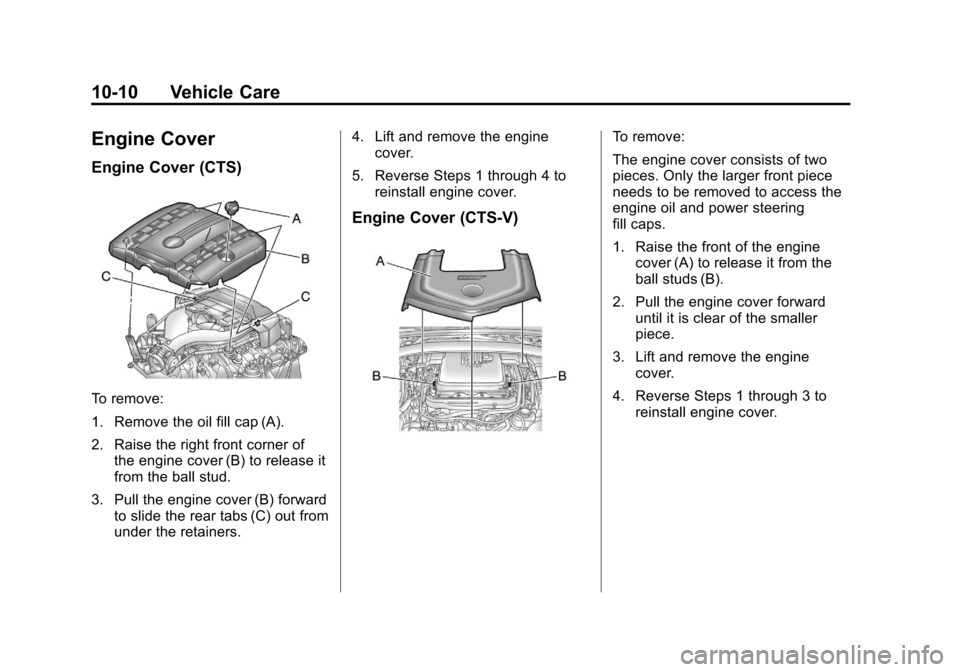
To remove:
1. Remove the oil fill cap (A).
2. Raise the right front corner ofthe engine cover (B) to release it
from the ball stud.
3. Pull the engine cover (B) forward to slide the rear tabs (C) out from
under the retainers. 4. Lift and remove the engine
cover.
5. Reverse Steps 1 through 4 to reinstall engine cover.
Engine Cover (CTS-V)
To remove:
The engine cover consists of two
pieces. Only the larger front piece
needs to be removed to access the
engine oil and power steering
fill caps.
1. Raise the front of the enginecover (A) to release it from the
ball studs (B).
2. Pull the engine cover forward until it is clear of the smaller
piece.
3. Lift and remove the engine cover.
4. Reverse Steps 1 through 3 to reinstall engine cover.
Page 344 of 496

Black plate (26,1)Cadillac CTS/CTS-V Owner Manual - 2011
10-26 Vehicle Care
Power Steering Fluid
SeeEngine Compartment Overviewon page 10‑6for the location of the
power steering fluid reservoir.
When to Check Power Steering
Fluid
It is not necessary to regularly
check power steering fluid unless
you suspect there is a leak in the
system or you hear an unusual
noise. A fluid loss in this system
could indicate a problem. Have the
system inspected and repaired.
How to Check Power Steering
Fluid
To check the power steering fluid:
1. Turn the key off and let the engine compartment cool down.
2. Wipe the cap and the top of the reservoir clean.
3. Unscrew the cap and wipe the dipstick with a clean rag.
4. Replace the cap and completely tighten it.
5. Remove the cap again and look at the fluid level on the dipstick.
The level should be between the
HOT and COLD marks. If necessary,
add only enough fluid to bring the
level between the marks.
What to Use
To determine what kind of fluid to
use, see Recommended Fluids and
Lubricants
on page 11‑7. Always
use the proper fluid.
Washer Fluid
What to Use
When adding windshield washer
fluid to the vehicle, be sure to read
the manufacturer's instructions
before use. If you will be operating
your vehicle in an area where the
temperature may fall below freezing,
use a fluid that has sufficient
protection against freezing.
Adding Washer Fluid
The WASHER FLUID LOW ADD
FLUID message will appear on the
Driver Information Center (DIC)
when the fluid level is low. See
Washer Fluid Messages
on
page 5‑45for more information.
Page 362 of 496
Black plate (44,1)Cadillac CTS/CTS-V Owner Manual - 2011
10-44 Vehicle Care
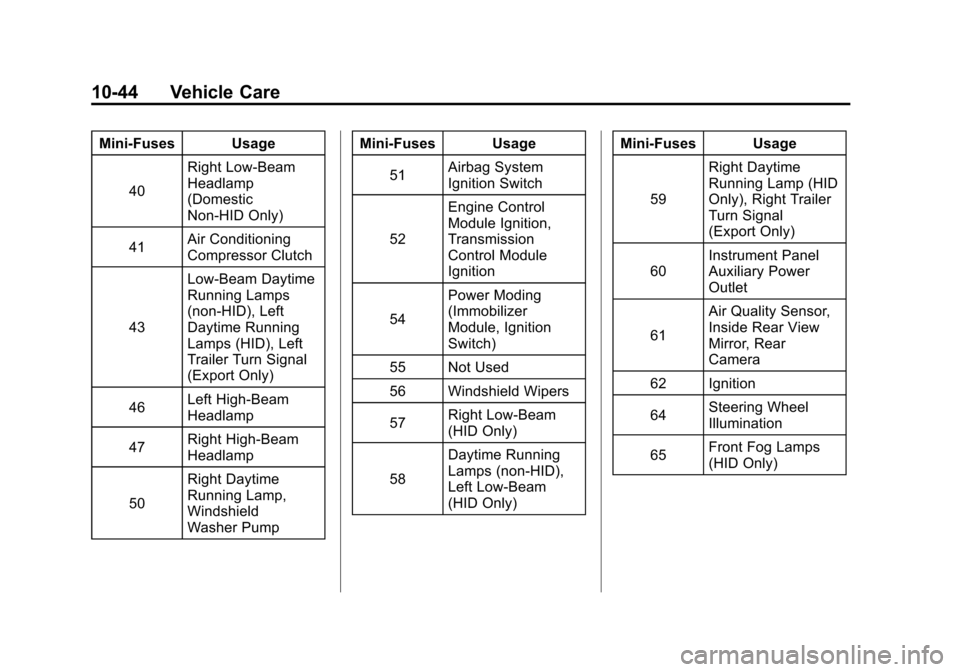
Mini‐Fuses Usage40 Right Low‐Beam
Headlamp
(Domestic
Non‐HID Only)
41 Air Conditioning
Compressor Clutch
43 Low‐Beam Daytime
Running Lamps
(non‐HID), Left
Daytime Running
Lamps (HID), Left
Trailer Turn Signal
(Export Only)
46 Left High‐Beam
Headlamp
47 Right High‐Beam
Headlamp
50 Right Daytime
Running Lamp,
Windshield
Washer Pump Mini‐Fuses Usage
51 Airbag System
Ignition Switch
52 Engine Control
Module Ignition,
Transmission
Control Module
Ignition
54 Power Moding
(Immobilizer
Module, Ignition
Switch)
55 Not Used
56 Windshield Wipers
57 Right Low‐Beam
(HID Only)
58 Daytime Running
Lamps (non‐HID),
Left Low‐Beam
(HID Only) Mini‐Fuses Usage
59 Right Daytime
Running Lamp (HID
Only), Right Trailer
Turn Signal
(Export Only)
60 Instrument Panel
Auxiliary Power
Outlet
61 Air Quality Sensor,
Inside Rear View
Mirror, Rear
Camera
62 Ignition
64 Steering Wheel
Illumination
65 Front Fog Lamps
(HID Only)
Page 366 of 496
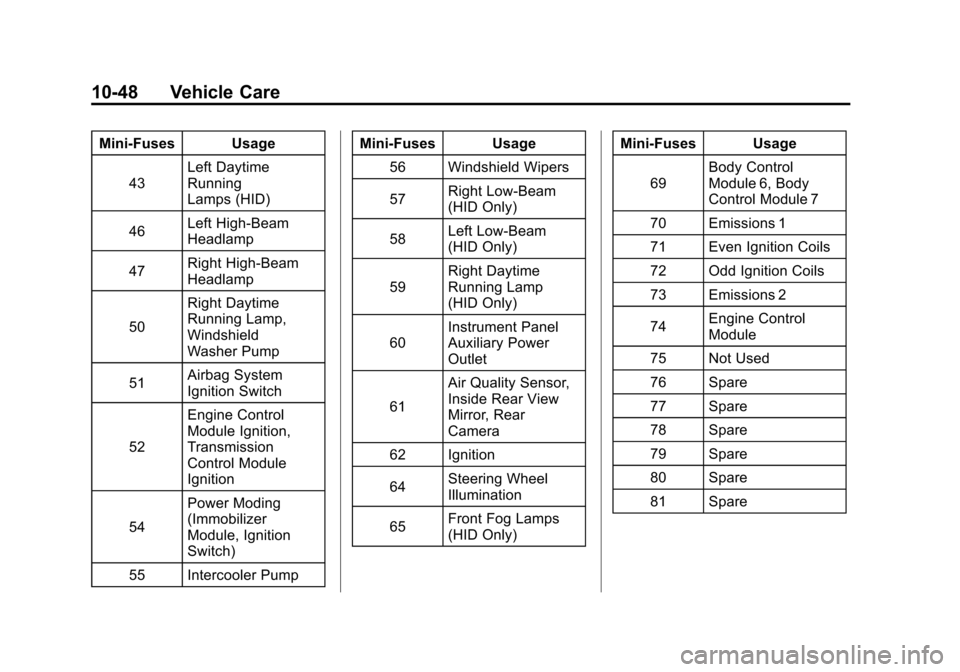
Black plate (48,1)Cadillac CTS/CTS-V Owner Manual - 2011
10-48 Vehicle Care
Mini‐Fuses Usage43 Left Daytime
Running
Lamps (HID)
46 Left High‐Beam
Headlamp
47 Right High‐Beam
Headlamp
50 Right Daytime
Running Lamp,
Windshield
Washer Pump
51 Airbag System
Ignition Switch
52 Engine Control
Module Ignition,
Transmission
Control Module
Ignition
54 Power Moding
(Immobilizer
Module, Ignition
Switch)
55 Intercooler Pump Mini‐Fuses Usage
56 Windshield Wipers
57 Right Low‐Beam
(HID Only)
58 Left Low‐Beam
(HID Only)
59 Right Daytime
Running Lamp
(HID Only)
60 Instrument Panel
Auxiliary Power
Outlet
61 Air Quality Sensor,
Inside Rear View
Mirror, Rear
Camera
62 Ignition
64 Steering Wheel
Illumination
65 Front Fog Lamps
(HID Only) Mini‐Fuses Usage
69 Body Control
Module 6, Body
Control Module 7
70 Emissions 1
71 Even Ignition Coils
72 Odd Ignition Coils
73 Emissions 2
74 Engine Control
Module
75 Not Used
76 Spare
77 Spare
78 Spare
79 Spare
80 Spare
81 Spare