change wheel CADILLAC CTS 2012 2.G User Guide
[x] Cancel search | Manufacturer: CADILLAC, Model Year: 2012, Model line: CTS, Model: CADILLAC CTS 2012 2.GPages: 496, PDF Size: 6.36 MB
Page 291 of 496

Black plate (41,1)Cadillac CTS/CTS-V Owner Manual (Include Mex) - 2012
Driving and Operating 9-41
The Driver Information Center (DIC)
briefly displays SUSPENSION
MODE TOUR or SUSPENSION
MODE SPORT on vehicle startup or
when a new mode is selected.
Press and release this button,
located in the center of the
instrument panel, to change modes.
Limited-Slip Rear Axle
Vehicles with a limited-slip rear axle
can give more traction on snow,
mud, ice, sand, or gravel. When
traction is low, this feature allows
the drive wheel with the most
traction to move the vehicle. The
limited-slip rear axle also gives the
driver enhanced control when
cornering hard or completing a
maneuver, such as a lane change.
Cruise Control
{WARNING
Cruise control can be dangerous
where you cannot drive safely at
a steady speed. So, do not use
the cruise control on winding
roads or in heavy traffic.
Cruise control can be dangerous
on slippery roads. On such roads,
fast changes in tire traction can
cause excessive wheel slip, and
you could lose control. Do not use
cruise control on slippery roads.
With cruise control, a speed of
about 40 km/h (25 mph) or more can
be maintained without keeping your
foot on the accelerator. Cruise
control does not work at speeds
below about 40 km/h (25 mph).
When the brakes are applied, the
cruise control turns off. If the vehicle has the Stabilitrak
®
system and begins to limit wheel
spin while you are using cruise
control, the cruise control will
automatically disengage. See
StabiliTrak
®System on page 9‑39.
When road conditions allow you to
safely use it again, the cruise
control can be turned back on.
CTS Shown, CTS‐V Similar
The cruise control buttons are
located on the left side of the
steering wheel.
Page 306 of 496

Black plate (56,1)Cadillac CTS/CTS-V Owner Manual (Include Mex) - 2012
9-56 Driving and Operating
vehicle such as a motor home, see
Recreational Vehicle Towing on
page 10‑108.
Driving Characteristics
and Towing Tips
{WARNING
The driver can lose control when
pulling a trailer if the correct
equipment is not used or the
vehicle is not driven properly. For
example, if the trailer is too
heavy, the brakes may not work
well—or even at all. The driver
and passengers could be
seriously injured. The vehicle may
also be damaged; the resulting
repairs would not be covered by
the vehicle warranty. Pull a trailer
only if all the steps in this section
have been followed. Ask your
dealer for advice and information
about towing a trailer with the
vehicle. The vehicle can tow a trailer if it is
equipped with the proper trailer
towing equipment. To identify the
trailering capacity of the vehicle, see
Trailer Towing (CTS-V and Coupe)
on page 9‑59
orTrailer Towing
(Except CTS-V and Coupe) on
page 9‑59. Trailering changes
handling, acceleration, braking,
durability, and fuel economy. With
the added weight, the engine,
transmission, wheel assemblies,
and tires are forced to work harder
and under greater loads. The trailer
also adds wind resistance,
increasing the pulling requirements.
For safe trailering, correctly use the
proper trailering equipment.
The following information has
important trailering tips and rules for
your safety and that of your
passengers. Read this section
carefully before pulling a trailer.
Pulling a Trailer
Here are some important points:
.There are many laws, including
speed limit restrictions that apply
to trailering. Check for legal
requirements with state or
provincial police.
.Do not tow a trailer at all during
the first 1 600 km (1,000 mi) the
new vehicle is driven. The
engine or other parts could be
damaged.
.During the first 800 km (500 mi)
that a trailer is towed, do not
drive over 80 km/h (50 mph) and
do not make starts at full throttle.
This reduces wear on the
vehicle.
.Vehicles with automatic
transmissions can tow in
D (Drive) but M (Manual Mode)
is recommended. See Manual
Mode on page 9‑29 for more
information. Use a lower gear if
the transmission shifts too often.
Page 339 of 496
Black plate (27,1)Cadillac CTS/CTS-V Owner Manual (Include Mex) - 2012
Vehicle Care 10-27
Some driving conditions or climates
can cause a brake squeal when the
brakes are first applied or lightly
applied. This does not mean
something is wrong with the brakes.
Properly torqued wheel nuts are
necessary to help prevent brake
pulsation. When tires are rotated,
inspect brake pads for wear and
evenly tighten wheel nuts in the
proper sequence to torque
specifications inCapacities and
Specifications on page 12‑2.
Brake linings should always be
replaced as complete axle sets.
Brake Pedal Travel
See your dealer if the brake pedal
does not return to normal height,
or if there is a rapid increase in
pedal travel. This could be a sign
that brake service might be
required.
Brake Adjustment
Every time the brakes are applied,
with or without the vehicle moving,
the brakes adjust for wear.
Replacing Brake System Parts
The braking system on a vehicle is
complex. Its many parts have to be
of top quality and work well together
if the vehicle is to have really good
braking. The vehicle was designed
and tested with top-quality brake
parts. When parts of the braking
system are replaced, be sure to get
new, approved replacement parts.
If this is not done, the brakes might
not work properly. For example,
installing disc brake pads that are
wrong for the vehicle, can change
the balance between the front and
rear brakes —for the worse. The
braking performance expected can
change in many other ways if the
wrong replacement brake parts are
installed.
Brake Fluid
The brake master cylinder reservoir
is filled with DOT 3 brake fluid as
indicated on the reservoir cap. See
Engine Compartment Overview on
page 10‑6 for the location of the
reservoir.
There are only two reasons why the
brake fluid level in the reservoir
might go down:
.The brake fluid level goes down
because of normal brake lining
wear. When new linings are
installed, the fluid level goes
back up.
.A fluid leak in the brake
hydraulic system can also cause
a low fluid level. Have the brake
Page 376 of 496

Black plate (64,1)Cadillac CTS/CTS-V Owner Manual (Include Mex) - 2012
10-64 Vehicle Care
Winter Tires
Consider installing winter tires on
the vehicle if frequent driving on
snow or ice covered roads is
expected. All season tires provide
good overall performance on most
surfaces, but they may not offer
the traction or the same level of
performance as winter tires on
snow or ice covered roads.
Winter tires, in general, are
designed for increased traction on
snow and ice covered roads. With
winter tires, there may be decreased
dry road traction, increased road
noise, and shorter tread life. After
changing to winter tires, be alert for
changes in vehicle handling and
braking.
See your dealer for details
regarding winter tire availability and
proper tire selection. Also, see
Buying New Tires on page 10‑79.If using snow tires:.Use tires of the same brand and
tread type on all four wheel
positions.
.Use only radial ply tires of the
same size, load range, and
speed rating as the original
equipment tires.
Winter tires with the same speed
rating as the original equipment tires
may not be available for H, V, W,
and ZR speed rated tires. If winter
tires with a lower speed rating are
chosen, never exceed the tire's
maximum speed capability.
Low-Profile Tires
If the vehicle has P235/50R18,
245/45ZR19, P245/45R19,
255/40ZR19, P265/45R18,
275/40ZR19 or 285/35ZR19 size
tires, they are classified as
low‐profile tires. These tires are designed for very responsive
driving on wet or dry pavement,
however, may produce more
road noise and tend to wear
faster.
Notice:
Low‐profile tires are
more susceptible to damage
from road hazards or curb
impact than standard profile
tires. Tire and/or wheel
assembly damage can occur
when coming into contact
with road hazards like,
potholes, or sharp edged
objects, or when sliding into a
curb. The warranty does not
cover this type of damage.
Keep tires set to the correct
inflation pressure and, when
possible, avoid contact with
curbs, potholes, and other
road hazards.
Page 390 of 496
Black plate (78,1)Cadillac CTS/CTS-V Owner Manual (Include Mex) - 2012
10-78 Vehicle Care
the tires have been rotated. See
Tire Pressure on page 10‑70
andVehicle Load Limits on
page 9‑11.
Reset the Tire Pressure Monitor
System. See Tire Pressure
Monitor Operation on
page 10‑73.
Check that all wheel nuts are
properly tightened. See “Wheel
Nut Torque” underCapacities
and Specifications on
page 12‑2.
{WARNING
Rust or dirt on a wheel, or on the
parts to which it is fastened, can
make wheel nuts become loose
after time. The wheel could come
off and cause an accident. When
changing a wheel, remove any
rust or dirt from places where the
wheel attaches to the vehicle. In
(Continued)
WARNING (Continued)
an emergency, a cloth or a paper
towel can be used; however, use
a scraper or wire brush later to
remove all rust or dirt.
Lightly coat the center of the
wheel hub with wheel bearing
grease after a wheel change or
tire rotation to prevent corrosion
or rust build-up. Do not get
grease on the flat wheel
mounting surface or on the
wheel nuts or bolts.
When It Is Time for New
Tires
Factors such as maintenance,
temperatures, driving speeds,
vehicle loading, and road conditions
affect the wear rate of the tires.
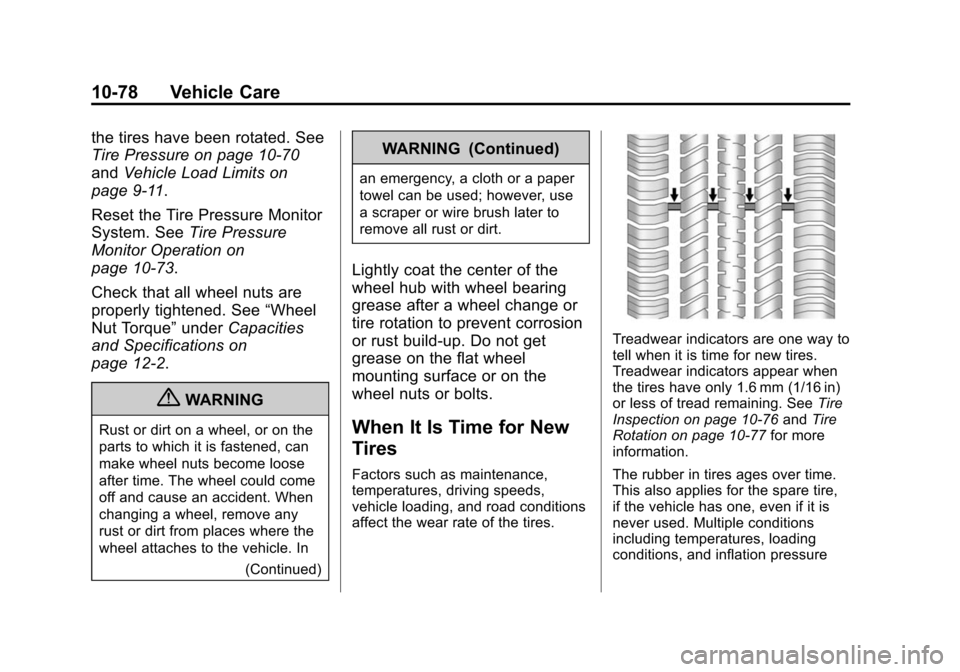
Treadwear indicators are one way to
tell when it is time for new tires.
Treadwear indicators appear when
the tires have only 1.6 mm (1/16 in)
or less of tread remaining. See Tire
Inspection on page 10‑76 andTire
Rotation on page 10‑77 for more
information.
The rubber in tires ages over time.
This also applies for the spare tire,
if the vehicle has one, even if it is
never used. Multiple conditions
including temperatures, loading
conditions, and inflation pressure
Page 397 of 496

Black plate (85,1)Cadillac CTS/CTS-V Owner Manual (Include Mex) - 2012
Vehicle Care 10-85
{WARNING
Changing a tire can be
dangerous. The vehicle can slip
off the jack and roll over or fall
causing injury or death. Find a
level place to change the tire. To
help prevent the vehicle from
moving:1. Set the parking brake firmly.
2. Put an automatic transmission in P (Park) or a
manual transmission in
1 (First) or R (Reverse).
3. Turn off the engine and do not restart while the vehicle
is raised.
(Continued)
WARNING (Continued)
4. Do not allow passengers toremain in the vehicle.
5. Place wheel blocks on both sides of the tire at the
opposite corner of the tire
being changed.
This vehicle may come with a jack
and spare tire or a tire sealant and
compressor kit. To use the jacking
equipment to change a spare tire
safely, follow the instructions below.
Then see Tire Changing on
page 10‑95. To use the tire sealant
and compressor kit, see Tire
Sealant and Compressor Kit on
page 10‑86. When the vehicle has a flat tire (B),
use the following example as a
guide to assist you in the placement
of wheel blocks (A).
A. Wheel Block
B. Flat Tire
Page 398 of 496

Black plate (86,1)Cadillac CTS/CTS-V Owner Manual (Include Mex) - 2012
10-86 Vehicle Care
The following information explains
how to repair or change a tire.
Tire Sealant and
Compressor Kit
{WARNING
Idling a vehicle in an enclosed
area with poor ventilation is
dangerous. Engine exhaust may
enter the vehicle. Engine exhaust
contains carbon monoxide (CO)
which cannot be seen or smelled.
It can cause unconsciousness
and even death. Never run the
engine in an enclosed area that
has no fresh air ventilation. For
more information, seeEngine
Exhaust on page 9‑26.
{WARNING
Overinflating a tire could cause
the tire to rupture and you or
others could be injured. Be sure
to read and follow the tire sealant
and compressor kit instructions
and inflate the tire to its
recommended pressure. Do not
exceed the recommended
pressure.
{WARNING
Storing the tire sealant and
compressor kit or other
equipment in the passenger
compartment of the vehicle could
cause injury. In a sudden stop or
collision, loose equipment could
strike someone. Store the tire
sealant and compressor kit in its
original location. If this vehicle has a tire sealant and
compressor kit, there may not be a
spare tire, tire changing equipment,
and on some vehicles there may not
be a place to store a tire.
The tire sealant and compressor
can be used to temporarily seal
punctures up to 6 mm (¼ in) in the
tread area of the tire. It can also be
used to inflate an under inflated tire.
If the tire has been separated from
the wheel, has damaged sidewalls,
or has a large puncture, the tire is
too severely damaged for the tire
sealant and compressor kit to be
effective. See
Roadside Service
(U.S. and Canada) on page 13‑7 or
Roadside Service (Mexico) on
page 13‑9.
Read and follow all of the tire
sealant and compressor kit
instructions.
Page 459 of 496

Black plate (7,1)Cadillac CTS/CTS-V Owner Manual (Include Mex) - 2012
Customer Information 13-7
GM Mobility
Reimbursement Program
(U.S. and Canada)
This program is available to
qualified applicants for cost
reimbursement of eligible
aftermarket adaptive equipment
required for the vehicle, such as
hand controls or a wheelchair/
scooter lift for the vehicle.
For more information on the limited
offer, visit www.gmmobility.com or
call the GM Mobility Assistance
Center at 1-800-323-9935. Text
Telephone (TTY) users, call
1-800-833-9935.General Motors of Canada also
has a Mobility Program. Call
1-800-GM-DRIVE (463-7483)
for details. TTY users call
1-800-263-3830.
Roadside Service
(U.S. and Canada)
In the United States or Canada, call
1-800-882-1112.
Text Telephone (TTY), U.S. only,
call
1-888-889-2438.
Service is available 24 hours a day,
365 days a year.
Calling for Service
When calling Roadside Service,
have the following information
ready:
.Your name, home address, and
home telephone number.
.Telephone number of your
location.
.Location of the vehicle.
.Model, year, color, and license
plate number of the vehicle.
.Odometer reading, Vehicle
Identification Number (VIN), and
delivery date of the vehicle.
.Description of the problem.
Coverage
Services are provided up to 5 years/
160 000 km (100,000 mi), whichever
comes first.
In the U.S., anyone driving the
vehicle is covered. In Canada, a
person driving the vehicle without
permission from the owner is not
covered.
Roadside Service is not a part of
the New Vehicle Limited Warranty.
Cadillac and General Motors of
Canada Limited reserve the right to
make any changes or discontinue
the Roadside Service program at
any time without notification.
Cadillac and General Motors of
Canada Limited reserve the right to
limit services or payment to an
owner or driver if they decide the
Page 488 of 496

Black plate (6,1)Cadillac CTS/CTS-V Owner Manual (Include Mex) - 2012
i-6 INDEX
Fuel EconomyDriving . . . . . . . . . . . . . . . . . . . . . . . . 1-24
Fuses EngineCompartment
Fuse Block . . . . . 10-40, 10-44, 10-47, 10-51
Fuses and Circuit
Breakers . . . . . . . . . . . . . . . . . . 10-40
Rear Compartment
Fuse Block . . . . . 10-54, 10-56, 10-58, 10-60
G
Garage Door Opener . . . . . . . . . . 5-53
Programming . . . . . . . . . . . . . . . . . 5-53
Gasoline Specifications . . . . . . . . . . . . . . . . . 9-51
Gauges Boost . . . . . . . . . . . . . . . . . . . . . . . . . 5-14
Engine CoolantTemperature . . . . . . . . . . . . . . . . 5-16
Engine Oil Pressure . . . . . . . . . . 5-15
Fuel . . . . . . . . . . . . . . . . . . . . . . . . . . 5-13
Odometer . . . . . . . . . . . . . . . . . . . . . 5-13 Gauges (cont.)
Speedometer . . . . . . . . . . . . . . . . . 5-13
Tachometer . . . . . . . . . . . . . . . . . . . 5-13
Trip Odometer . . . . . . . . . . . . . . . . 5-13
Warning Lights and
Indicators . . . . . . . . . . . . . . . . . . . 5-10
General Information Service and Maintenance . . . . . 11-1
Towing . . . . . . . . . . . . . . . . . . . . . . . . 9-55
Vehicle Care . . . . . . . . . . . . . . . . . . 10-3
Glove Box . . . . . . . . . . . . . . . . . . . . . . 4-1
GM Mobility Reimbursement Program . . . . . . . . . . . . . . . . . . . . . . 13-7H
Halogen Bulbs . . . . . . . . . . . . . . . . 10-37
Hard Drive Device (HDD) . . . . . . 7-28
Hazard Warning Flashers . . . . . . . 6-5
Head Restraints . . . . . . . . . . . . . . . . 3-2Active . . . . . . . . . . . . . . . . . . . . . . . . . 3-3
Headlamps Adaptive ForwardLighting (AFL) . . . . . . . . . . . . . . . . 6-5
Aiming . . . . . . . . . . . . . . . . . . . . . . 10-34
Automatic . . . . . . . . . . . . . . . . . . . . . . 6-4
Bulb Replacement . . . . . . . . . . 10-37 Headlamps (cont.)
Daytime Running
Lamps (DRL) . . . . . . . . . . . . . . . . . 6-3
Flash-to-Pass . . . . . . . . . . . . . . . . . . 6-2
High Intensity Discharge
(HID) Lighting . . . . . . . . . . . . . 10-37
High-Beam On Light . . . . . . . . . . 5-26
High/Low Beam Changer . . . . . . 6-2
Lamps On Reminder . . . . . . . . . 5-26
Washer . . . . . . . . . . . . . . . . . . . . . . . . 5-7
Heated Steering Wheel . . . . . . . . . . . . . . . . 5-4
Heated and Ventilated Front Seats . . . . . . . . . . . . . . . . . . . . . . . . 3-10
Heated Mirrors . . . . . . . . . . . . . . . . . 2-28
Heater Engine Coolant . . . . . . . . . . . . . . . 9-22
High-Beam On Light . . . . . . . . . . . 5-26
High-Speed Operation . . . . . . . . 10-72
Highway Hypnosis . . . . . . . . . . . . . . 9-8
Hill and Mountain Roads . . . . . . . . 9-8
Hood . . . . . . . . . . . . . . . . . . . . . . . . . . 10-5
Horn . . . . . . . . . . . . . . . . . . . . . . . . . . . . 5-4
How to Wear Safety Belts
Properly . . . . . . . . . . . . . . . . . . . . . . 3-13
Hydraulic Clutch . . . . . . . . . . . . . . 10-14
Page 494 of 496

Black plate (12,1)Cadillac CTS/CTS-V Owner Manual (Include Mex) - 2012
i-12 INDEX
Shift Lock Control FunctionCheck, Automatic
Transmission . . . . . . . . . . . . . . . . 10-31
Shifting Into Park . . . . . . . . . . . . . . . . . . . . . . 9-23
Out of Park . . . . . . . . . . . . . . . . . . . 9-24
Side Blind Zone Alert . . . . . . . . . . 9-45
Signals, Turn and
Lane-Change . . . . . . . . . . . . . . . . . 6-5
Spare Tire Compact . . . . . . . . . . . . . . . . . . . 10-103
Specifications and Capacities . . . . . . . . . . . . . . . . . . . . 12-2
Speed Limiter, Engine . . . . . . . . . 5-14
Speedometer . . . . . . . . . . . . . . . . . . 5-13
StabiliTrak OFF Light . . . . . . . . . . . . . . . . . . . . . 5-23
System . . . . . . . . . . . . . . . . . . . . . . . 9-39
Start Vehicle, Remote . . . . . . . . . 2-12
Starter Switch Check . . . . . . . . . 10-30
Starting the Engine . . . . . . . 1-4, 9-20 Steering . . . . . . . . . . . . . . . . . . . . . . . . 9-4
Fluid, Power . . . . . . . . . . . . . . . . 10-24
Heated Wheel . . . . . . . . . . . . . . . . . 5-4
Wheel Adjustment . . . . . . . . . . . . . 5-2
Wheel Controls . . . . . . . . . . . . . . . . 5-3
Storage Areas Cargo Cover . . . . . . . . . . . . . . . . . . . 4-2
Cargo Management System . . . 4-3
Center Console . . . . . . . . . . . . . . . . 4-2
Convenience Net . . . . . . . . . . . . . . 4-6
Glove Box . . . . . . . . . . . . . . . . . . . . . 4-1
Instrument Panel . . . . . . . . . . . . . . 4-1
Roof Rack System . . . . . . . . . . . . . 4-6
Storing the Tire Sealant and
Compressor Kit . . . . . .10-93, 10-94
Stuck Vehicle . . . . . . . . . . . . . . . . . . 9-11
Sun Visors . . . . . . . . . . . . . . . . . . . . . 2-32
Sunroof . . . . . . . . . . . . . . . . . . . . . . . . 2-32
Symbols . . . . . . . . . . . . . . . . . . . . . . . . . . iv
System Infotainment . . . . . . . . . . . . . . . . . . . 7-1
Roof Rack . . . . . . . . . . . . . . . . . . . . . 4-6T
Tachometer . . . . . . . . . . . . . . . . . . . . 5-13
Text Telephone (TTY) Users . . . 13-6
Theft-DeterrentSystems . . . . . . . . . . . . . . . 2-25, 2-26
Immobilizer . . . . . . . . . . . . . . . . . . . 2-25
Thigh Support Adjustment . . . . . . 3-6
Time . . . . . . . . . . . . . . . . . . . . . . . . . . . . 5-8
Tires
Buying New Tires . . . . . . . . . . . 10-79
Chains . . . . . . . . . . . . . . . . . . . . . . 10-83
Changing . . . . . . . . . . . . . . . . . . . 10-95
Compact Spare . . . . . . . . . . . . 10-103
Designations . . . . . . . . . . . . . . . 10-67
Different Size . . . . . . . . . . . . . . . 10-80
If a Tire Goes Flat . . . . . . . . . . 10-84
Inflation Monitor System . . . . 10-73
Inspection . . . . . . . . . . . . . . . . . . 10-76
Low Profile . . . . . . . . . . . . . . . . . 10-64
Messages . . . . . . . . . . . . . . . . . . . . 5-43
Pressure . . . . . . . . . . . . . . . . . . . . 10-72
Pressure Light . . . . . . . . . . . . . . . . 5-25
Pressure Monitor System . . . 10-72
Rotation . . . . . . . . . . . . . . . . . . . . 10-77
Sealant andCompressor Kit . . . . . . . . . . . 10-86