lock CADILLAC CTS 2019 Owners Manual
[x] Cancel search | Manufacturer: CADILLAC, Model Year: 2019, Model line: CTS, Model: CADILLAC CTS 2019Pages: 401, PDF Size: 6.85 MB
Page 290 of 401
Cadillac CTS/CTS-V Owner Manual (GMNA-Localizing-U.S./Canada/Mexico-
12460273) - 2019 - CRC - 5/16/18
VEHICLE CARE 289
Bulb Replacement
For the proper type of replacement
bulbs, or any bulb changing procedure
not listed in this section, contact your
dealer.
Caution
Do not replace incandescent bulbs
with aftermarket LED replacement
bulbs. This can cause damage to
the vehicle electrical system.
Halogen Bulbs
{Warning
Halogen bulbs have pressurized gas
inside and can burst if you drop or
scratch the bulb. You or others
could be injured. Be sure to read
and follow the instructions on the
bulb package.
High Intensity Discharge
(HID) Lighting
{Warning
The High Intensity Discharge (HID)
lighting system operates at a very
high voltage. If you try to service
any of the system components, you
could be seriously injured. Have
your dealer or a qualified technician
service them.
After an HID headlamp bulb has been
replaced, the beam might be a slightly
different shade than it was originally.
This is normal.
LED Lighting
This vehicle has several LED lamps.
For replacement of any LED lighting
assembly, contact your dealer.
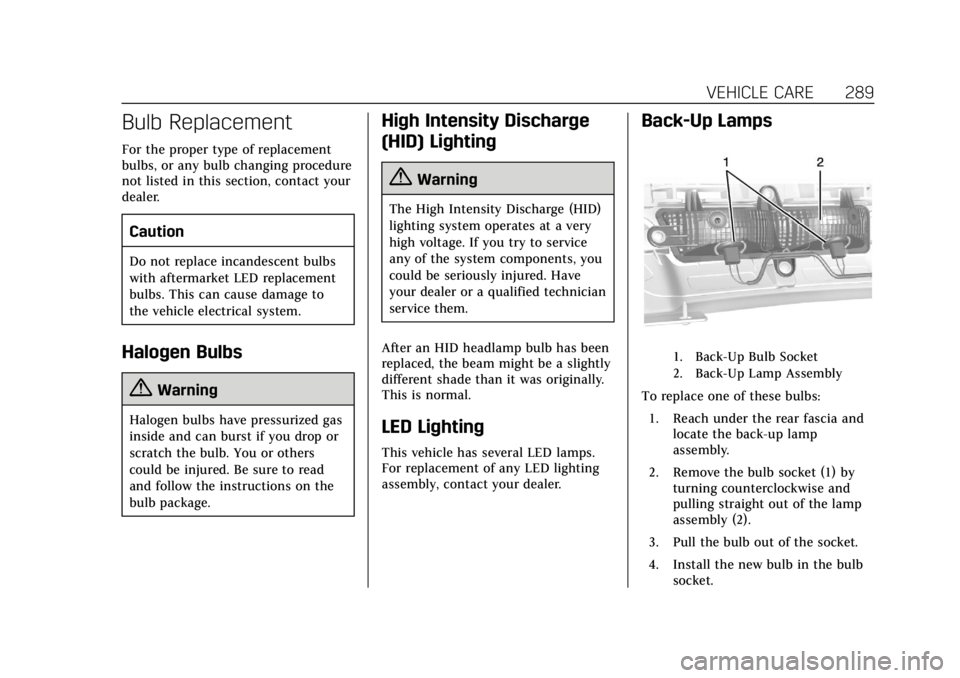
Back-Up Lamps
1. Back-Up Bulb Socket
2. Back-Up Lamp Assembly
To replace one of these bulbs: 1. Reach under the rear fascia and locate the back-up lamp
assembly.
2. Remove the bulb socket (1) by turning counterclockwise and
pulling straight out of the lamp
assembly (2).
3. Pull the bulb out of the socket.
4. Install the new bulb in the bulb socket.
Page 291 of 401

Cadillac CTS/CTS-V Owner Manual (GMNA-Localizing-U.S./Canada/Mexico-
12460273) - 2019 - CRC - 5/16/18
290 VEHICLE CARE
5. Install the bulb socket by turningclockwise.
License Plate Lamp
Lamp Assembly
Bulb Assembly
1. Bulb Socket
2. Bulb
3. Lamp Assembly
To replace one of these bulbs:
1. Push the lamp assembly (3) toward the center of the vehicle.
2. Pull the lamp assembly down to remove.
3. Turn the bulb socket (1) counterclockwise to remove it
from the lamp assembly (3).
4. Pull the bulb (2) straight out of the bulb socket (1).
5. Push the replacement bulb straight into the bulb socket and
turn the bulb socket clockwise to
install it into the lamp assembly.
6. Push the lamp assembly back into position until the release tab
locks into place.
Page 293 of 401

Cadillac CTS/CTS-V Owner Manual (GMNA-Localizing-U.S./Canada/Mexico-
12460273) - 2019 - CRC - 5/16/18
292 VEHICLE CARE
To check a fuse, look at the
silver-colored band inside the fuse.
If the band is broken or melted,
replace the fuse. Be sure to replace a
bad fuse with a new one of the
identical size and rating.
Fuses of the same amperage can be
temporarily borrowed from another
fuse location, if a fuse goes out.
Replace the fuse as soon as possible.
Engine Compartment Fuse
Block
The underhood fuse block is on the
passenger side of the engine
compartment.
Lift the fuse block cover to access the
fuses.The vehicle may not be equipped with
all of the fuses and relays shown.
Caution
Spilling liquid on any electrical
component on the vehicle may
damage it. Always keep the covers
on any electrical component.
Page 294 of 401

Cadillac CTS/CTS-V Owner Manual (GMNA-Localizing-U.S./Canada/Mexico-
12460273) - 2019 - CRC - 5/16/18
VEHICLE CARE 293
FusesUsage
1 –
2 – Fuses
Usage
3 Passenger motorized seat belt Fuses
Usage
4 –
5 –
6 Driver power seat
7 –
9 –
10 –
11 –
12 –
13 Passenger power seat
14 –
15 –
16 –
17 Headlamp washer
18 –
19 Antilock brake system pump
20 Antilock brake system valve
21 –
22 Driver motorized seat belt
Page 295 of 401
Cadillac CTS/CTS-V Owner Manual (GMNA-Localizing-U.S./Canada/Mexico-
12460273) - 2019 - CRC - 5/16/18
294 VEHICLE CARE
FusesUsage
26 –
27 –/Heated seat 2
28 –/Reverse lock out
29 Adaptive forward lighting, Automatic
headlamp leveling/
Pedestrian protection
30 –
31 Passenger window switch
32 –
33 Sunroof
34 Front wiper
35 Steering column lock
36 Rear bussed electrical center/Ignition
37 –/Malfunction
Indicator Lamp/
Ignition
38 Aeroshutter
39 O2 sensor/Emissions Fuses
Usage
40 Ignition coil even/O2 sensor
41 Ignition coil odd
42 Engine control module
43 –
44 –
45 Washer
48 Instrument panel/ Body/Ignition
49 Fuel system control module/Ignition
50 Heated steering wheel
51 Engine control module/Ignition
52 Transmission control module/Ignition
53 Coolant pump
55 –
56 Transmission control module Fuses
Usage
64 Adaptive headlamp leveling
65 Left HID headlamp
66 Right HID headlamp
67 Left/Right high-beam headlamp
68 Headlamp leveling motor
69 Horn
71 Cooling fan
72 Starter 2
73 Brake vacuum pump
74 Starter 1
75 Air conditioning clutch
76 –
Relays Usage
8 Headlamp washer
23 Wiper control
24 Wiper speed
Page 296 of 401
Cadillac CTS/CTS-V Owner Manual (GMNA-Localizing-U.S./Canada/Mexico-
12460273) - 2019 - CRC - 5/16/18
VEHICLE CARE 295
RelaysUsage
25 Engine control module
46 Rear washer
47 Front washer
54 Coolant pump
57 Low-beam headlamp relay
58 High-beam headlamp
59 Run/Crank
60 Starter 2
61 Vacuum pump
62 Starter 1
63 Air conditioning control
70 HornInstrument Panel Fuse
Block
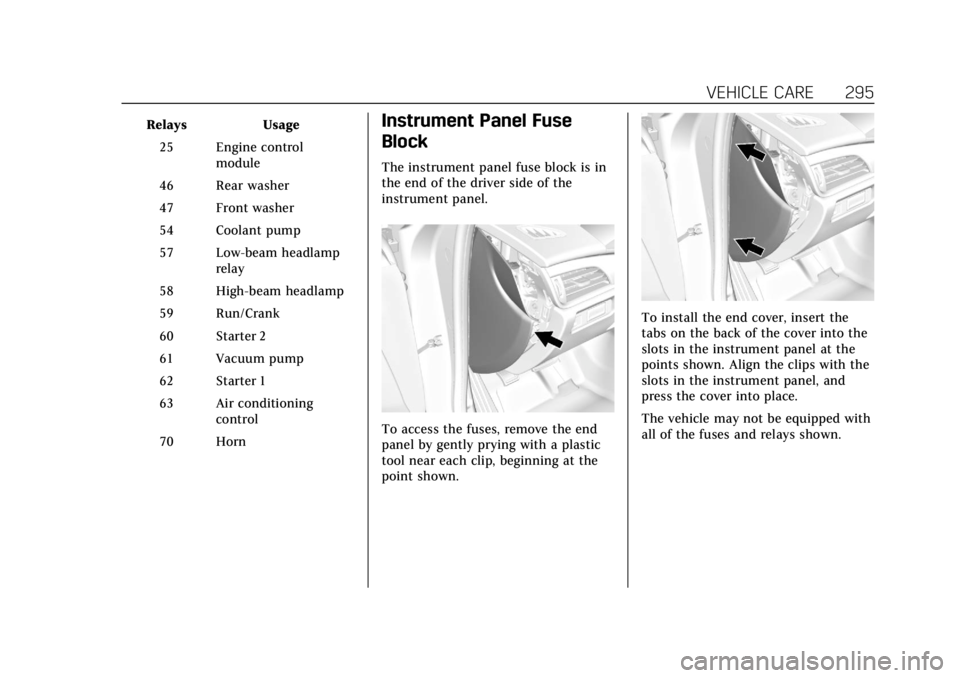
The instrument panel fuse block is in
the end of the driver side of the
instrument panel.
To access the fuses, remove the end
panel by gently prying with a plastic
tool near each clip, beginning at the
point shown.
To install the end cover, insert the
tabs on the back of the cover into the
slots in the instrument panel at the
points shown. Align the clips with the
slots in the instrument panel, and
press the cover into place.
The vehicle may not be equipped with
all of the fuses and relays shown.
Page 297 of 401

Cadillac CTS/CTS-V Owner Manual (GMNA-Localizing-U.S./Canada/Mexico-
12460273) - 2019 - CRC - 5/16/18
296 VEHICLE CARE
FusesUsage
2 Cupholder motor Fuses
Usage
3 Electric steering column lock Fuses
Usage
4 –
5 –
6 Tilt and telescopic steering column
8 Data link connector
9 Glovebox release
10 Shunt
11 Body control module 1
12 Body control module 5
13 Body control module 6
14 –
15 Body control module 7
16 Transmission control module
17 –
18 –
19 Auxiliary power outlet
20 Lighter
Page 298 of 401

Cadillac CTS/CTS-V Owner Manual (GMNA-Localizing-U.S./Canada/Mexico-
12460273) - 2019 - CRC - 5/16/18
VEHICLE CARE 297
FusesUsage
21 Wireless charger
22 Sensing diagnostic module/Automatic
occupant sensing
23 Radio/DVD/Heating, ventilation/Air
conditioning control
24 Display
25 Heated steering wheel
26 Wireless charger
27 Steering wheel controls
28 –
29 Visor vanity lamp
30 –
31 Retained accessory power/Accessory
32 –
33 Front heating, ventilation/Air
conditioning control
blower Circuit
Breakers Usage
CB1 Auxiliary power outlet
CB7 –
Relays Usage
K10 Retained accessory power/Accessory
K605 Logistics
K644 Retained accessory power/Accessory /
Glovebox releaseRear Compartment Fuse
Block
The rear compartment fuse block is
behind a cover on the driver side of
the rear compartment.
The vehicle may not be equipped with
all of the fuses, relays, and features
shown.
Page 300 of 401

Cadillac CTS/CTS-V Owner Manual (GMNA-Localizing-U.S./Canada/Mexico-
12460273) - 2019 - CRC - 5/16/18
VEHICLE CARE 299
FusesUsage
26 Front ventilated seats
27 Side blind zone alert/Lane departure warning/External
object calculating module
28 Trailer/Sunshade
29 Rear heated seats
30 Semi-active damping system
31 Transfer case control module/Rear control drive
module
32 Theft module/Universal garage door opener/Rain
sensor
33 Ultrasonic parking assist
34 Radio/DVD
35 –/Exhaust valve (V-series)
36 Trailer
37 Fuel system control module
38 Fuel pump prime/Exhaust valve (V-series) Fuses
Usage
39 –
42 Memory seat module
43 Body control module 3
44 –
45 Battery regulated voltage control
46 Engine control module/ Battery
47 –
48 –
49 Trailer module
53 –
55 –
Relays Usage
17 Trailer
18 Logistics
20 Rear window defogger
40 Run crank 2 (V-series) Relays
Usage
41 Fuel pump prime/ Run crank 2
50 Child door lock security
51 Rear closure
52 Rear closure 2
54 Door lock security
56 Fuel door
Page 318 of 401

Cadillac CTS/CTS-V Owner Manual (GMNA-Localizing-U.S./Canada/Mexico-
12460273) - 2019 - CRC - 5/16/18
VEHICLE CARE 317
Different Size Tires and
Wheels
If wheels or tires are installed that are
a different size than the original
equipment wheels and tires, vehicle
performance, including its braking,
ride and handling characteristics,
stability, and resistance to rollover
may be affected. If the vehicle has
electronic systems such as antilock
brakes, rollover airbags, traction
control, electronic stability control,
or All-Wheel Drive, the performance
of these systems can also be affected.
{Warning
If different sized wheels are used,
there may not be an acceptable
level of performance and safety if
tires not recommended for those
wheels are selected. This increases
the chance of a crash and serious
injury. Only use GM specific wheel
and tire systems developed for the
vehicle, and have them properly
installed by a GM certified
technician.See
Buying New Tires 0315 and
Accessories and Modifications 0259.
Uniform Tire Quality
Grading
The following information relates
to the system developed by the
United States National Highway
Traffic Safety Administration
(NHTSA), which grades tires by
treadwear, traction, and
temperature performance. This
applies only to vehicles sold in the
United States. The grades are
molded on the sidewalls of most
passenger car tires. The Uniform
Tire Quality Grading (UTQG)
system does not apply to deep
tread, winter tires, compact spare
tires, tires with nominal rim
diameters of 10 to 12 inches
(25 to 30 cm), or to some
limited-production tires.
While the tires available on
General Motors passenger cars
and light trucks may vary with respect to these grades, they must
also conform to federal safety
requirements and additional
General Motors Tire Performance
Criteria (TPC) standards.
Quality grades can be found where
applicable on the tire sidewall
between tread shoulder and
maximum section width. For
example:
Treadwear 200 Traction AA
Temperature A
All Passenger Car Tires Must
Conform to Federal Safety
Requirements In Addition To
These Grades.
Treadwear
The treadwear grade is a
comparative rating based on the
wear rate of the tire when tested
under controlled conditions on a
specified government test course.
For example, a tire graded
150 would wear one and one-half
(1½) times as well on the