brake light CADILLAC DEVILLE 1993 7.G User Guide
[x] Cancel search | Manufacturer: CADILLAC, Model Year: 1993, Model line: DEVILLE, Model: CADILLAC DEVILLE 1993 7.GPages: 406, PDF Size: 20.78 MB
Page 194 of 406
Downloaded from www.Manualslib.com manuals search engine with traffic. This is a mistake. Your brakes may not have time to cool
between hard
stops. Your brakes will wear out much faster if you do a
lot
of heavy braking.
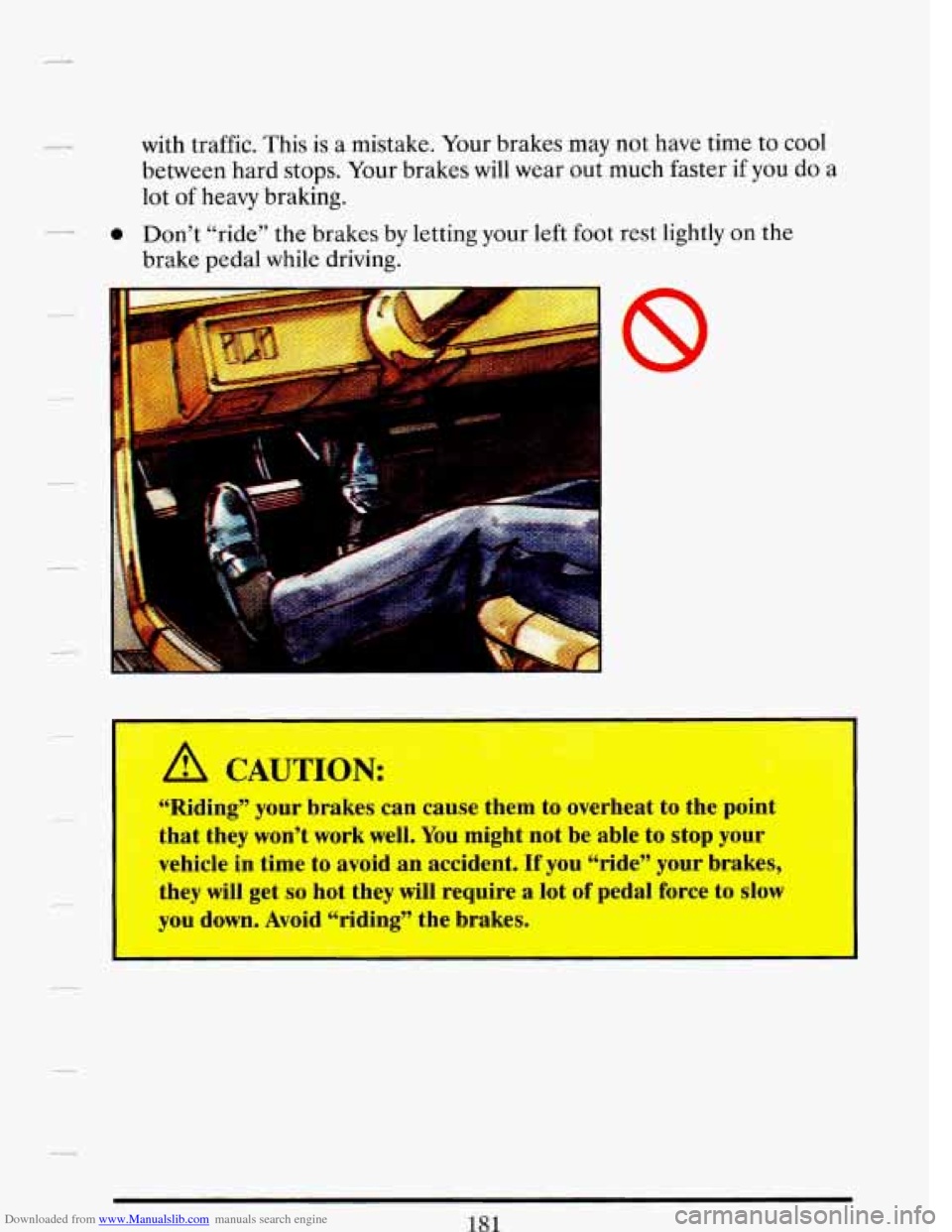
a Don’t “ride” the brakes by letting your left foot rest lightly on the
brake pedal while driving.
CAUTION:
“Riding” your braws can cause them to overheat to the point
that they won’t work well. You might not be able to stop your
vehicle in time to avoid an accident.
If you “ride” your brakes,
they will get
so hot they will require a lot of pedal force to slow
you down. Avoid “riding” the brakes.
Page 195 of 406
Downloaded from www.Manualslib.com manuals search engine If you keep pace with the traffic and allow realistic following distances,
you
will eliminate a lot of unnecessary braking. That means better
braking and longer brake life.
If your engine ever stops while you’re driving, brake normally but
don’t pump your brakes.
If you do, the pedal may get harder to push
down. If your engine stops, you will still have some power brake assist.
But you will use
it when you brake. Once the power assist is used up, it
may take longer
to stop and the brake pedal will be harder to push.
Anti-Lock Brakes (ABS)
Your Cadillac has an advanced electronic braking system that will help
prevent skidding.
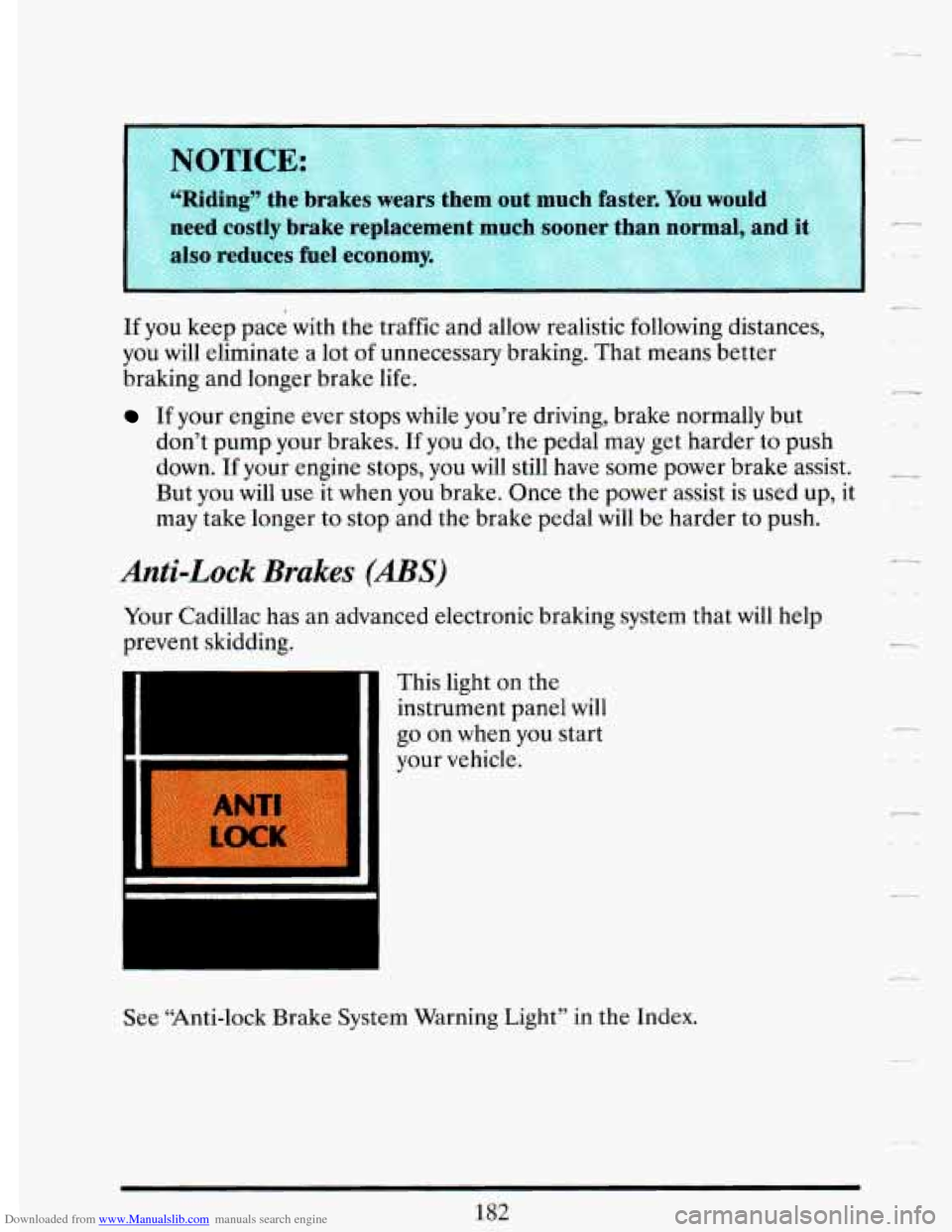
This light on the
instrument panel will
go on when you start
your vehicle.
I
Lr
See “Anti-lock Brake System Warning Light” in the Index.
Page 197 of 406
Downloaded from www.Manualslib.com manuals search engine A CAUTION:
I Anti-lock doesn’t change the time you need to get your foot up to
the brake pedal.
If you get too close to the vehicle in front of
you, you won’t have time to apply your brakes if that vehicle
suddenly slows
or stops. Always leave enough room up ahead to.
stop, even
t- lug ~OU have anti-lock brakes. ..
To Use Anti-Lock:
Don’t pump the brakes. Just hold the brake pedal down and let anti-lock
work for you.
When you start your vehicle and begin to drive away,
you may hear a
momentary motor or clicking noise. And you may even notice that your
brake pedal moves a little while this is going
on. This is the ABS system
testing itself. You may also hear this during
a hard stop.
Traction Control System (Option)
Your vehicle may have a traction control system that limits wheel spin.
This is especially useful in slippery road conditions. The traction control
system works at low speeds only, such as when you accelerate from
a stop.
It applies brake pressure to an individual wheel that the system senses is
about to spin.
ITER
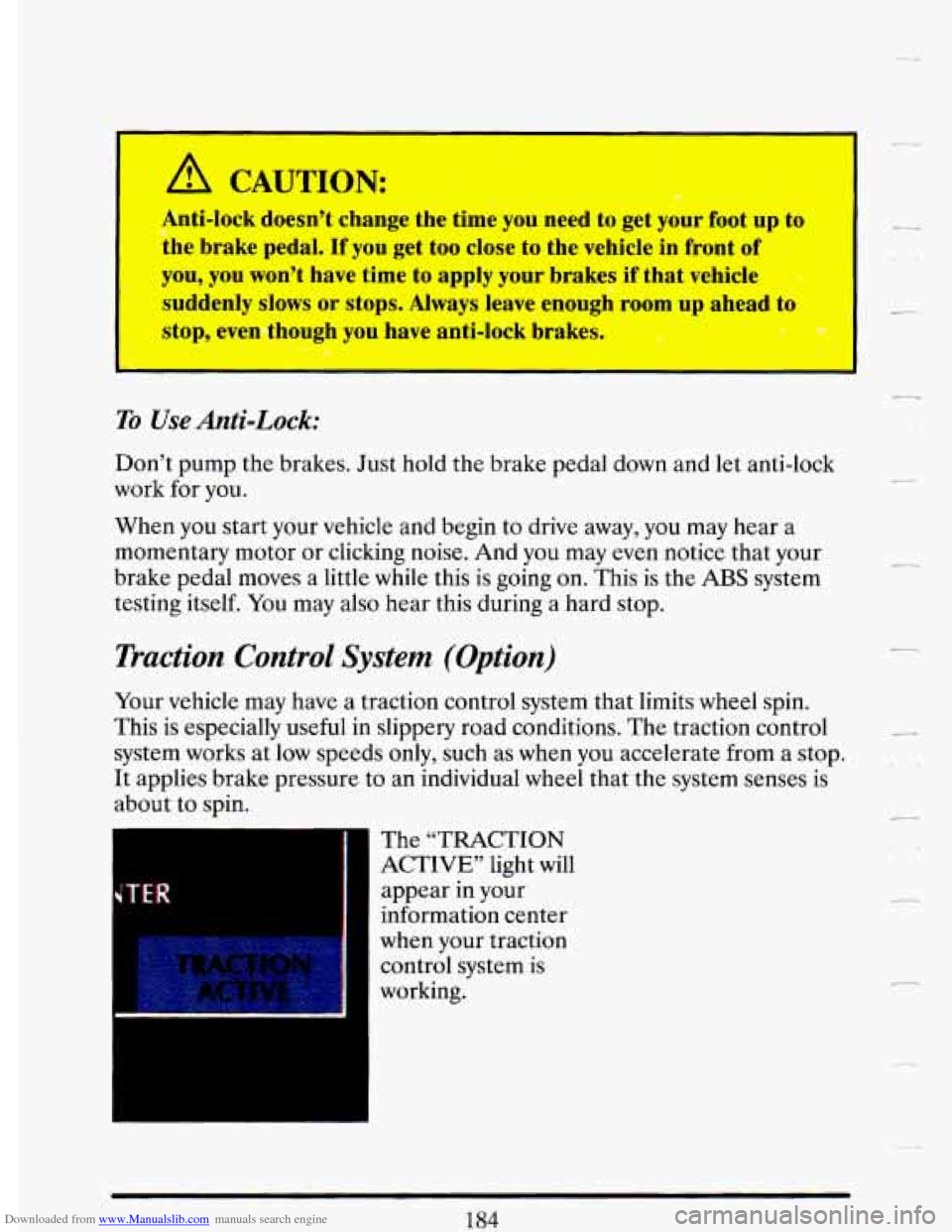
The “TRACTION
ACTIVE’’ light will
appear in your
information center
when your traction
control system is
working.
r
184
Page 198 of 406

Downloaded from www.Manualslib.com manuals search engine r
.-
You may feel the system working, or you may notice some noise, but this
is normal.
The “TRACTION
OFF” warning light
lets you know if your
traction control
I
system is not working.
See “Traction Control
System Warning
, , ,, . I , -1
Light” in the Index.
Disc Brake Wear Indicators
Your Cadillac has front disc brakes and rear drum brakes.
Disc brake pads have built-in wear indicators that make a high-pitched
warning sound when the brake pads are worn and new pads are needed.
The sound may come and
go or be heard all the time your vehicle is
moving (except when you are pushing on the brake pedal firmly).
A CAUTION
The brake wear waming sound means thgt sooner or later your
brakes won’t work well. That could lead to an accident. when
you hear the brake wear warning sound, have your vehicle
serviced. 5-
., I
185
Page 199 of 406
Downloaded from www.Manualslib.com manuals search engine VOTICE:
Cmtinuing to drive with worn-out brake pads could result in
I
costly brake repair
Some driving conditions or climates may cause a brake squeal when the
brakes are first applied or lightly applied. This does not mean something
is wrong with your brakes.
Rear Drum Brakes
Your rear drum brakes don’t have wear indicators, but if you ever hear a
rear brake rubbing noise, have the rear brake linings inspected.
Also, the
rear brake drums should be removed and inspected each time the tires
are removed for rotation or changing. When
you have the front brakes
replaced, have the rear brakes inspected, too.
Brake linings should always be replaced as complete axle sets.
Brake Pedal Travel
See your dealer if the brake pedal does not return to normal height, or if
there is a rapid increase in pedal travel. This could be a sign of brake
trouble.
Brake Adjustment
Every time you make a moderate brake stop, your brakes adjust for wear.
If you rarely make a moderate or heavier stop, then your brakes might
not adjust correctly. If you drive in that way, then
-- very carefully -- make
a
few moderate brake stops about every 1000 miles (1600 km), so your
brakes will adjust properly.
Braking in Emergencies
Use your anti-lock braking system when you need to. With anti-lock, you
can steer and brake at the same time.
In many emergencies, steering can
help you more than
even the very best braking.
186
- i
c
r
Page 201 of 406

Downloaded from www.Manualslib.com manuals search engine Try to adjust your speed so you can “drive” through the curve. Maintain a
reasonable, steady speed. Wait to accelerate until you are out of
the
curve, and then accelerate gently into the straightaway.
When you drive into a curve at night, it’s harder to see the road ahead
of
you because it bends away from the straight beams of your lights. This is
one good reason to drive slower.
Steering in Emergencies
There are times when steering can be more effective than braking. For
example, you come over a hill and find a truck stopped in your lane, or a
car suddenly pulls out from nowhere, or a child darts out from between
parked cars and stops right in front of you. You can avoid these problems
by braking
-- if you can stop in time. But sometimes you can’t; there isn’t
room. That’s the time for evasive action
-- steering around the problem.
Your Cadillac can perform
very well in emergencies like these. First apply
your brakes. It is better to remove as much speed as you can from a
possible collision. Then steer around the problem, to the left or right
depending on the space available.
An emergency like this requires close attention and a quick decision. If
you are holding the steering wheel at the recommended 9 and 3 o’clock
positions, you can turn it a
full 180 degrees very quickly without removing
either hand. But you have to act fast, steer quickly, and just as quickly
straighten the wheel once you have avoided the object. You must then be
prepared to steer back to your original lane and then brake to a
controlled stop.
Depending on your speed, this can be rather violent for an unprepared
driver. This is one of the reasons driving experts recommend that you use
your safety belts and keep both hands on the steering wheel.
188
-‘ I
-
I cc
-.
r
)--r
-
LL
Page 205 of 406
Downloaded from www.Manualslib.com manuals search engine Try not to pass more than one vehicle at a time on two-lane roads.
Reconsider before passing
the next vehicle.
Don’t overtake a slowly moving vehicle too rapidly. Even though the
brake lights are not flashing, it may be slowing down or starting to
turn.
0 If you’re being passed, make it easy for the following driver to get
ahead
of you. Perhaps you can ease a little to the right.
LOSS OF CONTROL
Let’s review what driving experts say about what happens when the three
control systems (brakes, steering and acceleration) don’t have enough
friction where the tires meet
the road to do what the driver has asked.
In any emergency, don’t give up. Keep trying to steer and constantly seek
an escape route or area
of less danger.
Skidding
In a skid, a driver can lose control of the vehicle. Defensive drivers avoid
most skids by taking reasonable care suited to existing conditions, and by
not “overdriving” those conditions. But skids are always possible.
The three types of skids correspond to your Cadillac’s three control
systems. In the braking skid your
wheels aren’t rolling. In the steering or
cornering skid, too much speed or steering
in a curve causes tires to slip
and lose cornering force. And in the acceleration skid too much throttle
causes the driving wheels to spin.
A cornering skid and an acceleration skid are best handled by easing your
foot off the accelerator pedal.
If your vehicle starts to slide (as when you turn
a corner on a wet, snow-
or ice-covered road), ease your foot off the accelerator pedal as
soon as
you feel the vehicle start to slide. Quickly steer the way you want the
vehicle to go. If you start steering quickly enough, your vehicle will
straighten out.
As it does, straighten the front wheels.
Of course, traction is reduced when water, snow, ice, gravel, or other
material is
on the road. For safety, you’ll want to slow down and adjust
your driving to these conditions. It is important
to slow down on slippery
192
Page 210 of 406
Downloaded from www.Manualslib.com manuals search engine i .. .
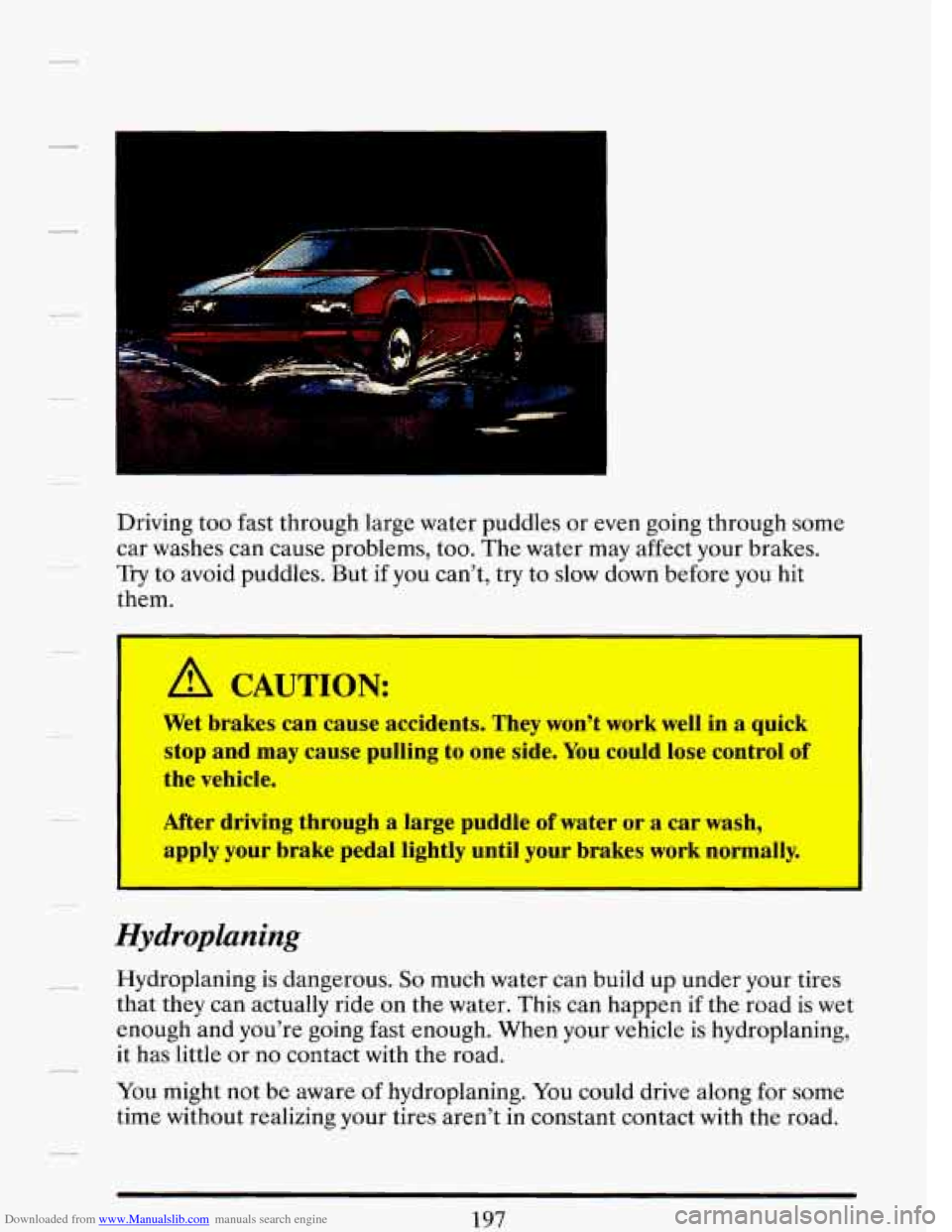
Driving too fast through large water puddles or even going through some
car washes can cause problems, too. The water may affect your brakes.
Try to avoid puddles. But if you can’t, try to slow down before you hit
them.
I
A CAUTION:
Wet brakes can cause accidents. They won’t work well in a quick
stop and may cause pulling to one side. You could lose control of
the vehicle.
After driving through a large puddle of water Or a car wash,
apply your brake pedal lightly until your brakes work normally.
Hydroplaning
Hydroplaning is dangerous. So much water can build up under your tires
that they can actually ride on the water. This can happen if the road is wet
enough and you’re going fast enough. When your vehicle is hydroplaning,
it has little or no contact with the road.
You might not be aware
of hydroplaning. You could drive along for some
time without realizing your tires aren’t in constant contact with the road.
Page 216 of 406
Downloaded from www.Manualslib.com manuals search engine Switch on your turn signal, check your rearview mirrors as you move
along, and glance over your shoulder as often as necessary.
Try to blend
smoothly with the traffic
flow.
Driving on the Freeway
Once you are on the freeway, adjust your speed to the posted limit or to
the prevailing rate if it’s slower. Stay in the right lane unless you want to
pass. If you are on
a two-lane freeway, treat the right lane as the slow lane
and the left lane as the passing lane.
If you are on a three-lane freeway, treat the right lane as the slower-speed
through lane, the middle lane as the higher-speed through lane, and the
left
lane as the passing lane.
Before changing lanes, check your rearview mirrors. Then use your turn
signal.
Just before you leave the lane, glance quickly over your shoulder to make
sure there isn’tanother vehicle in your “blind” spot.
If you are moving from an outside to a center lane on a freeway having
more than two lanes, make sure another vehicle isn’t about to move into
the same spot.
Look at the vehicles two lanes over and watch for telltale
signs: turn signals flashing, an increase in speed, or moving toward the
edge
of the lane. Be prepared to delay your move.
Once
you are moving on the freeway, make certain you allow a
reasonable following distance. Expect to move slightly slower at night.
Leaving the Freeway
When you want to leave the freeway, move to the proper lane well in
advance. Dashing across lanes at the last minute is dangerous. If you miss
your exit do not, under any circumstances, stop and back up. Drive on to
the next exit.
At each exit point is a deceleration lane. Ideally it should be long enough
for you to enter it at freeway speed (after signaling,
of course) and then
do your braking before moving onto the exit ramp. Unfortunately, not all
deceleration lanes are long enough
-- some are too short for all the
braking. Decide when to start braking. If you must brake
on the through
lane, and if there
is traffic close behind you, you can allow a little extra
203
Page 217 of 406
Downloaded from www.Manualslib.com manuals search engine time and flash your brake lights (in addition to your turn signal) as extra
warning that you are about to slow down and exit.
The exit ramp can be curved, sometimes quite sharply.
The exit speed is usually posted. Reduce your speed according to your
speedometer, not to your sense
of motion. After driving for any distance
at higher speeds,
you may tend to think you are going slower than you
actually are. For example,
40 mph (65 kmh) might seem like only 20 mph
(30 krn/h). Obviously, this could lead to serious trouble on a ramp
designed
for 20 mph (30 km/h)!
DmNG A LONG DISTANCE
Although most long trips today are made on freeways, there are still
many made
on regular highways.
Long-distance driving on freeways and regular highways is the same in
some ways. The trip has to be planned and the vehicle prepared, you
drive at higher-than-city speeds, and there are longer turns behind the
wheel. You’ll enjoy your trip more if you and your vehicle are in good
shape. Here are some tips for a successful long trip.
BEFORE LEAWNG ONA LONG TMP
Make sure you’re ready. Try to be well rested. If you must start when
you’re not fresh
-- such as after a day’s work -- don’t plan to make too
many miles that first part of the journey. Wear comfortable clothing and
shoes you can easily drive in.
Is your vehicle ready for a long trip? If you keep it serviced and
maintained, it’s ready to go. If it needs service, have it done before
starting out.
Of course, you’ll find experienced and able service experts in
Cadillac dealerships all across North America. They’ll be ready and
willing to help if you need it.
Here are some things you can check before a trip:
Windshield Washer Fluid: Is the reservoir full? Are all windows clean
inside and outside?
0 Wiper Blades: Are they in good shape?
Fuel, Engine Oil, Other Fluids: Have you checked all levels?
c
204