belt CADILLAC DEVILLE 1993 7.G Owner's Manual
[x] Cancel search | Manufacturer: CADILLAC, Model Year: 1993, Model line: DEVILLE, Model: CADILLAC DEVILLE 1993 7.GPages: 406, PDF Size: 20.78 MB
Page 42 of 406
Downloaded from www.Manualslib.com manuals search engine .- -
A CAUTION:
Air bags inflate with great force, faster than the blink of an eye.
If yoii’re too close to an inflating air bag, it could seriously
injure
you. Safety belts help keep you in position for an air bag
inflation in a crash. Always wear your safety belt, even with an
air bag, and sit as
far back as you can while still maintaining
control
of your vehicle,
Air Bag System Light
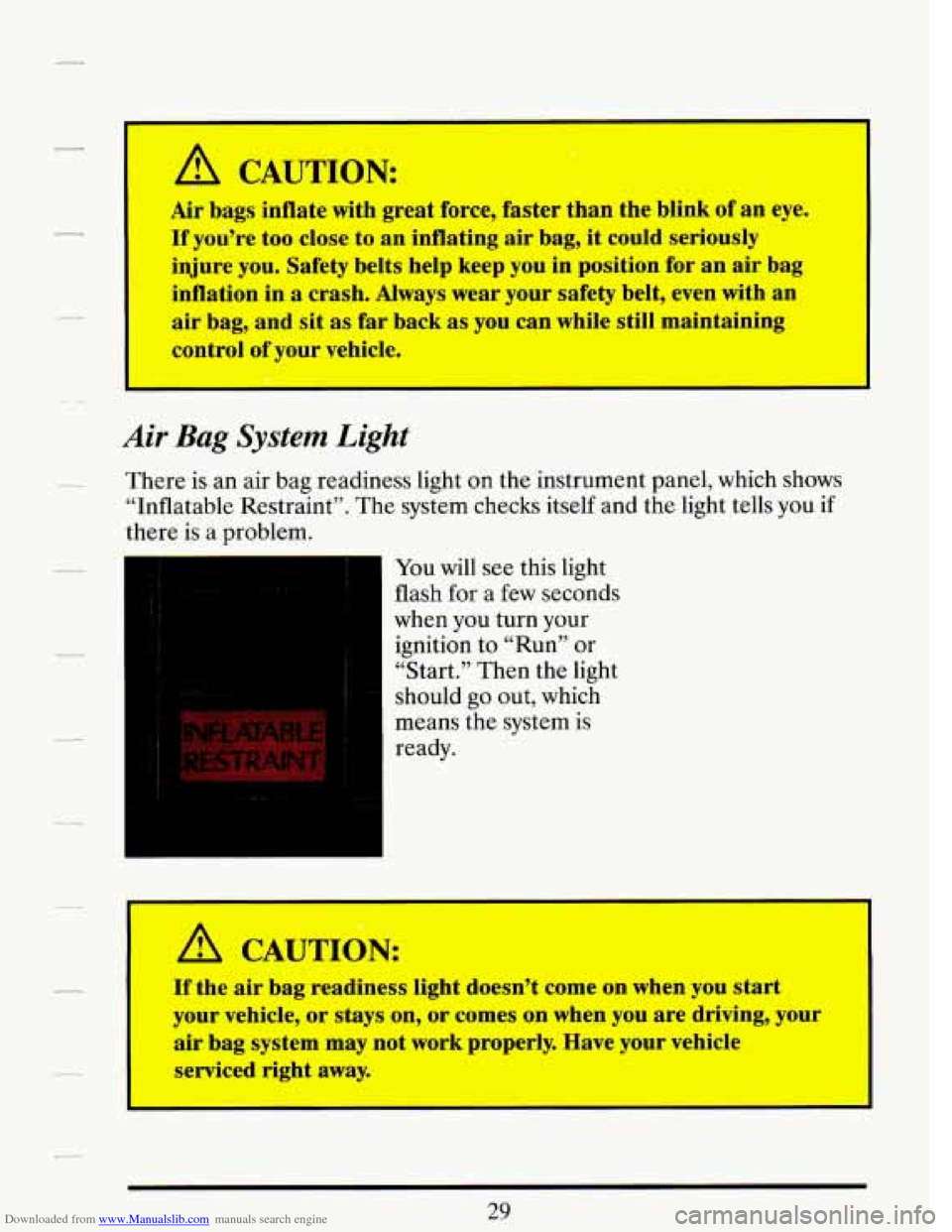
There is an air bag readiness light on the instrument panel, which shows
“Inflatable Restraint”. The system checks itself and the light tells you if
there
is a problem.
You will see this light
flash for a
few seconds
when you turn your
ignition to
“Run” or
“Start.” Then the light
should
go out, which
means the system
is
ready.
A CAUTION:
If the air bag readiness light doesn’t come on when you start
your vehicle, or stays on, or comes on when you are driving, your
air bag system may not work properly. Have your vehicle
serviced right
away.
29
Page 44 of 406
Downloaded from www.Manualslib.com manuals search engine What makes an air bag inflate?
In a frontal impact of sufficient severity, sensors strategically located on
the vehicle detect that the vehicle
is suddenly stopping as a result of a
reaction of the sodium azide sealed in the inflator. The reaction produces
nitrogen gas, which inflates the cloth bag. The inflator, cloth bag, and
related hardware are all part of the air bag inflator module packed inside
the steering wheel.
-
- crash. These sensors complete an electrical circuit, triggering a chemical
-
How does an air bag restrain?
occupants can contact the steering wheel. The air bag supplements the
protection provided by safety belts. Air bags distribute the force of the
occupant more gradually. But air bags would not provide protection in
many types of collisions, including rollovers and rear and side impacts,
primarily because an occupant’s motion is not toward the air bag. Air
bags should never
be regarded as anything more than a supplement to
safety belt protection in moderate to severe frontal and near-frontal
collisions.
-. - In moderate to severe frontal or near-frontal collisions, even belted
- impact more evenly over the occupant’s upper body, stopping the
__
-
What will you see after an air bag inflation?
After the air bag has inflated, it will then quickly deflate. This occurs so
__ quickly that some people may not even realize that the air bag inflated.
The air bag will not impede the driver’s vision or ability to steer the
vehicle, nor will it hinder the occupants from exiting the vehicle. There
__ will be small amounts of smoke coming from vents in the deflated air bag.
Some components
of the air bag module in the steering wheel hub may
be hot for a short time, but the portion
of the bag that comes into contact
with you will not be hot to the touch. The nitrogen gas used to inflate the
air bag
will have vented into the passenger compartment, and the bag will
be deflated within seconds after the collision. Nitrogen makes up about
80% of the air we breathe and is not hazardous. As the nitrogen vents
compartment.
__
- from the bag, small particles are also vented into the passenger
31
Page 46 of 406

Downloaded from www.Manualslib.com manuals search engine .LI Avoid wires wrapped with yellow tape, or yellow connectors. They are
probably part
of the air bag system.
But if the ignition has to be on for electrical work, or
if the steering
To do this:
- column is to be disassembled, the air bag system must be disconnected.
0 Turn off the ignition.
0 Remove the SIR (air bag) fuse. (See “Fuses and Circuit Breakers” in I_
the Index.)
_- 0 Disconnect the yellow connector at the base of the steering column.
When the work is complete, if the air bag system was disconnected, be
sure to reattach everything and replace the fuse before turning the
~ ignition on. When you turn the ignition key on, be sure you see the air
bag readiness light on the instrument panel.
If you don’t see this light
flash and then
go out as usual, have your air bag system repaired.
I__
SAFETYBELT USE DUMNG PREGNANCY
Safety belts work for everyone, including pregnant women. Like all
safety belts.
A pregnant woman should wear
a lap-shoulder belt, and the lap portion
should be worn as
low as possible throughout the pregnancy.
- occupants, they are more likely to be seriously injured if they don’t wear
I_
33
Page 47 of 406

Downloaded from www.Manualslib.com manuals search engine . .I ’ 1, . -
The best way to protect the fett 1s is to motect the mother. Wh
en a safety
belt is
worn properly, it’s more likely that the fetus won’t be hurt in a
crash. For pregnant women, as for anyone, the key
to making safety belts
effective is wearing them properly.
RIGHT FRONT PASSENGER POSITION
The right front passenger’s safety belt works the same way as the driver’s
safety belt. See “Driver Position,’’ earlier
in this part.
When the lap portion
of the belt is pulled out all the way, it will lock. If it - -
does, let it go back all the way and start again.
If your vehicle has a center passenger position, be Be sure to use the
correct buckle when buckling your lap-shoulder belt.
If you find that the
latch plate will not go fully into the buckle, see
if you are using the buckle
for the center passenger position.
-
34
-
Page 48 of 406
Downloaded from www.Manualslib.com manuals search engine L_ CENTER PASSENGER POSITION
__
Lap Belt
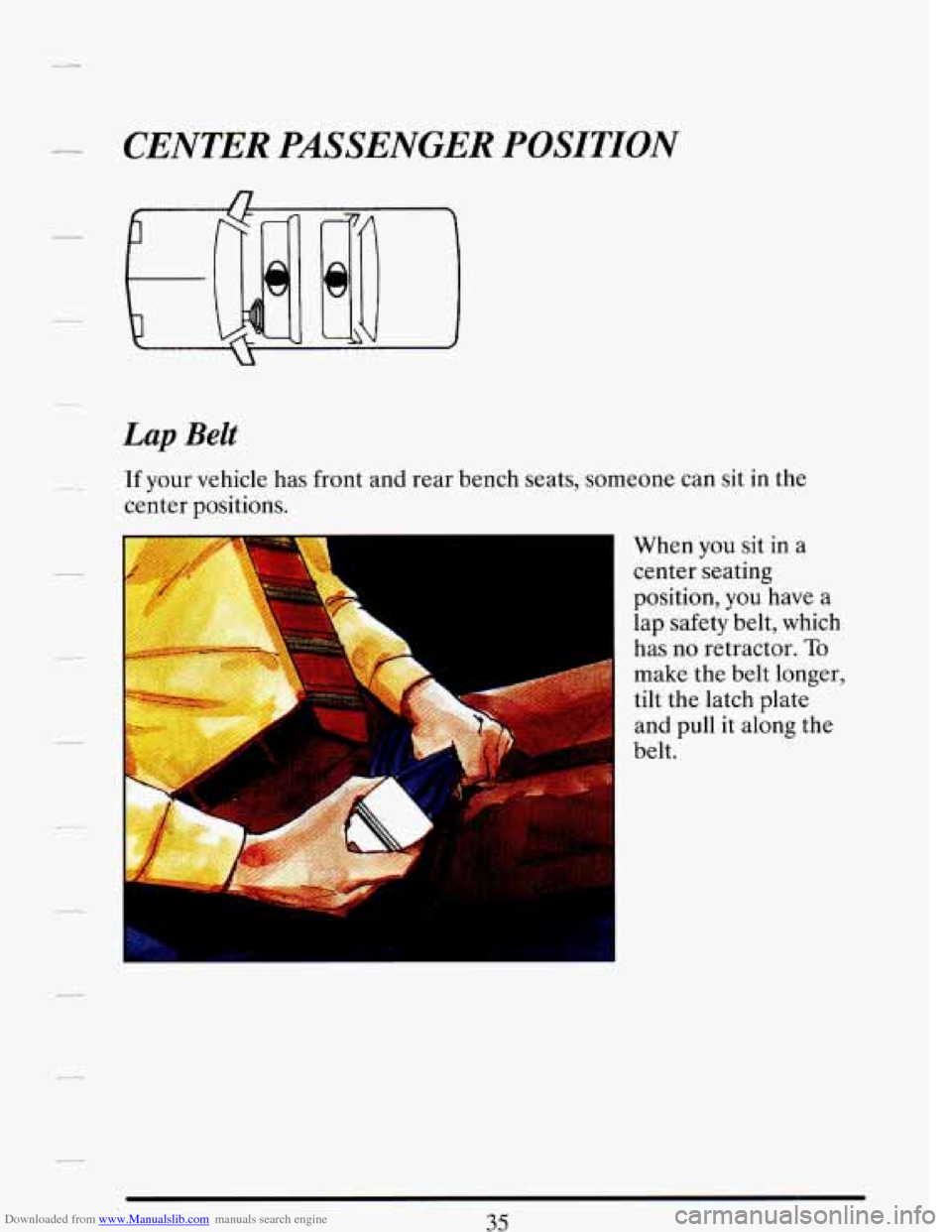
If your vehicle has front and rear bench seats, someone can sit in the
center positions.
When you
sit in a
center seating
position, you have a
lap safety belt, which
has no retractor.
To
make the belt longer,
tilt the latch plate
and pull
it along the
belt.
Page 49 of 406
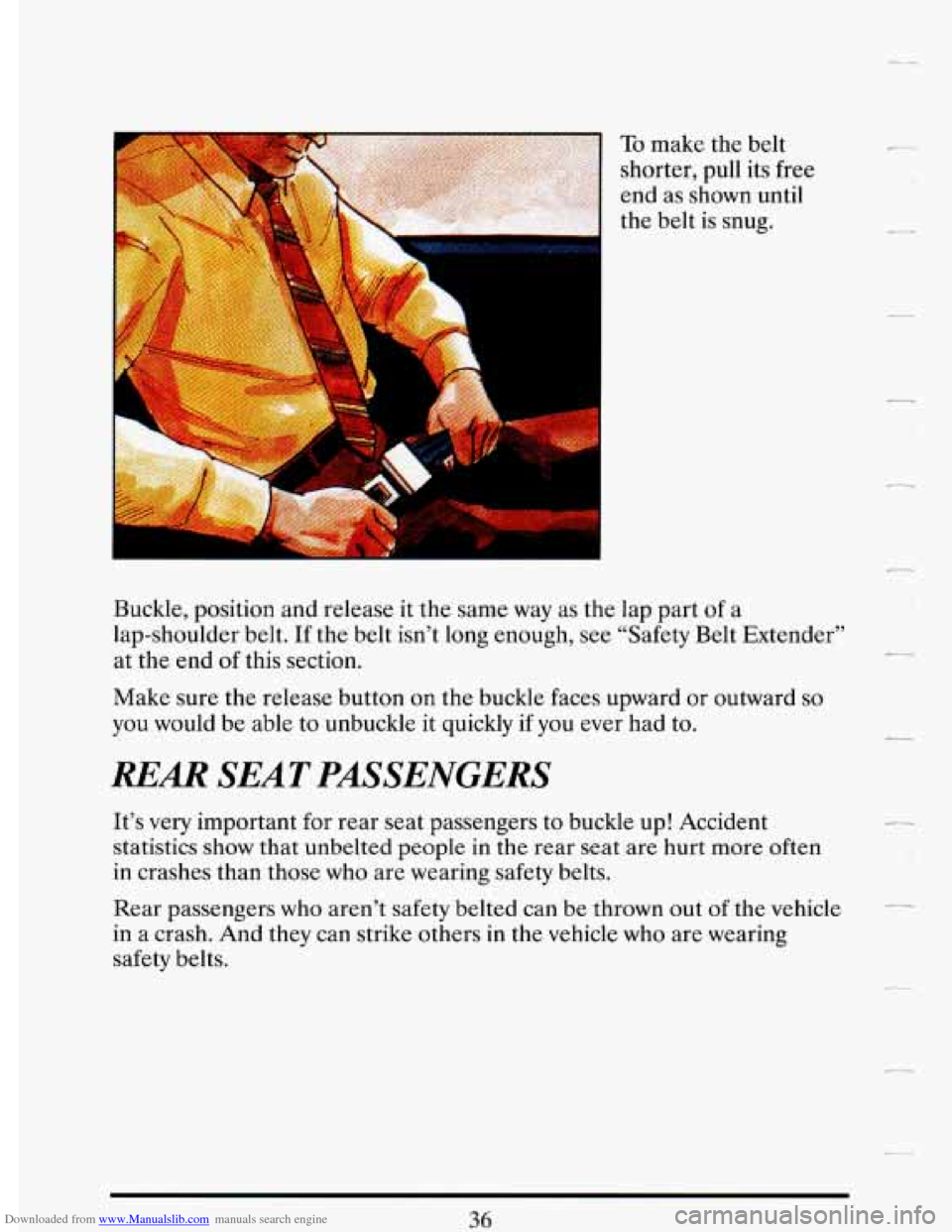
Downloaded from www.Manualslib.com manuals search engine Buckle, position and release it the same way as the lap part of a
lap-shoulder belt.
If the belt isn’t long enough, see “Safety Belt Extender”
at the end
of this section.
Make sure the release button
on the buckle faces upward or outward so
you would be able to unbuckle it quickly if you ever had to.
REAR SEAT PASSENGERS
It’s very important for rear seat passengers to buckle up! Accident
statistics show that unbelted people in the rear seat are hurt more often
in crashes than those who are wearing safety belts.
Rear passengers who aren’t safety belted can be thrown out of the vehicle
-
in a crash. And they can strike others in the vehicle who are wearing
safety belts.
36
Page 50 of 406
Downloaded from www.Manualslib.com manuals search engine Rear Seat Outside Passenger
Lap-Shoulder Belt
Positions
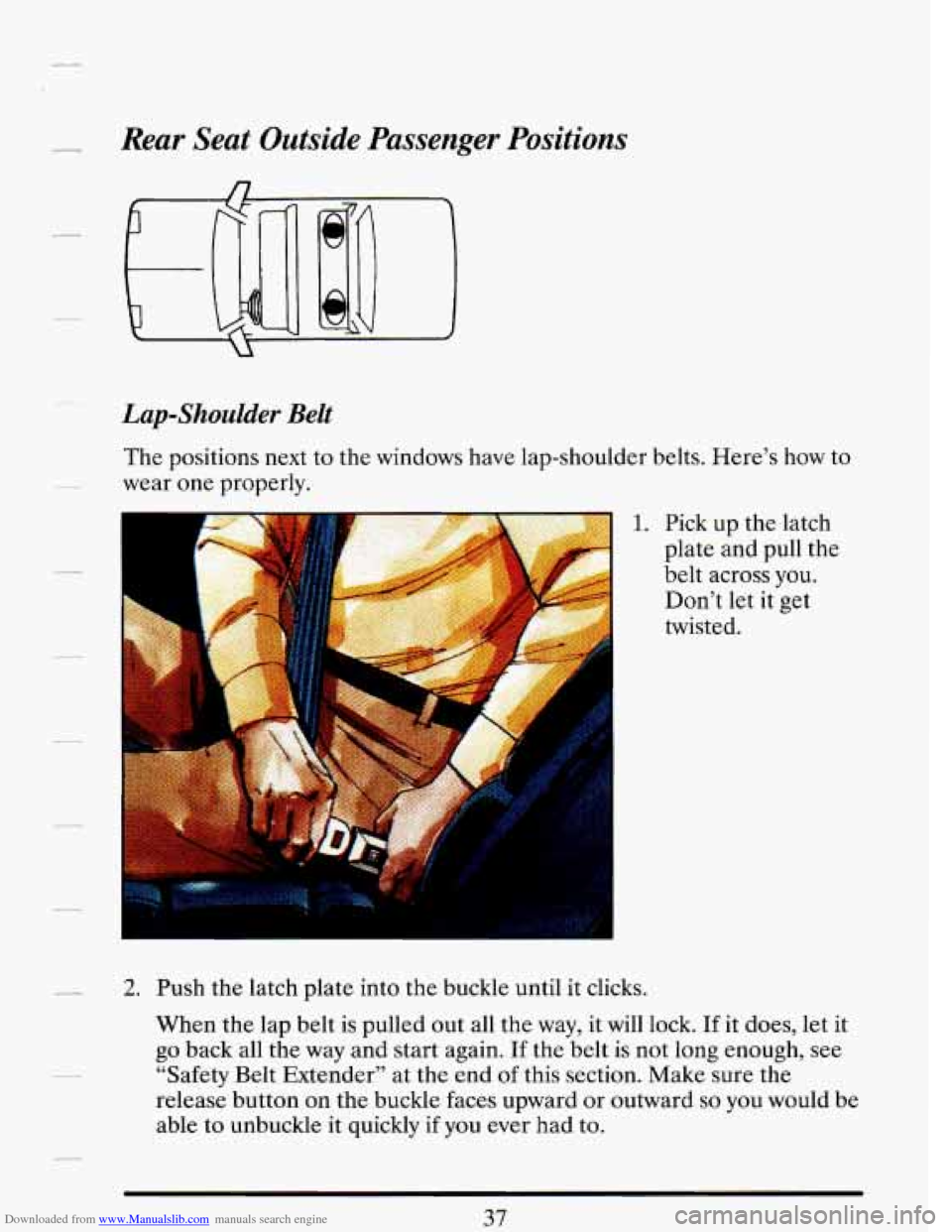
The positions next to the windows have lap-shoulder belts. Here’s how to
wear one properly.
I
1. Pick up the latch
plate and pull the
belt across you.
Don’t let it get
twisted.
__ 2. Push the latch plate into the buckle until it clicks.
When the lap belt
is pulled out all the way, it will lock. If it does, let it
go back all the way and start again. If the belt is not long enough, see
“Safety Belt Extender” at the end
of this section. Make sure the
release button on the buckle faces upward or outward
so you would be
able to unbuckle it quickly if you ever
had to.
37
Page 51 of 406
Downloaded from www.Manualslib.com manuals search engine n n
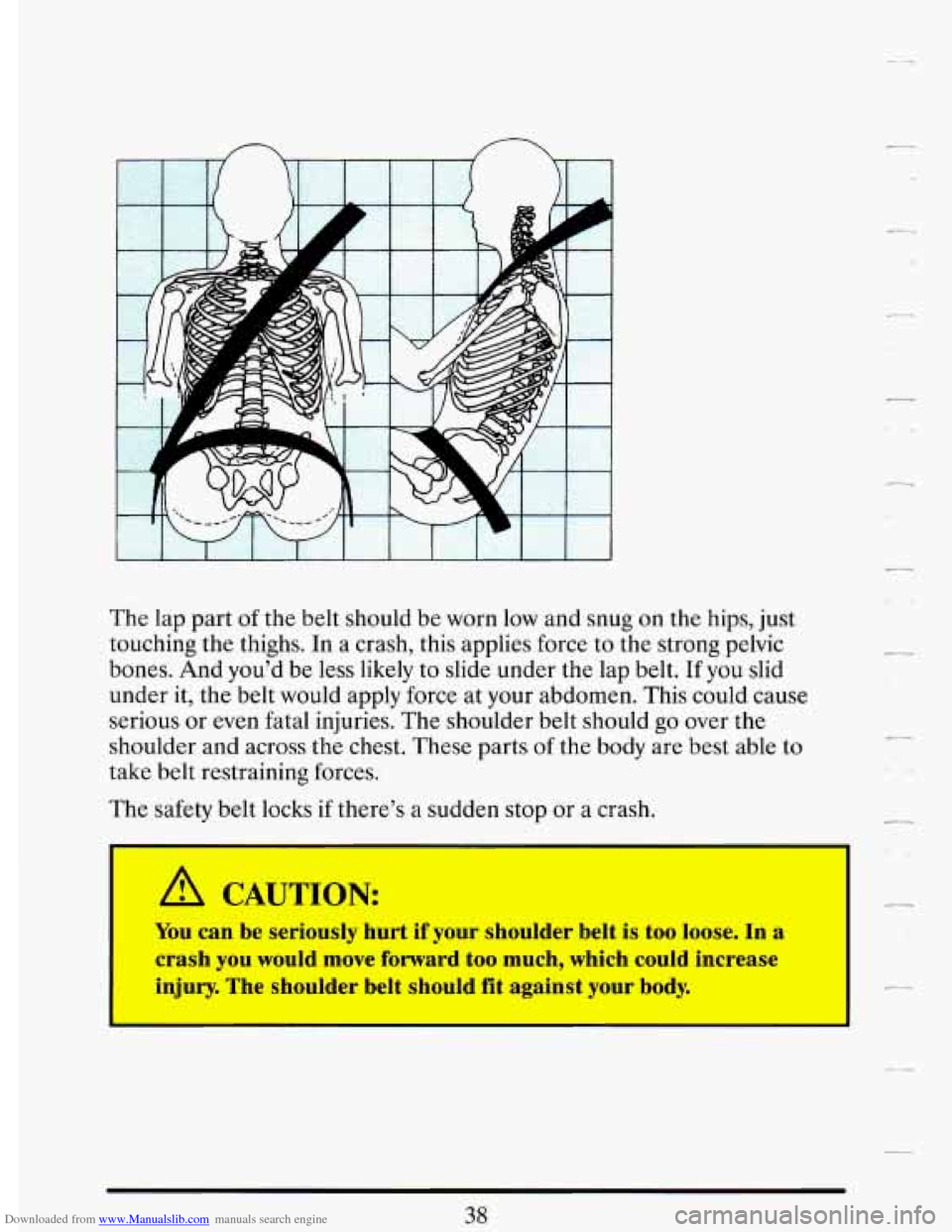
The lap part of the belt should be worn low and snug on the hips, just
touching the thighs. In a crash, this applies force to the strong pelvic
bones. And you’d be less likely to slide under the lap belt. If you slid
under it, the belt would apply force at your abdomen. This could cause
serious or even fatal injuries. The shoulder belt should
go over the
shoulder and across the chest. These parts
of the body are best able to
take belt restraining forces.
The safety belt locks if there’s a sudden stop or a crash.
I
A CAUTION:
You can be seriously hurt if your shoulder belt is too loose. In a
crash you would move forward too much, which could increase injury. jhoul-
r belt should fit against bur bc r, 1
38
Page 52 of 406
Downloaded from www.Manualslib.com manuals search engine r
.1
r
r
CHILDREN
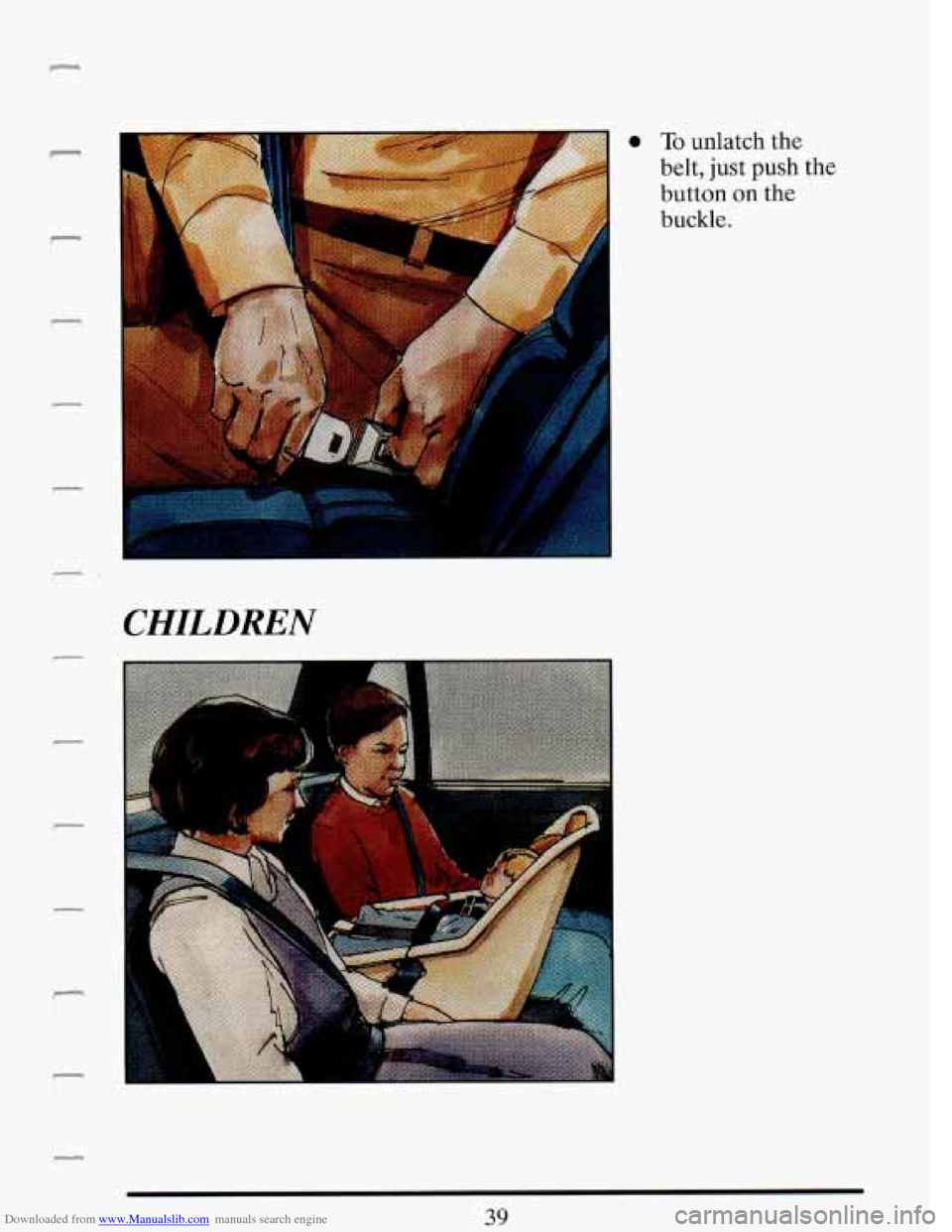
To unlatch the
belt,
just push the
button on the
buckle.
39
r
Page 53 of 406
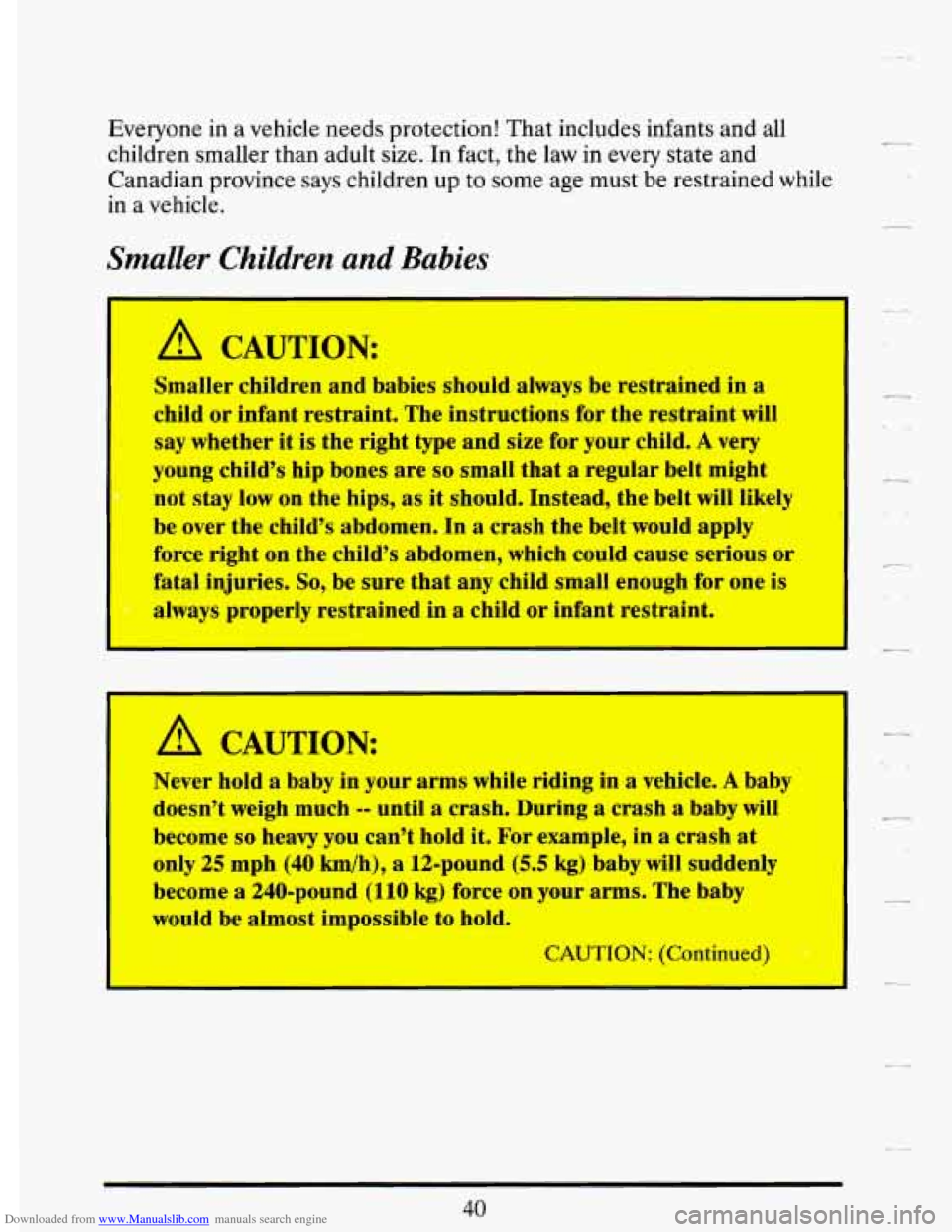
Downloaded from www.Manualslib.com manuals search engine Everyone in a vehicle needs protection! That includes infants and all
children smaller than adult size. In fact, the law in every state and
Canadian province says children up
to some age must be restrained while
in
a vehicle.
Smaller Children and Babies
A CAUTION:
Smaller children and babies should always be restrained in a
child or infant restraint. The instructions for the restraint will
say whether it is the right type and size for your child. A very
young child’s hip bones are
so small that a regular belt might
not stay low
on the hips, as it should. Instead, thebelt will likely
be over the child’s abdomen..In
01 crash the belt would apply
force right on the child’s abdomen, which could cause serious or
fatal injuries. So, be sure that any child small enough for one is
0 always properly restrained in a child or infant restraint.
A CAUTION
Never hold a baby in your arms while riding in a vehicle. A baby
doesn’t weigh much
-- until a crash. During a crash a baby will
become so heavy you can’t hold it. For example, in a crash at
only
25 mph (40 km/h), a l2-pound (5.5 kg) baby will suddenly
become
a 240-pound (110 kg) force on your arms. The baby
would be almost impossible to hold.
CAUTION (Contin1 ”
c-
40