brake CADILLAC DEVILLE 1993 7.G Owner's Manual
[x] Cancel search | Manufacturer: CADILLAC, Model Year: 1993, Model line: DEVILLE, Model: CADILLAC DEVILLE 1993 7.GPages: 406, PDF Size: 20.78 MB
Page 136 of 406
Downloaded from www.Manualslib.com manuals search engine - tire. If the warning light stays on after you replace the compact spare with
a full-size tire, or if it comes
on again when you’re driving, your Cadillac
needs service.
Traction Control System Warning Light (Option)
WER
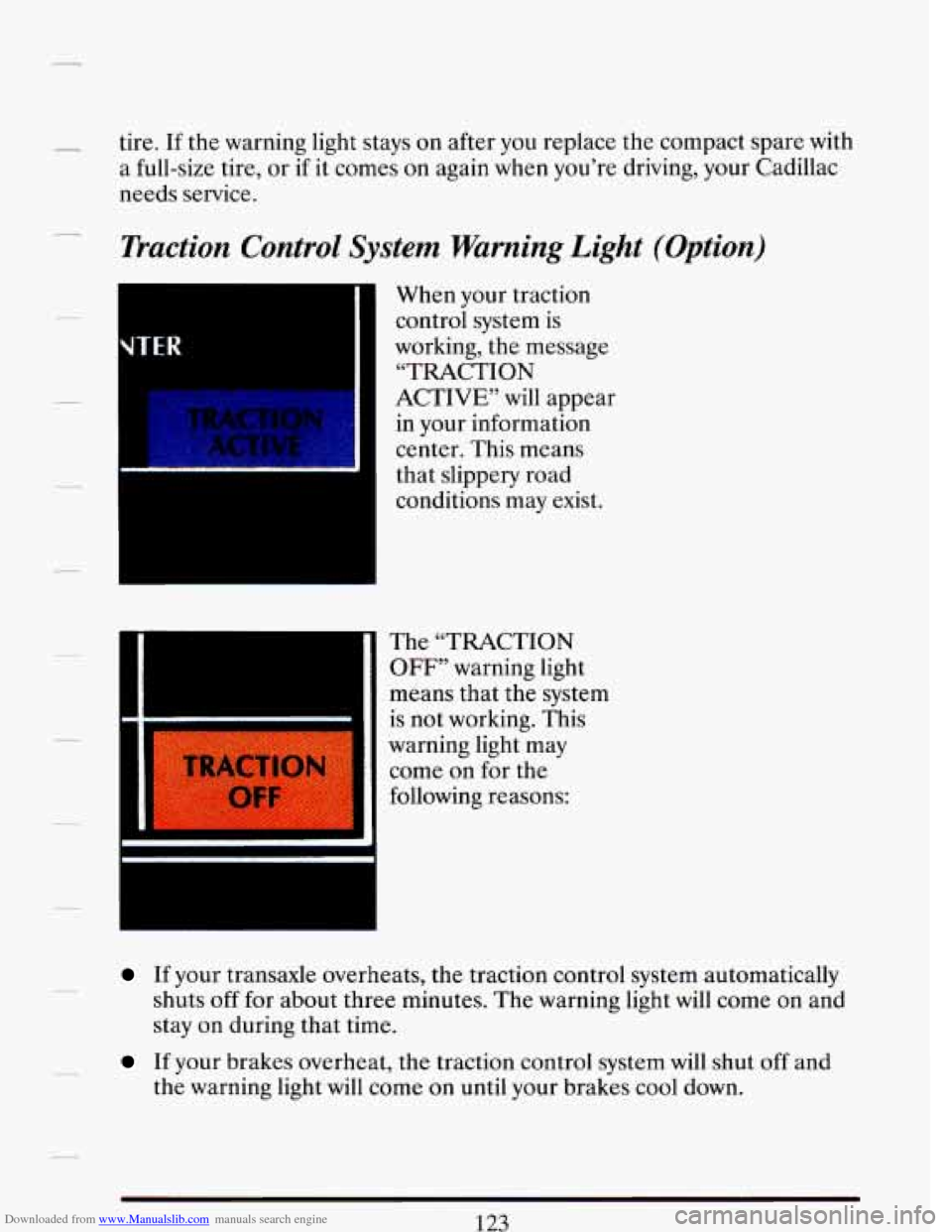
When your traction
control system
is
working, the message
“TRACTION
ACTIVE”
will appear
in your information
center. This means
that slippery road
conditions may exist.
The “TRACTION
OFF” warning light
means that the system
is not working. This
warning light may
come on for the
following reasons:
If your transaxle overheats, the traction control system automatically
shuts
off for about three minutes. The warning light will come on and
stay on during that time.
If your brakes overheat, the traction control system will shut off and
the warning light
will come on until your brakes cool down.
Page 149 of 406
Downloaded from www.Manualslib.com manuals search engine TRACTION CONTROL (OPTION)
If you have this feature, this brake only Traction Control complements
your anti-lock braking system.
Traction Control regulates tire spin during low-speed acceleration and
steady driving.
The Traction Control Brake-Only System uses the same wheel speed
sensors used by your Anti-Lock Brake System
(ABS). When wheel slip is
detected by the wheel sensors, the electronic control module sends a
signal to the brake pressure modulator to apply pressure pulses to the
brakes. Traction is then maximized and your vehicle is enabled to
accelerate or continue driving with a controlled amount of tire slip. This
low-speed system controls tire slippage and is fully functional until you
reach
a speed of 24 mph and then the traction control is gradually phased
out as your vehicle reaches
30 mph. To keep you informed of changing
road conditions the “TRACTION
ACTIVE” telltale light will illuminate
when the system
is activated.
-
Because this is a brake only Traction Control system, it is designed to
protect your vehicles powertrain components. The system
will
temporarily by disabled should the brakes or transaxle reach excessively
high temperatures and prolonged use
of traction control. The
“TRACTION
OFF” telltale light in the instrument panel informs you
when this system is not in operation.
ELECTRONIC LEVEL CONTROL
This keeps your vehicle level.
The ignition does not have to be
“ON” for the level control to work. The
system consists
of an electronic height sensor, a small electric air
compressor, and air adjustable shock absorbers mounted on the rear
of
the vehicle.
If the system has a slight leak, the air compressor will run frequently for a
few seconds each time.
For a massive air leak, the air compressor will stay on
for approximately 7
minutes. You should see your dealer for service, but you can keep driving
your Cadillac.
Page 188 of 406
Downloaded from www.Manualslib.com manuals search engine - YOUR OWN SIGNALS
Drivers signal to others, too. It’s not only more polite, it’s safer to let
requires driver signals.
- other drivers know what you are doing. And in some places the law
Turn and lane change signals. Always signal when you plan to turn or
change lanes.
If necessary, you can use hand signals out the window: Left arm straight
out
for a left turn, down for slow or about-to-stop, and up for a right turn.
Slowing down. If time allows, tap the brake pedal once or twice
in
advance of slowing or stopping. This warns the driver behind you.
Disabled. Your four-way flashers signal that your vehicle
is disabled or is
a hazard. See “Hazard Warning Flashers” in the Index.
- TRAFFIC OFFICER
The traffic police officer is also a source of important information. The
officer’s signals govern, no matter what the traffic lights or other signs
say.
The next section discusses some of the road conditions you may
encounter.
DEFENSIKE DmNG
The best advice anyone can give about driving is: Drive defensively.
Please start with a very important safety device in your Cadillac: Buckle
up. (See “Safety Belts” in the Index.)
Defensive driving really means “be ready for anything.”
On city streets,
rural roads, or freeways, it means “always expect the unexpected.”
Assume that pedestrians or other drivers are going to be careless and
make mistakes. Anticipate what they might do. Be ready for their
mistakes.
Expect children to dash out from behind parked cars, often followed
by
other children. Expect occupants in parked cars to open doors into traffic.
Watch for movement in parked cars
-- someone may be about to open a
door.
175
~ -.
Page 189 of 406
Downloaded from www.Manualslib.com manuals search engine Expect other drivers to run stop signs when you are on a through street.
Be ready to brake if necessary as you go through intersections.
You may
not have to use the brake, but
if you do, you will be ready.
If you’re driving through a shopping center parking lot where there are
well-marked lanes, directional arrows, and designated parking areas,
expect some drivers to ignore all these markings and dash straight toward
one part
of the lot.
Pedestrians can be careless. Watch
for them. In general, you must give
way to pedestrians even if you know you have the right of way.
Rear-end collisions are about the most preventable
of accidents. Yet they
are common. Allow enough following distance. It’s the best defensive
driving maneuver,
in both city and rural driving. You never know when
the vehicle in front
of you is going to brake or turn suddenly.
Here’s
a final bit of information about defensive driving. The most
dangerous time for driving in the
U.S. is very early on Sunday morning. In
fact, GM Research studies show that the most and the least dangerous
times for driving, every week, fall on the same day. That day is Sunday.
The most dangerous time is Sunday from
3 a.m. to 4 a.m. The safest time
is Sunday from
10 a.m. to 11 a.m. Driving the same distance on a Sunday
at
3 a.m. isn’t just a little more dangerous than it is at 10 a.m. It’s about
134 times more dangerous!
That leads to the next section.
-i
r
L.4
DRUNKEN DRMNG
Death and injury associated with drinking and driving is a national
tragedy. It’s the number one contributor to the highway death toll,
claiming thousands
of victims every year. Alcohol takes away three things
that anyone needs to drive a vehicle:
Judgment
0 Muscular Coordination
Vision
Police records show that half
of all motor vehicle-related deaths involve
alcohol
- a driver, a passenger or someone else, such as a pedestrian,
had been drinking. In most cases, these deaths are the result
of someone
176
Page 192 of 406
Downloaded from www.Manualslib.com manuals search engine - accident. At a BAC level of 0.10 percent, the chance of that driver having
an accident is
six times greater; at a level of 0.15 percent, the chances are
twenty-five times greater! And, the body takes about an hour to rid itself
of the alcohol in one drink. No amount of coffee or number of cold
showers will speed that up.
“I’ll be careful” isn’t the right answer. What
if there’s an emergency, a
person with a higher BAC might not be able to react quickly enough to
avoid the collision.
-
-_ need to take sudden action, as when a child darts into the street? A
-~ . There’s something else about drinking and driving that many people
don’t know. Medical research shows that alcohol in a person’s system can
make crash injuries worse. That’s especially true for brain, spinal cord
-- and heart injuries. That means that if anyone who has been drinking --
driver or passenger -- is in a crash, the chance of being killed or
permanently disabled is higher than if that person had not been drinking.
And we’ve already seen that the chance
of a crash itself is higher for
drinking drivers. -
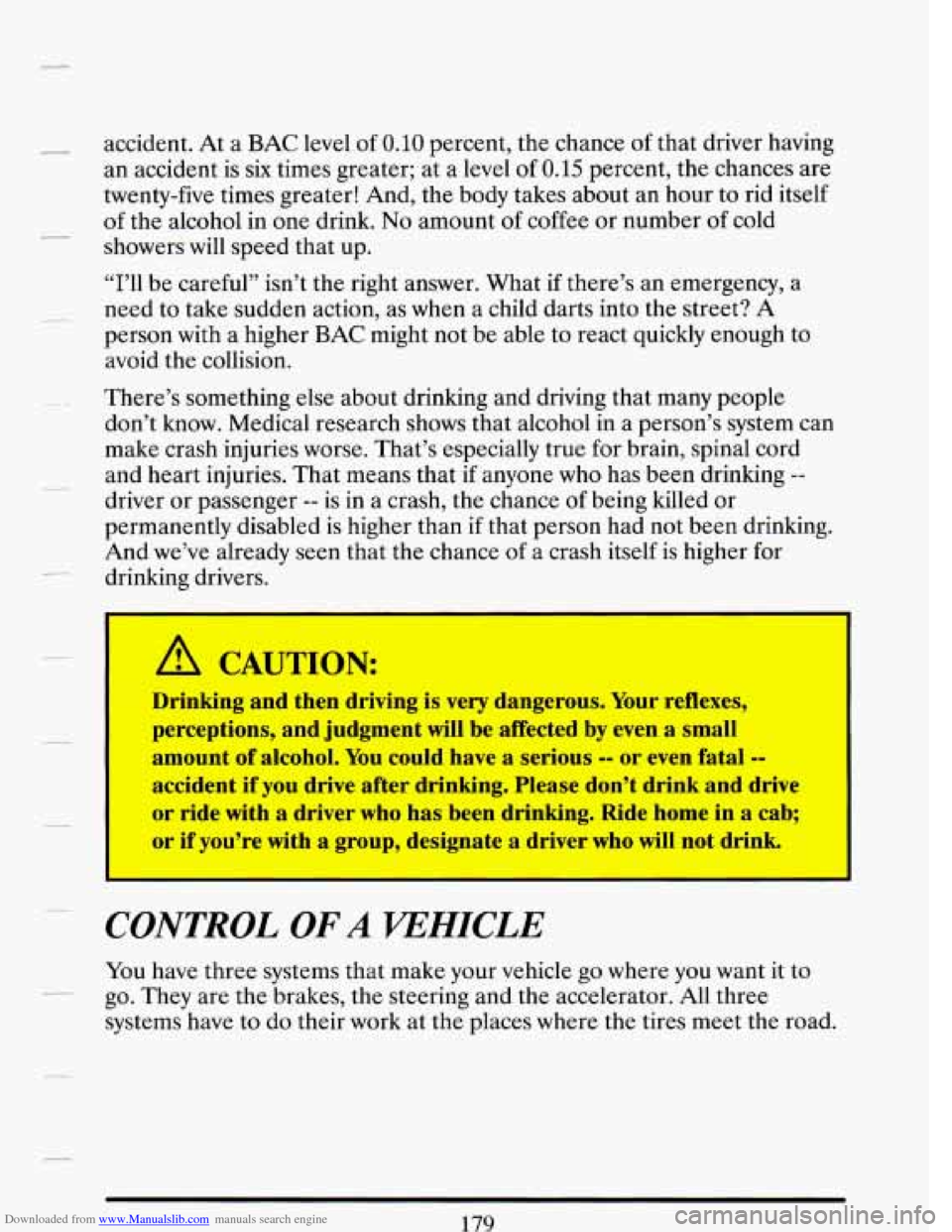
* Drinking and then driving is very dangerous. Your reflexes,
perceptions, and judgment will be affected by even a small
amount of alcohol. You could have a serious -- or even fatal --
accident if you drive after drinking. Please don’t drink and drive
or ride with a driver who has been drinking. Ride home’in a cab;
or if you’re with a pup, designate a driver who will not drink
- CONTROL OF A WHICLE
You have three systems that make your vehicle go where you want it to
go. They are the brakes, the steering and the accelerator.
All three
systems have to do their work at the places where the tires meet the road. --
179
Page 193 of 406

Downloaded from www.Manualslib.com manuals search engine Sometimes, as when you’re driving on snow or ice, it’s easy to ask more of
those control systems than the tires and road can provide. That means
you can lose control
of your vehicle.
BRAKING
Braking action involves perception time and reaction time.
First, you have to decide to push on the brake pedal. That’s perception
- time. Then you have to bring up your foot and do it. That’s reaction time.
Average reaction time is about 3/4 of a second. But that’s only an
average. It might be less with one driver and as long as
two or three
seconds or more with another. Age, physical condition, alertness,
coordination, and eyesight all play
a part. So do alcohol, drugs and
frustration. But even in 3/4
of a second, a vehicle moving at 60 mph (100
km/h) travels 66 feet (20 m). That could be a lot of distance in an
emergency,
so keeping enough space between your vehicle and others is
important.
And, of course, actual stopping distances vary greatly
with the surface of
the road (whether it’s pavement or gravel); the condition
of the road
(wet, dry, icy); tire tread; and the condition
of your brakes.
Most drivers treat their brakes with care. Some, however, overwork the
braking system with poor driving habits.
Avoid needless heavy braking. Some people drive in spurts -- heavy
acceleration followed by heavy braking
-- rather than keeping pace
180
Page 194 of 406
Downloaded from www.Manualslib.com manuals search engine with traffic. This is a mistake. Your brakes may not have time to cool
between hard
stops. Your brakes will wear out much faster if you do a
lot
of heavy braking.
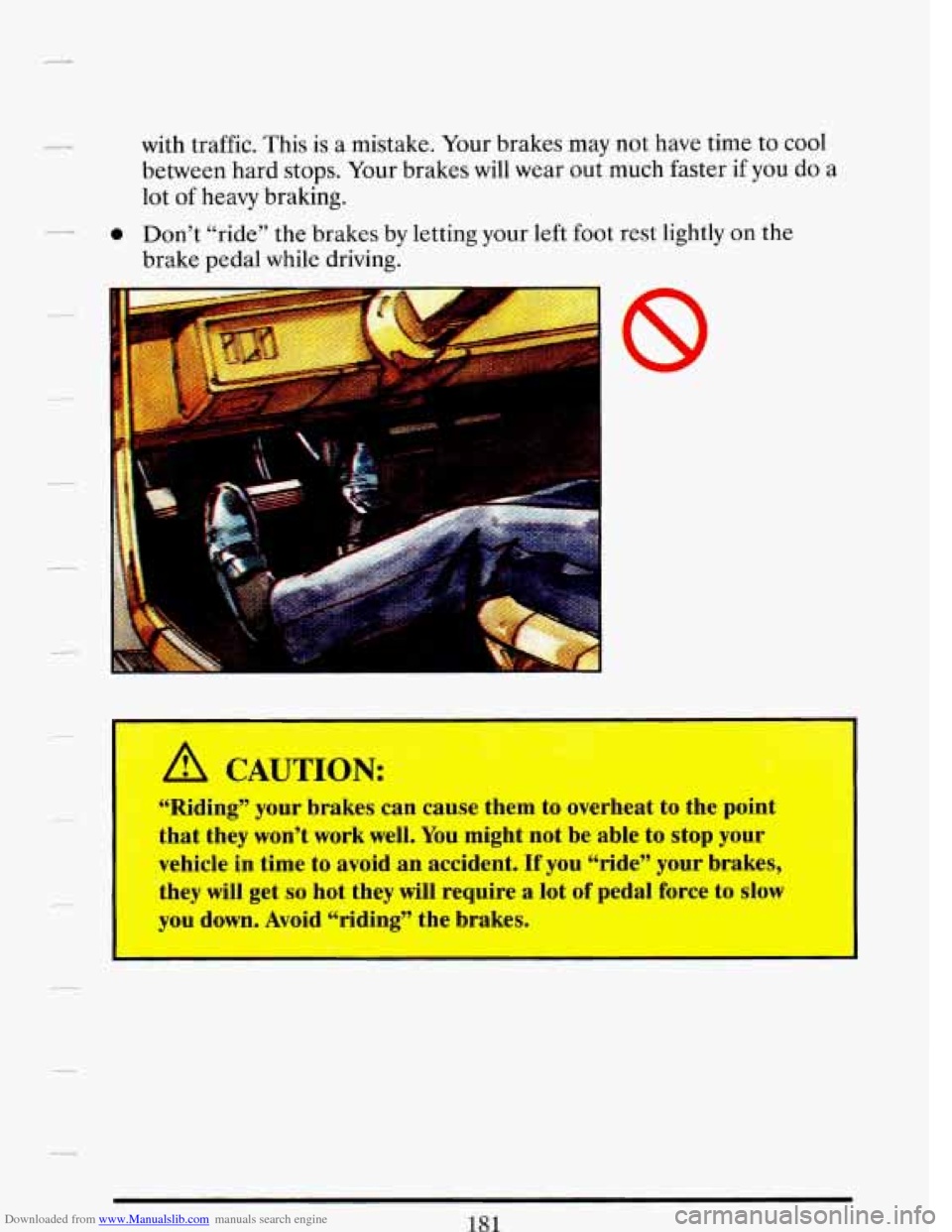
a Don’t “ride” the brakes by letting your left foot rest lightly on the
brake pedal while driving.
CAUTION:
“Riding” your braws can cause them to overheat to the point
that they won’t work well. You might not be able to stop your
vehicle in time to avoid an accident.
If you “ride” your brakes,
they will get
so hot they will require a lot of pedal force to slow
you down. Avoid “riding” the brakes.
Page 195 of 406
Downloaded from www.Manualslib.com manuals search engine If you keep pace with the traffic and allow realistic following distances,
you
will eliminate a lot of unnecessary braking. That means better
braking and longer brake life.
If your engine ever stops while you’re driving, brake normally but
don’t pump your brakes.
If you do, the pedal may get harder to push
down. If your engine stops, you will still have some power brake assist.
But you will use
it when you brake. Once the power assist is used up, it
may take longer
to stop and the brake pedal will be harder to push.
Anti-Lock Brakes (ABS)
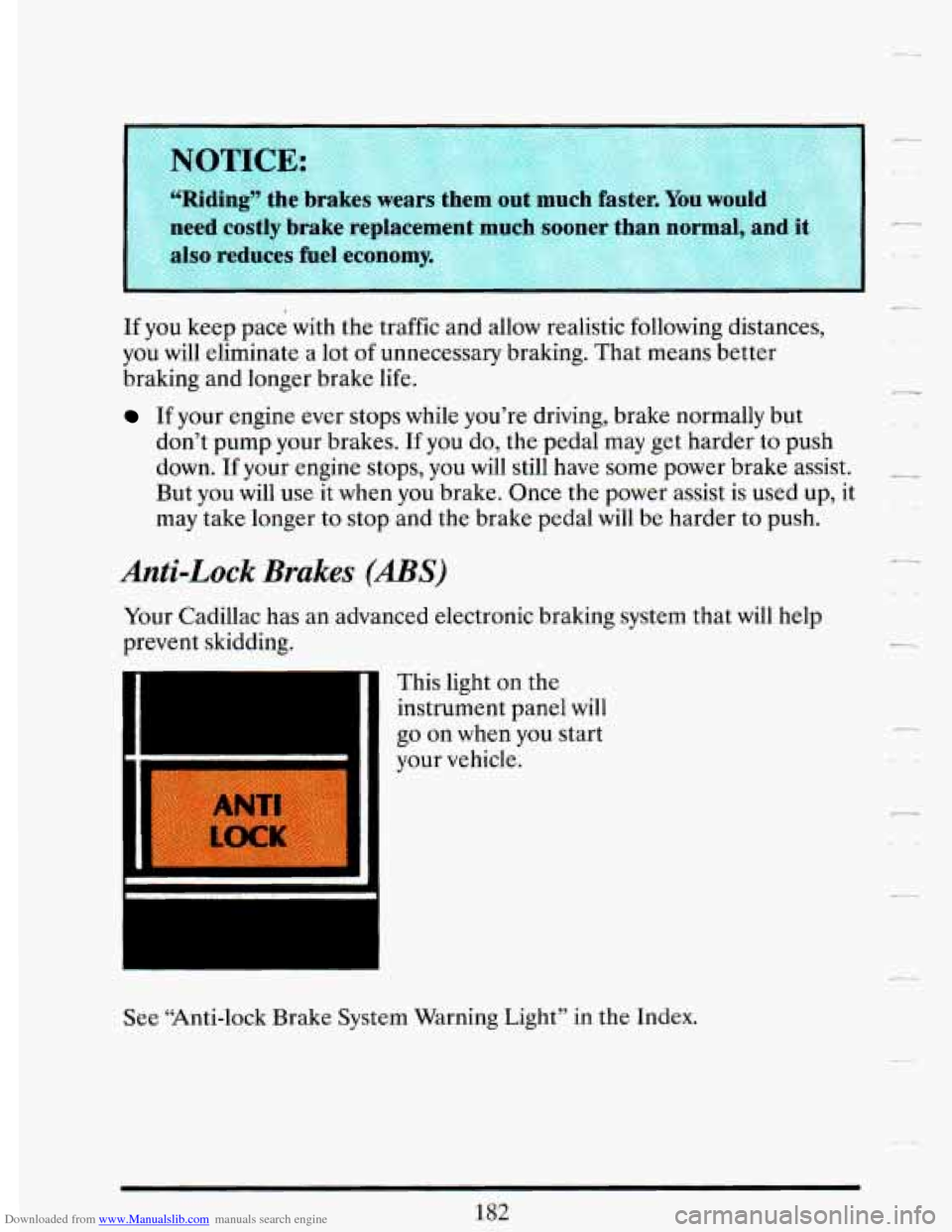
Your Cadillac has an advanced electronic braking system that will help
prevent skidding.
This light on the
instrument panel will
go on when you start
your vehicle.
I
Lr
See “Anti-lock Brake System Warning Light” in the Index.
Page 196 of 406
Downloaded from www.Manualslib.com manuals search engine -
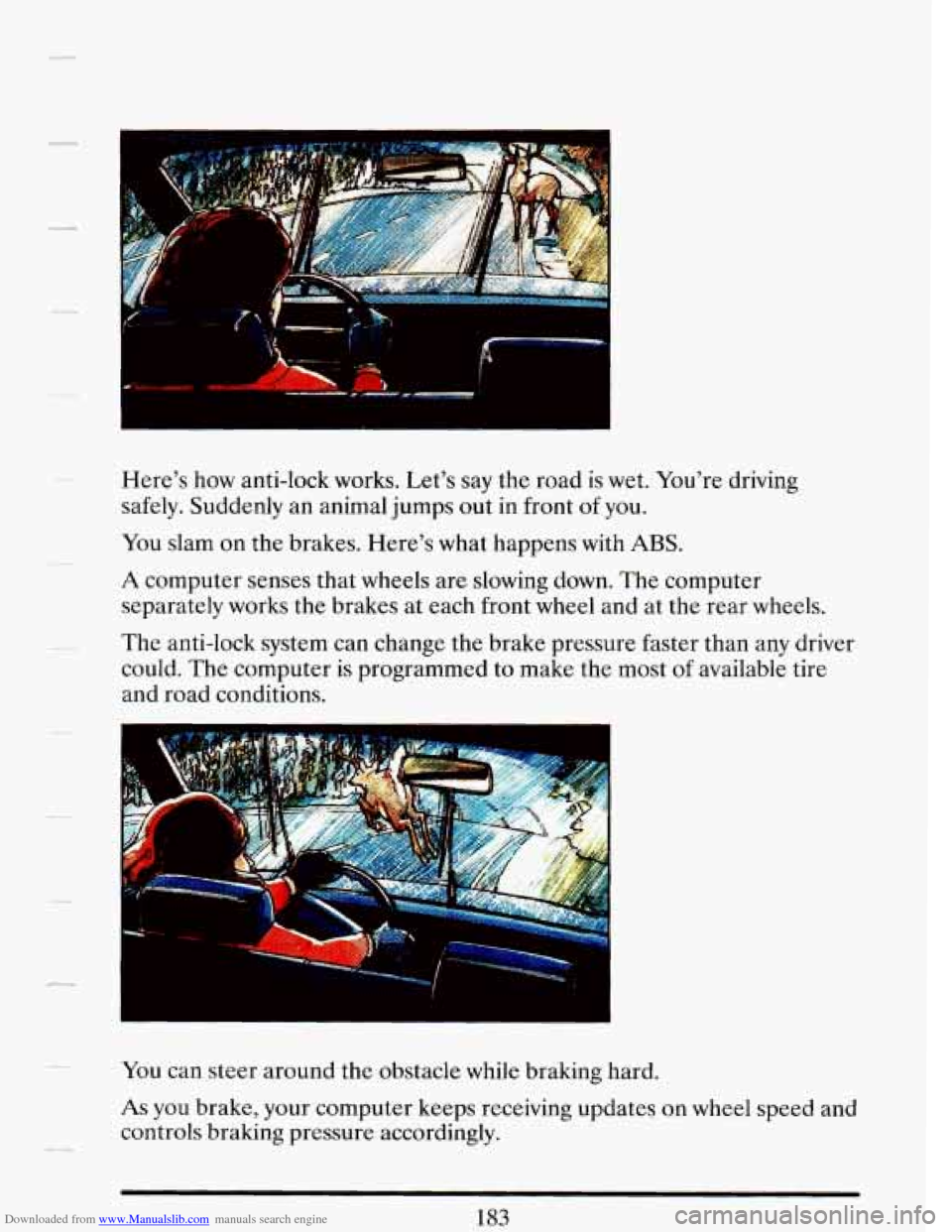
Here's how anti-lock works. Let's say the road is wet. You're driving
safely. Suddenly an animal jumps out in front
of you.
You slam on the brakes. Here's what happens with ABS.
A computer senses that wheels are slowing down. The computer
separately works the brakes at each front wheel and at the rear wheels.
The anti-lock system can change the brake pressure faster than any driver
could. The computer
is programmed to make the most of available tire
and road conditions.
-You can steer around the obstacle while braking hard.
As you brake, your computer keeps receiving updates on wheel speed and
controls braking pressure accordingly.
Page 197 of 406
Downloaded from www.Manualslib.com manuals search engine A CAUTION:
I Anti-lock doesn’t change the time you need to get your foot up to
the brake pedal.
If you get too close to the vehicle in front of
you, you won’t have time to apply your brakes if that vehicle
suddenly slows
or stops. Always leave enough room up ahead to.
stop, even
t- lug ~OU have anti-lock brakes. ..
To Use Anti-Lock:
Don’t pump the brakes. Just hold the brake pedal down and let anti-lock
work for you.
When you start your vehicle and begin to drive away,
you may hear a
momentary motor or clicking noise. And you may even notice that your
brake pedal moves a little while this is going
on. This is the ABS system
testing itself. You may also hear this during
a hard stop.
Traction Control System (Option)
Your vehicle may have a traction control system that limits wheel spin.
This is especially useful in slippery road conditions. The traction control
system works at low speeds only, such as when you accelerate from
a stop.
It applies brake pressure to an individual wheel that the system senses is
about to spin.
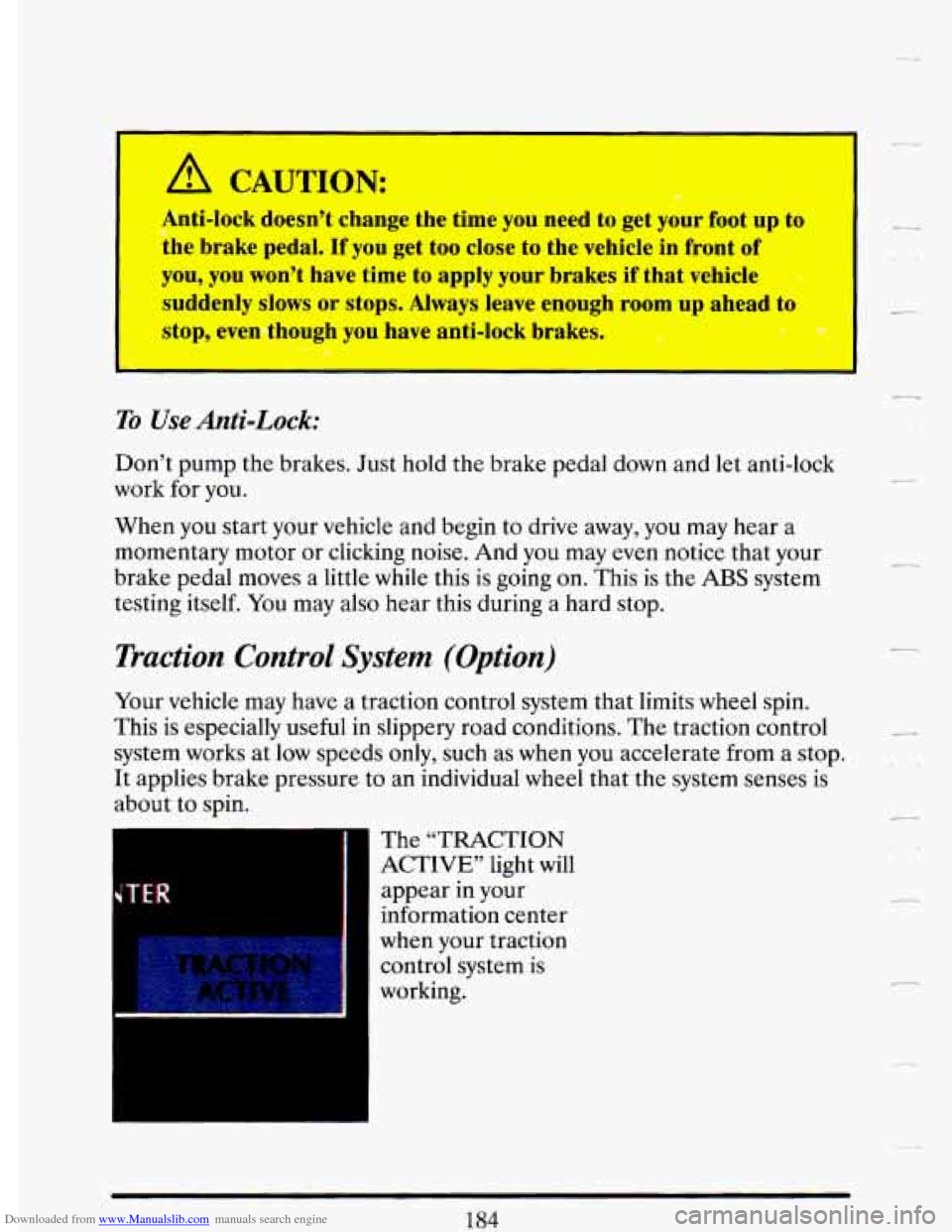
ITER
The “TRACTION
ACTIVE’’ light will
appear in your
information center
when your traction
control system is
working.
r
184