brakes CADILLAC DEVILLE 1993 7.G Owner's Manual
[x] Cancel search | Manufacturer: CADILLAC, Model Year: 1993, Model line: DEVILLE, Model: CADILLAC DEVILLE 1993 7.GPages: 406, PDF Size: 20.78 MB
Page 227 of 406
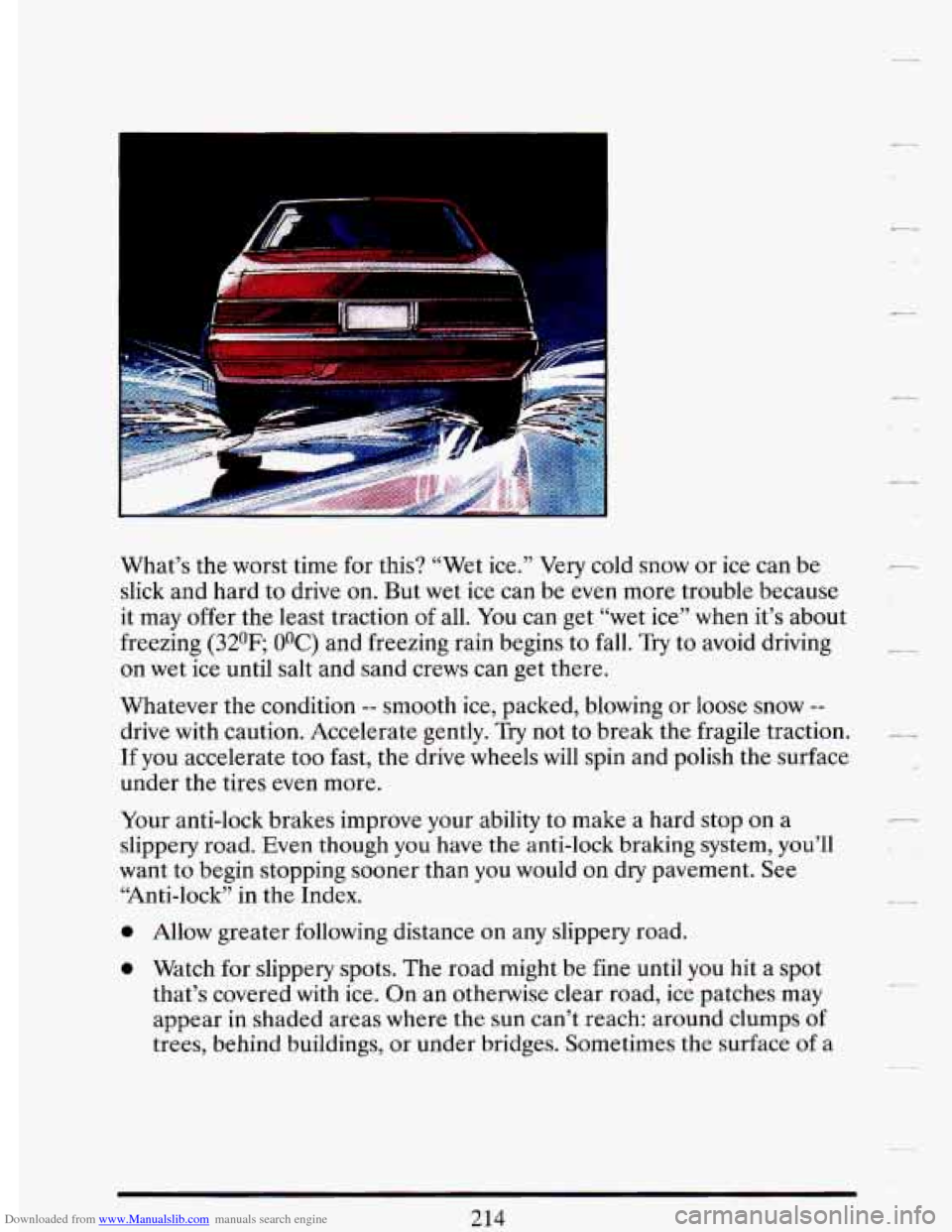
Downloaded from www.Manualslib.com manuals search engine What’s the worst time for this? “Wet ice.” Very cold snow or ice can be
slick and hard to drive
on. But wet ice can be even more trouble because
it may offer the least traction
of all. You can get “wet ice” when it’s about
freezing
(32OF; O°C) and freezing rain begins to fall. Try to avoid driving
on wet ice until salt and sand crews can get there.
Whatever the condition
-- smooth ice, packed, blowing or loose snow --
drive with caution. Accelerate gently. Try not to break the fragile traction.
If you accelerate too fast, the drive wheels
will spin and polish the surface
under the tires even more.
Your anti-lock brakes improve your ability to make a hard stop on
a
slippery road. Even though you have the anti-lock braking system, you’ll
want to begin stopping sooner than you would
on dry pavement. See
“Anti-lock” in the Index.
0 Allow greater following distance on any slippery roaa.
0 Watch for slippery spots. The road might be fine until you hit a spot
that’s covered with ice. On an otherwise clear road, ice patches may
appear in shaded areas where the sun can’t reach: around clumps
of
trees, behind buildings, or under bridges. Sometimes the surface of a
214
Page 230 of 406
Downloaded from www.Manualslib.com manuals search engine If You’re Stuck in Deep Snow
This manual explains how to get the vehicle out of deep snow without
damaging it. See “Rocking Your Vehicle” in the Index.
TOWING A TWLER
I
‘ A CAUTION:
If you don’t use the correct equipment and drive properly, you
can lose control when you pull
a trailer. For example, if the
trailer
is too heavy, the brakes may not work well -- or even at
all. You and your passengers could be seriously injured. Pull a
trailer only if you have followed all the steps in this section.
Your vehicle can tow a trailer.
To identify what the vehicle trailering
capacity is for your vehicle, you should read the information in “Weight
of the Trailer” that appears later in this section. But trailering is different
than just driving your vehicle by itself. Trailering means changes in
handling, durability, and fuel economy. Successful, safe trailering takes
correct equipment, and it has to be used properly.
That’s the reason for this section. In
it are many time-tested, important
trailering tips and safety rules. Many of these are important for your
safety and that
of your passengers. So please read this section carefully
before you pull a trailer.
Load-pulling components such as the engine, transaxle, wheel assemblies,
and tires are forced to work harder against the drag of the added weight.
The engine is required
to operate at relatively higher speeds and under
217
Page 233 of 406
Downloaded from www.Manualslib.com manuals search engine e Will you have to make any holes in the body of your vehicle when you
install a trailer hitch? If you do, then be sure to seal the holes later
when you remove the hitch.
If you don’t seal them, deadly carbon
monoxide
(CO) from your exhaust can get into your vehicle (see
“Carbon Monoxide’’ in the Index). Dirt and water can, too.
e Don’t let the steel in a hitch contact the aluminum on your bumper. If
you do, the two will corrode. You can use something like paint or
plastic tape to separate the steel and aluminum. The same steel to
aluminum problem can happen with fasteners, too.
Safety Chains
You should always attach chains between your vehicle and your trailer.
Cross the safety chains under the tongue
of the trailer so that the tongue
will not drop to the road if it becomes separated from the hitch.
Instructions about safety chains may be provided by the hitch
manufacturer or by the trailer manufacturer. Follow the manufacturer’s
recommendation
for attaching safety chains. Always leave just enough
slack
so you can turn with your rig. And, never allow safety chains to drag
on the ground.
Trailer Brakes
Does your trailer have its own brakes? Be sure to read and follow the
instructions for the trailer brakes
so you’ll be able to install, adjust and
maintain them properly. Because you have anti-lock brakes, do not try to
tap into your vehicle’s brake system.
If you do, both brake systems won’t
work well,
or at all.
Driving with a Trailer
Towing a trailer requires a certain amount of experience. Before setting
out for the open road,’you’ll want to get to know your rig. Acquaint
yourself with the feel
of handling and braking with the added weight of
the trailer. And always keep in mind that the vehicle you are driving is
now
a good deal longer and not nearly so responsive as your vehicle is by
itself.
Before you start, check the trailer hitch and platform, safety chains,
electrical connector, lights, tires and mirror adjustment. If the trailer has
L
.-.
Page 234 of 406
Downloaded from www.Manualslib.com manuals search engine electric brakes, start your vehicle and trailer moving and then apply the
trailer brake controller by hand to be sure the brakes are working. This
lets you check your electrical connection at the same time.
During your trip, check occasionally to be sure that the load is secure,
and that the lights and any trailer brakes are still working.
Following Distance
Stay at least twice as far behind the vehicle ahead as you would when
driving your vehicle without
a trailer. This can help you avoid situations
that require heavy braking and sudden turns.
Passing
You’ll need more passing distance up ahead when you’re towing a trailer.
And, because you’re a good deal longer, you’ll need to go much farther
beyond the passed vehicle before you can return to your lane.
Backing Up
Hold the bottom of the steering wheel with one hand. Then, to move the
trailer to the left, just move that hand to the left.
To move the trailer to
th.e right, move your hand to the right. Always back up slowly and,
if
possible, have someone guide you.
Making Turns
When you’re turning with a trailer, make wider turns than normal. Do
this so your trailer won’t strike soft shoulders, curbs, road signs, trees, or
other objects. Avoid jerky
or sudden maneuvers. Signal well in advance.
Turn Signals When Towing a Trailer
When you tow a trailer, your vehicle has to have a different turn signal
flasher and extra wiring. The green arrows on your instrument panel
will
flash whenever you signal a turn or lane change. Properly hooked up, the
trailer lights will also flash, telling other drivers you’re about to turn,
change lanes or stop.
When towing
a trailer, the green arrows on your instrument panel will
flash for turns even
if the bulbs on the trailer are burned out. Thus, you
221
Page 235 of 406
Downloaded from www.Manualslib.com manuals search engine may think drivers behind you are seeing your signal when they are not.
It’s important to check occasionally to be sure the trailer bulbs are still
working.
Your vehicle has bulb warning lights. When you plug trailer lights into
your vehicle’s lighting system, its bulb warning lights may not let you
know if one
of your lights goes out. So, when you have trailer lights
plugged in, be sure to check your vehicle and trailer lights
from time to
time to be sure they’re all working. Once you disconnect the trailer lights,
the bulb warning lights again can tell you if one of your vehicle lights is
out.
Driving On Grades
Reduce speed and shift to a lower gear before you start down a long or
steep downgrade.
If you don’t shift down, you might have to use your
brakes
so much that they would get hot and no longer work well.
On a long uphill grade, shift down to “3” (Drive) and reduce your speed
to
45 mph (70 km/h) to reduce the possibility of engine and transaxle
overheating.
Parking on Hills
You really should not park your vehicle, with a trailer attached, on a hill.
If something goes wrong, your rig could start to move. People can be
injured, and both your vehicle and the trailer can be damaged.
But if you ever have to park your rig on a hill, here’s how to do it:
1. Apply your regular brakes, but don’t shift into “P” (Park) yet.
2. Have someone place chocks under the trailer wheels.
3. When the wheel chocks are in place, release the regular brakes until
the chocks absorb the load.
4. Reapply the regular brakes. Then shift into “P” (Park) firmly and
apply your parking brake.
5. Release the regular brakes.
222
Page 236 of 406
Downloaded from www.Manualslib.com manuals search engine When You Are Ready to Leave After Parking on a Hill
1. Apply your regular brakes and hold the pedal down while you:
Start your engine;
0 Shift into a gear; and
0 Be sure the parking brake has released.
2. Let up on the brake pedal.
3. Drive slowly until the trailer is clear
of the chocks.
4. Stop and have someone pick up and store the chocks.
Maintenance When Trailer Towing
Your vehicle will need service more often when you’re pulling a trailer.
See the Maintenance Schedule for more on this. Things that are
especially important in trailer operation are automatic transaxle fluid
(don’t overfill), engine oil, axle lubricant, belts, cooling system, and brake
adjustment. Each
of these is covered in this manual, and the Index will
help you find them quickly. If you’re trailering, it’s a good idea to review
these sections before you start your trip.
Check periodically to see that all hitch nuts and bolts are tight.
223
Page 298 of 406
Downloaded from www.Manualslib.com manuals search engine put in, the fluid level goes back up. The other reason is that fluid is
leaking out
of the brake system. If it is, you should have your brake
system fixed, since a leak means that sooner
or later your brakes won’t
work well, or won’t work at all.
So, it isn’t a good idea to “top off” your
brake fluid. Adding brake fluid won’t correct a leak.
If you add fluid when
your linings are worn, then you’ll have too much fluid when you get new
brake linings.
You should add (or remove) brake fluid, as necessary, only
when work is done on the brake hydraulic system.
I
I A= CAUTION
I
I only when work is done on the brake hydraulic system.
If you have too much brake fluid, it can spill on the engine. The
fluid will burn if the engine is hot enough. You or others could
be burned, and your vehicle could be damaged. Add brake fluid
U
When your brake fluid falls to a low level, your brake warning light will
come on. See “Brake System Warning Light” in the Index.
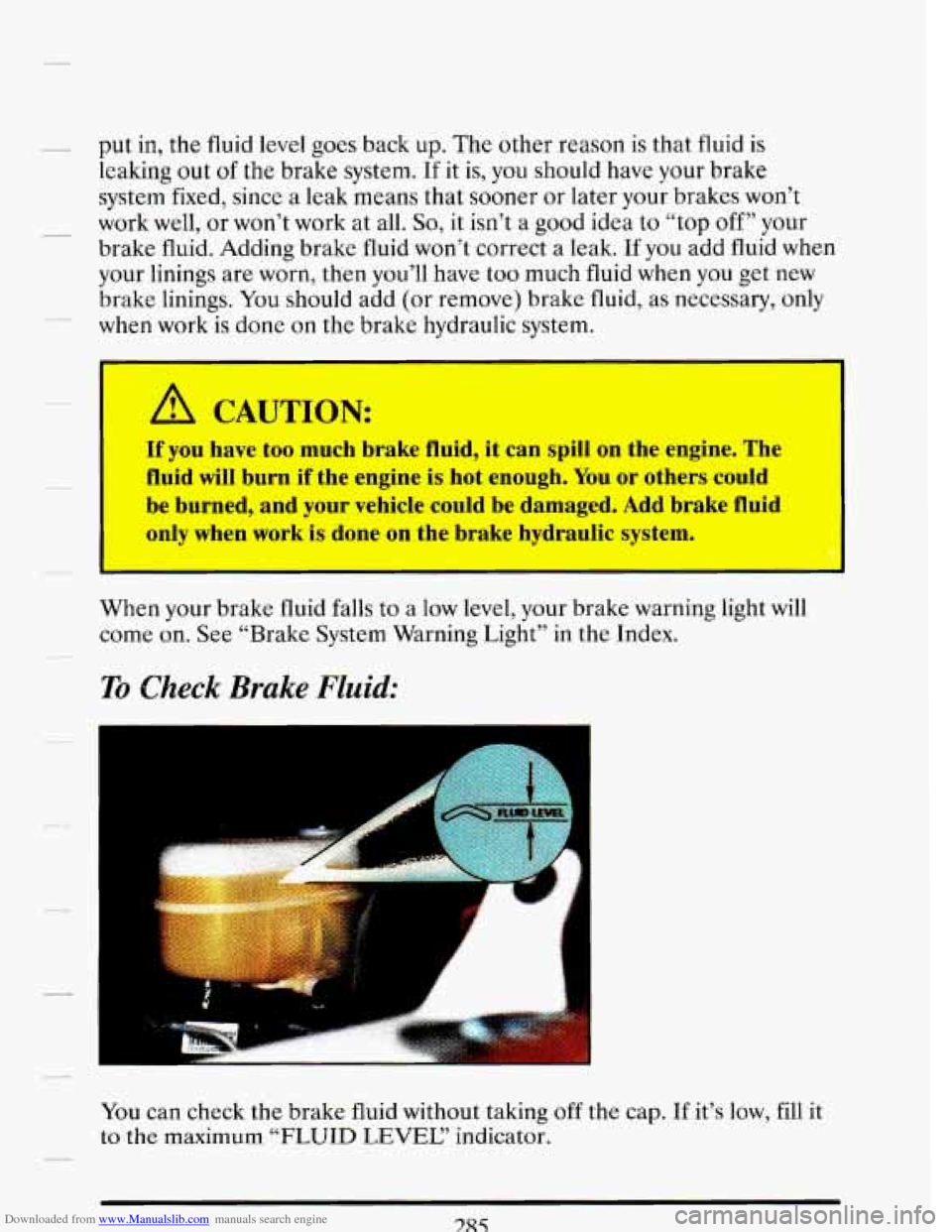
To Check Brake Fluid:
You can check the brake fluid without taking off the cap. If it’s low, fill it
to the maximum “FLUID LEVEC’ indicator.
285
Page 299 of 406

Downloaded from www.Manualslib.com manuals search engine What to Add:
When you do need brake fluid, use only DOT-3 brake fluid -- such as
Delco Supreme
11s (GM part No.1052535). Use new brake fluid from a
sealed container only.
REPLACING BRAKE SYSTEM PARTS
The braking system on a modern vehicle is complex. Its many parts have
to be
of top quality and work well together if the vehicle is to have really
good braking. Vehicles
we design and test have top-quality GM brake
parts in them, as your Cadillac does when it is new. When you replace
parts of your braking system
-- for example, when your brake linings wear
down and you have to have new ones put in
-- be sure you get new
genuine
GM replacement parts. If you don't, your brakes may no longer
work properly. For example, if someone puts in brake linings that are
wrong for your vehicle, the balance between your front and rear brakes
can change, for the worse. The braking performance you've come to
expect can change in many other ways if someone puts in the wrong
replacement brake parts.
L.:d
r I' u
286
Page 389 of 406
Downloaded from www.Manualslib.com manuals search engine .
.
.
.
.
. .
.
.
.
SUBJECT INDEX
A
ACC (Ignition Key Position) ........................... 74
Adding Accessory Power. Retained
.......................... 328
BrakeFluid ..................................... 284
Electrical Equipment ............................. 327
Engine Coolant ................................. 279
Power Steering Fluid ............................. 281
Transaxle Fluid .................................. 277
Additives. Engine Oil ............................... 272
Adjustment. Brake ................................. 186
Adult Safety Belt Usage .............................. 18
Air Bag ............................................ 28
Air Bag System Light ................................ 29
Aircleaner ....................................... 274
Air Conditioner .................................... 139
Air Conditioner. Warning Light ....................... 129
Air Outlets ........................................ 137
Air System ........................................ 137
Alarm. How To Turn Off Theft ........................ 71
Alcohol in Gasoline ................................. 261
Aluminum Wheels. Cleaning ......................... 322
AM Radio Reception ............................... 145
AM Stereo Radio Reception ......................... 1.45
Antenna. Cleaning Radio ............................ 164
Antifreeze ........................................ 278
Anti-lock Brakes ................................... 182
Anti-lock Brake System Warning Light ................. 122
Anti-Theft Tips ..................................... 70
Appearance Care ................................... 314
Appearance Care. Service and ........................ 260
Ashtrays .......................................... 115
Astroroof - Express Open ............................ 114
Automatic Air Conditioning System ................... 137
Automatic Door Lock ................................ 62
Automatic Overdrive ................................ 80
Air Cleaner & PCV Filter Replace .... See Maint . Book. p.22
Alcohol. Driving Under The Influence Of .............. 176
Arm. Wearing A Safety Belt Under Your ................ 26
.
1
Page 390 of 406
Downloaded from www.Manualslib.com manuals search engine .
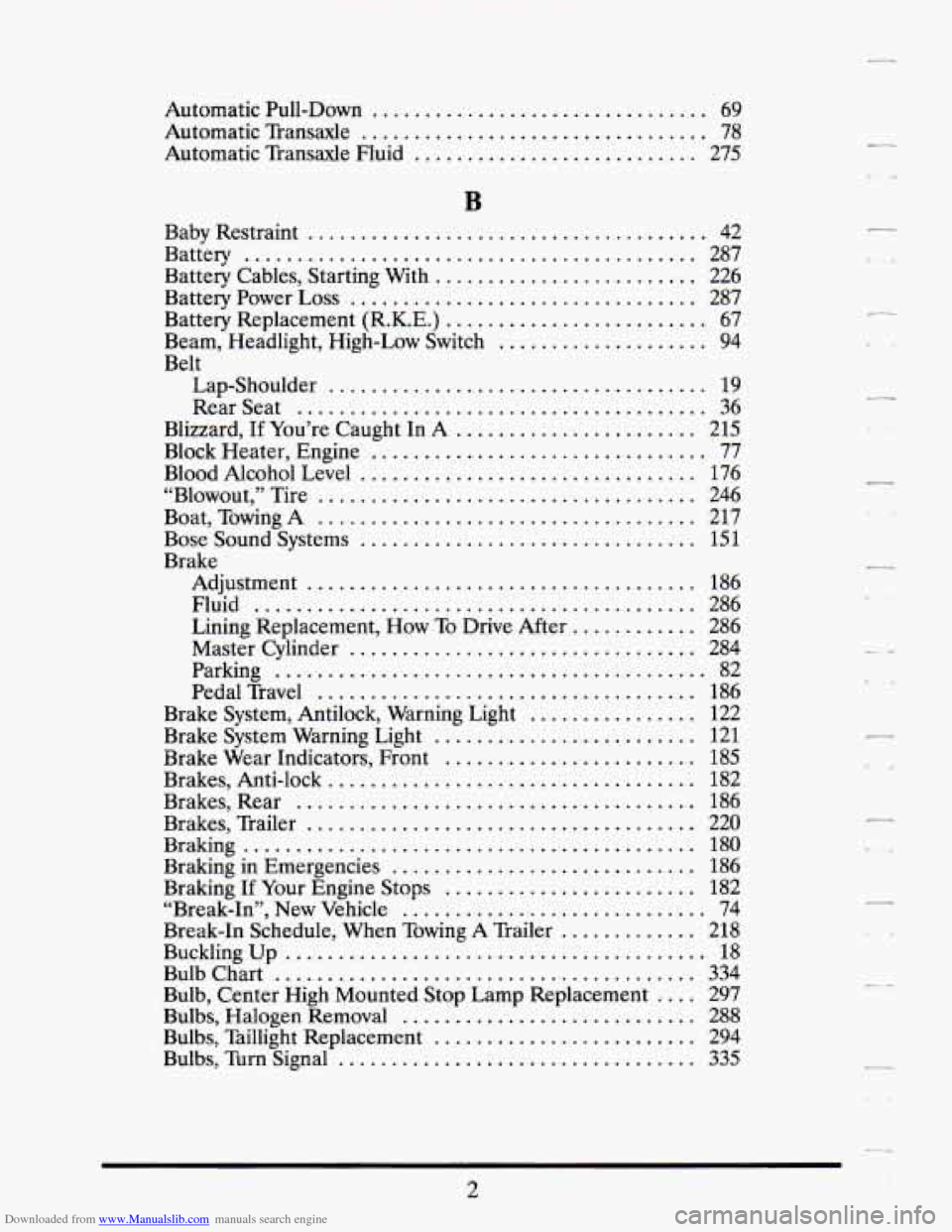
Automatic Pull-Down ................................ 69
Automatic Transaxle ................................. 78
Automatic Transaxle Fluid ........................... 275 .
Baby Restraint ...................................... 42
Battery ........................................... 287
Battery Cables. Starting With ......................... 226
Battery Power Loss ................................. 287
Battery Replacement (R.K.E.) ......................... 67
Beam. Headlight. High-Low Switch .................... 94
Belt
Lap-Shoulder
.................................... 19
Rear Seat ....................................... 36
Blizzard. If You’re Caught In A ....................... 215
Block Heater. Engine ................................ 77
Blood Alcohol Level ................................ 176
“Blowout. .. Tire .................................... 246
Boat. Towing A .................................... 217
Bose Sound Systems ................................ 151
Adjustment ..................................... 186
Fluid .......................................... 286
Lining Replacement. How To Drive After ............ 286
Master Cylinder ................................. 284
PedalTravel .................................... 186
Brake
Parking
......................................... 82
Brake System. Antilock. Warning Light ................ 122
Brake System Warning Light ......................... 121
Brake Wear Indicators. Front ........................ 185
Brakes. Anti-lock ................................... 182
Brakes. Rear ...................................... 186
Brakes. Trailer ..................................... 220
Braking in Emergencies ............................. 186
Braking ........................................... 180
Braking If Your Engine Stops ........................ 182
“Break-In”. New Vehicle ............................. 74
Break-In Schedule. When Towing A Trailer ............. 218
Bucklingup ........................................ 18
Bulb Chart ........................................ 334
Bulb. Center High Mounted Stop Lamp Replacement .... 297
Bulbs. Halogen Removal ............................ 288
Bulbs. Taillight Replacement ......................... 294
Bulbs. Turn Signal .................................. 335
.
.
b.
L-
-.-
‘Le
.
‘L
.
u
...
2