tires CADILLAC DEVILLE 1993 7.G Owner's Manual
[x] Cancel search | Manufacturer: CADILLAC, Model Year: 1993, Model line: DEVILLE, Model: CADILLAC DEVILLE 1993 7.GPages: 406, PDF Size: 20.78 MB
Page 245 of 406
Downloaded from www.Manualslib.com manuals search engine TOMNG YOUR mHICLE
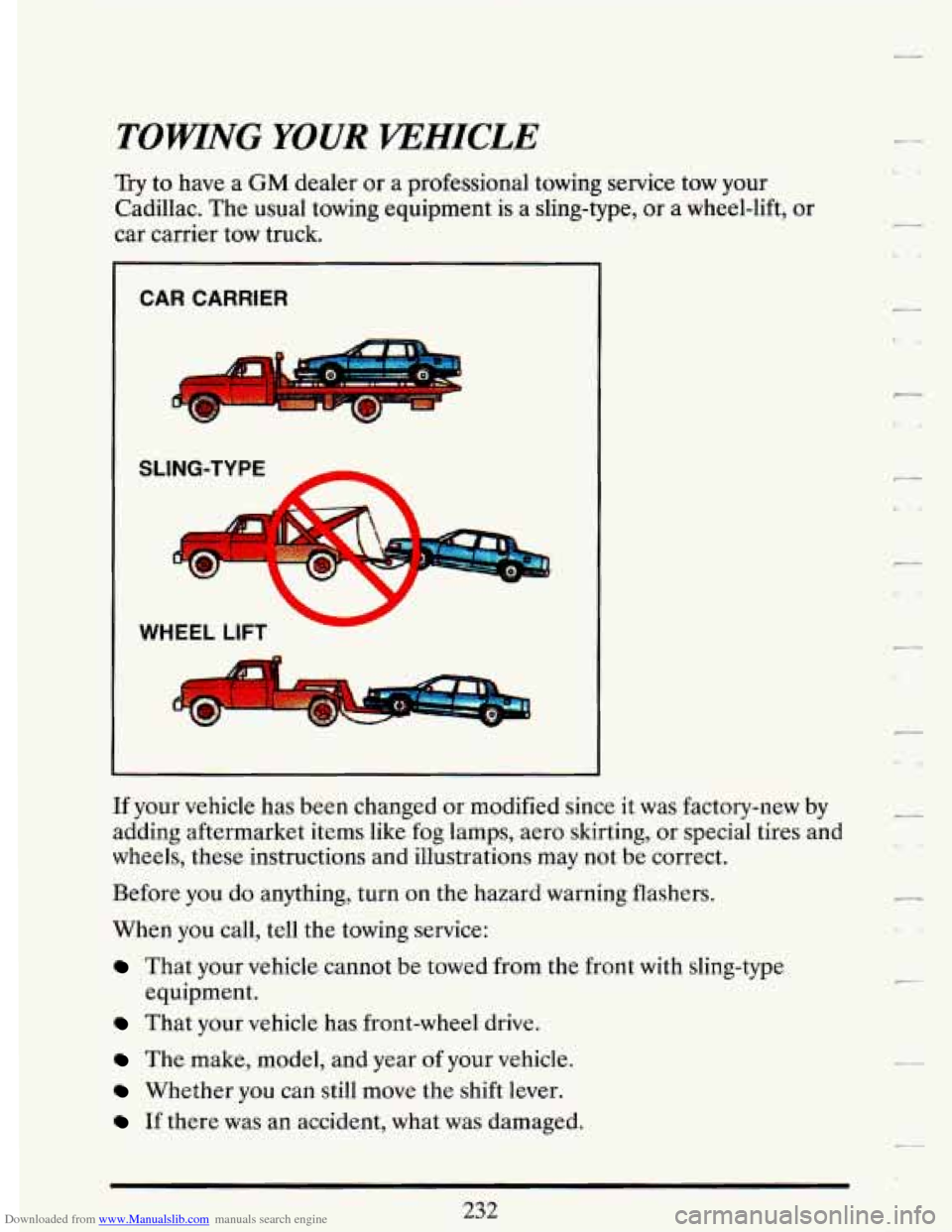
Try to have a GM dealer or a professional towing service tow your
Cadillac. The usual towing equipment
is a sling-type, or a wheel-lift, or
car carrier tow truck.
CAR CARRIER
.
SLING-TYPE
WHEEL LIFT
.
J
n
J
V
7
If your vehicle has been changed or modified since it was factory-new by
adding aftermarket items like fog lamps, aero skirting, or special tires and
wheels, these instructions and illustrations may not be correct.
Before you do anything, turn on the hazard warning flashers.
When you call, tell the towing service:
That your vehicle cannot be towed from the front with sling-type
That your vehicle has front-wheel drive.
The make, model, and year of your vehicle.
Whether you can still move the shift lever.
If there was an accident, what was damaged.
equipment.
232
Page 259 of 406
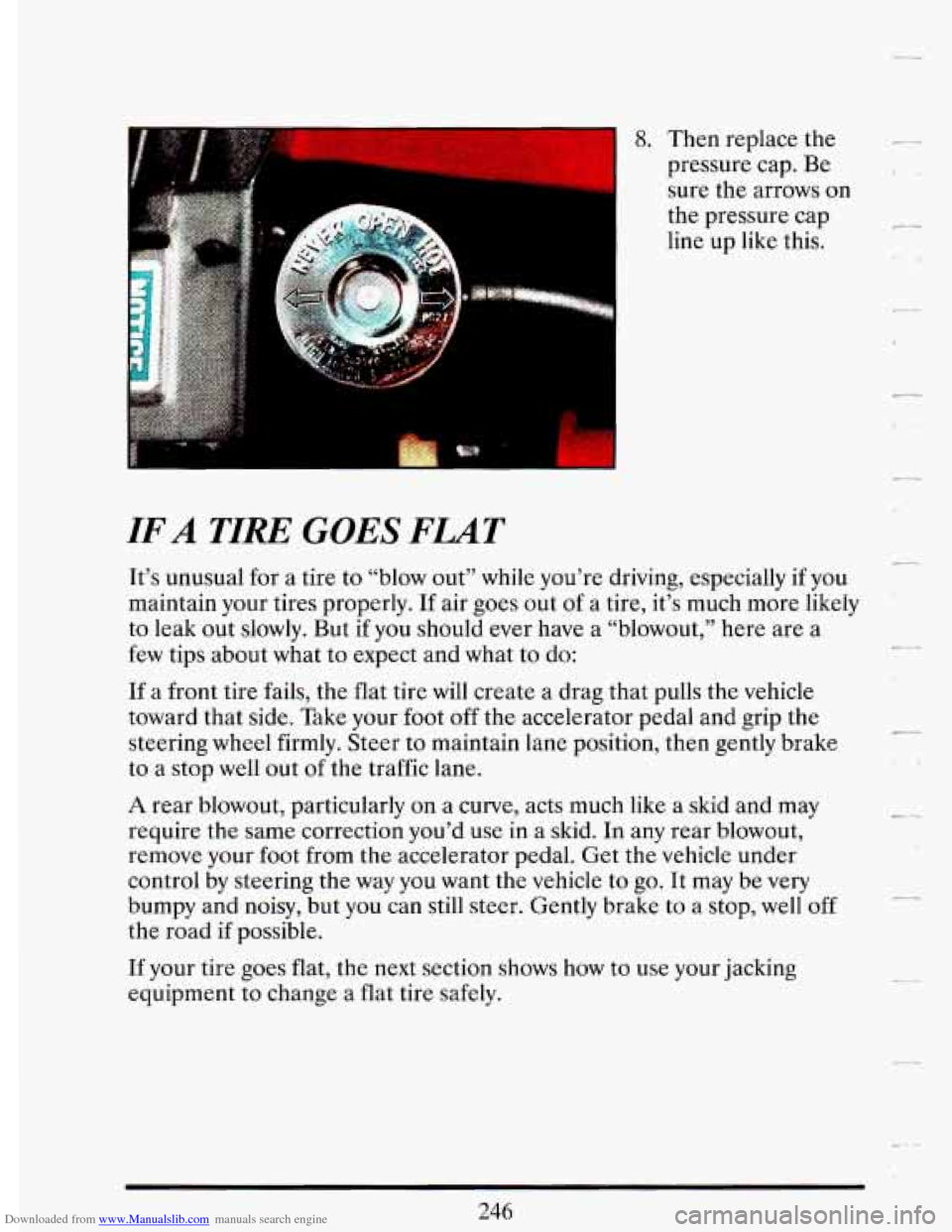
Downloaded from www.Manualslib.com manuals search engine I 8. Then replace the
pressure cap. Be sure the arrows on
the pressure cap
line up like this.
IF A TIRE GOES FLAT
It’s unusual for a tire to “blow out” while you’re driving, especially if you
maintain your tires properly. If air goes out
of a tire, it’s much more likely
to leak out slowly. But if you should ever have a “blowout,” here are a
few tips about what to expect and what to do:
If a front tire fails, the flat tire will create a drag that pulls the vehicle
toward that side. Take your foot
off the accelerator pedal and grip the
steering wheel firmly. Steer to maintain lane position, then gently brake
to a stop well out
of the traffic lane.
A rear blowout, particularly on a curve, acts much like a skid and may
require the same correction you’d use
in a skid. In any rear blowout,
remove your foot from the accelerator pedal. Get the vehicle under
control by steering the way you want the vehicle to go.
It may be very
bumpy and noisy, but you can still steer. Gently brake
to a stop, well off
the road if possible.
If your tire goes flat, the next section shows how to use your jacking
equipment to change a flat tire safely.
Page 270 of 406
Downloaded from www.Manualslib.com manuals search engine P
- r
Don’t use your compact spare on some other vehicle.
And don’t mix your compact spare or wheel with other wheels
or tires.
They won’t fit. Keep your spare and its wheel together.
A CAUTION:
Storing a jack, a tire, or other equipment in the passenger
compartment
of the vehicle could cause injury. In a sudden stop
or collision, loose equipment could strike someone. Store all
these in the proper place.
IF YOU’RE STUCK: IN SAND, MUD, ICE OR
SNOW
What you don’t want to do when your vehicle is stuck is to spin your
wheels. The method known as “rocking” can help you get out when
you’re stuck, but you must use caution.
257
Page 271 of 406
Downloaded from www.Manualslib.com manuals search engine A CAUTION:
If you let your tires spin at high speed, they can explode and you
or others could be injured. And, the transaxle or other parts
of
the vehicle can overheat. That could cause an engine fire or
other damage. When you’re stuck, spin the wheels as little as
possible. Don’t spin the wheels above
35 mph (55 km/h) as
shown on the beedometer.
transaxle back and forth, you can destroy your transarl-
Rocking your vehicle to get it out:
First, turn your steering wheel left and right. That
will clear the area
around your front wheels. Then shift back and forth between
“R’
(Reverse) and a forward gear, spinning the wheels as little as possible.
Release the accelerator pedal while
you shift, and press lightly on the
accelerator pedal when the transaxle is
in gear. If that doesn’t get you out
after
a few tries, you may need to be towed out. If you do need to be
towed out, see “Towing Your Vehicle”
in the Index.
-
L
Page 316 of 406
Downloaded from www.Manualslib.com manuals search engine - LOADING YOUR VEHICLE
TIRE-LOADING INFORMATION
/ OCCUPANTS VEHICLE CAP. WT.
FRT. CTR. RR. TOTAL LBS. KG
MAX. LOADING
& GVWR SAME AS VEHICLE
CAPACITY WEIGHT XXX COLD
TIRE
TIRE SIZE SPEED PRESSURE
RTG PSVKPa
F RT.
R R.
SPA.
IF TIRES ARE HOT. ADD 4PSV28KPa SEE
OWNER’S MANUAL
FOR ADDITIONAL
INFORMATION
GEN GME 1
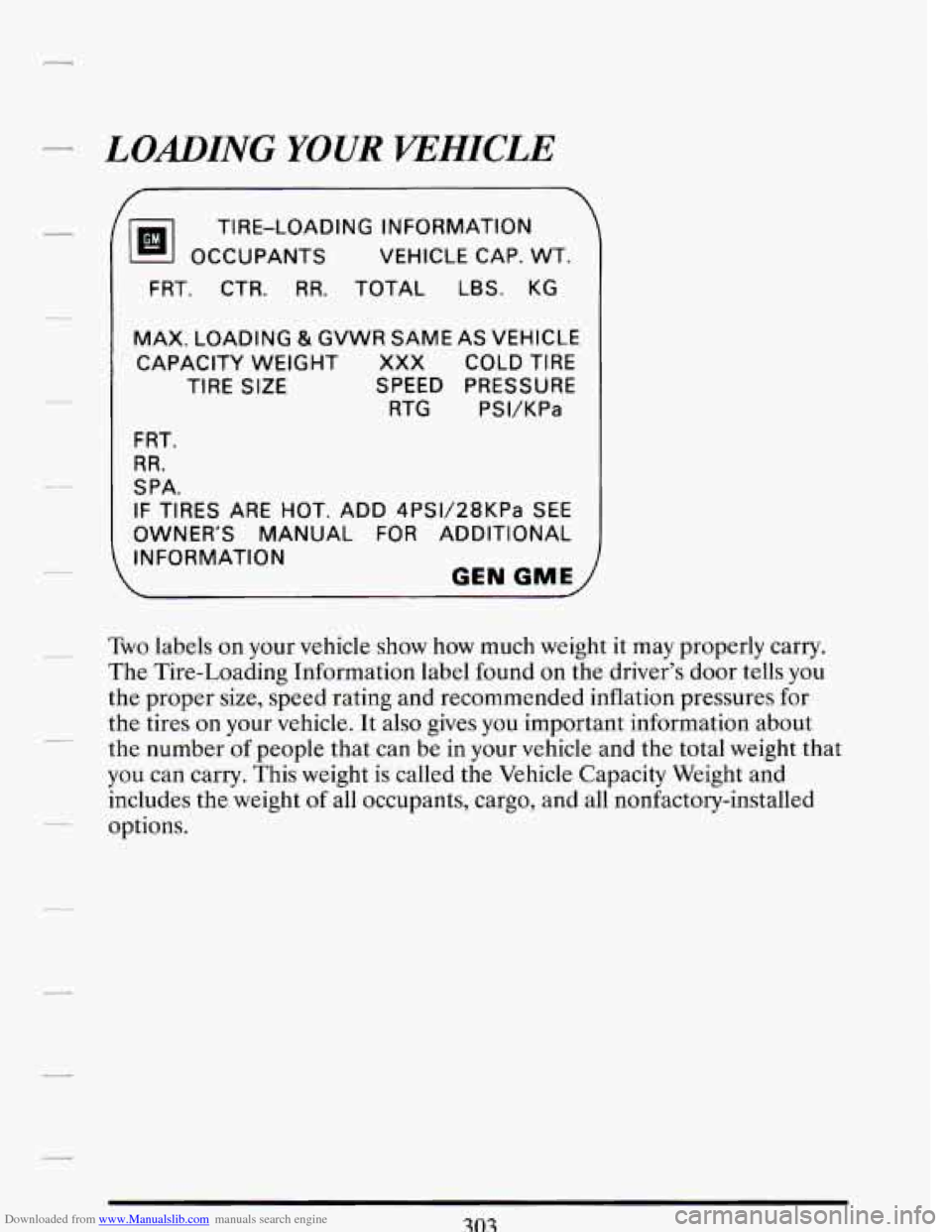
Two labels on your vehicle show how much weight it may properly carry.
The Tire-Loading Information label found
on the driver’s door tells you
the proper size, speed rating and recommended inflation pressures for
the tires on your vehicle. It also gives you important information about
the number
of people that can be in your vehicle and the total weight that
you can carry. This weight is called the Vehicle Capacity Weight and
includes the weight
of all occupants, cargo, and all nonfactory-installed
-_
__ options.
303
Page 318 of 406
Downloaded from www.Manualslib.com manuals search engine __ If you put things inside your vehicle -- like suitcases, tools, packages, or
anything else -- they will go as fast as the vehicle goes. If you have to stop
or turn quickly,
or if there is a crash, they’ll keep going.
A CAUTION
Things you put inside your vehicle can strike and injure people
in a sudden stop or tam, or in a crash.
Put things in the trunk of your vehicle.
In a trunk, put them as far forward as you can. lky to spread
the weight evenly.
Never
stack heavier things, like suitcases, inside the vehicle
so that some of them are above the tops of the seats.
When you carry something inside the vehicle, secure it
whenever you can.
a Don’t leave a seat folded down unless you need to.
TIRES
__
We don’t make tires. Your new vehicle comes with high quality tires made
by a leading tire manufacturer. These tires are warranted by the tire
manufacturers and their warranties are delivered with
every new Cadillac.
If your spare tire is a different brand than your road tires, you will have a
tire warranty folder from each of these manufacturers. c_
Page 319 of 406
Downloaded from www.Manualslib.com manuals search engine CAUTION:
Poorly maintained and improperly used tires are dangerous.
a
e
I,
a
Overloading your tires can cause overheating as a result of
too
much friction. You could have an air-out and a serious
accident. See “Loading Your Vehicle” in the Index.
Underinflated tires pose the
same danger as overloaded
tires. The resulting accident could cause serious iqjury.
Check all tires frequently to maintain the recommended
pressure. Tire pressure should be checked when your tires
are cold.
Overinflated tires are more likely to be cut, punctured, or
broken by a sudden impach such as whenyou hit a pothole.
Keep
tires at the recommended pressure.
Worn, old tires
can cause accidents. If your tread is badly
worn, or if your tires have been damaged, replace them.
I w
I-
Inflation - Tire Pressure
The Tire-Loading Information label which is on the driver’s door shows
the correct inflation pressures for your tires, when they’re
cold. “Cold”
means your vehicle has been sitting for at least three hours or driven no
more than a mile.
Page 320 of 406
Downloaded from www.Manualslib.com manuals search engine When to Check Check your tires once a month or more. Your tire
pressure should be:
30 psi (210 kPa) (Front and Rear)
35 psi (241 kPa) (Coachbuilder Package - Front and Rear)
32 psi (220 kPa) (H.D. Livery - Front and Rear)
32 psi (220 kPa) (Touring Sedan - Front)
30 psi (210 kPa) (Touring Sedan - Rear)
Recommended tire sizes are:
P205/70R15 (Front and Rear)
P215/75R15 (Coachbuilder - Front and Rear)
0 P215/60R16 Goodyear GA (Touring Sedan)
0 T125/70D15 (Compact Spare)
T125/70R15 (Touring Sedan - Compact Spare)
Don’t forget your compact spare tire. It
should be at 60 psi (420 kPa).
307
Page 321 of 406
Downloaded from www.Manualslib.com manuals search engine How to Check Use a good quality pocket-type gage to check tire
pressure. Simply looking at the tires will not tell you the pressure,
especially if you have radial tires
-- which may look properly inflated even
if they’re underinflated.
If your tires have valve caps, be sure to put them back on. They help
prevent leaks by keeping out dirt and moisture.
Tire Inspection and Rotation
To make your tires last longer, have them inspected and rotated at the
mileages recommended in your Maintenance Schedule. See “Scheduled Maintenance Service” in the Index.
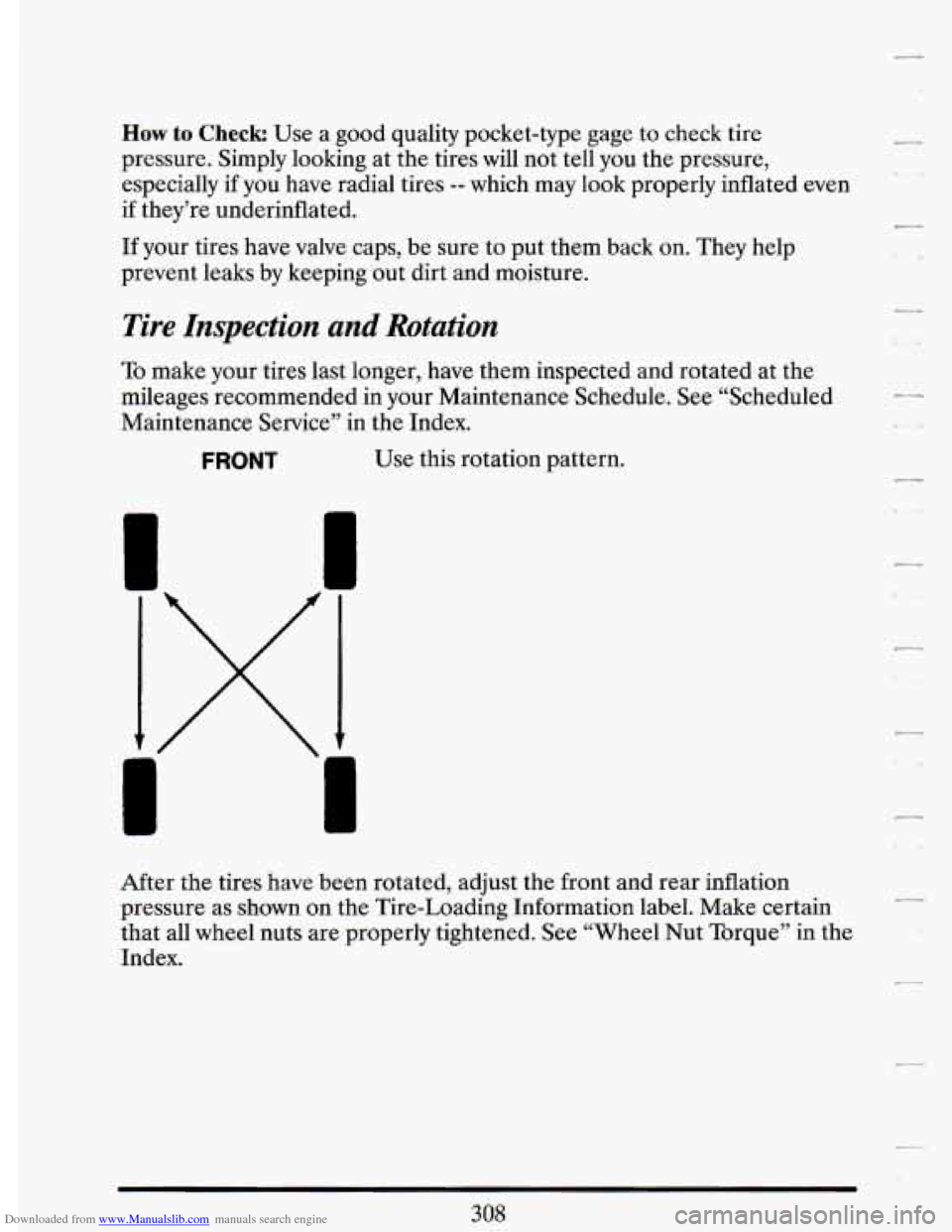
FRONT Use this rotation pattern.
After the tires have been rotated, adjust the front and rear inflation
pressure as shown on the Tire-Loading Information label. Make certain
that all wheel nuts are properly tightened.
See “Wheel Nut Torque” in the
Index.
Page 322 of 406

Downloaded from www.Manualslib.com manuals search engine ’ A CAUTION
Rust or dirt on a wheeI, or on the parts to which it is hstened,
cam make wheel nuts become loose after a time. Tbe wheel could
come off and cause an accident. When y~n change a wheel,
remove any rust or dirt fkom places where the wheel attaches to
the vehicle. In an emergency, you can use a cloth or a paper
towel to do this; but be sure to use a scraper of wire brush later,
if you need to, to get all the rust or dirt off. (See %hanging a
Flat Tire” in the T- ---*
I
When It’s Time for New Tires
One way to tell when
it’s time for
new tires is
to check the treadwear
indicators, which will
appear when your tires
have only 2/32 inch
(1.6 mm) or less of
tread remaining.
You need a new tire if:
ire.
0 You can see the indicators at three places around the t
You can see cord or fabric showing through the tire’s rubber.
The tread or sidewall is cracked, cut or snagged deep enough to show
cord or fabric.
The tire has a bump, bulge or split.
309