inflation CADILLAC DEVILLE 1993 7.G Owners Manual
[x] Cancel search | Manufacturer: CADILLAC, Model Year: 1993, Model line: DEVILLE, Model: CADILLAC DEVILLE 1993 7.GPages: 406, PDF Size: 20.78 MB
Page 42 of 406
Downloaded from www.Manualslib.com manuals search engine .- -
A CAUTION:
Air bags inflate with great force, faster than the blink of an eye.
If yoii’re too close to an inflating air bag, it could seriously
injure
you. Safety belts help keep you in position for an air bag
inflation in a crash. Always wear your safety belt, even with an
air bag, and sit as
far back as you can while still maintaining
control
of your vehicle,
Air Bag System Light
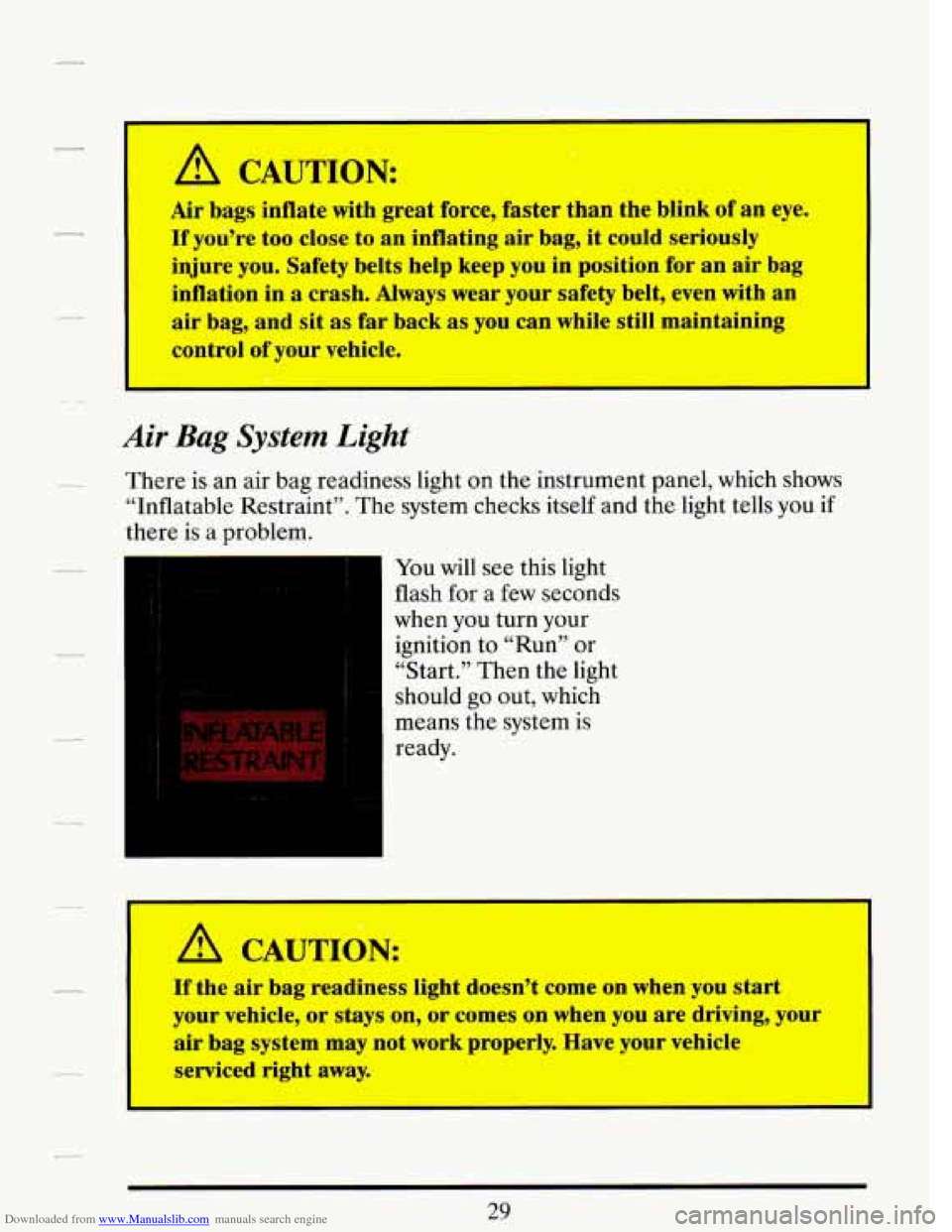
There is an air bag readiness light on the instrument panel, which shows
“Inflatable Restraint”. The system checks itself and the light tells you if
there
is a problem.
You will see this light
flash for a
few seconds
when you turn your
ignition to
“Run” or
“Start.” Then the light
should
go out, which
means the system
is
ready.
A CAUTION:
If the air bag readiness light doesn’t come on when you start
your vehicle, or stays on, or comes on when you are driving, your
air bag system may not work properly. Have your vehicle
serviced right
away.
29
Page 43 of 406
Downloaded from www.Manualslib.com manuals search engine How The Air Bag System Works
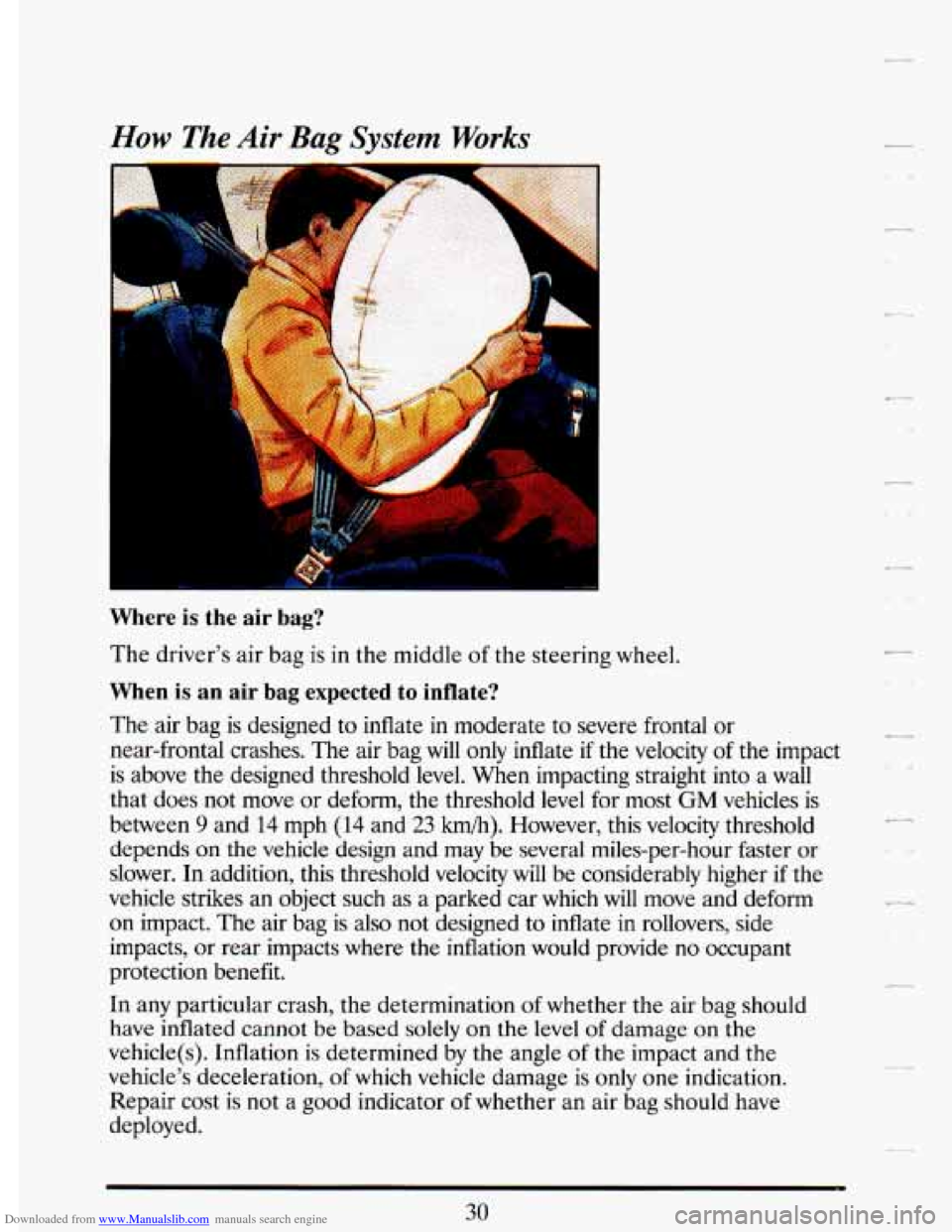
Where is the air bag?
The driver's air bag is in the middle of the steering wheel.
When is an air bag expected to inflate?
The air bag is designed to inflate in moderate to severe frontal or
near-frontal crashes. The air bag will only inflate if the velocity of the impact
is above the designed threshold level. When impacting straight into a wall
that does not move
or deform, the threshold level for most GM vehicles is
between
9 and 14 mph (14 and 23 km/h). However, this velocity threshold
depends
on the vehicle design and may be several miles-per-hour faster or
slower. In addition, this threshold velocity
will be considerably higher if the
vehicle strikes an object such as a parked car which
will move and deform
on impact. The air bag is also not designed to inflate in rollovers, side
impacts, or rear impacts where the inflation would provide no occupant
protection benefit.
In any particular crash, the determination
of whether the air bag should
have inflated cannot be based solely on the level
of damage on the
vehicle(s). Inflation
is determined by the angle of the impact and the
vehicle's deceleration,
of which vehicle damage is only one indication.
Repair cost
is not a good indicator of whether an air bag should have
deployed.
c_
Page 44 of 406
Downloaded from www.Manualslib.com manuals search engine What makes an air bag inflate?
In a frontal impact of sufficient severity, sensors strategically located on
the vehicle detect that the vehicle
is suddenly stopping as a result of a
reaction of the sodium azide sealed in the inflator. The reaction produces
nitrogen gas, which inflates the cloth bag. The inflator, cloth bag, and
related hardware are all part of the air bag inflator module packed inside
the steering wheel.
-
- crash. These sensors complete an electrical circuit, triggering a chemical
-
How does an air bag restrain?
occupants can contact the steering wheel. The air bag supplements the
protection provided by safety belts. Air bags distribute the force of the
occupant more gradually. But air bags would not provide protection in
many types of collisions, including rollovers and rear and side impacts,
primarily because an occupant’s motion is not toward the air bag. Air
bags should never
be regarded as anything more than a supplement to
safety belt protection in moderate to severe frontal and near-frontal
collisions.
-. - In moderate to severe frontal or near-frontal collisions, even belted
- impact more evenly over the occupant’s upper body, stopping the
__
-
What will you see after an air bag inflation?
After the air bag has inflated, it will then quickly deflate. This occurs so
__ quickly that some people may not even realize that the air bag inflated.
The air bag will not impede the driver’s vision or ability to steer the
vehicle, nor will it hinder the occupants from exiting the vehicle. There
__ will be small amounts of smoke coming from vents in the deflated air bag.
Some components
of the air bag module in the steering wheel hub may
be hot for a short time, but the portion
of the bag that comes into contact
with you will not be hot to the touch. The nitrogen gas used to inflate the
air bag
will have vented into the passenger compartment, and the bag will
be deflated within seconds after the collision. Nitrogen makes up about
80% of the air we breathe and is not hazardous. As the nitrogen vents
compartment.
__
- from the bag, small particles are also vented into the passenger
31
Page 269 of 406
Downloaded from www.Manualslib.com manuals search engine A CAUTION:
Storing a jack, a tire or otk --* equipment in the passengers
compartment
of the vehicle could cause injury. In a sudden stop
or collision loose equipment could strike someone. Store all
these in the proper place.
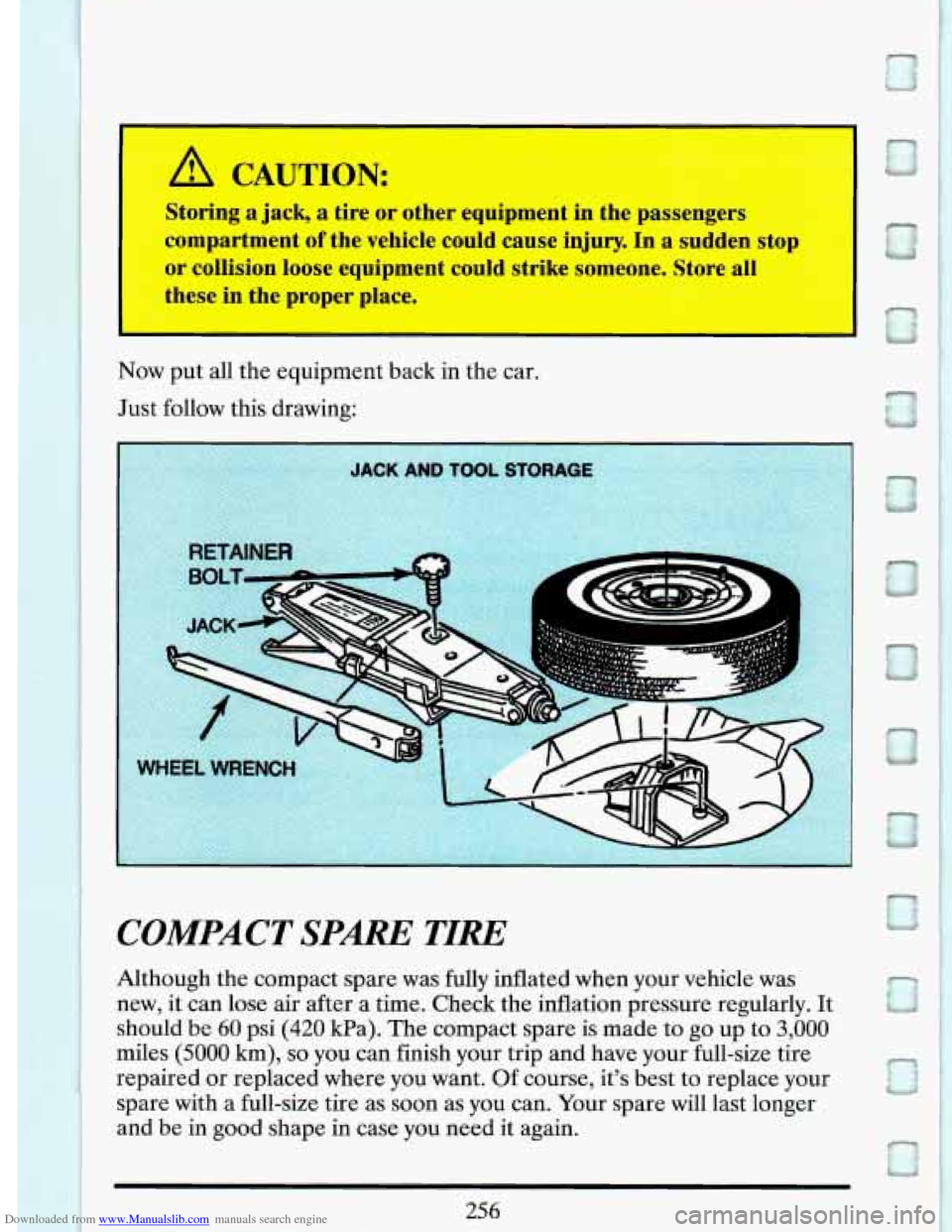
Now put all the equipment back in the cal
Just follow this drawing
COMPACT SPARE TIRE
Although the compact spare was fully inflated when your vehicle was
new, it can lose air after a time. Check the inflation pressure regularly. It
should be
60 psi (420 Wa). The compact spare is made to go up to 3,000
miles (5000 km), so you can finish your trip and have your full-size tire
repaired or replaced where you want.
Of course, it’s best to replace your
spare with a full-size tire as soon as you can. Your spare will last longer
and be in good shape in case you need it again.
256 E ;..
Page 316 of 406
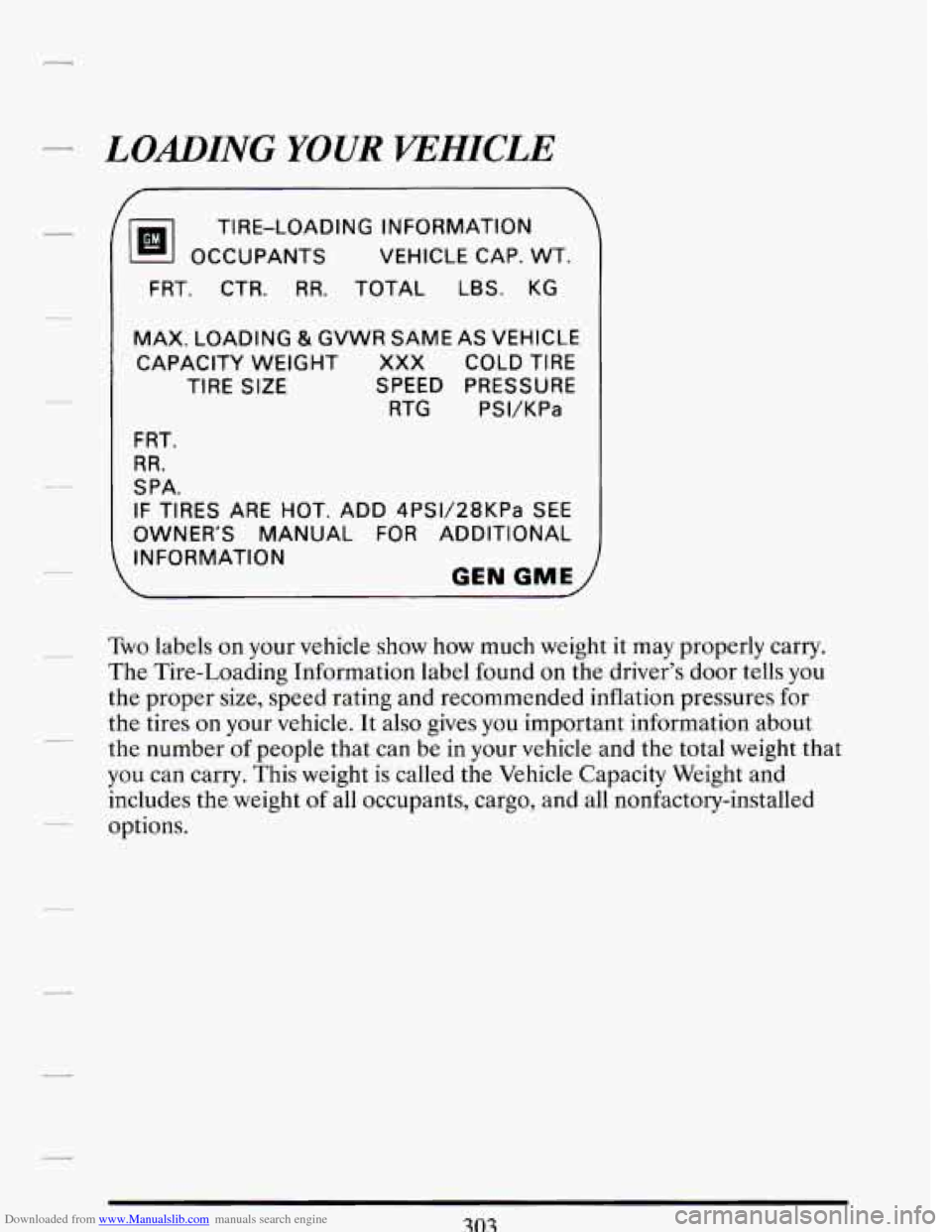
Downloaded from www.Manualslib.com manuals search engine - LOADING YOUR VEHICLE
TIRE-LOADING INFORMATION
/ OCCUPANTS VEHICLE CAP. WT.
FRT. CTR. RR. TOTAL LBS. KG
MAX. LOADING
& GVWR SAME AS VEHICLE
CAPACITY WEIGHT XXX COLD
TIRE
TIRE SIZE SPEED PRESSURE
RTG PSVKPa
F RT.
R R.
SPA.
IF TIRES ARE HOT. ADD 4PSV28KPa SEE
OWNER’S MANUAL
FOR ADDITIONAL
INFORMATION
GEN GME 1
Two labels on your vehicle show how much weight it may properly carry.
The Tire-Loading Information label found
on the driver’s door tells you
the proper size, speed rating and recommended inflation pressures for
the tires on your vehicle. It also gives you important information about
the number
of people that can be in your vehicle and the total weight that
you can carry. This weight is called the Vehicle Capacity Weight and
includes the weight
of all occupants, cargo, and all nonfactory-installed
-_
__ options.
303
Page 319 of 406
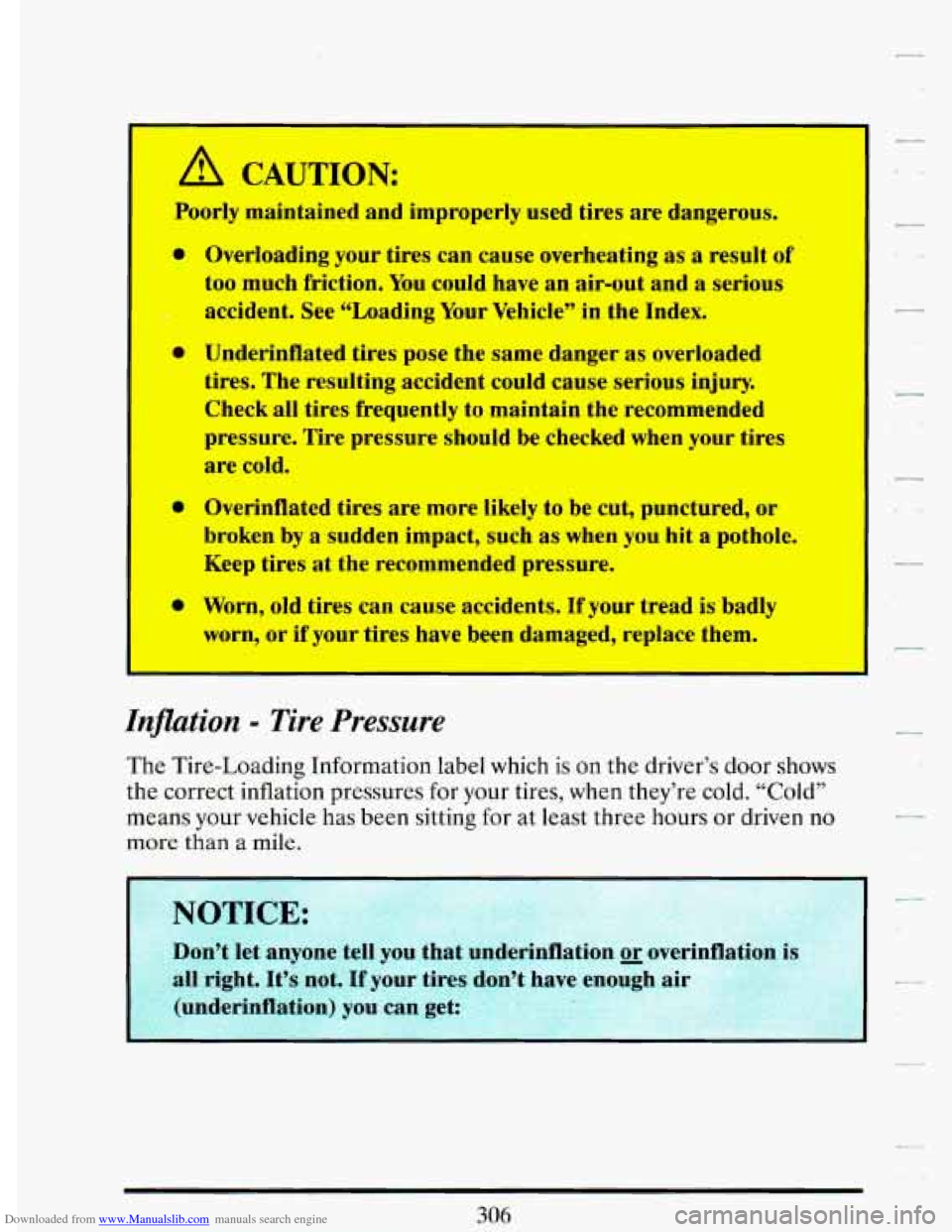
Downloaded from www.Manualslib.com manuals search engine CAUTION:
Poorly maintained and improperly used tires are dangerous.
a
e
I,
a
Overloading your tires can cause overheating as a result of
too
much friction. You could have an air-out and a serious
accident. See “Loading Your Vehicle” in the Index.
Underinflated tires pose the
same danger as overloaded
tires. The resulting accident could cause serious iqjury.
Check all tires frequently to maintain the recommended
pressure. Tire pressure should be checked when your tires
are cold.
Overinflated tires are more likely to be cut, punctured, or
broken by a sudden impach such as whenyou hit a pothole.
Keep
tires at the recommended pressure.
Worn, old tires
can cause accidents. If your tread is badly
worn, or if your tires have been damaged, replace them.
I w
I-
Inflation - Tire Pressure
The Tire-Loading Information label which is on the driver’s door shows
the correct inflation pressures for your tires, when they’re
cold. “Cold”
means your vehicle has been sitting for at least three hours or driven no
more than a mile.
Page 321 of 406
Downloaded from www.Manualslib.com manuals search engine How to Check Use a good quality pocket-type gage to check tire
pressure. Simply looking at the tires will not tell you the pressure,
especially if you have radial tires
-- which may look properly inflated even
if they’re underinflated.
If your tires have valve caps, be sure to put them back on. They help
prevent leaks by keeping out dirt and moisture.
Tire Inspection and Rotation
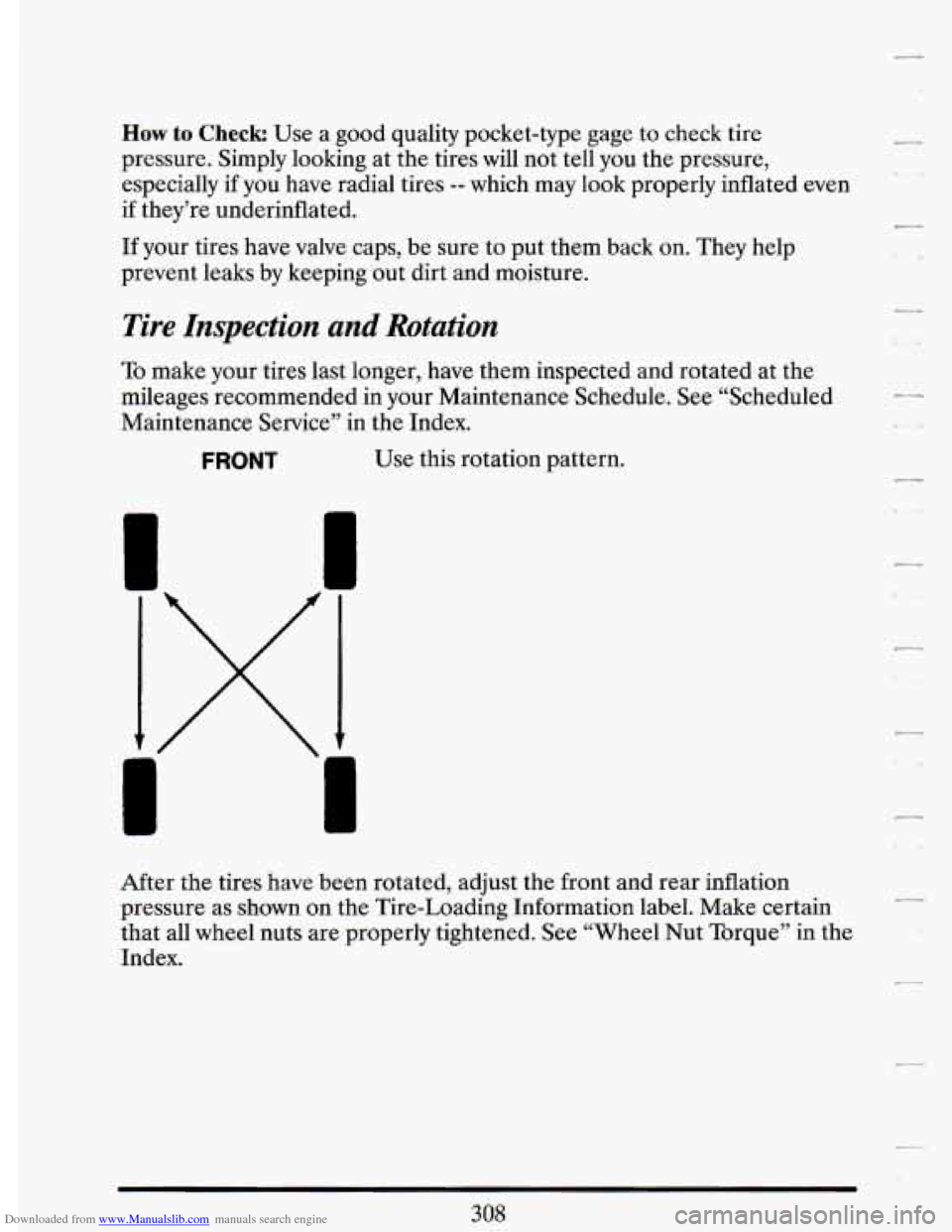
To make your tires last longer, have them inspected and rotated at the
mileages recommended in your Maintenance Schedule. See “Scheduled Maintenance Service” in the Index.
FRONT Use this rotation pattern.
After the tires have been rotated, adjust the front and rear inflation
pressure as shown on the Tire-Loading Information label. Make certain
that all wheel nuts are properly tightened.
See “Wheel Nut Torque” in the
Index.
Page 324 of 406
Downloaded from www.Manualslib.com manuals search engine Treadwear
The treadwear grade is a comparative rating based on the wear rate of
the tire when tested under controlled conditions on a specified
government test course. For example, a tire graded
150 would wear one
and a half
(1 112) times as well on the government course as a tire graded
100. The relative performance of tires depends upon the actual
conditions
of their use, however, and may depart significantly from the
norm due to variations in driving habits, service practices and differences
in road characteristics and climate.
Traction - A, B, C
The traction grades, from highest to lowest are: A, B, and C. They
represent the tire’s ability to stop on wet pavement as measured under
controlled conditions on specified government test surfaces
of asphalt
and concrete.
A tire marked C may have poor traction performance.
Warning: The traction grade assigned to this tire
is based on braking
(straight-ahead) traction tests and does not include cornering (turning)
traction.
Temperature - A, B, C
The temperature grades are A (the highest), B, and C, representing the
tire’s resistance to the generation
of heat and its ability to dissipate heat
when tested under controlled conditions on a specified indoor laboratory
test wheel. Sustained high temperature can cause the material of the tire
to degenerate and reduce tire life, and excessive temperature can lead to
sudden tire failure.
The grade C corresponds to a level of performance
which all passenger car tires must meet under the Federal Motor Vehicle
Safety Standard
No. 109. Grades B and A represent higher levels of
performance on the laboratory test wheel than the minimum required by
law.
Warning:
The temperature grade for this tire is established for a tire that
is properly inflated and not overloaded. Excessive speed, underinflation,
or excessive loading, either separately or in combination, can cause heat
buildup and possible tire failure.
Those grades are molded on the sidewalls
of passenger car tires.
311
Page 396 of 406

Downloaded from www.Manualslib.com manuals search engine How To Test The Alarm .............................. 72
How To Use This Manual .............................. 1
How To Wear Safety Belts Properly ..................... 18
Hydroplaning ...................................... 197
I
Ice, If You’re Stuck In ............................... 257
Idling Your Engine .................................. 89
Identification Label, Service Parts ..................... 327
Identification Number, Vehicle ....................... 326
If A Tire Goes Flat ................................. 246
Ignition Key Positions ................................ 74
Illuminated Entry System ............................. 65
Indicator, Bulbs For Turn Signal ...................... 335
Indicators, Warning, On Instrument Panel .............. 120
Infant Restraint ..................................... 42
Inflatable Restraint Light ............................. 29
Inflation, Proper Tire ............................... 307
Inside Mirrors (Daymight) .......................... 109
Inspection, Tire .................................... 308
Instrument Panel ................................... 118
Instrument Panel Warning Lights ..................... 120
Interior Cleaning ................................... 316
Introduction ........ See Front of Owner Information Manual
J
Jacking And Removing Flat Tire ...................... 251
Jump Starting ...................................... 227
K
Keyless Entry System ................................ 65
Keys, Ignition ....................................... 59
Keys .............................................. 58
Kilometer Indicator ................................ 119
L
Label, Fluid Usage ................................. 267
Lamp Housings, Exterior ............................ 288
Lamp Monitors .................................... 108
Lane Change Indicator ............................... 93
Lap-Shoulder Belt ................................... 19
Larger Children and Safety Belts ....................... 52
Latches, Front Seatback ............................... 9
Leaking, Of Exhaust Into Your Car ..................... 88
.i
-_
h- .Li
c
LA
8
Page 403 of 406

Downloaded from www.Manualslib.com manuals search engine .
.
.
.
.
.
Time. Setting The ............................... 158. 161
Tire Chains
....................................... 314
Tire. Flat
.......................................... 247
Tire Inflation
...................................... 307
Tire Inspection and Rotation
......................... 308
Tires
.. Loading .................................... 303
Tire Quality Grading
................................ 310
Tires
............................................. 305
Tires. and Winter Driving
............................ 212
Tires. When It's Time For New Tires
.................. 309
Torn Safety Belts
.................................... 57
Torque Lock. Automatic Transaxle
.................... 211
Towing A Trailer
................................... 217
Towing Your Cadillac
............................... 232
Traction Control
................................ 136. 184
Traction Control System Warning Light ................ 123
Trademarks. GM
................................... 260
Traffic Lights
...................................... 173
Traffic Officer
..................................... 175
Trailer Towing
..................................... 217
Transaxle. Automatic
................................. 78
Transaxle Fluid
.................................... 275
Transaxle Gear Positions
............................. 78
Travel. Brake Pedal
................................. 186
Trip Odometer
..................................... 119
Trunk Release. Remote
.............................. 69
Turn Signal and Lane Change Indicator
................. 92
Turn Signal/Multifunction Lever
....................... 93
Twilight Sentinel
................................... 105
"kisted Safety Belts
.................................. 27
Two Children Wearing The Same Safety Belt
............. 54
U
Underbody Maintenance ............................ 323
Uniform Tire Quality Grading
........................ 310
Universal Theft Deterrent
............................ 71
Unleaded Gasoline
................................. 261
Uphill Parking
..................................... 210
Upholstery Care
................................... 316
Urban Driving
..................................... 201
Used Oil. How
To Dispose Of ........................ 273
V
Vanity Mirrors. Front Seat ........................... 111
Vehicle Damage Warnings ............................. 2
.
15