lights CADILLAC DEVILLE 1994 7.G User Guide
[x] Cancel search | Manufacturer: CADILLAC, Model Year: 1994, Model line: DEVILLE, Model: CADILLAC DEVILLE 1994 7.GPages: 399, PDF Size: 20.97 MB
Page 130 of 399
Downloaded from www.Manualslib.com manuals search engine - Light Sensor
Cornering Lights
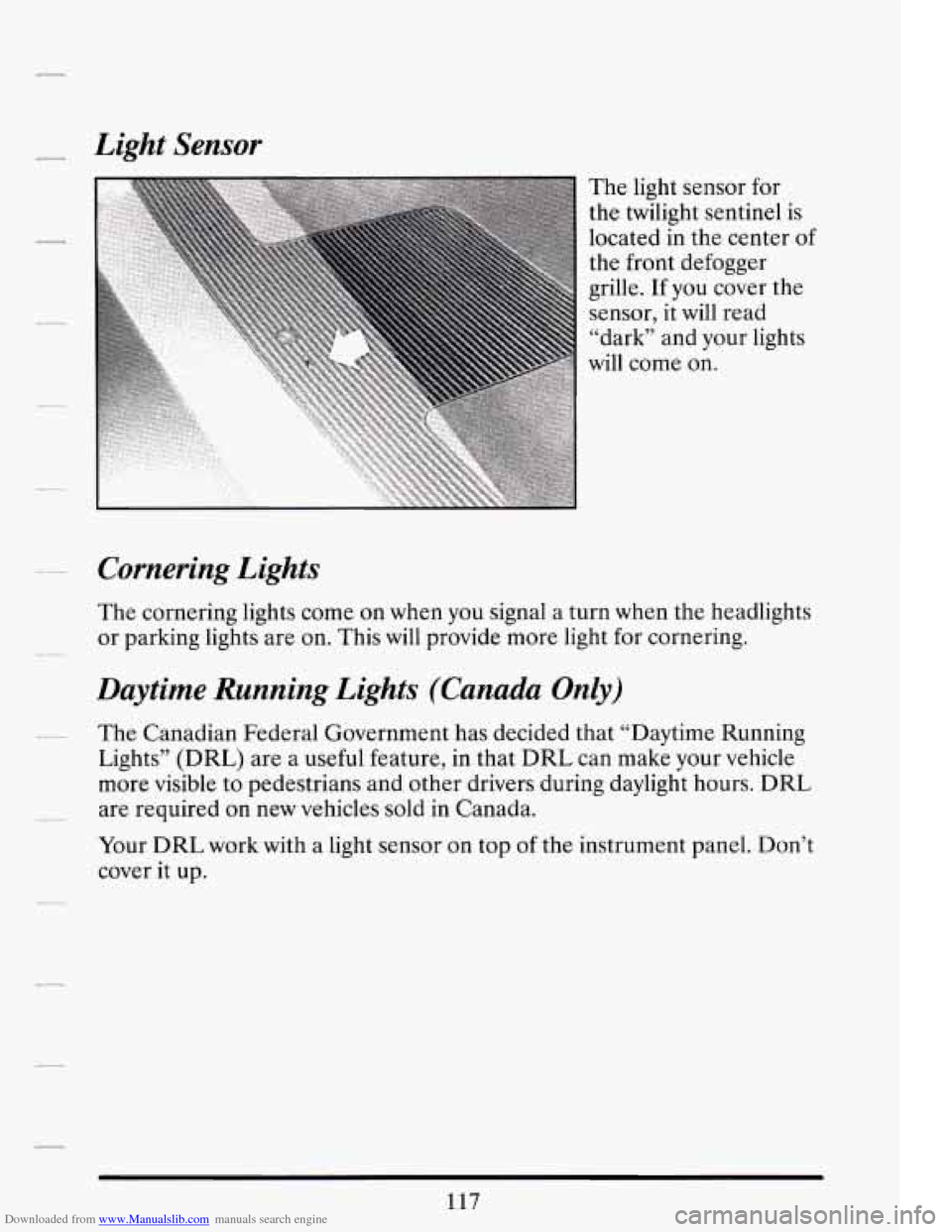
The light sensor for
the twilight sentinel is
located
in the center of
the front defogger
grille. If
you cover the
sensor, it will read
“dark” and your lights
will come on.
The cornering lights come
on when you signal a turn when the headlights
or parking lights are on. This will provide more light for cornering.
Daytime Running Lights (Canada Only)
The Canadian Federal Government has decided that “Daytime Running
Lights”
(DRL) are a useful feature, in that DRL can make your vehicle
more visible to pedestrians and other drivers during daylight hours. DRL
are required on new vehicles sold in Canada.
Your DRL work with a light sensor on top
of the instrument panel. Don’t
cover it up.
117
Page 131 of 399
Downloaded from www.Manualslib.com manuals search engine The low beam headlights will come on at reduced brightness in daylight
0
0
0
A
when:
The ignition is on
The headlight switch is off, and
The transaxle is not in
“P” (Park).
.ts
,t
dusk,
if the Twilight Sentinel feature is turned on, the exterior ligh
will come on automatically and the low beams
will change to full
brightness. At dawn, the exterior lights will go out and the low beams will
..
change to the reduced brightness of DRL (if the headlight switch is off).
Of course, you may still turn on the headlights any time you need to.
To idle your vehicle with the DRL
off, shift the transaxle into “P” (Park).
The DRL will stay off until you shift out
of “P” (Park).
Operation of Lights
Although your vehicle’s lighting system (headlights, parking lights, fog
lamps, side marker lights and taillights) meet all applicable federal
lighting requirements, certain states and provinces may apply their own
lighting regulations that may require special attention before you operate
-
these lights.
For example, some jurisdictions may require that you operate your. lower
beam lights with fog lamps at all times, or that headlights be turned on
whenever you must use your windshield wipers.
In addition, most
jurisdictions prohibit driving solely with parking lights, especially at dawn
or dusk. It is recommended that you check with your own state
or
provincial highway authority for applicable lighting regulations.
118
Page 132 of 399
Downloaded from www.Manualslib.com manuals search engine P
4
MapIReading Lights m
f-
!- i
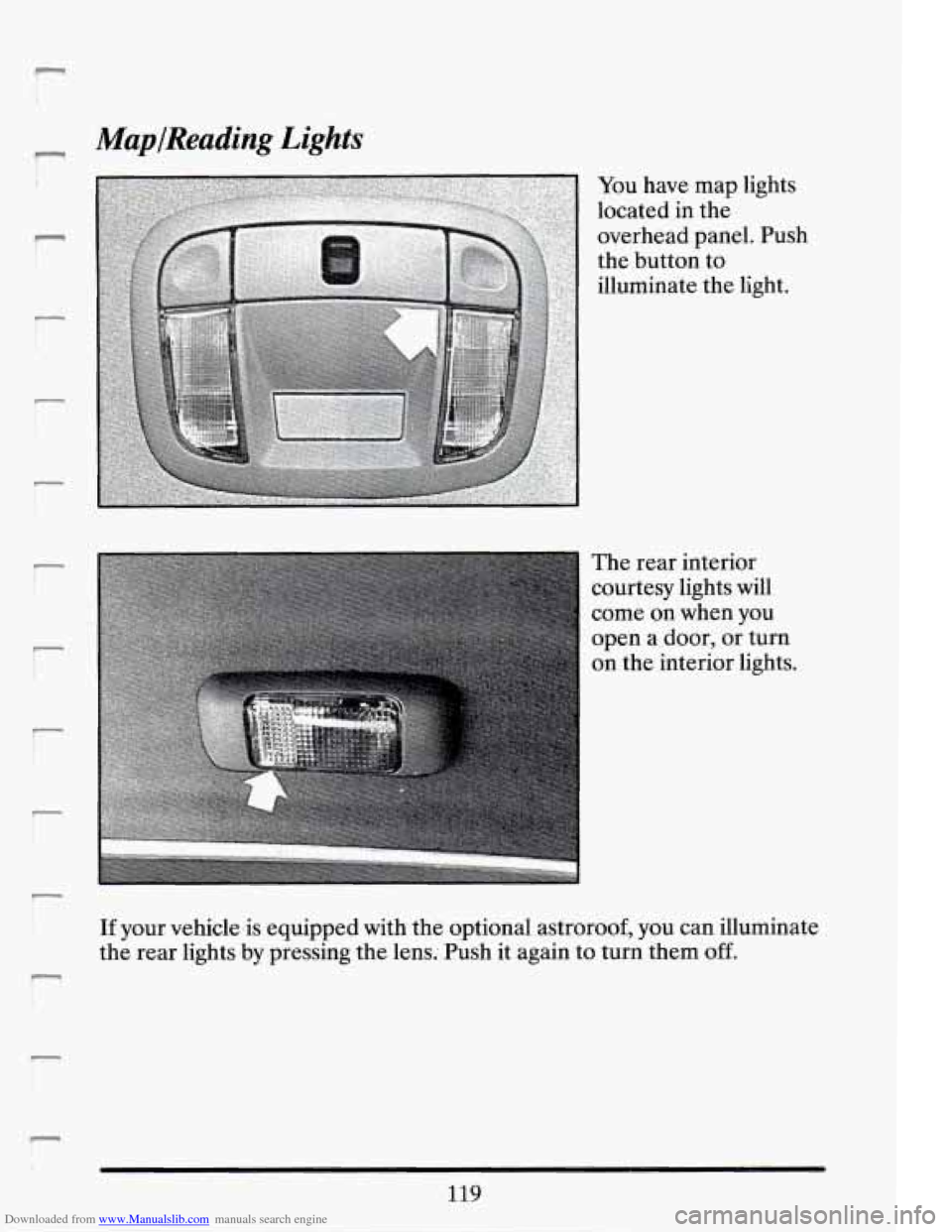
You have map lights
located in the
overhead.pane1. Push
the button to illuminate the light.
The rear interior
courtesy lights will
come on when you
open a door, or turn
on the interior lights.
If your vehicle.is equipped with the optional astrormf, you can illuminate
the rear lights by-pressing the lens; Push it again to turn them
off.
119
I
P
Page 133 of 399

Downloaded from www.Manualslib.com manuals search engine Rear Taillamp Monitor
The rear taillamp monitor is located at the top center over the back glass.
You
will see it as you are looking through your inside rearview mirror.
Two red indicators will illuminate to show that your taillights and brake
lights are working.
Page 134 of 399

Downloaded from www.Manualslib.com manuals search engine MIRRORS
Automatic Inside And Outside Rearview Mirrors
Your Cadillac has an
inside automatic
electrochromic rearview mirror
This mirror automatically changes to reduce glare from headlights behind
you.
A photocell on the back of the mirror senses when it is becoming
dark outside. Another photocell built into the mirror surface senses the
headlights behind you.
The mirror will darken gradually to reduce glare. This change may take a
few seconds.
OnlOff Switch
121
Page 145 of 399
Downloaded from www.Manualslib.com manuals search engine Odometer
You may wonder what happens if a car has to have a new odometer
installed. The new one will read the correct mileage. This is because the
computer stores the mileage in memory.
WMING LIGHTS
This section describes the warning lights that are on your vehicle. The
pictures will help you locate them.
Warning lights can signal that something is wrong before it becomes
serious enough to cause an expensive repair or replacement. Paying
attention to your warning lights could also save you or others from injury.
Warning lights
go on when there may be or is a problem with one of your
vehicle’s functions.
As you will see in the details on the next few pages,
some warning lights come on briefly when you turn the ignition key just to
let you know they’re working. If you are familiar with this section, you
should not be alarmed when this happens.
When one
of the warning lights comes on and stays on when you are
driving, check the section that tells you what to do about it. Please follow
the manual’s advice. Waiting to do repairs can be costly
-- and even
dangerous.
So please get to know your warning lights. They’re a big help.
Your vehicle may also have a driver information system that works along
with the warning lights. See “Driver Information System” in the Index.
Brake System Warning Light
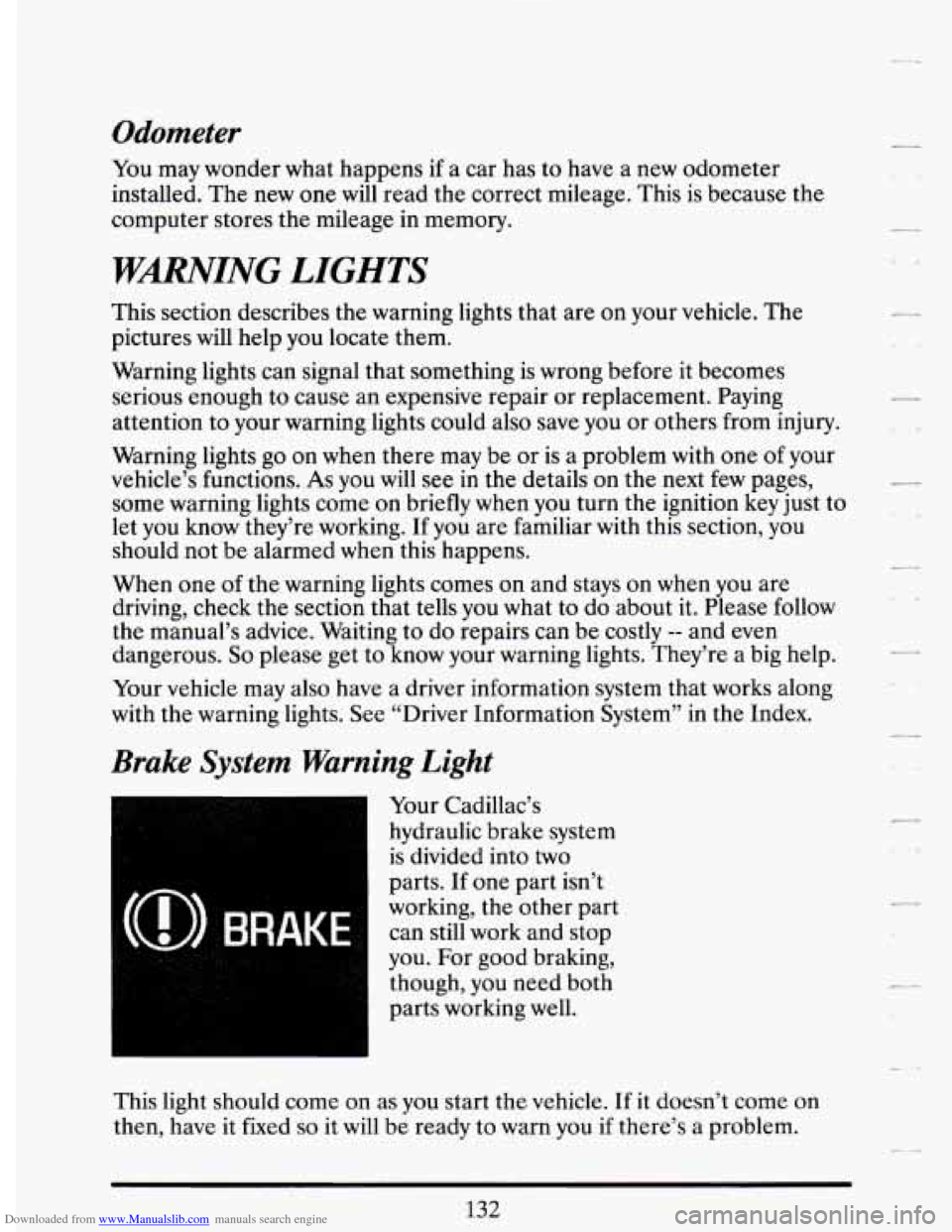
Your Cadillac’s
hydraulic brake system
is divided into
two
parts. If one part isn’t
working, the other part
can still work and stop
you. For good braking,
though, you need both
parts working
well.
r
L-l
This light should come on as you start the vehicle. If it doesn’t come on
then, have it fixed so it will be ready to warn you if there’s a problem.
Page 156 of 399

Downloaded from www.Manualslib.com manuals search engine BATTERY VOLTS HIGH - 08
This message shows that the electrical charging system is overcharging,
(more than 16 volts).
To avoid being stranded have the electrical system
checked by your Cadillac dealership at your earliest convenience.
You can
reduce the charging overload by using the accessories. Turn on the lights,
radio, set the Climate Control
on “AUTO” and the fan speed on “HI”
and turn the rear window defogger on.
You can monitor battery voltage
on the Driver Information Center by toggling the “INFORMATION’’
button. When the engine is running, the normal range is 11.5 to 15.5
volts.
BATTERY VOLTS LOW - 06
This message will appear when the electrical system is charging less than
10 volts, or
if the battery has been drained. If this message appears
immediately after starting it is possible that the generator can still
recharge the battery.
The battery should recharge after driving a few
miles and the message should go out. If this message appears while
driving or after starting your vehicle and stays on, have
it checked
immediately to determinethe cause of this problem. To help the
generator recharge the battery quickly,
you can reduce the load on the
electrical system by turning
off your accessories. You can monitor battery
voltage on the Driver Information Center by toggling
the
“INFORMXTION” button. The normal range is 11.5 to 15.5 volts.
CHECK BRAKE FLUID - 37
This message is displayed to inform the driver that the brake reservoir
fluid level is low. Check the brake reservoir
level and add as needed.
Have the brake system serviced by a Cadillac technician as soon as
possible. If the brake warning light is on, follow the directions in that
section.
CHECK FUEL GAGE,- 39
This message will appear when your fuel supply is less than 4 gallons and
your display is turned off.
143
Page 202 of 399

Downloaded from www.Manualslib.com manuals search engine - Do not get too close to the vehicle you want to pass while you’re
awaiting an opportunity. For one thing, following too closely reduces
your area
of vision, especially if you’re following a larger vehicle. Also,
you won’t have adequate space if the vehicle ahead suddenly slows or
stops. Keep back a reasonable distance.
0 When it looks like a chance to pass is coming up, start to accelerate
but stay in the right lane and don’t get too close. Time your move
so
you will be increasing speed as the time comes to move into the other
lane. If the way is clear to pass, you will have a “running start” that
more than makes up for the distance you would lose by dropping back.
And if something happens to cause you to cancel your pass, you need
only slow down and drop back again and wait for another opportunity.
- -- If other cars are lined up to pass a slow vehicle, wait your turn. But
take care that someone isn’t trying to pass you as you pull out to pass
the slow vehicle. Remember to glance over your shoulder and check
the blind spot.
0 Check your mirrors, glance over your shoulder, and start your left lane
change signal before moving out of the right lane to pass. When you
are far enough ahead of the passed vehicle to
see its front in your
inside mirror, activate your right lane change signal and move back
into the right lane. (Remember that your right outside mirror is
convex. The vehicle you just passed may seem to
be farther away from
you than it really is.)
0 Try not to pass more than one vehicle at a time on two-lane roads.
Reconsider before passing the next vehicle.
Don’t overtake a slowly moving vehicle too rapidly. Even though the
brake lights are not flashing, it may be slowing down or starting to
turn.
189
If you’re being passed, make.it easy for the following driver to get
ahead
of you. Perhaps you can ease a little to the right.
Page 204 of 399

Downloaded from www.Manualslib.com manuals search engine While driving on a surface with reduced traction, try your best to avoid
sudden steering, acceleration, or braking (including engine braking by
shifting
to a lower gear). Any sudden changes could cause the tires to
slide. You may not realize the surface is slippery until
your vehicle is
skidding. Learn to recognize warning clues -- such as enough water, ice or
packed snow on the road to make a “mirrored surface”
-- and slow down
when you have any doubt.
Remember:
Any anti-lock braking system (ABS) helps avoid only the
braking skid.
DRn/lNG ATNIGHT
ia
Night driving is more dangerous than day driving. One reason is that
some drivers are
likely to be impaired -- by alcohol or drugs, with night
vision problems, or by fatigue.
Here are some tips on night driving.
Drive defensively.
0 Don’t drink and drive.
Adjust your inside rearview mirror to reduce the glare from headlights
Since you can’t see as well, you may need to slow down and keep more
behind
you.
space
between you and other vehicles.
191
Page 205 of 399

Downloaded from www.Manualslib.com manuals search engine Slow down, especially on higher speed roads. Your headlights can light
up only
so much road ahead.
0 In remote areas, watch for animals.
If you’re tired, pull off the road in a safe place and rest.
Night Vision
No one can see as well at night as in the daytime. But as we get older
these differences increase. A 50-year-old driver
may require at least twice
as much light to see the same thing at night as
a 20-year-old.
What you do in the daytime can also affect your night vision.
For
example, if you spend the day in bright sunshine you are wise to wear
sunglasses. Your eyes will have less trouble adjusting to night. But if
you’re driving,. don’t wear sunglasses at night. They may cut down on
glare from headlights, but they also make a lot
of things invisible.
You can be temporarily blinded by approaching lights. It can take a
second or two, or even several seconds, for your eyes to readjust to the
dark. When you are faced with severe glare (as from a driver who doesn’t
lower the high beams, or a vehicle with misaimed headlights), slow down
a little. Avoid staring directly into the approaching lights.
Keep your windshield and all the glass on your vehicle clean
-- inside and
out. Glare at night is made much worse by dirt on the glass. Even the
inside
of the glass can build up a film caused by dust. Dirty glass makes
lights dazzle and flash more than clean glass would, making the pupils
of
your eyes contract repeatedly.
Remember that your headlights light up far less
of a roadway when you
are in
a turn or curve. Keep your eyes moving; that way, it’s easier to pick
out dimly lighted objects. Just as your headlights should be checked
regularly for proper aim,
so should your eyes be examined regularly.
Some drivers suffer from night blindness
-- the inability to see in dim light
-- and aren’t even aware of it.
192