brakes CADILLAC DEVILLE 1995 7.G Owners Manual
[x] Cancel search | Manufacturer: CADILLAC, Model Year: 1995, Model line: DEVILLE, Model: CADILLAC DEVILLE 1995 7.GPages: 403, PDF Size: 20.69 MB
Page 9 of 403
Downloaded from www.Manualslib.com manuals search engine This rich tradition continues
into the
'90s as Cadillac became the
first automobile manufacturer
to bc
awarded the prestigious Malcolm
Baldrige National Quality A\vard.
The 1992 SeviIle STS was the
first car ever to win all three major
automotive awards:
Car of the Year,
Motor Trend; Ten Best List,
Car &
Driver; Car of the Year, Automobile
Magazine.
L
A 1993 Cadillac Allanti m stock
technical
configuration; was selected
a: the pace car for the 76th Indianap-.
oii:? 5011. The demandlnE pact: car.
pertormancr and handling require-.
rncnts were met because of' such
advances as the Northstar sysrem.
The system Includes the 32 ITal
e.
dual overhead camshaft, Northstar
4.6 liter Vti engine, 4THO E clectroni-
call,: controlled automatic transask,
road sensing suspension. speed sew
sitiirc steering, antilock brakes and
traction control.
For more than nine decades
Cadillac
has been a leader in quality
and technical innovation. Now more
than
ever, substance takes shape
c
L.
c
Page 103 of 403
Downloaded from www.Manualslib.com manuals search engine NOTICE:
Driving with the parking brake on can cause your rear brakes to
overheat.
You may have to replace them and you could also
damage other parts of your vehicle.
Ifyou are towiqg a trniler nrzci ore parking or1 a hill, see "Towing a Trailer"
in the Index. This section shows what to do first to keep the trailer from
moving.
SHIFTING INTO PARK (P)
-4
-
4
c
u
Page 151 of 403
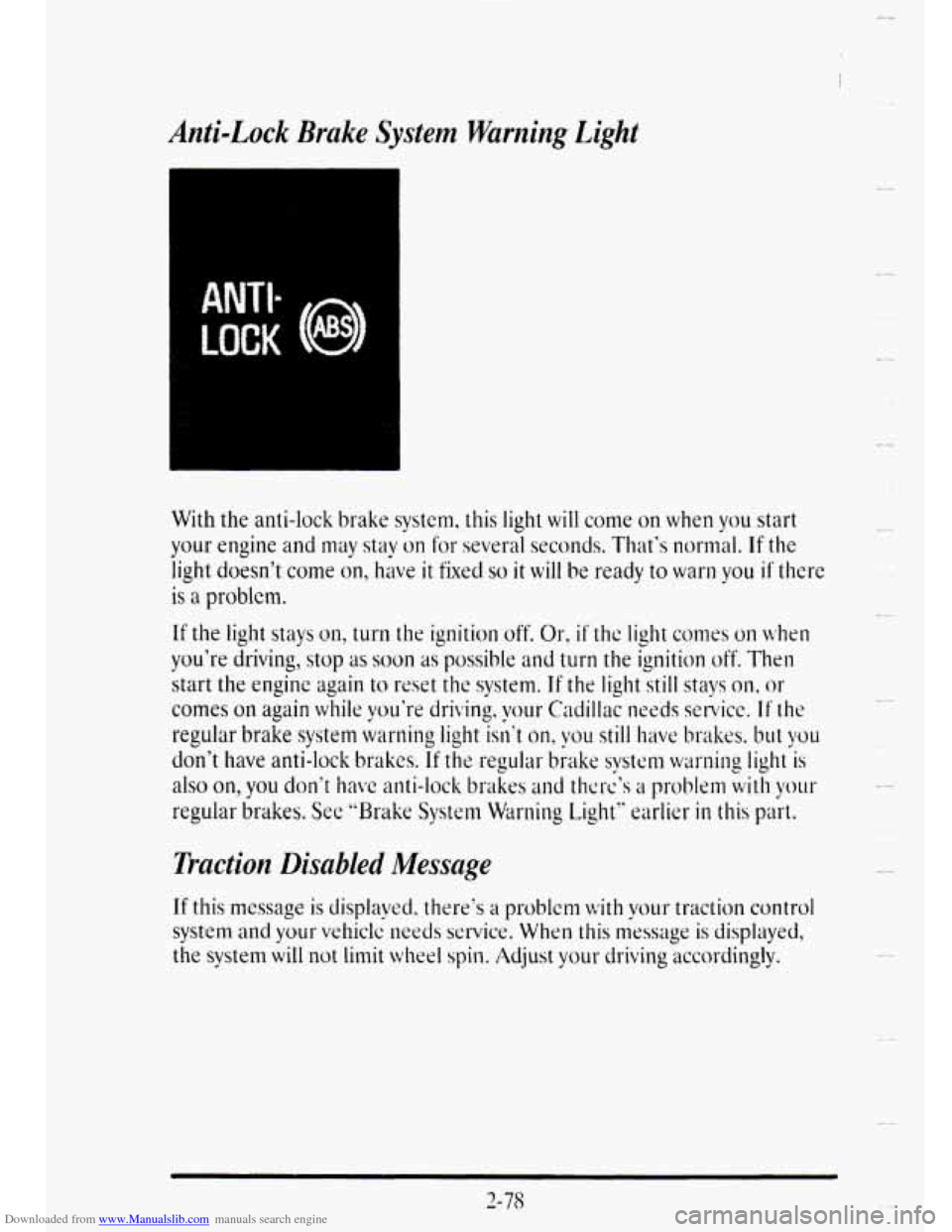
Downloaded from www.Manualslib.com manuals search engine Anti-Lock Brake System Warning Light
With the anti-lock brake system, this light will come on when you start
your engine and may stay on for several seconds. That‘s normal. If the
light doesn’t come on, hiwe it fixed so it will be ready to war11 you if there
is a problcm.
If the light stays on, turn the ignition off. Or, if’ the light comes on when
you’re driving, stop as soon as possible and turn the ignition off. Then
start the engine again
to reset the system. If the light still stays on, or
comes on again while you’re driving. your Cadillac needs setvicc. If the
regular brake system warning light isn’t on, vou still have brakes. but you
don‘t have anti-lock brakes. If the regular biake systm warning light is
also on,
you don’t have anti-lock brakes and thcrc’s a problem with yo~u
regular brakes. See “Brake System Warning Light” earlier in this part.
Traction Disabled Message
If this message is displayed. there‘s a problem with vo~~r traction control
system and your vehiclc needs service. When this message is displayed,
the system will not limit wheel spin. Adjust your driving accordingly.
2-7s
u
Page 198 of 403

Downloaded from www.Manualslib.com manuals search engine CONTROL OF A WHICLE
You have three systenx that make your vehicle go where you want it to go.
They are the brakes, thc steering and the accelerator. All three systems
have to do their work at thc places where the tires meet the road.
Sometimes, as when you're driving
on snow or ice, it's easy to ask more of
those control systems than the tires and road can provide. That means you
can
lose control of your vehicle.
4-5
Page 199 of 403

Downloaded from www.Manualslib.com manuals search engine Braking action involves yereeption time and recrction time.
First, you have, to decide to push on the brake pedal. That’sperceptioll
time. Then you have to bring up your foot and do it. That’s rerrction time.
Average rerzcfiorz
the is about 3/4 of a second. But that’s only an average.
It might be less with one driver and as long as two or three seconds or
more with another.
Age, physical condition, alertness, coordination, and
eyesight all play a part. So do alcohol, drugs and frustration. But even in
34 of a second, a vehicle moving at 60 mph (100 km/h) travels 66 feet
(20 m). That could be a lot of distance in an emergency, so keeping
enough space between
your vehicle and others is important.
And, of course, actual stopping distances vary greatly with the surface of
the road (whether it’s pavement or gravel); the condition of the road (wet,
dry, icy); tire tread;
and the condition of your brakes.
Avoid needless heavy braking. Some people drive in spurts
-- heavy
acceleration followed by heavy braking
-- rather than keeping pace with
traffic. This is a mistake. Your brakes may not have time to cool between
hard stops. Your brakes
will wear out much faster if you do a lot of heavy
braking.
If you keep pace with the traffic and allow realistic following
distances, you
will eliminate a lot of unnecessary braking. That means
better braking and longer brake life.
If your engine ever stops while you’re driving, brake normally but don’t
pump your brakes. If you do, the pedal may get harder to push down. If
your engine stops, you will still have some power brake assist. But you will
use it when you brake. Once the power assist is used up, it may take
longer
to stop and the brake pedal will be harder to push.
4-6
c-
Page 200 of 403
Downloaded from www.Manualslib.com manuals search engine 4nti-Lock Brakes (ABS)
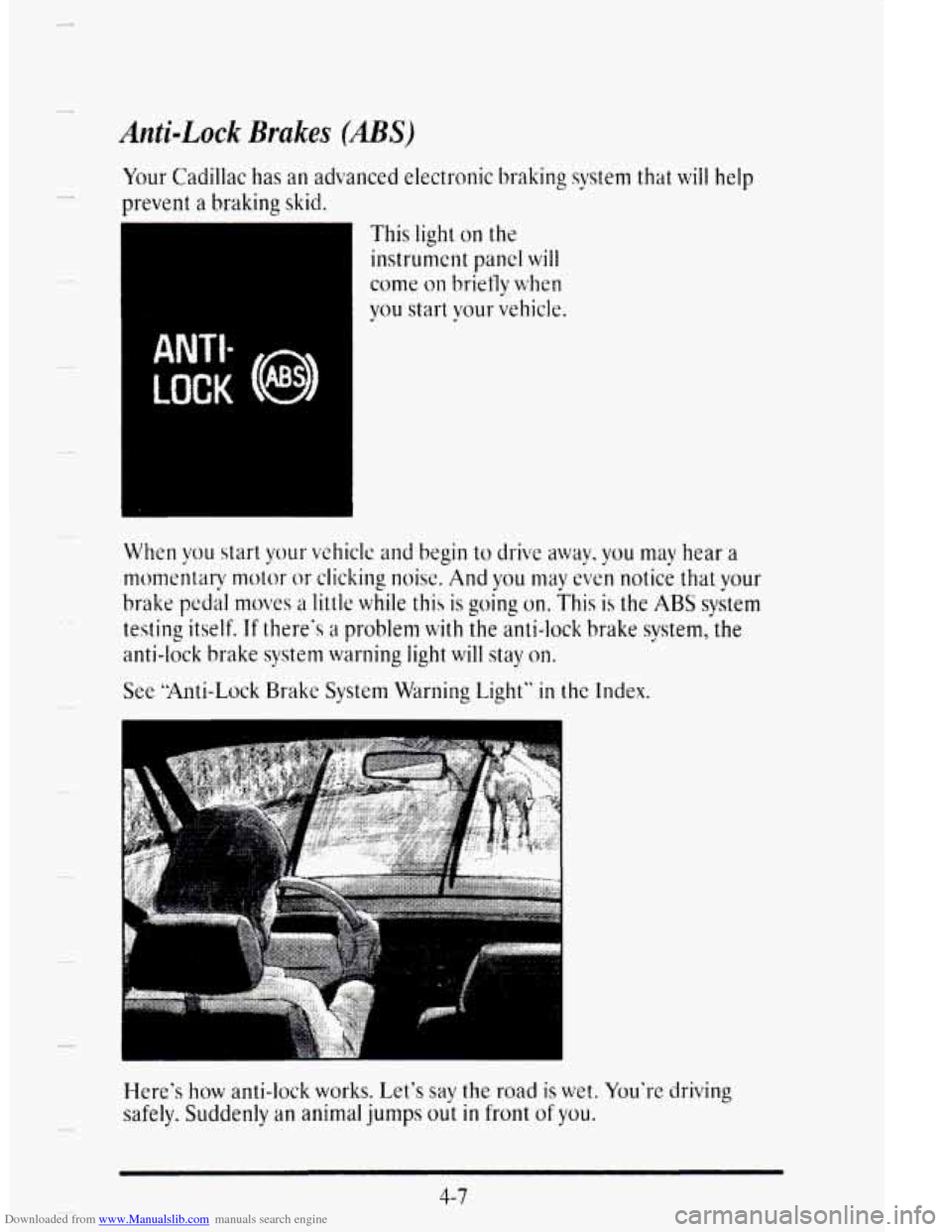
Your Cadillac has an advanced electronic braking system that will help
)revent a braking skid.
This light on the
instrunlent panel will
come on briefiy when
you start your vehicle.
LOCK (!I
ANTI-
When you start your vshiclc and begin to drive away, you may hear a
momentaw motor or cliclcing noise. And you may even notic; that your
brake pedal nloves a little while this is going on. This is the ABS system
testing itself. If there‘s a problem with the anti-lock brake system, the
anti-lock brake
system warning light will stay on.
See “Anti-Lock Brake System Warning Light” in the Index.
Here’s
how anti-lock works. Let‘s say the road is wet. You’re driving
safely. Suddenly an animal jumps out in front of you.
4-7
Page 201 of 403

Downloaded from www.Manualslib.com manuals search engine You slam on the brakes. Here's what happens with ABS.
A computer senses that wheels are slowing down. If one of the wheels is
about to stop rolling, the computer will separately work the brakes at each
front wheel
and at the rear wheels.
The anti-lock system can change the brake pressure faster than any driver
could. The computer
is programmed to make the most of available tire
and road conditions.
.. , ,.. .. . '.' - ... . ... .. *.
You can steer around the obstacle while braking hard.
As you brake, your computer keeps receiving updates
on wheel speed and
controls braking pressure accordingly.
Remember: Anti-lock doesn't change the time
you need to get your foot
up to the brake pedal. If you get too close to the vehicle in front of you,
you won't have time to apply your brakes if that vehicle suddenly slows or
stops. Always leave e.nough room up ahead to stop, even though you have
anti-lock brakes.
To Use Anti-Lock
Don't pump the brakes. Just hold the brake pedal down and fet anti-lock
work for
you. You may hear the anti-lock pump or motor operate, and
feel the brake pedal pulsate,
but this is normal.
4-8
Y
c
Page 202 of 403
Downloaded from www.Manualslib.com manuals search engine Traction Control System
c
Your vehicle has a traction control system that limits wheel spin. This is
especially useful in slippery road conditions. The system operates only if it
senses that one or both of ihc front wheels are spinning or beginning to
lose traction. When this happens, the system works the front brakes and
reduces engine power (by shutting
off fuel injectors) to limit wheel spin.
The TRACTION
ACTIVE message will display on the Driver
Information Center when the traction control
system is limiting wheel
spin. See “Driver Information Center Messages” in the Index. You may
feel the system working, or you may notice some noise, but this is normal.
If
your vehicle is in cruise control when the traction control svstem begins
to limit wheel spin, the cruise control will automatically disengage. When
road conditions
allow you to safely use it again, you may re-engage the
cruise control. (See “Cruise Control”
in the Index.)
The TRACTION DISABLED message will display on the Driver
Information Center to
let you know if there‘s a problem with your traction
control system. See “Driver Information Center Messages”
in the Index.
When this message is displaved, the system will not limit wheel spin.
Adjust your driving accordingly.
The traction control system automatically comes on whenever you start
your vehicle.
To limit wheel spin, especially in slippery road conditions,
you should always leave the svstem on. But you can turn the traction
control system
off if you ever-need to. (You should turn the system off if
your vehicle ever gets stuck in sand, mud, ice or snow. See “Rocking Your
Vehicle’’
in the Index.)
4-9
Page 205 of 403
Downloaded from www.Manualslib.com manuals search engine Steering in Emergencies
There are times when steering can be more effective than braking. For
example,
you come over a hill and find a truck stopped in your lane, or a
car suddenly pulls out from nowhere, or a child darts out from between
parked cars and stops right
in front of you. You can avoid these problems
by braking -- if you can stop in time. But sometimes you can’t; there isn’t
room. That’s the time for evasive action -- steering around the problem.
Your Cadillac can perform very well in emergencies like these. First apply
your brakes. It is better to remove as much speed as you can from a
possible
collision. Then steer around the problem, td the left or right
depending on the space available.
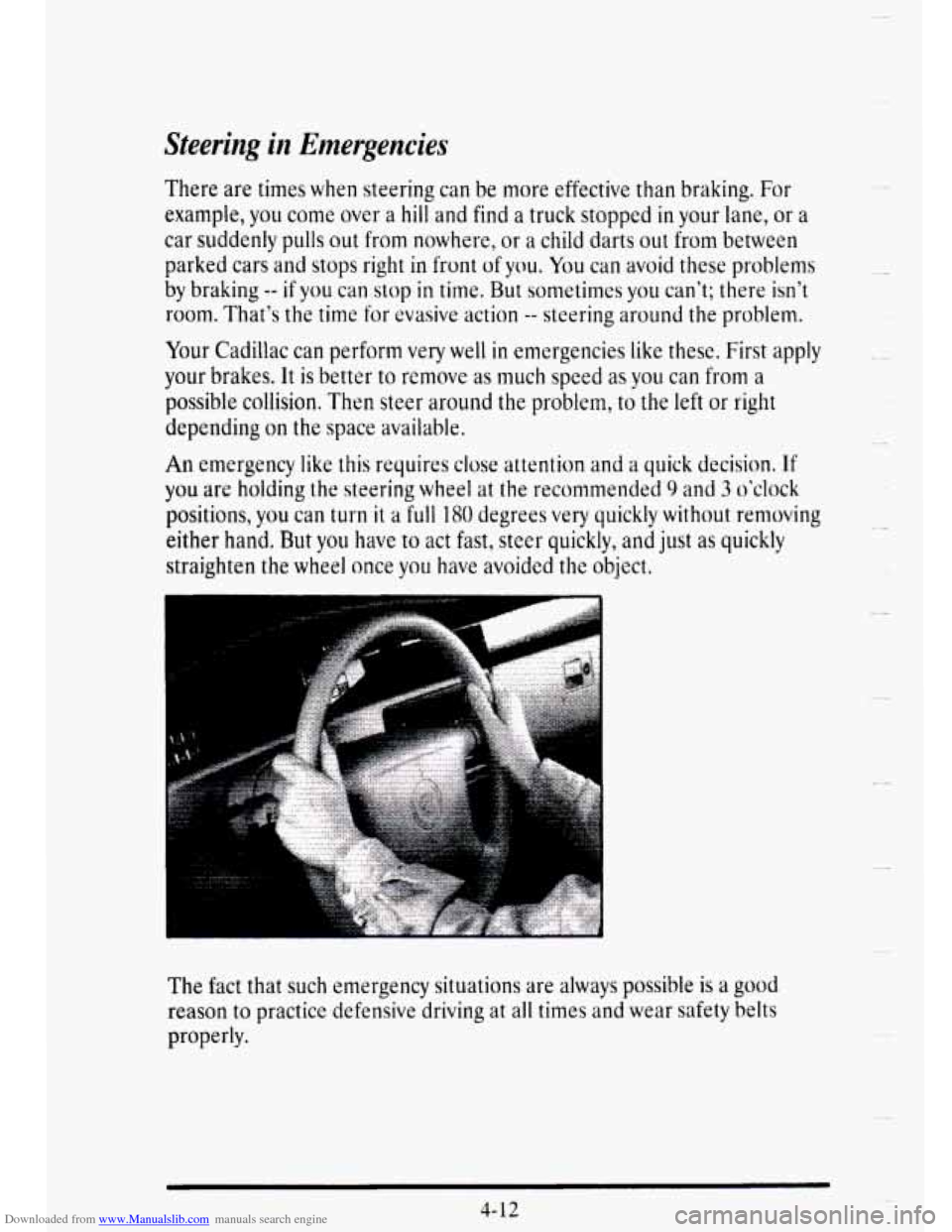
An emergency like this requires close attention and a quick decision. If
you are holding the steering wheel at the recommended 9 and 3 o’clock
positions, you can turn
it a full 180 degrees very quickly without renmving
either hand.
But you have to act fast, steer quickly, and just as quickly
straighten the wheel once
you have avoided the object,
-4 c
c-
.^
The fact that such emergency situations are always possible is a good
reason to practice defensive driving at
all times and wear safety belts
properly.
4-12
Page 208 of 403
Downloaded from www.Manualslib.com manuals search engine 0 Don't overtake a slowly moving vehicle too rapidly. Even though the
brake lamps are not flashing,
it may be slowing down or starting to turn,
0 If you're being passed, make it easv for the following driver to get
ahead
of you. Perhaps you can easi a little to the right.
LOSS OF CONTROL
Let's review what driving experts sav about what happens when the three
control svstems (brakes, steering an> acceleration)
don't have enough
friction where the tires meet the road to do what the driver has asked.
In any emergency, don't give up. Keep trying to steer and constantly seek
an escape route or area of less danger.
In a skid, a driver can lose control of the vehicle. Defensive drivers avoid
most skids
by taking reasonable care suited to existing conditions, and by
not "overdriving" those conditions.
But skids are always possible.
The three types of skids correspond to your Cadillac's three control
systems.
In the braking skid your wheels aren't rolling. In the steering or
cornering skid, too much speed or steering
in a curve causes tires to slip
and lose cornering force. And
in the acceleration skid too much throttle
causes
the driving wheels to spin.
A cornering skid is best handled by easing your foot off the accelerator
pedal.
Remember: Any traction control system helps avoid only the acceleration skid.
If your traction control system
is off? then an acceleration skid is also best
handled by easing your
foot off the accelerator pedal.
If your vehicle starts to slide, ease your foot off the accelerator pedal and
quickly steer
the way you want the vehicle to go. If you start steering
quickly enough, your vehicle may straighten out. Always be ready for a
second skid
if it occurs.
Of course, traction is reduced when water, snow, ice, gravel, or other material
is on the road. For safety, you'll want to slow down and adjust your driving to
these conditions. It is important to
slow down on slippery surfaces because
stopping distance will be longer and vehicle control more limited.
4-15