heating CADILLAC DEVILLE 1996 7.G User Guide
[x] Cancel search | Manufacturer: CADILLAC, Model Year: 1996, Model line: DEVILLE, Model: CADILLAC DEVILLE 1996 7.GPages: 354, PDF Size: 20.32 MB
Page 155 of 354
Downloaded from www.Manualslib.com manuals search engine The system will go off after a four-minute heating cycle.
If you shift out of
PARK (P), the system will only cycle
for
two minutes. If you want it to cycle again, press the
button. It will
go on for two-minute cycles after that. If
the windshield has cleared before the cycle is over, you
can turn it off by pressing the button again.
Use the defroster feature
to clear fog from the
windshield as previously described.
There is a metal film in the windshield which will block
out some radio or microwave signals. Therefore, the
heated windshield will reduce the useful range of
devices such as garage door openers and radar detectors.
(In certain states, radar detectors are legal.)
Do not use the DE-ICE button if your vehicle has a
cracked windshield.
A crack will not allow the system to
function properly. Have the windshield repaired before
using the DE-ICE button again.
Defogging and Defrosting
On cool, humid days, use DEFOG to keep the
windshield and side windows clear. Use DEFROST to
remove
fog or ice from the windshield quickly in
extremely humid
or cold conditions.
7
Press the DEFOG or DE-ICE button and adjust the fan
speed by pressing the fan button up or down. If you use
DEFROST, adjust
the fan speed the same way. If you
select DEFROST from AUTO, the system will control
the
fan speed. The temperature will also need to be
adjusted to your comfort level. Press the blue button to
decrease the temperature and the red button to increase the temperature.
Note that recirculation is not available
in the defrost or
defog modes.
-0
1
3-8
Page 156 of 354
Downloaded from www.Manualslib.com manuals search engine P
L-
c
(@ Rear Window Defogger
The lines you see on the rear window warrn the glass.
Press the button to turn on the rear defogger. With it,
the rear window and both outside rearview mirrors are heated.
The system will automatically shut off after
10 minutes. If further defogging is desired, press the
button again.
Do not attach a temporary vehicle license, tape or decals
across the defogger grid on the rear window.
NOTICE:
Scraping the inside of your rear window could
cut and damage the heating grids.
Your warranty
would not cover this damage.
And don’t put
decals there;
you might have to scrape them off.
Steering Wheel Controls for
Climate Control
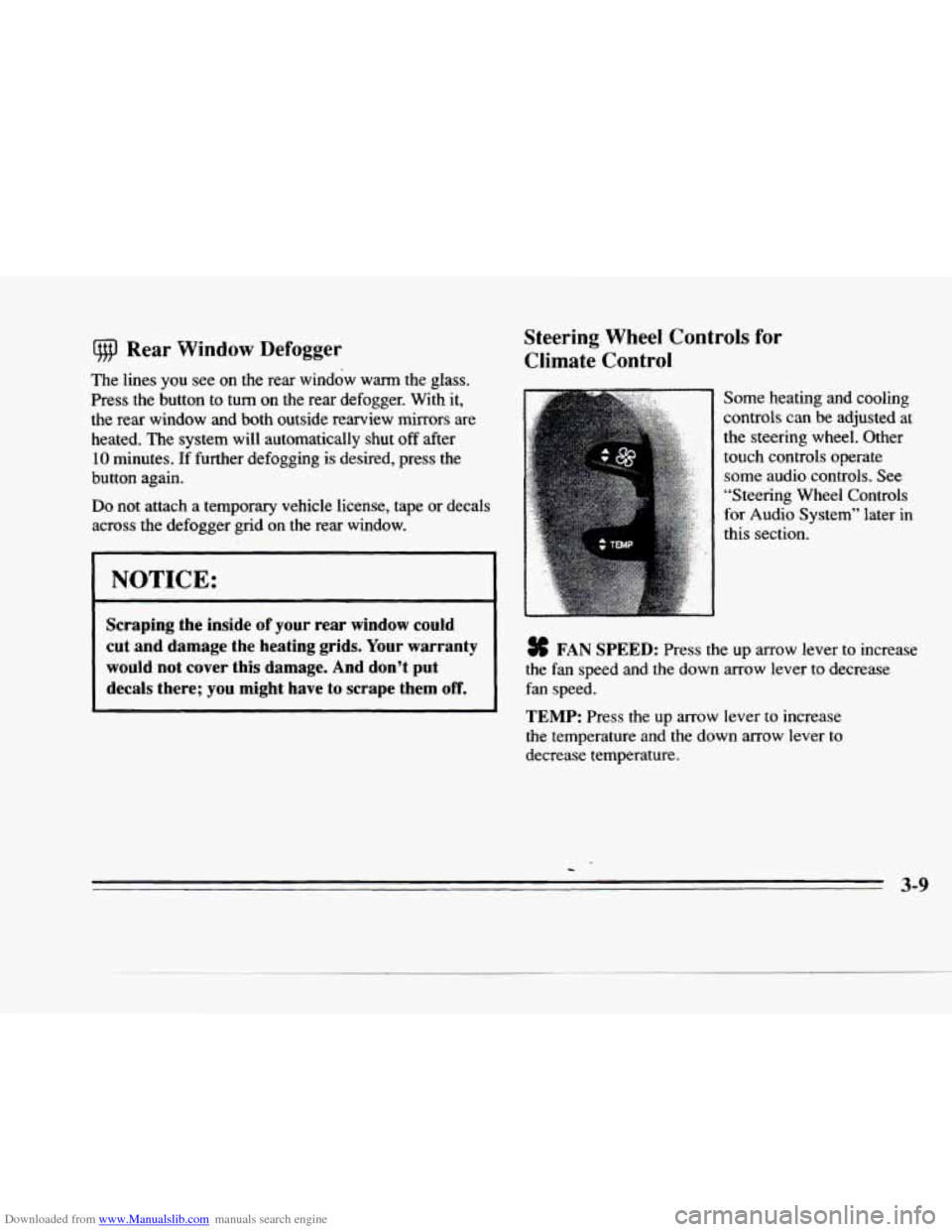
Some heating and cooling
controls can be adjusted at
the steering wheel. Other touch controls operate some audio controls. See
“Steering Wheel Controls
for Audio System’’ later in
this section.
# FAN SPEED: Press the up arrow lever to increase
the
fan speed and the down arrow lever to decrease
fan speed.
TEMP: Press the up arrow lever to increase
the temperature and the down arrow lever to
decrease temperature.
c
Page 219 of 354
Downloaded from www.Manualslib.com manuals search engine lhrn Signals When Towing a nailer
When you tow a trailer, your vehicle may need a
different
turn signal flasher and extra wiring. Check
with your Cadillac dealer. The green
arrows on your
instrument panel will flash whenever you signal a
turn
or lane change. Properly hooked up, the trailer lamps
will
also flash, telling other drivers you’re about to turn,
change lanes or stop.
When towing a trailer, the green arrows on your
instrument panel will flash for turns even
if the bulbs on
the trailer
are burned out. Thus, you may think drivers
behind you are seeing your signal when they are not. It’s
important to check occasionally to be sure the trailer
bulbs are still working.
Driving On Grades
Reduce speed and shift to a lower gear before you start
down a long or steep downgrade.
I€ you don’t shift
down, you might have to use your
brakes so much that
they would get hot and no longer work well.
On a long uphill grade,
shift down and reduce your
speed to around
45 mph (70 b/h) or less to reduce the
possibility
of engine and transaxle overheating.
If your vehicle weighs more
than 1,OOO lbs. (450 kg),
you may want to drive in
THIRD (3) instead of
OVERDRIVE (@).
4-38
Page 238 of 354
Downloaded from www.Manualslib.com manuals search engine Engine Overheating
You will find an ENGINE COOLANT HOT-IDLE
ENGINE message
or a STOP ENGINE ENGINE
OVERHEATED message on the DIC. There is also an
engine temperature warning light
on the instrument
panel. See “Engine Temperature Warning Light” in the
Index.
Overheated Engine Protection Operating
Mode
Y
Should a low coolant condition exist and the message
STOP ENGINE
ENGINE OVERHEATED is displayed,
an overheat protection mode which alternates firing
groups
of four cylinders helps prevent engine damage.
This operating mode
allows your vehicle to be driven
to a safe place in
an emergency; you may drive up to
50 miles (80 km). Towing a trailer in the overheat
protection mode should be avoided.
I NOTICE:
After driving in the Overheated Engine
Protection Operating Mode,
to avoid engine
damage, allow the engine to cool before
attempting any repair. The engine oil may be
severely degraded. Change the
oil and reset the
oil life indicator. See “Engine Oil, When to
~ Change” in the Index.
P
Page 243 of 354
Downloaded from www.Manualslib.com manuals search engine I NOTICE:
Engine damage if you keep running your engine
without coolant isn’t covered
by your warranty.
See “Overheated Engine Protection Operating
Mode” in the Index.
If there seems to
be no leak, with the engine on, check to
see if the electric engine fans are running. If the engine
is overheating, both fans should
be running. If they
aren’t, your vehicle needs service.
How to Add Coolant to the Coolant Surge
Tank
If you haven? found a problem yet, but the coolant level
isn’t at
the proper level (2.5 inches (60 mm) below the
base
of the fill neck), add a 50/50 mixture of clean
water (preferably distilled) and DEX-COOL TM
antifreeze at the coolant surge tank, but be sure the
cooling system, including
the coolant surge tank
pressure cap, is cool before you do it. (See “Engine Coolant”
in the Index for more information.)
I A CAUTION:
Steam and scalding liquids from a hot cooling
system
can blow out and burn you badly. They are
under pressure, and if you turn the coolant surge
tank pressure cap -- even a little -- they can come
out at
high speed. Never turn the cap when the
cooling system, including the coolant surge tank
pressure cap,
is hot. Wait for the cooling system
and coolantsurge tank pressure cap to cool if you
ever
have to turn the pressure cap.
5-20
Page 281 of 354
Downloaded from www.Manualslib.com manuals search engine Engine Coolant
The cooling system in your vehicle is filled with new
DEX-COOL (orange-colored, silicate-free) engine
coolant. This coolant is designed to remain in your vehicle for
5 years or 100,000 miles (166 0o0 km),
whichever occurs first.
The following explains your cooling system and how
to
add coolant when it is low. If you have a problem with
engine overheating, see “Engine Overheating” in
the Index.
A 50/50 mixture of water and the proper coolant for
your Cadillac will:
Give freezing protection down to -34°F (-37 O C).
Give boiling protection up to 265 “F (129 “C).
Protect against rust and corrosion.
0 Help keep the proper engine temperature.
Let the warning lights and gages work as they should.
NOTICE:
When adding coolant it is important that you use
DEX-COOL TM (orange-colored, silicate-free)
coolant meeting
GM Specification 6277M.
If silicated coolant is added to the system,
premature engine, heater core or radiator
corrosion may result. In addition, the engine
coolant
will require change sooner -- at
30,000 miles (50 000 km) or 24 months,
whichever occurs first.
What
to Use
Use a mixture of one-half clean water (preferably
distilled) and one-half
DEX-COOL (orange-colored,
silicate-free) antifreeze that meets
GM Specification
6277M, which won’t damage aluminum parts. Use
GM Engine Coolant Supplement (sealer) (GM Part
No. 3634621) with any complete coolant change. If you
use this mixture, you don’t need
to add anything else.
A special procedure is required for adding sealer; see the
Cadillac service manual.
(To order a service manual, see
“Service and Owner Publications”
in the Index.)
6-20 Y
Page 284 of 354
Downloaded from www.Manualslib.com manuals search engine hl
r
r
f
P
6'
r
Adding Coolant
If you need more coolant, add the proper mix at the
surge tank, but only when the engine is cool.
I A CAUTION:
You can be burned if you spill coolant on hot
engine parts. Coolant contains ethylene glycol,
and
it will burn if the engine parts are hot
enough. Don't spill coolant on a hot engine.
~~~ ~ ~~~~~~~
When replacing the pressure cap, make sure it is tight.
Surge Tank Pressure Cap
I NOTICE:
The surge tank cap is a 15 psi (105 kPa)
pressure-type
cap and must be tightly instalfed to
prevent coolant loss and possible engine damage
from overheating. Be sure
the arrows on the
cap line up.
If the surge tank pressure cap needs to be replaced, a
General Motors cap
is recommended.
Thermostat
Engine coolant temperature is controlled by a thermostat
in the engine coolant system. The thermostat stops the
flow of coolant through the radiator until the coolant
reaches a preset temperature.
If your thermostat needs to be replaced, a General
Motors thermostat
is recommended.
Page 297 of 354
Downloaded from www.Manualslib.com manuals search engine Tires
We don’t make tires. Your new Cadillac comes with
high-quality tires made by a leading tire manufacturer.
If you ever have questions about your tire warranty and
where to obtain service, see your Cadillac Warranty
booklet for details.
A CAUTION:
Poorly maintained and improperly used tires are
dangerous.
Overloading your tires can cause
overheating
as a result of too much friction.
You could have an air-out and a serious
accident. See “Loading Your Vehicle’’ in
the Index.
Underinflated tires pose the same danger as
overloaded tires. The resulting accident
could cause serious injury. Check all tires
frequently to maintain
the recommended
pressure. Tire pressure should
be checked
when your tires are cold.
CAUTION: (Continued)
Overinflated tires are more likely to be
cut, punctured or broken by
a sudden
impact
-- such as when you hit a pothole.
Keep tires
at the recommended pressure.
Worn, old tires can cause accidents. If your
tread is badly worn, or if your tires have
been damaged, replace them.
See “Inflation
-- Tire Pressure’’ in this section
for inflation pressure adjustment for higher
speed driving.
Inflation -- Tire Pressure
The Tire-Loading Information label which is located on
the rear edge of the driver’s door, shows the correct
inflation pressures for your tires when they’re cold.
“Cold” means your vehicle has been sitting for at least
three hours or driven no more
than a mile.
If you’ll be driving at speeds higher than
100 mph
(160 km/h) where it is legal, raise the cold inflation
pressure
of each tire to 35 psi (240 Wa). When you end
this very high-speed driving, reduce the cold inflation
6-36
Page 345 of 354
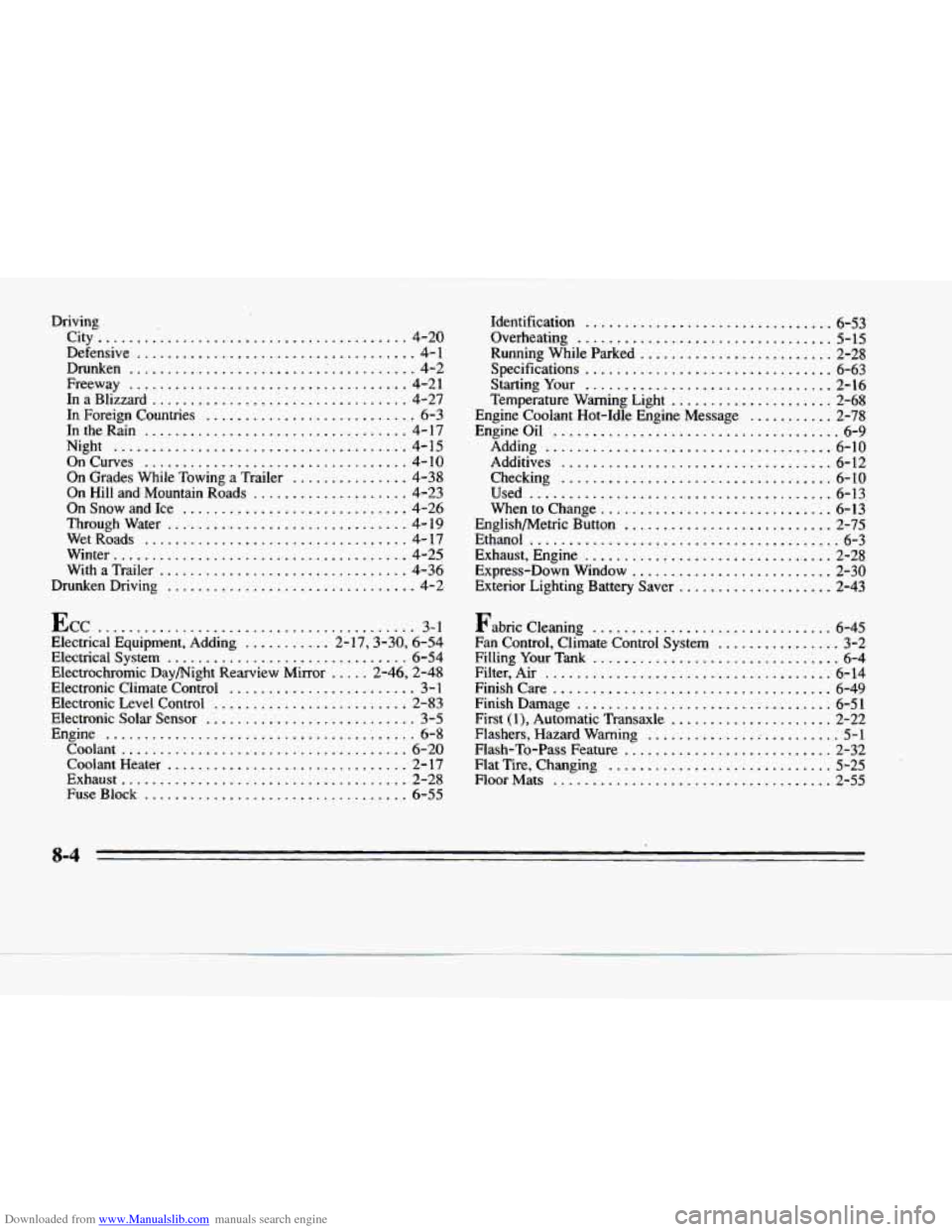
Downloaded from www.Manualslib.com manuals search engine Driving City
........................................ 4-20
Defensive
.................................... 4-1
Drunken
..................................... 4-2
Freeway
.................................... 4-21
InaBlizzard
................................. 4-27
In Foreign Countries ........................... 6-3
In the Rain .................................. 4- 17
Night
...................................... 4-15'
OnCurves .................................. 4-10
On Grades While Towing a Trailer ............... 4-38
On Hill and Mountain Roads
.................... 4-23
On Snow and Ice
............................. 4-26
Throughwater
............................... 4-19
WetRoads
.................................. 4-17
Winter
...................................... 4- 25
With a Trailer
................................ 4-36
Drunken Driving
................................ 4-2
ECC ......................................... 3-1
Electrical Equipment. Adding ........... 2.17.3.30. 6.54
Electrical System
............................... 6-54
Electrochromic Daymight Rearview Mirror
..... 2.46. 2.48
Electronic Climate Control
........................ 3- 1
Electronic Level Control ......................... 2-83
Electronic Solar Sensor
........................... 3-5
Engine
........................................ 6-8
Coolant ..................................... 6-20
Coolant Heater
............................... 2- 17
Exhaust ..................................... 2-28
FuseBlock .................................. 6-55 Identification
................................ 6-53
Overheating
................................. 5-15
Running While Parked
......................... 2-28
Specifications
................................ 6-63
StartingYour
................................ 2-16
Temperature Warning Light
..................... 2-68
Engine Oil
..................................... 6-9
Adding
..................................... 6-10
Additives
................................... 6-12
Checking
................................... 6-10
Used
....................................... 6-13
When
to Change .............................. 6-13
English/Metric Button
........................... 2-75
Exhaust. Engine
................................ 2-28
Engine Coolant Hot-Idle Engine Message ........... 2-78
Ethanol
........................................ 6-3
Express-Down Window .......................... 2-30
Exterior Lighting Battery Saver
.................... 2-43
Fabric Cleaning
............................... 6-45
Fan Control. Climate Control System
................ 3-2
Filling
Your Tank ................................ 6-4
Filter. Air
..................................... 6-14
Finish Care
.................................... 6-49
Finish Damage
................................. 6-51
First (1). Automatic Transaxle
..................... 2-22
Flashers. Hazard Warning
......................... 5-1
Flash-To-Pass Feature
........................... 2-32
Flat Tire. Changing
............................. 5-25
Floor Mats .................................... 2-55
8-4
.
..
1
-1
.
..
-
Page 346 of 354
Downloaded from www.Manualslib.com manuals search engine cy
c
c
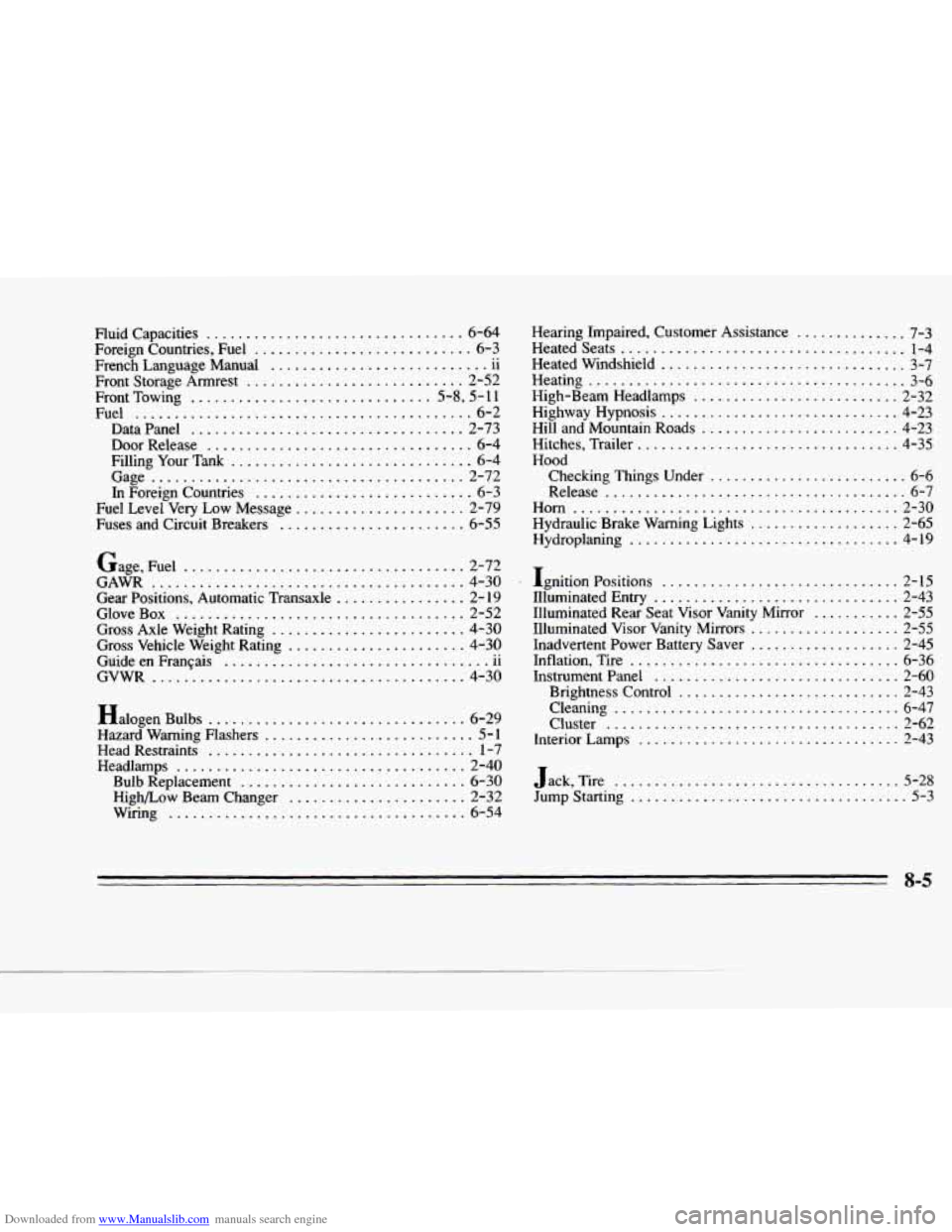
Fluid Capacities ................................ 6-64
Foreign Countries. Fuel ........................... 6-3
French Language Manual -11
Front Storage Armrest ........................... 2-52
Front Towing .............................. 5.8. 5.11
Fuel
........................................... 6-2
Data Panel .................................. 2-73
DoorRelease ................................. 6- 4
Filling Your Tank .............................. 6-4
Gage ....................................... 2- 72
In Foreign Countries ........................... 6-3
Fuel Level Very Low Message ..................... 2-79
Fuses and Circuit Breakers ....................... 6-55
.. ..........................
Gage. Fuel ................................... 2-72
GAWR ....................................... 4-30 .
Gear Positions, Automatic Transaxle ................ 2- 19
GloveBox .................................... 2-52
Gross Axle Weight Rating ........................ 4-30
Gross Vehicle Weight Rating ...................... 4-30
Guide en FranGais 11
GVWR ....................................... 4-30
.. .................................
c
Halogen Bulbs ................................ 6-29
c
Hazara Warning Flashers .......................... 5- 1
Head Restraints ................................. 1-7
Headlamps .................................... 2-40
Bulb Replacement ............................ 6-30
Highbow Beam Changer ...................... 2-32
Wiring ..................................... 6-5 4
Hearing Impaired. Customer Assistance .............. 7-3
Heated Seats .................................... 1-4
Heated Windshield ............................... 3-7
Heating ........................................ 3-6
High-Beam Headlamps .......................... 2-32
Highway Hypnosis .............................. 4-23
Hill and Mountain Roads ......................... 4-23
Hitches. Trailer ................................. 4-35
Hood
Checking Things Under
......................... 6-6
Release ...................................... 6-7
Horn ......................................... 2-30
Hydraulic Brake Warning Lights ................... 2-65
Hydroplaning .................................. 4-19
Ignition Positions .............................. 2-15
Illuminated Entry ............................... 2-43
Illuminated Rear Seat Visor Vanity Mirror ........... 2-55
Illuminated Visor Vanity Mirrors ................... 2-55
Inadvertent Power Battery Saver ................... 2-45
Inflation. Tire .................................. 6-36
Instrument Panel ............................... 2-60
Brightness Control ............................ 2-43
Cluster ..................................... 2-62
Interior Lamps ................................. 2-43
Cleaning .................................... 6-47
.................................... J ack. Tire 5-28
Jump Starting ................................... 5-3
8-5 .