window CADILLAC DEVILLE 1996 7.G Owners Manual
[x] Cancel search | Manufacturer: CADILLAC, Model Year: 1996, Model line: DEVILLE, Model: CADILLAC DEVILLE 1996 7.GPages: 354, PDF Size: 20.32 MB
Page 14 of 354
Downloaded from www.Manualslib.com manuals search engine c
c
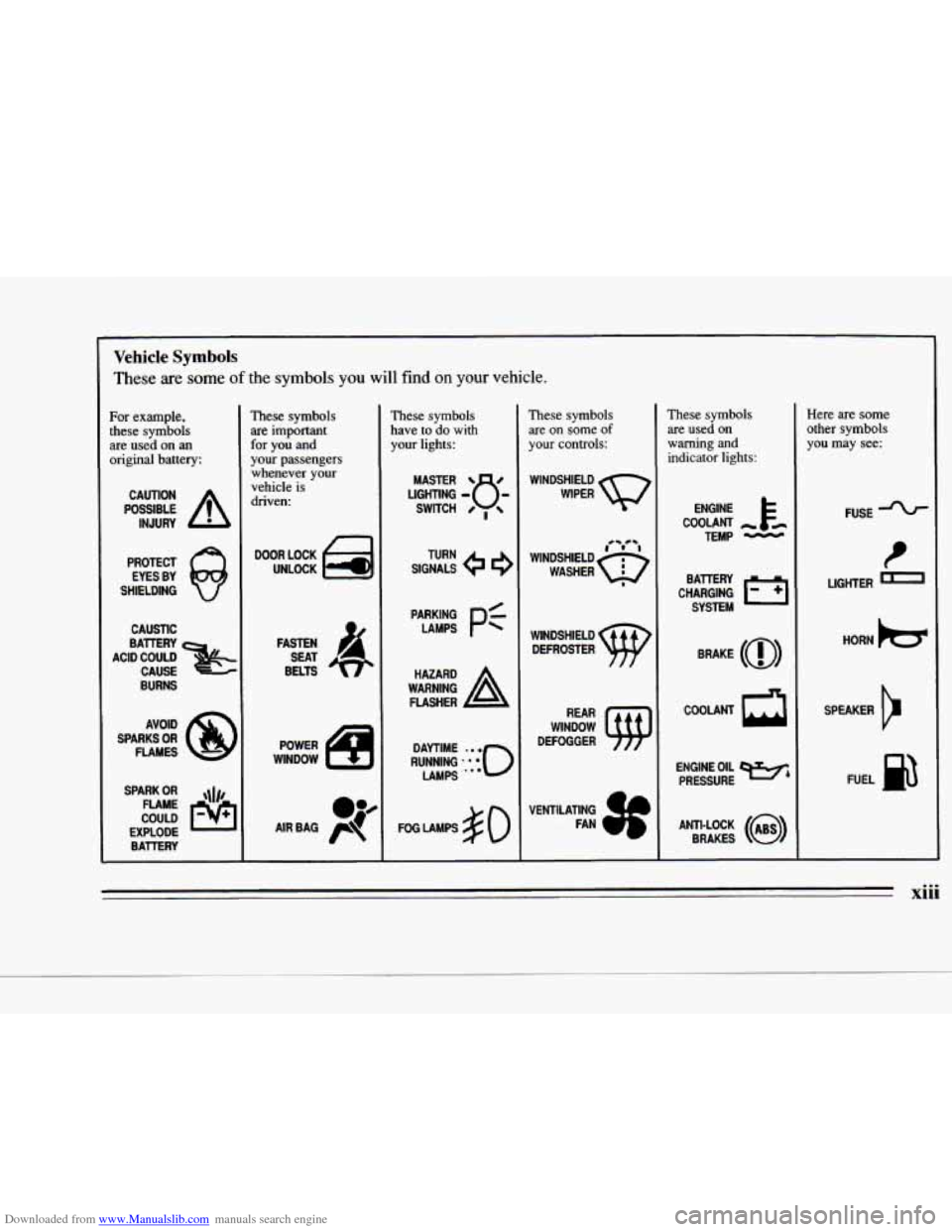
Vehicle Symbols
These are some of the symbols you will find on your vehicle.
For example,
these symbols
are used on
an
original battery:
POSSIBLE A
CAUTION
INJURY
PROTECT EYES BY
SHIELDING
CAUSTIC
BAllERY
CAUSE
BURNS
ACID COULD
&
AVOID
SPARKS
OR
FLAMES
SPARK
OR ,111,
COULD FLAME
EXPLODE BATTERY
These symbols are important
for
you and
your passengers whenever your
vehicle is
driven:
DOOR LOCK
UNLOCK
POWER
WINDOW
These symbols
have to do with
your lights:
SIGNALS @
TURN
WARNING
A
HAZARD
FLASHER
FOG LAMPS
$0
These symbols
are on some of
your controls:
WINDSHIELD
WIPER
VENTILATING FAN
(
These symbols
are used on
warning and
indicator lights:
COOLANT
TEMP
-
CHARGING I-1
BAllERY
SYSTEM
BRAKE
(a)
COOLANT a
ENGINE OIL w,
PRESSURE
ANTI-LocK
(@) BRAKES
Here are some
other symbols
you may see:
FUSE *
P
LIGHTER
HORN
h=r.
SPEAKER
c>
FUEL B
xiii
Page 40 of 354
Downloaded from www.Manualslib.com manuals search engine rc
c
c
What will you see after an air bag inflates?
After the air bag inflates, it quickly deflates. This occurs
so quickly that some people may not even realize the air
bag inflated. Some components of the air bag module in
the steering wheel
hub for the driver’s air bag, or the
instrument panel for the right front passenger’s bag, will
be hot for a short time. The part
of the bag that comes
into contact with you may be warm, but it
will never be
too hot to touch. There will be some smoke and dust
coming from vents in the deflated air bags. Air bag
inflation will not prevent the driver from seeing or from
being able to steer the vehicle, nor will it stop people
from leaving the vehicle.
A CAUTION: I
When an air bag inflates, there is dust in the air.
This dust could cause breathing problems for
people with a history of asthma or other
breathing trouble.
To avoid this, everyone in the
vehicle should get out as soon as it
is safe to do so.
If you have breathing problems but can’t get out
of the vehicle after an air bag inflates, then get
fresh air by opening a window or door.
Your vehicle has a feature that will automatically unlock
the doors and
tum the interior lamps on when the air bag
inflates
(if battery power is available). But if you want to,
you can lock the doors again and
turn the interior lamps
off by using the door lock and interior lamp controls.
m many crashes severe enough to inflate
an air bag,
windshields are broken by vehicle defomation.
Additional windshield breakage may
also occur from the
right front passenger air bag.
0 The air bags are designed to inflate only once. After they inflate, you’ll need some
new parts for your air
bag system. If you don’t get them, the
air bag system
won’t
be there to help protect you in another crash.
A new system will include air bag modules and
possibly other parts. The service manual for your
vehicle covers the need to replace other
parts.
0 Your vehicle is equipped with a crash sensing and
diagnostic module, which records information about the
air bag system. The module records information
about the readiness
of the system, when the sensors are
activated and driver’s safety belt usage at deployment.
1-25
Page 44 of 354
Downloaded from www.Manualslib.com manuals search engine c
c
c
c
c
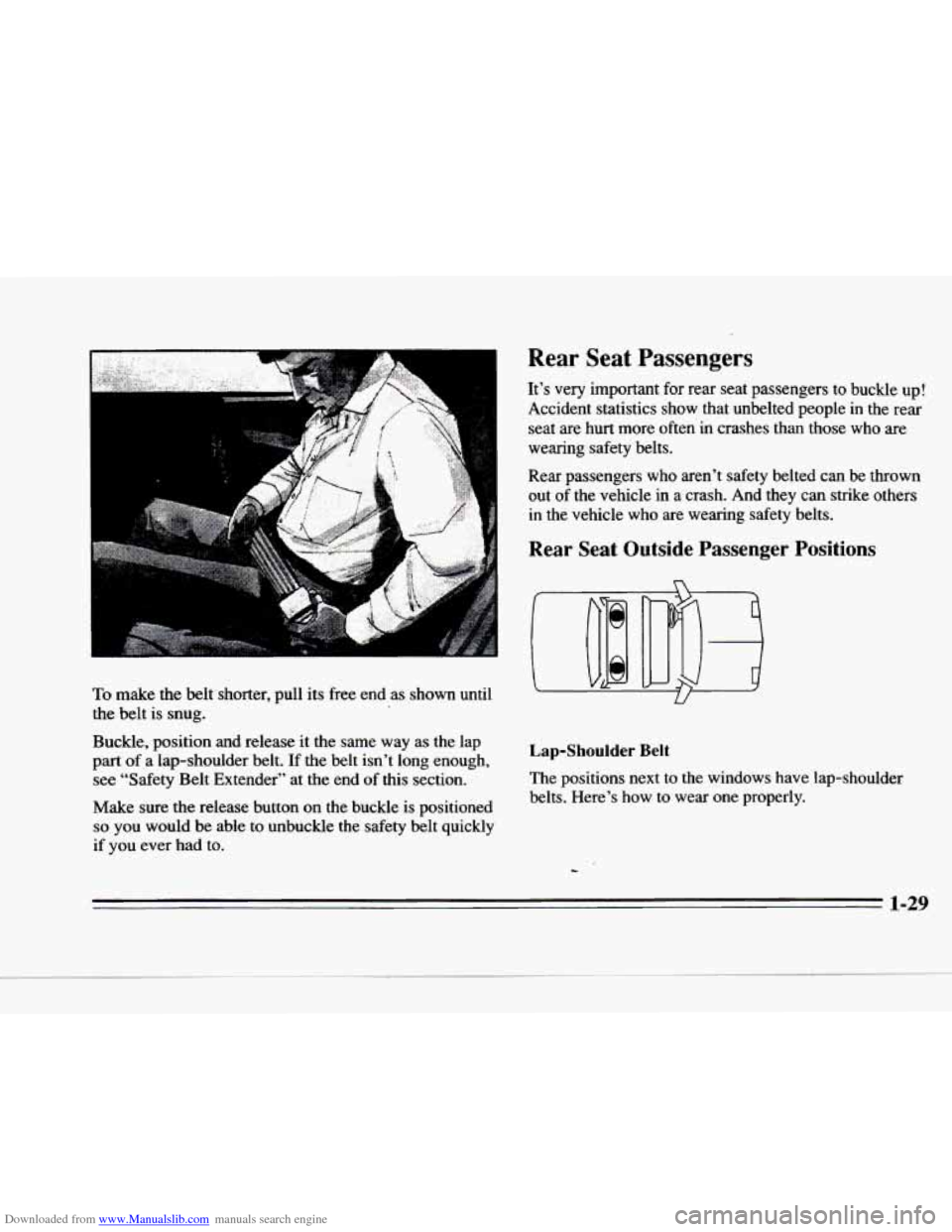
To make the belt shorter, pull its free end as shown until
the belt is snug.
Buckle, position and release it the
same way as the lap
part
of a lap-shoulder belt. If the belt isn’t long enough,
see “Safety Belt Extender’’ at the end of this section\
.
Make sure the release button on the buckle is positioned
so you would be able to unbuckle the safety belt quickly
if you ever had to.
Rear Seat Passengers
It’s very important for rear seat passengers to buckle up!
Accident statistics show that unbelted people in the rear
seat are hurt more often in crashes than those who are
wearing safety belts.
Rear passengers who aren’t safety belted can be thrown out of the vehicle in a crash. And they
can strike others
in the vehicle who are wearing safety belts.
Rear Seat Outside Passenger
Lap-Shoulder Belt
Positions
The positions next to the windows have lap-shoulder belts. Here’s how to wear one properly.
1-29
Page 59 of 354

Downloaded from www.Manualslib.com manuals search engine Larger Children If you have the choice, a child should sit next to a
window
so the child can wear a lap-shoulder belt and
get the additional restraint a shoulder belt can provide.
Accident statistics show that children are safer
if they
are restrained
in the rear seat. But they need to use the
safety belts properly.
Children who aren’t buckled up can be thrown out in
Children.who aren’t. buckled up can strike other
a crash.
people
who are.
Children
who have outgrown child restraints should
wear the vehicle’s safety belts.
1-44
S
Page 64 of 354
Downloaded from www.Manualslib.com manuals search engine C
c
f.
Section 2 Features and Controls
Here you can learn about the many standard and optional
features
on your Cadillac, and information on starting,
shifting and braking.
Also explained are the instrument
panel and
the warning systems that tell you if everythmg is
working properly -- and what to do if you have a problem.
Keys
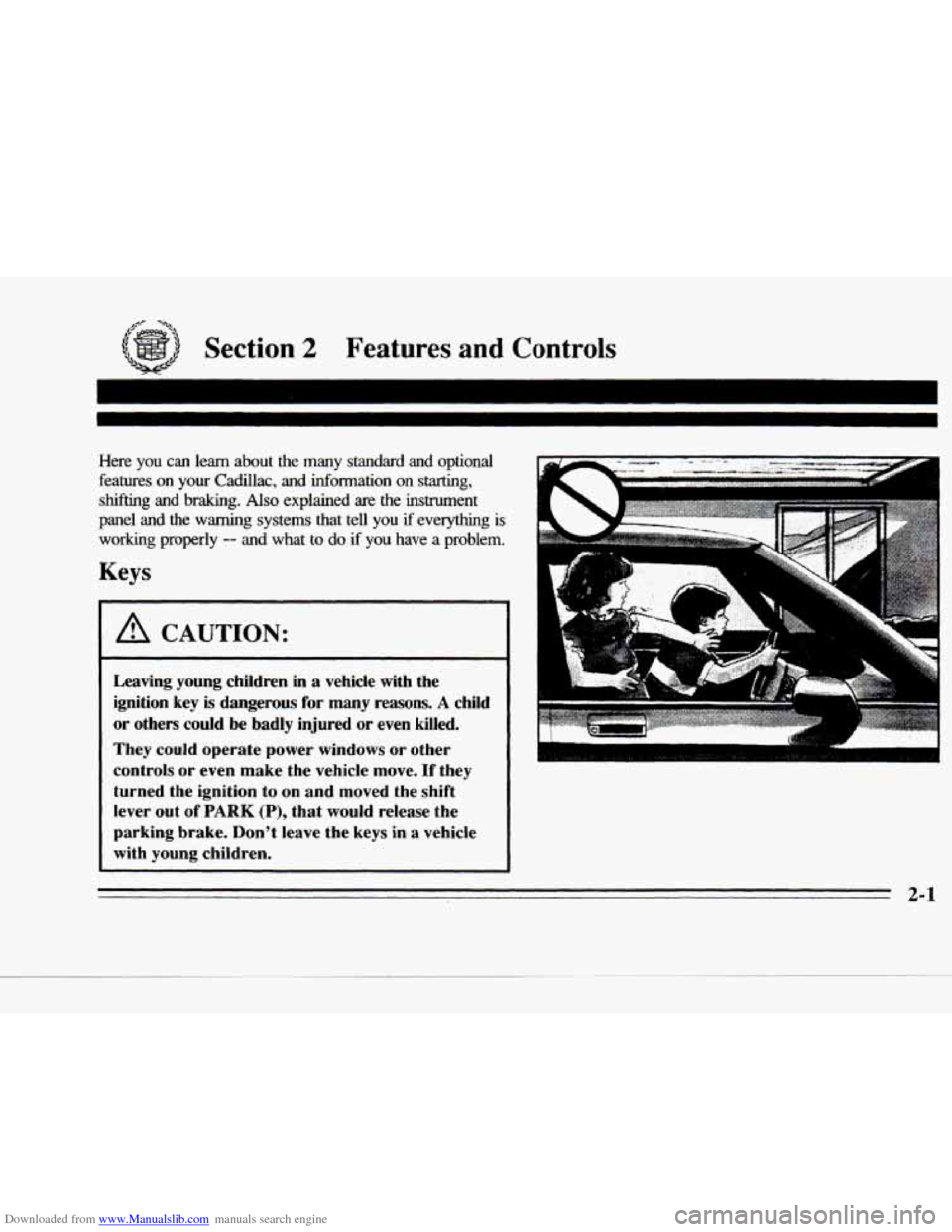
A CAUTION:
Leaving young children in a vehicle with the
ignition key
is dangerous for many reasons. A child
or others could be badly injured or even killed.
They
could operate power windows or other
controls
or even make the vehicle move. If they
turned the ignition to on and moved the shift
lever out
of PARK (P), that would release the
parking brake. Don't leave the keys
in a vehicle
with young children.
. ...(
1
2-1
Page 72 of 354
Downloaded from www.Manualslib.com manuals search engine c
C.
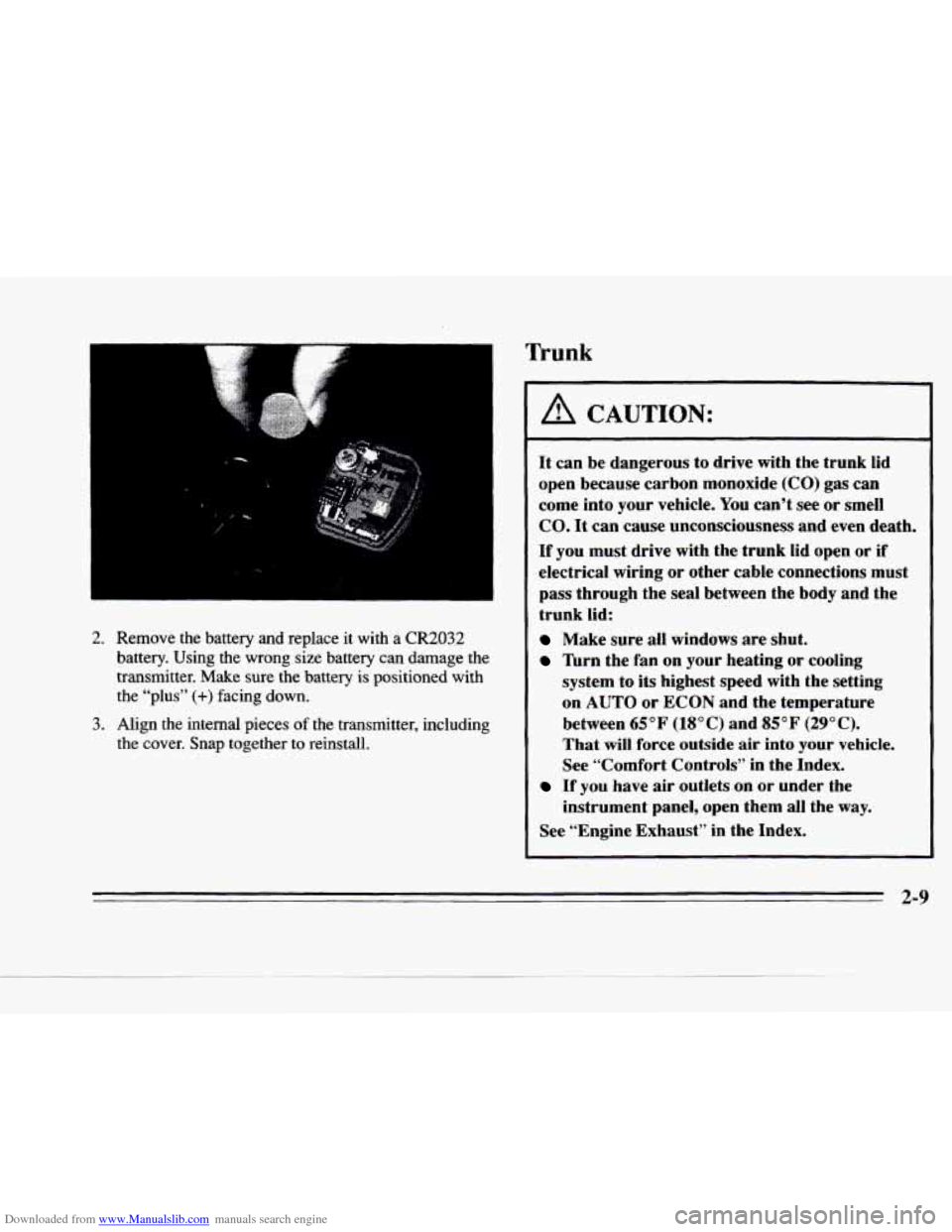
2. Remove the battery and replace it with a CR2032
battery. Using the wrong size battery can damage the
transmitter.
Make sure the battery is positioned with
the “plus”
(+) facing down.
3. Align the internal pieces of the transmitter, including
the cover. Snap together to reinstall.
Trunk
~~~
A CAUTION:
It can be dangerous to drive with the trunk lid
open because carbon monoxide
(CO) gas can
come into your vehicle. You can’t see or smell
CO. It can cause unconsciousness and even death.
If you
must drive with the trunk lid open or if
electrical wiring or other cable connections must
pass through the seal between the body and the
trunk lid:
Make sure all windows are shut.
firn the fan on your heating or cooling
system to its highest speed with the setting
on
AUTO or ECON and the temperature
between
65°F (18OC) and 85°F (29°C).
That will force outside air into your vehicle.
See “Comfort Controls” in the Index.
instrument panel, open them all the way.
If you have air outlets on or under the
See “Engine Exhaust” in the Index.
- 2-9
Page 74 of 354
Downloaded from www.Manualslib.com manuals search engine Trunk Lid Automatic Pull-Down Feature
P I A CAUTION:
zc
F-
c
~ ~~~
Your car has an automatic pull-down feature that
helps close the trunk electronically. Your fingers
can be trapped under the trunk lid as it goes
down. Your fingers could be injured, and you
would need someone to help you free them. Keep
your fingers away from the trunk lid as you close
it and as it
is going down.
Theft
Vehicle heft is big business, especially in some cities.
Although your Cadillac has a number of theft-deterrent
features, we know that nothing we put on it can make it
impossible to steal. However, there
are ways you can help.
Key in the Ignition
If you leave your vehicle with the keys inside, it’s an
easy target for joy riders or professional thieves -- so
don’t do it. When you park your Cadillac and open the driver’s
door, you’ll hear
a chime reminding you to remove your
key from the ignition and take it with you. Always do
this. Your steering wheel will
be locked, and so will
your ignition and transaxle. And remember to lock the
doors.
Parking at Night
Park in a lighted spot, close all windows and lock your
vehicle. Remember to keep
your valuables out of sight.
Put them in
a storage area, or take them with you.
Parking Lots
If you park in a lot where someone will be watching
your vehicle, it’s best to lock it up and take your keys. \
But what if you have
to leave your ignition key? What if
you have to leave something valuable
in your vehicle?
0 Put your valuables in a storage area, like your trunk
or glove box.
0 Lock the glove box.
Lock all the doors except the driver’s.
0 Then take the door key and remote lock control key
chain with you.
2-11
Page 76 of 354
Downloaded from www.Manualslib.com manuals search engine r-
c
Testing the Alarm
1. From inside the vehicle, roll down the window, then
get
out of the vehicle, keeping the door open.
2. From outside of the vehicle, with the door open, lock
the vehicle using the power door lock or
the Keyless
Entry system
and close the door. Wait 30 seconds.
3. Reach in and unlock the door using the manual lock
and open the door. The horn will sound and the
headlamps will flash.
If the alm does not sound when it should, check to see
if the horn works. The horn fuse may be blown. To
replace the fuse, see “Fuses and Circuit Breakers” in the\
Index.
If the fuse does not need to be replaced, you may
need to have your Cadillac serviced.
To reduce the possibility of theft, always activate the
optional theft-deterrent system when leaving your vehicle.
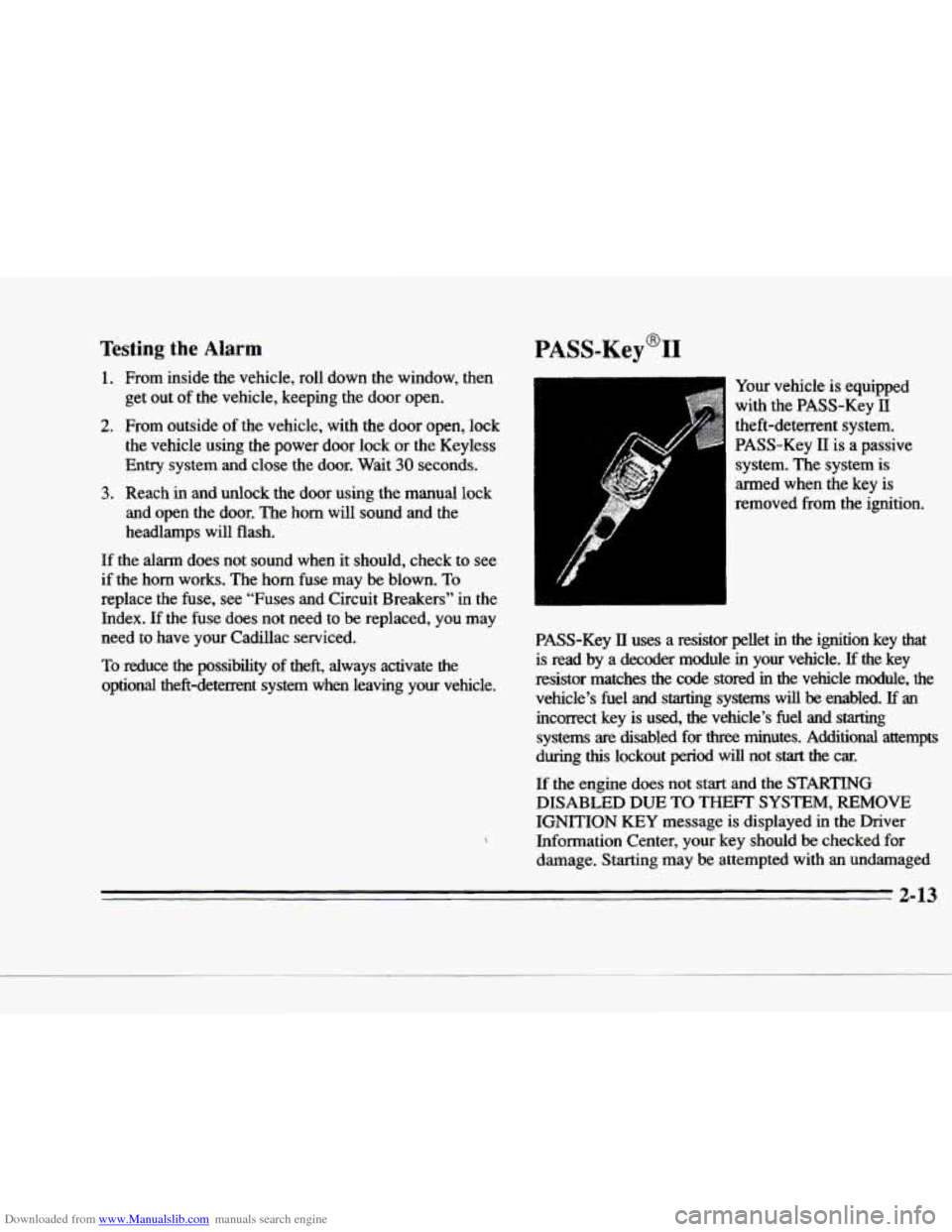
PASS-Key%
I Your vehicle is equipped
with the PASS-Key
I1
theft-deterrent system. PASS-Key
I1 is a passive
system. The system is
armed when the key is
removed from the ignition.
PASS-Key
11 uses a resistor pellet in the ignition key that
is read by a decoder module-in your vehicle. If the key
resistor matches the code stored
in the vehicle module, the
vehicle’s fuel and starting systems will
be enabled. If an
incorrect key is used, the vehicle’s fuel and starting
systems are disabled for three minutes. Additional attempts
during
this lockout period will not start the car.
If the engine does not start and the STARTING
DISABLED DUE TO THEFT SYSTEM, REMOVE
IGNITION KEY message is displayed in the Driver
Information Center, your
key should be checked for
damage.
Starting may be attempted with an undamaged
2-13
Page 79 of 354
Downloaded from www.Manualslib.com manuals search engine Retained Accessory Power
The following accessories on your Cadillac may be used
for up to 10 minutes after the ignition key is turned
to om:
Radio
0 Power Windows
Astroroof
Power to these accessories stops after
10 minutes or if any
door is opened.
If you want power for another 10 minutes,
turn the ignition key to RUN and then back to OFF.
Starting Your Engine
Move your shift lever to PARK (P) or NEUTRAL (N).
Your engine won’t start in any other position -- that’s a
safety feature.
To restart when you’re already moving,
use
NEUTRAL (N) only.
NOTICE:
Don’t try to shift to PARK (P) if your Cadillac
is moving. If you do, you could damage the
transaxle. Shift
to PARK (P) only when your
vehicle is stopped.
1. Without pushing the accelerator pedal, turn your
ignition
key to START. When the engine starts, let
go of the key. The idle speed will go down as your
engine gets warm.
NOTICE:
Holding your key in START for longer than
15 seconds at a time will cause your battery to
be drained much sooner. And the excessive heat
can damage your starter
motor.
r’
2. If it doesn’t start right away, hold your key in
START for about three seconds at a time until your
engine
starts. Wait about 15 seconds between each
try to help avoid draining your battery.
3. If your engine still won’t start (or starts but then
stops), it could be
flooded with too much gasoline.
Try pushing your accelerator pedal all the way to the
floor and holding it there as you hold the key in
START for about three seconds.
If the vehicle starts
briefly but then stops
again, do the same thing.
2-16 1
Page 91 of 354
Downloaded from www.Manualslib.com manuals search engine Engine Exhaust
/r CAUTION:
Engine exhaust can kill. It contains the gas
carbon monoxide
(CO), which you can’t see or
smell.
It can cause unconsciousness and death.
You might have exhaust coming in
if:
Your exhaust system sounds strange
Your vehicle gets rusty underneath.
Your vehicle was damaged in a collision.
Your vehicle was damaged when driving over
high points on the road or over road debris.
Repairs weren’t done correctly.
Your vehicle or exhaust system had been
If you ever suspect exhaust is coming into your
vehicle:
Drive it only with all the windows down to
Have your vehicle fixed immediately.
or different.
modified improperly. blow out any
CO; and
Running Your Engine While
You’re Parked
It’s better not to park with the engine running. But if you
ever have to, here are some things to know.
A CAUTION:
Idling the engine with the air system control off
could allow dangerous exhaust into your vehicle
(see the earlier Caution under “Engine
Exhaust”).
Also, idling
in a closed-in place can let deadly
carbon monoxide
(CO) into your vehicle even if
the fan switch
is at the highest setting. One place
this can happen
is a garage. Exhaust -- with
CO -- can come in easily. NEVER park in a
garage with the engine running.
Another closed-in place can be
a blizzard.
(See “Blizzard’ in the Index.)
2-28