trunk CADILLAC DEVILLE 1997 7.G Owner's Manual
[x] Cancel search | Manufacturer: CADILLAC, Model Year: 1997, Model line: DEVILLE, Model: CADILLAC DEVILLE 1997 7.GPages: 386, PDF Size: 21.61 MB
Page 232 of 386

Downloaded from www.Manualslib.com manuals search engine MFD BY GENERAL MOTORS CORP
DATE GVWR GAWR FRT GAWR RR
THIS VEHICLE CONFORMS TO ALL APPLI-
CABLE U.S. FEDERAL MOTOR VEHICLE
SAFETY, BUMPER, AND THEFT PREVENTION
STANDARDS
IN EFFECT ON THE DATE OF
MANUFACTURE SHOWN ABOVE.
The other label is the Certification label, found on the
rear edge of the driver’s door. It tells you the gross
weight capacity of your vehicle, called the GVWR
(Gross Vehicle Weight Rating). The GVWR includes the
weight
of the vehicle, all occupants, fuel and cargo.
Never exceed the
GVWR for your vehicle or the Gross
Axle Weight Rating (GAWR) for either the front or
rear axle.
If you do have a heavy load, you should spread it out.
Don’t
carry more than 203 lbs. (92 kg) in the trunk.
CAUTION:
Do not load your vehicle any heavier than the
GVWR, or either the maximum front or rear
GAWR. If you do, parts on your vehicle can
break, or it can change the
way your vehicle
handles. These could cause
you to lose control.
Also, overloading can shorten the life of
your vehicle.
1 NOTICE:
Your warranty does not cover parts or
components that fail because of overloading.
If you put things inside your vehicle -- like suitcases,
tools, packages or anything else
-- they will go as fast as
the vehicle goes.
If you have to stop or turn quickly, or
if there is a crash, they’ll keep going.
Page 233 of 386

Downloaded from www.Manualslib.com manuals search engine A CAUTION:
Things you put inside your vehicle can strike and
injure people in
a sudden stop or turn, or in
a crash.
Put things in the trunk of your vehicle. In a
trunk, put them as far forward as you can.
Try to spread the weight evenly.
Never stack heavier things, like suitcases,
inside the vehicle
so that some of them are
above the tops of the seats.
0 Don’t leave an unsecured child restraint in
your vehicle.
When you carry something inside the
vehicle, secure
it whenever you can.
Electronic Level Control
This feature keeps the rear of your vehicle level as the
load changes. It’s automatic
-- you don’t need to adjust
anything.
Towing a Trailer
A CAUTION:
If you don’t use the correct equipment and drive
properly, you can lose control when you pull
a
trailer. For example, if the trailer is too heavy, the
brakes may not work well
-- or even at all. You
and your passengers could be seriously injured.
Pull
a trailer only if you have followed all the
steps in this section. Ask your Cadillac dealer for
advice and information about towing
a trailer
with your vehicle.
I NOTICE:
Pulling a trailer improperly can damage your
vehicle and result in costly repairs not covered by
your warranty.
To pull a trailer correctly, follow
the advice in this part, and see your Cadillac
dealer for important information about towing
a
trailer with your vehicle.
Page 238 of 386
Downloaded from www.Manualslib.com manuals search engine Trailer- Wiring Harness
If your vehicle is equipped with the 3,666-&. (1 360 kg)
trailer towing package option, you will have a wiring
harness located under the trunk trim. The harness is a
five wire harness, with connector.
These trailer-wiring harness color codes should be
followed when connecting it to your trailer:
0 WHITE: Direct trailer ground for trailer lamps.
0 BROWN: Parking lamps.
0 YELLOW Left turn and stoplamps.
0 GREEN: Right turn and stoplamps.
BLUE: Auxiliary circuit.
Driving with a Trailer
Towing a trailer requires a certain amount of experience.
Before setting out for the open road, you’ll want to get
to know your rig. Acquaint yourself with the feel
of
handling and braking with the added weight of the
trailer. And always keep in mind that the vehicle you are driving is now a good deal longer and not nearly as
responsive as your vehicle
is by itself.
Before you
start, check the trailer hitch and platform
(and attachments), safety chains, electrical connector,
lamps, tires and mirror adjustment.
If the trailer has
electric brakes, start your vehicle and trailer moving and
then apply the trailer brake controller by hand to be sure
the brakes are working. This lets you check your
electrical connection at the same time.
During your trip, check occasionally to be sure that the
load is secure, and that the lamps and any trailer brakes are still working.
Following Distance
Stay at least twice as far behind the vehicle ahead as you
would when driving your vehicle without a trailer. This can help you avoid situations that require heavy braking and sudden turns.
4-37
Page 269 of 386
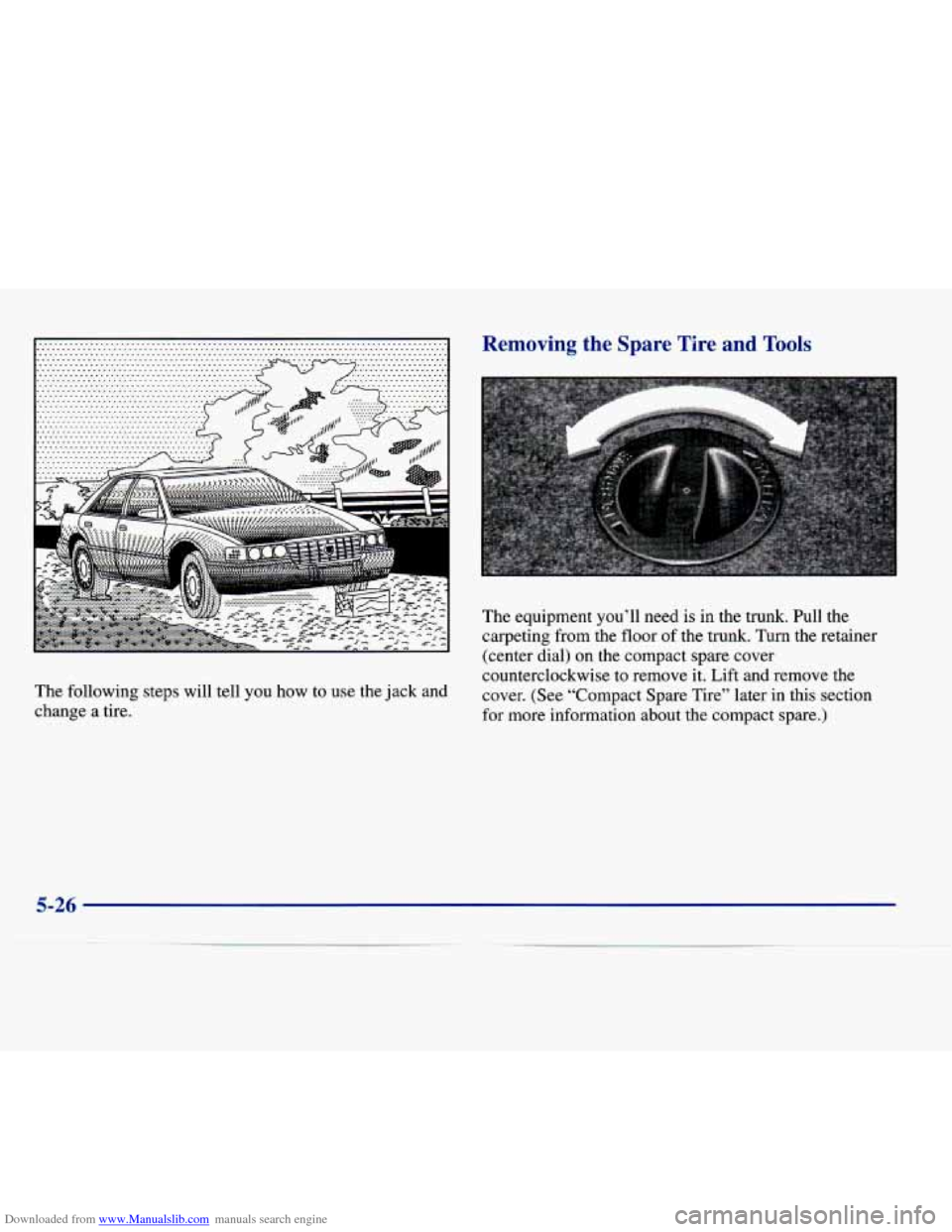
Downloaded from www.Manualslib.com manuals search engine The following steps will tell you how to use the jack and
change a tire.
Removing the Spare Tire and Tools
The equipment you’ll need is in the trunk. Pull the
carpeting from the floor of the trunk. Turn the retainer
(center dial) on the compact spare cover
counterclockwise to remove it. Lift and remove the
cover. (See “Compact Spare Tire” later in this section
for more information about the compact
spare.)
5-26
Page 270 of 386
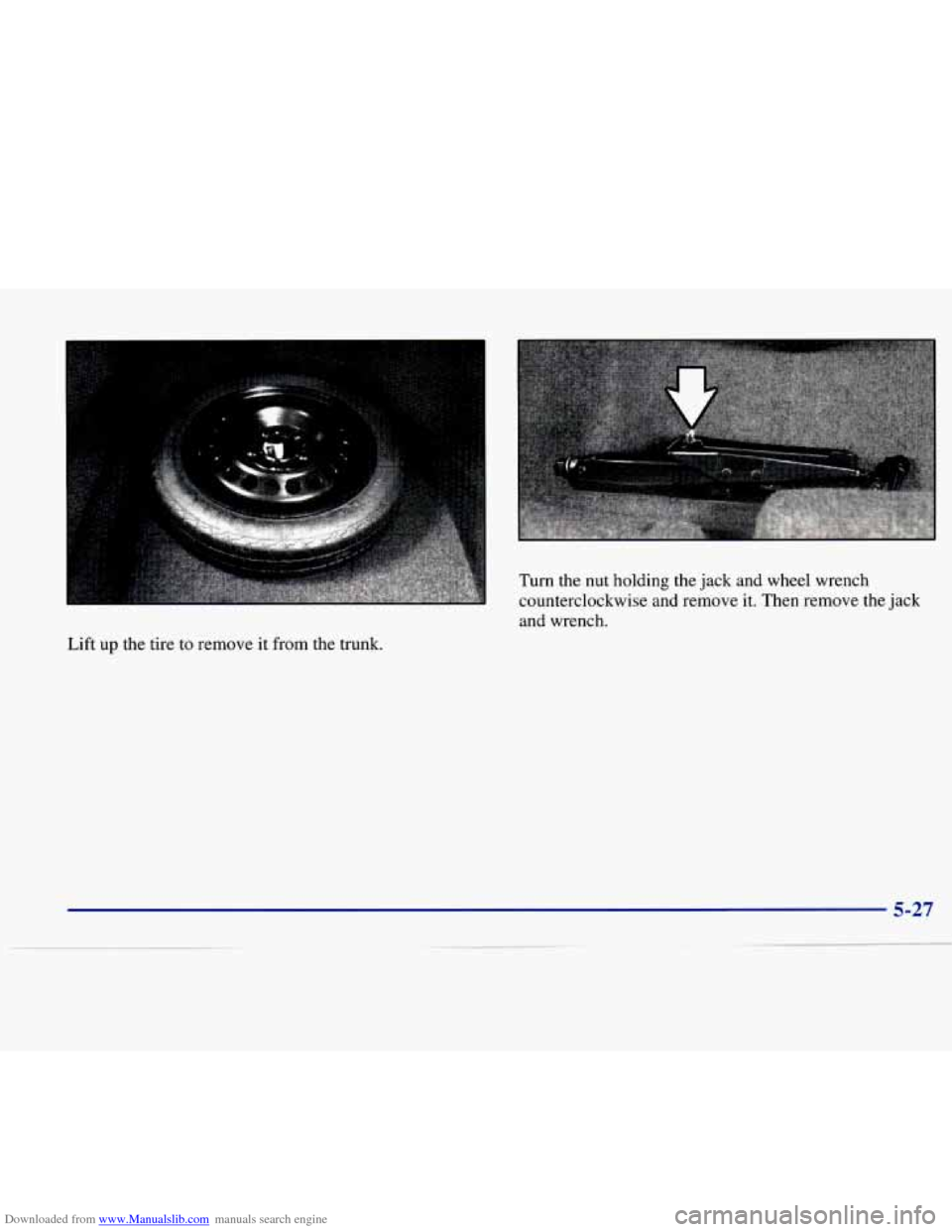
Downloaded from www.Manualslib.com manuals search engine Turn the nut holding the jack and wheel wrench
counterclockwise and remove it. Then remove the jack
and wrench.
Lift
up the tire to remove it from the trunk.
Page 276 of 386

Downloaded from www.Manualslib.com manuals search engine NOTICE:
Improperly tightened wheel nuts can lead to
brake pulsation and rotor damage.
To avoid
expensive brake repairs, evenly tighten the wheel
nuts in the proper sequence and
to the proper
torque specification.
Don’t try to put
a wheel cover on your compact spare
tire. It won’t fit. Store the wheel cover in the trunk
until you have the flat tire repaired or replaced.
NOTICE:
Wheel covers won’t fit on your compact spare. If
you try to put a wheel cover on your compact
spare, you could damage the cover or the spare.
Stoe-g the Flat Tire and Tools
Storing a jack, a tire or other equipment in the
passenger compartment
of the vehicle could
cause injury. In
a sudden stop or collision, loose
equipment could strike someone. Store all these
in the proper place.
After you’ve put the compact spare tire on your vehicle,
you’ll need to store the flat tire in your trunk. Use the
following procedure to secure the flat tire in the trunk.
Put the flat tire in the trunk
so the side that faces out
when it
is on the vehicle is facing down. The full-size
tire will not fit down into the well. Place
it so the front is
in the well and the rear is out of the well.
Page 278 of 386

Downloaded from www.Manualslib.com manuals search engine The compact spare is for temporary use only. Replace
the compact spare tire with a full-size tire as soon
as you
can. See the storage instructions label to replace your
compact spare into your trunk properly.
Compact Spare Tire
Although the compact spare tire was fully inflated when
your vehicle was new, it can lose air after a time. Check
the inflation pressure regularly.
It should be 60 psi
(420 Wa).
After installing the compact spare on your vehicle, you
should stop as soon as possible and make sure your
-
spare tire is correctly inflated. The compact spare is
made to perform well at speeds up to
65 mph
(105 km/h) for distances up to 3,000 miles (5 000 km),
so you can finish your trip and have your full-size tire
repaired or replaced where you want. Of course, it’s best
to replace your spare with a full-size tire as soon as you
can. Your spare will last longer and be in good shape in
case you need it again.
5-35
Page 289 of 386

Downloaded from www.Manualslib.com manuals search engine An alternate fuel door
release
is located inside of
the trunk on the left hand
side. Pull it
to release the
fuel door.
To take off the cap, turn it slowly to the left
(counterclockwise).
If you get gasoline on yourself and then
something ignites it, you could be badly burned.
Gasoline can spray out on you
if you open the
fuel filler cap too quickly. This spray can happen
if your tank
is nearly full, and is more likely in
hot weather. Open the fuel filler cap slowly and
wait for any “hiss” noise to stop. Then unscrew
the cap all the way.
Be careful not to spill gasoline. Clean gasoline from
painted surfaces as soon as possible. See “Cleaning the Outside of Your Cadillac” in the Index.
Hang the cap inside the fuel door while refueling.
6-6
Page 341 of 386

Downloaded from www.Manualslib.com manuals search engine Vehicle Identification Number (VIN) Service Parts Identification Label
You’ll find this label on the rear wall
of the trunk on the
passenger’s side. It’s very helpful if you ever need to
order parts. On this label is:
14 I SAMPLE4UXVM072675 I GN I I your VIN,
ENGlNEA97 ? ASSEMBLY the designation’
CODE MODEL YEAR PLANT 0 paint information and
This
is the legal identifier for your Cadillac. It appears
on a plate
in the front corner of the instrument panel, on
the driver’s side.
You can see it if you look through the
windshield from outside your vehicle. The
VIN also
appears on the Vehicle Certification and Service Parts
labels and the certificates of title and registration.
Engine Identification
The 8th character in your VIN is the engine code. This
code will help you identify your engine, specifications
and replacement parts.
0 a list of all production options and special equipment.
Be sure that this label is not removed from the vehicle.
6-58
Page 343 of 386
Downloaded from www.Manualslib.com manuals search engine MaxiF'usesIRelay Center
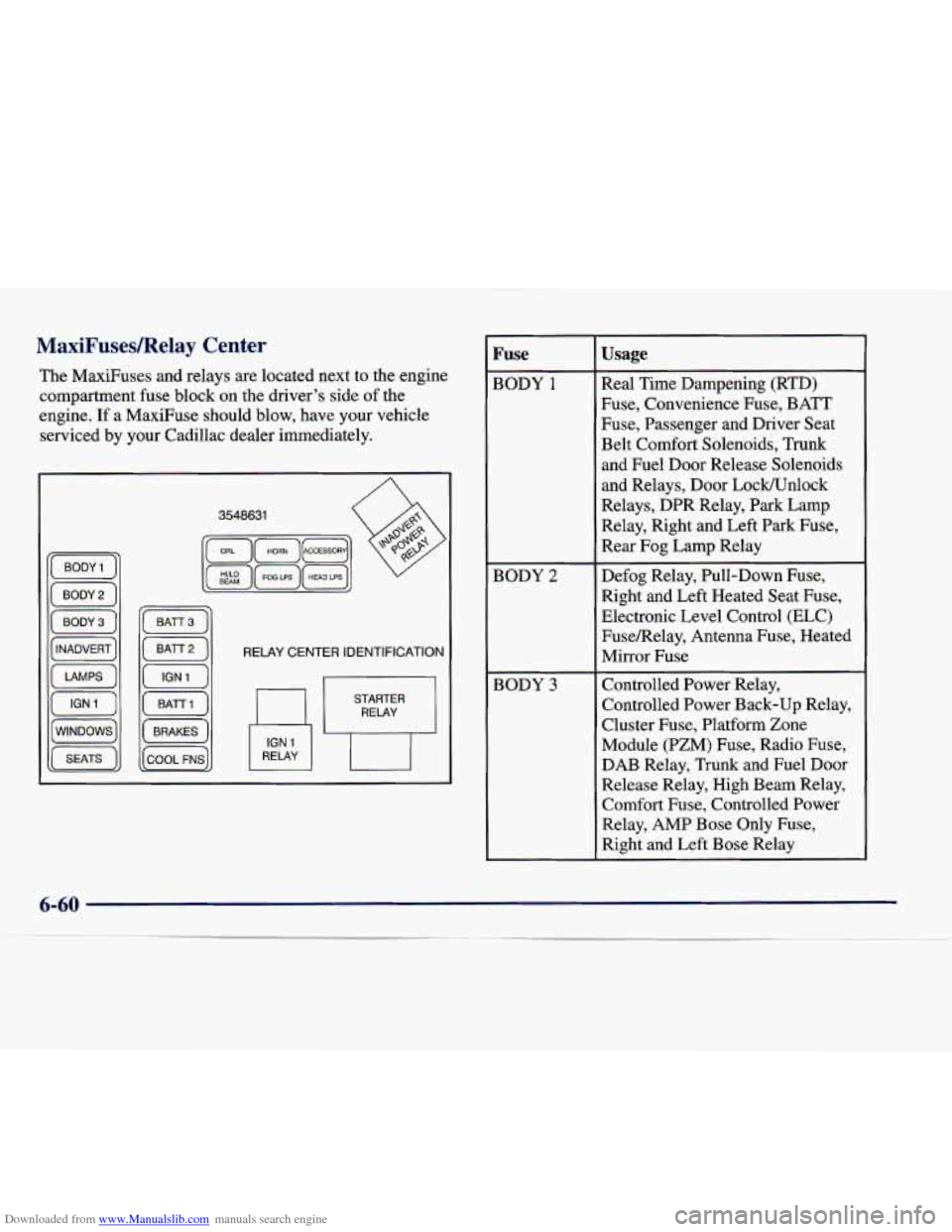
The MaxiFuses and relays are located next to the engine
compartment fuse block on the driver's side
of the
engine.
If a MaxiFuse should blow, have your vehicle
serviced by your Cadillac dealer immediately.
RELAY CENTER IDENTIFICATION
RELAY
Fuse
BODY 1
BODY 2
BODY 3
Usage
Real Time Dampening (RTD)
Fuse, Convenience Fuse, BATT
Fuse, Passenger and Driver Seat
Belt Comfort Solenoids, Trunk
and Fuel Door Release Solenoids
and Relays, Door Lock/Unlock
Relays, DPR Relay, Park Lamp
Relay, Right and Left Park Fuse,
Rear Fog Lamp Relay
Defog Relay, Pull-Down Fuse, Right and Left Heated Seat Fuse,
Electronic Level Control (ELC)
FuseRelay, Antenna Fuse, Heated
Mirror Fuse
Controlled Power Relay,
Controlled Power Back-up Relay,
Cluster Fuse, Platform Zone
Module (PZM) Fuse, Radio Fuse,
DAB Relay, Trunk and Fuel Door
Release Relay, High Beam Relay,
Comfort Fuse, Controlled Power
Relay, AMP Bose Only Fuse,
Right and Left Bose Relay