high CADILLAC DEVILLE 1997 7.G Owners Manual
[x] Cancel search | Manufacturer: CADILLAC, Model Year: 1997, Model line: DEVILLE, Model: CADILLAC DEVILLE 1997 7.GPages: 386, PDF Size: 21.61 MB
Page 10 of 386
Downloaded from www.Manualslib.com manuals search engine For the 1948 model, Cadillac introduced the legendary
tail fin which once more set the trend in automotive
styling for nearly two decades. This was closely
followed with the two door hardtop Coupe DeVille and
the industry's first modern overhead valve, high compression
V8 engine on the 1949 model.
Engineering innovations, conveniences and styling dominated the
'50s and '60s. Cruise control, automatic
climate control, tilt and telescoping steering wheels,
twilight sentinel and four door hard tops all debuted in
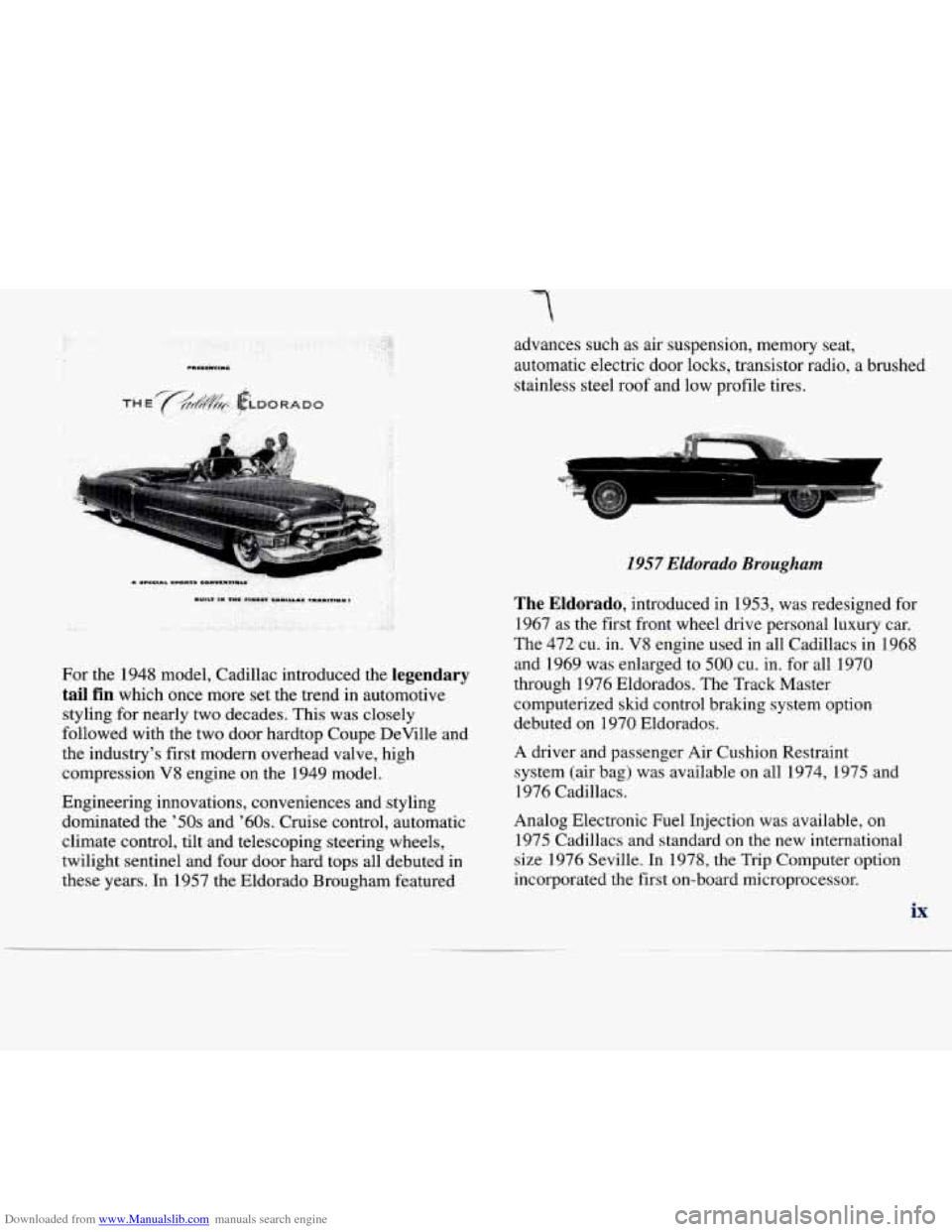
these years. In 1957 the Eldorado Brougham featured advances such as air suspension, memory seat,
automatic electric door locks, transistor radio, a brushed
stainless steel roof and low profile tires.
1
I957 Eldorado Brougham
The Eldorado, introduced in 1953, was redesigned
for
1967 as the first front wheel drive personal luxury car.
The 472 cu. in.
V8 engine used in all Cadillacs in 1968
and 1969 was enlarged to
500 cu. in. for all 1970
through 1976 Eldorados. The Track Master
computerized skid control braking system option
debuted
on 1970 Eldorados.
A driver and passenger Air Cushion Restraint system (air bag) was available on all 1974,
1975 and
1976 Cadillacs.
Analog Electronic Fuel Injection was available, on 1975 Cadillacs and standard on the new international
size 1976 Seville. In 1978, the Trip Computer option
incorporated the first on-board microprocessor.
ix
Page 11 of 386
Downloaded from www.Manualslib.com manuals search engine a
The electronics and computerization which were
pioneered by Cadillac in the
’70s came of age in the
’80s with Digital Fuel Injection and On-Board
Diagnostics in 1980, four wheel Anti-lock Brakes on 1986 models and Traction Control in the fall
of 1989.
The 1992 Seville STS was the first car ever to win all
three major automotive awards:
Car of the Year, Motor
Trend; Ten Best List, Car
& Driver; Car of the Year,
Automobile Magazine.
The year
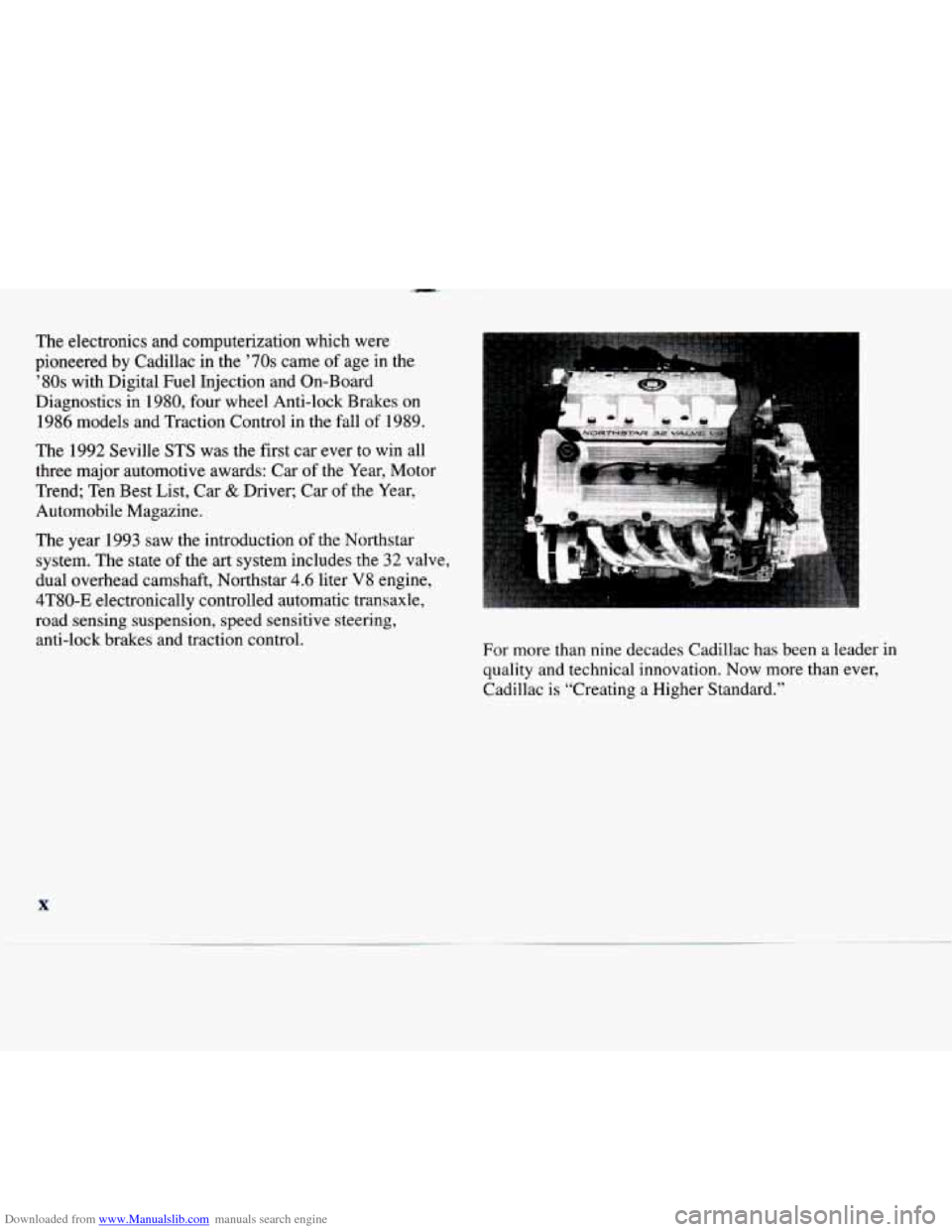
1993 saw the introduction of the Northstar
system. The state
of the art system includes the 32 valve,
dual overhead camshaft, Northstar
4.6 liter V8 engine,
4T80-E electronically controlled automatic transaxle,
road sensing suspension, speed sensitive steering, anti-lock brakes and traction control. For more than nine decades Cadillac has been a leader
in
quality and technical innovation. Now more than ever,
Cadillac is “Creating a Higher Standard.”
X
Page 20 of 386

Downloaded from www.Manualslib.com manuals search engine Heated Front Seat (Option) Reclining Front Seatbacks
The
control is located on the outboard side of each front
seat. Move the SEAT HEAT control to either
LO or HI
to turn on the heating elements in the seat. The LO
setting warms the seatback and cushion until the seat
approximates body temperature. The
HI setting heats the
seat to a slightly higher temperature.
A telltale light in
the control reminds you that the heating system is in use.
The heated seats can only be used when the ignition
is
turned on.
Press the recliner control forward or rearward to adjust
the seatback.
1-5
Page 29 of 386
Downloaded from www.Manualslib.com manuals search engine 3. Pick up the latch plate and pull the belt across you.
4. Push the latch plate into the buckle until it clicks.
Don’t
let it get twisted. I
Be sure to use the correct buckle when buckling your
lap-shoulder belt.
If you find that the latch plate will
not go fully into the buckle,
see if you are using the
buckle
for the center passenger position.
Pull up on the latch plate to make sure it is secure. If
the belt isn’t long enough, see “Safety Belt
Extender’’ at the end of this section.
Make sure the release button on the buckle is
positioned
so you would be able to unbuckle the
safety belt quickly
if you ever had to.
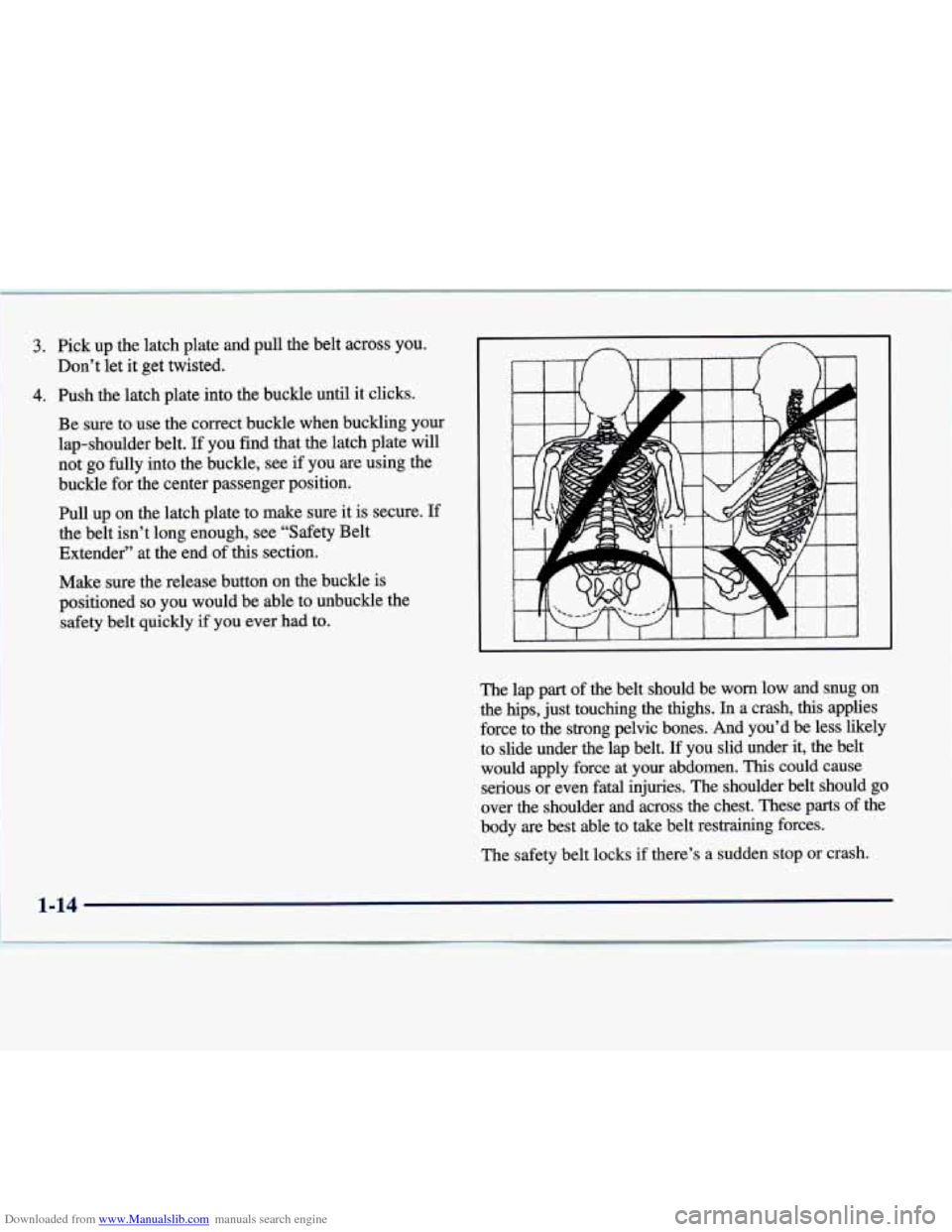
The lap part of the belt should be worn low and snug on
the hips, just touching the thighs.
In a crash, this applies
force to the strong pelvic bones. And you’d be less likely
to slide under the lap belt.
If you slid under it, the belt
would apply force at your abdomen.
This could cause
serious or even fatal injuries. The shoulder belt should go
over the shoulder and across the chest. These parts of the
body are best able to take belt restraining forces.
The safety belt locks
if there’s a sudden stop or crash.
1-14
Page 41 of 386
Downloaded from www.Manualslib.com manuals search engine When should an air bag inflate?
The driver’s and right front passenger’s frontal air bags
are designed to inflate in moderate to severe frontal or
near-frontal crashes. The frontal air bags are designed to
inflate only if the impact speed is above the system’s
designed “threshold level.” If your vehicle goes straight
into a wall that doesn’t move or deform, the threshold
level is about
9 to 15 mph (14 to 24 km/h). The
threshold level can vary, however, with specific vehicle
design,
so that it can be somewhat above or below this
range. If your vehicle strikes something that will move
or deform, such as
a parked car, the threshold level will
be higher. The driver’s and right front passenger’s
frontal air bags are not designed to inflate in rollovers,
side impacts, or rear impacts, because inflation would
not help the occupant.
The driver’s and right front passenger’s side impact air
bags are designed to inflate in moderate to severe side crashes involving a front door.
A side impact air bag
will inflate if the crash severity is above the system’s
designed “threshold level.” The threshold level can vary
with specific vehicle design. Side impact air bags are not
designed to inflate in frontal or near-frontal impacts, rollovers or rear impacts, because inflation would not
help the occupant.
A side impact air bag will only
deploy on the side of the vehicle that is struck.
In any particular crash, no one can say whether an air
bag should have inflated simply because of the damage
to a vehicle or because of what the repair costs were.
Inflation is determined by the angle of the impact and
how quickly the vehicle slows down in frontal and
near-frontal impacts. For side impact air bags, inflation
is determined by the location of the impact and how
quickly the side
of the vehicle deforms.
What makes an air bag inflate?
In an impact of sufficient severity, the air bag sensing
system detects that the vehicle
is in a crash. For both
frontal and side impact air bags, the sensing system
triggers a release of gas from the inflator, which inflates
the air bag. The inflator, air bag and related hardware
are all part of the air bag modules inside the steering
wheel, instrument panel and front doors.
1-26
Page 49 of 386

Downloaded from www.Manualslib.com manuals search engine The lap part of the belt should be worn low and snug on
the hips, just touching the thighs.
In a crash, this applies force to the
strong pelvic bones. And you’d be less likely
to slide under the lap belt.
If you slid under it, the belt
would apply force at your abdomen.
This could cause
serious
or even fatal injuries. The shoulder belt should go
over the shoulder and across the chest. These parts of the
body are best able to take belt restraining forces.
The safety belt locks if there’s a sudden stop
or a crash,
or if you pull the belt very quickly out of the retractor.
/! CAUT,,A
You can be seriously hurt if your shoulder belt is
too loose.
In a crash, you would move forward
too much, which could increase injury. The
shoulder belt should fit against your body.
1-34
Page 62 of 386

Downloaded from www.Manualslib.com manuals search engine A CAUTION:
I
Never do this. Here a child is sitting in a seat that has a
lap-shoulder belt, but the shoulder part is behind
the child.
If the child wears the belt in this way, in
a crash the child might slide under the belt. The
belt’s force would then be applied right on the
child’s abdomen. That could cause serious or
fatal injuries.
Wherever the child sits, the lap portion of the belt
should be
worn low and snug on the hips, just touching
the child’s thighs. This applies belt
force to the child’s
pelvic bones in a crash.
Page 73 of 386
Downloaded from www.Manualslib.com manuals search engine This device complies with Part 15 of the FCC Rules.
Operation
is subject to the following two conditions:
(1) this device may not cause harmful interference, and
(2) this device must accept any interference received,
including interference that may cause undesired operation.
This device complies with
RSS-210 of Industry and
Science Canada. Operation is subject to the following
two conditions:
(1) this device may not cause
interference, and
(2) this device must accept any
interference received, including interference that may
cause undesired operation of the device.
The range of this system is about
10 feet (3 m). At times
you
may notice a decrease in range. This is normal for
any remote lock control system. If the transmitter does
not work
or if you have to stand closer to your vehicle
for the transmitter to work, try this:
Check to determine if battery replacement is
necessary. See the instructions that follow.
Check the distance. You may be too far from your
vehicle. You may need to stand closer during rainy
or snowy weather.
Check the location. Other vehicles or objects may be
blocking the signal. Take a few steps
to the left or
right, hold the transmitter higher, and try again.
If you’re still having trouble, see your Cadillac
dealer
or a qualified technician for service. Changes
or modifications to this system
by other than an
authorized service facility could void authorization to
use this equipment.
Operation
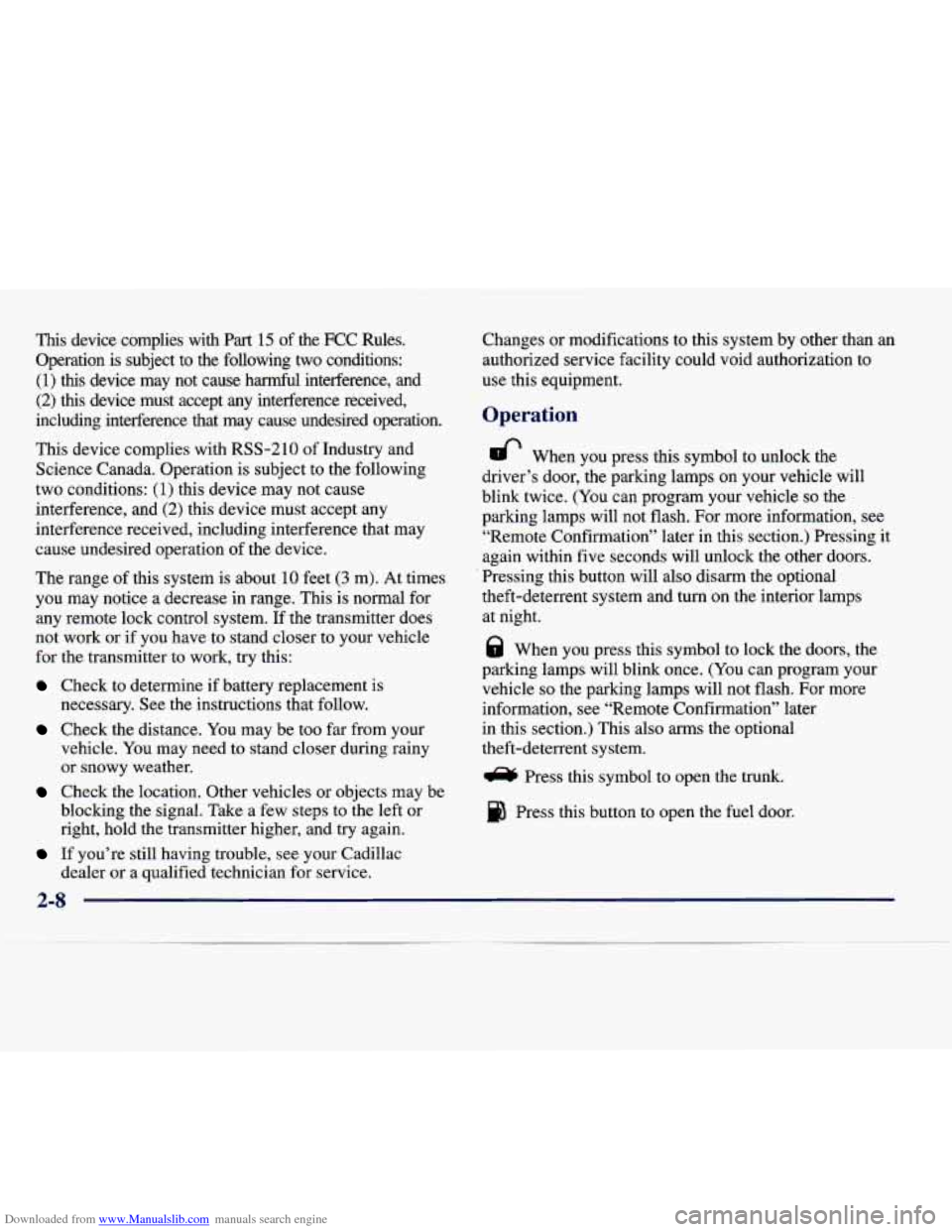
* When you press this symbol to unlock the
driver’s door, the parking lamps on your vehicle will
blink twice. (You can program your vehicle
so the
parking lamps will not flash. For more information, see
“Remote Confirmation” later in this section.) Pressing it
again within five seconds will unlock the other doors.
Pressing this button will also disarm the optional
theft-deterrent system and turn
on the interior lamps
at night.
8 When you press this symbol to lock the doors, the
parking lamps will blink once. (You can program your
vehicle
so the parking lamps will not flash. For more
information,
see “Remote Confirmation” later
in this section.) This also
arms the optional
theft-deterrent system.
Press this symbol to open the trunk.
Press this button to open the fuel door.
Page 78 of 386
Downloaded from www.Manualslib.com manuals search engine Trunk Trunk Lock Release
A CAU‘ [ON:
It can be dangerous to drive with the trunk lid
open because carbon monoxide
(CO) gas can
come into your vehicle. You can’t see or smell
CO. It can cause unconsciousness and even death.
If you must drive with the trunk lid open or
if
electrical wiring or other cable connections must
pass through the seal between the body and the
trunk lid:
Make sure all windows are shut.
0 ’hrn the fan on your heating or cooling
system to
its highest speed with the setting
on
AUTO or ECON and the temperature
between
65” F (18” C) and 85” F (29” C).
That will force outside air into your vehicle.
See “Comfort Controls” in the Index.
If you have air outlets on or under the
instrument panel, open them all the way.
See “Engine Exhaust” in the Index.
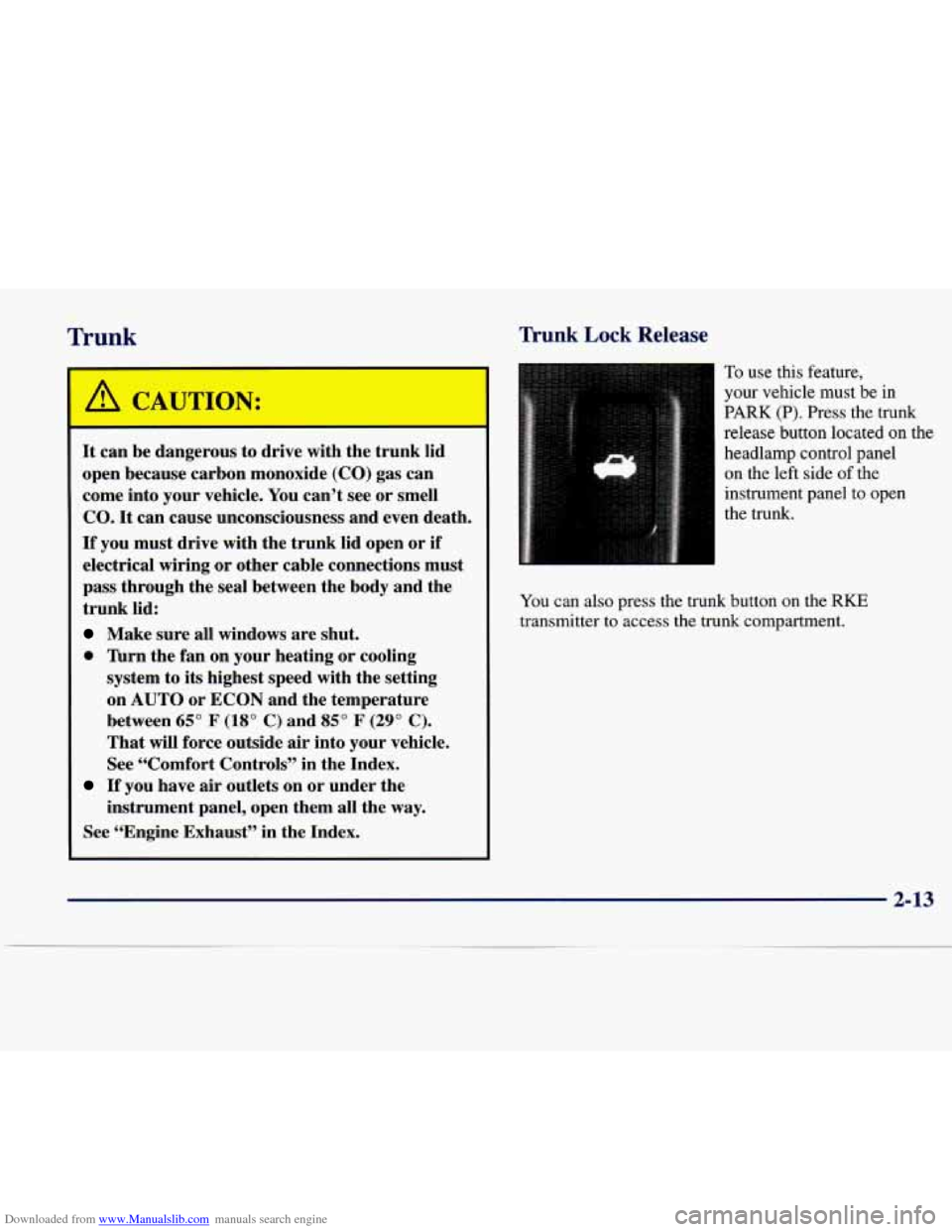
To use this feature,
your vehicle must be in
PARK (P). Press the trunk
release button located
on the
headlamp control panel on the left side of the
instrument panel to open
I
the trunk.
You can also press the trunk button on the RKE
transmitter to access the trunk compartment.
2-13
Page 91 of 386

Downloaded from www.Manualslib.com manuals search engine Ensure the shift lever is fully in PARK (P) range before
starting the engine. Your Cadillac has a brake-transaxle
shift interlock. You have to fully
apply your regular
brakes
before you can shift from PARK (P) when the
ignition key is in the RUN position. If you cannot shift
out of
PARK (P), ease pressure on the shift lever -- push
the shift lever all the way into PARK
(P) and release the
shift lever button on the floor shift console models as
you maintain brake application. Then move the shift
lever into the gear you wish. (Press the shift lever button
before moving the shift lever on
floor shift console
models.) See “Shifting Out of PARK (P)” in this section.
REVERSE (R): Use this gear
to back up.
NOTICE:
Shifting to REVERSE (R) while your vehicle is
moving forward could damage your transaxle.
Shift to REVERSE (R) only after your vehicle
has stopped.
Also use this gear to rock your vehicle back and forth to
get out
of snow, ice or sand without damaging your
transaxle. See
“If You’re Stuck in Sand, Mud, Ice or
Snow” in the Index for additional information.
NEUTRAL (N): In this position, the engine doesn’t
connect with the wheels.
To restart when you’re
already moving, use
NEUTRAL (N) only. Also, use
NEUTRAL (N) when your vehicle is being towed.
Shifting out of PARK
(P) or NEUTRAL (N) while
your engine
is “racing” (running at high speed) is
dangerous. Unless your foot
is firmly on the
brake pedal, your vehicle could move very
rapidly. You could lose control and hit people or
objects. Don’t shift out
of PARK (P) or
NEUTRAL (N) while your engine is racing.
NOTICE: I
Damage to your transaxle caused by shifting out
of
PARK (P) or NEUTRAL (N) with the engine
racing isn’t covered by your warranty.