fuel CADILLAC DEVILLE 1998 7.G Owner's Guide
[x] Cancel search | Manufacturer: CADILLAC, Model Year: 1998, Model line: DEVILLE, Model: CADILLAC DEVILLE 1998 7.GPages: 386, PDF Size: 22.36 MB
Page 241 of 386
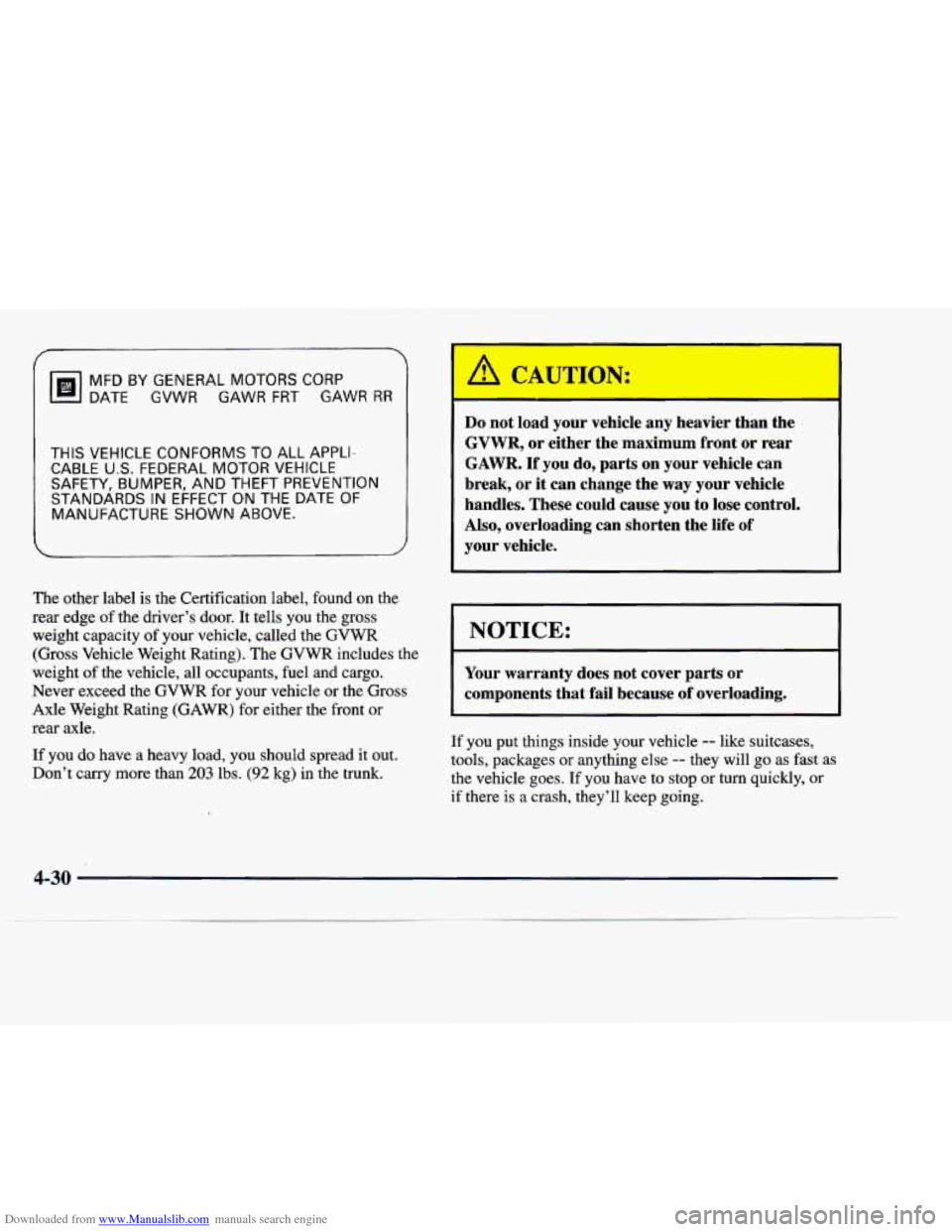
Downloaded from www.Manualslib.com manuals search engine MFDBYGENERALMOTORSCORP DATE
GVWR GAWR FRT GAWR RR
THIS VEHICLE CONFORMS TO ALL APPLI-
CABLE U.S. FEDERAL MOTOR VEHICLE
SAFETY, BUMPER, AND THEFT PREV.ENTlON
STANDARDS
IN EFFECT ON THE DATE OF
MANUFACTURE SHOWN ABOVE.
The other label is the Certification label, found on the
rear edge of the driver’s door. It tells you the gross
weight capacity of your vehicle, called the GVWR
(Gross Vehicle Weight Rating). The
GVWR includes the
weight
of the vehicle, all occupants, fuel and cargo.
Never exceed the GVWR for your vehicle or the Gross
Axle Weight Rating (GAWR) for either the front or
rear axle.
If you do have
a heavy load, you should spread it out.
Don’t
carry more than 203 lbs. (92 kg) in the trunk.
I A CAUTION:
Do not load your vehicle any heavier than the
GVWR, or either the maximum front or rear
GAWR.
If you do, parts on your vehicle can
break, or it can change the
way your vehicle
handles. These could cause you to lose control.
Also, overloading can shorten the life
of
your vehicle.
I NOTICE:
Your warranty does not cover parts or
components
that fail because of overloading.
If you put things inside your vehicle
-- like suitcases,
tools, packages or anything else
-- they will go as fast as
the vehicle goes. If you have to stop
or turn quickly, or
if there is
a crash, they’ll keep going.
4-30
Page 243 of 386
Downloaded from www.Manualslib.com manuals search engine Your vehicle can tow a trailer if it is equipped with the
proper trailer towing equipment. To identify what the
vehicle trailering capacity is for your vehicle, you
should read the information in “Weight of the Trailer”
that appears later in this section. But trailering is
different than just driving your vehicle by itself.
Trailering means changes in handling, durability and
fuel economy. Successful, safe trailering takes correct
equipment, and it has to be used properly.
That’s the reason for this part. In it are many
time-tested, ,important trailering tips and safety rules.
Many
of these are important for your safety and that of
your passengers.
So please read this section carefully
before you pull a trailer.
Load-pulling components such as the engine, transaxle,
wheel assemblies and tires
are forced to work harder
against the drag
of the added weight. The engine is
required to operate at relatively higher speeds and under
greater loads, generating extra heat. What’s more, the
trailer adds considerably to wind resistance, increasing
the pulling requirements.
If You Do Decide To Pull A Trailer
If you do, here are some important points:
0
0
0
0
0
There are many different laws, including speed limit
restrictions, having
to do with trailering. Make sure
your rig
will be legal, not only where you live but
also where you’ll be driving.
A good source for this
information can be state or provincial police.
Consider using a sway control if your trailer will
weigh
2,000 lbs. (900 kg) or less. You should always
use a sway control if your trailer will weigh more
than
2,000 lbs. (900 kg). You can ask a hitch dealer
about sway controls.
Don’t tow
a trailer at all during the first 1,000 miles
(1 600 km) your new vehicle is driven. Your engine,
axle or other parts could be damaged.
Then, during the first
500 miles (800 km) that you
tow a trailer, don’t drive over
50 mph (80 km/h) and
don’t make starts at full throttle. This helps your
engine and other parts of your vehicle wear in at the
heavier
loads.
Obey speed limit restrictions when towing a trailer.
Don’t drive faster than the maximum posted speed
for trailers (or no more than
55 mph (90 km/h)) to
save wear on your vehicle’s parts.
4-32
Page 288 of 386
Downloaded from www.Manualslib.com manuals search engine &&* -%%-,
Section 6 Service and Appearance Care
Here you will find information about the care of your vehicle. This section begins with service and fuel informa\
tion,
and then it shows how to check important fluid and lubricant levels. There is also techn\
ical information about your
vehicle, and a part devoted to its appearance care.
6-2
6-3
6-5 6-5
6-8
6-8
6-11
6-15
6-18
6-22
6-26
6-28
6-3 1
6-32
6-3
8
6-3 8
Service
Fuel
Fuels in Foreign Countries Filling Your Tank
Filling a Portable Fuel Container
Checking Things Under the Hood
Engine Oil
Air Cleaner
Automatic Transaxle Fluid
Engine Coolant
Windshield Washer Fluid
Brakes
Battery
Bulb Replacement
Windshield Wiper Blade Replacement Headlamp Aiming 6-4
1
6-49
6-49
6-52
6-54
6-55
6-55
6-56
6-57 6-57
6-66
6-66
6-67
6-67 Tires
Appearance Care
Cleaning the Inside of Your Vehicle
Cleaning the Outside
of Your Vehicle
Cleaning Aluminum or Chrome Wheels
(If Equipped)
Underbody Maintenance
Chemical Paint Spotting
Appearance Care Materials Chart
Vehicle Identification Number (VIN)
Electrical System Replacement Bulbs
Capacities and Specifications
Air Conditioning Refrigerants
Normal Maintenance Replacement
Parts
Page 290 of 386
Downloaded from www.Manualslib.com manuals search engine You can be injured and your vehicle could be
damaged
if you try to do service work on a
vehicle without knowing enough about it.
0 Be sure you have suffkient knowledge,
experience, the proper replacement parts
and tools before you attempt any vehicle
maintenance task.
Be sure to use the proper nuts, bolts and
other fasteners. “English” and “metric”
fasteners can be easily confused.
If you use
the wrong fasteners, parts can later break
or
fall off. You could be hurt.
Adding Equipment to the Outside of
Your Vehicle
Things you might add to the outside of your vehicle can
affect
the airflow around it. This may cause wind noise
and
affect windshield washer performance. Check with
your dealer before adding equipment to the outside
of
your vehicle.
Fuel
Use premium udeaded gasoline rated at 91 octane or
higher for best performance. You may use middle grade
or regular unleaded gasolines, but your vehicle may not
accelerate as well.
At a minimum, the gasoline you use should meet
specifications ASTM D4814 in the United States and
CGSB
3.5-M93 in Canada. Improved gasoline
specifications have been developed by the American
Automobile Manufacturers Association
(AAMA) for
better vehicle performance and engine protection. Gasolines meeting the AAMA specification could
provide improved driveability and emission control
system protection compared to other gasolines.
Be sure the posted octane for premium is at 1,east 91 (at
least 89 for middle grade and 87 for regular).
If the
octane is less than 87, you may get a heavy knocking
noise when you drive.
If it’s bqd enough, it can damage
your engine.
If you’re using fuel rated at the recommended octane or
higher and you hear heavy knocking, your engine needs
service. But don’t worry if you hear a little pinging
noise when you’re accelerating or driving up a
hill.
That’s normal, and you don’t have to buy a higher
6-3
Page 291 of 386
Downloaded from www.Manualslib.com manuals search engine octane fuel to get rid of pinging. It's the heavy, constant
knock that means you have a problem.
If your vehicle is certified to meet California Emission
Standards (indicated on the underhood emission control
label), it is designed to operate on fuels that meet
California specifications.
If such fuels are not available
in states adopting California emissions standards, your
vehicle will operate satisfactorily on fuels meeting
federal specifications, but emission control system
performance may be affected. The malfunction indicator lamp on your instrument panel may turn
on andor your
vehicle may
fail a smog-check test. If this occurs, return
to your authorized Cadillac dealer for diagnosis to
determine the cause of failure. In the event it is determined that the cause of the condition is the type of
fuels used, repairs may not be covered by your warranty.
Some gasolines that are not reformulated for low
emissions contain an octane-enhancing additive called
methylcyclopentadienyl manganese tricarbonyl (MMT); ask your service station operator whether or not his fuel
contains MMT. General Motors does not recommend the
use .of such gasolines. If fuels containing
MMT are used,
spark plug life may be reduced and your emission
control system performance may be affected. The malfunction indicator lamp on your instrument panel
may turn
on. If this occurs, return to your authorized
Cadillac dealer for service.
To provide cleaner air, all gasolines in the United States are now required to contain additives that will help
prevent deposits from forming in your engine and fuel system, allowing your emission control system to
function properly. Therefore,
you should not have to add
anything to the fuel. In addition, gasolines containing
oxygenates, such as ethers and ethanol, and
reformulated gasolines may be available in your area to
help clean the air. General Motors recommends that you
use these gasolines if they comply with the
specifications described earlier.
NOTICE:
Your vehicle was not designed for fuel that
contains methanol. Don't use it. It can corrode
metal parts in your fuel system and also damage plastic and rubber parts. That damage wouldn't
be covered under your warranty.
6-4
Page 292 of 386

Downloaded from www.Manualslib.com manuals search engine Fuels in Foreign Countries
If you plan on driving in another country outside the
United States or Canada, the proper fuel may be hard to
find. Never use leaded gasoline or any other fuel not
recommended in the previous text on fuel. Costly repairs
caused by use of improper fuel wouldn’t be covered by
your warranty.
To check on fuel availability, ask an auto club, or
contact a major oil company that does business in the
country where you’ll be driving.
You can also write us at the following address for
advice. Just tell us where you’re going and give your
Vehicle Identification Number (VIN).
General Motors Overseas Distribution Corporation
1908 Colonel Sam Drive
Oshawa, Ontario
L1H 8P7
Filling Your Tank
Gasoline vapor is highly flammable. It burns
violently, and that can cause very bad injuries.
Don’t smoke if you’re near gasoline or refueling
your vehicle. Keep sparks, flames and smoking
materials away from gasoline.
6-5
Page 293 of 386
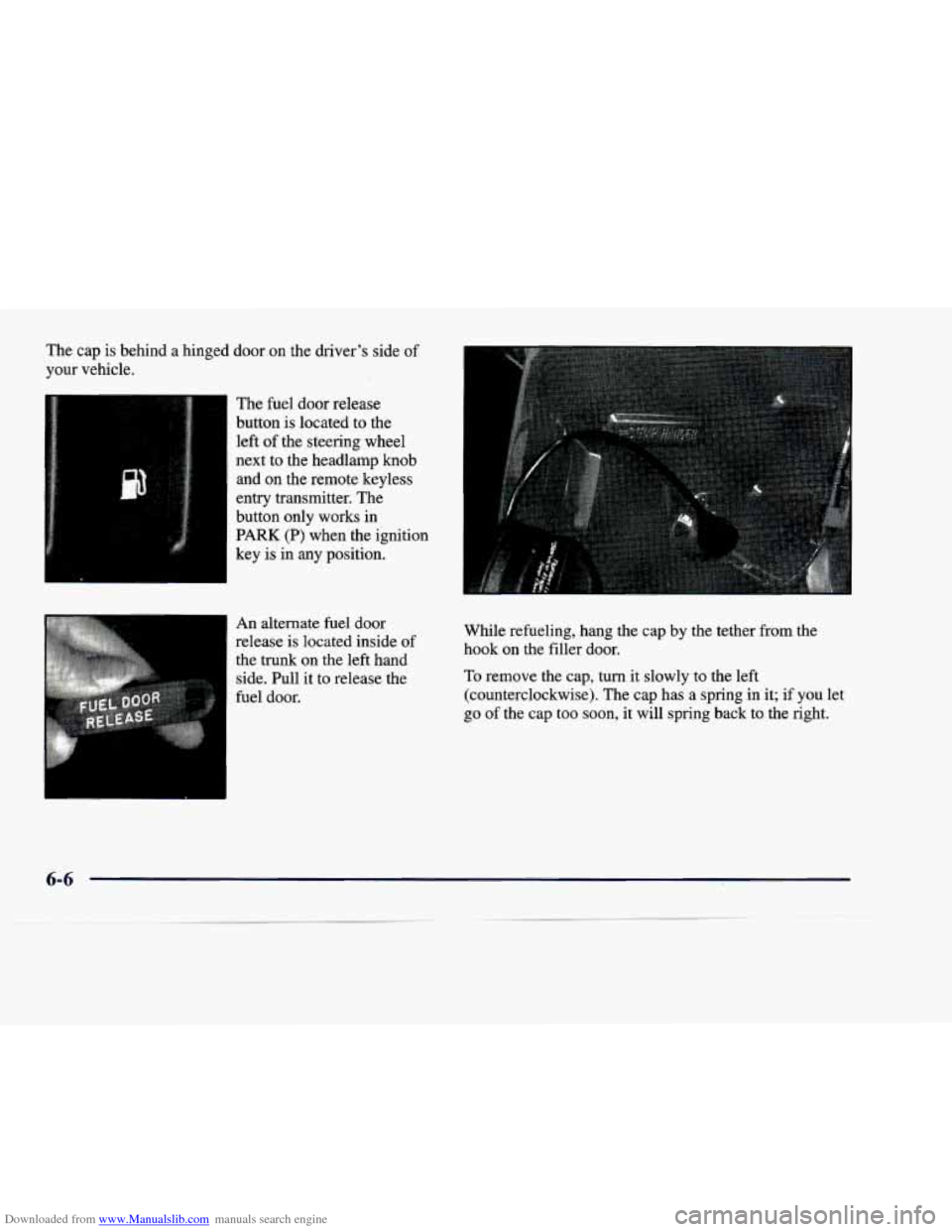
Downloaded from www.Manualslib.com manuals search engine The cap is behind a hinged door on the dnver’s side of
your vehicle.
The fuel door release
button is located to the
left of the steering wheel
next to the headlamp knob and on the remote keyless
entry transmitter. The
button only works in
PARK
(P) when the ignition
key
is in any position.
I
An alternate fuel door
release is located inside of
the trunk
on the left hand
side. Pull it to release the
fuel door. While refueling, hang the cap
by the tether from the hook on the filler door.
To remove the cap,
turn it slowly to the left
(counterclockwise). The cap has a spring in it; if
you let
go of the cap too soon, it will spring back to the right.
6-6
Page 294 of 386
Downloaded from www.Manualslib.com manuals search engine If you get gasoline on yourself and then
something ignites
it, you could be badly burned.
Gasoline can spray out on you
if you open the
fuel filler cap too quickly. This spray can happen
if your tank is nearly
full, and is more likely in
hot weather. Open the fuel filler cap slowly and
wait for any L‘hiss” noise to stop. Then unscrew
the cap all the
way.
Be careful not to spill gasoline. Clean gasoline from
painted surfaces as soon as possible. See “Cleaning the
Outside of
Your Vehicle” in the Index. When you put the
cap back on,
turn it to the right
(clockwise) until you hear a clicking sound. Make
sure you fully install the cap. The diagnostic system
can determine if the fuel cap has been left
off or
improperly installed. This would allow fuel to
evaporate into the atmosphere. See “Malfunction
Indicator Lamp” in the Index.
I 3
I NOTICE:
If you need a new cap, be sure to get the right
type. Your dealer can get one for you.
If you get
the wrong type, it may not
fit properly. This may
cause your malfunction indicator lamp to light
and your fuel tank and emissions system may be
damaged. See “Malfunction Indicator Lamp” in
the Index.
Page 295 of 386
Downloaded from www.Manualslib.com manuals search engine Filling a Portable Fuel Container
-
A CAUTION:
--
Never fill a portable fuel container while it is in
your vehicle, Static electricity discharge from the
container can ignite the gasoline vapor. You can
be badly burned and your vehicle damaged
if this
occurs. To help avoid injury to you and others:
Dispense gasoline only into approved
containers,
Do not fill a container while it is inside a
vehicle, in a vehicle’s trunk, pickup bed or
on any surface other than the ground.
inside
of the fill opening before operating
the nozzle. Contact should be maintained
until the filling
is complete.
0 Bring the fill nozzle in contact with the
Don’t smoke while pumping gasoline.
Checking Things Under the Hood
An electric fan under the hood can start up and
injure you even when the engine
is not running.
Keep hands, clothing and tools
away from any
underhood electric fan.
Things that burn can get on hot engine parts and
start a fire. These include liquids like gasoline,
oil, coolant, brake
fluid, windshield washer and
other
fluids, and plastic or rubber. You or others
could be burned. Be careful not to drop or spill
things that will burn onto a hot engine.
6-8
Page 298 of 386
Downloaded from www.Manualslib.com manuals search engine Underhood Lamp
Turn the parking lamps on to operate the underhood
lamp. The underhood lamp will come on when the
ho0.d
is opened.
Engine Oil
~MIUM UNLEADED - -
FUEL ONLY Dg Dg Dg MZ TRIP ; 4 4.
HHBHHHrn
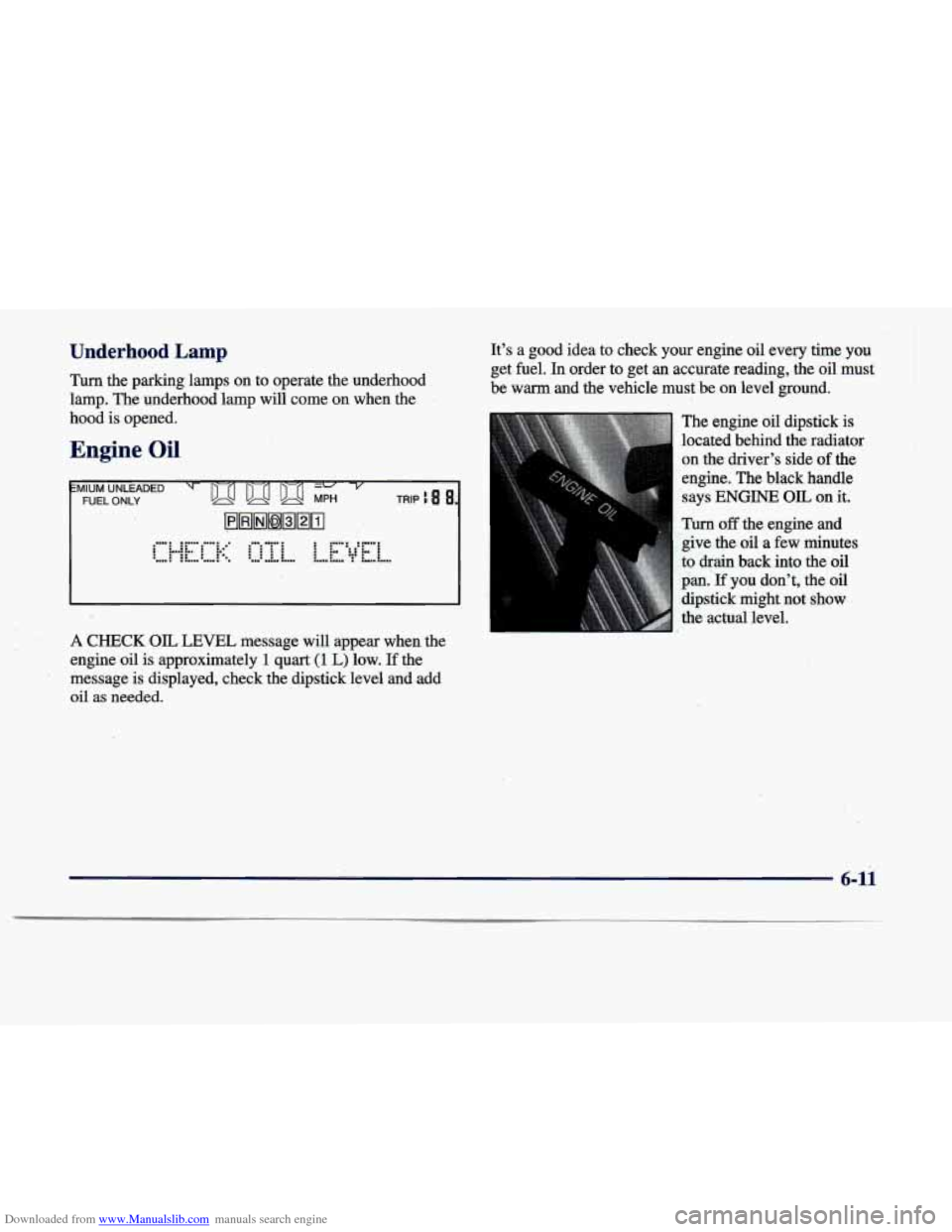
..". ."... "... .... -... . I ...... "... ........... ..... ....... .... "". . ..... ,:*. :::: ....... :::: :. ... "I. ."." "... ". " ". "..."... U..".. . ..... . : f. ,I.! I" ;
A CHECK OIL LEVEL message will appear when the
engine oil is approximately
1 quart (1 L) low. If the
' message is displayed, check the dipstick level and-add
oil as needed.
It's a good idea to check your engine oil every time you
get fuel. In order to get an accurate reading, the oil must
be
warm and the vehicle must be on level ground.
The engine
oil dipstick is
located behind the radiator
on the driver's side of the
engine. The black handle
'says
ENGINE OIL on it.
Turn off the engine .and
give the
oil a few minutes
to drain back into the
oil
pan.' If you don't, the oil
dipstick might not show
the actual'level.
I
6-11