change wheel CADILLAC DEVILLE 1999 7.G User Guide
[x] Cancel search | Manufacturer: CADILLAC, Model Year: 1999, Model line: DEVILLE, Model: CADILLAC DEVILLE 1999 7.GPages: 368, PDF Size: 2.61 MB
Page 256 of 368

yellowblue
5-18
5. Then replace the pressure cap. Be sure the arrows on
the pressure cap line up like this.
Start the engine and allow it to warm up. If the CHECK
COOLANT LEVEL message does not appear on the
Driver Information Center, coolant is at the proper fill
level. If a CHECK COOLANT LEVEL message does
appear, repeat Steps 1 to 3 and reinstall the pressure cap
or see your dealer.
If a Tire Goes Flat
It's unusual for a tire to ªblow outº while you're driving,
especially if you maintain your tires properly. If air goes
out of a tire, it's much more likely to leak out slowly.
But if you should ever have a ªblowout,º here are a few
tips about what to expect and what to do:
If a front tire fails, the flat tire will create a drag that
pulls the vehicle toward that side. Take your foot off the
accelerator pedal and grip the steering wheel firmly.
Steer to maintain lane position, and then gently brake to
a stop well out of the traffic lane.
A rear blowout, particularly on a curve, acts much like a
skid and may require the same correction you'd use in a
skid. In any rear blowout, remove your foot from the
accelerator pedal. Get the vehicle under control by
steering the way you want the vehicle to go. It may be
very bumpy and noisy, but you can still steer. Gently
brake to a stop
-- well off the road if possible.
If a tire goes flat, the next part shows how to use your
jacking equipment to change a flat tire safely.
Page 257 of 368

yellowblue
5-19
Changing a Flat Tire
If a tire goes flat, avoid further tire and wheel damage
by driving slowly to a level place. Turn on your hazard
warning flashers.
CAUTION:
Changing a tire can cause an injury. The vehicle
can slip off the jack and roll over you or other
people. You and they could be badly injured.
Find a level place to change your tire. To help
prevent the vehicle from moving:
1. Put the shift lever in PARK (P).
2. Set the parking brake firmly.
3. Turn off the engine.
To be even more certain the vehicle won't move,
you can put blocks at the front and rear of the
tire farthest away from the one being changed.
That would be the tire on the other side of the
vehicle, at the opposite end.
The following steps will tell you how to use the jack and
change a tire.
Page 263 of 368
yellowblue
5-25
CAUTION:
Rust or dirt on the wheel, or on the parts to
which it is fastened, can make the wheel nuts
become loose after a time. The wheel could come
off and cause an accident. When you change a
wheel, remove any rust or dirt from the places
where the wheel attaches to the vehicle. In an
emergency, you can use a cloth or a paper towel
to do this; but be sure to use a scraper or wire
brush later, if you need to, to get all the rust or
dirt off.
CAUTION:
Never use oil or grease on studs or nuts. If you
do, the nuts might come loose. Your wheel could
fall off, causing a serious accident.
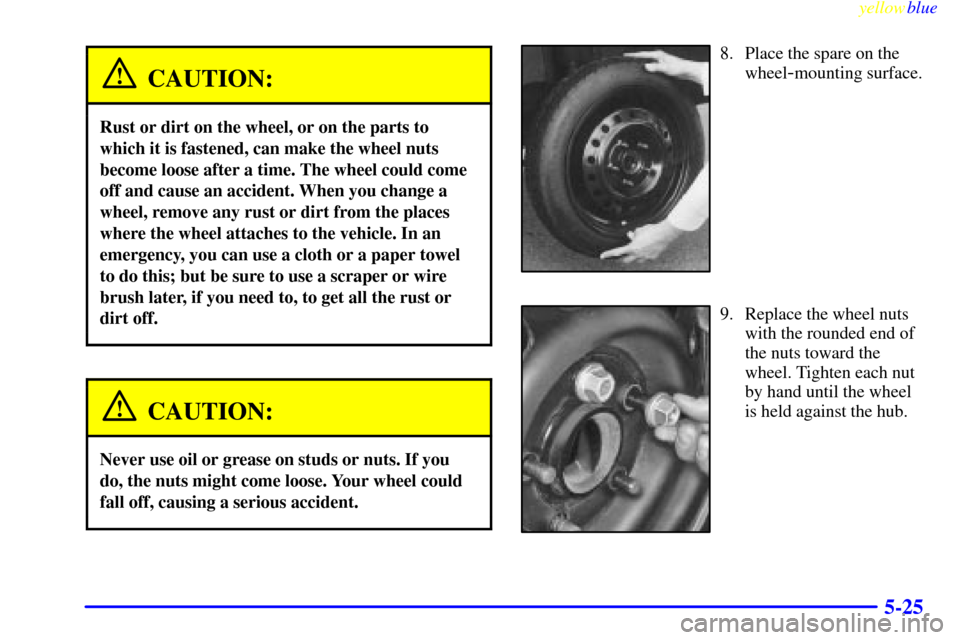
8. Place the spare on the
wheel
-mounting surface.
9. Replace the wheel nuts
with the rounded end of
the nuts toward the
wheel. Tighten each nut
by hand until the wheel
is held against the hub.
Page 315 of 368
yellowblue
6-45 Tire Inspection and Rotation
Tires should be rotated every 6,000 to 8,000 miles
(10 000 to 13 000 km). Any time you notice unusual
wear, rotate your tires as soon as possible and check
wheel alignment. Also check for damaged tires or
wheels. See ªWhen It's Time for New Tiresº and
ªWheel Replacementº later in this section for
more information.
The purpose of regular rotation is to achieve more
uniform wear for all tires on the vehicle. The first
rotation is the most important. See ªScheduled
Maintenance Servicesº in the Maintenance Schedule
booklet for scheduled rotation intervals.
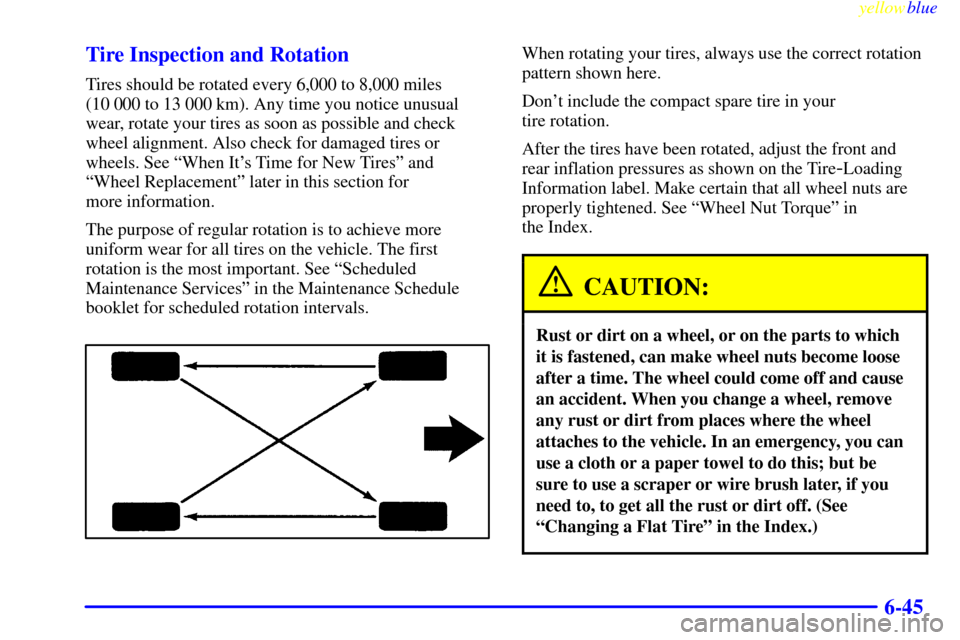
When rotating your tires, always use the correct rotation
pattern shown here.
Don't include the compact spare tire in your
tire rotation.
After the tires have been rotated, adjust the front and
rear inflation pressures as shown on the Tire
-Loading
Information label. Make certain that all wheel nuts are
properly tightened. See ªWheel Nut Torqueº in
the Index.
CAUTION:
Rust or dirt on a wheel, or on the parts to which
it is fastened, can make wheel nuts become loose
after a time. The wheel could come off and cause
an accident. When you change a wheel, remove
any rust or dirt from places where the wheel
attaches to the vehicle. In an emergency, you can
use a cloth or a paper towel to do this; but be
sure to use a scraper or wire brush later, if you
need to, to get all the rust or dirt off. (See
ªChanging a Flat Tireº in the Index.)
Page 340 of 368
yellowblue
6-70 Wheel Nut Torque
100 lb-ft (140 N´m)
Capacities
Transaxle (4T80-E) 15.0 quarts (14.2 L). . . . . . . . . .
Crankcase (Engine Oil with
Filter Change) 7.5 quarts (7.1 L). . . . . . . . . . . . . . .
Engine Cooling System 12.5 quarts (11.8 L). . . . . . . .
Fuel Tank 20.0 gallons (75.7 L). . . . . . . . . . . . . . . . . .
R
-134a Refrigerant 2.0 lbs. (0.91 kg). . . . . . . . . . . . .
NOTE: All capacities are approximate. When adding, be
sure to fill to the approximate level, as recommended in
this manual. Recheck fluid level after filling.
Air Conditioning Refrigerants
Not all air conditioning refrigerants are the same. If the air
conditioning system in your vehicle needs refrigerant, be
sure the proper refrigerant is used. If you're not sure, ask
your dealer.
Normal Maintenance
Replacement Parts
Air Filter Element AC Type A1096C. . . . . . . . . . . . .
Fuel Filter Element AC Type GF
-650 . . . . . . . . . . . .
Engine Oil Filter AC Type PF
-58 . . . . . . . . . . . . . . . .
PCV Valve AC Type CV
-774C . . . . . . . . . . . . . . . . . .
Spark Plugs AC Type 41
-900 . . . . . . . . . . . . . . . . . . .
Thermostat AC Type 131
-66 . . . . . . . . . . . . . . . . . . . .
Windshield Wiper Blade
(Pin Type) 22 inches (56.5 cm). . . . . . . . . . . . . . . . .
Vehicle Dimensions
Wheel Base 113.8 inches (289.0 cm). . . . . . . . . . . . .
Length 209.8 inches (533.0 cm). . . . . . . . . . . . . . . . .
Height 56.0 inches (142.1 cm). . . . . . . . . . . . . . . . . . .
Width 76.5 inches (194.3 cm). . . . . . . . . . . . . . . . . . .
Front Tread 60.9 inches (154.6 cm). . . . . . . . . . . . . . .
Rear Tread 60.9 inches (154.6 cm). . . . . . . . . . . . . . .