lock CADILLAC DEVILLE 1999 7.G Service Manual
[x] Cancel search | Manufacturer: CADILLAC, Model Year: 1999, Model line: DEVILLE, Model: CADILLAC DEVILLE 1999 7.GPages: 368, PDF Size: 2.61 MB
Page 131 of 368

yellowblue
2-71 Anti-Lock Brake System Warning Light
Digital Cluster Analog Cluster
With the anti
-lock brake system, the light(s) will come
on when you start your engine and may stay on for
several seconds. That's normal.If the light stays on, turn the ignition to OFF. Or, if the
light comes on when you're driving, stop as soon as
possible and turn the ignition off. Then start the engine
again to reset the system. If the light still stays on, or
comes on again while you're driving, your vehicle needs
service. If the regular brake system warning light isn't
on, you still have brakes, but you don't have anti
-lock
brakes. If the regular brake system warning light is also
on, you don't have anti
-lock brakes and there's a
problem with your regular brakes. See ªBrake System
Warning Lightº earlier in this section.
The anti
-lock brake system warning light should come
on briefly when you turn the ignition key to RUN. If the
light doesn't come on then, have it fixed so it will be
ready to warn you if there is a problem.
Page 140 of 368

yellowblue
2-80
TIMER: This feature is like a stopwatch, in that
you can clock the time it takes to get from one point
to another.
To operate, press the TIMER button until TIMER OFF
00:00:00 is displayed on the DIC. Each of the fields for
the hours, minutes and seconds are two numeric digits.
Once TIMER OFF 00:00:00 is displayed, press the
TIMER button to start the timing feature. Press the
TIMER button again to stop it. If you will be starting and
stopping your vehicle
-- during a trip for instance -- the
TIMER feature will automatically start timing where it left
off when you last stopped. To reset it, press and hold the
RESET NO button until the display reads TIMER
00:00:00. Press the INFORMATION SKIP button to
exit from the TIMER function.
RESET NO: Pressing this button will reset the MPG
AVG, GAL FUEL USED, AVG MPH and OIL LIFE
LEFT. Pressing RESET NO when a non
-resettable
display appears will cause a ªrecallº mode to occur.
When this happens, all DIC warning messages that have
been displayed since the ignition key was turned to
RUN will redisplay. If no messages were displayed, a
MONITORED SYSTEMS OK message will appear.MPG AVG (Reset): Press the INFORMATION SKIP
button to display the MPG AVG (Average Fuel
Economy), then press and hold the RESET NO
button until 0.0 MPG AVG is displayed.
GAL FUEL USED (Reset): Press the INFORMATION
SKIP button to display the GAL FUEL USED on the
DIC, then press and hold the RESET NO button
until 0.0 GAL FUEL USED is displayed.
AVG MPH (Reset): Press the INFORMATION
SKIP button to display the AVG MPH (Average Speed),
then press and hold the RESET NO button until
0.0 AVG MPH is displayed.
OIL LIFE LEFT (Reset): Press the INFORMATION
SKIP button to display the OIL LIFE LEFT, then press
and hold the RESET NO button until 100% OIL LIFE
LEFT is displayed. (This only needs to be reset after you
have had the oil changed.)
Page 141 of 368
yellowblue
2-81
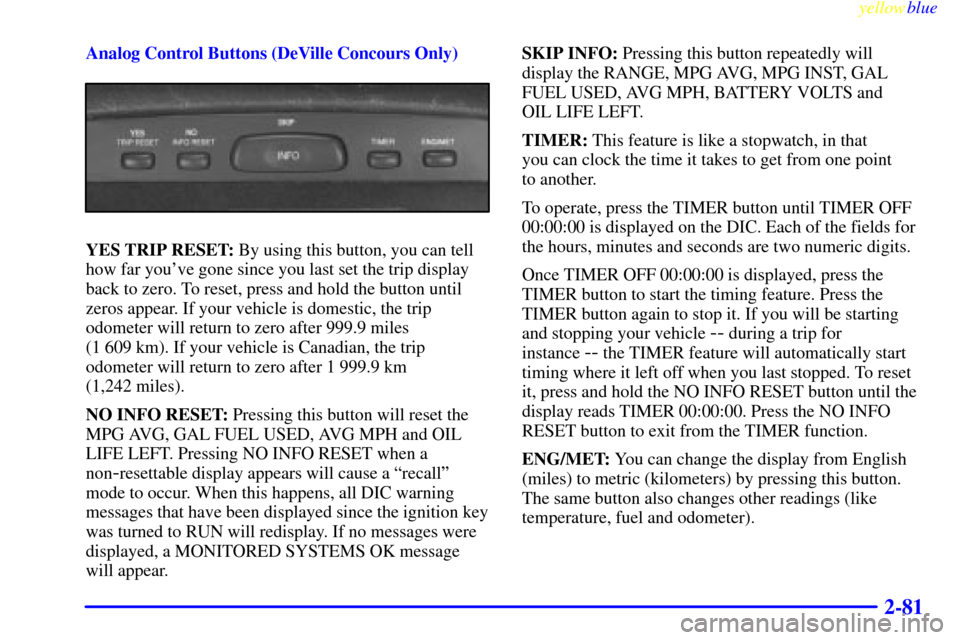
Analog Control Buttons (DeVille Concours Only)
YES TRIP RESET: By using this button, you can tell
how far you've gone since you last set the trip display
back to zero. To reset, press and hold the button until
zeros appear. If your vehicle is domestic, the trip
odometer will return to zero after 999.9 miles
(1 609 km). If your vehicle is Canadian, the trip
odometer will return to zero after 1 999.9 km
(1,242 miles).
NO INFO RESET: Pressing this button will reset the
MPG AVG, GAL FUEL USED, AVG MPH and OIL
LIFE LEFT. Pressing NO INFO RESET when a
non
-resettable display appears will cause a ªrecallº
mode to occur. When this happens, all DIC warning
messages that have been displayed since the ignition key
was turned to RUN will redisplay. If no messages were
displayed, a MONITORED SYSTEMS OK message
will appear.SKIP INFO: Pressing this button repeatedly will
display the RANGE, MPG AVG, MPG INST, GAL
FUEL USED, AVG MPH, BATTERY VOLTS and
OIL LIFE LEFT.
TIMER: This feature is like a stopwatch, in that
you can clock the time it takes to get from one point
to another.
To operate, press the TIMER button until TIMER OFF
00:00:00 is displayed on the DIC. Each of the fields for
the hours, minutes and seconds are two numeric digits.
Once TIMER OFF 00:00:00 is displayed, press the
TIMER button to start the timing feature. Press the
TIMER button again to stop it. If you will be starting
and stopping your vehicle
-- during a trip for
instance
-- the TIMER feature will automatically start
timing where it left off when you last stopped. To reset
it, press and hold the NO INFO RESET button until the
display reads TIMER 00:00:00. Press the NO INFO
RESET button to exit from the TIMER function.
ENG/MET: You can change the display from English
(miles) to metric (kilometers) by pressing this button.
The same button also changes other readings (like
temperature, fuel and odometer).
Page 151 of 368

yellowblue
2-91 Programmable Automatic Door Locks
Your vehicle's ignition must be in RUN. To begin
programming, press and hold the INFORMATION
SKIP (SKIP INFO) and RESET NO (NO INFO
RESET) buttons at the same time to display the
following prompts.
DOORS LOCK IN GEAR: All doors automatically
lock when shifted out of PARK (P). No automatic
door unlock.
DRIVR UNLOCK IN PARK: All doors automatically
lock when shifted out of PARK (P). Only the driver's
door automatically unlocks when shifted into PARK (P).
DRIVR UNLOCK KEY OFF: All doors automatically
lock when shifted out of PARK (P). Only the driver's
door automatically unlocks when the ignition key is
turned to OFF.
DOORS UNLOCK IN PARK: All doors automatically
lock when shifted out of PARK (P). All doors
automatically unlock when shifted into PARK (P).
DOORS UNLOCK KEY OFF: All doors
automatically lock when shifted out of PARK (P). All
doors automatically unlock when the ignition key is
turned to OFF.A ªyesº or ªnoº response must be made after each
prompt is displayed in order to continue on to the next
prompt or personalization feature. Press the TRIP YES
(YES TRIP RESET) button to choose yes, press the
RESET NO (NO INFO RESET) button to choose no or
press the INFORMATION SKIP (SKIP INFO) button to
ªskipº to the next personalization feature.
FEATURE ON appears when a yes response is made
and FEATURE OFF appears with a no response.
If a no response is made after the DOORS LOCK IN
GEAR prompt is displayed, FEATURE OFF will appear.
The automatic door locking system has been disabled
and no other door lock messages will be displayed.
LGHTS FLSH AT UNLOCK, which is the next
available personalization feature to display, will appear
next. See ªLock/Unlock Confirmationº following for
more information.
If a yes response is made after the DOORS LOCK IN
GEAR prompt is displayed, FEATURE ON appears.
The automatic door locking system is enabled and
allows the DRIVR UNLOCK IN PARK prompt to
appear. Choosing this prompt advances you to LGHTS
FLSH AT UNLOCK whereas a no response will display
the DRIVR UNLOCK KEY OFF prompt.
Page 152 of 368

yellowblue
2-92
If DRIVR UNLOCK KEY OFF is chosen, FEATURE
ON appears. You will advance to the LGHTS FLSH AT
UNLOCK prompt. If you don't choose this prompt,
FEATURE OFF appears as well as the next prompt
--
DOORS UNLOCK IN PARK. If this prompt is chosen,
FEATURE ON appears. If a no response was made,
DOORS UNLOCK KEY OFF will appear. At this point,
a yes or no response automatically brings up the LGHTS
FLSH AT UNLOCK feature.
Lock/Unlock Confirmation
This personalization feature allows the driver to
program the parking lamps to blink when the lock or
unlock buttons on the remote keyless entry transmitter
are pressed, to program the horn to sound when the lock
button is pressed and/or to program the exterior lamps to
turn on when the unlock button is pressed. Press the
TRIP YES (YES TRIP RESET) button to answer ªyes,º
press the RESET NO (NO INFO RESET) button to
indicate ªnoº or press the INFORMATION SKIP
(SKIP INFO) button to ªskipº to the next
personalization feature.To begin programming, your vehicle's ignition must be in
RUN. Press and hold the INFORMATION SKIP (SKIP
INFO) and RESET NO (NO INFO RESET) buttons at the
same time to display the following prompts.
LOCK/UNLOCK confirmation is the second feature to
appear. To ªskipº past the first personalization feature,
press the INFORMATION SKIP (SKIP INFO) button.
LGHTS FLSH AT UNLOCK: Parking lamps blink
twice when the unlock button on the remote keyless
entry transmitter is pressed.
LIGHTS FLASH AT LOCK: Parking lamps blink
once when the lock button on the remote keyless entry
transmitter is pressed.
HORN SOUNDS AT LOCK: Horn sounds when
the lock button on the remote keyless entry transmitter
is pressed.
EXT LIGHTS AT UNLOCK: Exterior lamps (parking
lamps, taillamps, sidemarker lamps, license plate lamps,
low
-beam headlamps, etc.) turn on when the unlock
button on the remote keyless entry transmitter is
pressed, and it is dark outside. These lamps stay on for
about 20 seconds or when the key is turned out of OFF.
Page 153 of 368

yellowblue
2-93
The prompts listed here appear in the same order as
displayed on the DIC. FEATURE ON appears when a
yes response is made and FEATURE OFF appears with
a no response. To skip to the next personalization feature
(REMOTE RECALL MEMORY), press the
INFORMATION SKIP (SKIP INFO) button.
Remote Recall Memory (If Equipped
with Memory Personalization)
Memory settings that have been previously programmed
(climate control settings, radio preset settings, exterior
lighting choices, lock/unlock confirmation choices and
programmable automatic door lock choices) can be
recalled by using the remote keyless entry transmitter or
by placing the key in your vehicle's ignition.
Before you begin programming, make sure that your
vehicle's ignition is in RUN. To begin programming,
press the INFORMATION SKIP (SKIP INFO) and
RESET NO (NO INFO RESET) buttons at the same
time for about two seconds. As mentioned, remote recall
memory is the third feature to appear. To ªskipº past the
first two personalization features, press the
INFORMATION SKIP (SKIP INFO) button.When REMOTE RECALL MEMORY appears, the driver
is able to recall memory settings when the unlock button
on the remote keyless entry transmitter is pressed. Press
the TRIP YES (YES TRIP RESET) button to select or
press the RESET NO (NO INFO RESET) button to
answer no and to continue on to the next prompt.
FEATURE ON displays when a yes response is made.
If a no response was made, the KEY IN RECALL
MEMORY prompt will show next. This choice recalls
memory settings when the key is placed in your
vehicle's ignition. FEATURE ON displays for a yes
response and FEATURE OFF for a no response. A yes
or no response is required.
Curb View Assist Mirror (If Equipped
with Memory Personalization)
If your vehicle has this personalization feature,
MIRROR TILT IN REV will be the fourth
personalization prompt to display on the DIC.
To program your vehicle, press the INFORMATION
SKIP (SKIP INFO) and RESET NO (NO INFO
RESET) buttons at the same time for about two seconds.
When MIRROR TILT IN REV appears, a ªyesº or ªnoº
response is needed. Press the TRIP YES (YES TRIP
RESET) button to answer yes or the RESET NO
(NO INFO RESET) button to answer no.
Page 154 of 368

yellowblue
2-94
FEATURE ON displays when a yes response is made
and FEATURE OFF shows after a no response. If you
do not want to change the setting of this feature, press
the INFORMATION SKIP (SKIP INFO) button to skip
to the next personalization feature which is Storage
Mode Personalization.
Storage Mode Personalization
Before you begin programming, make sure that your
vehicle's ignition is in RUN. To begin programming,
press the INFORMATION SKIP (SKIP INFO) and
RESET NO (NO INFO RESET) buttons at the same
time for about two seconds. The first message to appear
is DOORS LOCK IN GEAR. Press the INFORMATION
SKIP (SKIP INFO) button after this prompt is displayed
until the STORAGE MODE prompt appears on the DIC.
Press the TRIP YES (YES TRIP RESET) button to
answer ªyesº or press the RESET NO (NO INFO
RESET) button to indicate a ªnoº response.FEATURE ON appears when a yes response is made
and FEATURE OFF shows when a no response is made.
Since this is the last personalization feature available, a
yes or no response will end out of the DIC display.
Once the battery guard has been programmed, your
vehicle will enter the storage mode about 20 minutes
after the ignition key has been turned off.
Your vehicle will stay in the storage mode until the
ignition key is turned out of LOCK. The system will
ªwake
-upº when the door key is inserted into the door,
however, your vehicle will remain in the storage mode.
The ignition must be out of LOCK before the battery
guard is disabled.
Comfort Controls and Radio System
Personalization
These features allow both drivers to personalize their
own climate control settings as well as their radio
settings. For more information, see ªClimate
Control Personalizationº and ªRadio Personalizationº
in the Index.
Page 157 of 368
3-
yellowblue
3-1
Section 3 Comfort Controls and Audio Systems
In this section, you'll find out how to operate the comfort control and audio systems offered with your vehicle. Be
sure to read about the particular systems supplied with your vehicle.
3
-2 Comfort Controls
3
-2 Digital Cluster Climate Control Panel
(DeVille and DeVille d'Elegance Only)
3
-6 Analog Cluster Climate Control Panel
(DeVille Concours Only)
3
-9 Electronic Solar Sensor
3
-10 Air Conditioning
3
-10 Heating
3
-10 Defogging and Defrosting
3
-11 Rear Window Defogger
3
-12 Ventilation System
3
-13 HVAC Steering Wheel Controls
3
-13 Climate Control Personalization (If Equipped)
3
-14 Audio Systems
3
-14 Setting the Clock
3
-14 AM-FM Stereo with Cassette Tape Player
3
-18 AM-FM Stereo with Cassette Tape and
Compact Disc Player (If Equipped)3
-22 AM-FM Stereo with Cassette Tape and
Compact Disc Player with Radio Data
Systems (RDS) and Digital Signal Processing
(DPS) (If Equipped)
3
-31 Radio Data Systems (RDS) Program Type
(PTY) Selections
3
-32 CD Adapter Kits
3
-32 Trunk-Mounted CD Changer (If Equipped)
3
-36 Radio Personalization with Home and Away
Feature (If Equipped)
3
-37 Theft-Deterrent Feature
3
-37 Audio Steering Wheel Controls
3
-38 Understanding Radio Reception
3
-38 Tips About Your Audio System
3
-39 Care of Your Cassette Tape Player
3
-40 Care of Your Compact Discs
3
-41 Care of Your Compact Disc Player
3
-41 Power Antenna Mast Care
Page 159 of 368
yellowblue
3-3
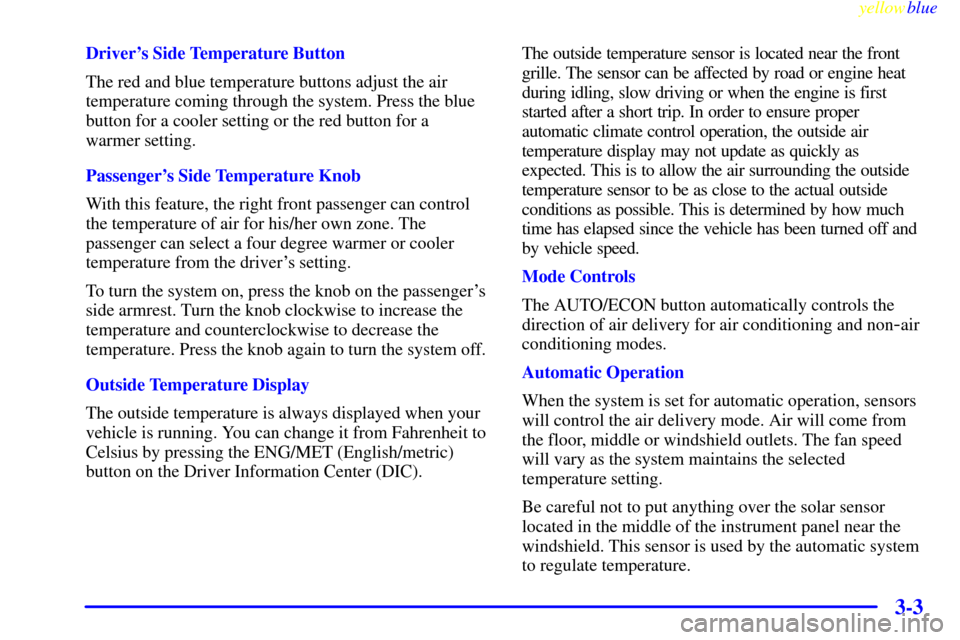
Driver's Side Temperature Button
The red and blue temperature buttons adjust the air
temperature coming through the system. Press the blue
button for a cooler setting or the red button for a
warmer setting.
Passenger's Side Temperature Knob
With this feature, the right front passenger can control
the temperature of air for his/her own zone. The
passenger can select a four degree warmer or cooler
temperature from the driver's setting.
To turn the system on, press the knob on the passenger's
side armrest. Turn the knob clockwise to increase the
temperature and counterclockwise to decrease the
temperature. Press the knob again to turn the system off.
Outside Temperature Display
The outside temperature is always displayed when your
vehicle is running. You can change it from Fahrenheit to
Celsius by pressing the ENG/MET (English/metric)
button on the Driver Information Center (DIC).The outside temperature sensor is located near the front
grille. The sensor can be affected by road or engine heat
during idling, slow driving or when the engine is first
started after a short trip. In order to ensure proper
automatic climate control operation, the outside air
temperature display may not update as quickly as
expected. This is to allow the air surrounding the outside
temperature sensor to be as close to the actual outside
conditions as possible. This is determined by how much
time has elapsed since the vehicle has been turned off and
by vehicle speed.
Mode Controls
The AUTO/ECON button automatically controls the
direction of air delivery for air conditioning and non
-air
conditioning modes.
Automatic Operation
When the system is set for automatic operation, sensors
will control the air delivery mode. Air will come from
the floor, middle or windshield outlets. The fan speed
will vary as the system maintains the selected
temperature setting.
Be careful not to put anything over the solar sensor
located in the middle of the instrument panel near the
windshield. This sensor is used by the automatic system
to regulate temperature.
Page 162 of 368
yellowblue
3-6 Analog Cluster Climate Control Panel
(DeVille Concours Only)
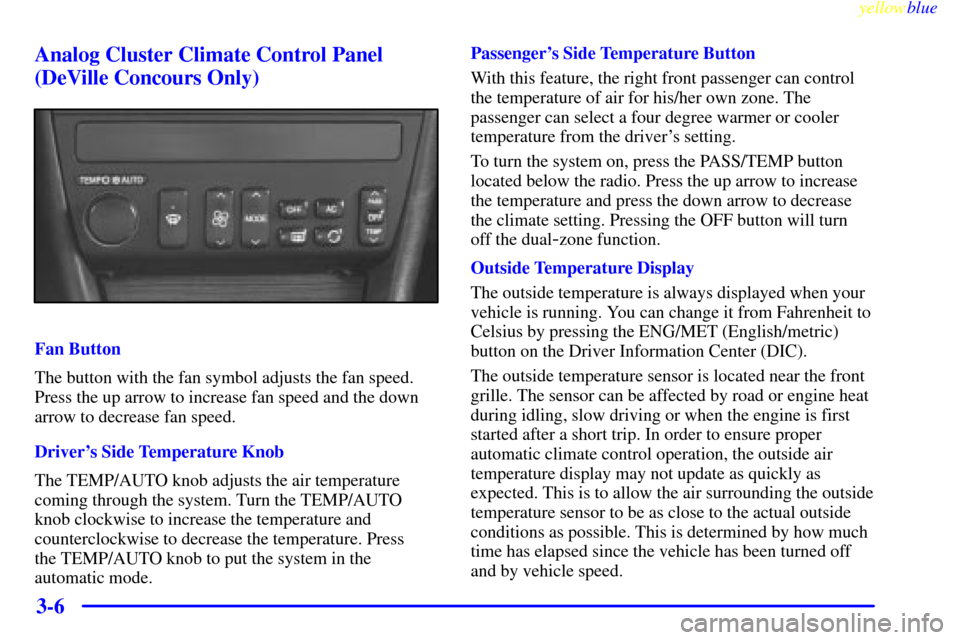
Fan Button
The button with the fan symbol adjusts the fan speed.
Press the up arrow to increase fan speed and the down
arrow to decrease fan speed.
Driver's Side Temperature Knob
The TEMP/AUTO knob adjusts the air temperature
coming through the system. Turn the TEMP/AUTO
knob clockwise to increase the temperature and
counterclockwise to decrease the temperature. Press
the TEMP/AUTO knob to put the system in the
automatic mode.Passenger's Side Temperature Button
With this feature, the right front passenger can control
the temperature of air for his/her own zone. The
passenger can select a four degree warmer or cooler
temperature from the driver's setting.
To turn the system on, press the PASS/TEMP button
located below the radio. Press the up arrow to increase
the temperature and press the down arrow to decrease
the climate setting. Pressing the OFF button will turn
off the dual
-zone function.
Outside Temperature Display
The outside temperature is always displayed when your
vehicle is running. You can change it from Fahrenheit to
Celsius by pressing the ENG/MET (English/metric)
button on the Driver Information Center (DIC).
The outside temperature sensor is located near the front
grille. The sensor can be affected by road or engine heat
during idling, slow driving or when the engine is first
started after a short trip. In order to ensure proper
automatic climate control operation, the outside air
temperature display may not update as quickly as
expected. This is to allow the air surrounding the outside
temperature sensor to be as close to the actual outside
conditions as possible. This is determined by how much
time has elapsed since the vehicle has been turned off
and by vehicle speed.