low beam CADILLAC DTS 2007 1.G User Guide
[x] Cancel search | Manufacturer: CADILLAC, Model Year: 2007, Model line: DTS, Model: CADILLAC DTS 2007 1.GPages: 518, PDF Size: 2.77 MB
Page 200 of 518

Entry Lighting
This feature turns on the courtesy lamps and the
backlighting to the door switches and to the exterior
lamp control when a door is opened or if you press
the remote keyless entry transmitter unlock button.
If activated due to the transmitter, the lighting will
remain active for about 40 seconds. Since the entry
lighting system uses the light sensor, it must be
dark outside in order for the courtesy lamps to turn
on. The courtesy lamps turn off approximately
25 seconds after the last door is closed. They will
dim to off if the ignition key is turned to RUN, or
immediately deactivate if the power locks are
activated.
Parade Dimming
This feature prohibits dimming of the digital
displays and backlighting during daylight hours
when the key is in the ignition and the headlamps
are on. This feature is fully automatic. When
the light sensor reads darkness outside and the
parking lamps are active, the digital displays
can be adjusted by turning the instrument panel
brightness knob counterclockwise to dim and
clockwise to brighten lighting.
Reading Lamps
The reading lamps are located on the overhead
console on the headliner and in the rear door
opening. These lamps come on automatically
when any door is opened and it is dark outside.
For manual operation, press the button to
turn them on. Press it again to turn them off.
If the reading lamps are left on, they automatically
shut off 10 minutes after the ignition has been
turned off.
Battery Load Management
The battery load management feature is
designed to monitor the vehicle’s electrical
load and determine when the battery is in a
heavy discharge condition. During times of high
electrical loading, the engine may idle at a higher
revolutions per minute (rpm) setting than normal
to make sure the battery charges. High electrical
loads may occur when several of the following are
on: headlamps, high beams, fog lamps, rear
window defogger, the climate control fan at high
speeds, heated seats and engine cooling fans.
200
Page 201 of 518

If the battery continues to discharge, even with
the engine idling at a higher rpm setting, some
electrical loads will automatically be reduced. When
this occurs, the rear window defogger may take
slightly longer to clear the glass, the heated seats
may not get as warm as they usually do and the
climate control fan may cut back to a lower speed.
For more battery saving information, see “Battery
Saver Active Message” underDIC Warnings and
Messages on page 246.
Electric Power Management
The vehicle has Electric Power Management (EPM)
that estimates the battery’s temperature
and state of charge. It then adjusts the voltage for
best performance and extended life of the battery.
When the battery’s state of charge is low, the
voltage is raised slightly to quickly put the charge
back in. When the state of charge is high, the
voltage is lowered slightly to prevent overcharging.
If the vehicle has a voltmeter gage or voltage
display on the Driver Information Center (DIC),
you may see the voltage move up or down.
This is normal. If there is a problem, an alert
will be displayed.The battery can be discharged at idle if the
electrical loads are very high. This is true for all
vehicles. This is because the generator (alternator)
may not be spinning fast enough at idle to produce
all the power that is needed for very high electrical
loads.
A high electrical load occurs when several of the
following loads are on: headlamps, high beams, fog
lamps, rear window defogger, climate control fan at
high speed, heated seats, engine cooling fans,
trailer loads, and loads plugged into accessory
power outlets.
EPM works to prevent excessive discharge of the
battery. It does this by balancing the generator’s
output and the vehicle’s electrical needs. It can
increase engine idle speed to generate more
power, whenever needed. It can temporarily
reduce the power demands of some accessories.
Normally, these actions occur in steps or levels,
without being noticeable. In rare cases at the
highest levels of corrective action, this action
may be noticeable to the driver. If so, a Driver
Information Center (DIC) message might be
displayed, such as Battery Saver Active or Service
Battery Charging System. If this message is
displayed, it is recommended that the driver reduce
the electrical loads as much as possible. SeeDIC
Warnings and Messages on page 246.
201
Page 238 of 518

Fog Lamp Light
The fog lamp light will
come on when the fog
lamps are in use.
The light will go out when the fog lamps are
turned off. SeeFog Lamps on page 198for more
information.
Lights On Reminder
This light comes on
whenever the parking
lamps are on.
SeeExterior Lamps on page 193for more
information.
Cruise Control Light
This light comes on
whenever you set your
cruise control.
The light will go out when the cruise control is
turned off. SeeCruise Control on page 176and
Adaptive Cruise Control on page 179for more
information.
Highbeam On Light
This light comes on
when the high-beam
headlamps are in use.
SeeHeadlamp High/Low-Beam Changer on
page 167for more information.
238
Page 319 of 518

No one can see as well at night as in the daytime.
But as we get older these differences increase.
A 50-year-old driver might require at least twice as
much light to see the same thing at night as a
20-year-old.
What you do in the daytime can also affect your
night vision. For example, if you spend the
day in bright sunshine you are wise to wear
sunglasses. Your eyes will have less trouble
adjusting to night. But if you are driving, do not
wear sunglasses at night. They might cut down on
glare from headlamps, but they also make a lot
of things invisible.
You can be temporarily blinded by approaching
headlamps. It can take a second or two, or
even several seconds, for your eyes to re-adjust
to the dark. When you are faced with severe glare,
as from a driver who does not lower the high
beams, or a vehicle with misaimed headlamps,
slow down a little. Avoid staring directly into
the approaching headlamps.Keep the windshield and all the glass on your
vehicle clean — inside and out. Glare at night is
made much worse by dirt on the glass. Even
the inside of the glass can build up a lm caused
by dust. Dirty glass makes lights dazzle and
ash more than clean glass would, making the
pupils of your eyes contract repeatedly.
Remember that the headlamps light up far less of a
roadway when you are in a turn or curve. Keep your
eyes moving; that way, it is easier to pick out dimly
lighted objects. Just as the headlamps should be
checked regularly for proper aim, so should your
eyes be examined regularly. Some drivers suffer
from night blindness — the inability to see in dim
light — and are not even aware of it.
319
Page 397 of 518

3. Disconnect the red positive (+) cable from the
vehicle with the good battery.
4. Disconnect the red positive (+) cable from the
other vehicle.
5. Return the remote positive (+) terminal cover
to its original position.
Headlamp Aiming
The vehicle has a visual optical headlamp aiming
system. The aim has been preset at the factory
and should need no further adjustment.
However, if the vehicle is damaged in an accident,
the headlamp aim may be affected and adjustment
may be necessary.
If oncoming vehicles ash their high beams at
you, this may also mean the vertical aim needs to
be adjusted.
It is recommended that the vehicle is taken to your
dealer/retailer for service if the headlamps need
to be re-aimed. It is possible however, to
re-aim the headlamps as described.Notice:To make sure your headlamps are
aimed properly, read all the instructions before
beginning. Failure to follow these instructions
could cause damage to headlamp parts.
The vehicle should:
Be placed so the headlamps are 25 ft. (7.6 m)
from a light colored wall.
Have all four tires on a level surface which is
level all the way to the wall.
Be placed so it is perpendicular to the wall.
Not have any snow, ice, or mud on it.
Be fully assembled and all other work stopped
while headlamp aiming is being performed.
Be normally loaded with a full tank of fuel and
one person or 160 lbs (75 kg) sitting on the
driver’s seat.
Have all tires properly inated.
Have the spare tire is in its original location in
the vehicle.
397
Page 398 of 518

Headlamp aiming is done with the vehicle’s
low-beam headlamps. The high-beam headlamps
will be correctly aimed if the low-beam headlamps
are aimed properly.
To adjust the vertical aim:
1. Open the hood. SeeHood Release on
page 363for more information.
2. Find the center line running through the lens
of the headlamp.
3. Record the distance from the ground to the
center line running through the lens of the
headlamp.4. At a wall, measure from the ground
upward (A) to the recorded distance from
Step 3 and mark it.
5. Draw or tape a horizontal line the width of the
vehicle at the wall where it was marked in
Step 4.
Notice:Do not cover a headlamp to improve
beam cut-off when aiming. Covering a
headlamp may cause excessive heat build-up
which may cause damage to the headlamp.
6. Turn on the low-beam headlamps and place a
piece of cardboard or equivalent in front of the
headlamp not being aimed. This should
allow only the beam of light from the headlamp
being aimed to be seen on the at surface.
398
Page 399 of 518

7. Locate the vertical headlamp aiming screws.
They are located under the hood near each
headlamp assembly. First lift the ap to
access either of them. Each one is the top
outboard screw by the “V” on the cover panel
next to the aiming ap.
The adjustment screw can be turned with a
6 mm hex wrench.8. Turn the vertical aiming screw until the
headlamp beam is aimed to the horizontal tape
line. Turn it clockwise or counterclockwise to
raise or lower the angle of the beam.
The top edge of the cut-off should be
positioned at the bottom edge of the horizontal
tape line.
9. Make sure that the light from the headlamp is
positioned at the bottom edge of the horizontal
tape line. The lamp on the left (A) shows
the correct headlamp aim. The lamp on the
right (B) shows the incorrect headlamp aim.
10. Repeat Steps 7 through 9 for the opposite
headlamp.
399
Page 400 of 518
Bulb Replacement
It is recommended that all bulbs be replaced by
your dealer.
High Intensity Discharge (HID)
Lighting
{CAUTION:
The low beam high intensity discharge
lighting system operates at a very high
voltage. If you try to service any of the
system components, you could be
seriously injured. Have your dealer or a
qualied technician service them.
Your vehicle has HID headlamps. After your
vehicle’s HID headlamp bulb has been replaced,
you may notice that the beam is a slightly different
shade than it was originally. This is normal.
Windshield Wiper Blade
Replacement
Windshield wiper blades should be inspected for
wear or cracking. SeeScheduled Maintenance
on page 465for more information on wiper blade
inspection.
Replacement blades come in different types and
are removed in different ways. Here’s how to
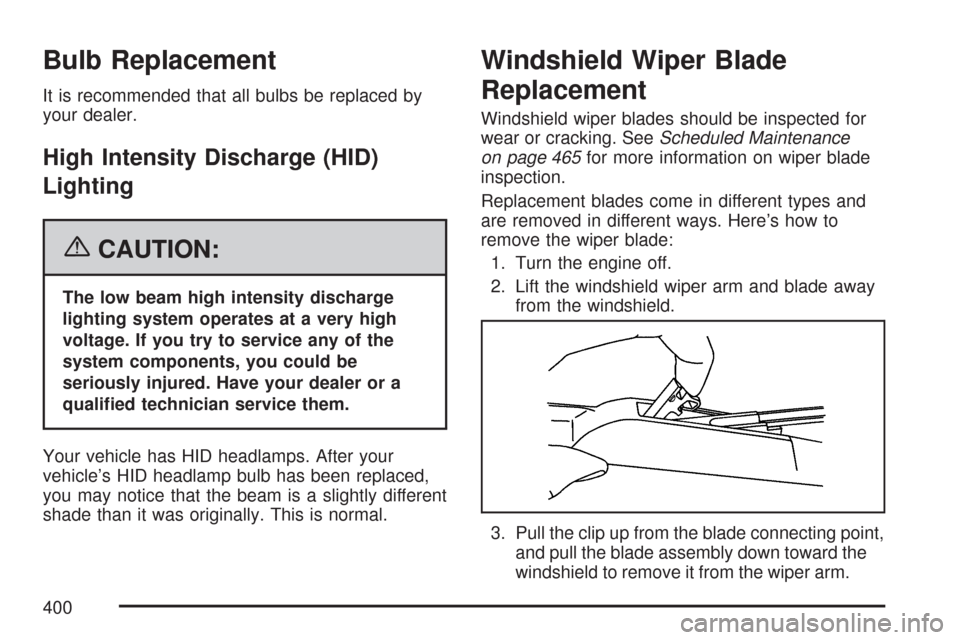
remove the wiper blade:
1. Turn the engine off.
2. Lift the windshield wiper arm and blade away
from the windshield.
3. Pull the clip up from the blade connecting point,
and pull the blade assembly down toward the
windshield to remove it from the wiper arm.
400
Page 453 of 518

Fuses Usage
F1 Spare
F2 Driver’s Side Low-Beam
F3 Passenger’s Side Low-Beam
F4 Airbag Ignition
F5 Engine Control ModuleFuses Usage
F6 Transaxle Ignition
F7 Spare
F8 Spare
F9 Spare
453
Page 509 of 518

H
Hazard Warning Flashers............................ 164
Head Restraints............................................ 16
Headlamp
Aiming..................................................... 397
Headlamp Wiring......................................... 451
Headlamps
Bulb Replacement.................................... 400
Daytime Running Lamps.......................... 197
Exterior Lamps......................................... 193
Flash-to-Pass........................................... 172
High Intensity Discharge (HID) Lighting.... 400
High/Low Beam Changer......................... 167
On Reminder........................................... 197
Wiper Activated........................................ 197
Heated Seats................................................ 11
Heated Steering Wheel............................... 166
Heater......................................................... 210
Highbeam On Light..................................... 238
High-Speed Operation, Tires........................ 413
Highway Hypnosis....................................... 325
Hill and Mountain Roads............................. 326
Hood
Checking Things Under............................ 362
Release................................................... 363Horn............................................................ 164
How to Use This Manual................................ 4
How to Wear Safety Belts Properly............... 24
I
Ignition Positions......................................... 118
Inadvertent Power Battery Saver................. 202
Infants and Young Children, Restraints.......... 45
Ination - Tire Pressure............................... 411
Instrument Panel
Overview.................................................. 162
Instrument Panel (I/P)
Brightness................................................ 199
Cluster..................................................... 223
J
Jump Starting.............................................. 392
K
Keyless Entry System................................... 95
Keys............................................................. 93
509