check oil CADILLAC DTS 2010 1.G User Guide
[x] Cancel search | Manufacturer: CADILLAC, Model Year: 2010, Model line: DTS, Model: CADILLAC DTS 2010 1.GPages: 480, PDF Size: 17.56 MB
Page 336 of 480
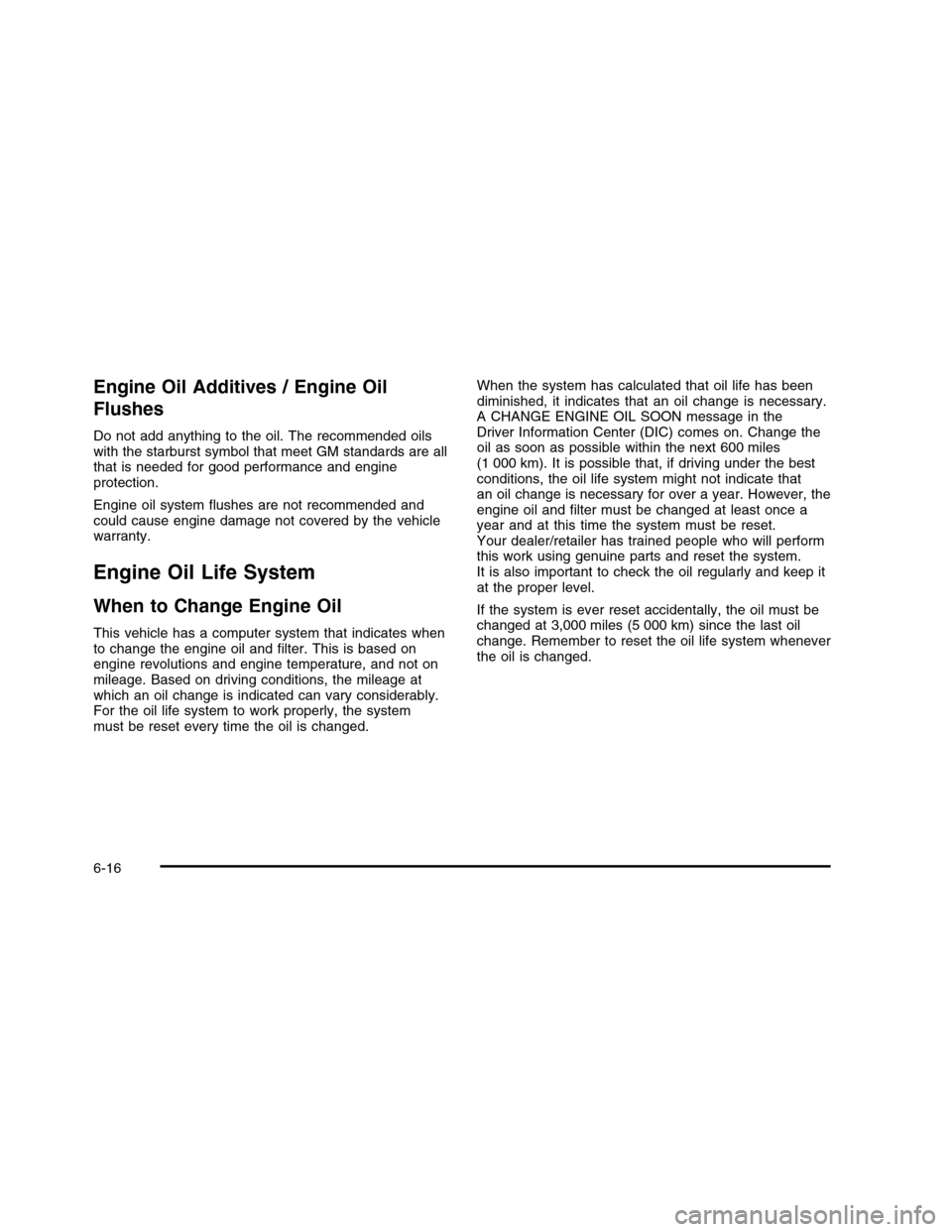
Engine Oil Additives / Engine Oil
Flushes
Do not add anything to the oil. The recommended oilswith the starburst symbol that meet GM standards are allthat is needed for good performance and engineprotection.
Engine oil system flushes are not recommended andcould cause engine damage not covered by the vehiclewarranty.
Engine Oil Life System
When to Change Engine Oil
This vehicle has a computer system that indicates whento change the engine oil and filter. This is based onengine revolutions and engine temperature, and not onmileage. Based on driving conditions, the mileage atwhich an oil change is indicated can vary considerably.For the oil life system to work properly, the systemmust be reset every time the oil is changed.
When the system has calculated that oil life has beendiminished, it indicates that an oil change is necessary.A CHANGE ENGINE OIL SOON message in theDriver Information Center (DIC) comes on. Change theoil as soon as possible within the next 600 miles(1 000 km). It is possible that, if driving under the bestconditions, the oil life system might not indicate thatan oil change is necessary for over a year. However, theengine oil and filter must be changed at least once ayear and at this time the system must be reset.Your dealer/retailer has trained people who will performthis work using genuine parts and reset the system.It is also important to check the oil regularly and keep itat the proper level.
If the system is ever reset accidentally, the oil must bechanged at 3,000 miles (5 000 km) since the last oilchange. Remember to reset the oil life system wheneverthe oil is changed.
6-16
Page 339 of 480
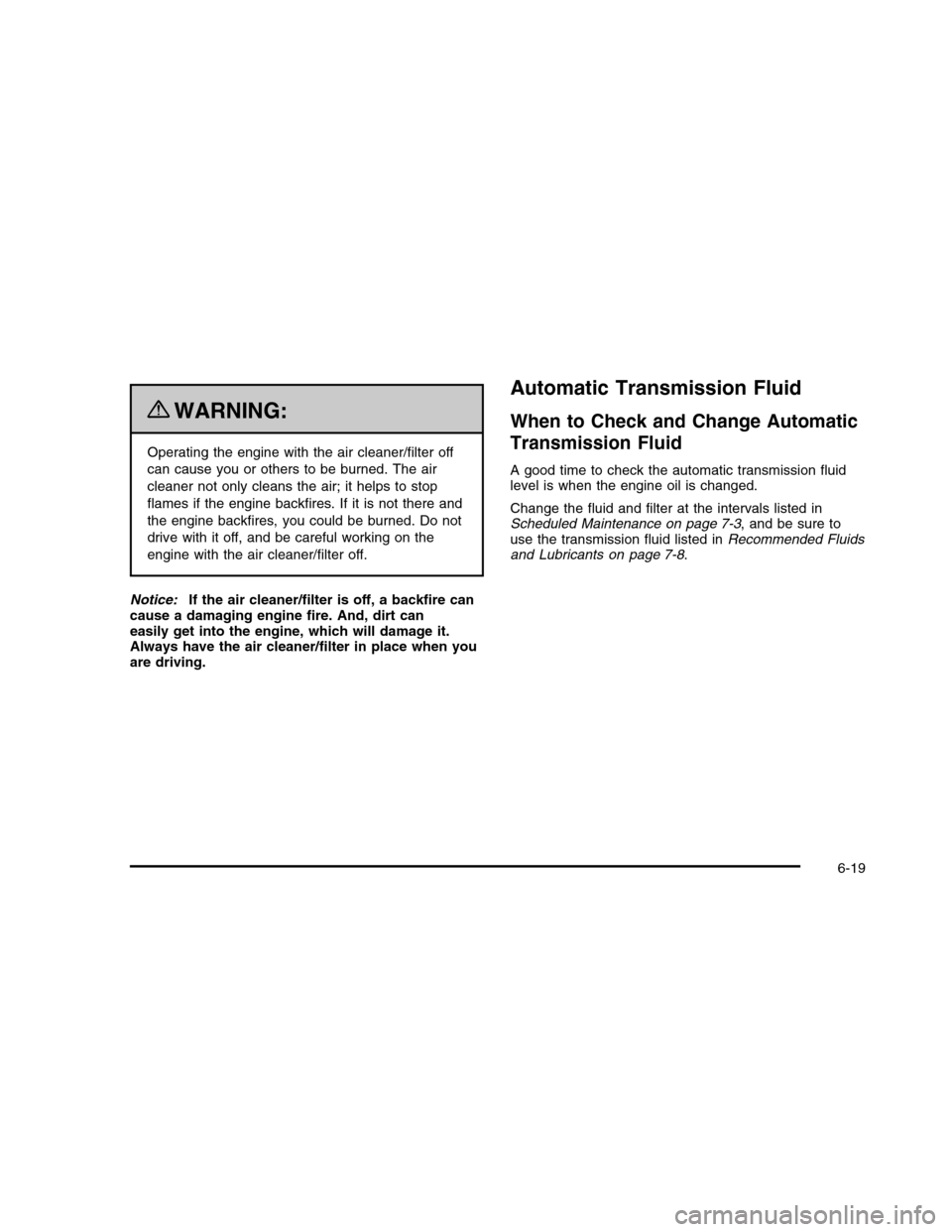
{WARNING:
Operating the engine with the air cleaner/filter off
can cause you or others to be burned. The air
cleaner not only cleans the air; it helps to stop
flames if the engine backfires. If it is not there and
the engine backfires, you could be burned. Do not
drive with it off, and be careful working on the
engine with the air cleaner/filter off.
Notice:If the air cleaner/filter is off, a backfire cancause a damaging engine fire. And, dirt caneasily get into the engine, which will damage it.Always have the air cleaner/filter in place when youare driving.
Automatic Transmission Fluid
When to Check and Change Automatic
Transmission Fluid
A good time to check the automatic transmission fluidlevel is when the engine oil is changed.
Change the fluid and filter at the intervals listed inScheduled Maintenance on page 7-3, and be sure touse the transmission fluid listed inRecommended Fluidsand Lubricants on page 7-8.
6-19
Page 345 of 480

Checking Coolant
The vehicle must be on a level surface when checkingthe coolant level.
Check to see if coolant is visible in the coolant recoverytank. If the coolant inside the coolant recovery tank isboiling, do not do anything else until it cools down.If coolant is visible but the coolant level is not ator above the FULL COLD mark, add a 50/50 mixture ofclean, drinkable water and DEX-COOL®coolant atthe coolant recovery tank, but be sure the coolingsystem is cool before this is done. SeeEngine Coolanton page 6-23for more information.
How to Add Coolant to the Surge Tank
{WARNING:
You can be burned if you spill coolant on hot
engine parts. Coolant contains ethylene glycol and
it will burn if the engine parts are hot enough. Do
not spill coolant on a hot engine.
Notice:This vehicle has a specific coolant fillprocedure. Failure to follow this procedure couldcause the engine to overheat and be severelydamaged.
{WARNING:
An electric engine cooling fan under the hood can
start up even when the engine is not running and
can cause injury. Keep hands, clothing, and tools
away from any underhood electric fan.
6-25
Page 411 of 480

Spare Tire
This vehicle may have a spare tire, which, when new,was fully inflated. A spare tire may lose air over time, socheck its inflation pressure regularly. SeeInflation - TirePressure on page 6-54andLoading the Vehicle onpage 5-18for information regarding proper tire inflationand loading your vehicle. For instructions on how toremove, install or store a spare tire, seeRemoving theFlat Tire and Installing the Spare Tire on page 6-83.
After installing the spare tire on your vehicle, you shouldstop as soon as possible and make sure the spare iscorrectly inflated. Have the damaged or flat roadtire repaired or replaced as soon as you can andinstalled back onto your vehicle. This way, a spare tirewill be available in case you need it again.
Your vehicle may have a different size spare tire thanthe road tire originally installed on your vehicle.This spare tire was developed for use on your vehicle,so it is all right to drive on it.
If your vehicle has a spare tire that does not match yourvehicle’s original road tires and wheels in size andtype, do not include the spare in the tire rotation.
Appearance Care
Interior Cleaning
The vehicle’s interior will continue to look its best if it iscleaned often. Although not always visible, dust anddirt can accumulate on the upholstery. Dirt can damagecarpet, fabric, leather, and plastic surfaces. Regularvacuuming is recommended to remove particles from theupholstery. It is important to keep the upholstery frombecoming and remaining heavily soiled. Soils should beremoved as quickly as possible. The vehicle’s interiormay experience extremes of heat that could causestains to set rapidly.
Lighter colored interiors may require more frequentcleaning. Use care because newspapers and garmentsthat transfer color to home furnishings may alsotransfer color to the vehicle’s interior.
When cleaning the vehicle’s interior, only use cleanersspecifically designed for the surfaces being cleaned.Permanent damage may result from using cleaners onsurfaces for which they were not intended. Use glasscleaner only on glass. Remove any accidental over-sprayfrom other surfaces immediately. To prevent over-spray,apply cleaner directly to the cleaning cloth.
6-91
Page 429 of 480
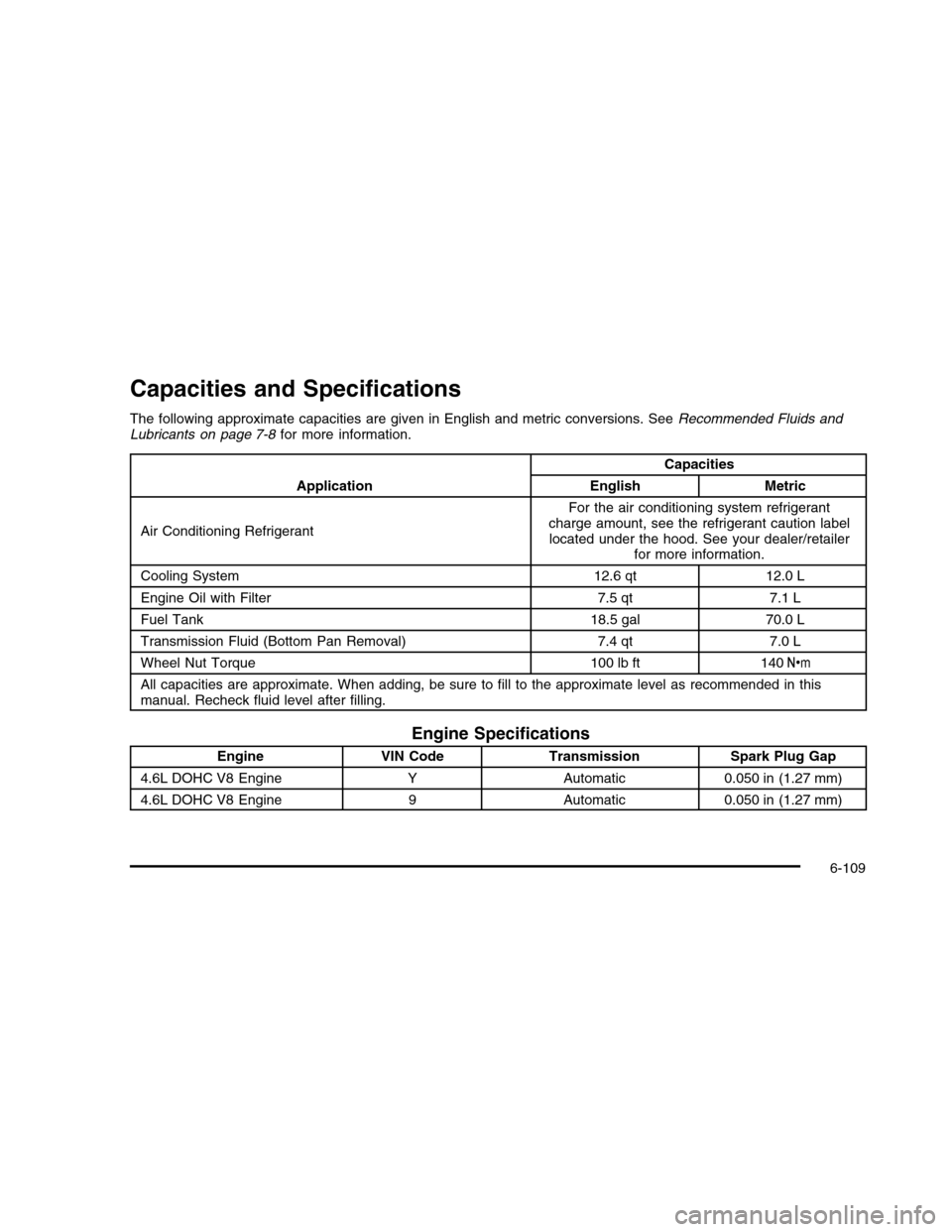
Capacities and Specifications
The following approximate capacities are given in English and metric conversions. SeeRecommended Fluids andLubricants on page 7-8for more information.
Application
Capacities
EnglishMetric
Air Conditioning Refrigerant
For the air conditioning system refrigerantcharge amount, see the refrigerant caution labellocated under the hood. See your dealer/retailerfor more information.
Cooling System12.6 qt12.0 L
Engine Oil with Filter7.5 qt7.1 L
Fuel Tank18.5 gal70.0 L
Transmission Fluid (Bottom Pan Removal)7.4 qt7.0 L
Wheel Nut Torque100 lb ft140Y
All capacities are approximate. When adding, be sure to fill to the approximate level as recommended in thismanual. Recheck fluid level after filling.
Engine Specifications
EngineVIN CodeTransmissionSpark Plug Gap
4.6L DOHC V8 EngineYAutomatic0.050 in (1.27 mm)
4.6L DOHC V8 Engine9Automatic0.050 in (1.27 mm)
6-109
Page 433 of 480

Rotation of New Tires
To maintain ride, handling, and performance of thevehicle, it is important that the first rotation service fornew tires be performed when they have 8 000 to13 000 km (5,000 to 8,000 miles). SeeTire Inspectionand Rotation on page 6-62.
Scheduled Maintenance
When the Change Engine Oil Soon
Message Displays
Change engine oil and filter. SeeEngine Oil onpage 6-13.An Emission Control Service.
When the Change Engine Oil Soon message displays,service is required for the vehicle as soon as possible,within the next 1 000 km/600 miles. If driving underthe best conditions, the engine oil life system might notindicate the need for vehicle service for more than ayear. The engine oil and filter must be changed at leastonce a year and the oil life system must be reset.Your dealer/retailer has trained service technicians whowill perform this work and reset the system.
If the engine oil life system is reset accidentally, servicethe vehicle within 5 000 km/3,000 miles since the lastservice. Reset the oil life system whenever the oilis changed. SeeEngine Oil Life System on page 6-16.
When the Change Engine Oil Soon message displays,certain services, checks, and inspections are required.
Every Engine Oil Change
•Change engine oil and filter. SeeEngine Oil on
page 6-13.An Emission Control Service.
•Engine coolant level check. SeeEngine Coolant on
page 6-23.
•Windshield washer fluid level check. SeeWindshield
Washer Fluid on page 6-31.
•Tire inflation check. SeeInflation - Tire Pressure on
page 6-54.
•Tire wear inspection. SeeTire Inspection and
Rotation on page 6-62.
•Rotate tires. SeeTire Inspection and Rotation on
page 6-62.
7-3
Page 434 of 480
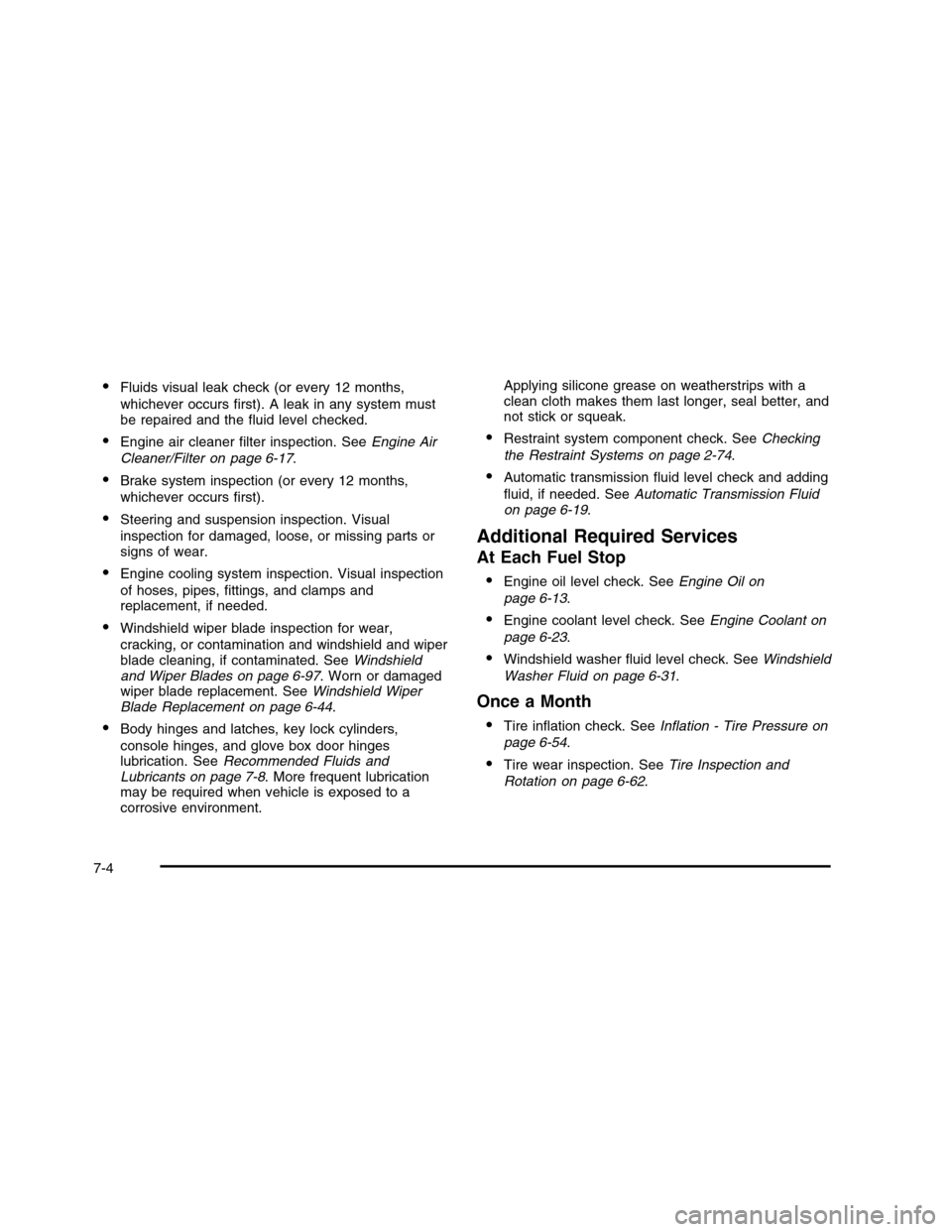
•Fluids visual leak check (or every 12 months,
whichever occurs first). A leak in any system mustbe repaired and the fluid level checked.
•Engine air cleaner filter inspection. SeeEngine Air
Cleaner/Filter on page 6-17.
•Brake system inspection (or every 12 months,
whichever occurs first).
•Steering and suspension inspection. Visual
inspection for damaged, loose, or missing parts orsigns of wear.
•Engine cooling system inspection. Visual inspection
of hoses, pipes, fittings, and clamps andreplacement, if needed.
•Windshield wiper blade inspection for wear,
cracking, or contamination and windshield and wiperblade cleaning, if contaminated. SeeWindshieldand Wiper Blades on page 6-97. Worn or damagedwiper blade replacement. SeeWindshield WiperBlade Replacement on page 6-44.
•Body hinges and latches, key lock cylinders,
console hinges, and glove box door hingeslubrication. SeeRecommended Fluids andLubricants on page 7-8. More frequent lubricationmay be required when vehicle is exposed to acorrosive environment.
Applying silicone grease on weatherstrips with aclean cloth makes them last longer, seal better, andnot stick or squeak.
•Restraint system component check. SeeChecking
the Restraint Systems on page 2-74.
•Automatic transmission fluid level check and adding
fluid, if needed. SeeAutomatic Transmission Fluidon page 6-19.
Additional Required Services
At Each Fuel Stop
•Engine oil level check. SeeEngine Oil on
page 6-13.
•Engine coolant level check. SeeEngine Coolant on
page 6-23.
•Windshield washer fluid level check. SeeWindshield
Washer Fluid on page 6-31.
Once a Month
•Tire inflation check. SeeInflation - Tire Pressure on
page 6-54.
•Tire wear inspection. SeeTire Inspection and
Rotation on page 6-62.
7-4
Page 435 of 480
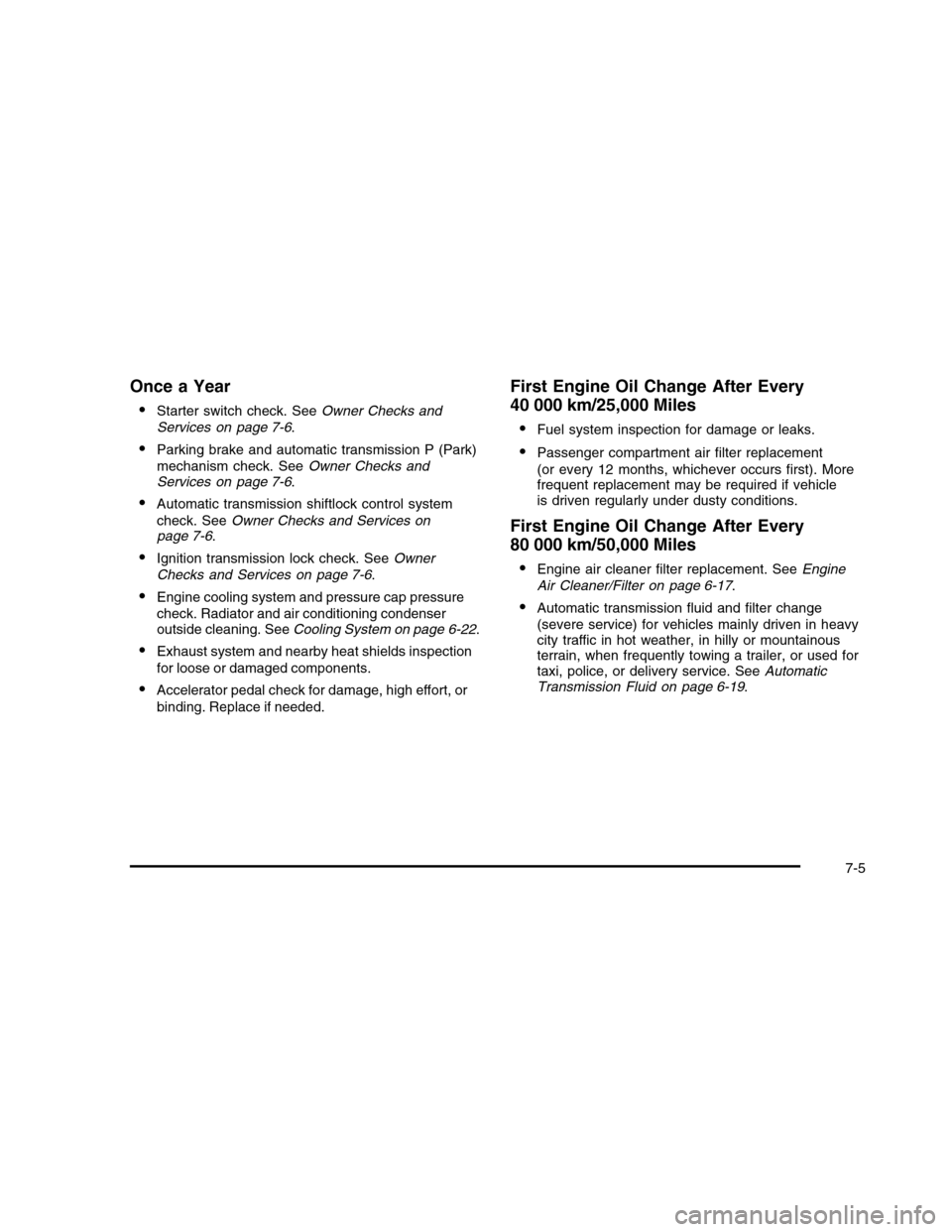
Once a Year
•Starter switch check. SeeOwner Checks and
Services on page 7-6.
•Parking brake and automatic transmission P (Park)
mechanism check. SeeOwner Checks andServices on page 7-6.
•Automatic transmission shiftlock control system
check. SeeOwner Checks and Services onpage 7-6.
•Ignition transmission lock check. SeeOwner
Checks and Services on page 7-6.
•Engine cooling system and pressure cap pressure
check. Radiator and air conditioning condenseroutside cleaning. SeeCooling System on page 6-22.
•Exhaust system and nearby heat shields inspection
for loose or damaged components.
•Accelerator pedal check for damage, high effort, or
binding. Replace if needed.
First Engine Oil Change After Every
40 000 km/25,000 Miles
•Fuel system inspection for damage or leaks.
•Passenger compartment air filter replacement
(or every 12 months, whichever occurs first). Morefrequent replacement may be required if vehicleis driven regularly under dusty conditions.
First Engine Oil Change After Every
80 000 km/50,000 Miles
•Engine air cleaner filter replacement. SeeEngine
Air Cleaner/Filter on page 6-17.
•Automatic transmission fluid and filter change
(severe service) for vehicles mainly driven in heavycity traffic in hot weather, in hilly or mountainousterrain, when frequently towing a trailer, or used fortaxi, police, or delivery service. SeeAutomaticTransmission Fluid on page 6-19.
7-5
Page 436 of 480

First Engine Oil Change After Every
120 000 km/75,000 Miles
•Professional Vehicle Only: Engine cooling system
drain, flush, and refill, cooling system and cappressure check, and cleaning of outside of radiatorand air conditioning condenser (or every 5 years,whichever occurs first). SeeEngine Coolanton page 6-23.An Emission Control Service.
First Engine Oil Change After Every
160 000 km/100,000 Miles
•Automatic transmission fluid and filter change
(normal service). SeeAutomatic Transmission Fluidon page 6-19.
•Spark plug replacement.An Emission Control
Service.
First Engine Oil Change After Every
240 000 km/150,000 Miles
•Except Professional Vehicle: Engine cooling system
drain, flush, and refill, cooling system and cappressure check, and cleaning of outside of radiatorand air conditioning condenser (or every 5 years,whichever occurs first). SeeEngine Coolanton page 6-23.An Emission Control Service.
•Engine accessory drive belt inspection for fraying,
excessive cracks, or obvious damage andreplacement, if needed.An Emission ControlService.
Owner Checks and Services
Starter Switch Check
{WARNING:
When you are doing this inspection, the vehicle
could move suddenly. If the vehicle moves, you or
others could be injured.
1. Before starting this check, be sure there is enoughroom around the vehicle.
2. Firmly apply both the parking brake and the regularbrake. SeeParking Brake on page 3-30.
Do not use the accelerator pedal, and be ready toturn off the engine immediately if it starts.
3. Try to start the engine in each gear. The vehicleshould start only in P (Park) or N (Neutral). If thevehicle starts in any other position, contactyour dealer/retailer for service.
7-6
Page 438 of 480
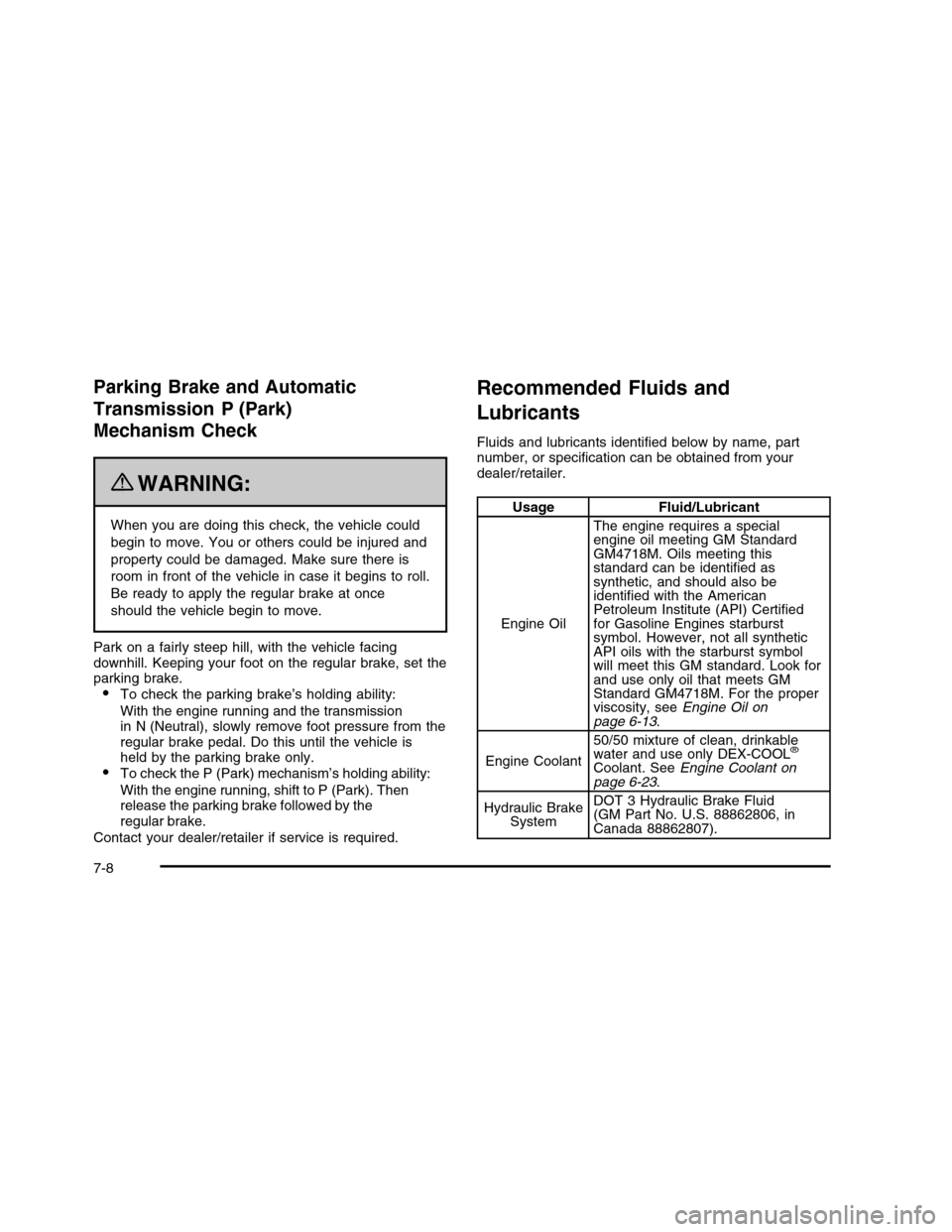
Parking Brake and Automatic
Transmission P (Park)
Mechanism Check
{WARNING:
When you are doing this check, the vehicle could
begin to move. You or others could be injured and
property could be damaged. Make sure there is
room in front of the vehicle in case it begins to roll.
Be ready to apply the regular brake at once
should the vehicle begin to move.
Park on a fairly steep hill, with the vehicle facingdownhill. Keeping your foot on the regular brake, set theparking brake.
•To check the parking brake’s holding ability:
With the engine running and the transmissionin N (Neutral), slowly remove foot pressure from theregular brake pedal. Do this until the vehicle isheld by the parking brake only.
•To check the P (Park) mechanism’s holding ability:
With the engine running, shift to P (Park). Thenrelease the parking brake followed by theregular brake.
Contact your dealer/retailer if service is required.
Recommended Fluids and
Lubricants
Fluids and lubricants identified below by name, partnumber, or specification can be obtained from yourdealer/retailer.
UsageFluid/Lubricant
Engine Oil
The engine requires a specialengine oil meeting GM StandardGM4718M. Oils meeting thisstandard can be identified assynthetic, and should also beidentified with the AmericanPetroleum Institute (API) Certifiedfor Gasoline Engines starburstsymbol. However, not all syntheticAPI oils with the starburst symbolwill meet this GM standard. Look forand use only oil that meets GMStandard GM4718M. For the properviscosity, seeEngine Oil onpage 6-13.
Engine Coolant
50/50 mixture of clean, drinkablewater and use only DEX-COOL®
Coolant. SeeEngine Coolant onpage 6-23.
Hydraulic BrakeSystem
DOT 3 Hydraulic Brake Fluid(GM Part No. U.S. 88862806, inCanada 88862807).
7-8