engine oil CADILLAC DTS 2010 1.G Owner's Manual
[x] Cancel search | Manufacturer: CADILLAC, Model Year: 2010, Model line: DTS, Model: CADILLAC DTS 2010 1.GPages: 480, PDF Size: 17.56 MB
Page 336 of 480

Engine Oil Additives / Engine Oil
Flushes
Do not add anything to the oil. The recommended oilswith the starburst symbol that meet GM standards are allthat is needed for good performance and engineprotection.
Engine oil system flushes are not recommended andcould cause engine damage not covered by the vehiclewarranty.
Engine Oil Life System
When to Change Engine Oil
This vehicle has a computer system that indicates whento change the engine oil and filter. This is based onengine revolutions and engine temperature, and not onmileage. Based on driving conditions, the mileage atwhich an oil change is indicated can vary considerably.For the oil life system to work properly, the systemmust be reset every time the oil is changed.
When the system has calculated that oil life has beendiminished, it indicates that an oil change is necessary.A CHANGE ENGINE OIL SOON message in theDriver Information Center (DIC) comes on. Change theoil as soon as possible within the next 600 miles(1 000 km). It is possible that, if driving under the bestconditions, the oil life system might not indicate thatan oil change is necessary for over a year. However, theengine oil and filter must be changed at least once ayear and at this time the system must be reset.Your dealer/retailer has trained people who will performthis work using genuine parts and reset the system.It is also important to check the oil regularly and keep itat the proper level.
If the system is ever reset accidentally, the oil must bechanged at 3,000 miles (5 000 km) since the last oilchange. Remember to reset the oil life system wheneverthe oil is changed.
6-16
Page 337 of 480

How to Reset the Engine Oil Life
System
The Engine Oil Life System calculates when to changethe engine oil and filter based on vehicle use. Wheneverthe oil is changed, reset the system so it can calculatewhen the next oil change is required. If a situation occurswhere the oil is changed prior to a CHANGE ENGINE OILSOON message in the Driver Information Center (DIC)being turned on, reset the system.
After the oil has been changed, the CHANGE ENGINEOIL SOON message must be reset:
1. Turn the key to the ON/RUN position withoutstarting the engine.
2. Press the INFO button on the Driver InformationCenter (DIC) until OIL LIFE REMAINING isdisplayed. SeeDIC Operation and Displays onpage 4-62.
3. Press and hold the INFO RESET button until 100%is displayed. This resets the oil life indicator.
4. Turn the key to LOCK/OFF.
If the CHANGE ENGINE OIL SOON message comesback on when the vehicle is started, the engine oillife system has not reset. Repeat the procedure.
What to Do with Used Oil
Used engine oil contains certain elements that can beunhealthy for your skin and could even cause cancer.Do not let used oil stay on your skin for very long. Cleanyour skin and nails with soap and water, or a goodhand cleaner. Wash or properly dispose of clothing orrags containing used engine oil. See the manufacturer’swarnings about the use and disposal of oil products.
Used oil can be a threat to the environment. If youchange your own oil, be sure to drain all the oil from thefilter before disposal. Never dispose of oil by putting itin the trash, pouring it on the ground, into sewers, or intostreams or bodies of water. Recycle it by taking it to aplace that collects used oil.
Engine Air Cleaner/Filter
SeeEngine Compartment Overview on page 6-12forthe location of the engine air cleaner/filter.
When to Inspect the Engine Air
Cleaner/Filter
Inspect the air cleaner/filter at the MaintenanceIIintervals and replace it at the first oil change after each50,000 mile (80 000 km) interval. SeeScheduledMaintenance on page 7-3for more information. If youare driving in dusty/dirty conditions, inspect the filterat each engine oil change.
6-17
Page 339 of 480
{WARNING:
Operating the engine with the air cleaner/filter off
can cause you or others to be burned. The air
cleaner not only cleans the air; it helps to stop
flames if the engine backfires. If it is not there and
the engine backfires, you could be burned. Do not
drive with it off, and be careful working on the
engine with the air cleaner/filter off.
Notice:If the air cleaner/filter is off, a backfire cancause a damaging engine fire. And, dirt caneasily get into the engine, which will damage it.Always have the air cleaner/filter in place when youare driving.
Automatic Transmission Fluid
When to Check and Change Automatic
Transmission Fluid
A good time to check the automatic transmission fluidlevel is when the engine oil is changed.
Change the fluid and filter at the intervals listed inScheduled Maintenance on page 7-3, and be sure touse the transmission fluid listed inRecommended Fluidsand Lubricants on page 7-8.
6-19
Page 344 of 480

What to Use
{WARNING:
Adding only plain water to the cooling system can
be dangerous. Plain water, or some other liquid
such as alcohol, can boil before the proper coolant
mixture will. The vehicle’s coolant warning system
is set for the proper coolant mixture. With plain
water or the wrong mixture, the engine could get
too hot but you would not get the overheat
warning. The engine could catch fire and you or
others could be burned. Use a 50/50 mixture of
clean, drinkable water and DEX-COOL®coolant.
Use a 50/50 mixture of clean, drinkable water andDEX-COOL®coolant. If using this mixture, nothing elseneeds to be added. This mixture:
•Gives freezing protection down to!34°F (!37°C),
outside temperature.
•Gives boiling protection up to 265°F (129°C),
engine temperature.
•Protects against rust and corrosion.
•Will not damage aluminum parts.
•Helps keep the proper engine temperature.
Notice:If an improper coolant mixture is used, theengine could overheat and be badly damaged.The repair cost would not be covered by the vehiclewarranty. Too much water in the mixture canfreeze and crack the engine, radiator, heater core,and other parts.
Notice:If extra inhibitors and/or additives are usedin the vehicle’s cooling system, the vehicle couldbe damaged. Use only the proper mixture ofthe engine coolant listed in this manual for thecooling system. SeeRecommended Fluids andLubricants on page 7-8for more information.
6-24
Page 345 of 480

Checking Coolant
The vehicle must be on a level surface when checkingthe coolant level.
Check to see if coolant is visible in the coolant recoverytank. If the coolant inside the coolant recovery tank isboiling, do not do anything else until it cools down.If coolant is visible but the coolant level is not ator above the FULL COLD mark, add a 50/50 mixture ofclean, drinkable water and DEX-COOL®coolant atthe coolant recovery tank, but be sure the coolingsystem is cool before this is done. SeeEngine Coolanton page 6-23for more information.
How to Add Coolant to the Surge Tank
{WARNING:
You can be burned if you spill coolant on hot
engine parts. Coolant contains ethylene glycol and
it will burn if the engine parts are hot enough. Do
not spill coolant on a hot engine.
Notice:This vehicle has a specific coolant fillprocedure. Failure to follow this procedure couldcause the engine to overheat and be severelydamaged.
{WARNING:
An electric engine cooling fan under the hood can
start up even when the engine is not running and
can cause injury. Keep hands, clothing, and tools
away from any underhood electric fan.
6-25
Page 349 of 480

If No Steam Is Coming From The
Engine Compartment
If an engine overheat warning is displayed but no steamcan be seen or heard, the problem may not be tooserious. Sometimes the engine can get a little too hotwhen the vehicle:
•Climbs a long hill on a hot day.
•Stops after high-speed driving.
•Idles for long periods in traffic.
•Tows a trailer.
If the overheat warning is displayed with no sign ofsteam:
1. Turn the air conditioning off.
2. Turn the heater on to the highest temperature andto the highest fan speed. Open the windows asnecessary.
3. In heavy traffic, let the engine idle in N (Neutral) whilestopped. If it safe to do so, pull off the road, shift toP (Park) or N (Neutral) and let the engine idle.
If the temperature overheat gage is no longer in theoverheat zone or an overheat warning no longer displays,the vehicle can be driven. Continue to drive the vehicleslow for about 10 minutes. Keep a safe vehicle distancefrom the car in front of you. If the warning does not comeback on, continue to drive normally.
If the warning continues, pull over, stop, and park thevehicle right away.
If there is no sign of steam, idle the engine for threeminutes while parked. If the warning is still displayed, turnoff the engine until it cools down. Also, see!OverheatedEngine Protection Operating Mode!next in this section.
Overheated Engine Protection
Operating Mode
If an overheated engine condition exists and themessage ENGINE OVERHEATED STOP ENGINE isdisplayed, an overheat protection mode which alternatesfiring groups of cylinders helps prevent engine damage.In this mode, you will notice a loss in power andengine performance. This operating mode allows yourvehicle to be driven to a safe place in an emergency.Driving extended miles (km) and/or towing a trailer in theoverheat protection mode should be avoided.
Notice:After driving in the overheated engineprotection operating mode, to avoid engine damage,allow the engine to cool before attempting anyrepair. The engine oil will be severely degraded.Repair the cause of coolant loss, change the oil andreset the oil life system. SeeEngine Oil onpage 6-13.
6-29
Page 353 of 480

{WARNING:
With the wrong kind of fluid in the brake hydraulic
system, the brakes might not work well. This could
cause a crash. Always use the proper brake fluid.
Notice:
•Using the wrong fluid can badly damage brake
hydraulic system parts. For example, just afew drops of mineral-based oil, such as engineoil, in the brake hydraulic system can damagebrake hydraulic system parts so badly that theywill have to be replaced. Do not let someoneput in the wrong kind of fluid.
•If brake fluid is spilled on the vehicle’s painted
surfaces, the paint finish can be damaged. Becareful not to spill brake fluid on the vehicle.If you do, wash it off immediately. SeeWashingYour Vehicle on page 6-95.
Brake Wear
This vehicle has disc brakes. Disc brake pads havebuilt-in wear indicators that make a high-pitched warningsound when the brake pads are worn and new padsare needed. The sound can come and go or be heard allthe time the vehicle is moving, except when applyingthe brake pedal firmly.
{WARNING:
The brake wear warning sound means that soon
the brakes will not work well. That could lead to an
accident. When the brake wear warning sound is
heard, have the vehicle serviced.
Notice:Continuing to drive with worn-out brakepads could result in costly brake repair.
Some driving conditions or climates can cause a brakesqueal when the brakes are first applied or lightlyapplied. This does not mean something is wrong withthe brakes.
6-33
Page 429 of 480
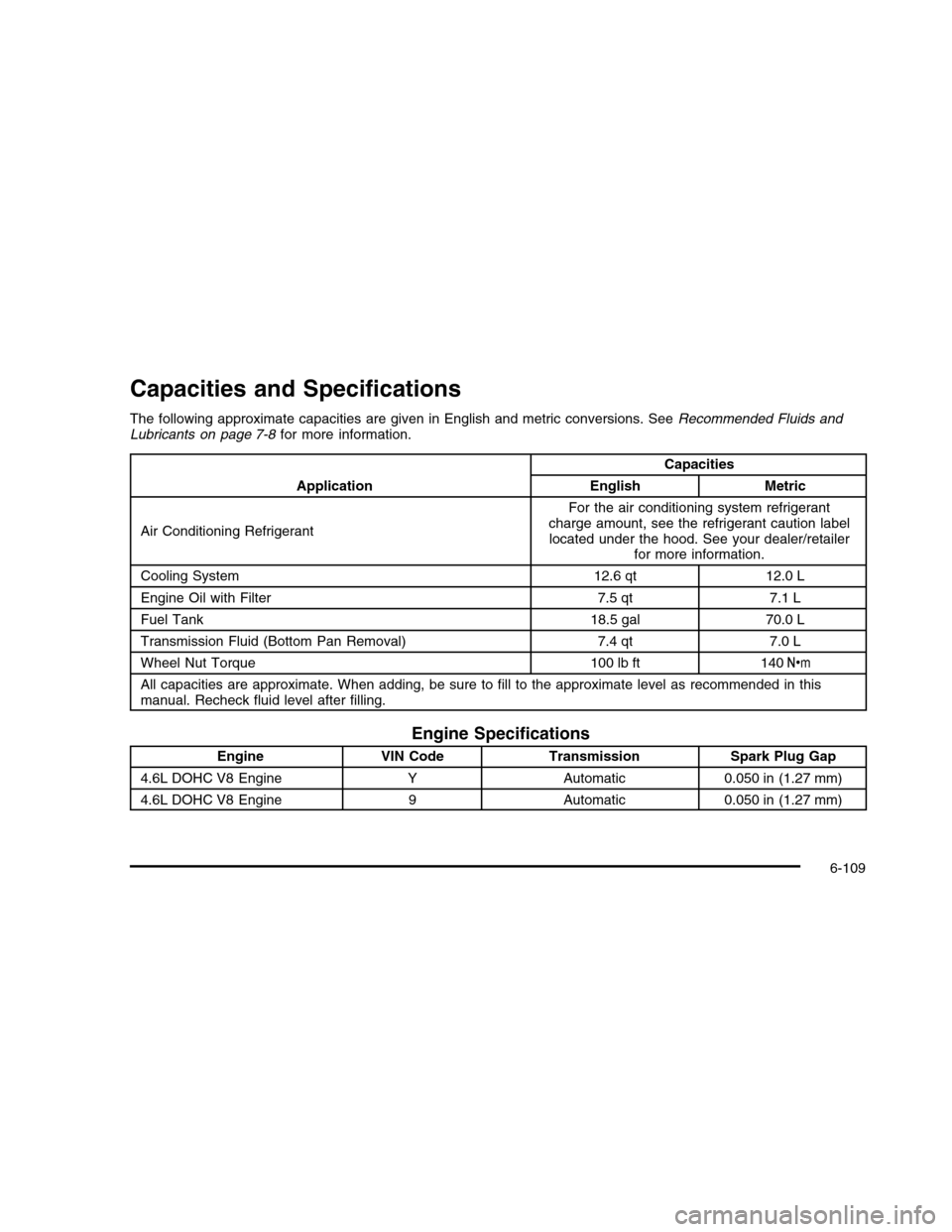
Capacities and Specifications
The following approximate capacities are given in English and metric conversions. SeeRecommended Fluids andLubricants on page 7-8for more information.
Application
Capacities
EnglishMetric
Air Conditioning Refrigerant
For the air conditioning system refrigerantcharge amount, see the refrigerant caution labellocated under the hood. See your dealer/retailerfor more information.
Cooling System12.6 qt12.0 L
Engine Oil with Filter7.5 qt7.1 L
Fuel Tank18.5 gal70.0 L
Transmission Fluid (Bottom Pan Removal)7.4 qt7.0 L
Wheel Nut Torque100 lb ft140Y
All capacities are approximate. When adding, be sure to fill to the approximate level as recommended in thismanual. Recheck fluid level after filling.
Engine Specifications
EngineVIN CodeTransmissionSpark Plug Gap
4.6L DOHC V8 EngineYAutomatic0.050 in (1.27 mm)
4.6L DOHC V8 Engine9Automatic0.050 in (1.27 mm)
6-109
Page 433 of 480

Rotation of New Tires
To maintain ride, handling, and performance of thevehicle, it is important that the first rotation service fornew tires be performed when they have 8 000 to13 000 km (5,000 to 8,000 miles). SeeTire Inspectionand Rotation on page 6-62.
Scheduled Maintenance
When the Change Engine Oil Soon
Message Displays
Change engine oil and filter. SeeEngine Oil onpage 6-13.An Emission Control Service.
When the Change Engine Oil Soon message displays,service is required for the vehicle as soon as possible,within the next 1 000 km/600 miles. If driving underthe best conditions, the engine oil life system might notindicate the need for vehicle service for more than ayear. The engine oil and filter must be changed at leastonce a year and the oil life system must be reset.Your dealer/retailer has trained service technicians whowill perform this work and reset the system.
If the engine oil life system is reset accidentally, servicethe vehicle within 5 000 km/3,000 miles since the lastservice. Reset the oil life system whenever the oilis changed. SeeEngine Oil Life System on page 6-16.
When the Change Engine Oil Soon message displays,certain services, checks, and inspections are required.
Every Engine Oil Change
•Change engine oil and filter. SeeEngine Oil on
page 6-13.An Emission Control Service.
•Engine coolant level check. SeeEngine Coolant on
page 6-23.
•Windshield washer fluid level check. SeeWindshield
Washer Fluid on page 6-31.
•Tire inflation check. SeeInflation - Tire Pressure on
page 6-54.
•Tire wear inspection. SeeTire Inspection and
Rotation on page 6-62.
•Rotate tires. SeeTire Inspection and Rotation on
page 6-62.
7-3
Page 434 of 480

•Fluids visual leak check (or every 12 months,
whichever occurs first). A leak in any system mustbe repaired and the fluid level checked.
•Engine air cleaner filter inspection. SeeEngine Air
Cleaner/Filter on page 6-17.
•Brake system inspection (or every 12 months,
whichever occurs first).
•Steering and suspension inspection. Visual
inspection for damaged, loose, or missing parts orsigns of wear.
•Engine cooling system inspection. Visual inspection
of hoses, pipes, fittings, and clamps andreplacement, if needed.
•Windshield wiper blade inspection for wear,
cracking, or contamination and windshield and wiperblade cleaning, if contaminated. SeeWindshieldand Wiper Blades on page 6-97. Worn or damagedwiper blade replacement. SeeWindshield WiperBlade Replacement on page 6-44.
•Body hinges and latches, key lock cylinders,
console hinges, and glove box door hingeslubrication. SeeRecommended Fluids andLubricants on page 7-8. More frequent lubricationmay be required when vehicle is exposed to acorrosive environment.
Applying silicone grease on weatherstrips with aclean cloth makes them last longer, seal better, andnot stick or squeak.
•Restraint system component check. SeeChecking
the Restraint Systems on page 2-74.
•Automatic transmission fluid level check and adding
fluid, if needed. SeeAutomatic Transmission Fluidon page 6-19.
Additional Required Services
At Each Fuel Stop
•Engine oil level check. SeeEngine Oil on
page 6-13.
•Engine coolant level check. SeeEngine Coolant on
page 6-23.
•Windshield washer fluid level check. SeeWindshield
Washer Fluid on page 6-31.
Once a Month
•Tire inflation check. SeeInflation - Tire Pressure on
page 6-54.
•Tire wear inspection. SeeTire Inspection and
Rotation on page 6-62.
7-4