airbag off CADILLAC DTS 2010 1.G Owners Manual
[x] Cancel search | Manufacturer: CADILLAC, Model Year: 2010, Model line: DTS, Model: CADILLAC DTS 2010 1.GPages: 480, PDF Size: 17.56 MB
Page 15 of 480

Safety Belt
Refer to the following sections for important informationon how to use safety belts properly.
•Safety Belts: They Are for Everyone on page 2-12.
•How to Wear Safety Belts Properly on page 2-17.
•Lap-Shoulder Belt on page 2-26.
•Lap Belt on page 2-32.
•Lower Anchors and Tethers for Children (LATCH)
on page 2-45.
Sensing System for Passenger
Airbag
The passenger sensing system will turn off the rightfront passenger frontal airbag and seat-mountedside impact airbag under certain conditions. The driverairbags and roof-rail airbags are not affected by this.
The passenger airbag status indicator will be visible onthe overhead console when the vehicle is started.
SeePassenger Sensing System on page 2-67forimportant information.
United StatesCanada
1-9
Page 60 of 480

Shoulder Belt Height Adjuster
The vehicle has a shoulder belt height adjuster for thedriver and right front passenger seating positions.
Adjust the height so that the shoulder portion of the beltis centered on the shoulder. The belt should be awayfrom the face and neck, but not falling off the shoulder.Improper shoulder belt height adjustment couldreduce the effectiveness of the safety belt in a crash.
Press the releasebutton (A) and move theheight adjuster to thedesired position. Theadjuster can be moved upby pushing up on theshoulder belt guide.
After the adjuster is set to the desired position, try tomove it down without pressing the release buttonto make sure it has locked into position.
Safety Belt Pretensioners
This vehicle has safety belt pretensioners for frontoutboard occupants. Although the safety beltpretensioners cannot be seen, they are part of thesafety belt assembly. They can help tighten the safetybelts during the early stages of a moderate to severefrontal or near frontal crash if the threshold conditions forpretensioner activation are met. And, if your vehiclehas side impact airbags, safety belt pretensioners canhelp tighten the safety belts in a side crash.
Pretensioners work only once. If the pretensionersactivate in a crash, they will need to be replaced, andprobably other new parts for the vehicle’s safetybelt system. SeeReplacing Restraint System PartsAfter a Crash on page 2-75.
Rear Safety Belt Comfort Guides
This vehicle may have rear shoulder belt comfort guidesfor each outside passenger position in the rear seat. Ifnot, they are available through your dealer/retailer. Theguides may provide added safety belt comfort for olderchildren who have outgrown booster seats and for someadults. When installed the comfort guide positions theshoulder belt away from the neck and head.
2-28
Page 69 of 480

Infants and Young Children
Everyone in a vehicle needs protection! This includesinfants and all other children. Neither the distancetraveled nor the age and size of the traveler changesthe need, for everyone, to use safety restraints. In fact,the law in every state in the United States and inevery Canadian province says children up to some agemust be restrained while in a vehicle.
{WARNING:
Children can be seriously injured or strangled if a
shoulder belt is wrapped around their neck and
the safety belt continues to tighten. Never leave
children unattended in a vehicle and never allow
children to play with the safety belts.
Airbags plus lap-shoulder belts offer protection for adultsand older children, but not for young children and infants.Neither the vehicle’s safety belt system nor its airbagsystem is designed for them. Every time infants andyoung children ride in vehicles, they should have theprotection provided by appropriate child restraints.
Children who are not restrained properly can strike otherpeople, or can be thrown out of the vehicle.
2-37
Page 76 of 480

Where to Put the Restraint
According to accident statistics, children and infants aresafer when properly restrained in a child restraintsystem or infant restraint system secured in a rearseating position.
We recommend that children and child restraints besecured in a rear seat, including: an infant or achild riding in a rear-facing child restraint; a child ridingin a forward-facing child seat; an older child riding ina booster seat; and children, who are large enough,using safety belts.
A label on your sun visor says, “Never put a rear-facingchild seat in the front.” This is because the risk to therear-facing child is so great, if the airbag deploys.
{WARNING:
A child in a rear-facing child restraint can be
seriously injured or killed if the right front passenger
airbag inflates. This is because the back of the
rear-facing child restraint would be very close to the
inflating airbag. A child in a forward-facing child
restraint can be seriously injured or killed if the right
front passenger airbag inflates and the passenger
seat is in a forward position.
Even if the passenger sensing system has turned
off the right front passenger frontal airbag, no
system is fail-safe. No one can guarantee that an
airbag will not deploy under some unusual
circumstance, even though it is turned off.
Secure rear-facing child restraints in a rear seat,
even if the airbag is off. If you secure a
forward-facing child restraint in the right front seat,
always move the front passenger seat as far back
as it will go. It is better to secure the child restraint in
a rear seat.
SeePassenger Sensing System on page 2-67for
additional information.
2-44
Page 86 of 480

Securing a Child Restraint in the
Right Front Seat Position
This vehicle has airbags. A rear seat is a safer place tosecure a forward-facing child restraint. SeeWhere toPut the Restraint on page 2-44.
In addition, the vehicle has a passenger sensing systemwhich is designed to turn off the right front passengerfrontal airbag and seat-mounted side impact airbagunder certain conditions. SeePassenger SensingSystem on page 2-67andPassenger Airbag StatusIndicator on page 4-51for more information, includingimportant safety information.
A label on the sun visor says, “Never put a rear-facingchild seat in the front.” This is because the risk tothe rear-facing child is so great, if the airbag deploys.
{WARNING:
A child in a rear-facing child restraint can be
seriously injured or killed if the right front passenger
airbag inflates. This is because the back of the
rear-facing child restraint would be very close to the
inflating airbag. A child in a forward-facing child
restraint can be seriously injured or killed if the right
front passenger airbag inflates and the passenger
seat is in a forward position.
Even if the passenger sensing system has turned
off the right front passenger frontal airbag, no
system is fail-safe. No one can guarantee that an
airbag will not deploy under some unusual
circumstance, even though it is turned off.
Secure rear-facing child restraints in a rear seat,
even if the airbag is off. If you secure a
forward-facing child restraint in the right front seat,
always move the front passenger seat as far back
as it will go. It is better to secure the child restraint in
a rear seat.
SeePassenger Sensing System on page 2-67for
additional information.
2-54
Page 87 of 480

If the child restraint has the LATCH system, seeLowerAnchors and Tethers for Children (LATCH) onpage 2-45for how and where to install the child restraintusing LATCH. If a child restraint is secured using asafety belt and it uses a top tether, seeLower Anchorsand Tethers for Children (LATCH) on page 2-45fortop tether anchor locations.
Do not secure a child seat in a position without a toptether anchor if a national or local law requires that thetop tether be anchored, or if the instructions thatcome with the child restraint say that the top strap mustbe anchored.
In Canada, the law requires that forward-facing childrestraints have a top tether, and that the tether beattached.
You will be using the lap-shoulder belt to secure thechild restraint in this position. Follow the instructions thatcame with the child restraint.
1. Move the seat as far back as it will go beforesecuring the forward-facing child restraint.
When the passenger sensing system has turned offthe right front passenger frontal airbag andseat-mounted side impact airbag, the off indicatoron the passenger airbag status indicator should lightand stay lit when you start the vehicle. SeePassenger Airbag Status Indicator on page 4-51.
2. Put the child restraint on the seat.
3. Pick up the latch plate, and run the lap and shoulderportions of the vehicle’s safety belt through oraround the restraint. The child restraint instructionswill show you how.
2-55
Page 89 of 480

6. To tighten the belt, push down on the child restraint,pull the shoulder portion of the belt to tighten thelap portion of the belt and feed the shoulderbelt back into the retractor. When installing aforward-facing child restraint, it may be helpful touse your knee to push down on the child restraint asyou tighten the belt.
7. Push and pull the child restraint in differentdirections to be sure it is secure.
If the airbags are off, the off indicator in the passengerairbag status indicator will come on and stay onwhen the vehicle is started.
If a child restraint has been installed and the onindicator is lit, see “If the On Indicator is Lit for aChild Restraint ” underPassenger Sensing System onpage 2-67for more information.
To remove the child restraint, unbuckle the vehiclesafety belt and let it return to the stowed position.
2-57
Page 92 of 480

{WARNING:
Children who are up against, or very close to, any
airbag when it inflates can be seriously injured or
killed. Airbags plus lap-shoulder belts offer
protection for adults and older children, but not for
young children and infants. Neither the vehicle’s
safety belt system nor its airbag system is designed
for them. Young children and infants need the
protection that a child restraint system can provide.
Always secure children properly in your vehicle.
To read how, seeOlder Children on page 2-33or
Infants and Young Children on page 2-37.
There is an airbagreadiness light on theinstrument panel, whichshows the airbag symbol.
The system checks the airbag electrical system formalfunctions. The light tells you if there is an electricalproblem. SeeAirbag Readiness Light on page 4-50for more information.
Where Are the Airbags?
The driver frontal airbag is in the middle of thesteering wheel.
2-60
Page 98 of 480

What Will You See After an Airbag
Inflates?
After the frontal airbags and seat-mounted side impactairbags inflate, they quickly deflate, so quickly thatsome people may not even realize an airbag inflated.Roof-rail airbags may still be at least partially inflated forsome time after they deploy. Some components ofthe airbag module may be hot for several minutes. Forlocation of the airbag modules, seeWhat Makes anAirbag Inflate? on page 2-65.
The parts of the airbag that come into contact with youmay be warm, but not too hot to touch. There maybe some smoke and dust coming from the vents in thedeflated airbags. Airbag inflation does not preventthe driver from seeing out of the windshield or beingable to steer the vehicle, nor does it prevent people fromleaving the vehicle.
{WARNING:
When an airbag inflates, there may be dust in the
air. This dust could cause breathing problems for
people with a history of asthma or other breathing
trouble. To avoid this, everyone in the vehicle
should get out as soon as it is safe to do so. If
you have breathing problems but cannot get out of
the vehicle after an airbag inflates, then get fresh
air by opening a window or a door. If you
experience breathing problems following an airbag
deployment, you should seek medical attention.
The vehicle has a feature that may automatically unlockthe doors, turn on the interior lamps and hazardwarning flashers, and shut off the fuel system after theairbags inflate. You can lock the doors, turn off theinterior lamps and hazard warning flashers by using thecontrols for those features.
2-66
Page 99 of 480
{WARNING:
A crash severe enough to inflate the airbags may
have also damaged important functions in the
vehicle, such as the fuel system, brake and
steering systems, etc. Even if the vehicle appears
to be drivable after a moderate crash, there may
be concealed damage that could make it difficult
to safely operate the vehicle.
Use caution if you should attempt to restart the
engine after a crash has occurred.
In many crashes severe enough to inflate the airbag,windshields are broken by vehicle deformation.Additional windshield breakage may also occur from theright front passenger airbag.
•Airbags are designed to inflate only once. After an
airbag inflates, you will need some new parts forthe airbag system. If you do not get them, the airbagsystem will not be there to help protect you inanother crash. A new system will include airbagmodules and possibly other parts. The servicemanual for your vehicle covers the need to replaceother parts.
•The vehicle has a crash sensing and diagnostic
module which records information after a crash.SeeVehicle Data Recording and Privacy onpage 8-18andEvent Data Recorders on page 8-19.
•Let only qualified technicians work on the airbag
systems. Improper service can mean that anairbag system will not work properly. See yourdealer/retailer for service.
Passenger Sensing System
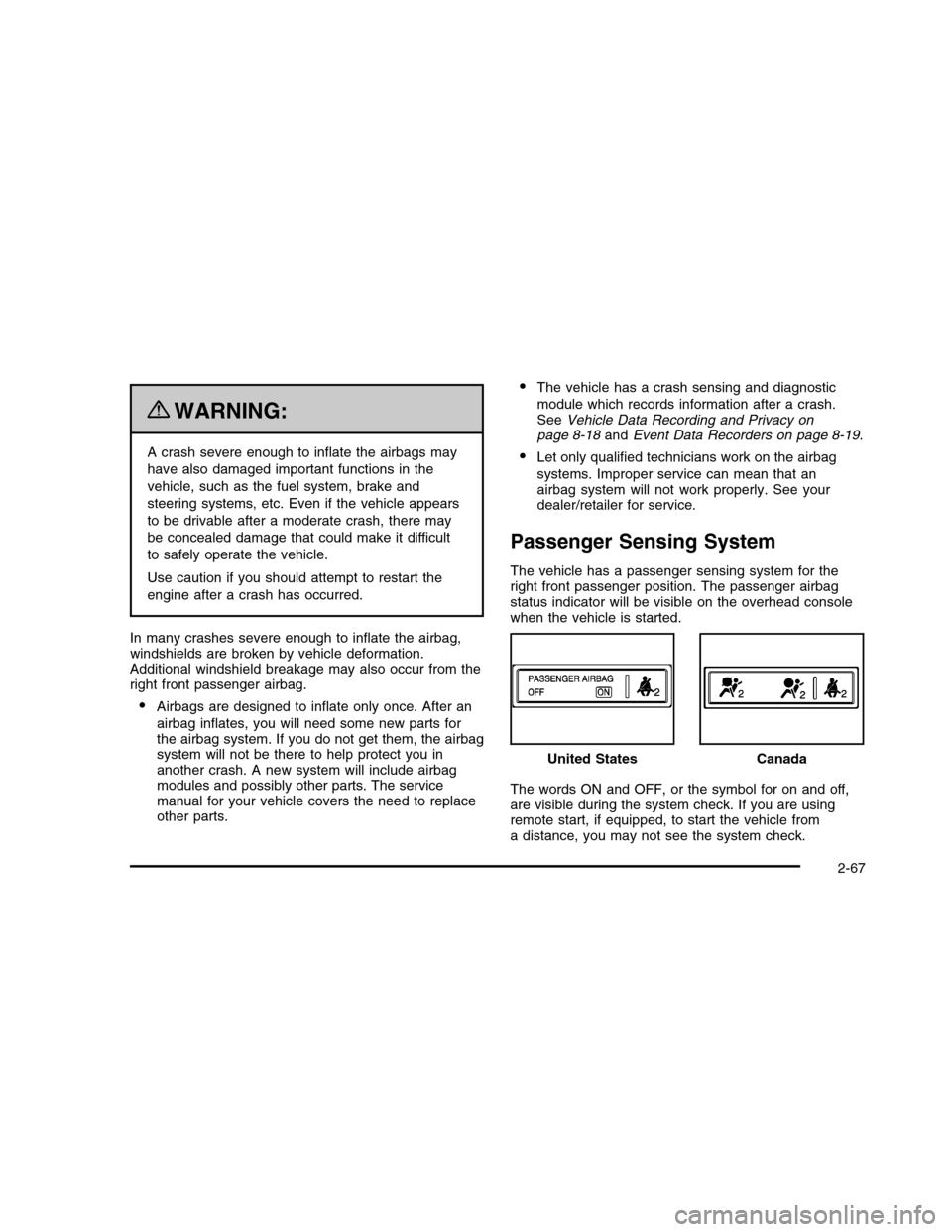
The vehicle has a passenger sensing system for theright front passenger position. The passenger airbagstatus indicator will be visible on the overhead consolewhen the vehicle is started.
The words ON and OFF, or the symbol for on and off,are visible during the system check. If you are usingremote start, if equipped, to start the vehicle froma distance, you may not see the system check.
United StatesCanada
2-67