check oil CADILLAC DTS 2011 1.G User Guide
[x] Cancel search | Manufacturer: CADILLAC, Model Year: 2011, Model line: DTS, Model: CADILLAC DTS 2011 1.GPages: 470, PDF Size: 4.72 MB
Page 326 of 470

Black plate (16,1)Cadillac DTS Owner Manual - 2011
Obtaining an accurate oil level reading is essential:1. If the engine has been running recently, turn off the engine and allow several minutes for the oil to
drain back into the oil pan. Checking your oil level
too soon after engine shut off will not provide an
accurate oil level reading.
2. Pull out the dipstick and clean it with a paper towel or cloth, then push it back in all the way. Remove it
again, keeping the tip down, and check the level.
When to Add Engine Oil
If the oil is below the cross-hatched area at the tip of
the dipstick, add one liter/quart of the recommended oil
and then recheck the level. See “Selecting the Right
Engine Oil” for an explanation of what kind of oil to use.
For engine oil crankcase capacity, see Capacities and
Specifications on page 6‑112. Notice:
Do not add too much oil. Oil levels above or
below the acceptable operating range shown on the
dipstick are harmful to the engine. If you find that
you have an oil level above the operating range,
i.e. the engine has so much oil that the oil level gets
above the cross-hatched area that shows the proper
operating range, the engine could be damaged. You
should drain out the excess oil or limit your driving
of the vehicle and seek a service professional to
remove the excess amount of oil.
See Engine Compartment Overview
on page 6‑14for
the location of the engine oil fill cap.
Add enough oil to put the level somewhere in the proper
operating range. Push the dipstick all the way back in
when through.
Selecting the Right Engine Oil
Selecting the right engine oil depends on both the
proper oil specification and viscosity grade:
Specification
Use and ask for engine oils with the dexos™
certification mark. Oils meeting the requirements
of your vehicle should have the dexos™ certification
mark on the container. This certification mark
indicates that the oil has been approved to the
dexos™ specification.
6-16
Page 328 of 470

Black plate (18,1)Cadillac DTS Owner Manual - 2011
When selecting an oil of the appropriate viscosity grade,
be sure to always select an oil that meets the required
specification, dexos™. See“Specification”for more
information.
Engine Oil Additives/Engine Oil Flushes
Do not add anything to the oil. The recommended oils
with the dexos™ specification and displaying the
dexos™ certification mark are all that is needed for
good performance and engine protection.
Engine oil system flushes are not recommended and
could cause engine damage not covered by the vehicle
warranty.
What to Do with Used Oil
Used engine oil contains certain elements that can be
unhealthy for your skin and could even cause cancer.
Do not let used oil stay on your skin for very long. Clean
your skin and nails with soap and water, or a good hand
cleaner. Wash or properly dispose of clothing or rags
containing used engine oil. See the manufacturer's
warnings about the use and disposal of oil products.
Used oil can be a threat to the environment. If you
change your own oil, be sure to drain all the oil from the
filter before disposal. Never dispose of oil by putting it
in the trash or pouring it on the ground, into sewers,
or into streams or bodies of water. Recycle it by taking it
to a place that collects used oil.
Engine Oil Life System
When to Change Engine Oil
This vehicle has a computer system that indicates when
to change the engine oil and filter. This is based on
engine revolutions and engine temperature, and not on
mileage. Based on driving conditions, the mileage at
which an oil change is indicated can vary considerably.
For the oil life system to work properly, the system must
be reset every time the oil is changed.
When the system has calculated that oil life has been
diminished, it indicates that an oil change is necessary.
A CHANGE ENGINE OIL SOON message in the Driver
Information Center (DIC) comes on. Change the oil as
soon as possible within the next 600 miles (1 000 km).
It is possible that, if driving under the best conditions,
the oil life system might indicate that an oil change is
not necessary for up to a year. The engine oil and filter
must be changed at least once a year and, at this time,
the system must be reset. Your dealer has trained
service people who will perform this work and reset the
system. It is also important to check the oil regularly
over the course of an oil drain interval and keep it at the
proper level.
If the system is ever reset accidentally, the oil must be
changed at 3,000 miles (5 000 km) since the last oil
change. Remember to reset the oil life system
whenever the oil is changed.
6-18
Page 331 of 470
Black plate (21,1)Cadillac DTS Owner Manual - 2011
Automatic Transmission Fluid
When to Check and Change Automatic
Transmission Fluid
A good time to check the automatic transmission fluid
level is when the engine oil is changed.
Change the fluid and filter at the intervals listed in
Scheduled Maintenance
on page 7‑3, and be sure to
use the transmission fluid listed in Recommended
Fluids and Lubricants on page 7‑9.
How to Check Automatic Transmission
Fluid
Because this operation can be a little difficult, you
may choose to have this done at the dealer service
department.
If you do it yourself, be sure to follow all the instructions
here or you could get a false reading on the dipstick. Notice:
Too much or too little fluid can damage the
transmission. Too much can mean that some of the
fluid could come out and fall on hot engine parts
or exhaust system parts, starting a fire. Too little
fluid could cause the transmission to overheat. Be
sure to get an accurate reading if checking the
transmission fluid.
Wait at least 30 minutes before checking the
transmission fluid level if you have been driving:
.When outside temperatures are above
32°C (90°F).
.At high speed for quite a while.
.In heavy traffic —especially in hot weather.
.While pulling a trailer.
To get the right reading, the fluid should be at normal
operating temperature, which is 82°C to 93°C
(180°F to 200°F).
Get the vehicle warmed up by driving about 24 km
(15 miles) when outside temperatures are above 10°C
(50°F). If it is colder than 10°C (50°F), you may have to
drive longer.
6-21
Page 336 of 470
Black plate (26,1)Cadillac DTS Owner Manual - 2011
Engine Coolant
The cooling system in the vehicle is filled with
DEX-COOL®engine coolant. This coolant is designed
to remain in the vehicle for five years or 150,000 miles
(240 000 km), whichever occurs first.
The following explains the cooling system and how to
check and add coolant when it is low. If there is a
problem with engine overheating, see Engine
Overheating on page 6‑29.
What to Use
{WARNING:
Adding only plain water or some other liquid to the
cooling system can be dangerous. Plain water
and other liquids, can boil before the proper
coolant mixture will. The vehicle's coolant warning
system is set for the proper coolant mixture. With
plain water or the wrong mixture, the engine could
get too hot but you would not get the overheat
warning. The engine could catch fire and you or
others could be burned. Use a 50/50 mixture of
clean, drinkable water and DEX-COOL coolant. Use a 50/50 mixture of clean, drinkable water and
DEX-COOL
®coolant. If using this mixture, nothing else
needs to be added. This mixture:
.Gives freezing protection down to −34°F (−37°C),
outside temperature.
.Gives boiling protection up to 265°F (129°C),
engine temperature.
.Protects against rust and corrosion.
.Will not damage aluminum parts.
.Helps keep the proper engine temperature.
Notice: If an improper coolant mixture is used, the
engine could overheat and be badly damaged. The
repair cost would not be covered by the vehicle
warranty. Too much water in the mixture can freeze
and crack the engine, radiator, heater core, and
other parts.
Notice: If extra inhibitors and/or additives are used
in the vehicle's cooling system, the vehicle could be
damaged. Use only the proper mixture of the engine
coolant listed in this manual for the cooling system.
See Recommended Fluids and Lubricants
on
page 7‑9for more information.
6-26
Page 337 of 470

Black plate (27,1)Cadillac DTS Owner Manual - 2011
Checking Coolant
The vehicle must be on a level surface when checking
the coolant level.
Check to see if coolant is visible in the coolant recovery
tank. If the coolant inside the coolant recovery tank is
boiling, do not do anything else until it cools down.
If coolant is visible but the coolant level is not at or
above the FULL COLD mark, add a 50/50 mixture of
clean, drinkable water and DEX-COOL
®coolant at the
coolant recovery tank, but be sure the cooling system is
cool before this is done. See Engine Coolant
on
page 6‑26for more information.
How to Add Coolant to the Surge Tank
{WARNING:
You can be burned if you spill coolant on hot
engine parts. Coolant contains ethylene glycol
and it will burn if the engine parts are hot enough.
Do not spill coolant on a hot engine.
Notice: This vehicle has a specific coolant fill
procedure. Failure to follow this procedure could
cause the engine to overheat and be severely
damaged.
{WARNING:
An electric engine cooling fan under the hood can
start up even when the engine is not running and
can cause injury. Keep hands, clothing, and tools
away from any underhood electric fan.
6-27
Page 404 of 470
Black plate (94,1)Cadillac DTS Owner Manual - 2011
Spare Tire
This vehicle may have a spare tire, which, when new,
was fully inflated. A spare tire may lose air over time, so
check its inflation pressure regularly. SeeInflation - Tire
Pressure
on page 6‑57and Loading the Vehicleon
page 5‑18for information regarding proper tire inflation
and loading your vehicle. For instructions on how to
remove, install or store a spare tire, see Removing the
Flat Tire and Installing the Spare Tire on page 6‑86.
After installing the spare tire on your vehicle, you should
stop as soon as possible and make sure the spare is
correctly inflated. Have the damaged or flat road tire
repaired or replaced as soon as you can and installed
back onto your vehicle. This way, a spare tire will be
available in case you need it again.
Your vehicle may have a different size spare tire than
the road tire originally installed on your vehicle. This
spare tire was developed for use on your vehicle, so it
is all right to drive on it.
If your vehicle has a spare tire that does not match your
vehicle's original road tires and wheels in size and type,
do not include the spare in the tire rotation.
Appearance Care
Interior Cleaning
The vehicle's interior will continue to look its best if it is
cleaned often. Although not always visible, dust and dirt
can accumulate on the upholstery. Dirt can damage
carpet, fabric, leather, and plastic surfaces. Regular
vacuuming is recommended to remove particles from
the upholstery. It is important to keep the upholstery
from becoming and remaining heavily soiled. Soils
should be removed as quickly as possible. The
vehicle's interior may experience extremes of heat
that could cause stains to set rapidly.
Lighter colored interiors may require more frequent
cleaning. Use care because newspapers and garments
that transfer color to home furnishings may also transfer
color to the vehicle's interior.
When cleaning the vehicle's interior, only use cleaners
specifically designed for the surfaces being cleaned.
Permanent damage may result from using cleaners
on surfaces for which they were not intended. Use
glass cleaner only on glass. Remove any accidental
over-spray from other surfaces immediately. To prevent
over-spray, apply cleaner directly to the cleaning cloth.
6-94
Page 422 of 470
Black plate (112,1)Cadillac DTS Owner Manual - 2011
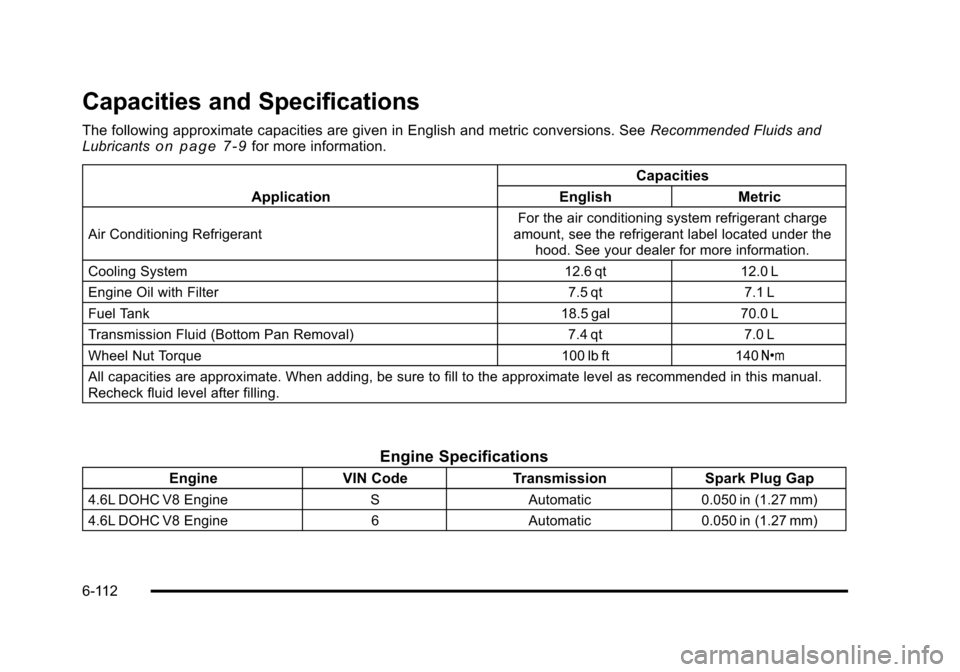
Capacities and Specifications
The following approximate capacities are given in English and metric conversions. SeeRecommended Fluids and
Lubricantson page 7‑9for more information.
Application Capacities
English Metric
Air Conditioning Refrigerant For the air conditioning system refrigerant charge
amount, see the refrigerant label located under the hood. See your dealer for more information.
Cooling System 12.6 qt12.0 L
Engine Oil with Filter 7.5 qt7.1 L
Fuel Tank 18.5 gal70.0 L
Transmission Fluid (Bottom Pan Removal) 7.4 qt7.0 L
Wheel Nut Torque 100 lb ft140Y
All capacities are approximate. When adding, be sure to fill to the approximate level as recommended in this manual.
Recheck fluid level after filling.
Engine Specifications
Engine VIN CodeTransmission Spark Plug Gap
4.6L DOHC V8 Engine SAutomatic 0.050 in (1.27 mm)
4.6L DOHC V8 Engine 6Automatic 0.050 in (1.27 mm)
6-112
Page 425 of 470

Black plate (3,1)Cadillac DTS Owner Manual - 2011
At your dealer, you can be certain that you will receive
the highest level of service available. Your dealer has
specially trained service technicians, uses genuine
replacement parts, as well as, up‐to‐date tools and
equipment to ensure fast and accurate diagnostics.
The proper replacement parts, fluids, and lubricants to
use are listed inRecommended Fluids and Lubricants
on page 7‑9andMaintenance Replacement Partson
page 7‑10. We recommend the use of genuine parts
from your dealer.
Rotation of New Tires
To maintain ride, handling, and performance of the
vehicle, it is important that the first rotation service for
new tires be performed. Tires should be rotated every
12 000 km/7,500 miles. See Tire Inspection and
Rotation on page 6‑65.
Scheduled Maintenance
When the Change Engine Oil Soon
Message Displays
Change engine oil and filter. See Engine Oilon
page 6‑15. An Emission Control Service.
When the CHANGE ENGINE OIL SOON message
displays, service is required for the vehicle as soon as
possible, within the next 1 000 km/600 miles. If driving
under the best conditions, the engine oil life system
might not indicate the need for vehicle service for more
than a year. The engine oil and filter must be changed
at least once a year and the oil life system must be
reset. Your dealer has trained service technicians who
will perform this work and reset the system. If the
engine oil life system is reset accidentally, service the
vehicle within 5 000 km/3,000 miles since the last
service. Reset the oil life system whenever the oil is
changed. See Engine Oil Life System on page 6‑18.
When the Change Engine Oil Soon message displays,
certain services, checks, and inspections are required.
7-3
Page 426 of 470

Black plate (4,1)Cadillac DTS Owner Manual - 2011
Every Engine Oil Change
.Change engine oil and filter. Reset oil life system.
SeeEngine Oilon page 6‑15andEngine Oil Life
Systemon page 6‑18. An Emission Control
Service.
.Engine coolant level check. See Engine Coolanton page 6‑26.
.Engine cooling system inspection. Visual
inspection of hoses, pipes, fittings, and clamps
and replacement, if needed.
.Windshield washer fluid level check. See
Windshield Washer Fluid on page 6‑32.
.Windshield wiper blade inspection for wear,
cracking, or contamination and windshield and
wiper blade cleaning, if contaminated. See
Windshield and Wiper Blades
on page 6‑99.
Worn or damaged wiper blade replacement. See
Windshield Wiper Blade Replacement
on
page 6‑46.
.Tire inflation pressures check. See Inflation - Tire
Pressure on page 6‑57.
.Tire wear inspection. See Tire Inspection and
Rotation on page 6‑65.
.Rotate tires if necessary. See Tire Inspection and
Rotation on page 6‑65.
.Fluids visual leak check (or every 12 months,
whichever occurs first). A leak in any system must
be repaired and the fluid level checked.
.Engine air cleaner filter inspection. See Engine Air
Cleaner/Filter on page 6‑19.
.Brake system inspection (or every 12 months,
whichever occurs first).
.Steering and suspension inspection. Visual
inspection for damaged, loose, or missing parts or
signs of wear.
.Body hinges and latches, key lock cylinders,
console hinges, and glove box door hinges
lubrication. See Recommended Fluids and
Lubricants
on page 7‑9. More frequent
lubrication may be required when the vehicle is
exposed to a corrosive environment. Applying
silicone grease on weatherstrips with a clean cloth
makes them last longer, seal better, and not stick
or squeak.
.Restraint system component check. See Checking
the Restraint Systems on page 2‑70.
.Fuel system inspection for damage or leaks.
.Exhaust system and nearby heat shields
inspection for loose or damaged components.
7-4
Page 427 of 470
Black plate (5,1)Cadillac DTS Owner Manual - 2011
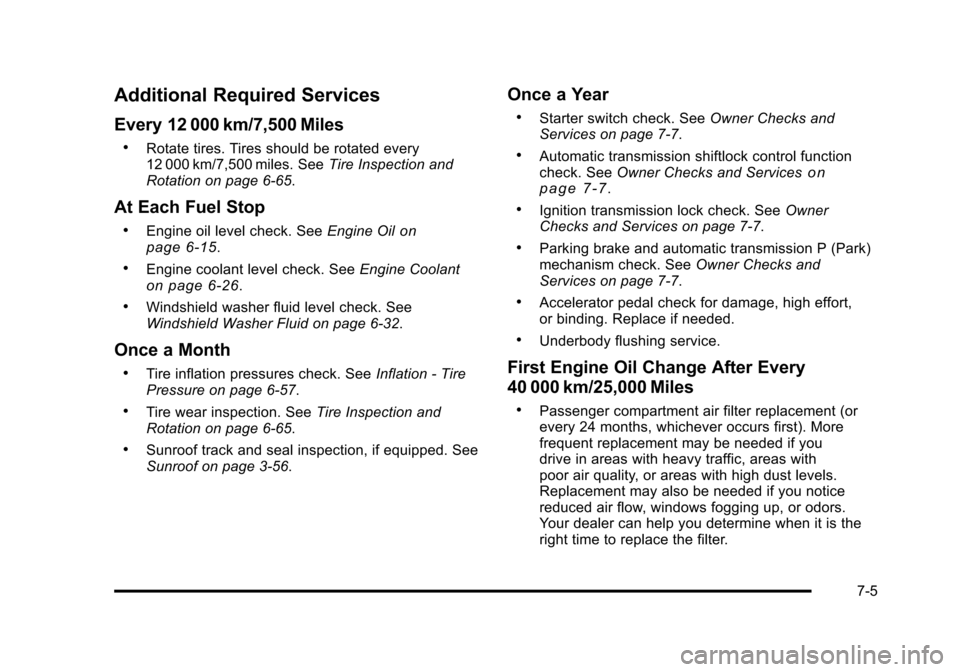
Additional Required Services
Every 12 000 km/7,500 Miles
.Rotate tires. Tires should be rotated every
12 000 km/7,500 miles. SeeTire Inspection and
Rotation on page 6‑65.
At Each Fuel Stop
.Engine oil level check. See Engine Oilon
page 6‑15.
.Engine coolant level check. See Engine Coolanton page 6‑26.
.Windshield washer fluid level check. See
Windshield Washer Fluid on page 6‑32.
Once a Month
.Tire inflation pressures check. See Inflation - Tire
Pressure on page 6‑57.
.Tire wear inspection. See Tire Inspection and
Rotation on page 6‑65.
.Sunroof track and seal inspection, if equipped. See
Sunroof on page 3‑56.
Once a Year
.Starter switch check. See Owner Checks and
Services on page 7‑7.
.Automatic transmission shiftlock control function
check. See Owner Checks and Serviceson
page 7‑7.
.Ignition transmission lock check. See Owner
Checks and Services on page 7‑7.
.Parking brake and automatic transmission P (Park)
mechanism check. See Owner Checks and
Services on page 7‑7.
.Accelerator pedal check for damage, high effort,
or binding. Replace if needed.
.Underbody flushing service.
First Engine Oil Change After Every
40 000 km/25,000 Miles
.Passenger compartment air filter replacement (or
every 24 months, whichever occurs first). More
frequent replacement may be needed if you
drive in areas with heavy traffic, areas with
poor air quality, or areas with high dust levels.
Replacement may also be needed if you notice
reduced air flow, windows fogging up, or odors.
Your dealer can help you determine when it is the
right time to replace the filter.
7-5