brake fluid CADILLAC DTS 2011 1.G Owners Manual
[x] Cancel search | Manufacturer: CADILLAC, Model Year: 2011, Model line: DTS, Model: CADILLAC DTS 2011 1.GPages: 470, PDF Size: 4.72 MB
Page 5 of 470
Black plate (5,1)Cadillac DTS Owner Manual - 2011
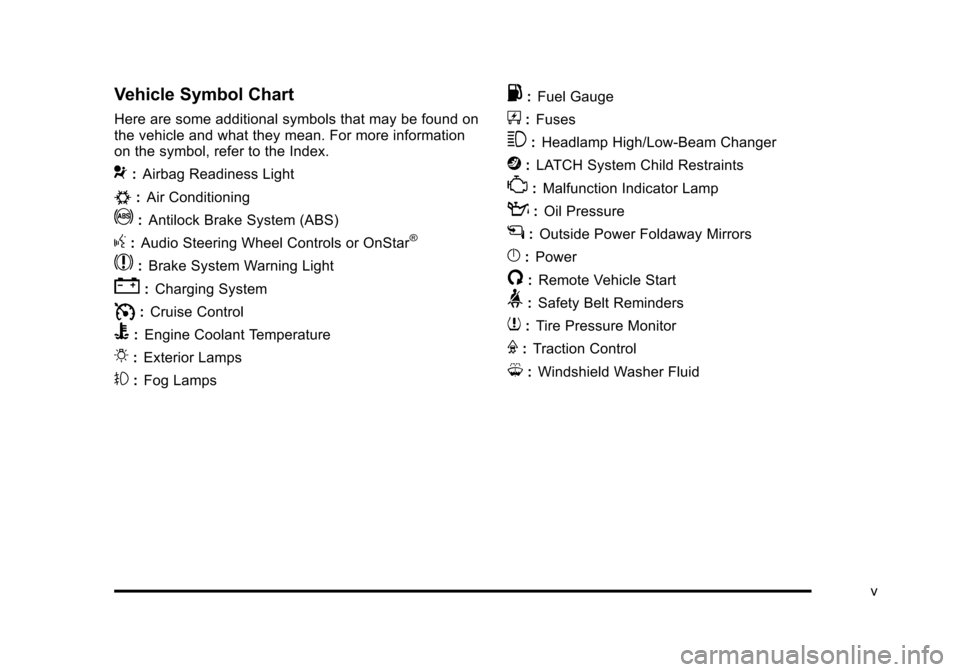
Vehicle Symbol Chart
Here are some additional symbols that may be found on
the vehicle and what they mean. For more information
on the symbol, refer to the Index.
9:Airbag Readiness Light
#:Air Conditioning
!:Antilock Brake System (ABS)
g:Audio Steering Wheel Controls or OnStar®
$: Brake System Warning Light
":Charging System
I:Cruise Control
B: Engine Coolant Temperature
O:Exterior Lamps
#:Fog Lamps
.: Fuel Gauge
+:Fuses
3: Headlamp High/Low-Beam Changer
j:LATCH System Child Restraints
*: Malfunction Indicator Lamp
::Oil Pressure
g:Outside Power Foldaway Mirrors
}:Power
/:Remote Vehicle Start
>:Safety Belt Reminders
7:Tire Pressure Monitor
F:Traction Control
M:Windshield Washer Fluid
v
Page 179 of 470
:Press to turn the system](/img/23/7895/w960_7895-178.png "CADILLAC DTS 2011 1.G Owners Manual Black plate (17,1)Cadillac DTS Owner Manual - 2011
The ACCs are located on the steering wheel.
The cruise control buttons are located on left side of the
steering wheel.
](On):Press to turn the system")
Black plate (17,1)Cadillac DTS Owner Manual - 2011
The ACCs are located on the steering wheel.
The cruise control buttons are located on left side of the
steering wheel.
](On):Press to turn the system on.
+ Res (Resume/Accelerate): Press to make the
vehicle resume to a previously set speed or to increase
the set speed when ACC is already active.
Set–: Press to set the speed or to decrease the set
speed when ACC is already active.
[(Cancel): Press to disengage ACC without erasing
the set speed from memory. +GAP (Increase Following Distance):
Press to
increase the distance between your vehicle and other
vehicles.
−GAP (Decrease Following Distance): Press to
decrease the distance between your vehicle and other
vehicles.
ACC will not work if the master cylinder brake fluid level
is low.
Engaging ACC With the Set Button
If the adaptive cruise control switch is on when not in
use, it could get bumped and go into cruise when not
desired. Keep the adaptive cruise control switch off
when cruise is not being used.
The set speed is selected by the driver. This is the
speed your vehicle will travel if there is no vehicle
detected in its path.
To set ACC, do the following:
1. Press the
]button.
2. Get up to the speed desired.
3. Press in the SET– button and release it.
4. Take your foot off the accelerator pedal.
Once ACC is set, it may immediately apply the brakes if
it detects a vehicle ahead is too close or moving slower
than your vehicle.
4-17
Page 234 of 470

Black plate (72,1)Cadillac DTS Owner Manual - 2011
SERVICE AIR BAG
This message displays when there is a problem with
the airbag system. Have your vehicle serviced by your
dealer immediately. SeeAirbag Readiness Light
on
page 4‑48for more information.
SERVICE A/C SYSTEM
This message displays when the air delivery mode door
or the electronic sensors that control the air conditioning
and heating systems are no longer working. Have the
climate control system serviced by your dealer if you
notice a drop in heating and air conditioning efficiency.
SERVICE BATTERY CHARGING
SYSTEM
This message displays when a problem with the
charging system has been detected. The charging
system light also displays on the instrument panel
cluster. See Charging System Light
on page 4‑49for
more information. Have your vehicle serviced by your
dealer.
SERVICE BRAKE ASSIST
This message displays if there is a problem with the
brake system. The brake system warning light and
the antilock brake system warning light may also be
displayed on the instrument panel cluster. See Brake
System Warning Light
on page 4‑50and Antilock
Brake System (ABS) Warning Lighton page 4‑51for
more information. If this happens, stop as soon as
possible and turn off the vehicle. Restart the vehicle
and check for the message on the DIC display. If the
message is displayed or appears again when you begin
driving, the brake system needs service. See your
dealer as soon as possible. See Brakes
on page 6‑33for more information.
SERVICE BRAKE SYSTEM
This message displays if the ignition is on to inform the
driver that the brake fluid level is low. Have the brake
system serviced by your dealer as soon as possible.
SERVICE LANE DEPARTURE SYSTEM
If your vehicle has the Lane Departure Warning (LDW)
system, this message may display to indicate that the
LDW system is not working properly. If this message
remains on after continued driving, the system needs
service. See your dealer. SeeLane Departure Warning
(LDW)
on page 3‑45for more information.
4-72
Page 292 of 470
Black plate (14,1)Cadillac DTS Owner Manual - 2011
Highway Hypnosis
Always be alert and pay attention to your surroundings
while driving. If you become tired or sleepy, find a safe
place to park your vehicle and rest.
Other driving tips include:
.Keep the vehicle well ventilated.
.Keep interior temperature cool.
.Keep your eyes moving—scan the road ahead
and to the sides.
.Check the rearview mirror and vehicle instruments
often.
Hill and Mountain Roads
Driving on steep hills or through mountains is different
than driving on flat or rolling terrain. Tips for driving in
these conditions include:
.Keep the vehicle serviced and in good shape.
.Check all fluid levels and brakes, tires, cooling
system, and transmission.
.Going down steep or long hills, shift to a
lower gear.
{WARNING:
If you do not shift down, the brakes could get so
hot that they would not work well. You would then
have poor braking or even none going down a hill.
You could crash. Shift down to let the engine
assist the brakes on a steep downhill slope.
{WARNING:
Coasting downhill in N (Neutral) or with the
ignition off is dangerous. The brakes will have to
do all the work of slowing down and they could
get so hot that they would not work well. You
would then have poor braking or even none going
down a hill. You could crash. Always have the
engine running and the vehicle in gear when
going downhill.
5-14
Page 310 of 470
Black plate (32,1)Cadillac DTS Owner Manual - 2011
3. When the wheel chocks are in place, release thebrake pedal until the chocks absorb the load.
4. Reapply the brake pedal. Then apply the parking brake and shift the transmission into P (Park).
5. Release the brake pedal.
Leaving After Parking on a Hill
1. Apply and hold the brake pedal while you:
.start the engine,
.shift into a gear, and
.release the parking brake.
2. Let up on the brake pedal.
3. Drive slowly until the trailer is clear of the chocks.
4. Stop and have someone pick up and store the chocks.
Maintenance When Trailer Towing
The vehicle needs service more often when pulling a
trailer. See Scheduled Maintenanceon page 7‑3for
more information. Things that are especially important
in trailer operation are automatic transmission fluid,
engine oil, belts, cooling system and brake system. It is
a good idea to inspect these before and during the trip.
Check periodically to see that all hitch nuts and bolts
are tight.
Engine Cooling When Trailer Towing
The cooling system may temporarily overheat during
severe operating conditions. See Engine Overheating
on page 6‑29.
Changing a Tire When Trailer Towing
If the vehicle gets a flat tire while towing a trailer, be
sure to secure the trailer and disconnect it from the
vehicle before changing the tire.
5-32
Page 311 of 470
Black plate (1,1)Cadillac DTS Owner Manual - 2011
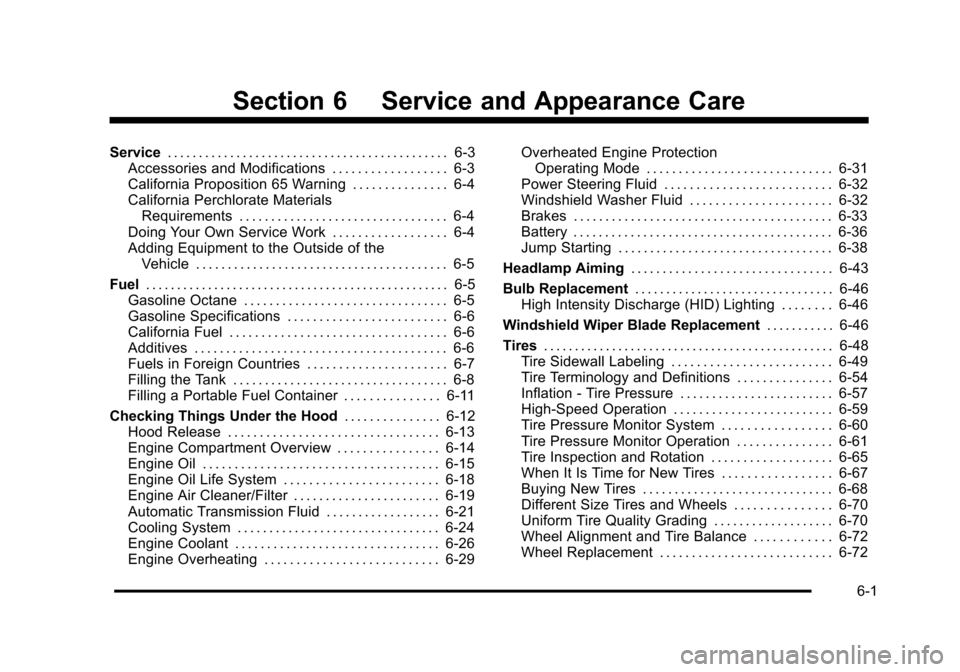
Section 6 Service and Appearance Care
Service. . . . . . . . . . . . . . . . . . . . . . . . . . . . . . . . . . . . . . . . . . . . . 6-3
Accessories and Modifications . . . . . . . . . . . . . . . . . . 6-3
California Proposition 65 Warning . . . . . . . . . . . . . . . 6-4
California Perchlorate Materials Requirements . . . . . . . . . . . . . . . . . . . . . . . . . . . . . . . . . 6-4
Doing Your Own Service Work . . . . . . . . . . . . . . . . . . 6-4
Adding Equipment to the Outside of the Vehicle . . . . . . . . . . . . . . . . . . . . . . . . . . . . . . . . . . . . . . . . 6-5
Fuel . . . . . . . . . . . . . . . . . . . . . . . . . . . . . . . . . . . . . . . . . . . . . . . . . 6-5
Gasoline Octane . . . . . . . . . . . . . . . . . . . . . . . . . . . . . . . . 6-5
Gasoline Specifications . . . . . . . . . . . . . . . . . . . . . . . . . 6-6
California Fuel . . . . . . . . . . . . . . . . . . . . . . . . . . . . . . . . . . 6-6
Additives . . . . . . . . . . . . . . . . . . . . . . . . . . . . . . . . . . . . . . . . 6-6
Fuels in Foreign Countries . . . . . . . . . . . . . . . . . . . . . . 6-7
Filling the Tank . . . . . . . . . . . . . . . . . . . . . . . . . . . . . . . . . . 6-8
Filling a Portable Fuel Container . . . . . . . . . . . . . . . 6-11
Checking Things Under the Hood . . . . . . . . . . . . . . .6-12
Hood Release . . . . . . . . . . . . . . . . . . . . . . . . . . . . . . . . . 6-13
Engine Compartment Overview . . . . . . . . . . . . . . . . 6-14
Engine Oil . . . . . . . . . . . . . . . . . . . . . . . . . . . . . . . . . . . . . 6-15
Engine Oil Life System . . . . . . . . . . . . . . . . . . . . . . . . 6-18
Engine Air Cleaner/Filter . . . . . . . . . . . . . . . . . . . . . . . 6-19
Automatic Transmission Fluid . . . . . . . . . . . . . . . . . . 6-21
Cooling System . . . . . . . . . . . . . . . . . . . . . . . . . . . . . . . . 6-24
Engine Coolant . . . . . . . . . . . . . . . . . . . . . . . . . . . . . . . . 6-26
Engine Overheating . . . . . . . . . . . . . . . . . . . . . . . . . . . 6-29 Overheated Engine Protection
Operating Mode . . . . . . . . . . . . . . . . . . . . . . . . . . . . . 6-31
Power Steering Fluid . . . . . . . . . . . . . . . . . . . . . . . . . . 6-32
Windshield Washer Fluid . . . . . . . . . . . . . . . . . . . . . . 6-32
Brakes . . . . . . . . . . . . . . . . . . . . . . . . . . . . . . . . . . . . . . . . . 6-33
Battery . . . . . . . . . . . . . . . . . . . . . . . . . . . . . . . . . . . . . . . . . 6-36
Jump Starting . . . . . . . . . . . . . . . . . . . . . . . . . . . . . . . . . . 6-38
Headlamp Aiming . . . . . . . . . . . . . . . . . . . . . . . . . . . . . . . . 6-43
Bulb Replacement . . . . . . . . . . . . . . . . . . . . . . . . . . . . . . . . 6-46
High Intensity Discharge (HID) Lighting . . . . . . . . 6-46
Windshield Wiper Blade Replacement . . . . . . . . . . .6-46
Tires . . . . . . . . . . . . . . . . . . . . . . . . . . . . . . . . . . . . . . . . . . . . . . . 6-48
Tire Sidewall Labeling . . . . . . . . . . . . . . . . . . . . . . . . . 6-49
Tire Terminology and Definitions . . . . . . . . . . . . . . . 6-54
Inflation - Tire Pressure . . . . . . . . . . . . . . . . . . . . . . . . 6-57
High-Speed Operation . . . . . . . . . . . . . . . . . . . . . . . . . 6-59
Tire Pressure Monitor System . . . . . . . . . . . . . . . . . 6-60
Tire Pressure Monitor Operation . . . . . . . . . . . . . . . 6-61
Tire Inspection and Rotation . . . . . . . . . . . . . . . . . . . 6-65
When It Is Time for New Tires . . . . . . . . . . . . . . . . . 6-67
Buying New Tires . . . . . . . . . . . . . . . . . . . . . . . . . . . . . . 6-68
Different Size Tires and Wheels . . . . . . . . . . . . . . . 6-70
Uniform Tire Quality Grading . . . . . . . . . . . . . . . . . . . 6-70
Wheel Alignment and Tire Balance . . . . . . . . . . . . 6-72
Wheel Replacement . . . . . . . . . . . . . . . . . . . . . . . . . . . 6-72
6-1
Page 322 of 470

Black plate (12,1)Cadillac DTS Owner Manual - 2011
Checking Things Under
the Hood
{WARNING:
An electric fan under the hood can start up and
injure you even when the engine is not running.
Keep hands, clothing, and tools away from any
underhood electric fan.
{WARNING:
Things that burn can get on hot engine parts and
start a fire. These include liquids like fuel, oil,
coolant, brake fluid, windshield washer and other
fluids, and plastic or rubber. You or others could
be burned. Be careful not to drop or spill things
that will burn onto a hot engine.
6-12
Page 325 of 470
Black plate (15,1)Cadillac DTS Owner Manual - 2011
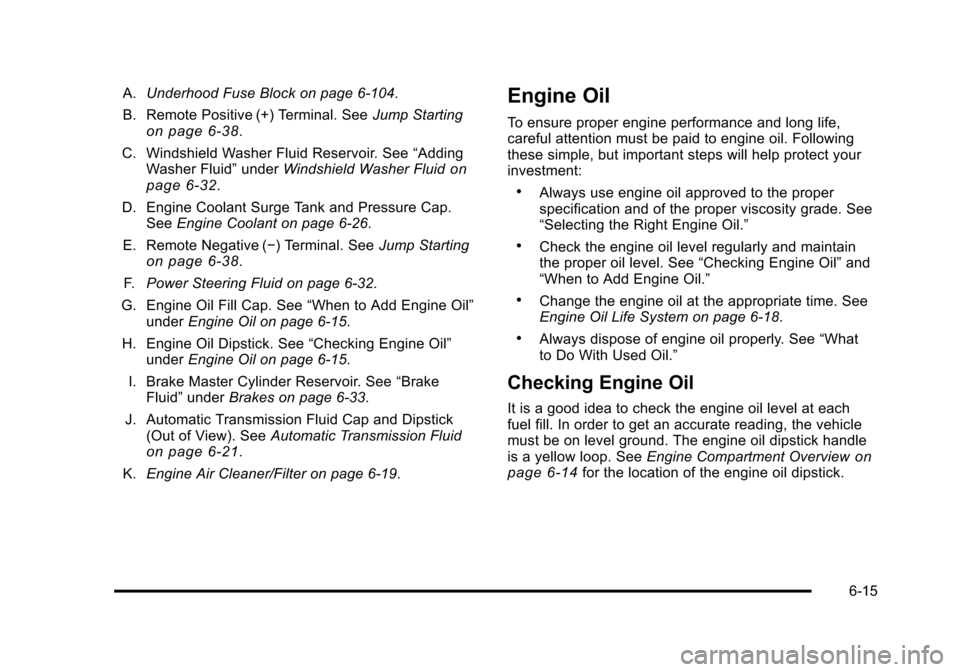
A.Underhood Fuse Block on page 6‑104.
B. Remote Positive (+) Terminal. See Jump Starting
on page 6‑38.
C. Windshield Washer Fluid Reservoir. See “Adding
Washer Fluid” underWindshield Washer Fluid
on
page 6‑32.
D. Engine Coolant Surge Tank and Pressure Cap. See Engine Coolant on page 6‑26.
E. Remote Negative (−) Terminal. See Jump Starting
on page 6‑38.
F. Power Steering Fluid on page 6‑32.
G. Engine Oil Fill Cap. See “When to Add Engine Oil”
under Engine Oil on page 6‑15.
H. Engine Oil Dipstick. See “Checking Engine Oil”
under Engine Oil on page 6‑15.
I. Brake Master Cylinder Reservoir. See “Brake
Fluid” under Brakes on page 6‑33.
J. Automatic Transmission Fluid Cap and Dipstick (Out of View). See Automatic Transmission Fluid
on page 6‑21.
K. Engine Air Cleaner/Filter on page 6‑19.
Engine Oil
To ensure proper engine performance and long life,
careful attention must be paid to engine oil. Following
these simple, but important steps will help protect your
investment:
.Always use engine oil approved to the proper
specification and of the proper viscosity grade. See
“Selecting the Right Engine Oil.”
.Check the engine oil level regularly and maintain
the proper oil level. See “Checking Engine Oil”and
“When to Add Engine Oil.”
.Change the engine oil at the appropriate time. See
Engine Oil Life System on page 6‑18.
.Always dispose of engine oil properly. See “What
to Do With Used Oil.”
Checking Engine Oil
It is a good idea to check the engine oil level at each
fuel fill. In order to get an accurate reading, the vehicle
must be on level ground. The engine oil dipstick handle
is a yellow loop. See Engine Compartment Overview
on
page 6‑14for the location of the engine oil dipstick.
6-15
Page 332 of 470

Black plate (22,1)Cadillac DTS Owner Manual - 2011
Checking the Fluid Level
Prepare the vehicle as follows:1. Park the vehicle on a level place. Keep the engine running.
2. With the parking brake applied, place the shift lever in P (Park).
3. With your foot on the brake pedal, move the shift lever through each gear range, pausing for about
three seconds in each range. Then, position the
shift lever in P (Park).
4. Let the engine run at idle for three to five minutes. Then, without shutting off the engine, follow these
steps:
1. Locate the transmission fluid cap which is located next to the radiator hose and below the engine air
cleaner/filter assembly on the driver side of the
vehicle. The cap is marked TRANS FLUID. See
Engine Compartment Overview
on page 6‑14for
more information on location.
2. After removing the engine air cleaner/filter assembly to reach the transmission fluid cap, turn
the cap counterclockwise to remove. Pull out the
dipstick and wipe it with a clean rag or paper towel.
3. Push it back in all the way, wait three seconds, and then pull it back out again.
6-22
Page 343 of 470
Black plate (33,1)Cadillac DTS Owner Manual - 2011
Adding Washer Fluid
The WASHER FLUID LOW ADD FLUID message will
be displayed on the Driver Information Center (DIC)
when the fluid is low. SeeDIC Warnings and Messages
on page 4‑65for more information.
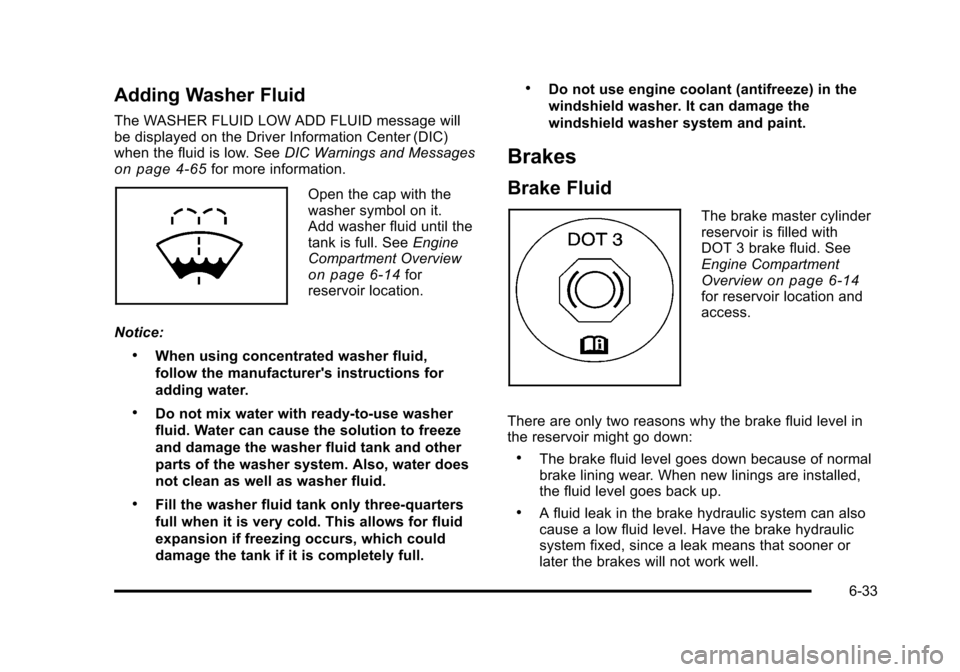
Open the cap with the
washer symbol on it.
Add washer fluid until the
tank is full. SeeEngine
Compartment Overview
on page 6‑14for
reservoir location.
Notice:
.When using concentrated washer fluid,
follow the manufacturer's instructions for
adding water.
.Do not mix water with ready-to-use washer
fluid. Water can cause the solution to freeze
and damage the washer fluid tank and other
parts of the washer system. Also, water does
not clean as well as washer fluid.
.Fill the washer fluid tank only three-quarters
full when it is very cold. This allows for fluid
expansion if freezing occurs, which could
damage the tank if it is completely full.
.Do not use engine coolant (antifreeze) in the
windshield washer. It can damage the
windshield washer system and paint.
Brakes
Brake Fluid
The brake master cylinder
reservoir is filled with
DOT 3 brake fluid. See
Engine Compartment
Overview
on page 6‑14for reservoir location and
access.
There are only two reasons why the brake fluid level in
the reservoir might go down:
.The brake fluid level goes down because of normal
brake lining wear. When new linings are installed,
the fluid level goes back up.
.A fluid leak in the brake hydraulic system can also
cause a low fluid level. Have the brake hydraulic
system fixed, since a leak means that sooner or
later the brakes will not work well.
6-33