tow CADILLAC ELDORADO 1993 10.G User Guide
[x] Cancel search | Manufacturer: CADILLAC, Model Year: 1993, Model line: ELDORADO, Model: CADILLAC ELDORADO 1993 10.GPages: 398, PDF Size: 20.66 MB
Page 102 of 398
Downloaded from www.Manualslib.com manuals search engine Console Shift Lever
1. Hold the brake pedal down with your right foot.
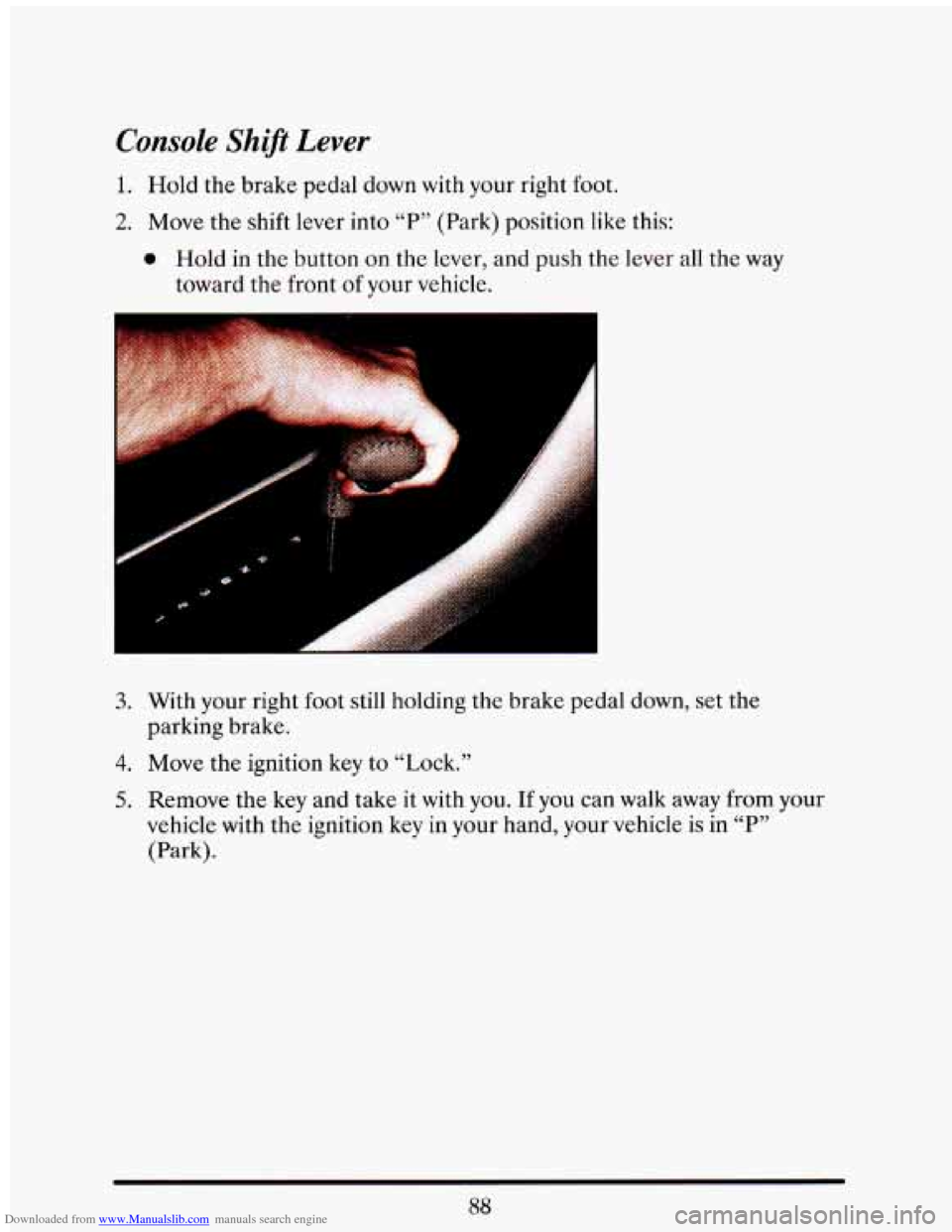
2. Move the shift lever into “P” (Park) position like this:
0 Hold in the button on the lever, and push the lever all the way
toward the front
of your vehicle.
3. With your right foot still holding the brake pedal down, set the
parking brake.
4. Move the ignition key to “Lock.”
5. Remove the key and take it with you. If you can walk away from your
vehicle with the ignition key
in your hand, your vehicle is in “P”
(Park).
88
Page 103 of 398
Downloaded from www.Manualslib.com manuals search engine Leaving Your Vehicle With the Engine Running
It can be dangerous to leave your vehicle with the engine ---.* . ’
running. Your vehicle could move suddenly if the shift lever is .- : :->=:I
not fully in “P” (Park) with the parking brake firmly set. And, i -
-”I leave the vehicle with the engine running, it could overheat
and even catch fire. You or others could be injured. Don’A
yo1 vehicle with the engine running unlc , you ha I
.-
. J .. .: . ?- -.. -. .. -
~ -- ~I
If you have to leave your vehicle with the engine running, be sure your
vehicle is
in “P7, (Park) and your parking brake is firmly set before you
leave
it. After you’ve moved the shift lever into the “P” (Park) position,
hold the regular brake pedal down. Then, see if you can move the shift
lever away from “P” (Park) without first pulling
it toward you (or, if you
have the console shift lever, without first pushing the button). If you can,
it means that the shift lever wasn’t
fully locked into “P7, (Park).
SHIFTING OUT OF “P” (PARK)
Your Cadillac has a brake-transaxle shift interlock. You have to fully
apply your regular brake before you can shift from
“P7’ (Park) when the
ignition is
in the “Run” position. See “Automatic Transaxle” in the Index.
If you cannot shift
out of “P” (Park), ease pressure on the shift lever --
push the shift lever all the way into “P” (Park) and also release the shift
lever button
on floor shift console models as you maintain brake
application. Then move
the shift lever into the gear you wish. (Press the
shift lever button before moving the shift lever.)
If you ever hold the
brake pedal down but still can’t shift out of “P” (Park), try this:
1. Turn the key to “Off.” Open and close the driver’s door to turn off the
2. Apply and hold the brake until the end of Step 4.
3. Shift to “N” (Neutral).
Retained
Accessory Power feature.
4. Start the vehicle and then shift to the drive gear you want.
5. Have the vehicle fixed as soon as you can.
Page 111 of 398
Downloaded from www.Manualslib.com manuals search engine As you signal a turn or a lane change, if the arrows don’t flash but just
stay on, a signal bulb may be burned out and other drivers won’t see your
turn signal.
If a bulb is burned out, replace it to help avoid an accident. If the green
arrows
don’t go on at ail when you signal a turn, check the fuse (see
“Fuses” in the Index) and for burned-out bulbs.
Headlight High-Low Beam
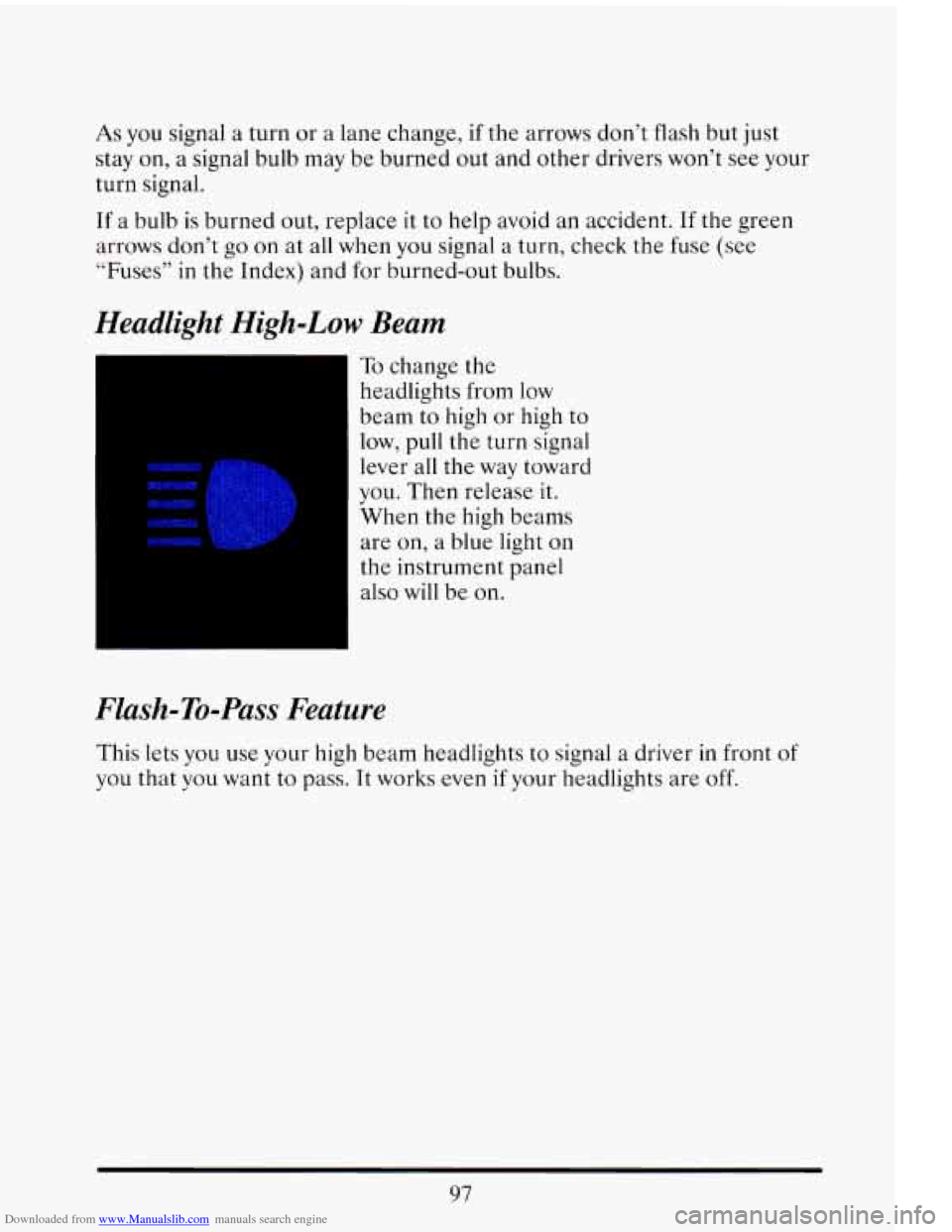
To change the
headlights from low
beam to high or high to
low, pull the turn signal
lever all the way toward
you. Then release it.
When the high beams
are on, a blue light on
the instrument panel
also will be
on.
Flash-To-Pass Feature
This lets you use your high beam headlights to signal a driver in front of
you that you want to pass. It works even if your headlights are off.
97
Page 112 of 398
Downloaded from www.Manualslib.com manuals search engine To use it, pull the multifunction lever toward you. When you do:
If your headlights are off Your high beam headlights will turn on. They’ll
stay
on as long as you hold the lever there. Release the lever to turn them
off.
If your headlights are on. but on low beam: The system works normally.
Just pull the lever. Your headlights
will shift to high beam and stay there.
To return to low beam, just pull the lever toward you.
If your headlights are on. and on high beam: Your headlights will switch
to low beam.
To get back to high beam, pull the lever toward you.
Windshield Wipers
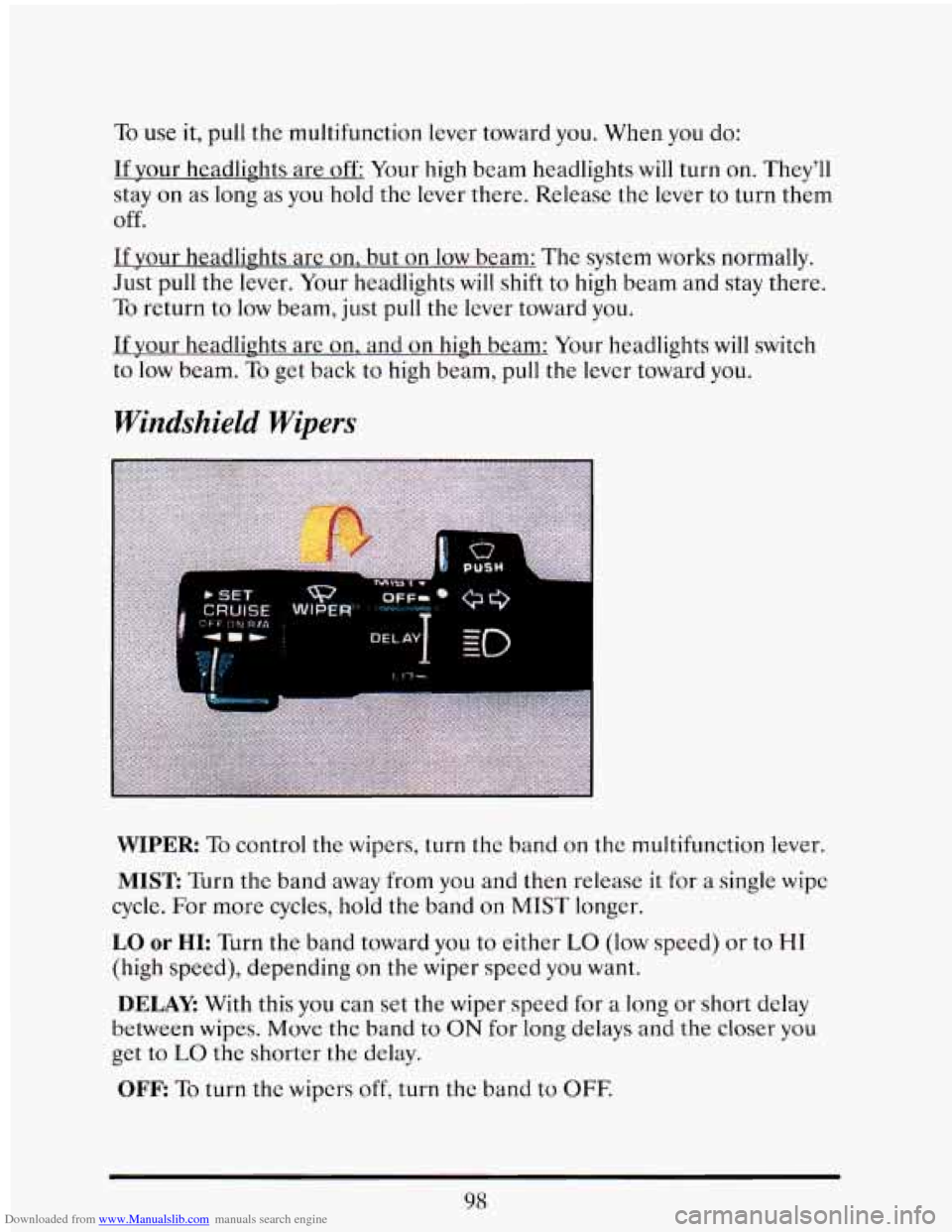
WIPER To control the wipers, turn the band on the multifunction lever.
MIST: Turn the band away from you and then release it for a single wipe
cycle. For more cycles, hold the band
on MIST longer.
LO or HI: Turn the band toward you to either LO (low speed) or to HI
(high speed), depending on the wiper speed you want.
DELAY: With this you can set the wiper speed for a long or short delay
between wipes. Move the band to ON for long delays and the closer you
get to LO the shorter the delay.
OFF: To turn the wipers off, turn the band to OFF.
98
Page 138 of 398
Downloaded from www.Manualslib.com manuals search engine some warning lights come on briefly when you turn the ignition key just to
let you know they’re working.
If you are familiar with this section, you
should not be alarmed when this happens.
When one
of the warning lights comes on and stays on when you are
driving, check the section that tells you what to do about it. Please follow
the manual’s advice. Waiting to do repairs can be costly
-- and even
dangerous.
So please get to know your warning lights. They’re a big help.
Your vehicle may
also have a driver information system that works along
with the warning lights. See “Driver Information System” in the Index.
Brake System Warning Light
Your Cadillac hydraulic brake system is divided into two parts. If one part
isn’t working, the other part can still work and stop you. For good
braking, though, you need both parts working
well.
If the warning light goes on, there could be a brake problem. Have your
brake system inspected right away.
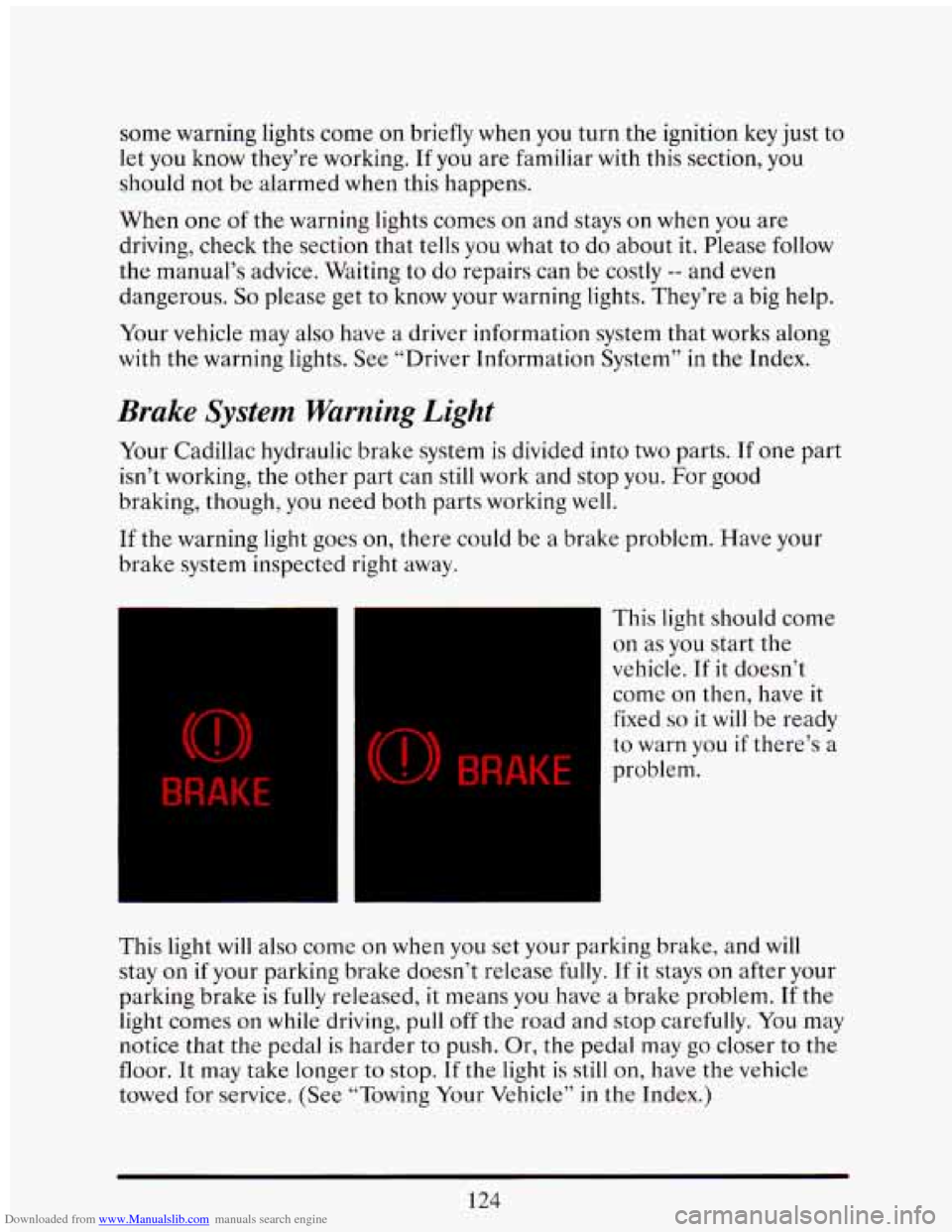
BRAKE
(0) BRAKE
This light should come
on as you start the
vehicle. If it doesn’t
come
on then, have it
fixed
so it will be ready
to warn you if there’s a
problem.
This light will also come
on when you set your parking brake, and will
stay
on if your parking brake doesn’t release fully. If it stays on after your
parking brake
is fully released, it means you have a brake problem. If the
light comes
on while driving, pull off the road and stop carefully. You may
notice that the pedal is harder
to push. Or, the pedal may go closer to the
floor. It may take longer to stop.
If the light is still on, have the vehicle
towed for service. (See “Towing Your Vehicle” in
the Index.)
124
Page 139 of 398
Downloaded from www.Manualslib.com manuals search engine I
A CAUTION:
Your brake system may not be working properly if the brake
warning light is
on. Driving with the brake warning light on can
lead to an accident. If the light is still
on after you've pulled off
service. e road and
stopped carefully, have the vehicle towed for
I
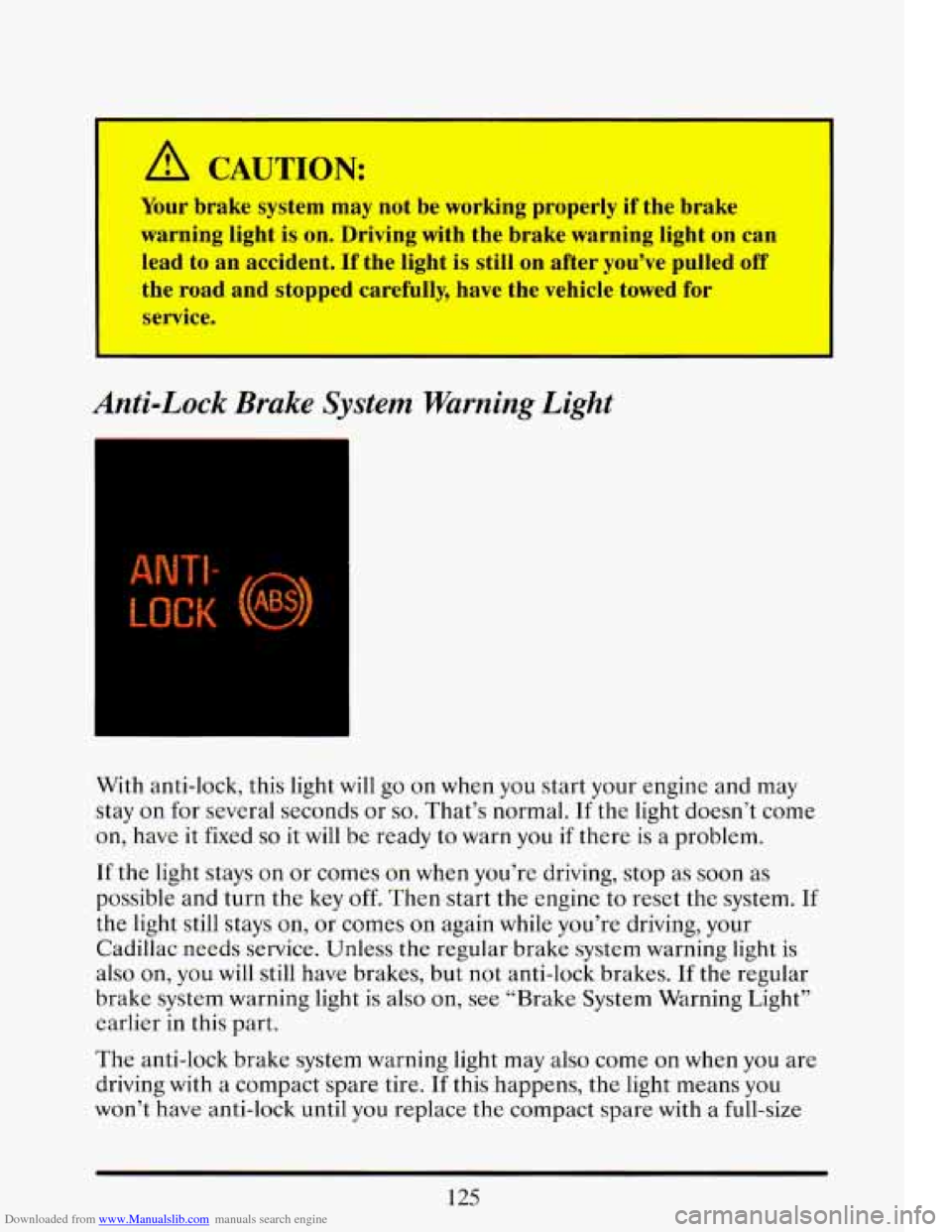
Anti-Lock Brake System Warning Light
=
With anti-lock, this light will go on when you start your engine and may
stay
on for several seconds or so. That's normal. If the light doesn't come
on, have it fixed
so it will be ready to warn you if there is a problem.
If the light stays on or comes on when you're driving, stop as soon
as
possible and turn the key off. Then start the engine to reset the system. If
the light still stays on, or comes on again while you're driving, your
Cadillac needs service. -Unless the regular brake system warning light is
also on,
you will still have brakes, but not anti-lock brakes. If the regular
brake system warning light is also on, see "Brake System Warning Light"
earlier in this part.
The anti-lock brake system warning light may also come
on when you are
driving with a compact spare tire.
If this happens, the light means you
won't have anti-lock until you replace the compact spare with a full-size
125
Page 186 of 398
Downloaded from www.Manualslib.com manuals search engine TRAFFIC OFFICER
The traffic police officer is also a source of important information. The
officer’s signals govern, no matter what the traffic lights
or other signs
say.
The next section discusses some
of the road conditions you may
encounter.
DEFENSIVE DMNG
The best advice anyone can give about driving is: Drive defensively.
Please start with a
very important safety device in your Cadillac: Buckle
up. (See “Safety Belts” in the Index.)
Defensive driving really means “be ready for anything.” On city streets,
rural roads, or freeways, it means “always expect the unexpected.”
Assume that pedestrians or other drivers are going to be careless and
make mistakes. Anticipate what they might do. Be ready for their
mistakes.
Expect children to dash out from behind parked cars, often followed by
other children. Expect occupants in parked cars to open doors into traffic.
Watch for movement in parked cars
-- someone may be about to open a
door.
Expect other drivers to run stop signs when you are
on a through street.
Be ready to brake if necessary as
you go through intersections. You may
not have to use the brake, but if
you do, you will be ready.
If you’re driving through a shopping center parking lot where there are
well-marked lanes, directional arrows, and designated parking are\
as,
expect some drivers to ignore all these markings and dash straight toward
one part
of the lot.
Pedestrians can be careless. Watch for them. In general, you must give
way
to pedestrians even if you know you have the right of way.
Rear-end collisions are about the most preventable of accidents. Yet they
are common. Allow enough following distance. It’s the best defensive
driving maneuver,
in both city and rural driving. You never know wh.en
the vehicle in front
of you is going to brake or turn suddenly.
172
Page 212 of 398
Downloaded from www.Manualslib.com manuals search engine Switch on your turn signal, check your rearview mirrors as you move
along, and glance over your shoulder as often as necessary.
Try to blend
smoothly with the traffic flow.
Driving on the Freeway
Once you are on the freeway, adjust your speed to the posted limit or to
the prevailing rate
if it’s slower. Stay in the right lane unless you want to
pass.
If you are on a two-lane freeway, treat the right lane as the slow lane
and the left lane as the passing lane.
If you are on
a three-lane freeway, treat the right lane as the slower-speed
through lane, the middle lane as the higher-speed through lane,\
and the left lane as the passing lane.
Before changing lanes, check your rearview mirrors. Then use your turn
signal.
Just before you leave the lane, glance quicklyover your shoulder to make
sure there isn’t another vehicle in your “blind” spot.
If you are moving from an outside to a center lane on a freeway having
more than two lanes, make sure another vehicle isn’t about to move into
the same spot. Look at the vehicles two lanes over and watch for telltale
signs: turn signals flashing, an increase
in speed, or moving toward the
edge
of the lane. Be prepared to delay your move.
Once you are moving on the freeway, make certain you allow
a
reasonable following distance. Expect to move slightly slower at night.
Leaving the Freeway
When you want to leave the freeway, move to the proper lane well in
advance. Dashing across lanes at the last minute
is dangerous. If you miss
your exit do not, under any circumstances, stop and back up. Drive on to
the next
exit.
At each exit point is a deceleration lane. Ideally it should be long enough
for you to enter it at freeway speed (after signaling,
of course) and then
do your braking before moving onto the exit ramp. Unfortunately, not all
deceleration lanes
are long enough -- some are too short for all the
braking. Decide when to start braking.
If you must brake on the through
lane, and if there is traffic close behind you, you can allow a little extra
Page 216 of 398
Downloaded from www.Manualslib.com manuals search engine If you drive regularly in steep country, or if you’re planning to visit there,
here are some tips that can
make your trips safer and more enjoyable.
0 Keep your vehicle in good shape. Check all fluid levels and also the
brakes, tires, cooling system and transaxle. These parts can work hard
on mountain roads.
Know how to go down hills. The most important thing to know is this:
let your engine do some
of the slowing down. Don’t make your brakes
do it all. Shift to a lower gear when you go down a steep or long hill.
That way, you
will slow down without excessive use of your brakes.
<
A CAUTION: .r S<*.
If you don’t shift down, your brakes could get so hot that they ’+--*
wouldn’t work well. You would then have poor braking or even
none going down
a hill. You could crash. Shift down to let your
engine assist your brakes on
a stef downhil’ lope.
- - i. .*$
Coasting downhill in “N” (Neutral) or with the ignition off is
dangerous. Your brakes will have to do all the work of slowing
down. They could get
so hot that they wouldn’t work well. You
could crash. Always have your engine running and your vehicle
in gear when you
go downhill.
0 Know how to go uphill. You may want to shift down to a lower gear.
The lower gears help cool your engine and transaxle, and you can
climb the hill better.
Stay in your own lane when driving on two-lane roads in hills or
mountains. Don’t swing wide or cut across the center
of the road.
Drive at speeds that let you stay
in your own lane. That way, you won’t
be surprised by a vehicle coming toward
you in the same lane.
202
Page 225 of 398
Downloaded from www.Manualslib.com manuals search engine TOWING A TMLER
’ A CAUTION:
If you don’t use the correct equipment and drive properly, you
can lose control when you pull
a trailer. For example, if the
trailer is too heavy, the brakes may not work well
-- or even at
all. You and your passengers could be seriously injured. Pull a
trailer onp7 ;€you have followed all the step? in this section.
NOTJCE
Fulling
I
in costly repairs not covered by your wan lty. To pull a trailer
correctly, follow the advice
in this secti I.
Load-pulling components such as the engine, transaxle, wheel assemblies,
and tires are forced to
work harder against the drag of the added weight.
The engine is required
to operate at relatively higher speeds and under
greater loads, generating extra heat. What’s more, the traile\
r adds
considerably to wind resistance, increasing the pulling requirements.
All of that means changes in:
0 Handling
0 Durability
Fuel economy
If You Do Decide To Pull A Trailer
If you do, here are some important points.
There are many different laws having to do with trailering. Make sure
your rig will be legal,
not only where you live but also where you’ll be
driving.
A good source for this information can be state or provincial
police.
21 1