tires CADILLAC ELDORADO 1993 10.G Owner's Manual
[x] Cancel search | Manufacturer: CADILLAC, Model Year: 1993, Model line: ELDORADO, Model: CADILLAC ELDORADO 1993 10.GPages: 398, PDF Size: 20.66 MB
Page 242 of 398
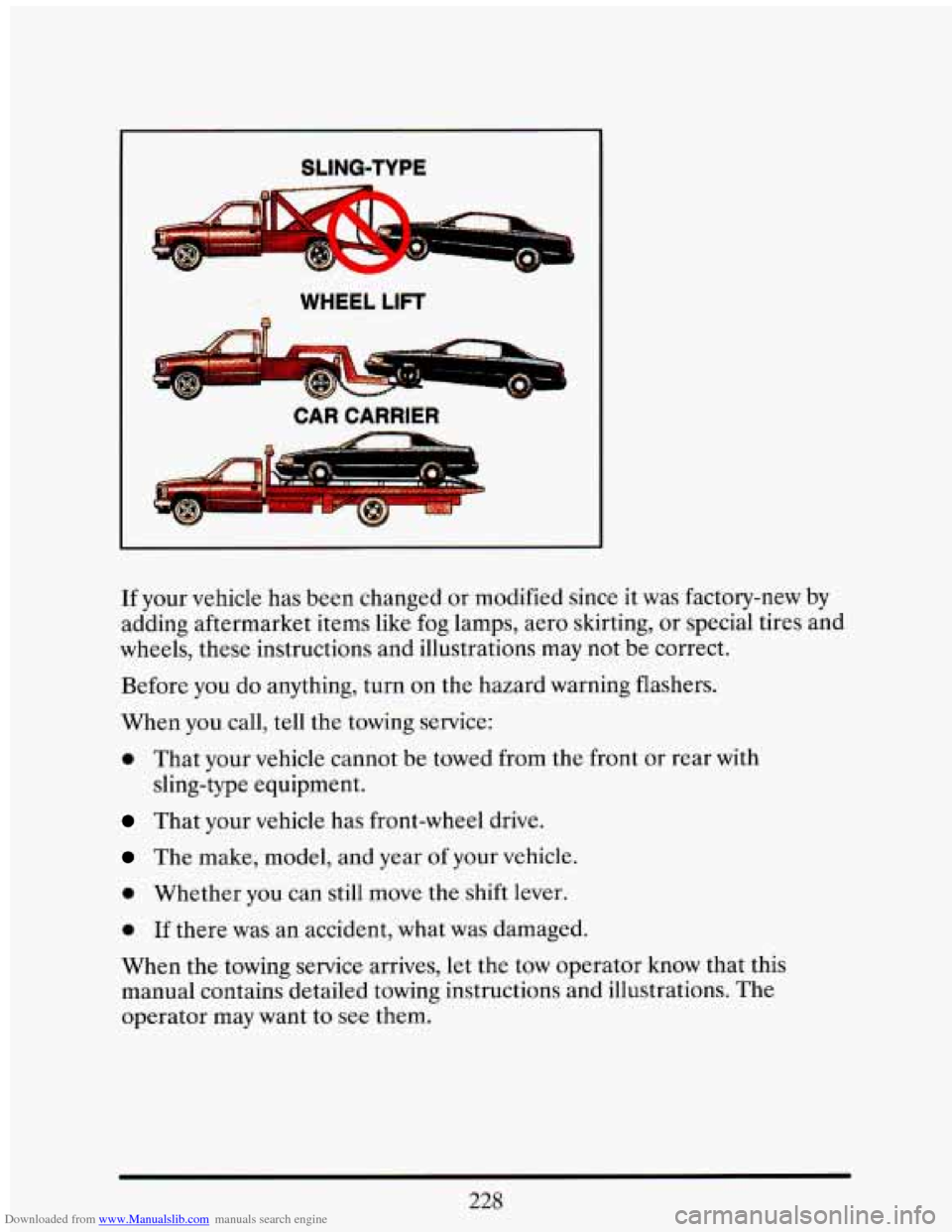
Downloaded from www.Manualslib.com manuals search engine I SLING-TYPE
WHEEL LIFT
If your vehicle has been changed or modified since it was factory-new by
adding aftermarket items like fog lamps, aero skirting, or spec\
ial tires and
wheels, these instructions and illustrations may not be correct.
Before
you do anything, turn on the hazard warning flashers.
When
you call, tell the towing service:
0 That your vehicle cannot be towed from the front or rear with
That your vehicle has front-wheel drive.
The make, model, and year of your vehicle.
0 Whether you can still move the shift lever.
sling-type equipment,
0 If there
was an accident, what was damaged.
When the towing service arrives, let the
tow operator know that this
manual contains detailed towing instructions and illustrations. The
operator may want
to see them.
228
Page 260 of 398
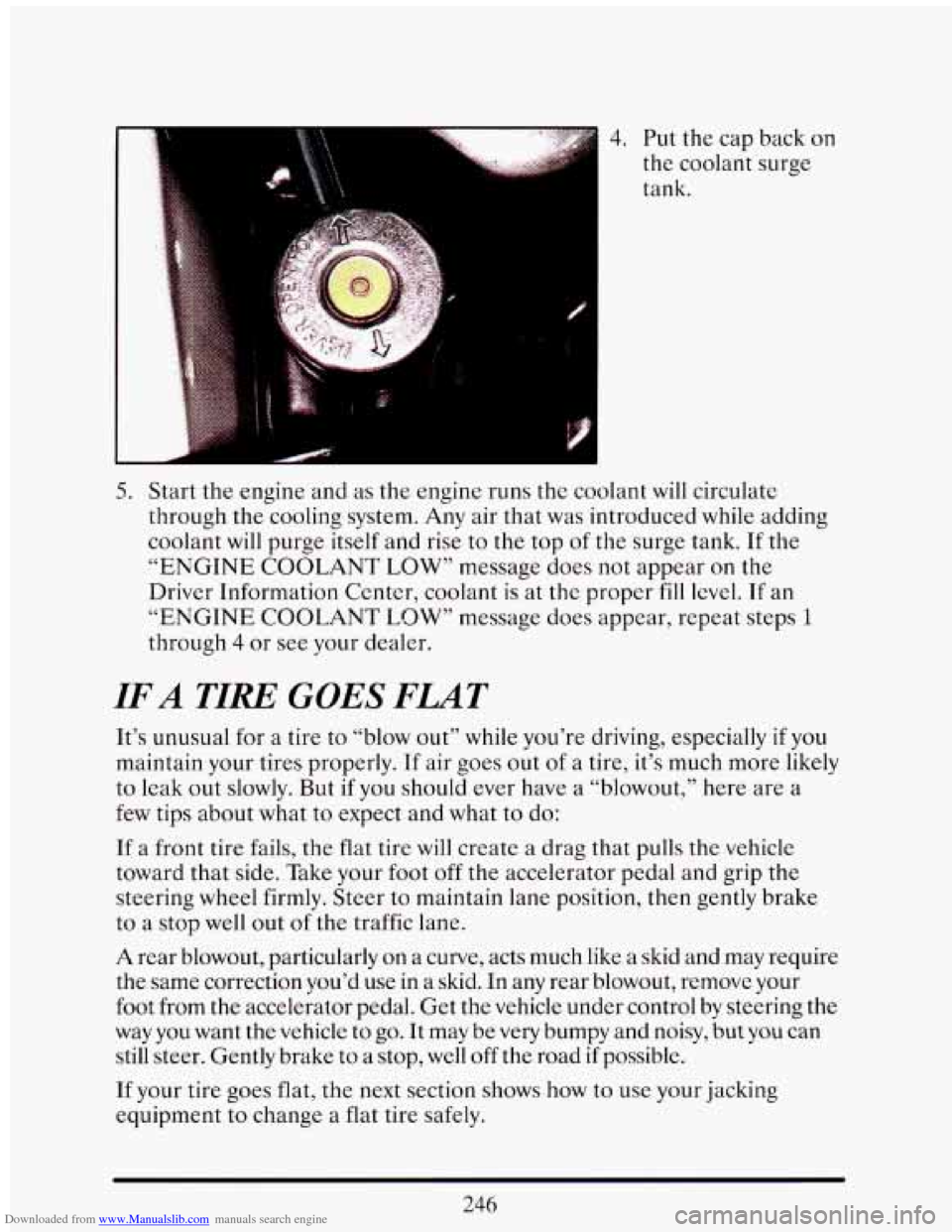
Downloaded from www.Manualslib.com manuals search engine 4. Put the cap back on
the coolant surge
tank.
5. Start the engine and as the engine runs the coolant will circulate
through the cooling system. Any air that was introduced while adding
coolant will purge itself and rise to the top of the surge tank.
If the
“ENGINE COOLANT LOW” message does not appear on the
Driver Information Center, coolant is at the proper
fill level. If an
“ENGINE COOLANT LOW” message does appear, repeat steps
1
through 4 or see your dealer.
IFA TIRE GOES FLAT
It’s unusual for a tire to “blow out7’ while you’re driving, especially if you
maintain
your tires properly. If air goes out of a tire, it’s much more likely
to leak out slowly. But if you should ever have a “blowout,” here are a
few tips about what to expect and what to do:
If a front tire fails, the flat tire
will create a drag that pulls the vehicle
toward that side. Take your foot off the accelerator pedal and grip the
steering wheel firmly. Steer to maintain lane position, then gently brake
to
a stop well out of the traffic lane.
A rear blowout, particularly on a curve, acts much like
a skid and may require
the same correction you’d use in a skid. In any rear blowout, remove your
foot from the accelerator pedal. Get the vehicle under control by steering the
way you want the vehicle
to go. It may be very bumpy and noisy, but you can
still steer. Gently brake to
a stop, well off the road if possible.
If your tire goes flat, the next section shows how to use your jacking
equipment to change a flat tire safely.
246
Page 270 of 398
Downloaded from www.Manualslib.com manuals search engine Dog’t;ake your compact spare through an automatic car wash
+th-&&ie rails. The compact spare can get caught on the rails.
1 hat can damage the tire and wheel, and maybe other parts of
your vehicle,
Don’t use your compact spare on some other vehicle.
And don’t mix your compact spare
or wheel with other wheels or tires.
They won’t fit. Keep your spare and
its wheel together.
NOTICE:
Tire chains won’t fit your cornpal spare. Using thc
damage your vehicle and destroy
le c 1ins too.
4ains on your compaet sparer
Storing a jack,
a tire, or
Impartment
of the vehicle could cause injury. In a sudden stor
or collision, loose eq
these iRfhe DroD(
DI $2- &? .F%.,.
IF YOU’RE STUCK: IN SAND, MUD, ICE OR
SNOW
What you don’t want to do when your vehicle is stuck is to spin your
wheels. The method known
as “rocking” can help you get out when
you’re stuck, but you must use caution.
256
Page 271 of 398
Downloaded from www.Manualslib.com manuals search engine If you let your tires spin at high speed, they can explode and you
or others could be injured. And, the transaxle or other parts of
the vehicle can overheat. That could cause an engine
compartment fire or other damage. When you’re stuck, spin the
wheels as little as possible. Don’t spin the wheels above
35 mph
(55 km/h) as shown on the speedometer.
-3pannmg your
H ; can destroy parts of your v( cle as well
I as the tires. If you spin the wheels too fast while shifting your
transaxle back and forth, you can destroy your transarj
.
Rocking your vehicle to get it out:
First, turn your steering wheel left and right. That will clear the area
around your front wheels. Then shift back and forth between
“R’
(Reverse) and a forward gear, spinning the wheels as little as possible.
Release the accelerator pedal while you shift, and press lightly on the
accelerator pedal when the transaxle is in gear.
If that doesn’t get you out
after
a few tries, you may need to be towed out. If you do need to be
towed out, see “Towing
Your Vehicle” in the Index.
257
Page 317 of 398
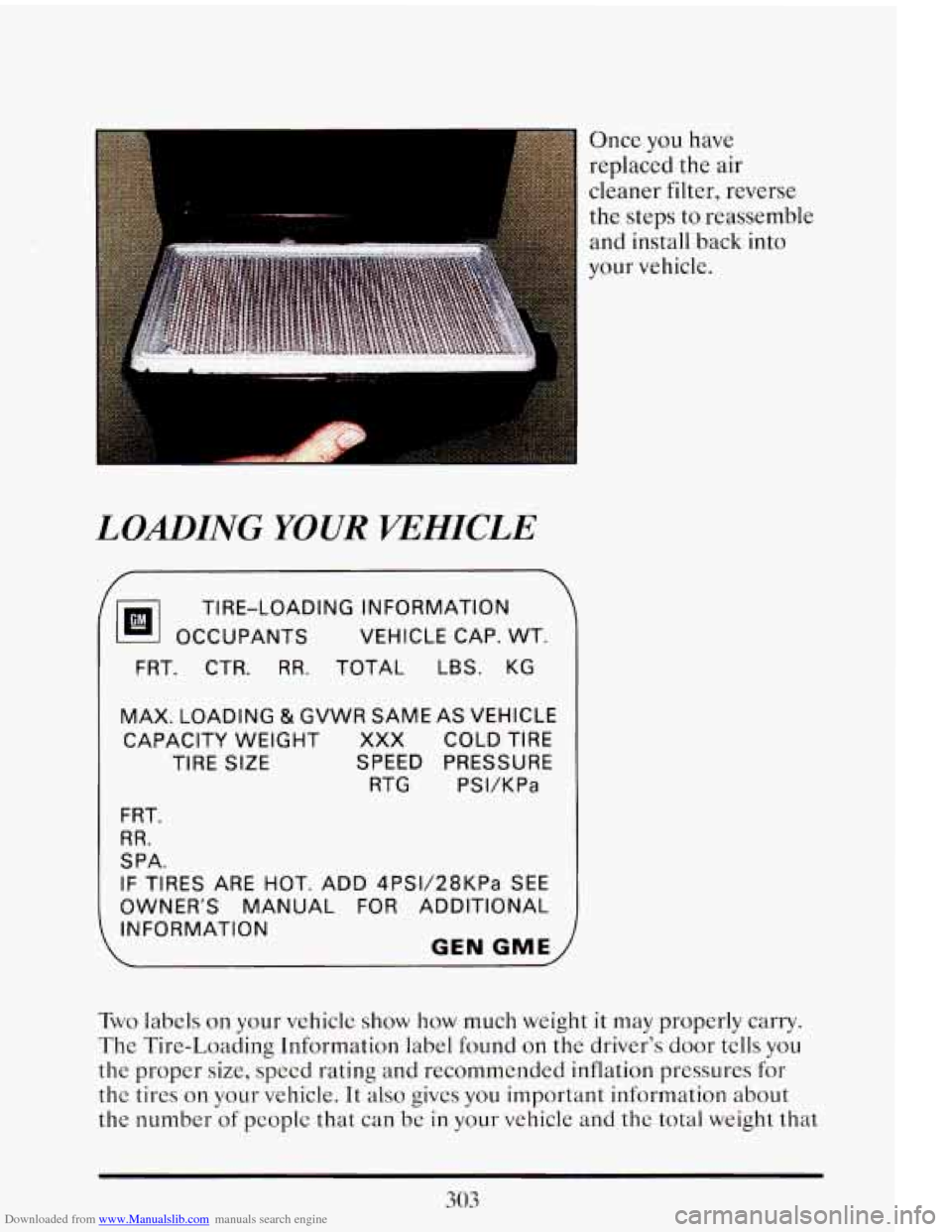
Downloaded from www.Manualslib.com manuals search engine Once you have
replaced
the air
cleaner filter, reverse the steps to reassemble and install back into
your vehicle.
LOADING YOUR VEHICLE
OCCUPANTS VEHICLE
CAP. WT.
TIRE-LOADING
INFORMATION
FRT. CTR.
RR. TOTAL LBS. KG
MAX. LOADING
& GVWR SAME AS VEHICLE
CAPACITY WEIGHT XXX COLD TIRE
TIRE
SIZE SPEED PRESSURE
RTG
PS VKPa
FRT.
RR.
SPA.
IF TIRES ARE HOT. ADD 4PSV28KPa SEE
OWNER'S MANUAL FOR ADDITIONAL
GEN GME \INFORMATION
Two labels on your vehiclc show how much weight it may properly carry.
The Tire-Loading Information label found on the driver's door tells you
the proper size, speed rating and recommended inflation pressures for
the tires on your vehicle.
It also gives you important information about
the number of people that can be in your vehicle and thc total weight that
303
Page 319 of 398
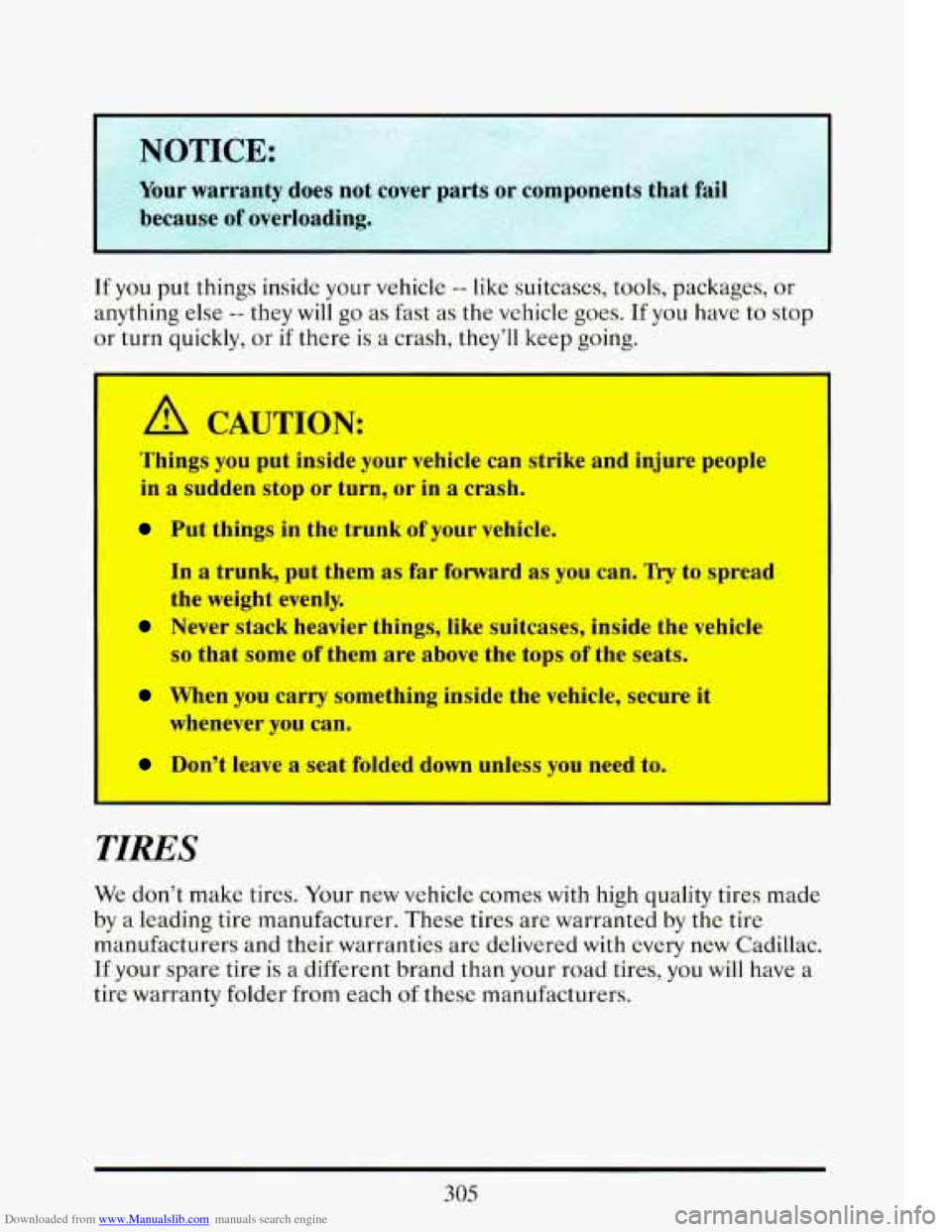
Downloaded from www.Manualslib.com manuals search engine If you put things inside your vehicle -- like suitcases, tools, packages, or
anything
else -- they will go as fast as the vehicle goes. If you have to stop
or turn quickly, or if there is a crash, they’ll keep going.
I
A CAUTION:
Things you put inside your vehicle can strike and injure people
in
a sudden stop or turn, or in a crash.
Put things in the trunk of your vehicle.
In
a trunk, put them as far forward as you can. Try to spread
the weight evenly.
so that some of them are above the tops of the seats.
When you carry something inside the vehic’ , ~ ~ ~ re it
Never stack heavier things, like suitcases, inside the vehicle
whenever you can.
Don’t leave a seat folded down unless you need to.
TIRES
We don’t make tires. Your new vehicle comes with high quality tires made
by a leading tire manufacturer. These tires are warranted by the tire
manufacturers and their warranties are delivered with
every new Cadillac.
If your spare tire is a different brand than your road tires, you will have a
tire warranty folder from each
of these manufacturers.
Page 320 of 398
Downloaded from www.Manualslib.com manuals search engine Inflation = Tire Pressure
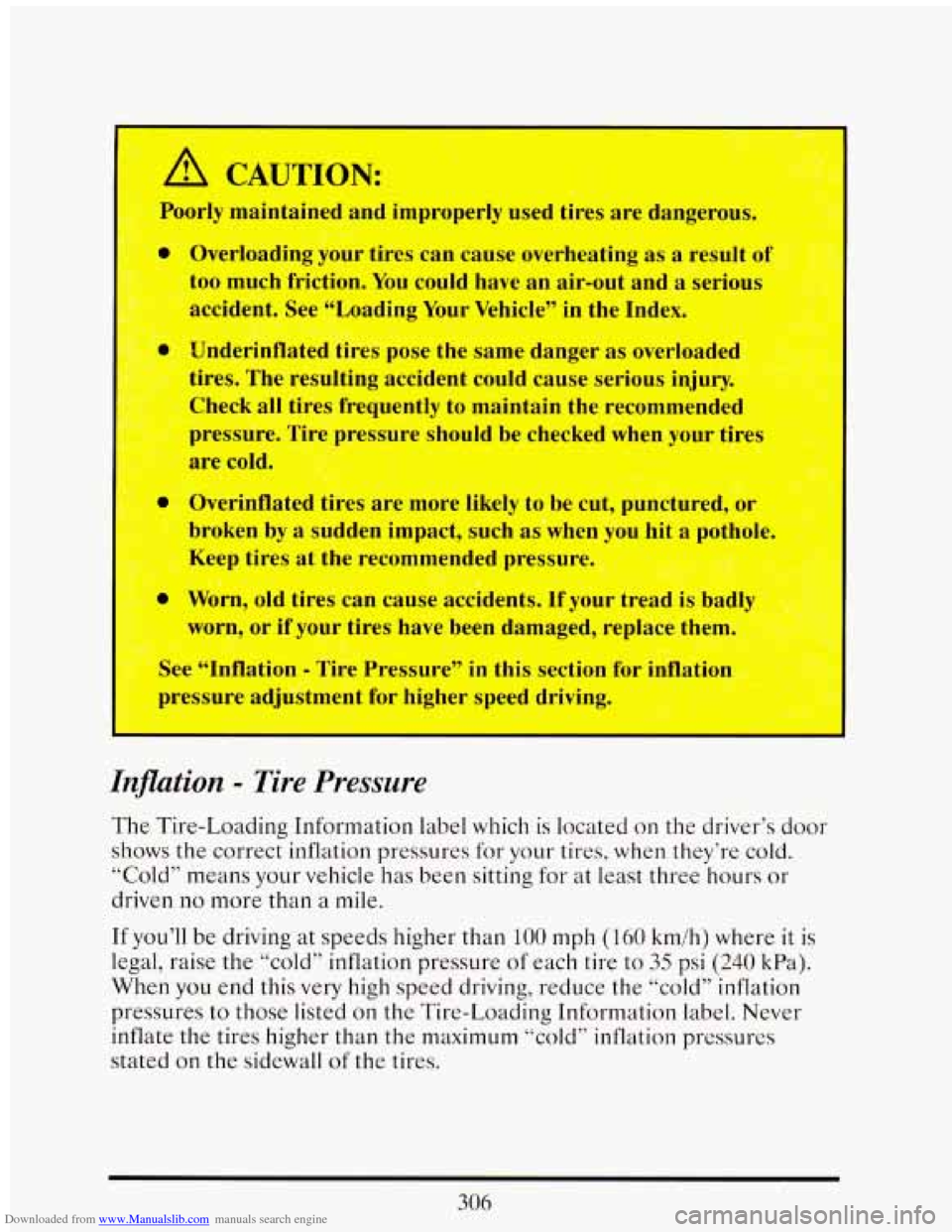
The Tire-Loading Information label which is located on the driver’s door
shows
the correct inflation pressures for your tires, when they’re cold.
“Cold” means your
vehicle has been sitting for at least three hours or
driven
no more than a mile.
If you’ll be driving at speeds higher than 100 mph (160 km/h) where it is
legal, raise the “cold” inflation pressure of each tire to 35 psi (240 kPa).
When you end this very high speed driving, reduce the “cold” inflation
pressures to those listed
on the Tire-Loading Information label. Never
inflate
the tires higher than the maximum “cold” inflation pressures
stated on the sidewall
of the tires.
306
Page 321 of 398
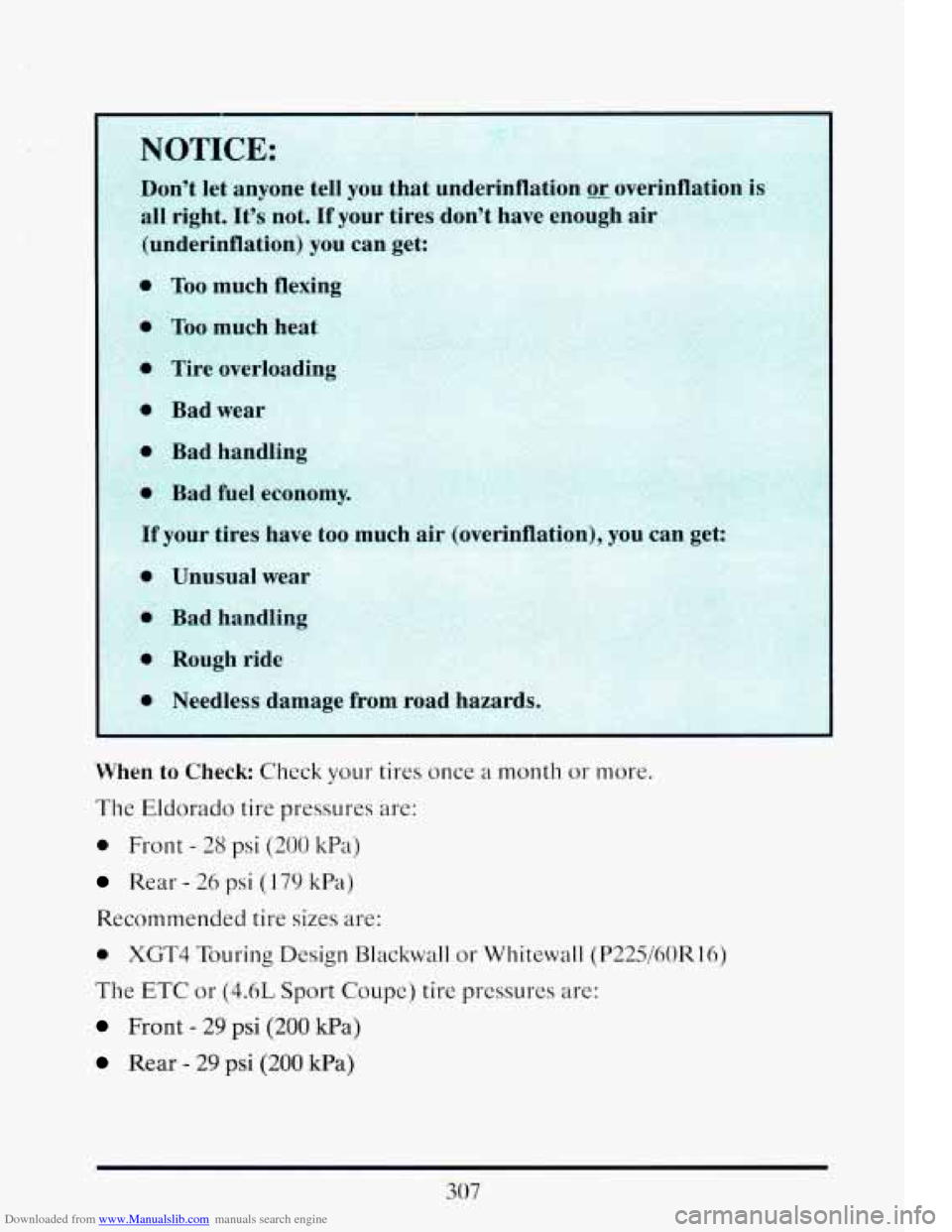
Downloaded from www.Manualslib.com manuals search engine When to Check Check your tires once a month or more.
The Eldorado tire pressures
are:
0 Front - 28 psi (200 kPa)
Rear - 26 psi ( 179 kPa)
Recommended tire sizes are:
0 XGT4 Touring Design Blackwall or Whitewall (P225/60R16)
The ETC or (4.6L Sport Coupe) tire pressures are:
Front - 29 psi (200 kPa)
Rear - 29 psi (200 kPa)
307
Page 323 of 398
Downloaded from www.Manualslib.com manuals search engine Rust or dirt on a wheel, or on the parts to which it is fastened,
can
make wheel nuts become loose afkr a time. The wheel could
come off and cause an accident. When you change a wheel,
remove any rust or dirt from places where the wheel attaches to
the vehicle. In an emergency, you can use a cloth or a paper
towel to do this; but be sure to use a scraper or wire brush later,
if you need lo, to get all the rust or dirt off. (See “Changing a
Flat Til .’I in the Index.)
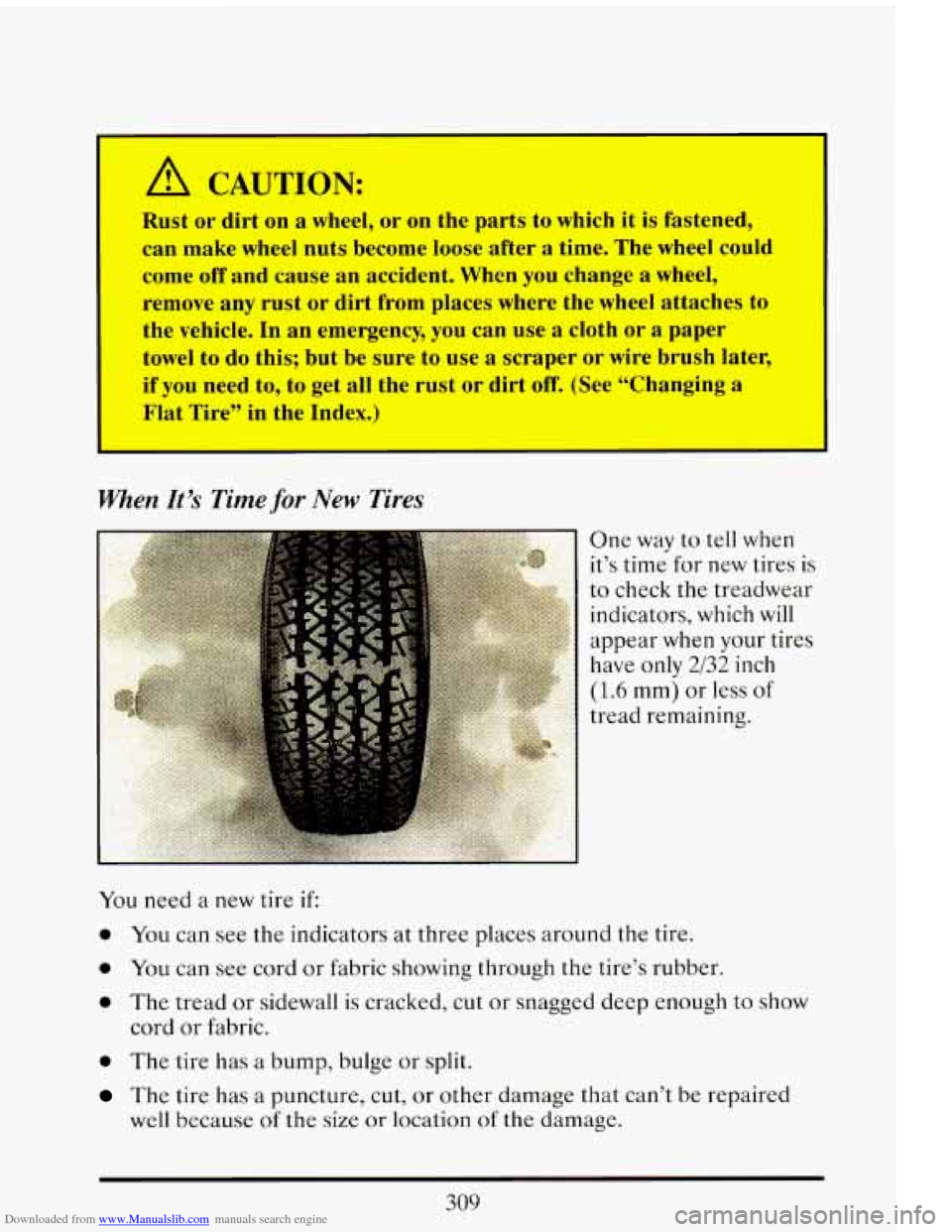
When It% Time for New Tires
One way to tell when
it’s time for new tires is
to check the treadwear
indicators, which
will
appear when your tires
have only
2/32 inch
(1.6 mm) or less of
tread remaining.
You need a new tire if:
0 You can see the indicators at three places around the tire.
0 You can see cord or fabric showing through the tire’s rubber.
0 The tread or sidewall is cracked, cut or snagged deep enough to show
0 The tire has a bump, bulge or split.
cord
or fabric.
The tire has a puncture, cut, or other damage that can’t be repaired
well because
of the size or location of the damage.
309
Page 324 of 398
Downloaded from www.Manualslib.com manuals search engine Buying New Tires
To find out what kind and size of tires you need, look at the Tire-Loading
Information label.
The tires installed on your vehicle when it was new had a Tire
Performance Criteria Specification (TPC Spec) number on each tire’s
sidewall. When you
get new tires, get ones with that same TPC Spec
number. That way, your vehicle will continue to have tires that are
designed to give proper endurance, handling, speed rating, traction, ride
and other things during normal service on your vehicle. If your tires have
an all-season tread design, the TPC number will be followed by a
“MS”
(for mud and snow).
If you ever replace your tires with those not having a TPC Spec number,
make sure they are the same size, load range, speed rating and
construction type (bias, bias-belted or radial) as your original tires.
A CAUTION:
Mixing tires could cause you to lose control while driving. If you
mix tires of different sizes or types (radial and bias-belted
tires), the vehicle may not handle properly, and you could have
a
crash. Be sure to use the same size and type tires on all four
wheels.
It’s all right to drive with your compact spare, though. It was
developed
for use on your vehicle.
Uniform Tire Quality Grading
The following information relates to the system developed by the United
States National Highway Traffic Safety Administration which grades tires
by treadwear, traction and temperature performance. (This applies only
to vehicles sold in the United States.)