engine oil CADILLAC ELDORADO 1995 10.G User Guide
[x] Cancel search | Manufacturer: CADILLAC, Model Year: 1995, Model line: ELDORADO, Model: CADILLAC ELDORADO 1995 10.GPages: 395, PDF Size: 20.17 MB
Page 185 of 395
Downloaded from www.Manualslib.com manuals search engine Care of Your Cassette Tupe Player
A tape player that is not cleaned regularly can cause reduced sound
quality, ruined cassettes or a damaged mechanism. Cassette tapes should
be stored
in their cases away from contaminants, direct sunlight and
extreme heat. If they aren’t, they may not operate properly or cause
failure
of the. tape player.
Your tape player should be cleaned regularly each month or after every
SO hours of use. If you notice a reduction in sound quality, try a known
good cassette to see
if the tape or the tape player is at fault. If this other
cassette
has no improvement in sound quality, clean the tape player.
Cleaning may be done
with a scrubbing action, non-abrasive cleaning
cassette. This system uses a cleaning cassette
with pads which scrub the
tape head as the hubs
of the cleaner cassette turn. It is normal for the
cartridge to eject while cleaning. Insert the cassette at least three times
to
ensure thorough cleaning. A scrubbing action cleaning cassette is
available through your Cadillac dealership.
You may also choose
a non-scrubbing action, wet-type cleaner which uses
a cassette
with a fabric belt to clean the tape head. This type of cleaning
cassette
will not eject. It may not clean as thoroughly as the scrubbing type
cleaner.
Cassette tapes are subject to wear
and the sound quality may degrade
over time. Always make sure that the cassette tape
is in good condition
before you have your tape player serviced.
Care of Your Compact Discs
Handle discs carefully. Store them in their original cases or other
protective cases and away from direct sunlight and dust. If the surface
of a
disc is soiled, dampen a clean, soft cloth
in a mild, neutral detergent
solution and clean
it, wiping from the centcr to the edge.
Be sure never to touch the signal surface when handling discs. Pick up discs
by grasping the outer edges or the edge of the hole and the outer edge.
3-20
Page 209 of 395
Downloaded from www.Manualslib.com manuals search engine Just before you leave the lane, glance quickly over your shoulder to make
sure there
isn’t anothcr vehicle in your “blind” spot.
Once you are moving on the freeway, make certain
you allow a reasonable
following distance. Expect
to move slightly slower at night.
When you want to leave the freeway, move to the proper lane well in
advance. If you miss your exit do not, under any circumstances, stop and
back up. Drive on to the next exit.
The exit ramp can be curved, sometimes quite sharply.
The
exit speed is usually posted.
Reduce your speed according
to your speedometer, not to your sense of
motion. After driving for any distance at higher speeds, you may tend to
think you are going slower than you actually are.
BEFORE LEAVTNG ONA LONG TRlP
Make sure you’re ready. Try to be well rested. If you must start when
you’re not fresh
-- such as after a day’s work -- don’t plan to make too
many
miles that first part of the journey. Wear comfortable clothing and
shoes
you can easily drive in.
Is your vehicle ready for a long trip? If you keep it serviced and
maintained, it’s ready
to go. If it needs service, have it done before
starting out.
Of course, you’ll find experienced and able service experts in
Cadillac dealerships all across North America. They’ll be ready and
willing
to help if you need it.
Here are some things you can check before a trip:
a
0
a
0
a
WindshieEd Wusher Fluid: Is the reservoir full? Are all windows clean
inside and outside?
Wiper. Blades: Are they in good shape‘?
Fzd, Engine Oil, Other Fluids: Have you checked all levels?
Lnmnps: Are they all working? Are the lenses clean?
Tires: They are vitally important to a safe, trouble-free trip. Is the tread
good enough for long-distance driving? Are the tires all inflated to the
recommended pressure?
4-22
Page 226 of 395
Downloaded from www.Manualslib.com manuals search engine Parking on Hills
c
You really should not park your vehicle, with a trailer attached, on a hill.
If something goes wrong, your rig could start to move. People can be
injured, and both your vehicle and the trailer can be damaged.
But
if you ever have to park your rig on a hill, here’s how to do it:
1. Apply your regular brakes, but do not shift into PARK (P).
2. Have someone place chocks under the trailer wheels.
3. When the wheel chocks are in place, release the regular brakes until
the chocks absorb the load.
4. Reapply the regular brakes. Then shift into PARK (P) firmly and apply
5. Release the regular brakes.
your parking
brake.
When You Are Ready to Leave Afier Parking on a Hill
1. Apply your regular brakes and hold the pedal down while you:
Start your engine;
Shift into a gear; and
Be sure the parking brake has released.
2. Let up on the brake pedal.
3. Drive slowly until the trailer is clear of the chocks.
4. Stop and have someone pick up and store the chocks.
Maintenance When Trailer Towing
Your vehicle will need service more often when you’re pulling a trailer.
See the Maintenance Schedule
for more on this. Things that are especially
important in trailer operation are automatic transaxle fluid (don’t
overfill), engine oil, belt, cooling system, and brake adjustment. Each
of
these is covered in this manual, and the Index will help you find them
quickly.
If you’re trailering, it’s a good idea to review these sections before
you start your trip.
Check periodically to see that all hitch nuts and bolts are tight.
4-39
Page 239 of 395
Downloaded from www.Manualslib.com manuals search engine ENGINE OKEMEATING
The Driver Information Center will display either ENGINE COOLANT
HOT-IDLE ENGINE or
STOP ENGINE ENGINE OVERHEATING.
In addition you will find the warning light about a hot engine on your
instrument panel on Canadian vehicles.
Overheated Engine Protection Operating Mode
Should a low coolant condition exist and the message STOP ENGINE
ENGINE OVERHEATING is displayed, an overheat protection mode
which alternates firing groups of four cylinders helps prevent engine
damage. This operating
mode allows your vehicle to be driven to a safe
place
in an emergency; you may drive up to 50 miles (80 km). Towing a
trailer in the overheat protection mode should be avoided.
NOTICE:
After driving in the “Overheated Engine Protection Operating
Mode,” to avoid engine damage, allow the engine
to cool before
attempting any repair. The engine oil may be severely degraded.
Change the oil and reset the
oil life indicator. See “Engine Oil,
When
to Change” in the Index.
5-12
Page 243 of 395
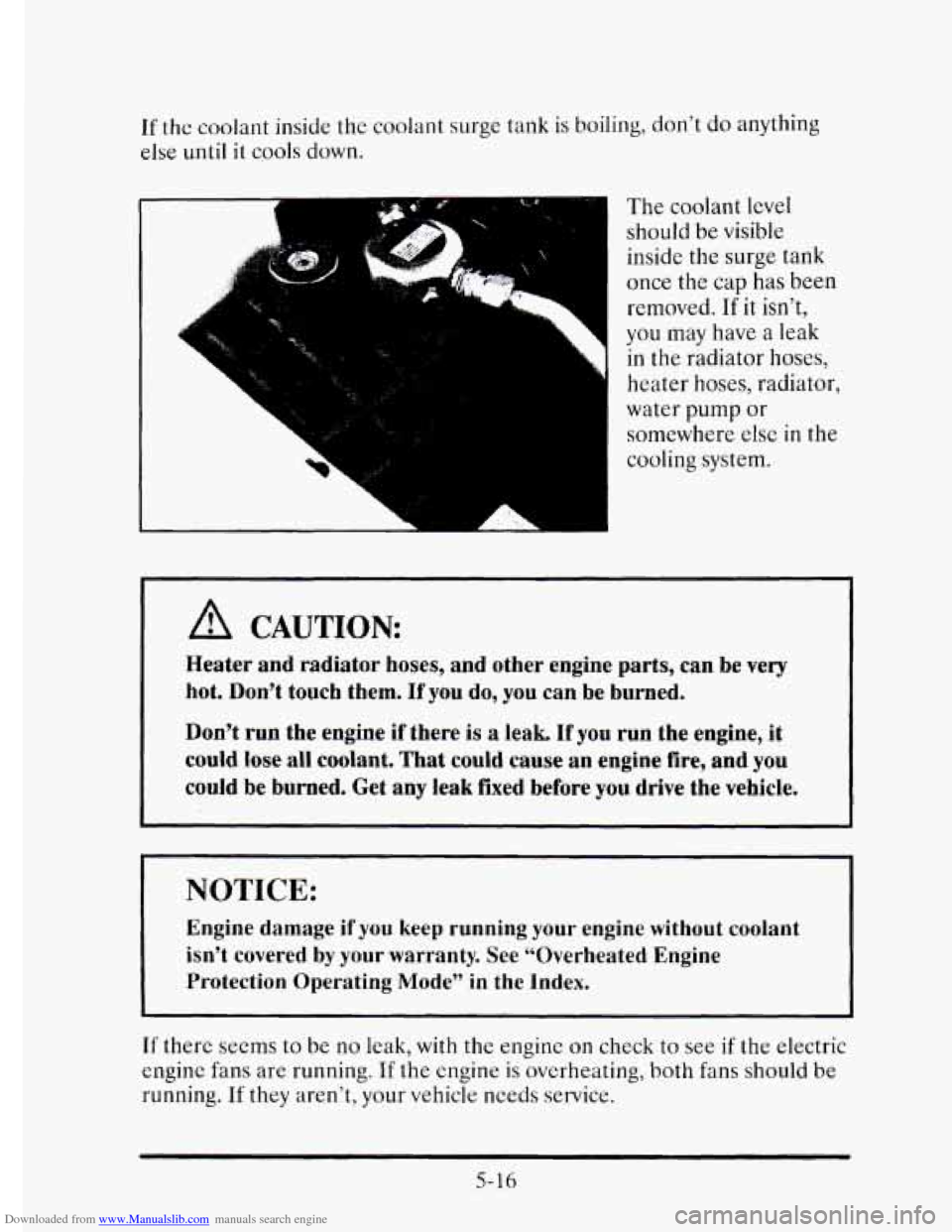
Downloaded from www.Manualslib.com manuals search engine If the coolant inside the coolant surge tank is boiling, don’t do anything
else until
it cools down.
A CAUTION
The coolant level
should be visible
inside
the surge tank
once the cap
has been
removed.
If it isn’t,
you may have a leak
in the radiator hoses,
heater
hoses, radiator,
water pump or
somewhere
else in the
cooling system.
Heater and radiator hoses, and other engine parts, can be very
hot. Don’t
touch them. If you do, you can be burned.
Don’t run the engine if there
is a leak. If you run the engine, it
could lose all coolant. That could cause an engine fire, and you
could be burned. Get any leak fixed before you drive the vehicle.
I NOTICE:
Engine damage if you keep running your engine without coolant
isn’t covered
by your warranty. See “Overheated Engine
Protection Operating Mode”
in the Index.
If there seems to be no leak, with the engine on check to see if the electric
engine fans are running.
If the engine is overheating, both fans should be
running. If they aren’t, your vehicle needs service.
5-16
Page 245 of 395
Downloaded from www.Manualslib.com manuals search engine ..
A CAUTION:
Adding only plain water to your cooling system can be
dangerous. Plain water, or some other liquid like alcohol, can
boil before the proper coolant mix
will. Your vehicle’s coolant
warning system
is set for the proper coolant mix. With plain
water or the
wrong mix, your engine could get too hot but you
wouldn’t get the overheat warning. Your engine could catch
fire
and you or others could be burned. Use a 50/50 mix of clean
water and
a proper antifreeze.
NOTICE:
In cold weather, water can freeze and crack the engine, radiator,
heater core
and other parts. So use the recommended coolant.
You can be burned if you spill coolant on hot engine parts.
Coolant contains ethylene glycol and it will burn if the engine
parts
are hot enough. Don’t spill coolant on a hot engine.
5-18
Page 263 of 395
Downloaded from www.Manualslib.com manuals search engine Gasolines for Cleaner Air
Your use of gasoline with deposit control additives will help prevent
deposits from forming
in your engine and fuel system. That helps keep
your engine in tune and your emission control system working properly.
It’s good for your vehicle, and you’ll be doing your part for cleaner air.
Many gasolines are now blended with oxygenates. General Motors
recommends that you use gasolines with these blending materials, such as
MTBE and ethanol. By doing so, you can help clean the air, especially in
those parts
of the country that have high carbon monoxide levels.
In addition, some gasoline suppliers are now producing reformulated
gasolines. These gasolines are specially designed to reduce vehicle
emissions. General Motors recommends that
you use reformulated
gasoline. By doing
so, you can help clean the air, especially in those parts
of the country that have high ozone levels.
You should ask your service station operators if their gasolines contain
deposit control additives and oxygenates, and if they have been
reformulated to reduce vehicle emissions.
FUELS IN FOmIGN COUNTMES
If you plan on driving in another country outside the U.S. or Canada,
unleaded fuel may be hard to find. Do not use leaded gasoline. If you use
even one tankful,
your emission controls won’t work well or at all. With
continuous use, spark plugs can get fouled, the exhaust system can
corrode, and your engine oil can deteriorate quickly. Your vehicle’s
oxygen sensor
will be damaged. All of that means costly repairs that
wouldn’t be covered
by your warranty.
To check on fuel availability, ask an auto club, or contact a major oil
company that does business in the country where you’ll be driving.
You can also write us at the following address for advice. Just tell
us
where you’re going and give your Vehicle Identification Number (VIN).
6-4
General Motors Overseas Distribution Corporation,
North American Export Sales
(NAES)
1908 Colonel Sam Drive
Oshawa, Ontario
L1H 8P7
Page 268 of 395
Downloaded from www.Manualslib.com manuals search engine Fluid Usage Label
LI
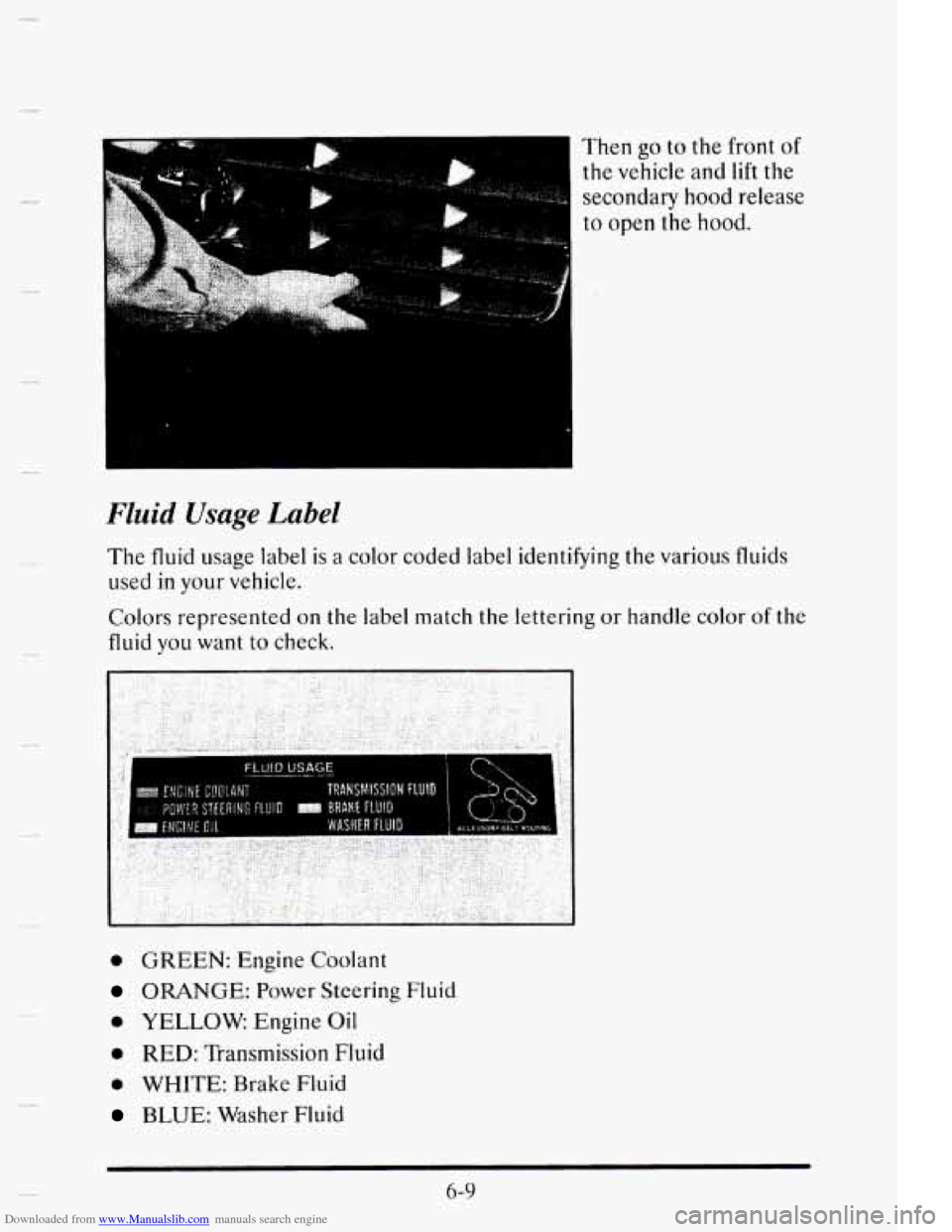
Then go to the front of
the vehicle and lift the
secondary hood release
to open the hood.
The fluid usage label is a color coded label identifying the various fluids
used in your vehicle.
Colors represented on the label match the lettering or handle color
of the
fluid you want
to check.
0 GREEN: Engine Coolant
ORANGE: Power Steering Fluid
0 YELLOW: Engine Oil
0 RED: Transmission Fluid
0 WHITE: Brake Fluid
BLUE: Washer Fluid
6-9
Page 269 of 395
Downloaded from www.Manualslib.com manuals search engine ENGINE OIL
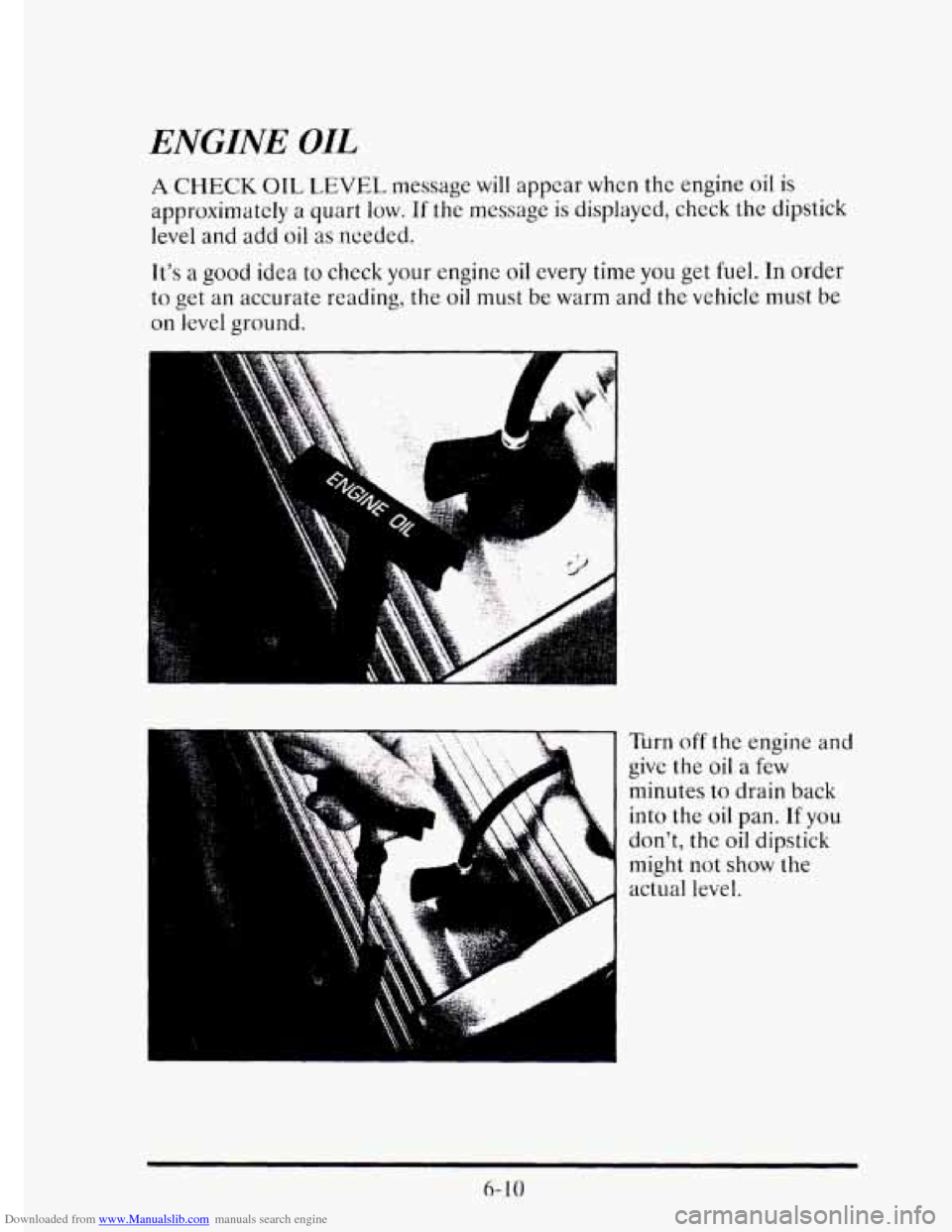
A CHECK OIL LEVEL message will appear whcn the engine oil is
approximately a quart low. If the message is displayed, check the dipstick
level
and add oil as needed.
It's
a good idea to check your engine oil every time you get fuel. In order
to get
an accurate reading, the oil must be warm and the vehicle must be
on level ground.
Turn off the engine and
give the oil a few
minutes to drain back
into the
oil pan. If you
don't, the oil dipstick
might not
show the
actual level.
6- 10
Page 270 of 395
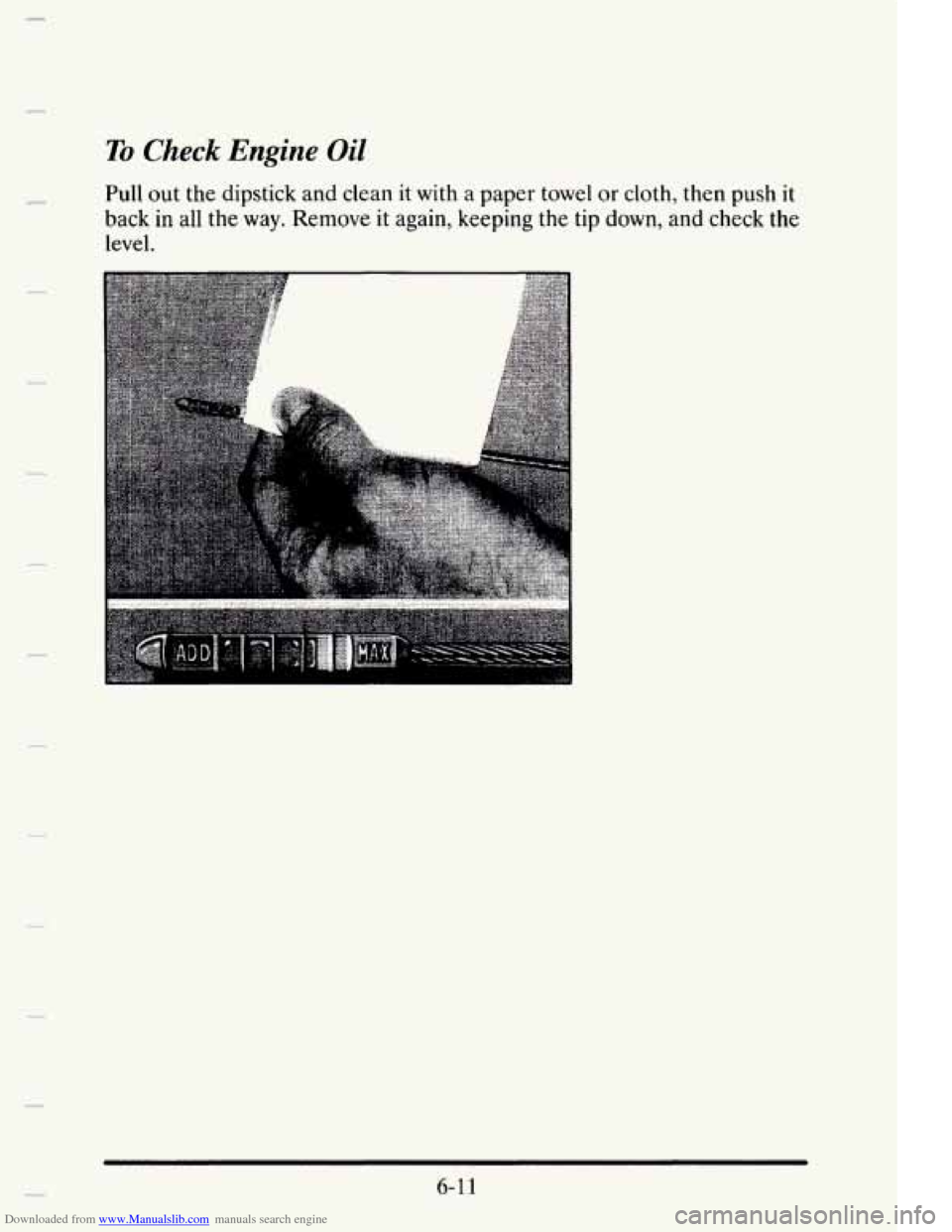
Downloaded from www.Manualslib.com manuals search engine To Check Engine Oil
Pull out the dipstick and clean it with a paper towel or cloth, then push it
back
in all the way. Remove it again, keeping the tip down, and check the
level.
6-1 1