tires CADILLAC ELDORADO 1995 10.G Owner's Manual
[x] Cancel search | Manufacturer: CADILLAC, Model Year: 1995, Model line: ELDORADO, Model: CADILLAC ELDORADO 1995 10.GPages: 395, PDF Size: 20.17 MB
Page 302 of 395
Downloaded from www.Manualslib.com manuals search engine Inflation - Tire Pressure
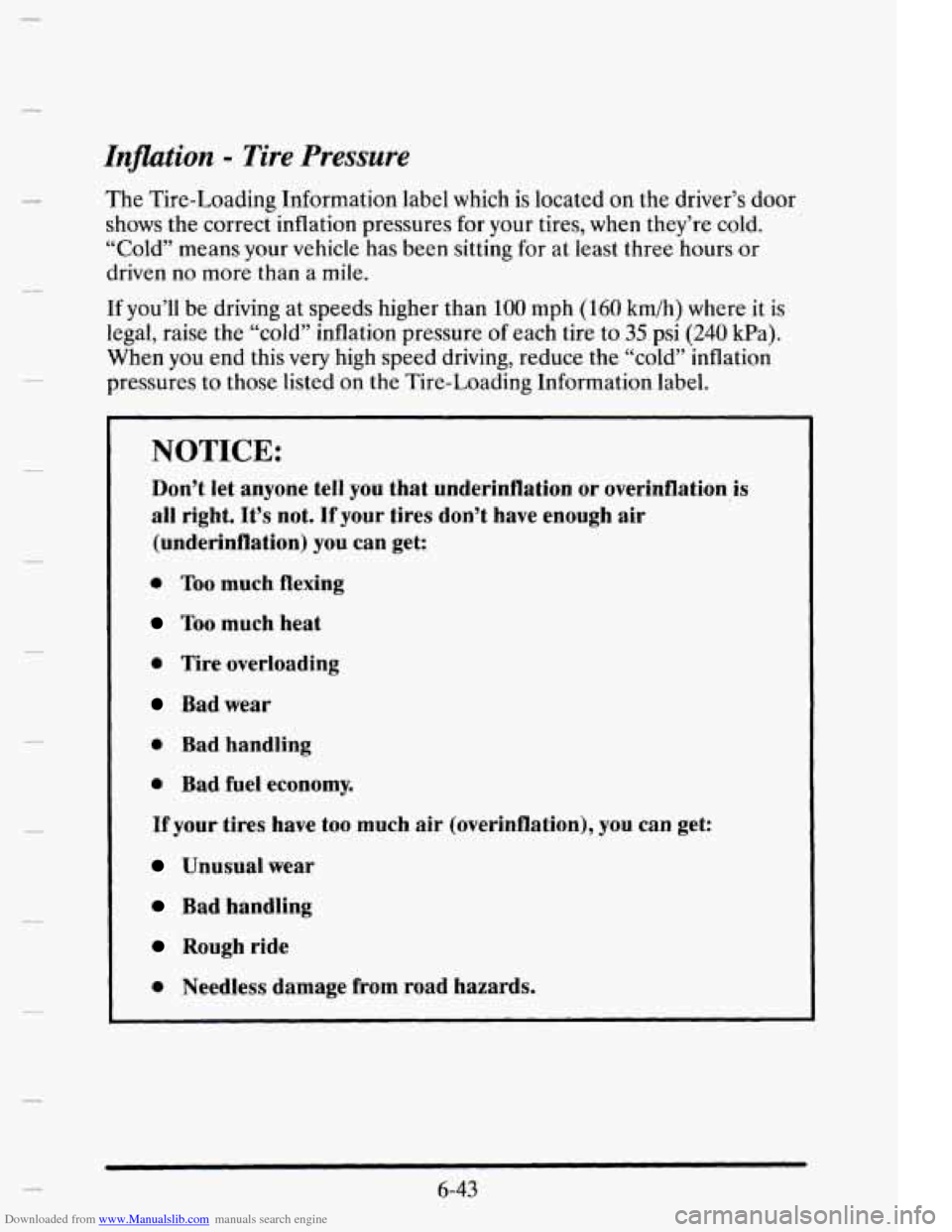
The Tire-Loading Information label which is located on the driver’s door
shows the correct inflation pressures for
your tires, when they’re cold.
“Cold” means your vehicle has been sitting for at least three hours or
driven
no more than a mile.
If you’ll be driving at speeds higher than 100 mph (160 km/h) where it is
legal, raise the “cold” inflation pressure
of each tire to 35 psi (240 kPa).
When you end this very high speed driving, reduce the “cold” inflation
pressures to those listed
on the Tire-Loading Information label.
NOTICE:
Don’t let anyone tell you that underinflation or overinflation,is
all right. It’s not.
If your tires don’t have enough air
(underinflation) you can get:
0 Too much flexing
Too much heat
0 Tire overloading
Bad wear
0 Bad handling
0 Bad fuel economy.
If your tires have too much air (overinflation), you can get:
Unusual wear
Bad handling
Rough ride
0 Needless damage from road hazards.
6-43
Page 303 of 395
Downloaded from www.Manualslib.com manuals search engine When to Check
Check your tires once a month or more.
Don’t forget your compact sparc tire.
It should be at 60 psi (420 kPa).
How to Check
Use a good quality pocket-type gage to check tire pressure. Simply
looking at the tires
will not tell you the pressure, especially ii you have
radial tires
-- which may look properly inflated even if they’re
underinflated.
If your tires have valve caps, be sure to put them back on. They help
prevent leaks
by keeping out dirt and moisture.
Tire Inspection and Rotation
Tires should be inspected every 6,000 to 8,000 miles (10 000 to ‘13 000 km)
for any signs
of unusual wear. If unusual wear is present, rotate your tires
as
soon as possible and check wheel alignment. Also check for damaged
tires or wheels. See “When it’s Time for
New Tires” and “Wheel
Replacement” later in this section
for more information.
The purpose of regular rotation is to achieve more uniform wear for all tires
on the vehicle. The first rotation is the most important. See “Scheduled
Maintenance Services”
in the Index for scheduled rotation intervals.
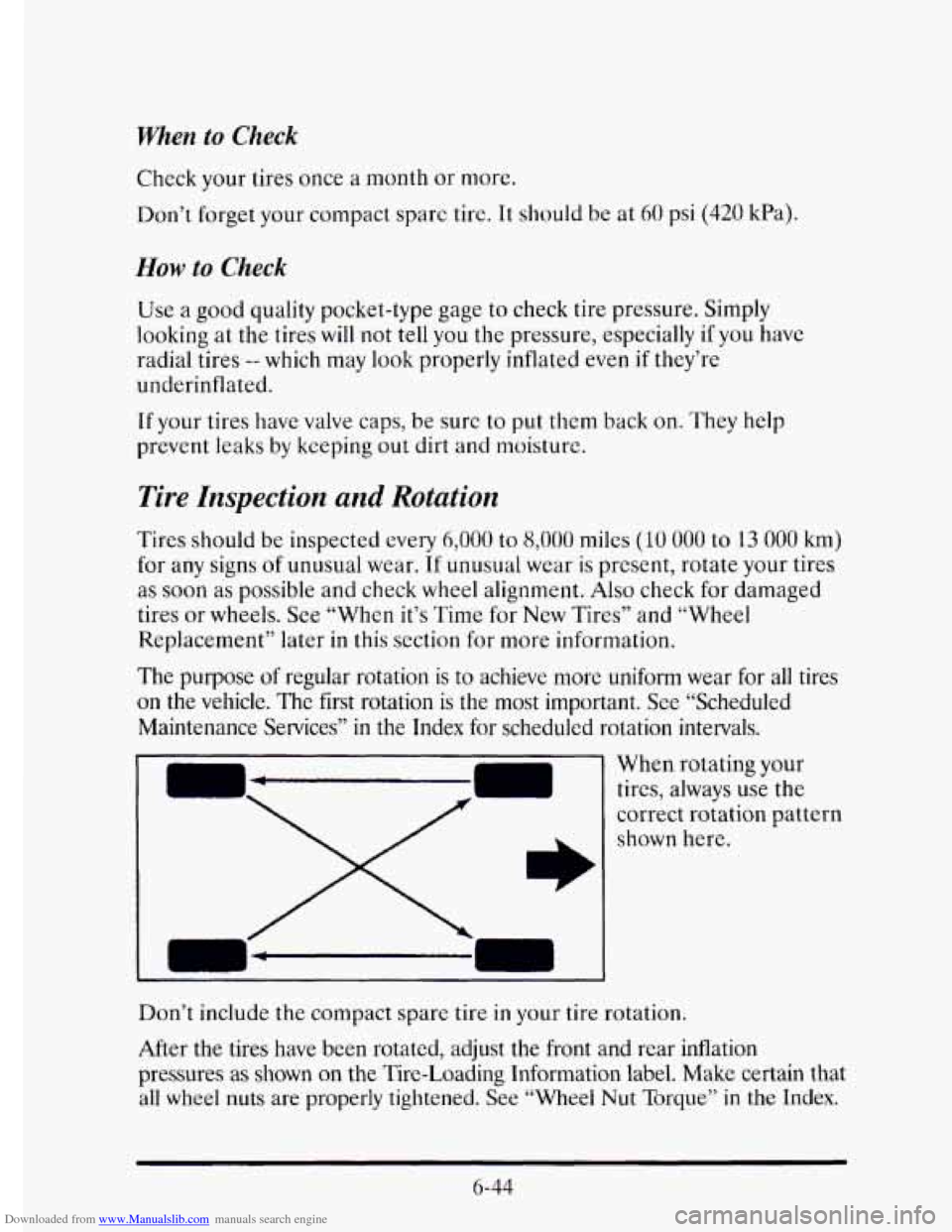
When rotating your
tires, always use
the
correct rotation pattern
shown here.
Don’t include the compact spare tire
in your tire rotation.
After the tires have been rotated, adjust
the front and rear inflation
pressures as
shown on the Tire-Loading Information label. Make certain that
all wheel nuts are properly tightened. See “Wheel Nut Torque” in the Index.
6-44
Page 304 of 395
Downloaded from www.Manualslib.com manuals search engine When it% Time for New Tires
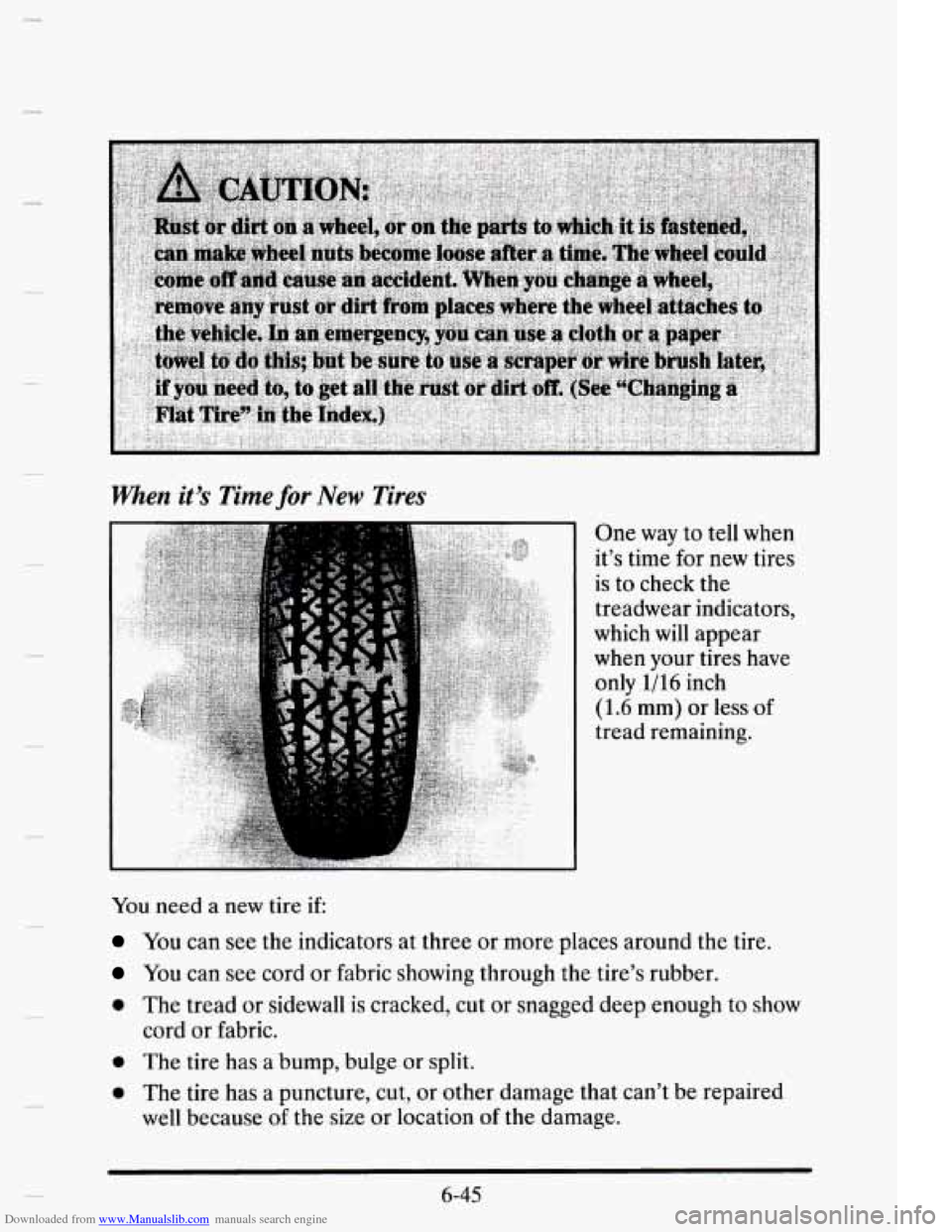
One way to tell when
it’s time for new tires
is to check the
treadwear indicators,
which will appear
when your tires have
only
1/16 inch
(1.6 mm) or less of
tread remaining.
You need a new tire if
You can see the indicators at three or more places around the tire.
You can see cord or fabric showing through the tire’s rubber.
0 The tread or sidewall is cracked, cut or snagged deep enough to show
cord
or fabric.
0 The tire has a bump, bulge or split.
0 The tire has a puncture, cut, or other damage that can’t be repaired
well because
of the size or location of the damage.
6-45
Page 305 of 395
Downloaded from www.Manualslib.com manuals search engine Buying New Tires
To find out what kind and size of tires you need, look at the Tire-Loading
Information label.
The tires installed on your vehicle when it was new had a Tire
Performance Criteria Specification (TPC Spec) number on each tire's
sidewall. When you get new tires, get ones with that same
TPC Spec
number. That way, your vehicle
will continue to have tires that are
designed to give proper endurance, handling, speed rating, traction, ride
and other things during normal service
on your vehicle. If your tires have
an all-season tread design, the
TPC number will be followed by an MS
(for mud and snow).
If you ever replace your tires with those not having a TPC Spec number,
make sure they are the same size,
load range, speed rating and
construction type (bias, bias-belted or radial) as
your original tires.
Mixing tires could cause you to lose control while driving. If yuu
mix tires of different sizes or types (radial and bias-belted
tires), the vehicle may
not handle properly, and you could hpve a
.. crash. Be sure to use the same size and type tires on all four
wheels.
It's all right to drive with your compact spare, though. It was
' developed for use on your vehicle.
. ..
6-46
Page 306 of 395
Downloaded from www.Manualslib.com manuals search engine Uniform Tire Quality Grading
The following information relates to the system developed by the United
States National Highway Traffic Safety Administration which grades tires
by treadwear, traction and temperature performance. (This applies only
to vehicles sold in the United States.)
Treadwear
The treadwear grade is a comparative rating based on the wear rate of the
tire when tested under controlled conditions on a specified government
test course. For example,
a tire graded 150 would wear one and a half
(1 1/2) times as well on the government course as a tire graded 100. The
relative performance
of tires depends upon the actual conditions of their
use, however, and may depart significantly from the norm due to
variations
in driving habits, service practices and differences in road
characteristics and climate.
Traction - A, B, C
The traction grades, from highest to lowest are: A, B, and C. They
represent the tire’s ability to stop on wet pavement as measured under
controlled conditions on specified government test surfaces
of asphalt and
concrete.
A tire marked C may have poor traction performance.
Warning: The traction grade assigned
to this tire is based on braking
(straight-ahead) traction tests and does not include cornering \
(turning)
traction.
6-47
Page 307 of 395
Downloaded from www.Manualslib.com manuals search engine Temperature - A, B, C
The temperature grades are A (the highest), B, and C, representing the
tire’s resistance to the generation of heat and its ability to dissipate heat
when tested under controlled conditions on a specified indoor laboratory
test wheel. Sustained high temperature can cause the material
of the tire
to degenerate and reduce tire life, and excessive temperature can lead to
sudden tire failure. The grade
C corresponds to a level of performance
which all passenger car tires must meet under
the Federal Motor Vehicle
Safety Standard
No. 109. Grades B and A represent higher levels of
performance on the laboratory test wheel than the minimum required by
law.
Warning:
The temperature grade for this tire is established for a tire that
is properly inflated and not overloaded. Excessive speed, underinflation,
or excessive loading, either separately or
in combination, can cause heat
buildup and possible tire failure.
These grades are molded on the sidewalls
of passenger car tires.
While the
tires available as standard or optional equipment on General
Motors vehicles may vary with respect
to these grades, all such tires meet
General Motors performance standards and have been approved for use
on General Motors vehicles. All passenger type
(P Metric) tires must
conform to Federal safety requirements
in addition to these grades.
wheel Alignment and Tire Balance
The wheels on your vehicle were aligned and balanced carefully at the
factory to give
you the longest tire life and best overall performance.
In most cases, you
will not need to have your wheels aligned again.
However,
if you notice unusual tire wear or your vehicle pulling one way
or the other, the alignment may need to be reset.
If you notice your
vehicle vibrating when driving on
a smooth road, your wheels may need to
be rebalanced.
6-48
Page 309 of 395
Downloaded from www.Manualslib.com manuals search engine Used Replacement Wheels
Tire Chains
NOTICE:
Use tire chains only where legal and only when you must. Use
only
SAE Class “S” type chains that are the proper size for your
tires. Install them on the front tires and tighten them
as tightly
as possible with the ends securely fastened. Drive slowly and
follow the chain manufacturer’s instructions.
If you can hear
the chains contacting
your vehicle, stop and retighten them. If
the contact continues, slow down until it stops. Driving too fast
or spinning the wheels with chains on will damage your vehicle.
I
6-50
Page 317 of 395
Downloaded from www.Manualslib.com manuals search engine Foreign materials such as calcium chloride and other salts, ice melting
agents, road
oil and tar, tree sap, bird droppings, chemicals from
industrial chimneys, etc. can damage your vehicle’s finish if they remain
on painted surfaces. Wash the vehicle as soon as possible. If necessary, use
non-abrasive cleaners that are marked safe for painted surfaces
to remove
foreign matter.
Exterior painted surfaces are subject
to aging, weather and chemical
fallout that can take their toll over a period
of years. You can help to keep
the paint finish looking
new by keeping your Cadillac garaged or covered
whenever possible.
ALUMINUM WHEELS
Your aluminum wheels have a protective coating similar to the painted
surface
of your vehicle. Don’t use strong soaps, chemicals, chrome polish,
abrasive cleaners or abrasive cleaning brushes on them because
you could
damage this coating. After rinsing thoroughly, a wax may be applied.
NOTICE:
Don’t use an automatic car wash that has hard silicon carbide
cleaning brushes. These brushes can take the protective coating
off your aluminum wheels.
TIRES
To clean your tires, use a stiff brush with a tire cleaner.
When applying a tire dressing always take care to wipe
off any overspray
or splash from painted surfaces. Petroleum-based products may damage
the paint finish.
SHEETMETAL DMGE
6-58
If your vehicle is damaged and requires sheet metal repair or
replacement, make sure the body repair shop applies anti-corrosion
material to the parts repaired or replaced to restore corrosion protection.
.c
Page 319 of 395
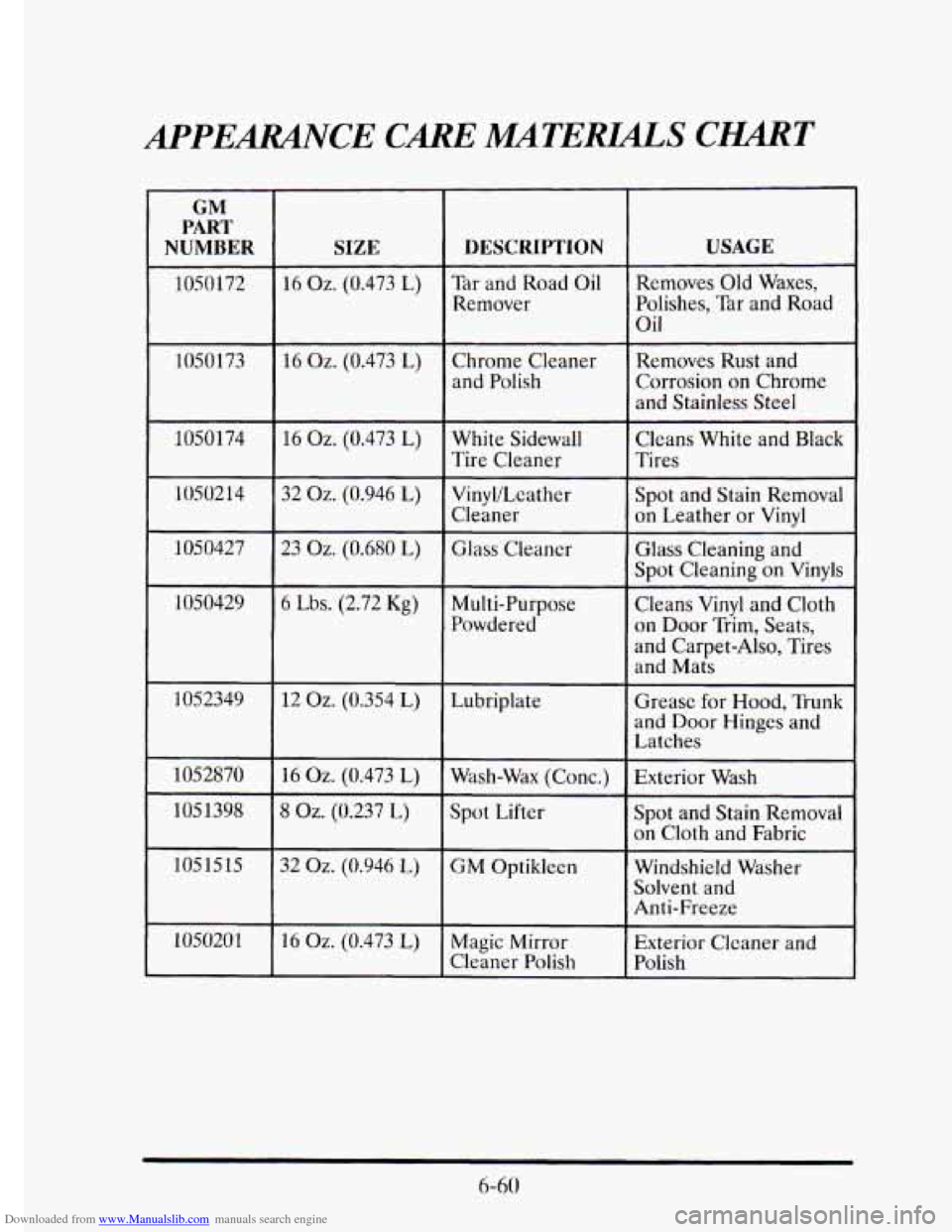
Downloaded from www.Manualslib.com manuals search engine APPEMCE CAREMTERllALS C'T
GM
PART
NUMBER SIZE DESCRIPTION
1050172 16 Oz. (0.473 L) Tar and Road Oil
Remover
1050173
16 02. (0.473 L) Chrome Cleaner
and Polish
1050174
16 02. (0.473 L) White Sidewall
1050214 32
Oz. (0.946 L) Vinyl/Leather Tire Cleaner
Cleaner
I 1050427 I I
23 02. (0.680 L) Glass Cleaner
1050429
6 Lbs. (2.72 Kg) Multi-Purpose
Powdered
I 1051398 I 8 02. (0.237 L) I Spot Lifter
1051515 32
Oz. (0.946 L) GM Optikleen
1050202 16 02. (0.473 L) Magic Mirror
Cleaner Polish
USAGE
Removes Old Waxes,
Polishes, Tar and Road
Oil
Removes Rust and
Corrosion
on Chrome
and Stainless Steel
Cleans White and Black
Tires
Spot and Stain Removal
on Leather or Vinyl
Glass Cleaning and
Spot Cleaning
on Vinyls
Cleans Vinyl and Cloth
on Door Trim, Seats,
and Carpet-Also, Tires
and Mats
~ ~~
Grease for Hood, Trunk
and Door
Hinges and
Latches
Exterior Wash
Spot and Stain Removal
on Cloth and Fabric
WindshieId Washer
Solvent and
Ant i-Freeze
Exterior Cleaner and
Polish
6-60
Page 381 of 395
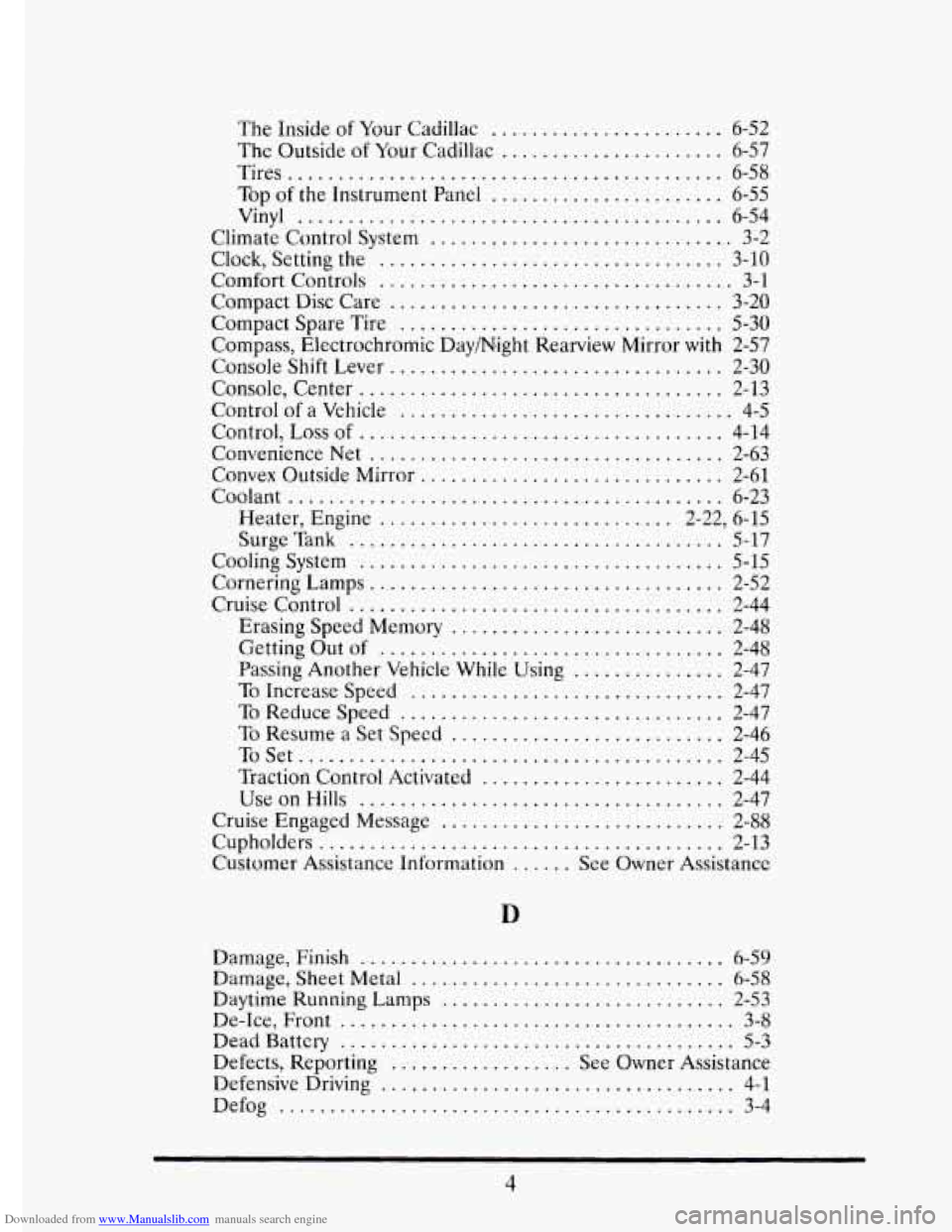
Downloaded from www.Manualslib.com manuals search engine The Inside of Your Cadillac ....................... 6-52
The Outside
of Your Cadillac ...................... 6-57
Tires
........................................... 6-58
Top
of the Instrument Panel ....................... 6-55
Vinyl
.......................................... 6-54
Climate Control System
.............................. 3-2
Clock. Setting the
.................................. 3-10
Comfort Controls
................................... 3-1
Compact Disc Care
................................. 3-20
Compact Spare Tire
................................ 5-30
Compass, Electrochromic Daymight Rearview Mirror
with 2-57
Console Shift Lever
................................. 2-30
Console. Center
.................................... 2-13
ControI
of a Vehicle ................................. 4-5
Control,
Loss of .................................... 4-14
Convenience Net
................................... 2-63
Convex Outside Mirror
.............................. 2-61
Coolant
........................................... 6-23
Heater, Engine
............................. 2-22. 6-15
SurgeTank
..................................... 5-17
Cooling System .................................... 5-15
Cornering Lamps
................................... 2-52
Cruise Control
..................................... 2-44
Erasing Speed Memory
........................... 2-48
Getting Out
of .................................. 2-48
Passing Another Vehicle While Using
............... 2-47
To Increase Speed ............................... 2-47
To Reduce Speed ................................ 2-47
To Resume a Set Speed
........................... 2-46
To Set .......................................... 2-45
Traction Control Activated
........................ 2-44
Use on Hills .................................... 2-47
Cruise Engaged Message
............................ 2-88
Cupholders ........................................ 2-13
Customer Assistance Information
...... See Owner Assistance
Damage.
Finish .................................... 6-59
Damage. Sheet Metal ............................... 6-58
Daytime Running Lamps ............................ 2-53
De.Ice. Front ....................................... 3-8
Dead Battery ....................................... 5-3
Defects. Reporting .................. See Owner Assistance
Defensive Driving
................................... 4-1
Defog
............................................. 3-4
4