tow CADILLAC ELDORADO 1995 10.G Owner's Manual
[x] Cancel search | Manufacturer: CADILLAC, Model Year: 1995, Model line: ELDORADO, Model: CADILLAC ELDORADO 1995 10.GPages: 395, PDF Size: 20.17 MB
Page 222 of 395
Downloaded from www.Manualslib.com manuals search engine n
Weight of the Trailer Tongue
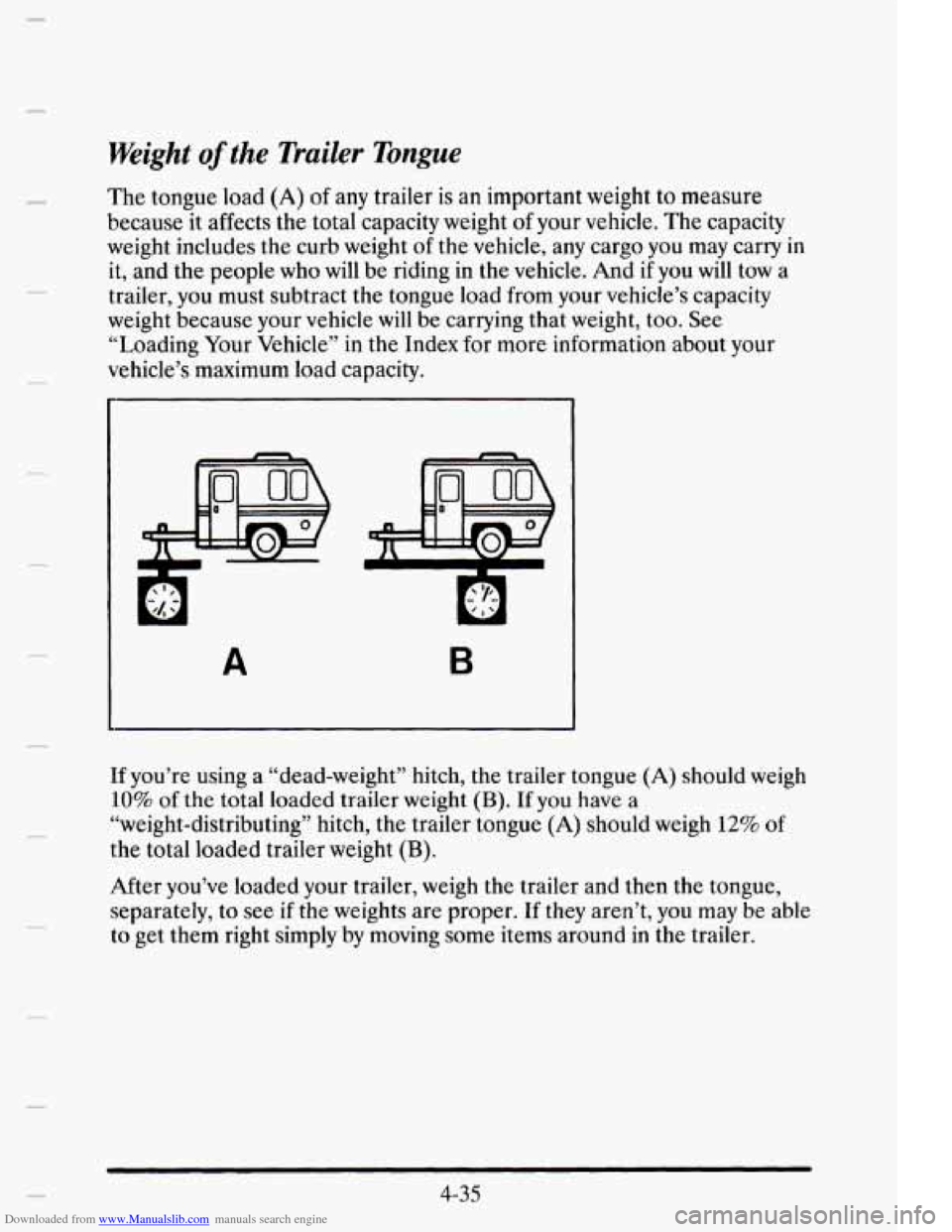
The tongue load (A) of any trailer is an important weight to measure
because it affects the total capacity weight
of your vehicle. The capacity
weight includes
the curb weight of the vehicle, any cargo you may carry in
it, and the people
who will be riding in the vehicle. And if you will tow a
trailer, you must subtract the tongue load from your vehicle’s capacity
weight because your vehicle will be carrying that weight,
too. See
“Loading Your Vehicle”
in the Index for more information about your
A
vehicle’smaximum load capacity.
If you’re using a “dead-weight” hitch, the trailer tongue (A) should weigh
:LO% of the total loaded trailer weight (B). If you have a
“weight-distributing” hitch, the trailer tongue (A) should weigh
12% of
the total loaded trailer weight (B).
After you’ve loaded your trailer, weigh the trailer and then the tongue,
separately, to
see if the weights are proper. If they aren’t, you may be able
to get them right simply by moving some items around in the trailer.
4-35
Page 224 of 395
Downloaded from www.Manualslib.com manuals search engine Driving with a Trailer
n Towing a trailer requires a certain amount of experience. Before setting
out for the open road, you’ll want to get to
know your rig. Acquaint
yourself with the feel
of handling and braking with the added weight of
the trailer. And always keep in mind that the vehicle you are driving is
now a good deal longer and not nearly as responsive as your vehicle is by
itself.
Before you start, check the trailer hitch and platform (and attachments),
safety chains, electrical connector, lamps, tires and mirror adjustment. If
the trailer has electric brakes, start your vehicle and trailer moving and
then apply the trailer brake controller by hand to be sure the brakes are
working. This lets you check your electrical connection at the same time.
. During your trip, check occasionally to be sure that the load is secure, and
that the lights and any trailer brakes are still working.
Following Distance
Stay at least twice as far behind the vehicle ahead as you would when
driving your vehicle without a trailer. This can help you avoid situations
that require heavy braking and sudden turns.
Passing
You’ll need more passing distance up ahead when you’re towing a trailer.
And, because you’re a good deal longer, you’ll need to
go much farther
beyond the passed vehicle before you can return to your lane.
Backing Up
Hold the bottom of the steering wheel with one hand. Then, to move the
trailer to the left, just move that hand to the left.
To move the trailer to
the right, move your hand to the right. Always back up slowly and,
if
possible, have someone guide you.
4-37
Page 225 of 395
Downloaded from www.Manualslib.com manuals search engine Making Turns
NOTICE:
Making very sharp turns while trailering could cause the trailer
to come in contact with the vehicle. Your vehicle could be
damaged. Avoid making very sharp turns while trailering.
When you’re turning with a trailer, make wider turns than normal. DO this
so your trailer won’t strike soft shoulders, curbs, road signs, trees, or other
objects. Avoid jerky or sudden maneuvers. Signal well in advance.
Turn Signals When Towing a Trailer
When you tow a trailer, your vehicle has to have a different turn signal
flasher and extra wiring. The green arrows on your instrument panel will
flash whenever you signal
a turn or lane change. Properly hooked up, the
trailer lamps
will also flash, telling other drivers you’re about to turn,
change lanes or stop.
When towing a trailer, the green arrows on your instrument panel
will
flash for turns even if the bulbs on the trailer are burned out. Thus, you
may think drivers behind you are seeing your
signal when they are not. It’s
important to
che.ck occasionally to be sure the trailer bulbs are still
working.
Driving On Grades
Reduce speed and shift to a lower gear before you start down a long or
steep downgrade.
If you don’t shift down, you might have to use your
brakes
so much that they would get hot and no longer work well.
4-38
Page 226 of 395
Downloaded from www.Manualslib.com manuals search engine Parking on Hills
c
You really should not park your vehicle, with a trailer attached, on a hill.
If something goes wrong, your rig could start to move. People can be
injured, and both your vehicle and the trailer can be damaged.
But
if you ever have to park your rig on a hill, here’s how to do it:
1. Apply your regular brakes, but do not shift into PARK (P).
2. Have someone place chocks under the trailer wheels.
3. When the wheel chocks are in place, release the regular brakes until
the chocks absorb the load.
4. Reapply the regular brakes. Then shift into PARK (P) firmly and apply
5. Release the regular brakes.
your parking
brake.
When You Are Ready to Leave Afier Parking on a Hill
1. Apply your regular brakes and hold the pedal down while you:
Start your engine;
Shift into a gear; and
Be sure the parking brake has released.
2. Let up on the brake pedal.
3. Drive slowly until the trailer is clear of the chocks.
4. Stop and have someone pick up and store the chocks.
Maintenance When Trailer Towing
Your vehicle will need service more often when you’re pulling a trailer.
See the Maintenance Schedule
for more on this. Things that are especially
important in trailer operation are automatic transaxle fluid (don’t
overfill), engine oil, belt, cooling system, and brake adjustment. Each
of
these is covered in this manual, and the Index will help you find them
quickly.
If you’re trailering, it’s a good idea to review these sections before
you start your trip.
Check periodically to see that all hitch nuts and bolts are tight.
4-39
Page 236 of 395
Downloaded from www.Manualslib.com manuals search engine n
c
TOWING YOUR VEHICLE
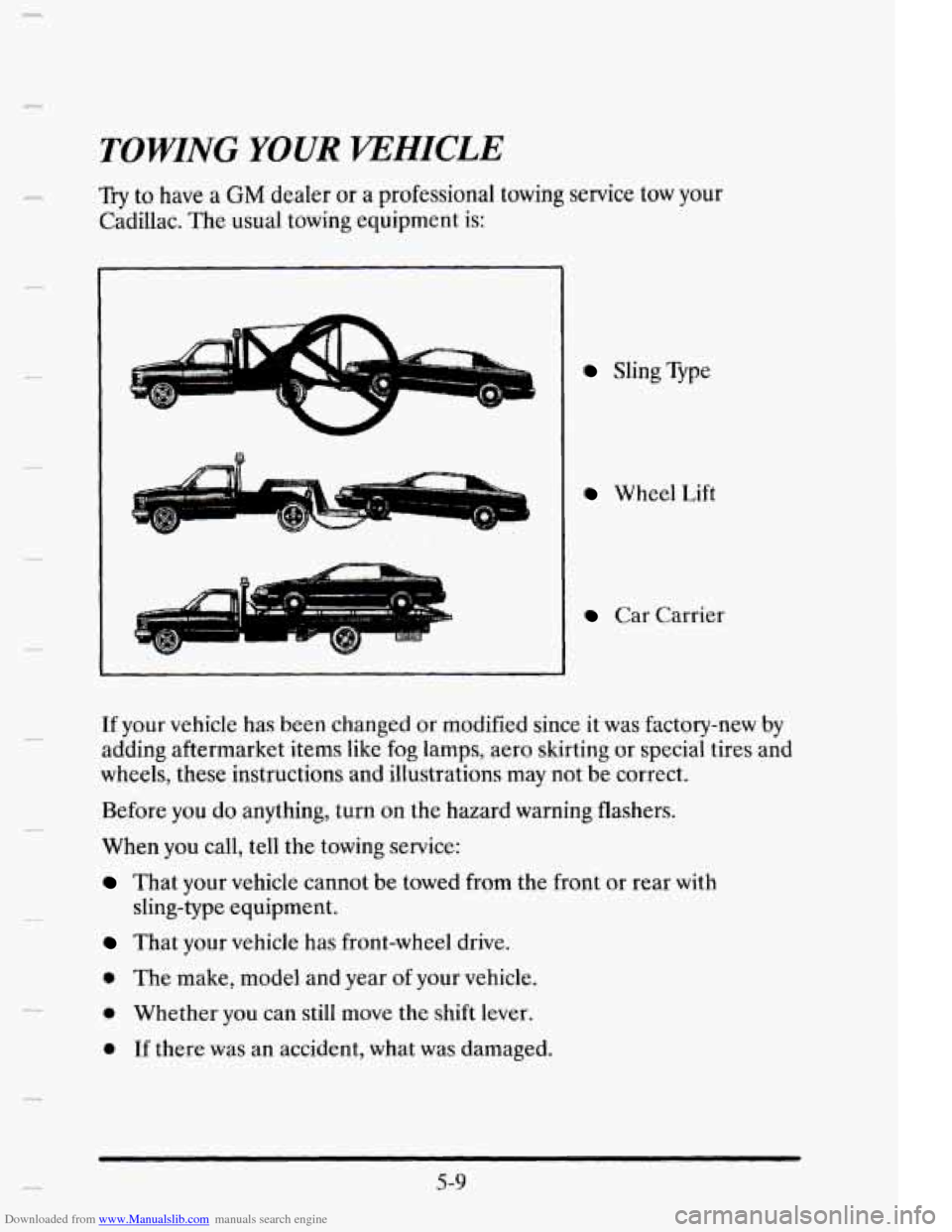
Try to have a GM dealer or a professional towing service tow your
Cadillac. The usual towing equipment is:
W
W
W
W W
Sling Type
Wheel Lift
Car Carrier
If your vehicle has been changed or modified since it was factory-new by
adding aftermarket items Iike fog lamps, aero skirting
or special tires and
wheels, these instructions and illustrations may not be correct.
Before you do anything, turn on the hazard warning flashers.
When you call, tell the towing service:
That your vehicle cannot be towed from the front or rear with
That your vehicle has front-wheel drive.
0 The make, model and year of your vehicle.
0 Whether you can still move the shift lever.
0 If there was an accident, what was damaged.
sling-type
equipment.
5-9
Page 237 of 395
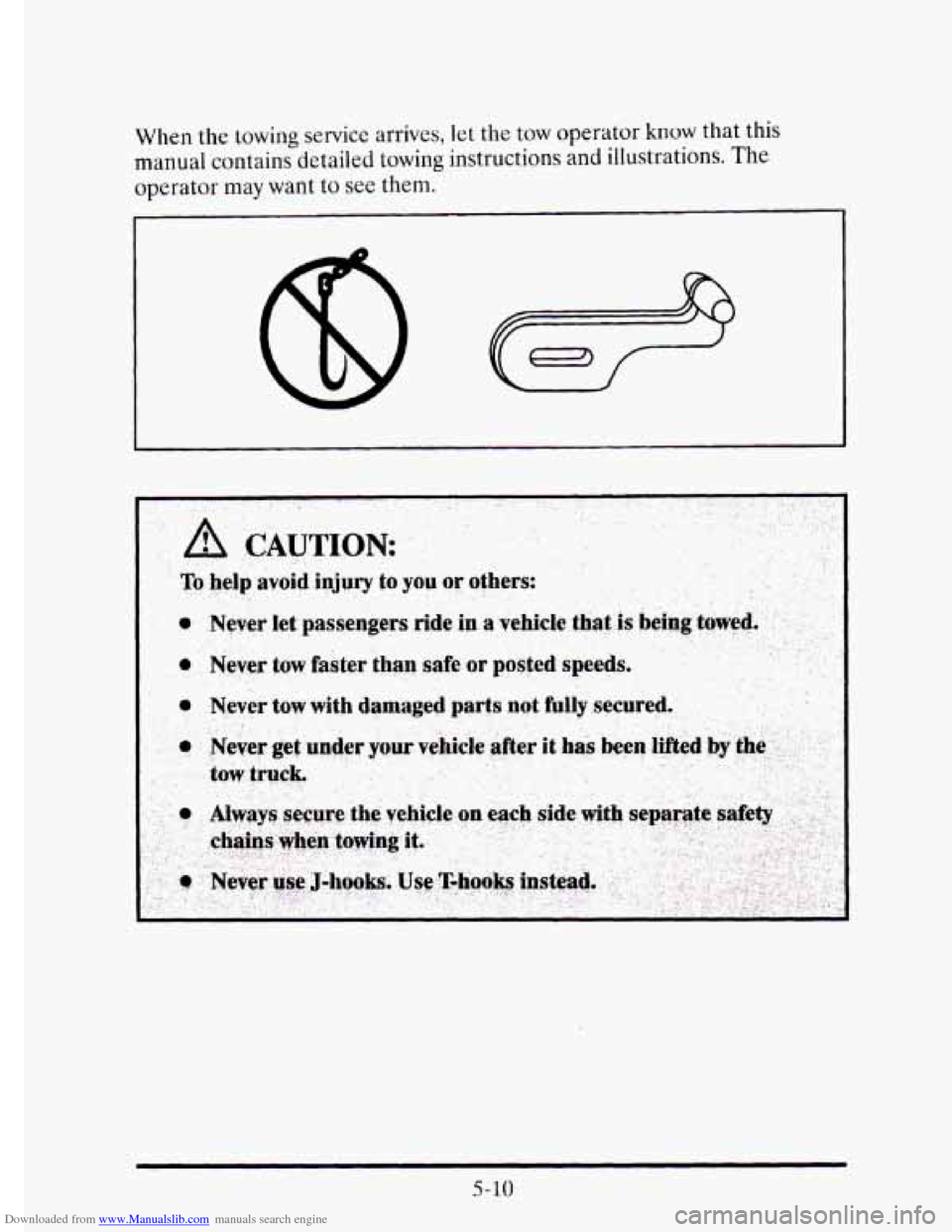
Downloaded from www.Manualslib.com manuals search engine When the towing service arrives, let the tow operator know that this
manual contains detailed
towing instructions and illustrations. The
operator may want to see them.
.. .. ..
5-10
Page 238 of 395
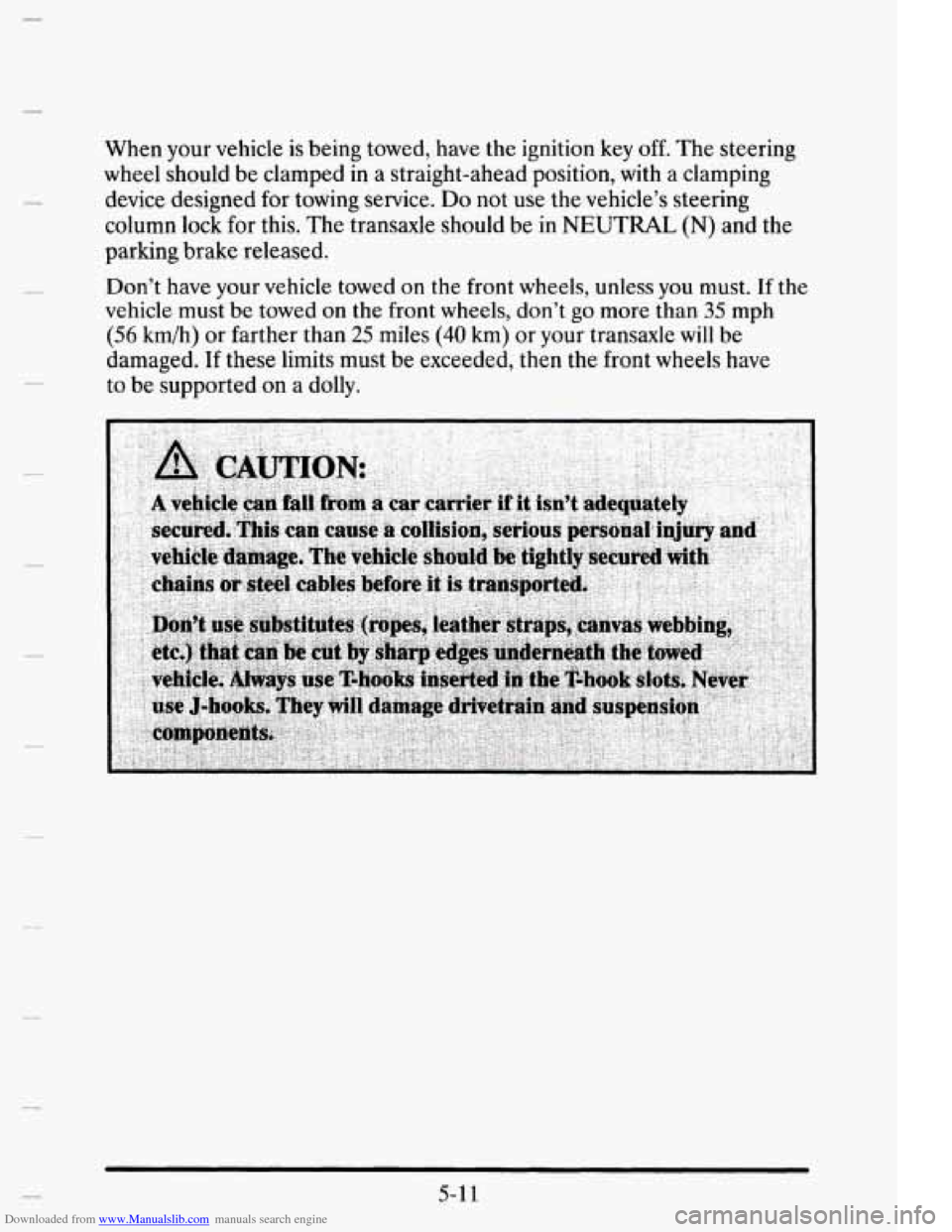
Downloaded from www.Manualslib.com manuals search engine When your vehicle is being towed, have the ignition key off. The steering
wheel should
be clamped in a straight-ahead position, with a clamping
device designed for towing service.
Do not use the vehicle’s steering
column lock
for this. The transaxle should be in NEUTRAL (N) and the
parking brake released.
Don’t have your vehicle towed
on the front wheels, unless you must. If the
vehicle must
be towed on the front wheels, don’t go more than 35 mph
(56 km/h) or farther than 25 miles (40 km) or your transaxle will be
damaged. If these limits must be exceeded, then the front wheels have
to be supported on a dolly.
5-1 1
Page 239 of 395
Downloaded from www.Manualslib.com manuals search engine ENGINE OKEMEATING
The Driver Information Center will display either ENGINE COOLANT
HOT-IDLE ENGINE or
STOP ENGINE ENGINE OVERHEATING.
In addition you will find the warning light about a hot engine on your
instrument panel on Canadian vehicles.
Overheated Engine Protection Operating Mode
Should a low coolant condition exist and the message STOP ENGINE
ENGINE OVERHEATING is displayed, an overheat protection mode
which alternates firing groups of four cylinders helps prevent engine
damage. This operating
mode allows your vehicle to be driven to a safe
place
in an emergency; you may drive up to 50 miles (80 km). Towing a
trailer in the overheat protection mode should be avoided.
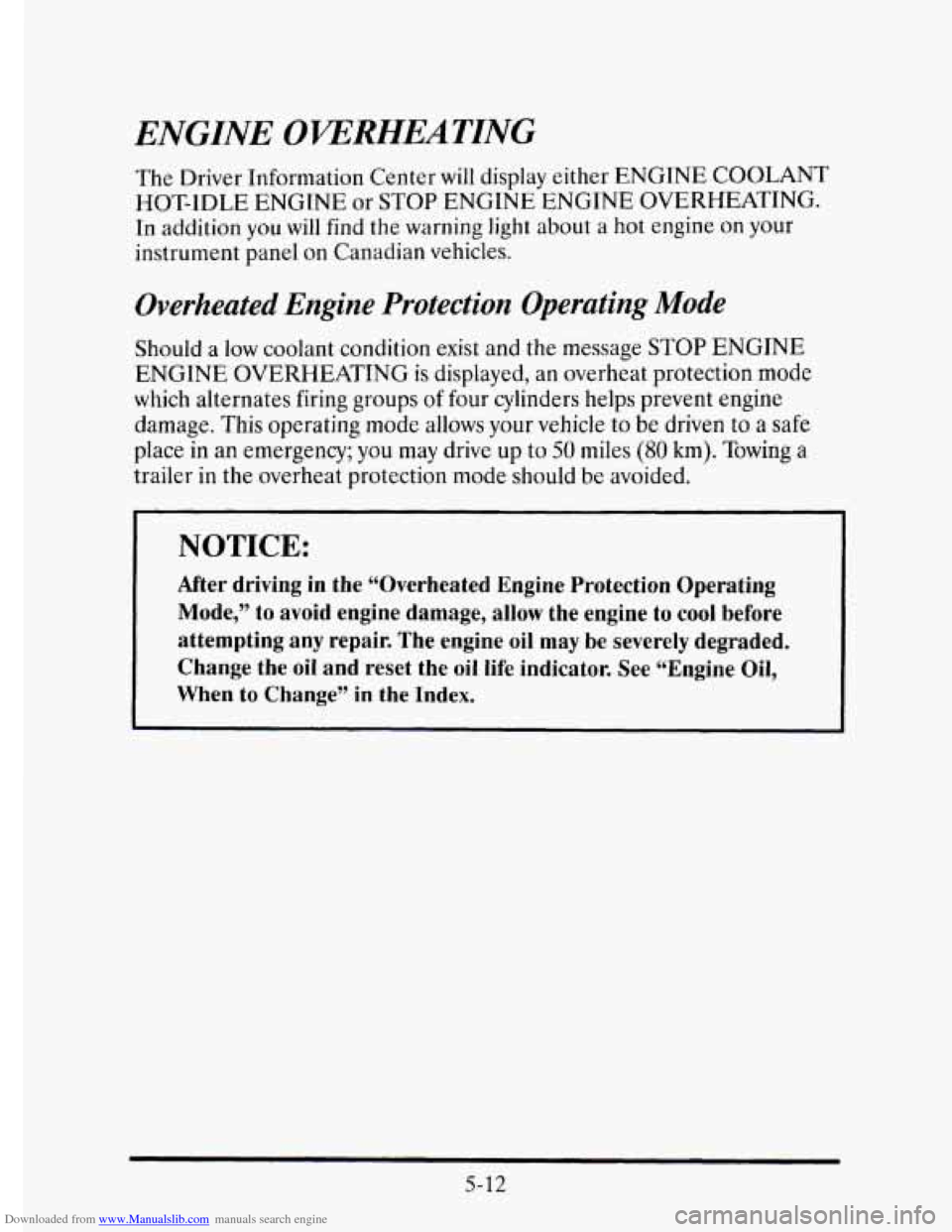
NOTICE:
After driving in the “Overheated Engine Protection Operating
Mode,” to avoid engine damage, allow the engine
to cool before
attempting any repair. The engine oil may be severely degraded.
Change the oil and reset the
oil life indicator. See “Engine Oil,
When
to Change” in the Index.
5-12
Page 241 of 395
Downloaded from www.Manualslib.com manuals search engine If No Steam Is Coming From Your Engine
If you get the overheat warning but see or hear no steam, the problem
may not be
too serious. Sometimes the engine can get a little too hot
when you:
0 Climb a long hili on a hot day.
0 Stop after high speed driving.
Idle for long periods in traffic.
Tow a trailer.
If you get the overheat warning with no sign of steam,
try this for a minute
or
so:
1. Turn off your air conditioner.
2. Dial temperature control to the highest heat setting and open the
window,
as necessary.
3. If you’re in a traffic jam, shift to NEUTRAL (N); otherwise, shift to
the highest gear wh.ile driving
-- AUTOMATIC OVERDRIVE (@) or
THIRD (3).
If you no longer have the overheat warning, you can drive. Just to be safe,
drive slower for about
10 minutes. If the warning doesn’t come back on,
you
can drive normally.
If the warning continues,
pull over, stop, and park your vehicle right away.
If there’s
still no sign of steam, you can idle the engine for two or three
minutes while you’re parked,
to see if the warning stops. But then, if you
still have the warning, turn off the engine and get everyone out of the vehicle
until it cools down. Also, See “Overheated Engine Protection Operating
Mode’’ listed previously
in this section.
5-14
You may decide not to lift the hood but to get service help right away.
Page 248 of 395
Downloaded from www.Manualslib.com manuals search engine .. i
k
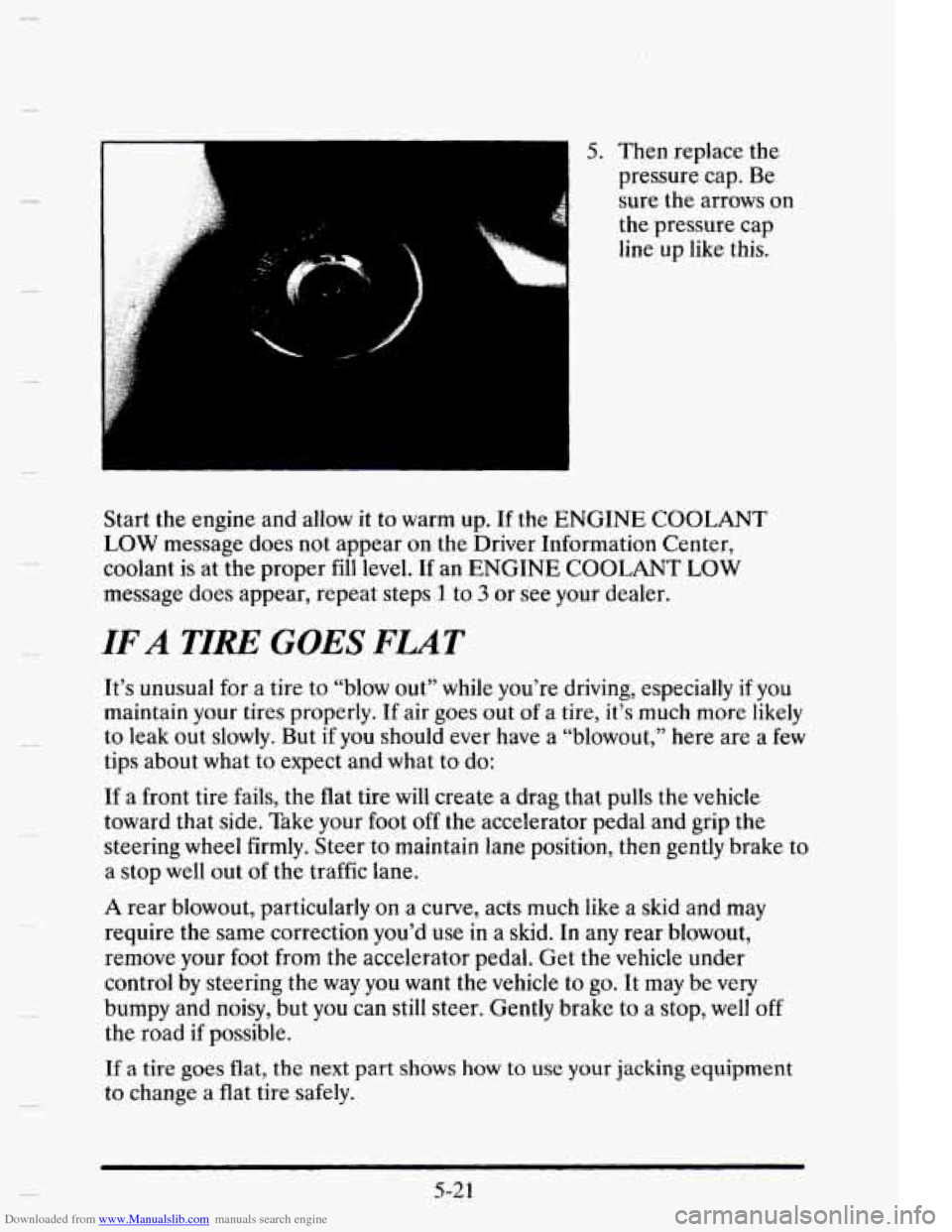
5. Then replace the
pressure cap. Be
sure
the arrows on
the pressure cap
line up
like this.
Start the engine and allow
it to warm up. If the ENGINE COOLANT
LOW message does not appear on the Driver Information Center,
coolant
is at the proper fill level. If an ENGINE COOLANT LOW
message does appear, repeat steps 1 to 3 or see your dealer.
IF A TIRE GOES FLAT
It’s unusual for a tire to “blow out” while you’re driving, especially if you
maintain your tires properly.
If air goes out of a tire, it’s much more likely
to leak out slowly. But
if you should ever have a “blowout,” here are a few
tips about what to expect and what to do:
If a front tire fails, the flat tire will create a drag that pulls the vehicle
toward that side. Take your foot
off the accelerator pedal and grip the
steering
wheel firmly. Steer to maintain lane position, then gently brake to
a stop well out of
the traffic lane.
A rear blowout, particularly on a curve, acts much like a skid and may
require the same correction you’d use
in a skid. In any rear blowout,
remove your foot from the accelerator pedal. Get the vehicle under
control by steering
the way you want the vehicle to go. It may be very
bumpy and noisy, but you can still steer. Gently brake to a stop, well off
the road if possible.
If a tire goes flat, the next part shows how to use your jacking equipment
to change a flat tire safely.
5-2 1