check engine light CADILLAC ELDORADO 1996 10.G User Guide
[x] Cancel search | Manufacturer: CADILLAC, Model Year: 1996, Model line: ELDORADO, Model: CADILLAC ELDORADO 1996 10.GPages: 354, PDF Size: 19.33 MB
Page 141 of 354
Downloaded from www.Manualslib.com manuals search engine CHECK BRAKE FLUID LEVEL - 37: This message
will display if the ignition
is in the RUN position to
inform the driver that the brake fluid level is low. Check
the brake reservoir level and add fluid as needed. Have
the brake system serviced by a Cadillac technician as
soon as possible. If the brake warning light is on, follow
the directions in that part.
CHECK COOLANT LEVEL - 02: This message will
appear when there is a low level of engine coolant. Have
the cooling system serviced by a Cadillac technician as
soon as possible.
CHECK FUEL GAGE - 39: This message will appear
when the
fuel supply is less than four gallons (I 5.2 L)
and the display is turned off (digital clusters only).
CHECK OIL LEVEL - 36: For correct operation of
the low oil sensing system, your vehicle should be on a
level surface.
A false CHECK OIL LEVEL message
may appear
if the vehicle is parked on grades. The oil
level sensing system does not check for actual oil level
if the engine has been off for a short period of time, and
the oil level is never sensed while the engine is running.
If the CHECK
OIL LEVEL message appears, and your
vehicle has been parked
on level ground with the engine
off for at least
30 minutes, the oil level should be checked
by observing the oil dipstick. Prior to checking
the oil level be sure
the engine has been off for five
minutes and your vehicle
is on a level surface. Then
check the dipstick and add oil if necessary. See “Engine
Oil”
in the Index.
CHECK WASHER FLUID - 25: This message will
appear for several seconds indicating that you need
washer solvent.
CRUISE ENGAGED - 43: This message will appear
for a few seconds when you select a speed at which
to cruise.
DOOR OPEN - 141: The passenger’s door is open or
ajar when this message appears. The vehicle’s engine
must be running and the transaxle
not in PARK (P) for
this message to display.
A chime will also sound when
the vehicle’s speed is greater than
5 mph (8.1 km/h).
DRIVER DOOR OPEN - 140: This message
will display when the vehicle is being shifted out of
PARK (P) with the engine running to signal that the
driver’s door
is open or ajar. A chime will also sound
when the vehicle’s speed is greater than 5 mph
(8.1 km/h).
2-80
Page 167 of 354
Downloaded from www.Manualslib.com manuals search engine LEVEL: Press the plus or minus symbol on this button
to adjust the amount of effect desired when in
DSP
mode. Some experimenting with this button will help
you determine the best sound.
Adjusting the Speakers
BAL: Press this button lightly so it extends. Turn the
BAL knob to move the sound to the left or right
speakers. The middle position is a detent and balances
the speakers. Turn the knob clockwise to adjust sound to
the right speakers and counterclockwise for left
speakers.
FADE: Press this button lightly so it extends. Turn the
FADE knob to move the sound to the front or rear
speakers. The middle position is a detent and balances
the speakers. Turn the knob clockwise to adjust the
sound to the front speakers and counterclockwise for
rear speakers.
Push the knobs back in when you’re not using them.
Playing a Cassette Tape
With the radio on, insert a cassette tape. The tape will
begin playing as soon as
it is inserted. While the tape
is playing, use the VOL, FADE, BAL,
TREB and BASS controls just as you do for the radio.
Other controls may have different functions when a tape
is inserted. The display will show TAPE with an arrow
to indicate which side of the tape is playing.
PLAY will
appear on the display when a tape is playing.
If an error occurs while trying
to play a cassette tape, it
could be that:
The cassette tape is tight and the cassette player
cannot turn the hubs of the tape. (Hold the cassette
tape with the open end down and try turning the right
hub counterclockwise with a pencil. Flip the tape
over and repeat. If the hubs do not turn easily, your
cassette tape may
be damaged and should not be
used
in the player. Try a new tape to be sure your
player is working properly.
0 The cassette tape is broken. (Check to see if your
tape
is broken. Try a new tape.)
Note that cassette tape adapter kits for portable compact
disc players will not work
in your cassette player. These
adapters
will cause an error message to show on the
display, and the adapter cassette
will be ejected.
3-20
Page 189 of 354
Downloaded from www.Manualslib.com manuals search engine Avoid needless heavy braking. Some people drive in
spurts -- heavy acceleration followed by heavy
braking
-- rather than keeping pace with traffic. This is a
mistake. Your brakes may not have time to cool between
hard stops. Your brakes will wear out much faster
if you
do a lot of heavy braking. If you keep pace with the
traffic and allow realistic following distances, you
will
eliminate a lot of unnecessary braking. That means
better braking and longer brake life.
If your engine ever stops while you’re driving, brake
normally but don’t pump your brakes. If you do, the
pedal may get harder
to push down. If your engine
stops,
you will still have some power brake assist. But
you will use it when
you brake. Once the power assist is
used
up, it may take longer to stop and the brake pedal
will be harder to push. Your
vehicle has anti-lock brakes
(ABS). ABS is an
advanced electronic braking system that will help
prevent
a braking skid.
When you start your engine and begin to drive away,
your anti-lock brake system will check itself. You may
hear
a momentary motor or clicking noise while this test
is going on, and you may even notice that your brake
pedal moves a little. This is normal,
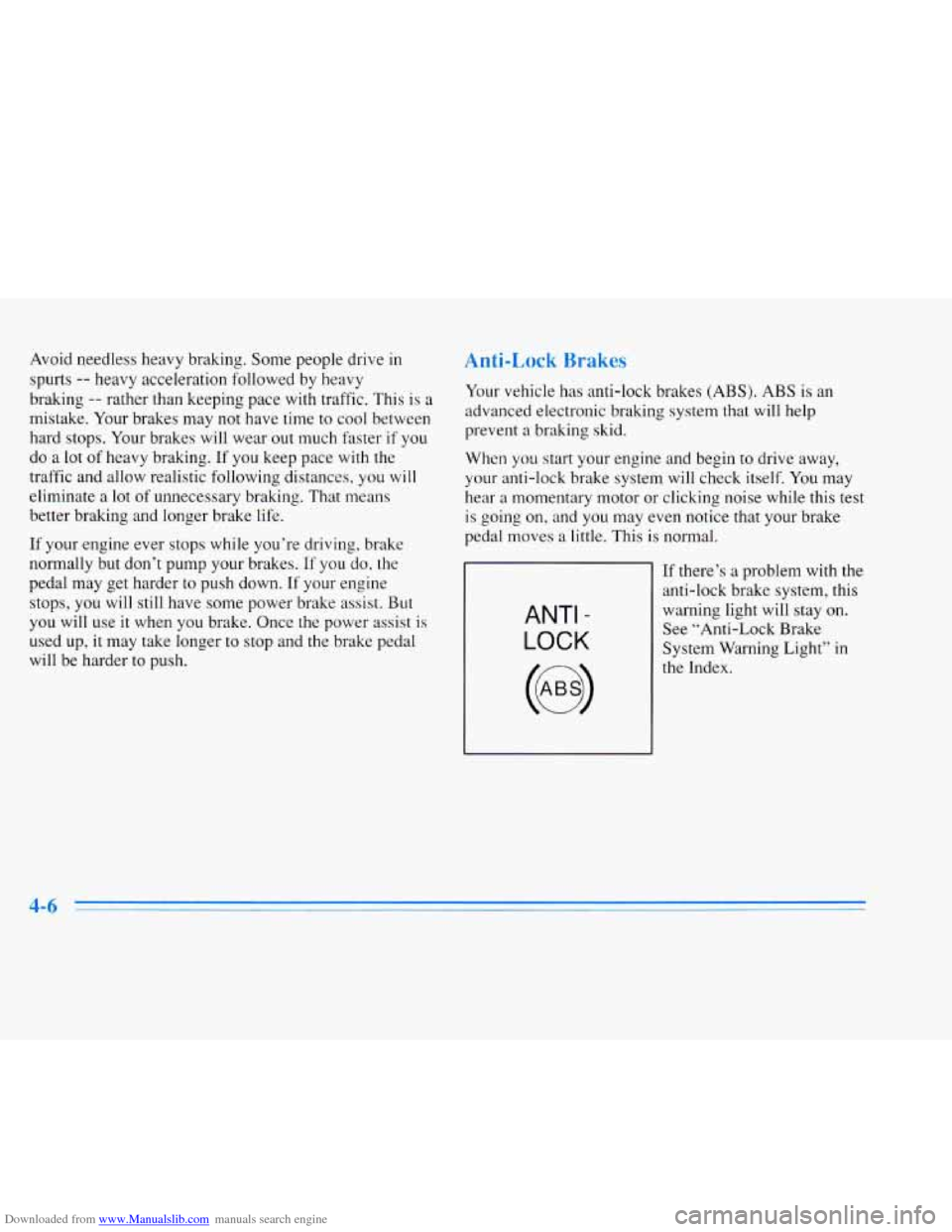
ANTI -
LOCK
If there’s a problem with the
anti-lock brake system, this
warning light will stay on.
See “Anti-Lock Brake
System Warning Light” in
the Index.
Page 199 of 354
Downloaded from www.Manualslib.com manuals search engine Here are some tips on night driving.
Drive defensively.
Don’t drink and drive.
Since you can’t see as well, you may need to slow
down and keep more space between you and other
vehicles.
Slow down, especially on higher speed roads. Your
headlamps can light
up only so much road ahead.
In remote areas, watch for animals.
If you’re tired, pull off the road in a safe place and
rest.
Night ’
No one can see as well at night as in the daytime. But as
we get older these differences increase.
A 50-year-old
driver may require at least twice as much light to see the
same thing at night as a 20-year-old.
What
you do in the daytime can also affect your night
vision. For example,
if you spend the day in bright
sunshine you are wise to wear sunglasses. Your eyes
will
have less trouble adjusting to night. But if you’re
driving, don’t wear sunglasses at night. They may cut
down
on glare from headlamps, but they also make a lot
of things invisible. You
can be temporarily blinded by approaching
headlamps. It can take a second or two,
or even several
seconds, for your eyes to readjust to the dark. When
you
are faced with severe glare (as from a driver who
doesn’t lower the high beams, or a vehicle with
misaimed headlamps),
slow down a little. Avoid staring
directly into the approaching headlamps.
Keep your windshield and all the glass
on your vehicle
clean
-- inside and out. Glare at night is made much
worse by dirt on the glass. Even the inside of the glass
can build up a film caused by dust. Dirty glass makes
lights dazzle and flash more than clean glass would,
making the pupils
of your eyes contract repeatedly.
Remember
that your headlamps light up far less of a
roadway when you are in a turn or curve. Keep your
eyes moving; that way, it’s easier
to pick out dimly
lighted objects. Just as your headlamps should be
checked regularly for proper aim,
so should your eyes
be examined regularly. Some drivers suffer from night
blindness
-- the inability to see in dim light -- and aren’t
even aware of it.
4-16 -
Page 203 of 354
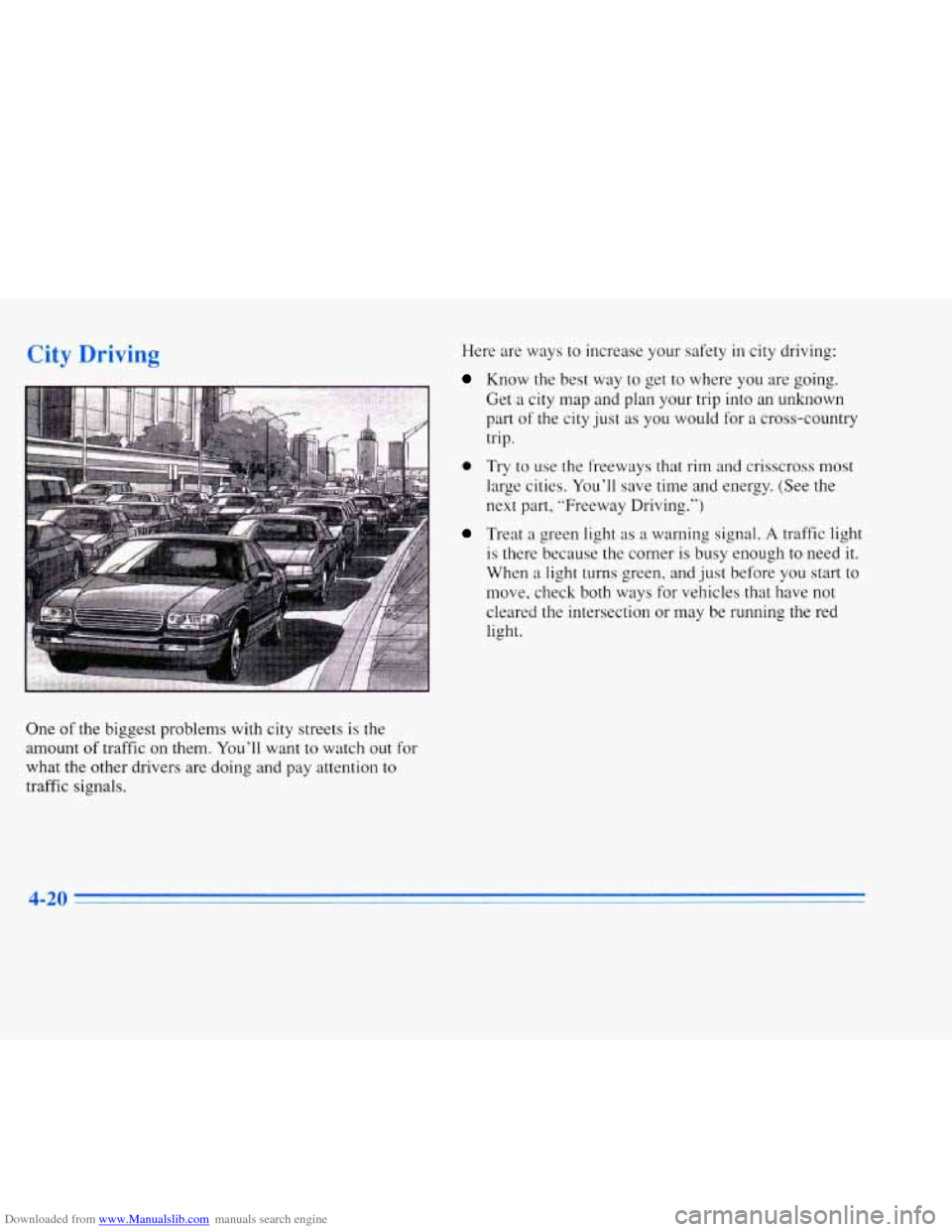
Downloaded from www.Manualslib.com manuals search engine City Drivirm
One of the biggest problems with city streets is the
amount
of traffic on them. You’ll want to watch out for
what the other drivers are doing and pay attention
to
traffic signals. Here are ways to increase your safety
in city driving:
Know the best way to get to where you are
going.
Get a city map and plan your trip into an unknown
part
of the city just as you would for a cross-country
trip.
0 Try to LIS~ the freeways that rim and crisscross most
large cities.
You’ll save time and energy. (See the
next part, “Freeway Driving.”)
Treat a green light as a warning signal. A traffic light
is there because the corner is busy enough to need it.
When
a light turns green, and just before you start to
move, check both ways for vehicles that have not
cleared the intersection or may be running the red
light.
Page 204 of 354
Downloaded from www.Manualslib.com manuals search engine 4 reeway urwm
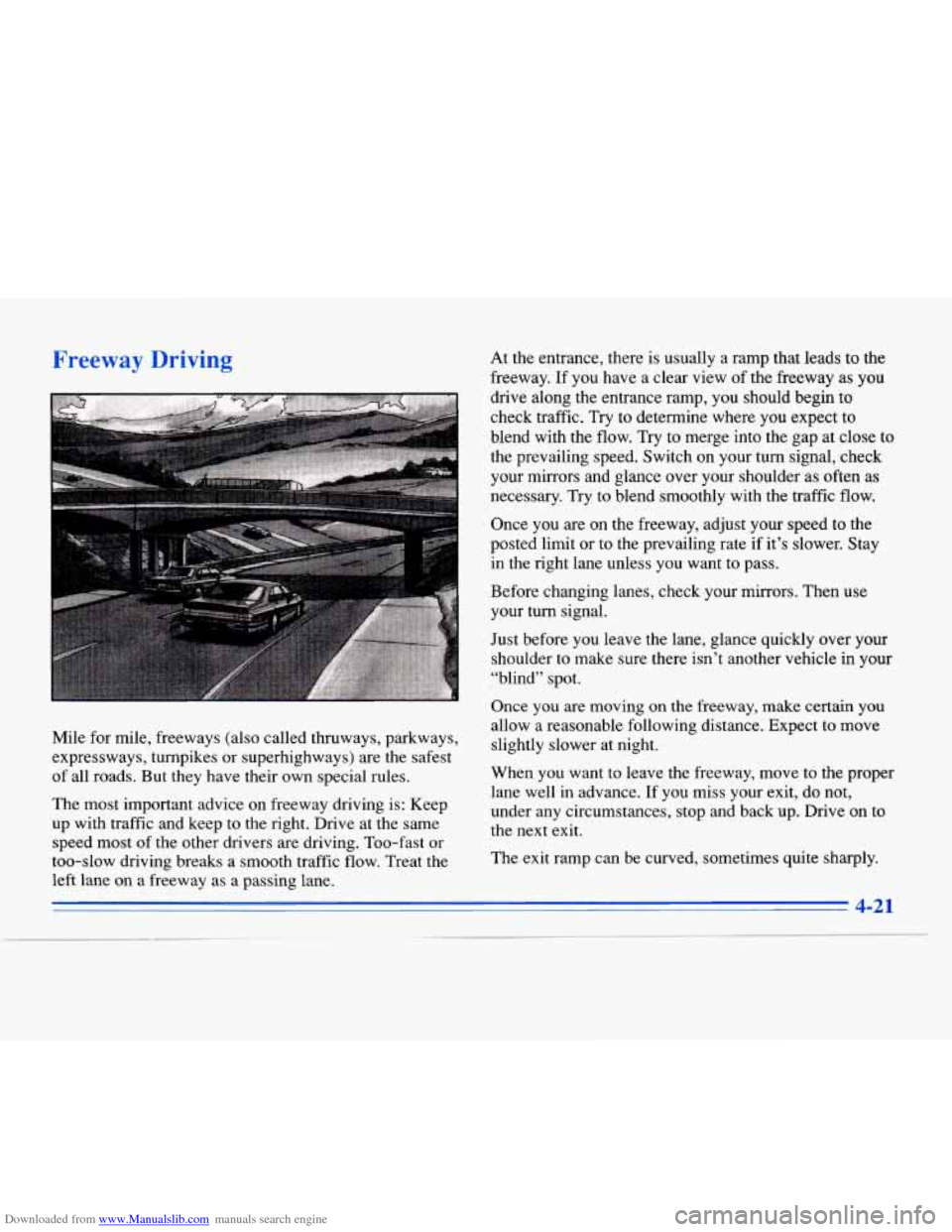
Mile for mile, freeways (also called thruways, parkways,
expressways, turnpikes or superhighways) are the safest
of all roads. But they have their own special rules.
The most important advice on freeway driving is: Keep
up with traffic and keep to the right. Drive at the same
speed most of the other drivers are driving. Too-fast or
too-slow driving breaks a smooth traffic flow. Treat the
left lane on a freeway as
a passing lane. At
the entrance, there
is usually a ramp that leads to the
freeway.
If you have a clear view of the freeway as you
drive along the entrance ramp, you should begin to
check traffic. Try
to determine where you expect to
blend with the flow. Try to merge into the gap at close to
the prevailing speed. Switch on your turn signal, check
your mirrors and glance over your shoulder as often as
necessary. Try to blend smoothly with the traffic flow.
Once you are on the freeway, adjust your speed
to the
posted limit or to the prevailing rate if it’s slower. Stay
in the right lane unless you want to pass.
Before changing lanes, check your mirrors. Then use
your turn signal.
Just before you leave the lane, glance quickly over your
shoulder to make sure there isn’t another vehicle in your
“blind” spot.
Once you are moving on
the freeway, make certain you
allow a reasonable following distance. Expect to move
slightly slower at night.
When you want to leave the freeway, move to the proper
lane well in advance. If you miss your exit, do not,
under any circumstances, stop and back
up. Drive on to
the next exit.
The exit ramp can be curved, sometimes quite sharply.
Page 226 of 354
Downloaded from www.Manualslib.com manuals search engine 6. Check that the jumper cables don’t have loose or
missing insulation.
If they do, you could get a shock.
The vehicles could also be damaged.
Before you connect the cables, here are some things
you should know. Positive
(+) will go to positive (+)
and negative (-) will go to negative (-) or a metal
engine part. Don’t connect positive
(+) to negative (-)
or you’ll get a short that would damage the battery and
maybe other parts, too.
Using a match near a battery can cause battery
gas to explode. People have been hurt doing this,
and some have been blinded. Use
a flashlight if
you need more light.
Be sure the battery has enough water. You don’t
need to add water to the Delco Freedom@ battery
installed in every new
GM vehicle. But if a
battery has filler caps, be sure the right amount
of fluid is there. If it is low,
add water to take care
of that first.
If you don’t, explosive gas could be
present.
Battery fluid contains acid that can burn you.
Don’t get it on you. If you accidentally get it in
your eyes
or on your skin, flush the place with
water and get medical help immediately.
Fans or other moving engine parts can injure you
badly. Keep your hands away from moving parts
once the engines are running.
5-5
Page 280 of 354
Downloaded from www.Manualslib.com manuals search engine Checking Coolant
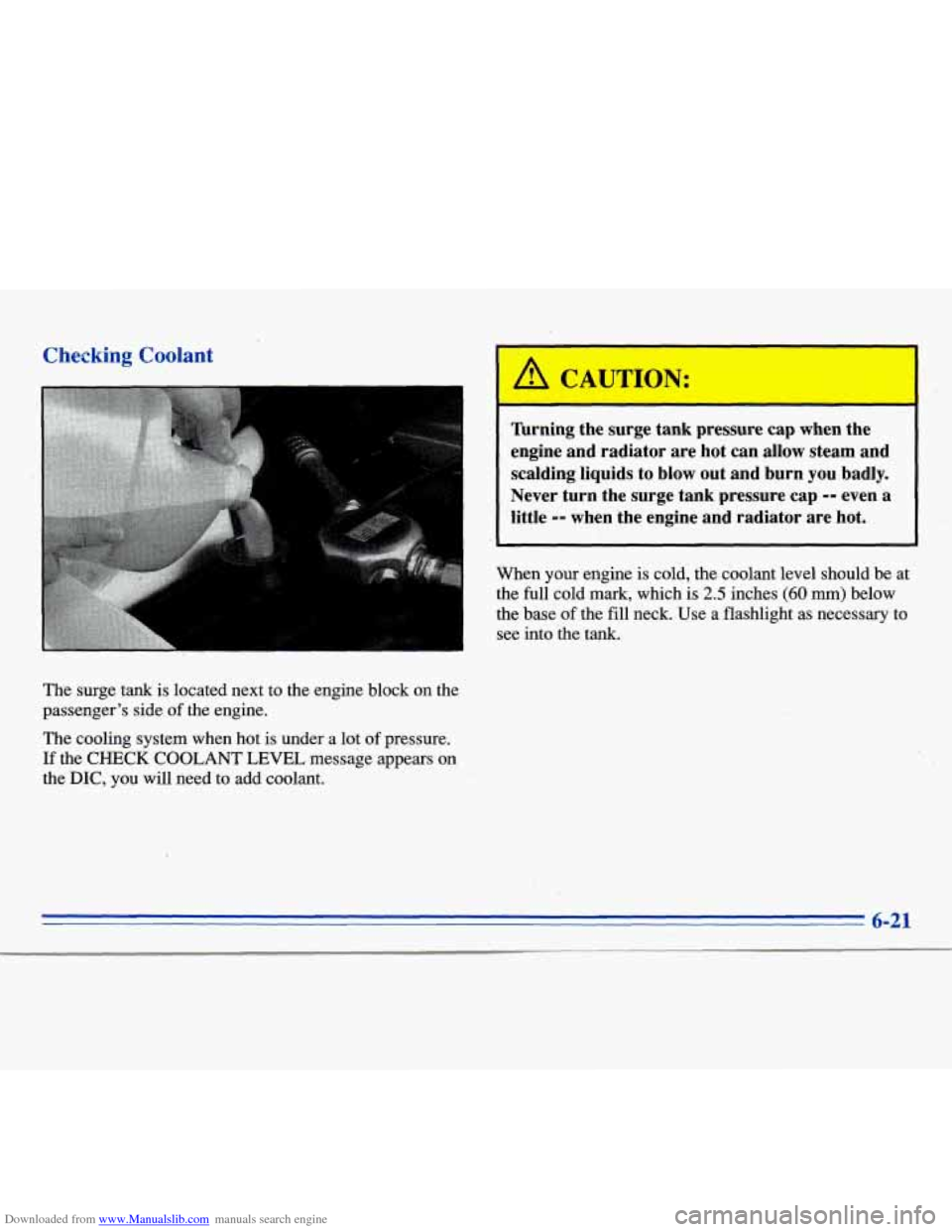
The surge tank is located next to the engine block on the
passenger’s side of the engine.
The cooling system when hot is under
a lot of pressure.
If the CHECK COOLANT LEVEL message appears on
the
DIC, you will need to add coolant.
A CAUTION:
I
I
lhrning the surge tank pressure cap when the
engine and radiator are hot can allow steam and
scalding liquids
to blow out and burn you badly.
Never turn the surge tank pressure cap
-- even a
little
-- when the engine and radiator are hot.
When your engine is cold, the coolant level should be at
the full cold mark, which is
2.5 inches (60 mm) below
the base
of the fill neck. Use a flashlight as necessary to
see into the tank..
6-21
Page 343 of 354
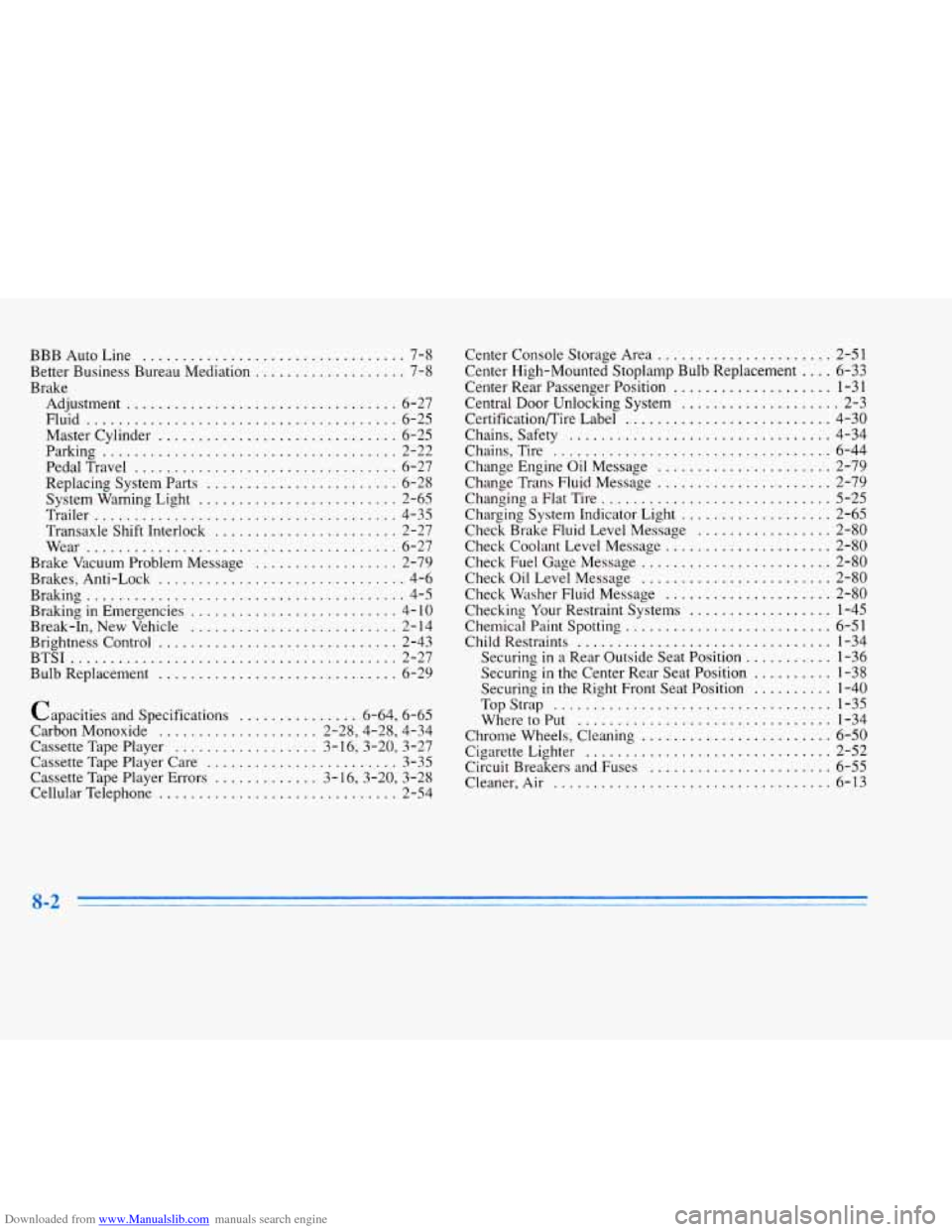
Downloaded from www.Manualslib.com manuals search engine BBB Auto Line ................................. 7-8
Better Business Bureau Mediation
................... 7-8
Brake Adjustment
.................................. 6-27
Fluid
....................................... 6-25
Master Cylinder
.............................. 6-25
Parking
..................................... 2-22
PedalTravel
................................. 6-27
Replacing System Parts
........................ 6-28
System Warning Light
......................... 2-65
Trailer
...................................... 4-35
Transaxle Shift Interlock
....................... 2-27
Wear
....................................... 6-27
Brake Vacuum Problem Message
.................. 2-79
Brakes. Anti-Lock
............................... 4-6
Braking
........................................ 4-5
Braking
in Emergencies .......................... 4- 10
Break-In. New Vehicle .......................... 2- 14
Brightness Control
.............................. 2-43
Bulb Replacement
.............................. 6-29
BTSI
......................................... 2-27
Capacities and Specifications
............... 6.64. 6.65
Carbon Monoxide
.................... 2.28.4.28. 4.34
Cassette Tape Player
.................. 3.16.3.20. 3.27
Cassette Tape Player Care
........................ 3-35
Cassette Tape Player Errors
............. 3.16. 3.20. 3.28
Cellular Telephone
.............................. 2-54 Center Console
Storage Area
...................... 2-51
Center High-Mounted Stoplamp Bulb Replacement
.... 6-33
Center Rear Passenger Position
.................... 1-31
Certificationnire Label
.......................... 4-30
Chains. Safety
................................. 4-34
Chains. Tire
................................... 6-44
Change Engine Oil Message
...................... 2-79
Changing a Flat Tire
............................. 5-25
Chargmg System Indicator Light
................... 2-65
Check Brake Fluid Level Message
................. 2-80
Check Coolant Level Message
..................... 2-80
Check Fuel Gage Message
........................ 2-80
Check Oil Level Message
........................ 2-80
Check %&her Fluid Message
..................... 2-80
Checking Your Restraint Systems
.................. 1-45
Chemical Paint Spotting
.......................... 6-51
Child Restraints
................................ 1-34
Securing in
a Rear Outside Seat Position ........... 1-36
Securing
in the Center Rear Seat Position .......... 1-38
Securing
in the Right Front Seat Position .......... 1-40
TopStrap
................................... 1-35
WheretoPut ................................ 1-34
Chrome Wheels. Cleaning
........................ 6-50
Circuit Breakers and Fuses
....................... 6-55
Cleaner. Air
................................... 6-13
Central Door Unlocking System
.................... 2-3
Change Trans Fluid Message
...................... 2-79
Cigarette Lighter
............................... 2-52
Page 345 of 354
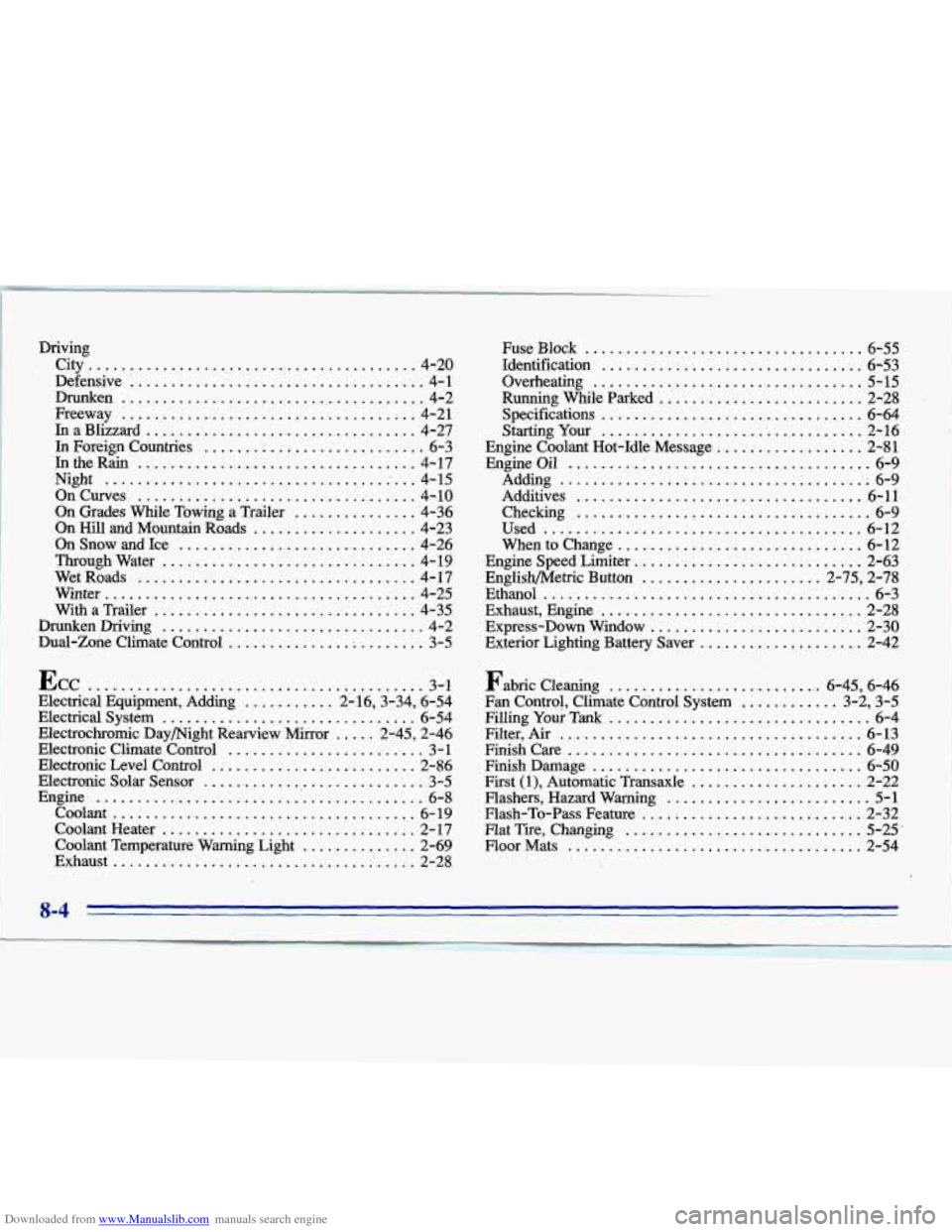
Downloaded from www.Manualslib.com manuals search engine Driving City
........................................ 4-20
Defensive
................................... 4-1
Drunken
..................................... 4-2
Freeway
.................................... 4-21
In Foreign Countries ....... 1 ................... 6-3
Night
....................................... 4-15
In a Blizzard .................................. 4-27
IntheRain
.................................. 4-17
On Curves
.................................. 4-10
On Grades While Towing a Trailer ............... 4-36
Through Water
............................... 4-19
Wet Roads
.................................. 4-17
Winter
...................................... 4-25
With a Trailer
................................ 4-35
On Hill and Mountain Roads .................... 4-23
On Snow and Ice
............................. 4-26
DrunkenDriving
................................ 4-2
Dual-Zone Climate Control
............... -, ........ 3-5
I ECC .......................................... 3-I
Electrical Equipment, Adding
........... 2-16,3-34, 6-54
Electrical System
............................... 6-54
Electronic Climate Control
........................ 3 - 1
Electronic Level Control ......................... 2-86
Electronic Solar Sensor
........................... 3-5
Coolant Heater
............................... 2-17
Coolant Temperature Warning Light
.............. 2-69
Electrochromic
Daymight Rearview Mirror
..... 2-45, 2-46
Engine
......................................... 6-8
Coolant
...................................... 6-19
Exhaust
...................................... 2-28 Fuse Block
.................................. 6-55
Overheating
................................. 5-15
Running
While Parked ......................... 2-28
Specifications
................................ 6-64
Starting Your ................................ 2-16
Engine Coolant Hot-Idle Message
.................. 2-81
Identification
................................. 6-53
Engine Oil ..................................... 6-9
Adding
...................................... 6-9
Additives 6-11
Used ....................................... 6-12
Engine Speed Limiter 2-63
Ethanol
........................................ 6-3
...................................
Checking .................................... 6-9
When to Change ............................... 6-12
English/Metric Button
...................... 2-75, 2-78
Exhaust, Engine
................................ 2-28
Express-Down Window
.......................... 2-30
Exterior Lighting Battery Saver
.................... 2-42
Fabric Cleaning
.................. 1 ........ 6-45, 6-46
Fan Control, Climate Control System
........... 3-2, 3-5
Filling
Your Tank ................................ 6-4
Finish Care
.................................... 6-49
First
(l), Automatic Transaxle ..................... 2-22
Flashers, Hazard Warning
......................... 5-1
Flat Tire, Changing
............................. 5-25
Floor Mats
.................................... 2-54
............................
Filter, Air ..................................... 6-13
FinishDamage
6-50 ! ..................................
Flash-To-PassFeature ........................... 2-32