maintenance CADILLAC ELDORADO 1996 10.G User Guide
[x] Cancel search | Manufacturer: CADILLAC, Model Year: 1996, Model line: ELDORADO, Model: CADILLAC ELDORADO 1996 10.GPages: 354, PDF Size: 19.33 MB
Page 277 of 354
Downloaded from www.Manualslib.com manuals search engine I 3.
5.
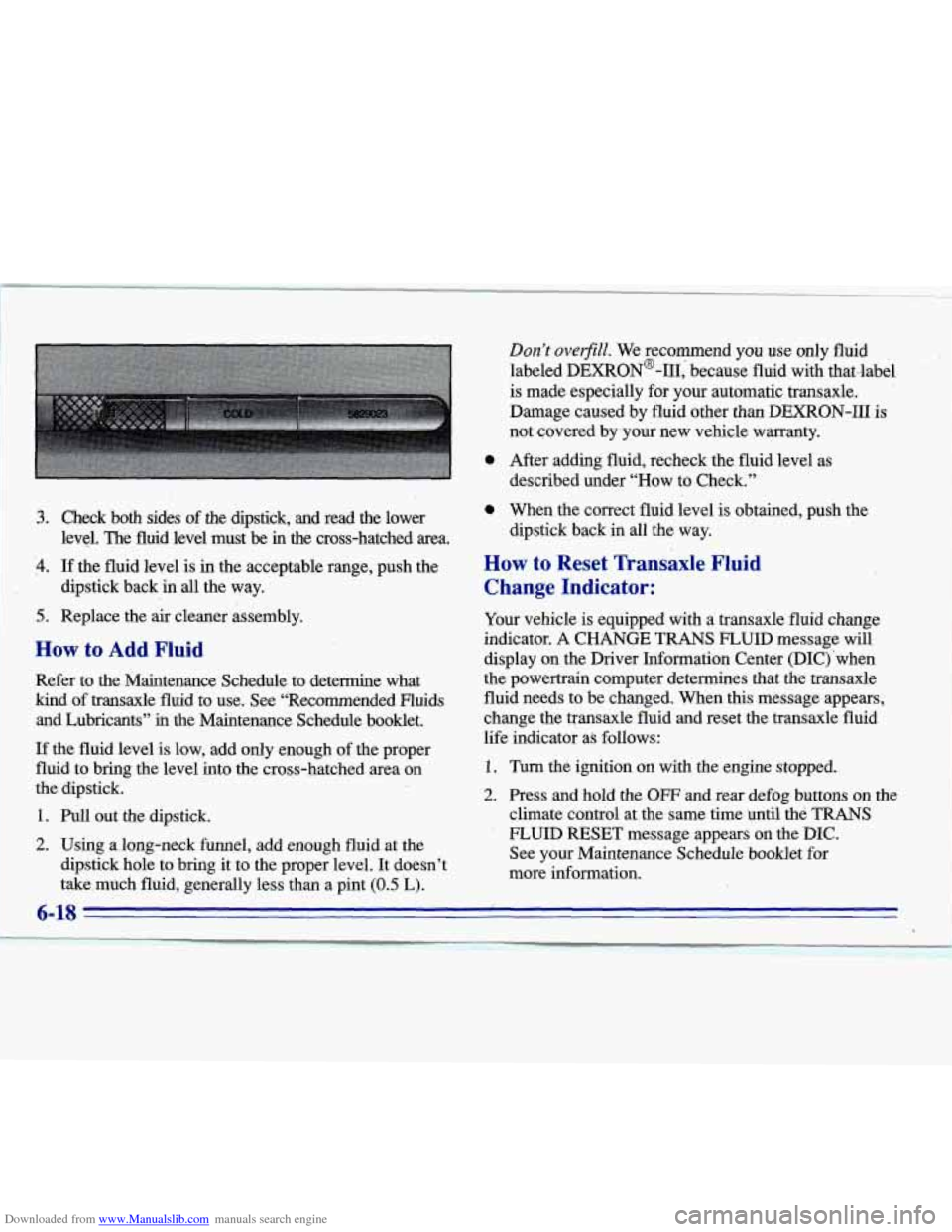
Check both sides of the dipstick, and read the lower
level. The fluid level must be in’the cross-hatched area.
If the fluid level is in the acceptable range, push the
dipstick back in all the way.
Replace the
air cleaner assembly.
How to Add Fluid
Refer to the Maintenance Schedule to determine what
kind of transaxle fluid to use. See “Recommended Fluids and Lubricants”
ii.1 the Maintenance Schedule booklet.
If the fluid level is low, add only,enough of the proper
fluid to bring the level into the cross-hatched area on
the dipstick. 1
1. Pull out the dipstick.
2. Using along-neck funnel, add enough fluid at the
dipstick hole to bring it to the proper level. It doesn’t
take,much fluid, generally less than a pint
(0.5 ‘L).
0
0
Don’t overfiill. We recommend you use only fluid
labeled DEXRON@-111, because fluid with that-label
is made especially for your automatic transaxle.
Damage caused by fluid other than DEXRON-I11
is
not covered by your new vehicle warranty.
After adding fluid, recheck the fluid level
as
described under “How to Check.”
When the correct fluid level is obtained, push the
dipstick back in all the way.
How to Reset Transaxle Fluid
Change Indicator:
Your vehicle is equipped with a transaxle fluid change
indicator.
A CHANGE TRANS FLUID message will
display on the Driver Information Center (DIC) ‘when
the powertrain computer determines that the transaxle
fluid needs to be changed. When
this message appears,
change the transaxle fluid and reset the transaxle fluid
life indicator as follows:
1. Turn the ignition on with the engine stopped.
2. Press and hold the OW and rear defog buttons on the
climate control at the same time until the
TRANS
- FLUID RESET message appears on the DIC.
See your Maintenance Schedule booklet
for
more information.
Page 282 of 354
Downloaded from www.Manualslib.com manuals search engine Thermostat
Engine coolant temperature is controlled by a thermostat
in the engine coolant system. The thermostat stops the
flow of coolant through the radiator until the coolant
reaches a preset temperature.
If your thermostat needs to be replaced, a General
Motors thermostat is recommended.
Power Steering Fluid
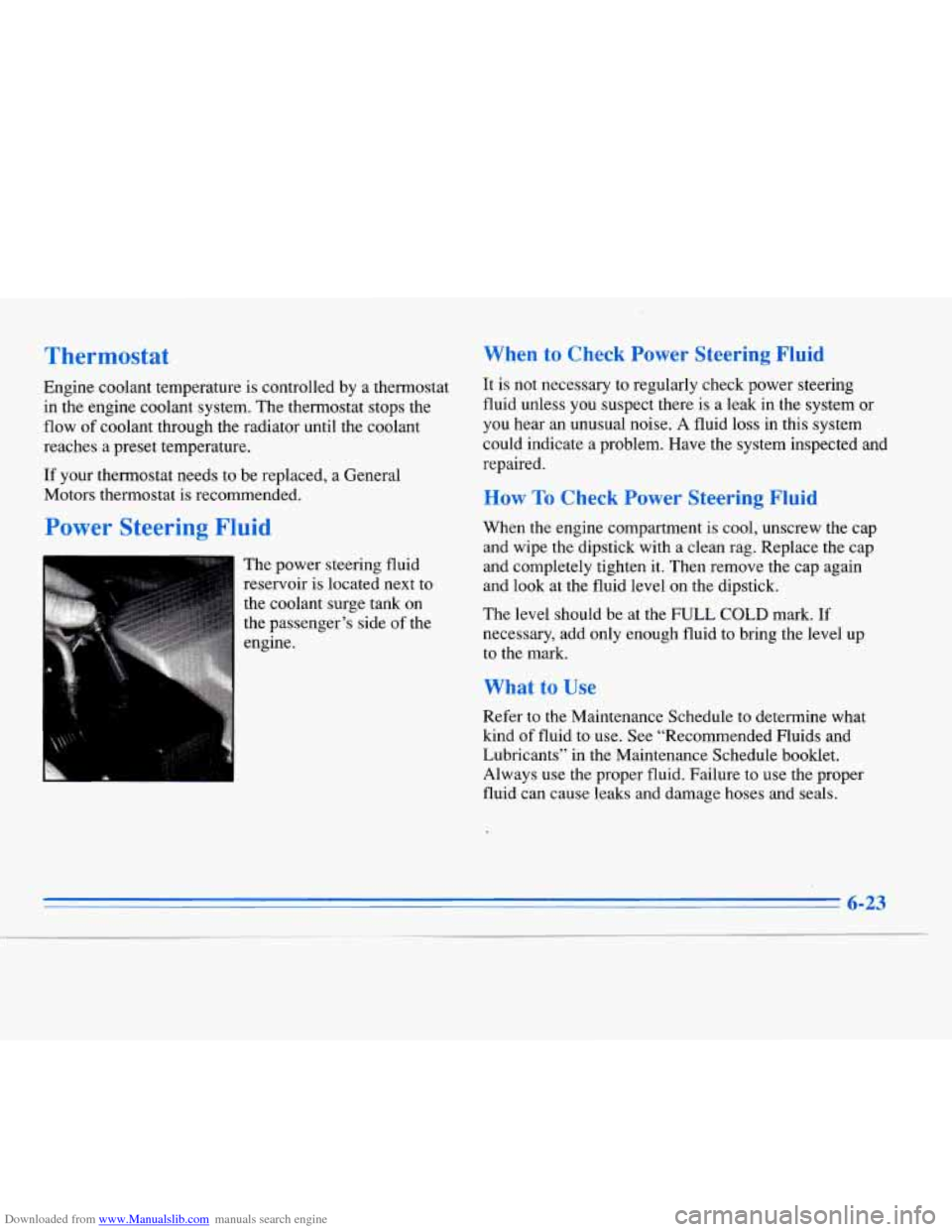
The power steering fluid
reservoir is located next to
the coolant surge tank on
the passenger’s side of the
engine.
When to Check Power Steering Fluid
It is not necessary to regularly check power steering
fluid unless you suspect there is a leak in the system or
you hear an unusual noise. A fluid loss in this system
could indicate a problem. Have the system inspected and
repaired.
How To Check Power Steering Fluid
When the engine compartment is cool, unscrew the cap
and wipe the dipstick with a clean rag. Replace the cap
and completely tighten
it. Then remove the cap again
and look at the fluid level on the dipstick.
The level should be at the FULL
COLD mark. If
necessary, add only enough fluid to bring the level up
to the mark.
What to Use
Refer to the Maintenance Schedule to determine what
kind of fluid to use. See “Recommended Fluids and
Lubricants” in the Maintenance Schedule booklet.
Always use the proper fluid. Failure to use the proper
fluid can cause leaks and damage hoses and seals.
6-23
Page 294 of 354
Downloaded from www.Manualslib.com manuals search engine Wiper Blade Replacement
It’s a good idea to clean or replace the wiper blade
assembly on a regular basis or when worn. For proper
windshield wiper blade length and type, see “Normal
Maintenance Replacement Parts” later in this section.
To replace the wiper blade assembly:
1. Turn the ignition key to ACCESSORY and turn the
wipers on. Position the wipers on the windshield in
the “mid” wipe position. Then with the door open,
turn the key to OFF.
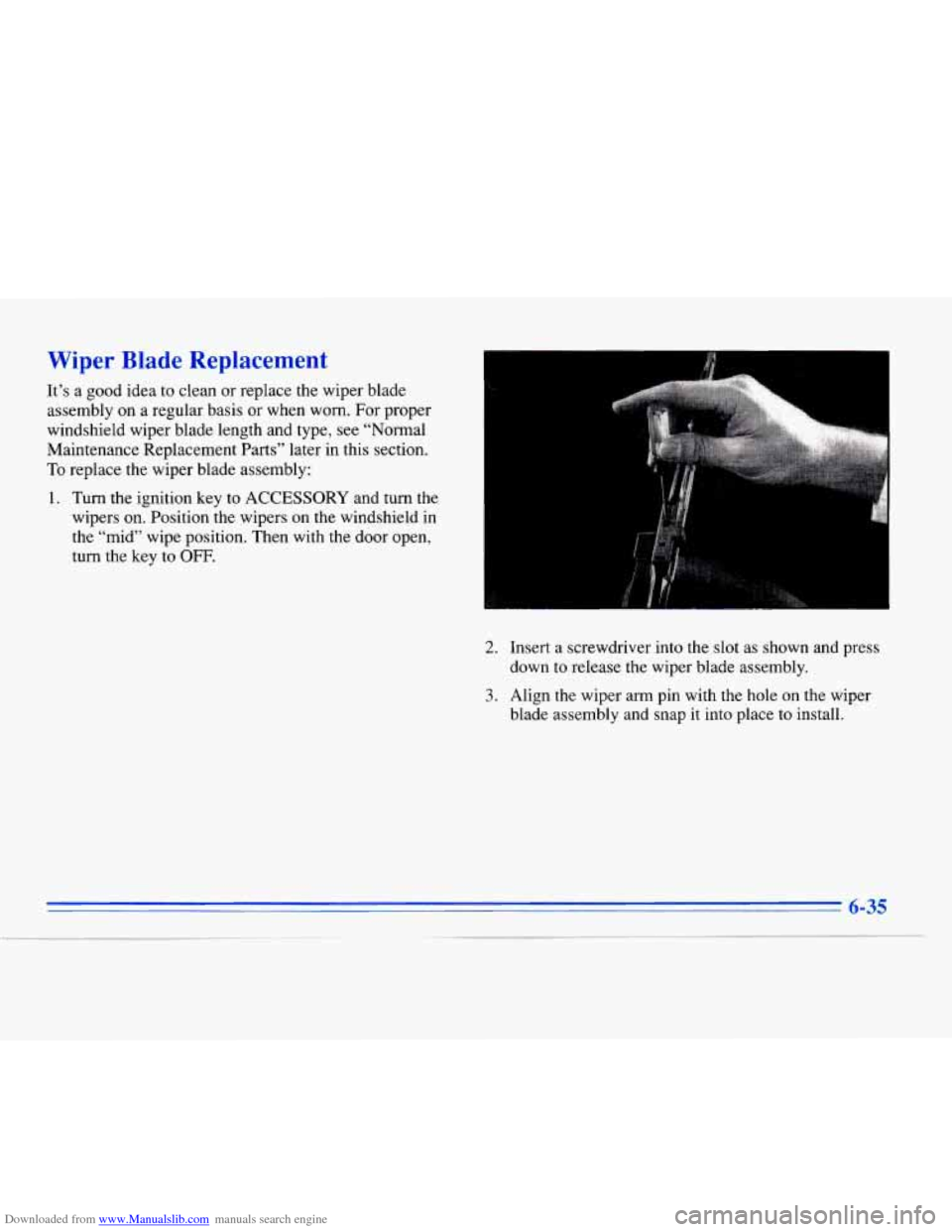
2. Insert a screwdriver into the slot as shown and press
down to release the wiper blade assembly.
3. Align the wiper arm pin with the hole on the wiper
blade assembly and snap it into place to install.
6-35
1
Page 297 of 354
Downloaded from www.Manualslib.com manuals search engine When to Check
Check your tires once a month or more.
Don’t forget your compact spare tire. It should
be at
60 psi (420 Wa).
How to Check
Use a good quality pocket-type gage to check tire
pressure.
You can’t tell if your tires are properly inflated
simply by looking at them. Radial tires may look
properly inflated even when they’re underinflated.
Be sure to put the valve caps back on the valve stems.
They help prevent
le:.& by keeping out dirt and
moisture.
Tire Inspection and Rotation
Tires should be inspected every 6,000 to 8,000 miles
(10 000 to 13 000 km) for any signs of unusual wear.
If unusual wear is present, rotate your tires as soon as
possible and check wheel alignment. Also check for
damaged tires or wheels. See “When It’s Time for
New
Tires” and “Wheel Replacement” later in this section for
more information. The
purpose
of regular rotation is to achieve more
uniform wear for all tires on
the vehicle. The first
rotation
is the most important. See “Scheduled
Maintenance Services”
in the Maintenance Schedule
booklet for scheduled rotation intervals.
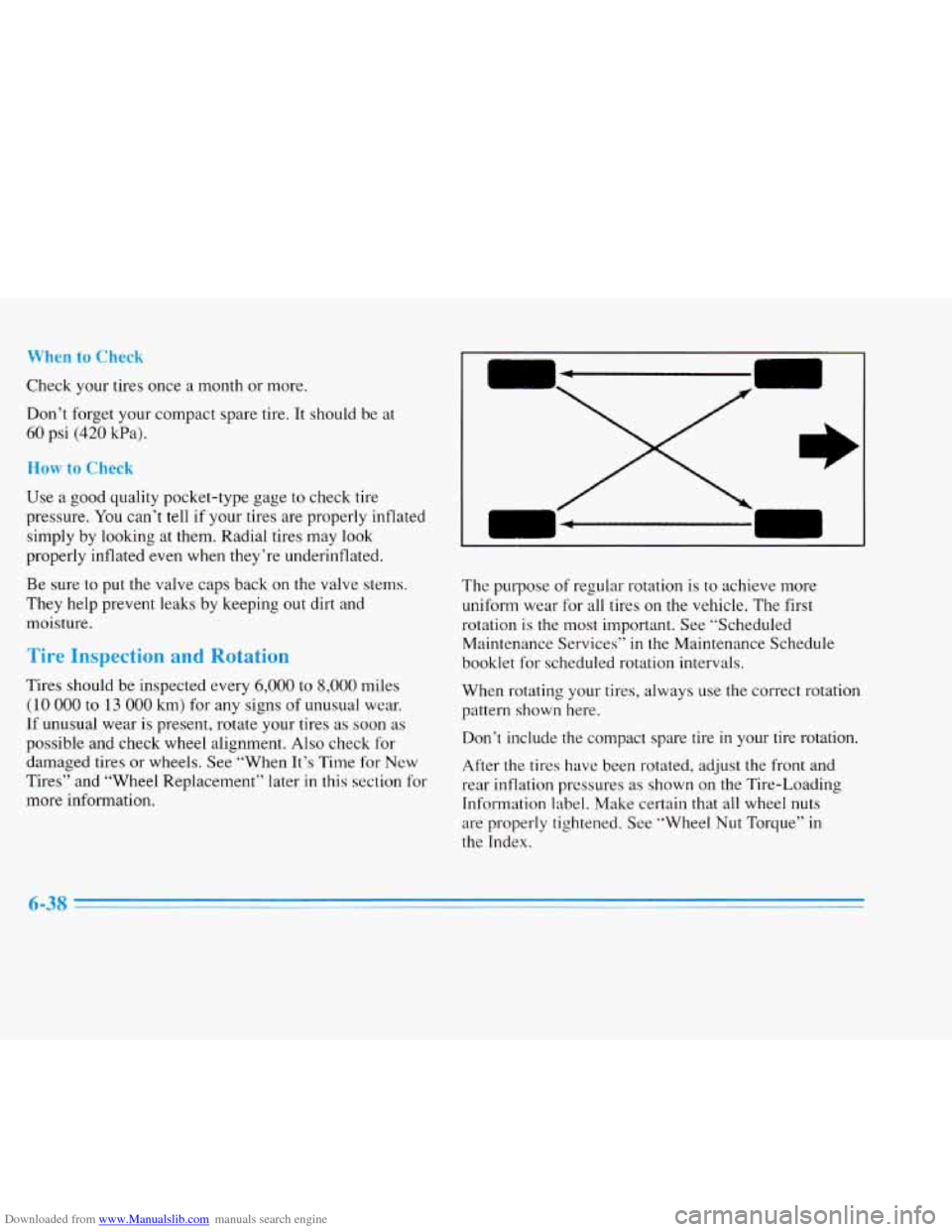
When rotating your tires, always use the correct rotation
pattern shown here.
Don’t include the compact spare tire
in your tire rotation.
After the tires have been rotated, adjust the front and
rear
inflation pressures as shown on the Tire-Loading
Information label. Make certain that all wheel nuts
are properly tightened. See ”Wheel Nut Torque” in
the Index.
6-38
Page 307 of 354
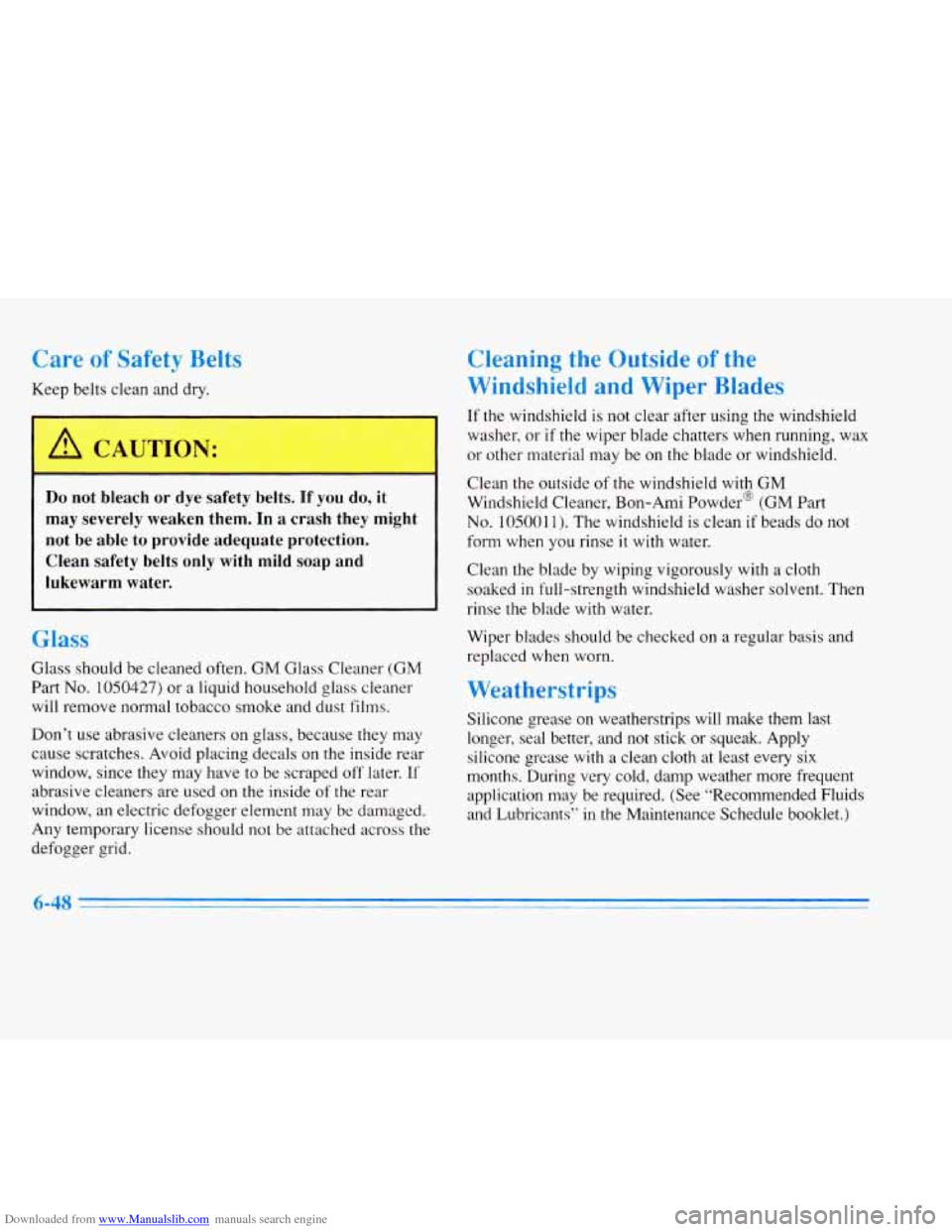
Downloaded from www.Manualslib.com manuals search engine Care af Safety Belts
Keep belts clean and dry.
A CAUTION:
Do not bleach or dye safety belts. If you do, it
may severely weaken them.
In a crash they might
not be able to provide adequate protection.
Clean safety belts only with mild
soap and
lukewarm water.
Glass
Glass should be cleaned often. GM Glass Cleaner (GM
Part No. 1050427) or a liquid household glass cleaner
will remove normal tobacco smoke and dust films.
Don’t use abrasive cleaners on glass, because they may
cause scratches. Avoid placing decals on the inside rear
window, since they may have to be scraped
off later. If
abrasive cleaners are used on the inside of the rear
window, an electric defogger element may be damaged.
Any temporary license should not be attached across the
defogger grid.
Cleaning the Outside of the
Windshield and Wiper Blades
If the windshield is not clear after using the windshield
washer, or
if the wiper blade chatters when running, wax
or other material may be on the blade or windshield.
Clean the outside of the windshield with
GM
Windshield Cleaner, Bon-Ami Powder@ (GM Part
No. 105001 1). The windshield is clean if beads do not
form when you rinse it with water.
Clean the blade by wiping vigorously with a cloth
soaked in full-strength windshield washer solvent. Then
rinse the blade
with water.
Wiper blades should be checked on a regular basis and
replaced when worn.
Weatherstrips
Silicone grease on weatherstrips will make them last
longer, seal better, and not stick or squeak. Apply
silicone grease
with a clean cloth at least every six
months. During very cold, damp weather more frequent
application may be required. (See “Recommended Fluids
and Lubricants’’
in the Maintenance Schedule booklet.)
6-48
Page 310 of 354
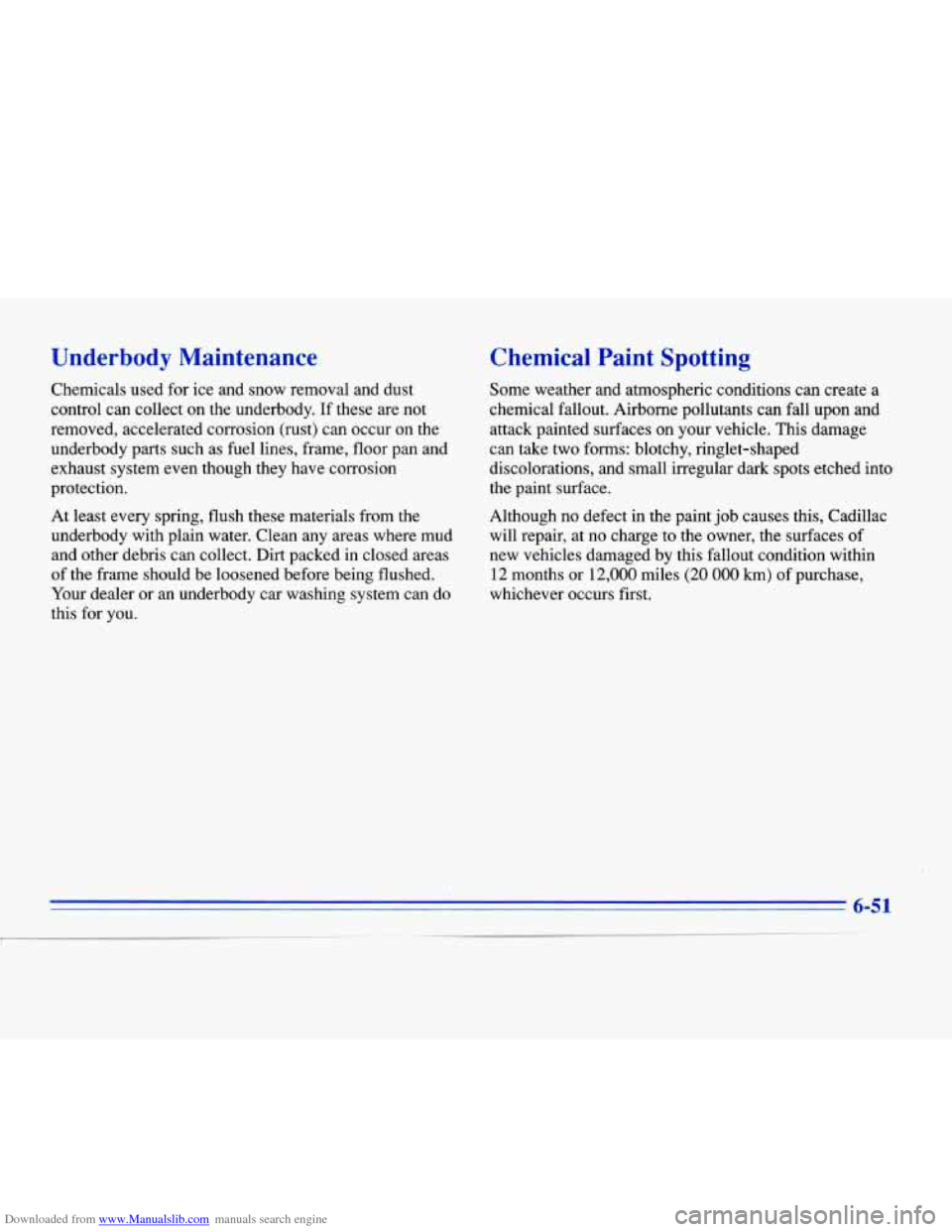
Downloaded from www.Manualslib.com manuals search engine Underbody Maintenance
Chemicals used for ice and snow removal and dust
control can collect on the underbody.
If these are not
removed, accelerated corrosion (rust) can occur on the
underbody parts such as fuel lines, frame, floor pan and
exhaust system even though they have corrosion
protection.
At least every spring, flush these materials from the
underbody with plain water. Clean any areas where mud
and other debris can collect. Dirt packed in closed areas
of the frame should be loosened before being flushed.
Your dealer
or an underbody car washing system can do
this for you.
Chemical Paint Spotting
Some weather and atmospheric conditions can create a
chemical fallout. Airborne pollutants can fall upon and
attack painted surfaces on your vehicle. This damage
can take two forms: blotchy, ringlet-shaped
discolorations, and small irregular dark spots etched into
the paint surface.
Although no defect in the paint job causes this, Cadillac
will repair, at no charge to the owner, the surfaces of
new vehicles damaged by this fallout condition within
12 months or 12,000 miles (20
000 km) of purchase,
whichever occurs first.
6-51
- I
Page 325 of 354
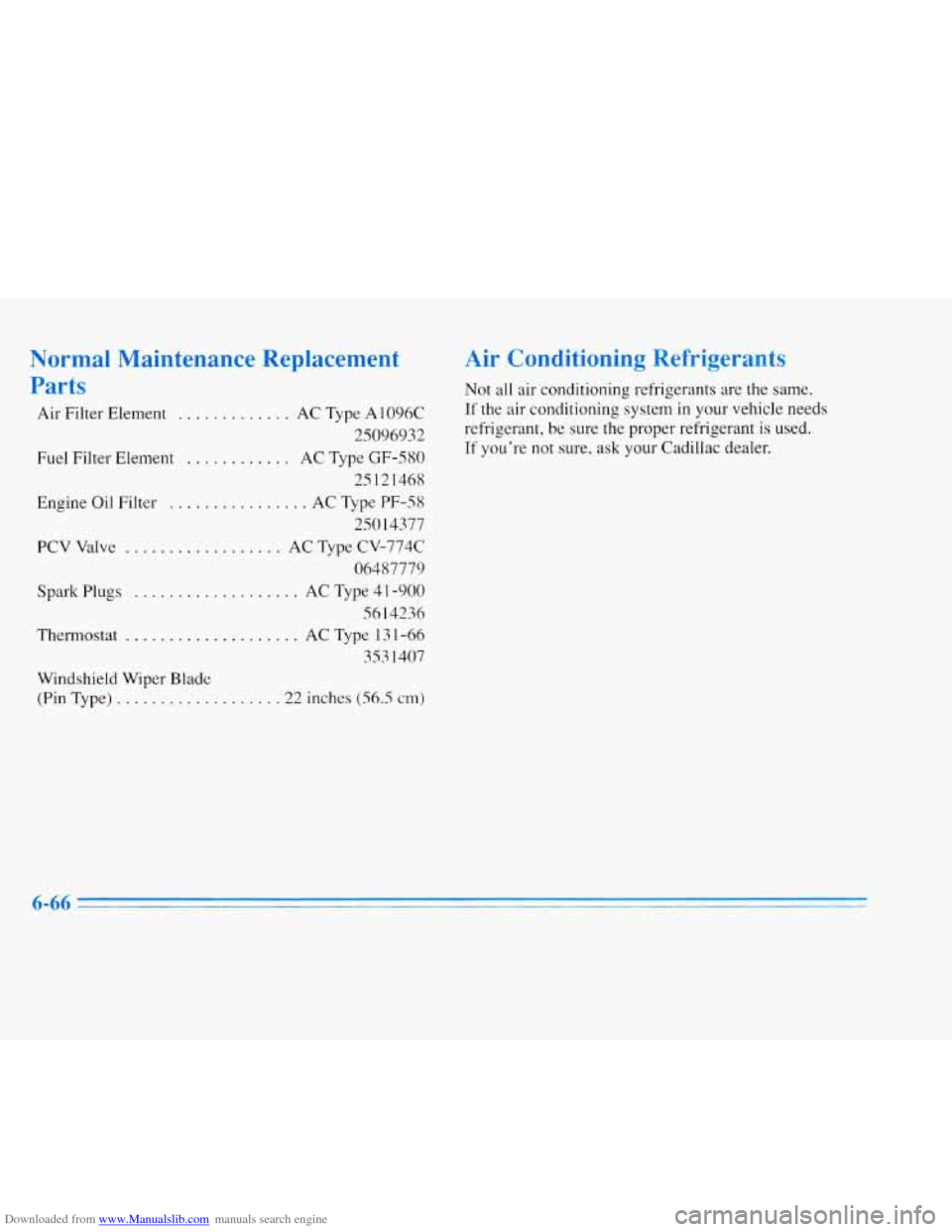
Downloaded from www.Manualslib.com manuals search engine Normal Maintenance Replacement
Parts
Air Filter Element . . , . . ...... AC Type A1096C
25096932
Fuel Filter Element ............ AC Type GF-580
25121468
Engine Oil Filter ................ AC Type PF-58
250 14377
PCV
Valve ................ AC Type CV-774C
06487779
Spark Plugs ................... AC Type 4 1-900
56 14236
Thermostat .................... AC Type 13 1-66
353 1407
Windshield Wiper Blade
(Pin Type) .................. .22 inches (56.5 cm)
Air Conditioning Refrigerants
Not all air conditioning refrigerants are the same.
If the air conditioning system in your vehicle needs
refrigerant, be sure the proper refrigerant
is used.
If you’re not sure, ask your Cadillac dealer.
6-66
Page 339 of 354
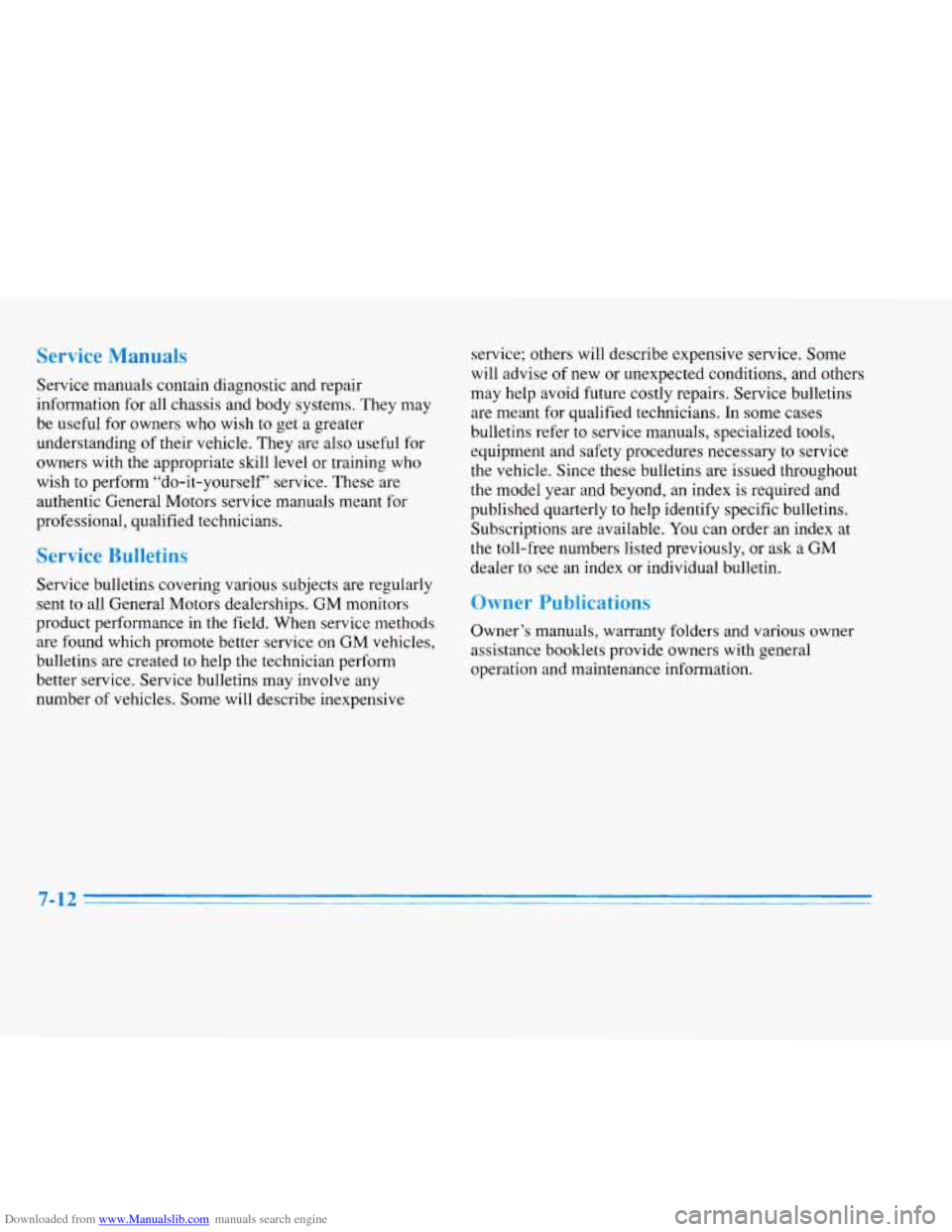
Downloaded from www.Manualslib.com manuals search engine Service Manuals
Service manuals contain diagnostic and repair
information for all chassis and body systems. They may
be useful for owners who wish to get a greater
understanding
of their vehicle. They are also useful for
owners with the appropriate skill level or training who
wish to perform “do-it-yourself’ service. These are
authentic General Motors service manuals meant for
professional, qualified technicians.
Service Bulletins
Service bulletins covering various subjects are regularly
sent to all General Motors dealerships.
GM monitors
product performance in the field. When service methods
are found which promote better service on
GM vehicles,
bulletins are created to help the technician perform
better service. Service bulletins may involve any
number
of vehicles. Some will describe inexpensive service; others will describe
expensive service. Some
will advise
of new or unexpected conditions, and others
may help avoid future costly repairs. Service bulletins
are meant for qualified technicians. In some cases
bulletins refer to service manuals, specialized tools,
equipment and safety procedures necessary
to service
the vehicle. Since these bulletins are issued throughout
the model year and beyond, an index is required and
published quarterly to help identify specific bulletins.
Subscriptions are available. You can order an index at
the toll-free numbers listed previously, or ask a
GM
dealer to see an index or individual bulletin.
Owner Publications
Owner’s manuals, warranty folders and various owner
assistance booklets provide owners with general
operation and maintenance information.
7-12
Page 347 of 354
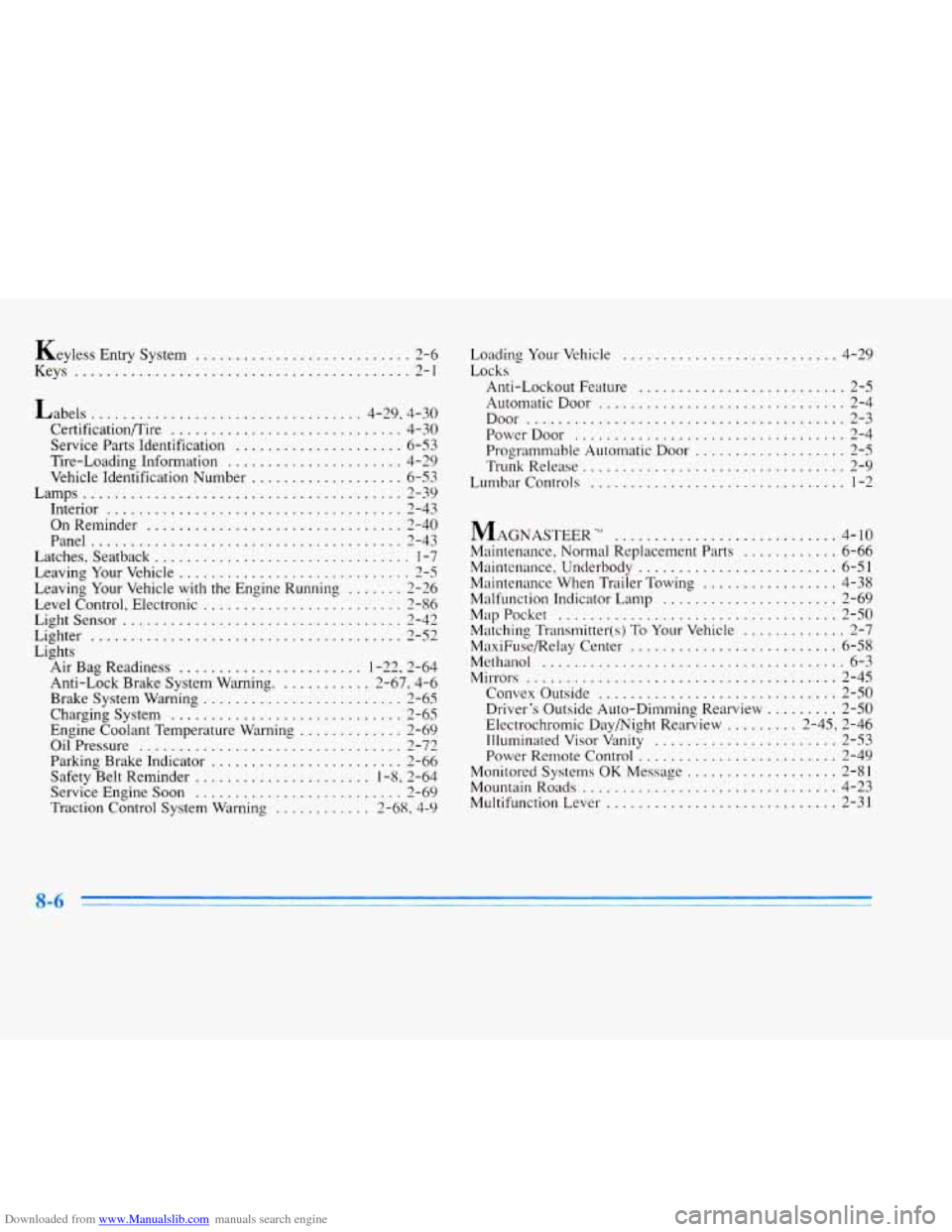
Downloaded from www.Manualslib.com manuals search engine Keyless Entry System ........................... 2-6
Keys
.......................................... 2-1
Labels
.................................. 4-29. 4-30
Certification/Tire
............................. 4-30
Service Parts Identification ..................... 6-53
Tire-Loading Information
...................... 4-29
Vehicle Identification Number
................... 6-53
Lamps
........................................ 2-3c)
Interior ..................................... 2-43
On Reminder ................................ 2-40
Panel ....................................... 2-43
Latches. Seatback
................................ 1-7
Leaving Your Vehicle ............................. 2-5
Level Control. Electronic ......................... 2-86
Lightsensor
................................... 2-42
Lighter
....................................... 2-52
Lights Air
Bag Readiness ....................... 1-22. 2-64
Anti-Lock Brake System Warning
............ 2-67? 4-6
Brake System Warning
......................... 2-65
Charging System
............................. 2-65
Engine Coolant Temperature Warning
............. 2-69
Oil Pressure
................................. 2-72
Parking Brake Indicator ........................ 2-66
Safety Belt Reminder
...................... 1-8. 2-64
Service Engine Soon
.......................... 2-69
Traction Control System Warning
............ 2-68 . 4-0
Leaving
Your Vehicle with the Engine Running
....... 2-26 Loading
Your Vehicle
........................... 4-29
Locks Anti-Lockout Feature
.......................... 2-5
Automatic Door ............................... 2-4
Door
........................................ 2-3
PowerDoor
.................................. 2-4
Programmable Automatic Door
................... 2-5
Trunk Release
................................. 2-9
Lumbar Controls
................................ 1-2
MAGNASTEER -b! ............................ 4-10
Maintenance. Normal Replacement Parts ............ 6-66
Maintenance. Underbody
......................... 6-51
Maintenance When Trailer Towing
................. 4-38
Malfunction Indicator Lamp
...................... 2-69
MapPocket
................................... 2-50
Matching Transmitter(s)
To Your Vehicle ............. 2-7
MaxiFuse/Relay Center
.......................... 6-58
Methanol
...................................... 6-3
Mirrors
....................................... 2-45
Convex Outside
.............................. 2-50
Driver’s Outside Auto-Dimming Rearview
......... 2-50
Electrochromic Day/Night Rearview
......... 2-45. 2-46
Illuminated Visor Vanity
....................... 2-53
Power Remote Control
......................... 2-49
Monitored Systems
OK Message ................... 2-81
Mountain Roads
................................ 4-23
Multifunction Lever
............................. 2-31
Page 352 of 354
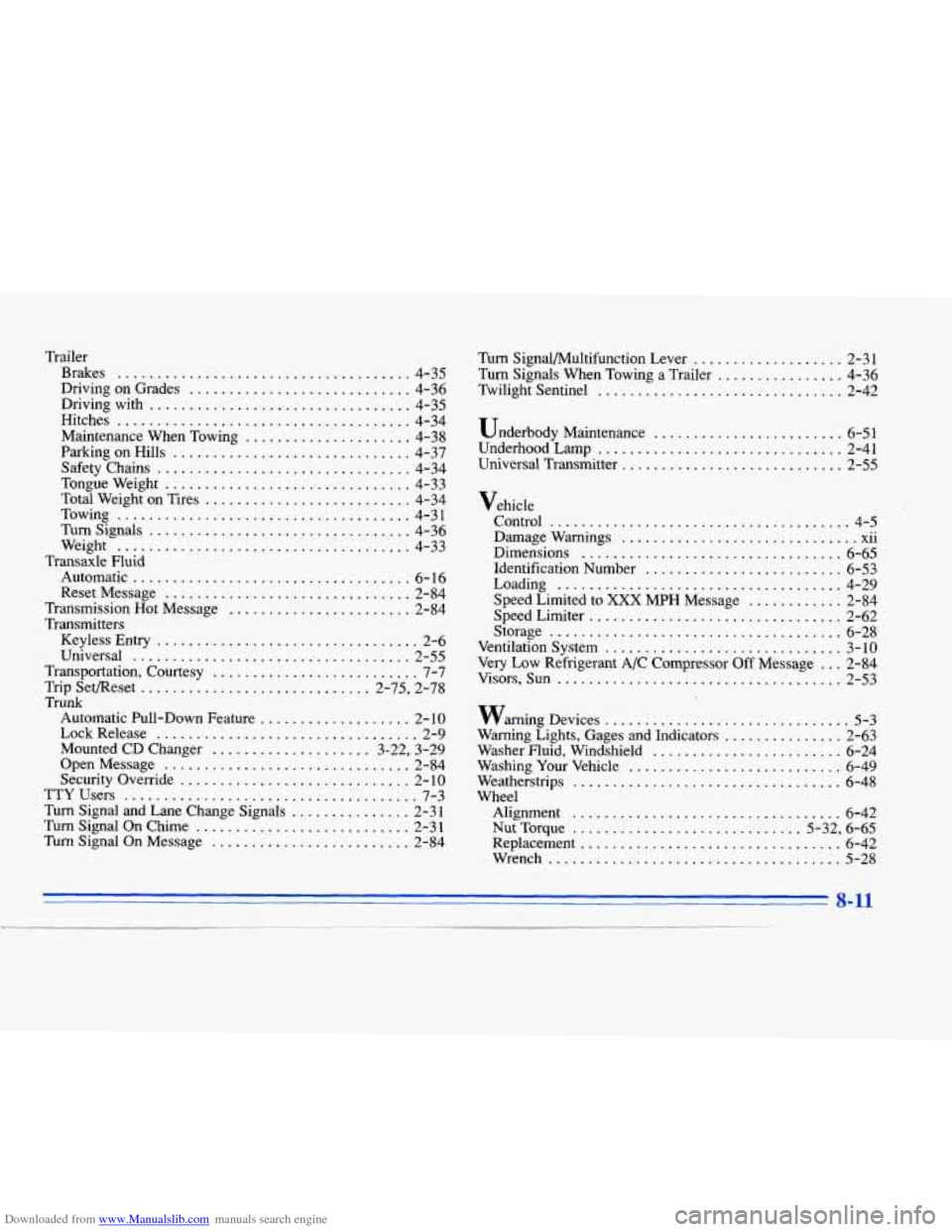
Downloaded from www.Manualslib.com manuals search engine Trailer Brakes
..................................... 4-35
Driving on Grades
............................ 4-36
Driving with
................................. 4-35
Maintenance When Towing
..................... 4-38
Parking on Hills
.............................. 4-37
Safety Chains
................................ 4-34
Total Weight on Tires
.......................... 4-34
Turn Signals
................................. 4-36
Automatic
................................... 6- 16
Reset Message
............................... 2-84
Transmission
Hot Message ....................... 2-84
Keyless Entry
................................. 2-6
Universal
................................... 2-55
Transportation, Courtesy
.......................... 7-7
Trip Set/Reset ............................. 2-75, 2-78
Automatic Pull-Down Feature
................... 2- 10
LockRelease
................................. 2-9
Mounted CD Changer
.................... 3-22, 3-29
OpenMessage
............................... 2-84
Security Override
............................. 2- 10
TTY Users
..................................... 7-3
Turn Signal and Lane Change Signals
............... 2-3 1
Turn Signal On Chime ........................... 2-31
Turn Signal On Message
......................... 2-84
Hitches
..................................... 4-34
Tongueweight
............................... 4-33
Towing
..................................... 4-31
Weight
..................................... 4-33
Transaxle Fluid
Transmitters
Trunk
Turn Signal/Multifunction Lever ................... 2-3 1
Turn Signals When Towing a Trailer ................ 4-36
Twilight Sentinel
............................... 2-42
Underbody Maintenance
........................ 6-51
Underhood Lamp
............................... 2-41
Universal Transmitter
............................ 2-55
Vehicle Control
...................................... 4-5
Damage Warnings
x11
Dimensions ................................. 6-65
Loading
.................................... 4-29
.. ..............................
Identification Number ......................... 6-53
Speed Limited to
XXX MPH Message ............ 2-84
Speed Limiter
................................ 2-62
Storage
..................................... 6-28
Ventilation System
.............................. 3-10
Visors, Sun
.................................... 2-53
Very Low
Refrigerant A/C Compressor
Off Message ... 2-84
warning Devices
............................... 5-3
Warning Lights. Gages and Indicators
............... 2-63
Washer Fluid. Windshield
........................ 6-24
Washing Your Vehicle
........................... 6-49
Weatherstrips
.................................. 6-48
Nut Torque ............................. 5-32, 6-65
Replacement
................................. 6-42
Wrench
..................................... 5-28
Wheel
Alignment
.................................. 6-42