brakes CADILLAC ELDORADO 1996 10.G Owner's Manual
[x] Cancel search | Manufacturer: CADILLAC, Model Year: 1996, Model line: ELDORADO, Model: CADILLAC ELDORADO 1996 10.GPages: 354, PDF Size: 19.33 MB
Page 218 of 354
Downloaded from www.Manualslib.com manuals search engine leave just enough slack so you can turn with your rig.
And, never allow safety chains to drag on the ground.
Trailer Brakes
Because you have anti-lock brakes, don’t try to tap into
your vehicle’s hydraulic brake system. If you do, both
brake systems won’t work
Be sure to read and follow
brakes
so you’ll be able to
them properly. well,
or at all.
the instructions for the trailer
install, adjust and maintain
Driving with a ”hailer
Towing a trailer requires a certain amount of experience.
Before setting out for the open road, you’ll want to get
to know your rig. Acquaint yourself with the feel of
handling and braking with the added weight of the
trailer. And always keep in mind that the vehicle you are
driving
is now a good deal longer and not nearly as
responsive as your vehicle is by itself.
Before you start, check the trailer hitch and platform
(and attachments), safety chains, electrical connector,
lamps, tires and mirror adjustment.
If the trailer has
electric brakes, start your vehicle and trailer moving and
then apply the trailer brake controller by hand to be sure
the brakes
are working. This lets you check your
electrical connection at the same time. During your trip, check occasionally
to be sure that the
load is secure, and that the lamps and any trailer brakes
are still working.
Following Distance
Stay at least twice as far behind the vehicle ahead as you
would when driving your vehicle without a trailer. This
can help you avoid situations that require heavy braking
and sudden turns.
Passing
You’ll need more passing distance up ahead when
you’re towing a trailer. And, because you’re a good deal
longer, you’ll need to go much farther beyond the
passed vehicle before you can return to your lane.
Backing Up
Hold the bottom of the steering wheel with one hand.
Then, to move the trailer to the left, just move that hand
to the left.
To move the trailer to the right, move your
hand to the right. Always back up slowly and, if
possible, have someone guide you.
4-35
Page 219 of 354
Downloaded from www.Manualslib.com manuals search engine Making Turns
NOTICE:
Making very sharp turns while trailering could
cause the trailer to come in contact with the
vehicle. Your vehicle could
be damaged. Avoid
making very sharp turns while trailering.
I
When you’re turning with a trailer, make wider turns
than normal.
Do this so your trailer won’t strike soft
shoulders, curbs, road signs, trees or other objects.
Avoid jerky
or sudden maneuvers. Signal well in
advance.
Turn Signals When Towing a Trailer
When you tow a trailer, your vehicle may need a
different turn signal flasher and extra wiring. Check
with your Cadillac dealer. The green arrows on your
instrument panel will flash whenever you signal a turn
or lane change. Properly hooked
up, the trailer lamps
will also flash, telling other drivers you’re about to
turn,
change lanes or stop. When
towing
a trailer, the green arrows on your
instrument panel will flash for turns even if the bulbs on
the trailer are burned out. Thus, you
may think drivers
behind you are seeing your signal when they are not. It’s
important to check occasionally to be sure the trailer
bulbs are still working.
Driving On Grades
Reduce speed and shift to a lower gear hefor-e you start
down a long or steep downgrade.
If you don’t shift
down,
you might have to use your brakes so much that
they would get hot and no longer work well.
On a long uphill grade, shift down and reduce your
speed to around
45 mph (70 km/h) or less to reduce the
possibility
of engine and transaxle overheating.
4-36
Page 220 of 354
Downloaded from www.Manualslib.com manuals search engine Parking on Hills
You really should not park your vehicle, with a trailer
attached, on
a hill. If something goes wrong, your rig
could start
to move. People can be injured, and both
your vehicle and the trailer can be damaged.
But if
you ever have to park your rig on a hill, here’s
how to do it:
1.
2.
3.
4.
5.
Apply your regular brakes, but do not shift into
PARK (P).
Have someone place chocks under the trailer wheels.
When the wheel chocks
are in place, release the
regular brakes until the chocks absorb the load.
Reapply the regular brakes. Then shift into
PARK
(P) firmly and apply your parking brake.
Release the regular brakes.
When You Are Ready to Leave After
Parking
on a Hill
1. Apply your regular brakes and hold the pedal down
while you:
Start your engine;
Shift into a gear; and
0 Be sure the parking brake has released.
2. Let up on the brake pedal.
3. Drive slowly until the trailer is clear of the chocks.
4. Stop and have someone pick up and store the chocks.
Maintenance When Trailer Towing
Your vehicle will need service more often when you’re
pulling a trailer. See the Maintenance Schedule for more
on this. Things that are especially important in trailer
operation are automatic transaxle fluid (don’t overfill),
engine oil, belt, cooling system and brake adjustment.
Each of these
is covered in this manual, and the Index
will help you find them quickly. If you’re trailering, it’\
s
a good idea to review these sections before you start
your trip.
Check periodically to see that all hitch nuts and bolts are tight.
4-37
Page 284 of 354
Downloaded from www.Manualslib.com manuals search engine Brakes
Brake Fluid
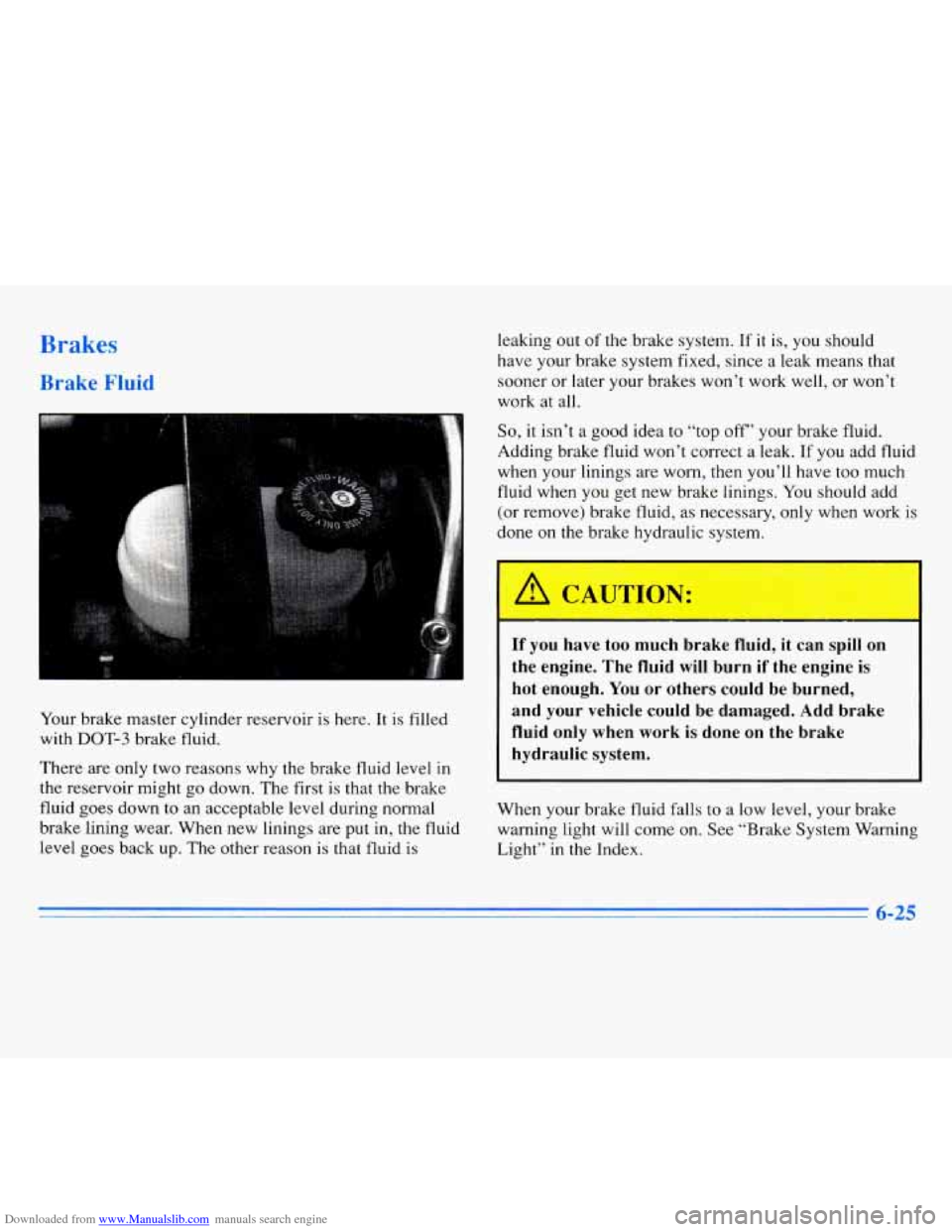
Your brake master cylinder reservoir is here. It is filled
with
DOT-3 brake fluid.
There are only two reasons why the brake fluid level
in
the reservoir might go down. The first is that the brake
fluid goes down to an acceptable level during normal
brake lining wear. When new linings are put in, the fluid
level goes back up. The other reason is that fluid
is
leaking out of the brake system. If it is, you should
have your brake system fixed, since a leak means that
sooner or later your brakes won’t work well, or won’t
work at all.
So, it isn’t a good idea to “top off’ your brake fluid.
Adding brake fluid won’t correct a leak.
If you add fluid
when your linings are
worn, then you’ll have too much
fluid when you get new brake linings. You should add
(or remove) brake fluid, as necessary, only when work is
done on the brake hydraulic system.
I
If you have too much brake fluid, it can spill on
the engine. The fluid will burn if the engine is
hot enough.
You or others could be burned,
and your vehicle could be damaged. Add brake
fluid only when work
is done on the brake
hydraulic system.
When your brake fluid falls to a low level, your brake
warning light will come
on. See “Brake System Warning
Light” in the Index.
6-25
Page 285 of 354
Downloaded from www.Manualslib.com manuals search engine What to Add
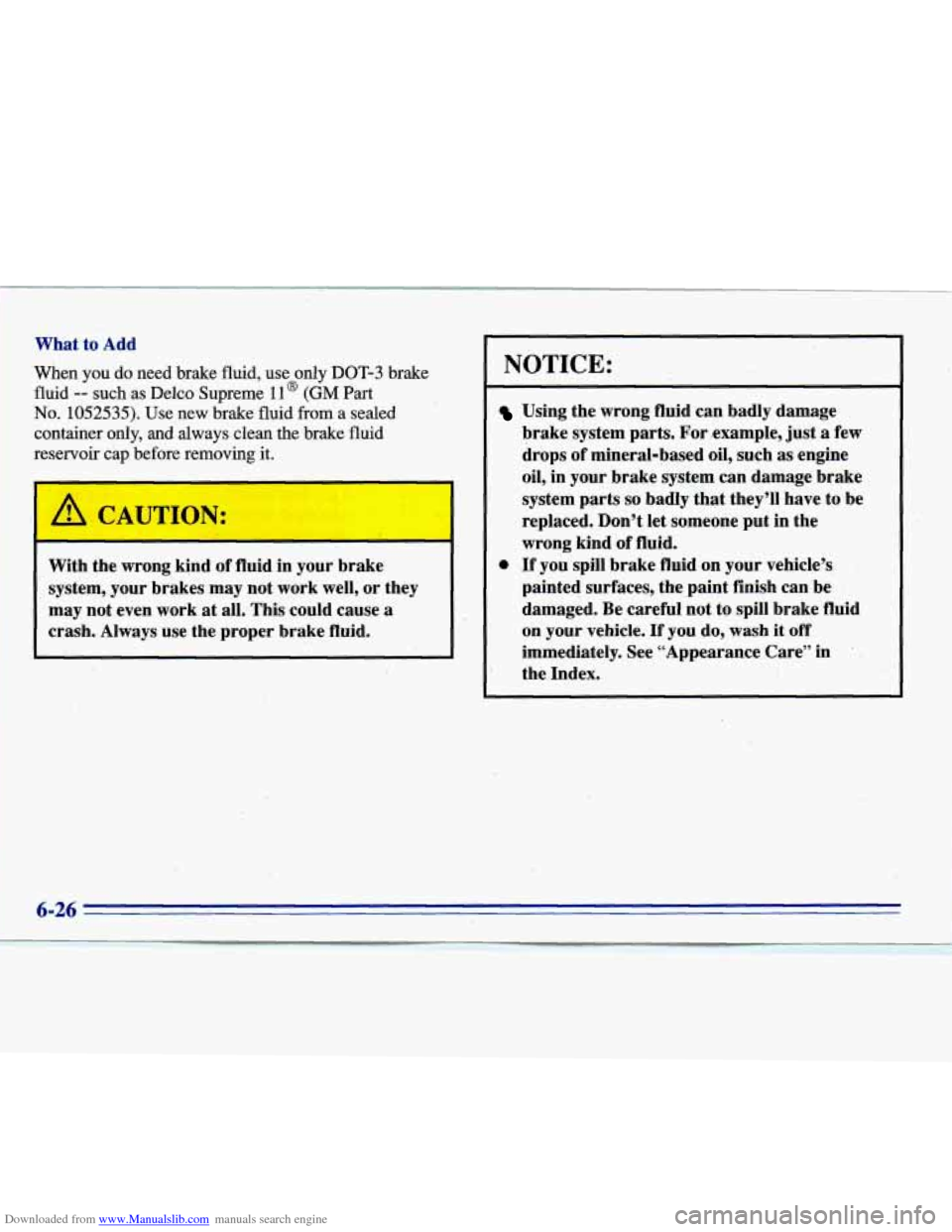
When you do need brake fluid, use only DOT-3 brake
fluid
-- such.as Delco Supreme 11 @ (GM Part
No. 1052535). Use new brake fluid from a sealed
container only, and always clean the brake fluid
reservoir cap before removing
it.
With the wrong kind of fluid in your brake
system, your brakes may not work well, or they
may not even work at all. This could cause
a
crash. Always use the proper brake fluid,.
NOTICE:
Using the wrong fluid can badly damage
brake system parts. For (example, just
a few
drops of mineral-based oil, such as engine
oil, in your brake system can damage brake
system parts
so badly that they’ll have to be
replaced. Don’t let someone put in the
wrong kind of fluid.
0 If you spill brake fluid on your vehicle’s. .,
painted surfaces, the paint finish can be
damaged. Be careful not to spill brake fluid
on your vehicle. If you do, wash it off
immediately. See “Appearance Care” in F.
the Index.
,. .. 7 ., ..
6-26
Page 286 of 354
Downloaded from www.Manualslib.com manuals search engine Brake Wear
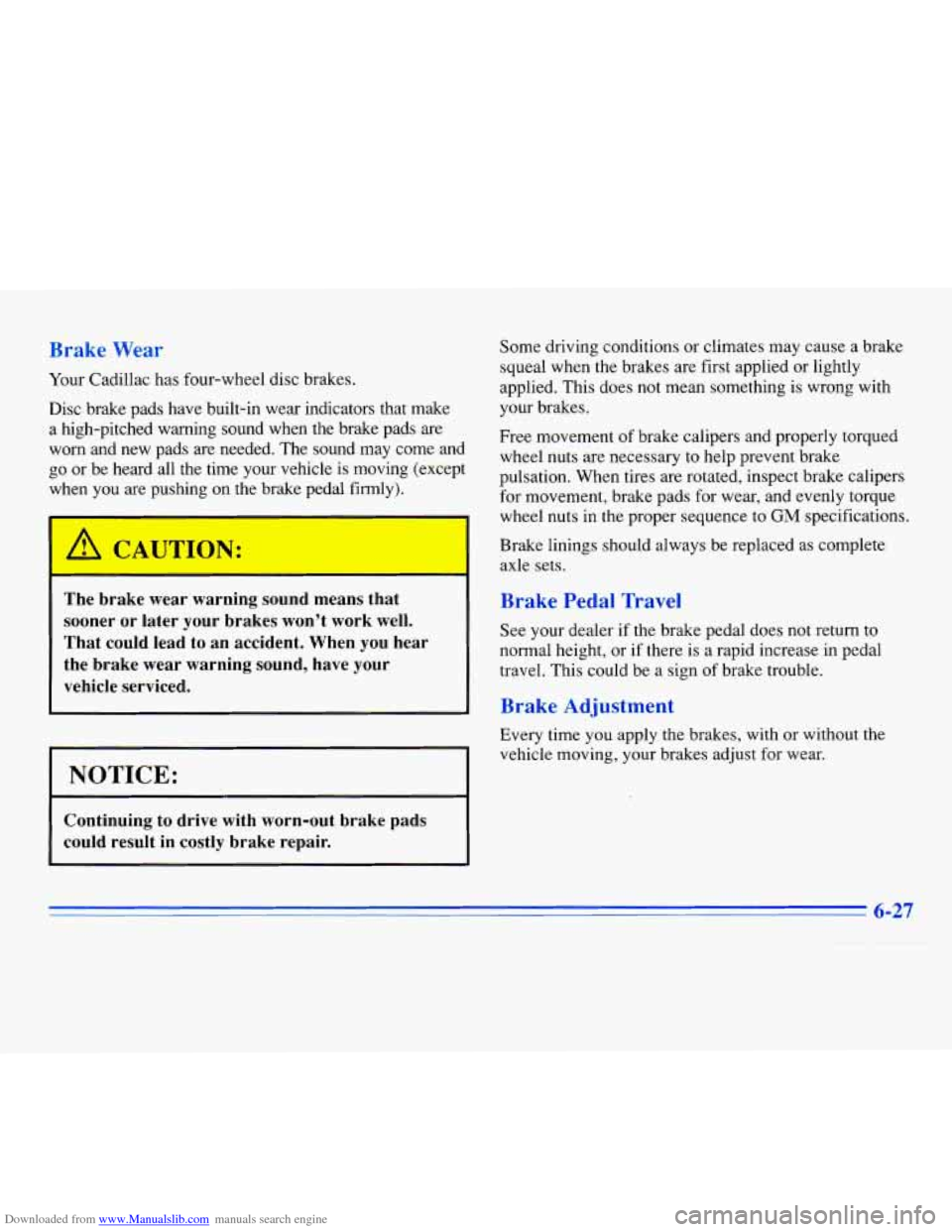
Your Cadillac has four-wheel disc brakes.
Disc brake pads have built-in wear indicators that make
a high-pitched warning sound when the brake pads are
worn and new pads are needed. The sound may come and
go or be heard all the time your vehicle is moving (except
when you are pushing on the brake pedal firmly).
The brake wear warning sound means that
sooner or later your brakes won’t work well.
That could lead to an accident. When you hear
the brake wear warning sound, have your vehicle serviced.
NOTICE:
~~~~~
Continuing to drive with worn-out brake pads
could result
in costly brake repair.
Some driving conditions or climates may cause a brake
squeal when the brakes are first applied or lightly
applied. This does
not mean something is wrong with
your brakes.
Free movement of brake calipers and properly torqued
wheel nuts are necessary to help prevent brake
pulsation. When tires are rotated, inspect brake calipers
for movement, brake pads for wear, and evenly torque
wheel nuts in the proper sequence to
GM specifications.
Brake linings should always be replaced as complete
axle sets.
Brake Pedal Travel
See your dealer if the brake pedal does not return to
normal height, or if there
is a rapid increase in pedal
travel. This could be a sign of brake trouble.
Brake Adjustment
Every time you apply the brakes, with or without the
vehicle moving, your brakes adjust for wear.
Page 287 of 354
Downloaded from www.Manualslib.com manuals search engine Replacing Brake System Parts
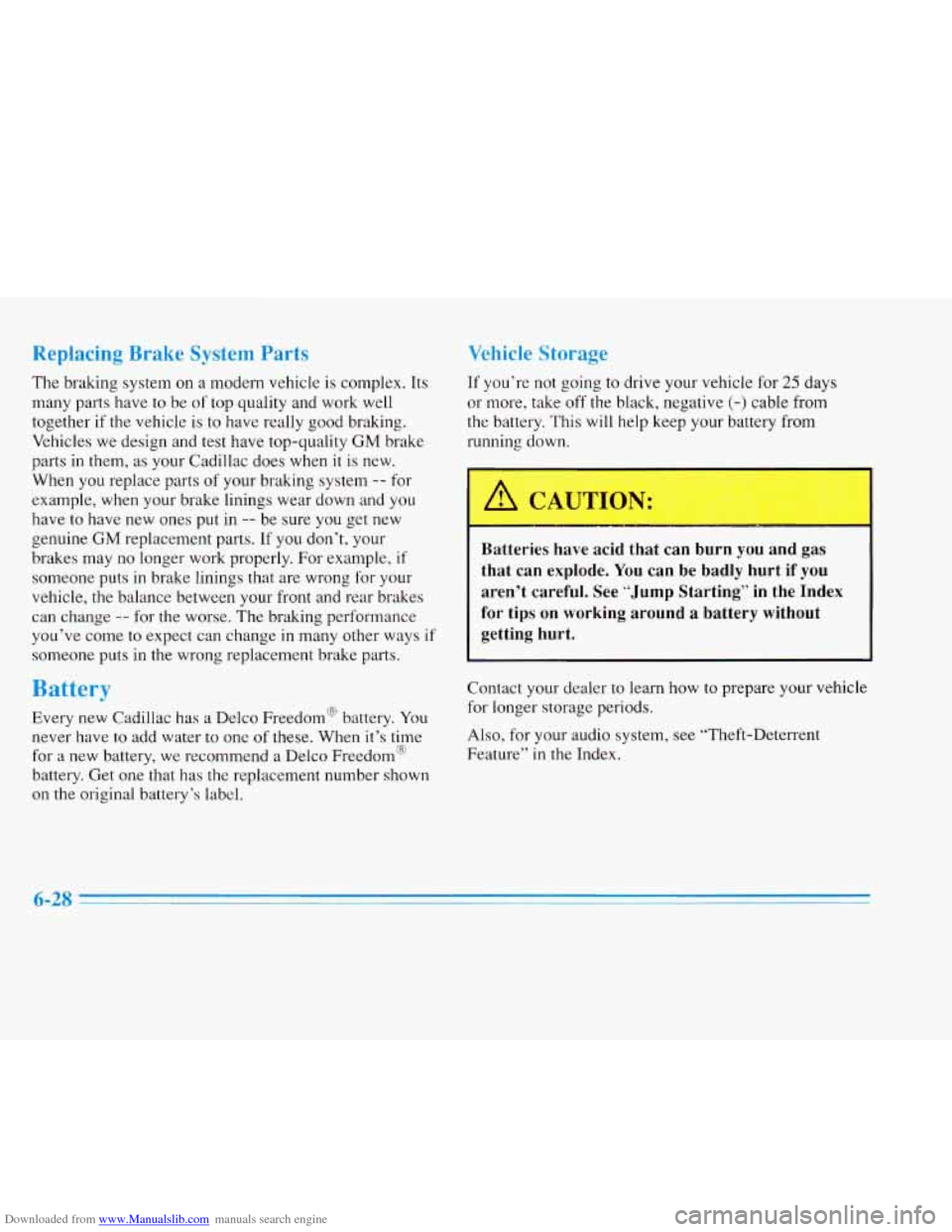
The braking system on a modem vehicle is complex. Its
many parts have to be of top quality and work well
together if the vehicle is to have really good braking.
Vehicles we design and test have top-quality
GM brake
parts
in them, as your Cadillac does when it is new.
When
you replace parts of your braking system -- for
example, when your brake linings wear down and you
have
to have new ones put in -- be sure you get new
genuine GM replacement parts. If you don’t, your
brakes may no longer work properly. For example,
if
someone puts in brake linings that are wrong for your
vehicle,
the balance between your front and rear brakes
can change
-- for the worse. The braking performance
you’ve come to expect can change in many other ways if
someone puts in the wrong replacement brake parts.
Battery
Every new Cadillac has a Delco Freedom@ battery. You
never have
to add water to one of these. When it’s time
for a new battery, we recommend a Delco Freedom@
battery. Get one that has the replacement number shown
on the original battery’s label.
Vehicle Storage
If you’re not going to drive your vehicle for 25 days
or more, take off the black, negative
(-) cable from
the battery. This will help keep your battery from
running down.
I
Batteries have acid that can burn you and gas
that can explode.
You can be badly hurt if you
aren’t careful. See
“Jump Starting” in the Index
for tips on working around
a battery without
getting hurt.
Contact your dealer to learn how to prepare your vehicle
for longer storage periods.
Also, for your audio system, see “Theft-Deterrent
Feature”
in the Index.
6-28
Page 319 of 354
Downloaded from www.Manualslib.com manuals search engine Fuse
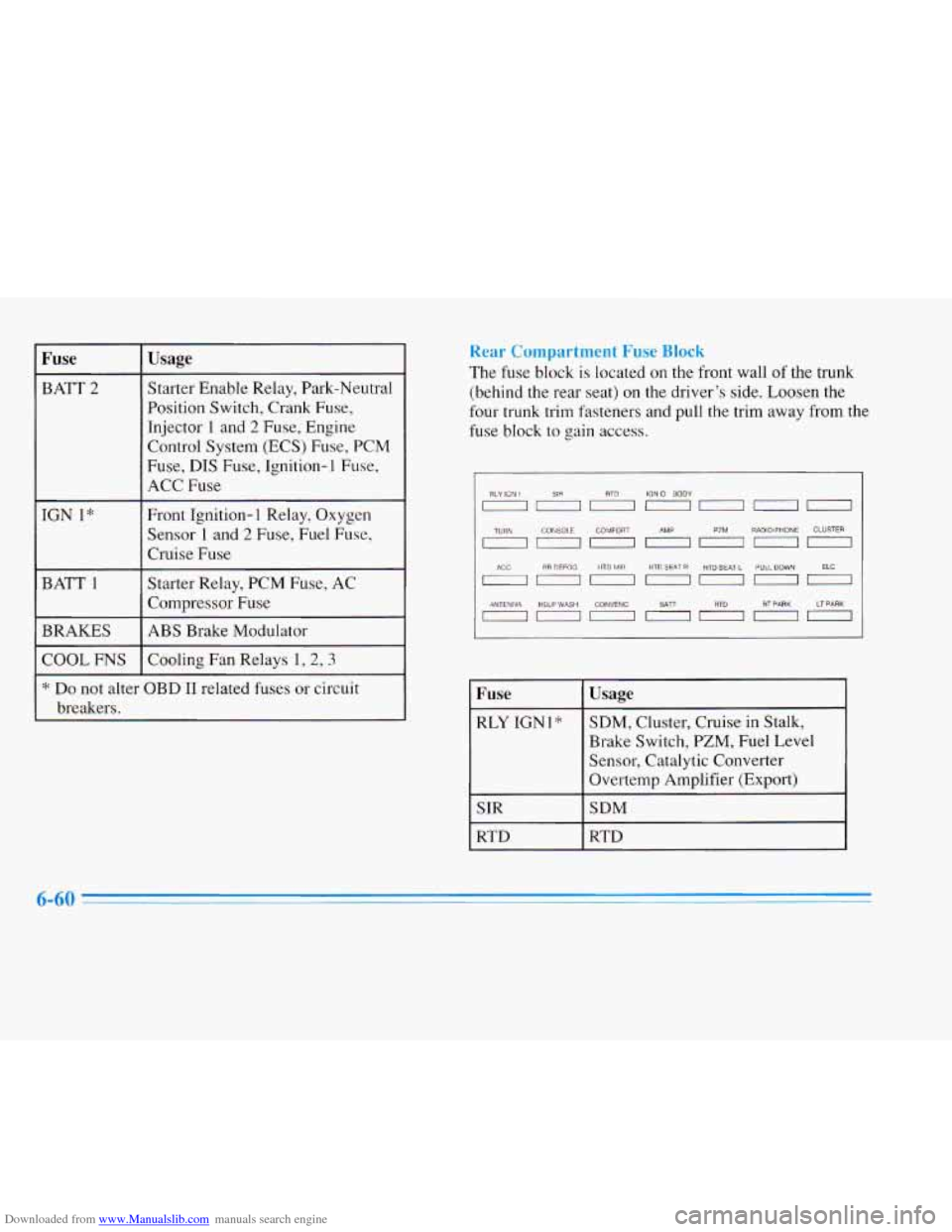
BATT 2
IGN i*
BATT 1
BRAKES
COOL
FNS
Usage
Starter Enable Relay, Park-Neutral
Position Switch, Crank Fuse,
Injector
1 and 2 Fuse, Engine
Control System (ECS) Fuse, PCM
Fuse,
DIS Fuse, Ignition- 1 Fuse,
ACC Fuse
Front Ignition-
1 Relay, Oxygen
Sensor
1 and 2 Fuse, Fuel Fuse,
Cruise Fuse
Starter Relay,
PCM Fuse, AC
Compressor Fuse
ABS Brake Modulator
Cooling Fan Relays
1,2,3
* Do not alt.er OBD I1 related fuses or circuit
breakers.
Rear Compartment Fuse Block
The fuse block is located on the front wall of the trunk
(behind the rear seat)
on the driver’s side. Loosen the
four
trunk trim fasteners and pull the trim away from the
fuse block
to gain access.
RLY ICN 1 SIR RTD
TURN CONSOLE COMFORT
n-0
ANTENNA HDLP WASH CONVENC
noon
IGNO DODY
AMP
nono
PZM RADlOiPHONE CLUSTER
uno-
HTD SEAT R HTD SEAT L PULL DOWN ELC
BATT RTD
RT PARK LT PARK
onon
I Fuse I Usage
RLY IGN 1 * SDM, Cluster, Cruise in Stalk,
Brake Switch,
PZM, Fuel Level
Sensor, Catalytic Converter
Overtemp Amplifier (Export)
I SIR I SDM
I RTD I RTD I
6-60
Page 342 of 354
Downloaded from www.Manualslib.com manuals search engine ........
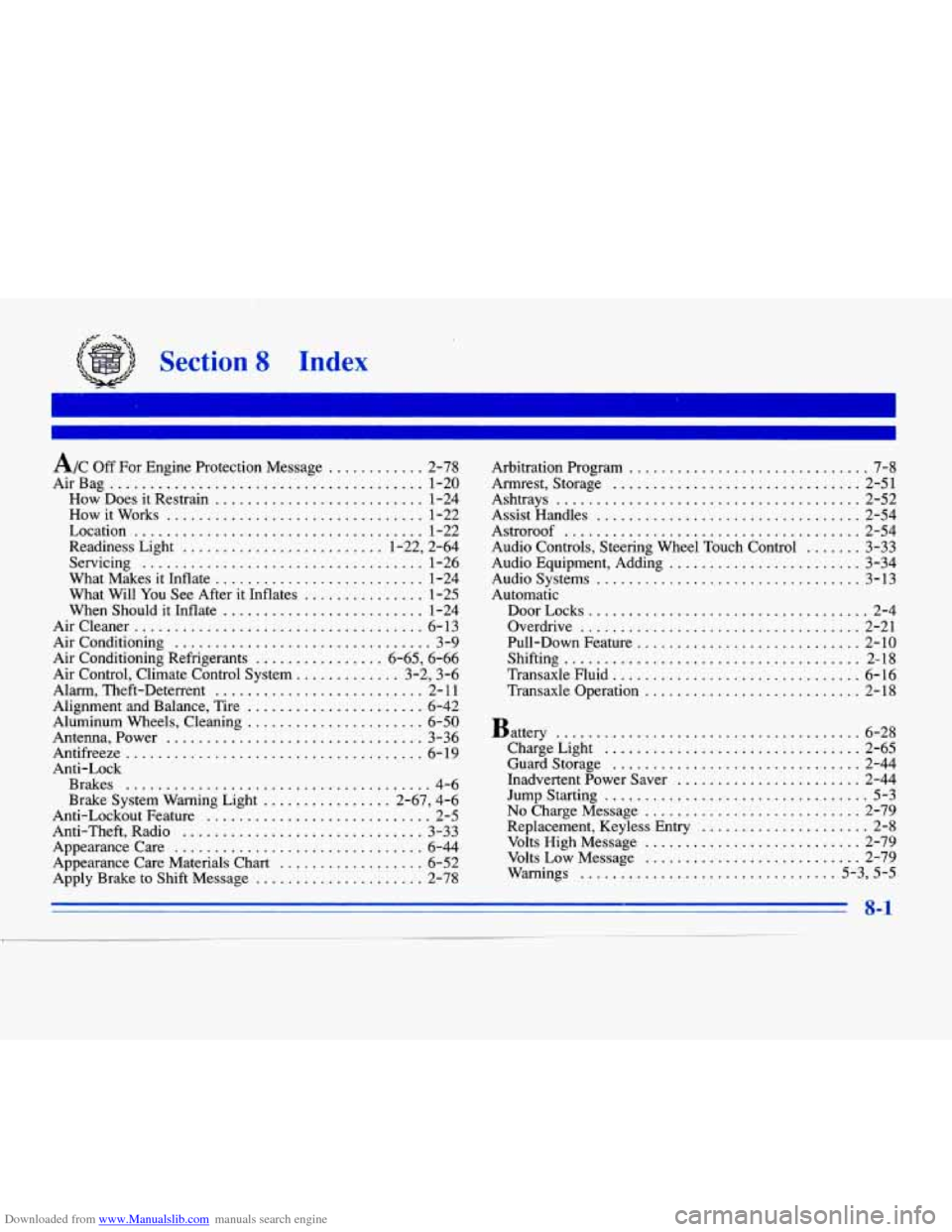
Section 8 Index
. .
.
A/C Off For Engine Protection Message ............ 2-78
AirBag
....................................... 1-20
How Does it Restrain
.......................... 1-24
How it Works
................................ 1-22
Location
.................................... 1-22
Readiness Light
......................... 1.22. 2.64
Servicing
................................... 1-26
What Makes
it Inflate .......................... 1-24
What Will You See After it Inflates
............... 1-25
When Should it Inflate
......................... 1-24
Air Cleaner
.................................... 6- 13
Air Conditioning
................................ 3-9
Air Conditioning Refrigerants
................ 6.65. 6.66
Air Control. Climate Control System
............. 3.2. 3.6
Alarm. Theft-Deterrent
.......................... 2- 11
Alignment and Balance. Tire
...................... 6-42
Aluminum Wheels. Cleaning
...................... 6-50
Antenna. Power
................................ 3-36
Antifreeze
..................................... 6- 19
Anti-Lock
Brakes
...................................... 4-6
Brake System Warning Light
................ 2.67. 4.6
Anti-Lockout Feature
............................ 2-5
Anti.Theft. Radio
.............................. 3-33
Appearance Care
............................... 6-44
Appearance Care Materials Chart
.................. 6-52
Apply Brake to Shift Message
..................... 2-78 Arbitration Program
.............................. 7-8
Armrest. Storage ............................... 2-51
Ashtrays
...................................... 2-52
Assist Handles
................................. 2-54
Astroroof
..................................... 2-54
Audio Controls. Steering Wheel Touch Control
....... 3-33
Audio Equipment. Adding
........................ 3-34
Audio Systems
................................. 3-13
Automatic
DoorLocks
................................... 2-4
Overdrive
................................... 2-21
Pull-Down Feature
............................ 2-10
Shifting
..................................... 2-18
Transaxle Fluid
............................... 6-16
Transaxle Operation
........................... 2-18
Battery
...................................... 6-28
ChargeLight
................................ 2-65
Guard Storage
............................... 2-44
Inadvertent Power Saver
....................... 2-44
Jump Starting
................................. 5-3
Replacement. Keyless Entry
..................... 2-8
Volts High Message
........................... 2-79
Volts Low Message
........................... 2-79
Warnings
................................ 5-3. 5-5
No Charge Message ........................... 2-79
8-1
I
Page 343 of 354
Downloaded from www.Manualslib.com manuals search engine BBB Auto Line ................................. 7-8
Better Business Bureau Mediation
................... 7-8
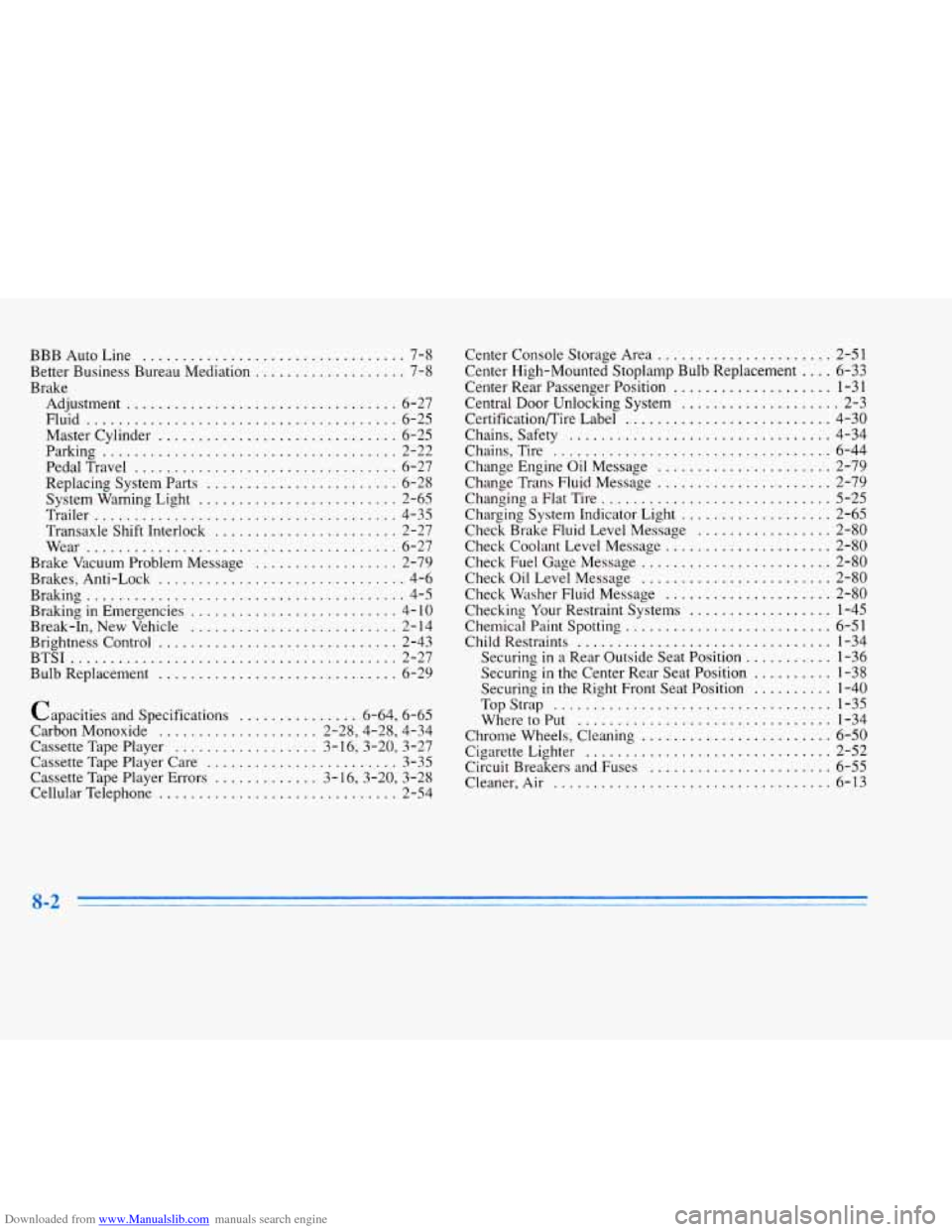
Brake Adjustment
.................................. 6-27
Fluid
....................................... 6-25
Master Cylinder
.............................. 6-25
Parking
..................................... 2-22
PedalTravel
................................. 6-27
Replacing System Parts
........................ 6-28
System Warning Light
......................... 2-65
Trailer
...................................... 4-35
Transaxle Shift Interlock
....................... 2-27
Wear
....................................... 6-27
Brake Vacuum Problem Message
.................. 2-79
Brakes. Anti-Lock
............................... 4-6
Braking
........................................ 4-5
Braking
in Emergencies .......................... 4- 10
Break-In. New Vehicle .......................... 2- 14
Brightness Control
.............................. 2-43
Bulb Replacement
.............................. 6-29
BTSI
......................................... 2-27
Capacities and Specifications
............... 6.64. 6.65
Carbon Monoxide
.................... 2.28.4.28. 4.34
Cassette Tape Player
.................. 3.16.3.20. 3.27
Cassette Tape Player Care
........................ 3-35
Cassette Tape Player Errors
............. 3.16. 3.20. 3.28
Cellular Telephone
.............................. 2-54 Center Console
Storage Area
...................... 2-51
Center High-Mounted Stoplamp Bulb Replacement
.... 6-33
Center Rear Passenger Position
.................... 1-31
Certificationnire Label
.......................... 4-30
Chains. Safety
................................. 4-34
Chains. Tire
................................... 6-44
Change Engine Oil Message
...................... 2-79
Changing a Flat Tire
............................. 5-25
Chargmg System Indicator Light
................... 2-65
Check Brake Fluid Level Message
................. 2-80
Check Coolant Level Message
..................... 2-80
Check Fuel Gage Message
........................ 2-80
Check Oil Level Message
........................ 2-80
Check %&her Fluid Message
..................... 2-80
Checking Your Restraint Systems
.................. 1-45
Chemical Paint Spotting
.......................... 6-51
Child Restraints
................................ 1-34
Securing in
a Rear Outside Seat Position ........... 1-36
Securing
in the Center Rear Seat Position .......... 1-38
Securing
in the Right Front Seat Position .......... 1-40
TopStrap
................................... 1-35
WheretoPut ................................ 1-34
Chrome Wheels. Cleaning
........................ 6-50
Circuit Breakers and Fuses
....................... 6-55
Cleaner. Air
................................... 6-13
Central Door Unlocking System
.................... 2-3
Change Trans Fluid Message
...................... 2-79
Cigarette Lighter
............................... 2-52