stop start CADILLAC ELDORADO 1996 10.G Owner's Manual
[x] Cancel search | Manufacturer: CADILLAC, Model Year: 1996, Model line: ELDORADO, Model: CADILLAC ELDORADO 1996 10.GPages: 354, PDF Size: 19.33 MB
Page 179 of 354
Downloaded from www.Manualslib.com manuals search engine PUSHBUTTONS: Press buttons one through six to
go from one compact disc to another that is loaded
in
the changer.
SIDE: Press this button to select the next disc in the
changer. Each time you press this button, DISC
LOADING will appear on the display and the disc
number
on the radio display will move to the next
available CD.
REV: Press this button to reverse quickly through a
track selection.
FF: Press this button to advance quickly through a
track selection.
RDM: Press this button to enter random play mode.
RDM will appear on the display. The loaded discs will
be played in random rather than sequential (1,2, 3. . .)
order. Press SEEK while RDM is on the display to
randomly seek through discs and tracks. Press RDM
again to return to sequential order.
SEEK: Press the left arrow while playing a compact
disc
to go back to the start of a current track, if more
than eight seconds have played. Press the left arrow
again and the changer will
go to previous tracks. Press
the right arrow to go to the next higher track on the disc.
SCAN: When you press SCAN while playing a CD, you
will hear the first few seconds of each disc. Press SCAN
again to stop on a CD. The CD will be muted while
scanning and SCAN will appear on the display.
EJECT: Slide the CD changer door all the way open
and the disc
will automatically eject.
Compact Disc Changer Errors
If ERROR appears on the display, an error has occurred
and the compact disc temporarily cannot play.
CD CHANGER ERROR could be displayed for the
following:
0 The road is too rough. The disc should play when the
road
is smoother.
The disc is dirty, scratched, wet or loaded label side
UP.
The air is very humid. If so, wait about an hour and
try again.
3-32
Page 189 of 354
Downloaded from www.Manualslib.com manuals search engine Avoid needless heavy braking. Some people drive in
spurts -- heavy acceleration followed by heavy
braking
-- rather than keeping pace with traffic. This is a
mistake. Your brakes may not have time to cool between
hard stops. Your brakes will wear out much faster
if you
do a lot of heavy braking. If you keep pace with the
traffic and allow realistic following distances, you
will
eliminate a lot of unnecessary braking. That means
better braking and longer brake life.
If your engine ever stops while you’re driving, brake
normally but don’t pump your brakes. If you do, the
pedal may get harder
to push down. If your engine
stops,
you will still have some power brake assist. But
you will use it when
you brake. Once the power assist is
used
up, it may take longer to stop and the brake pedal
will be harder to push. Your
vehicle has anti-lock brakes
(ABS). ABS is an
advanced electronic braking system that will help
prevent
a braking skid.
When you start your engine and begin to drive away,
your anti-lock brake system will check itself. You may
hear
a momentary motor or clicking noise while this test
is going on, and you may even notice that your brake
pedal moves a little. This is normal,
ANTI -
LOCK
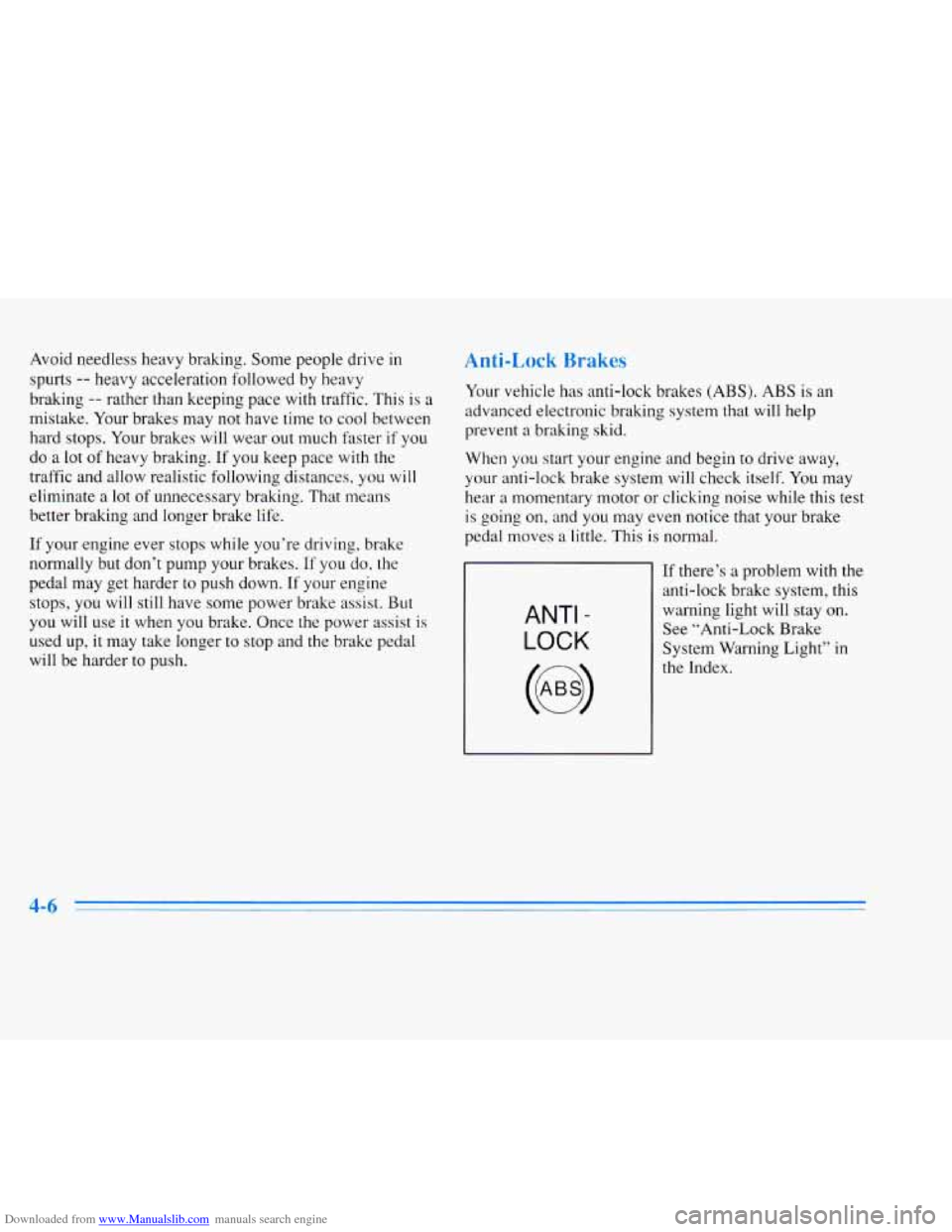
If there’s a problem with the
anti-lock brake system, this
warning light will stay on.
See “Anti-Lock Brake
System Warning Light” in
the Index.
Page 196 of 354
Downloaded from www.Manualslib.com manuals search engine Passing
The driver of a vehicle about to pass another on a
two-lane highway waits for just the right moment,
accelerates, moves around the vehicle ahead, then goes
back into the right lane again. A simple maneuver?
Not necessarily! Passing another vehicle on a two-lane
highway is a potentially dangerous move, since the
passing vehicle occupies the same lane as oncoming
traffic for several seconds. A miscalculation, an error in
judgment, or a brief surrender to frustration or anger can
suddenly put the passing driver face to face with the
worst of all traffic accidents
-- the head-on collision.
So here are some tips for passing:
“Drive ahead.” Look down the road, to the sides and to
crossroads for situations that might affect your passing
patterns.
If you have any doubt whatsoever about
making a successful pass, wait for a better time.
Watch for traffic signs, pavement markings and lines.
If you
can see a sign up ahead that might indicate a
turn or in intersection, delay your pass. A broken
center line usually indicates it’s all right to pass (providing the road ahead is clear). Never cross a solid
line on your side of the lane or a double solid line,
even if the road seems empty of approaching traffic.
0 Do not get too close to the vehicle you want to pass
while you’re awaiting an opportunity. For one thing,
following too closely reduces your area of vision,
especially if you’re following a larger vehicle. Also,
you won’t have adequate space if the vehicle ahead
suddenly slows or stops. Keep back a reasonable
distance.
0 When it looks like a chance to pass is coming up,
start to accelerate but stay
in the right lane and don’t
get too close. Time your move
so you will be
increasing speed as the time comes to move into the
other lane. If the way is clear to pass, you will have a
“running start’’ that more than makes up for the
distance you would lose by dropping back. And if
something happens to cause you to cancel your pass,
you need only slow down and drop back again and
wait for another opportunity.
If other cars are lined up to pass a slow vehicle, wait
your turn. But take care that someone isn’t trying to
pass you as you pull out to pass the slow vehicle.
Remember to glance over your shoulder and check
the blind spot.
I
4-13
Page 200 of 354
Downloaded from www.Manualslib.com manuals search engine Driving in Rain and on Wet Roads Rain and wet roads can mean driving trouble. On a wet
road, you can’t stop, accelerate or turn as well because
your tire-to-road traction isn’t
as good as on dry roads.
And, if your tires don’t have much tread left, you’ll get
even less traction. It’s always wise to go slower and be
cautious
if rain starts to fall while you are driving. The
surface may get wet suddenly when your reflexes are
tuned for driving on dry pavement.
The heavier the rain, the harder it is to see. Even if your
windshield wiper blades are in good shape, a heavy rain
can make it harder to
see road signs and traffic signals,
pavement markings, the edge of the road and even
people walking.
It’s wise
to keep your wiping equipment in good shape
and keep your windshield washer tank filled. Replace
your windshield wiper inserts when they show signs of
streaking
or missing areas on the windshield, or when
strips of rubber start to separate from the inserts.
4-17 I
I
Page 219 of 354
Downloaded from www.Manualslib.com manuals search engine Making Turns
NOTICE:
Making very sharp turns while trailering could
cause the trailer to come in contact with the
vehicle. Your vehicle could
be damaged. Avoid
making very sharp turns while trailering.
I
When you’re turning with a trailer, make wider turns
than normal.
Do this so your trailer won’t strike soft
shoulders, curbs, road signs, trees or other objects.
Avoid jerky
or sudden maneuvers. Signal well in
advance.
Turn Signals When Towing a Trailer
When you tow a trailer, your vehicle may need a
different turn signal flasher and extra wiring. Check
with your Cadillac dealer. The green arrows on your
instrument panel will flash whenever you signal a turn
or lane change. Properly hooked
up, the trailer lamps
will also flash, telling other drivers you’re about to
turn,
change lanes or stop. When
towing
a trailer, the green arrows on your
instrument panel will flash for turns even if the bulbs on
the trailer are burned out. Thus, you
may think drivers
behind you are seeing your signal when they are not. It’s
important to check occasionally to be sure the trailer
bulbs are still working.
Driving On Grades
Reduce speed and shift to a lower gear hefor-e you start
down a long or steep downgrade.
If you don’t shift
down,
you might have to use your brakes so much that
they would get hot and no longer work well.
On a long uphill grade, shift down and reduce your
speed to around
45 mph (70 km/h) or less to reduce the
possibility
of engine and transaxle overheating.
4-36
Page 220 of 354
Downloaded from www.Manualslib.com manuals search engine Parking on Hills
You really should not park your vehicle, with a trailer
attached, on
a hill. If something goes wrong, your rig
could start
to move. People can be injured, and both
your vehicle and the trailer can be damaged.
But if
you ever have to park your rig on a hill, here’s
how to do it:
1.
2.
3.
4.
5.
Apply your regular brakes, but do not shift into
PARK (P).
Have someone place chocks under the trailer wheels.
When the wheel chocks
are in place, release the
regular brakes until the chocks absorb the load.
Reapply the regular brakes. Then shift into
PARK
(P) firmly and apply your parking brake.
Release the regular brakes.
When You Are Ready to Leave After
Parking
on a Hill
1. Apply your regular brakes and hold the pedal down
while you:
Start your engine;
Shift into a gear; and
0 Be sure the parking brake has released.
2. Let up on the brake pedal.
3. Drive slowly until the trailer is clear of the chocks.
4. Stop and have someone pick up and store the chocks.
Maintenance When Trailer Towing
Your vehicle will need service more often when you’re
pulling a trailer. See the Maintenance Schedule for more
on this. Things that are especially important in trailer
operation are automatic transaxle fluid (don’t overfill),
engine oil, belt, cooling system and brake adjustment.
Each of these
is covered in this manual, and the Index
will help you find them quickly. If you’re trailering, it’\
s
a good idea to review these sections before you start
your trip.
Check periodically to see that all hitch nuts and bolts are tight.
4-37
Page 265 of 354
Downloaded from www.Manualslib.com manuals search engine If you get gasoline on yourself and then
something ignites it,
you could be badly burned.
Gasoline can spray out on you
if you open the
fuel fillet cap too quickly. This spray can happen
if your tank is nearly full, and is more likely in
hot weather. Open the fuel filler cap slowly and
wait for any “hiss” noise to stop. Then unscrew-
the cap all the way.
1 Be careful not to spill gasoline. Clean gasoline from
painted surfaces
as soon as possible. See “Cleaning the
Outside of Your Cadillac”
in the Index.
When you put the cap back on, turn it to the right until
you hear at least three clicks. Make sure you fully install the cap.
NOTICE:
If you need a new cap, be sure to get the.right
type. Your dealer can get one for you.
If yau get
the wrong type, it may not
fit or have proper
venting, and your fuel tank and emissions system
might be damaged.
Checking Things Under the Hood
I A CAUTION:
An,electric fan under the hood can start up and
injure you even when the engine
is not running.
Keep hands, clothing and tools away from any
underhood electric fan.
’ 6-6
Page 351 of 354
Downloaded from www.Manualslib.com manuals search engine Steering Wheel Touch Control ................ 3-13. 3-33
Stop Engine Low Oil Pressure Message
............. 2-83
Stop Engine Overheated Message
.................. 2-83
Storage Compartments
........................... 2-50
Storage. Vehicle
................................ 6-28
Stuck:
In Sand. Mud. Ice or Snow .................. 5-36
Sunvisors
.................................... 2-53
Sunglasses Storage
.............................. 2-5 1
Supplemental Inflatable Restraint .................. 1-20
Surge Tank. Coolant
........................ 5- 18. 5-20
Surge Tank Pressure Cap ......................... 6-22
Symbols. Vehicle
................................ x111 ...
Tachometer .................................. 2-62
Taillamp Bulb Replacement
....................... 6-34
TapePlayerCare
............................... 3-35
Telephone. Cellular
............................. 2-54
Temperature Control. Climate Control System ..... 3-2. 3-6
Temperature Control. Passenger
.................... 3-8
Theft
......................................... 2-10
Theft System Problem/Car May Not Restart Message
. . 2-83
Theft-Deterrent System
.......................... 2- 1 1
Theft-Deterrent Audio Feature .................... 3-33
Thermostat
.................................... 6-23
Third (3)’ Automatic Transaxle
.................... 2-2 1
Tilt Steering Wheel ............................. 2-30
Time. Setting the
............................... 3- 1 3
Tire Chains
.................................... 6-44
TireLoading
................................... 4-29
Tire-Loading Information Label
................... 4-29 Tires
......................................... 6-36
Alignment and Balance
........................ 6-42
BuyingNew
................................. 6-40
Chains
..................................... 6-44
Changing a Flat
.............................. 5-25
Cleaning
.................................... 6-50
Compact Spare
............................... 5-35
Inflation
.................................... 6-37
Inspection and Rotation
........................ 6-38
Pressure
.................................... 6-37
Temperature
................................. 6-42
Traction
.................................... 6-41
Treadwear
................................... 6-41
Uniform Quality Grading ....................... 6-41
Wear Indicators .............................. 6-39
Wheel Replacement
........................... 6-42
When
It’s Time for New ....................... 6-39
Top Speed Fuel Cut-Off Message
.................. 2-83
TorqueLock
................................... 2-26
Torque, Wheel
Nut ......................... 5-32, 6-65
Towing a Trailer
................................ 4-31
Towing Your Vehicle
............................. 5-8
Traction Active
...................................... 2-85
Active Message
............................... 4-8
Control System
................................ 4-8
OffMessage
................................. 2-84
Ready Message
.............................. 2-84
Loading
.................................... 4-29
TopStrap
..................................... 1-35
Control System Warning Light .............. 2-68, 4-9
.