check engine CADILLAC ELDORADO 1996 10.G Workshop Manual
[x] Cancel search | Manufacturer: CADILLAC, Model Year: 1996, Model line: ELDORADO, Model: CADILLAC ELDORADO 1996 10.GPages: 354, PDF Size: 19.33 MB
Page 261 of 354
Downloaded from www.Manualslib.com manuals search engine You can be injured and your vehicle could be
damaged if you try to do service work on a
vehicle without knowing enough about it.
Be sure you have sufficient knowledge,
experience, and the proper replacement
parts and tools before you attempt any
vehicle maintenance task.
0 Be sure to use the proper nuts, bolts and
other fasteners. “English’ and “metric”
fasteners can be easily confused. If you use
the wrong fasteners, parts can later break
or fall off. You could be hurt.
Fuel
Use premium unleaded gasoline rated at 91 octane or
higher. At a minimum, it should meet specifications
ASTM
D4,814 in the United States and CGSB 3.5-M93
in Canada. Improved gasoline specifications have been
i ~ developed by the American Automobile Manufacturers
Association (AAMA) for. better vehicle performance
and engine protection. Gasolines meeting the
AAMA
specification could provide improved driveability and
emission control system protection compared
to other
gasolines.
Be sure the posted octane for premium is at least 91. If
the octane is less than 91, you may get a heavy knocking
2
noise when you drive. (In an emergency, you may be
able to use
a lower octane -- as low as 87 -- if heavy
knocking does not occur.)
If you’re using 91 or higher
octane unleaded gasoline and you still hear heavy
knocking, your engine needs service.
If your vehicle is certified to meet California Emission Standards (indicated on the underhood tune-up label),
it is designed to operate on fuels that meet California
specifications.
If such fuels are not available in states
adopting California emissions standards, your vehicle
will operate satisfactorily on fuels meeting federal
specifications, but emission control system performance
may be affected. The malfunction inbcator lamp on
your instrument panel may
turn on and/or your vehicle
may fail a smog-check test.
If this occurs, return to your
authorized Cadillac dealer for diagnosis to determine the
cause
of failure. In the event it is determined that the
cause of the condition is the type of fuels used, repairs
may not be covered by your warranty.
6-2
Page 262 of 354
Downloaded from www.Manualslib.com manuals search engine In Canada, some gasolines contain an octane-enhancing
additive called MMT. If you use such fuels, your
emission control system performance may deteriorate
and the malfunction indicator lamp on your instrument
panel may turn on. If this happens, return to your
authorized Cadillac dealer for service.
To provide cleaner air, all gasolines are now required to
contain additives that will help prevent deposits from
forming in your engine and fuel system, allowing your
emission control system to function properly. Therefore,
you should not have to add anything to the fuel. In
addition, gasolines containing oxygenates, such as ethers
and ethanol, and reformulated gasolines may be
available in your area to help clean the air. General
Motors recommends that you use these gasolines if they
comply with the specifications described earlier.
NOTICE:
Your vehicle was not designed for fuel that
contains methanol. Don’t use it. It can corrode
metal parts
in your fuel system and also damage
plastic and rubber parts. That damage wouldn’t
be covered under your warranty.
Fuels in Foreign Countries
If you plan on driving in another country outside the
United States
or Canada, the proper fuel may be hard to
find. Never use leaded gasoline
or any other fuel not
recommended in the previous text on fuel. Costly repairs
caused by use of improper fuel wouldn’t be covered
by
your warranty.
To check on fuel availability, ask an auto club, or
contact a major oil company that does business in the
country where you’ll be driving.
You can also write us at the following address for
advice. Just tell us where you’re going and give your
Vehicle Identification Number (VIN).
General Motors Overseas Distribution Corporation
North American Export Sales (NAES)
1908 Colonel Sam Drive
Oshawa, Ontario
L1H 8P7
6-3
- r
Page 265 of 354
Downloaded from www.Manualslib.com manuals search engine If you get gasoline on yourself and then
something ignites it,
you could be badly burned.
Gasoline can spray out on you
if you open the
fuel fillet cap too quickly. This spray can happen
if your tank is nearly full, and is more likely in
hot weather. Open the fuel filler cap slowly and
wait for any “hiss” noise to stop. Then unscrew-
the cap all the way.
1 Be careful not to spill gasoline. Clean gasoline from
painted surfaces
as soon as possible. See “Cleaning the
Outside of Your Cadillac”
in the Index.
When you put the cap back on, turn it to the right until
you hear at least three clicks. Make sure you fully install the cap.
NOTICE:
If you need a new cap, be sure to get the.right
type. Your dealer can get one for you.
If yau get
the wrong type, it may not
fit or have proper
venting, and your fuel tank and emissions system
might be damaged.
Checking Things Under the Hood
I A CAUTION:
An,electric fan under the hood can start up and
injure you even when the engine
is not running.
Keep hands, clothing and tools away from any
underhood electric fan.
’ 6-6
Page 268 of 354
Downloaded from www.Manualslib.com manuals search engine e Oil
......... ............... . ........... ........... ...... ........... ...... .. .. ............ .... .......... ........... ....... ........... ..... ...................................................
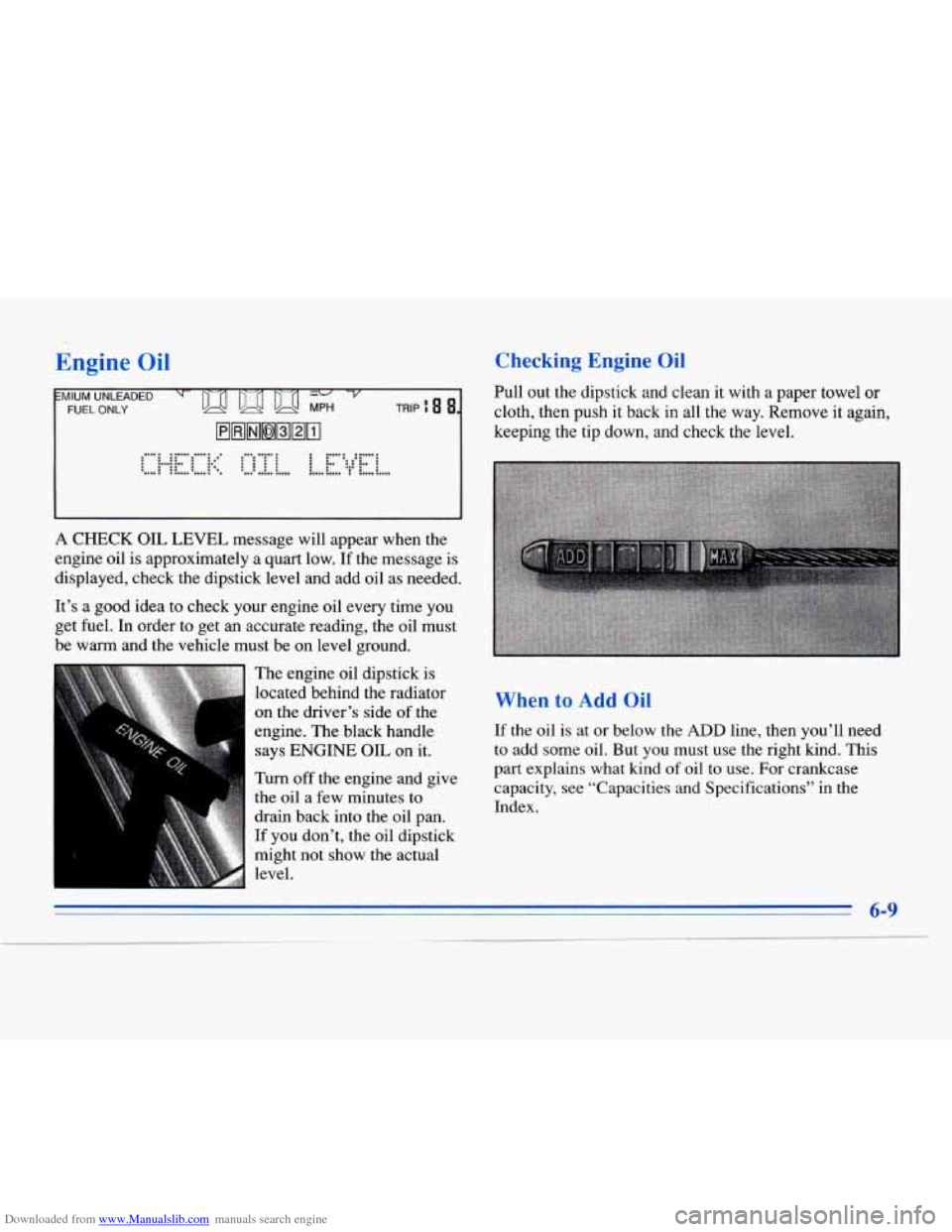
A CHECK OIL LEVEL message will appear when the
engine oil is approximately a quart low. If the message is
displayed, check the dipstick level and add oil as needed.
It’s
a good idea to check your engine oil every time you
get fuel. In order to get an accurate reading, the oil must
be warm and the vehicle must be on level ground.
The engine oil dipstick is
located behind the radiator
on the driver’s side of the
engine. The black handle
says
ENGINE OIL on it.
Turn off the engine and give
the oil a few minutes to
drain back into the oil pan.
If you don’t, the oil dipstick
might not show the actual
level.
Checking Engine Oil
Pull out the dipstick and clean it with a paper towel or
cloth, then push it back in all the way. Remove it again,
keeping
the tip down, and check the level.
11 the oil is at or below the ADD line, then you’ll need
to add some oil. But you must use the right kind, This
part explains what kind of oil to use. For crankcase
capacity, see “Capacities
and Specifications’’ in the
Index.
6-9
Page 271 of 354
Downloaded from www.Manualslib.com manuals search engine When to Change Engine Oil
Your Cadillac has an Oil Life Indicator. This feature
will let you know when to change your
oil and
filter
-- usually between 3,000 miles (5 000 km) and
7,500 miles (12 500 km) since your last oil change.
Under severe conditions,
the indicator may come on
before
3,000 miles (5 000 km). Never drive your vehicle
more than
7,500 miles (12 500 km) or 12 months,
(whichever occurs first) without an
oil change.
The system won’t detect dust in the oil.
So, if you
drive in a dusty area, be sure to change your oil every
3,000 miles (5 000 km) or sooner if the CHANGE
ENGINE OIL message comes on. Remember to reset
the Oil Life Indicator when the oil has been changed.
For more information, see “Oil Life Indicator”
in
the Index.
How to Reset the Oil Life Indicator
After the oil has been changed, display the OIL LIFE
LEFT message by pressing the 1NFORMATION button.
Then press and hold the RESET button until the display
shows
“100.” This resets the oil life index. The message
will remain off until the next oil change is needed. The
percentage of oil life remaining may be checked
at any time
by pressing the INFORMATION button several
times
until the OIL LIFE LEFT message appears. For
more information on
the Oil Life feature, see “Oil Life
Indicator” in the Index.
What to Do with Used Oil
Did you know that used engine oil contains certain
elements that may be unhealthy for your skin and could
even cause cancer? Don’t let used oil stay on your skin
for very long. Clean your skin and nails with soap
and
water, or a good hand cleaner. Wash or properly throw
away clothing or rags containing used engine oil. (See
the manufacturer’s warnings about the use and disposal
of oil products.)
Used
oil can be a real threat to the environment. If you
change your own oil, be sure to drain all free-flowing oil
from the filter before disposal. Don’t ever dispose
of oil
by putting it in the trash, pouring
it on the ground, into
sewers, or into streams or bodies of water. Instead,
recycle
it by taking it to a place that collects used oil. If
you have a problem properly disposing of your used oil,
ask your dealer, a service station or a local recycling
center for
help.
6-12
Page 275 of 354
Downloaded from www.Manualslib.com manuals search engine Automatic Transaxle Fluid
When to Check and Change
A good time to check your automatic transaxle fluid
level is when the engine oil is changed.
Change both the fluid and filter every
50,000 miles
(83 000 km) if the vehicle is mainly driven under one or
more
of these conditions:
0 In heavy city traffic where the outside temperature
regularly reaches
90°F (32°C) or higher.
0 In hilly or mountainous terrain.
0 When doing frequent trailer towing.
Uses such as found in taxi, police or delivery service.
If you do not use your vehicle under any of these
conditions, the fluid and filter do not require changing.
See “Scheduled Maintenance Services” in the
Maintenance Schedule booklet.
How to Check
Because this operation can be a little difficult, you may
choose
to have this done at your Cadillac dealership
service department.
If
you do it yourself, be sure to follow all the instructions
here, or you could get a false reading on the dipstick.
NOTICE:
Too much or too little fluid can damage your
transaxle.
Too much can mean that some of the
fluid could come out and fall on hot engine parts
or exhaust system parts, starting a fire. Be sure to
get an accurate reading if you check your
transaxle fluid.
Wait at least 30 minutes before checking the transaxle
fluid level
if you have been driving:
0 When outside temperatures are above 90°F (32°C).
0 At high speed for quite a while.
0 In heavy traffic -- especially in hot weather.
0 While pulling a trailer.
6-16
Page 277 of 354
Downloaded from www.Manualslib.com manuals search engine I 3.
5.
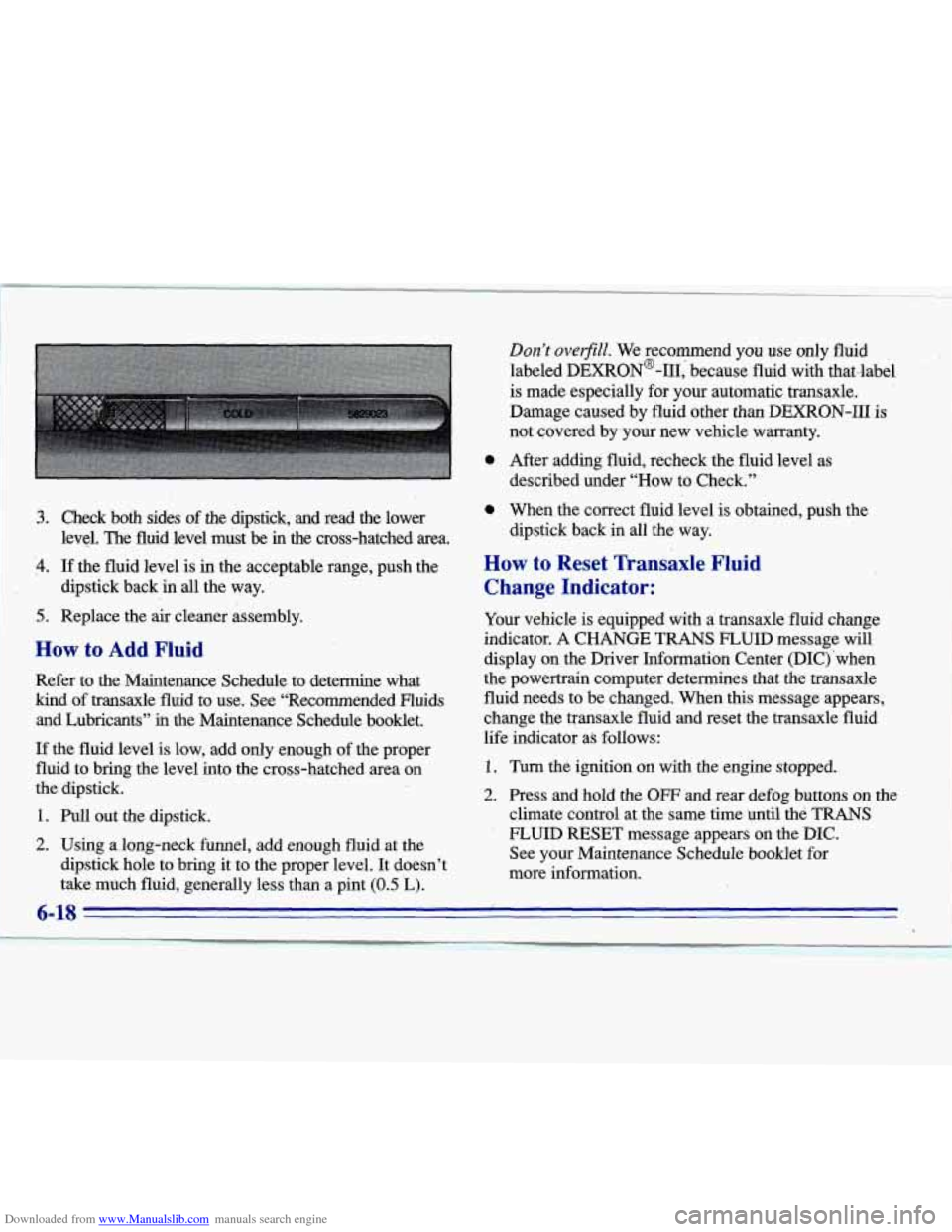
Check both sides of the dipstick, and read the lower
level. The fluid level must be in’the cross-hatched area.
If the fluid level is in the acceptable range, push the
dipstick back in all the way.
Replace the
air cleaner assembly.
How to Add Fluid
Refer to the Maintenance Schedule to determine what
kind of transaxle fluid to use. See “Recommended Fluids and Lubricants”
ii.1 the Maintenance Schedule booklet.
If the fluid level is low, add only,enough of the proper
fluid to bring the level into the cross-hatched area on
the dipstick. 1
1. Pull out the dipstick.
2. Using along-neck funnel, add enough fluid at the
dipstick hole to bring it to the proper level. It doesn’t
take,much fluid, generally less than a pint
(0.5 ‘L).
0
0
Don’t overfiill. We recommend you use only fluid
labeled DEXRON@-111, because fluid with that-label
is made especially for your automatic transaxle.
Damage caused by fluid other than DEXRON-I11
is
not covered by your new vehicle warranty.
After adding fluid, recheck the fluid level
as
described under “How to Check.”
When the correct fluid level is obtained, push the
dipstick back in all the way.
How to Reset Transaxle Fluid
Change Indicator:
Your vehicle is equipped with a transaxle fluid change
indicator.
A CHANGE TRANS FLUID message will
display on the Driver Information Center (DIC) ‘when
the powertrain computer determines that the transaxle
fluid needs to be changed. When
this message appears,
change the transaxle fluid and reset the transaxle fluid
life indicator as follows:
1. Turn the ignition on with the engine stopped.
2. Press and hold the OW and rear defog buttons on the
climate control at the same time until the
TRANS
- FLUID RESET message appears on the DIC.
See your Maintenance Schedule booklet
for
more information.
Page 279 of 354
Downloaded from www.Manualslib.com manuals search engine Adding only plain water to your cooling system
can be dangerous. Plain water, or some other
liquid like alcohol, can boil before the proper
coolant mix will. Your vehicle’s coolant warning
system is set
for the proper coolant mix. With
plain water or the wrong mix, your engine could
get too hot but you wouldn’t get the overheat
warning. Your engine could catch fire and you or
others could be burned.
Use a 50/50 mix of clean
water
and DEX-COOL (orange-colored,
silicate-free) antifreeze.
NOTICE:
If you use an improper coolant mix, your engine
could overheat and be badly damaged. The
repair cost wouldn’t be covered by your
warranty.
Too much water in the mix can freeze
and crack the engine, radiator, heater core and
other parts.
If you have to add coolant more than four times a year,
have your dealer check your cooling system.
NOTICE:
If you use the proper coolant, you don’t have to
add extra inhibitors or additives which claim to
improve the system. These can be harmful.
6-20
Page 280 of 354
Downloaded from www.Manualslib.com manuals search engine Checking Coolant
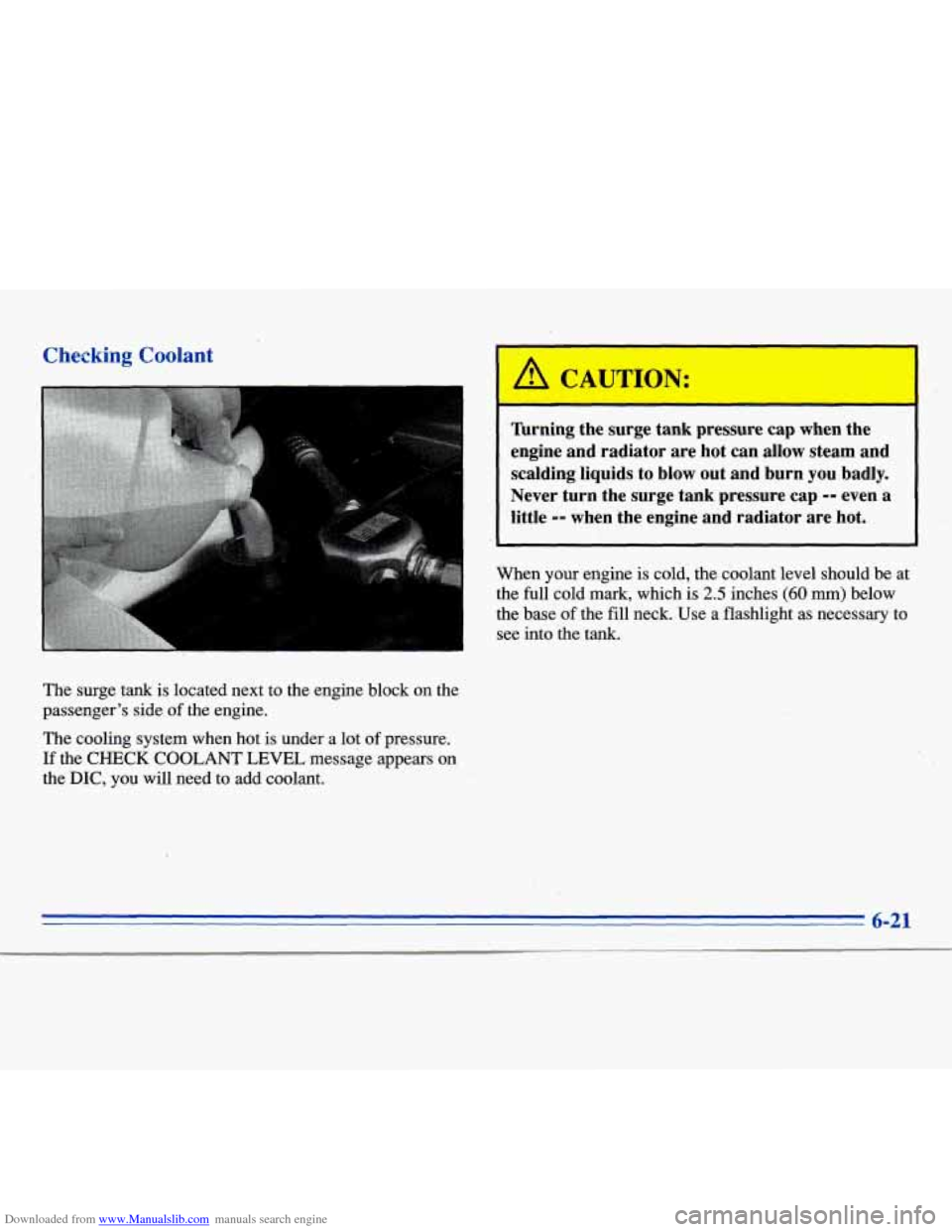
The surge tank is located next to the engine block on the
passenger’s side of the engine.
The cooling system when hot is under
a lot of pressure.
If the CHECK COOLANT LEVEL message appears on
the
DIC, you will need to add coolant.
A CAUTION:
I
I
lhrning the surge tank pressure cap when the
engine and radiator are hot can allow steam and
scalding liquids
to blow out and burn you badly.
Never turn the surge tank pressure cap
-- even a
little
-- when the engine and radiator are hot.
When your engine is cold, the coolant level should be at
the full cold mark, which is
2.5 inches (60 mm) below
the base
of the fill neck. Use a flashlight as necessary to
see into the tank..
6-21
Page 282 of 354
Downloaded from www.Manualslib.com manuals search engine Thermostat
Engine coolant temperature is controlled by a thermostat
in the engine coolant system. The thermostat stops the
flow of coolant through the radiator until the coolant
reaches a preset temperature.
If your thermostat needs to be replaced, a General
Motors thermostat is recommended.
Power Steering Fluid
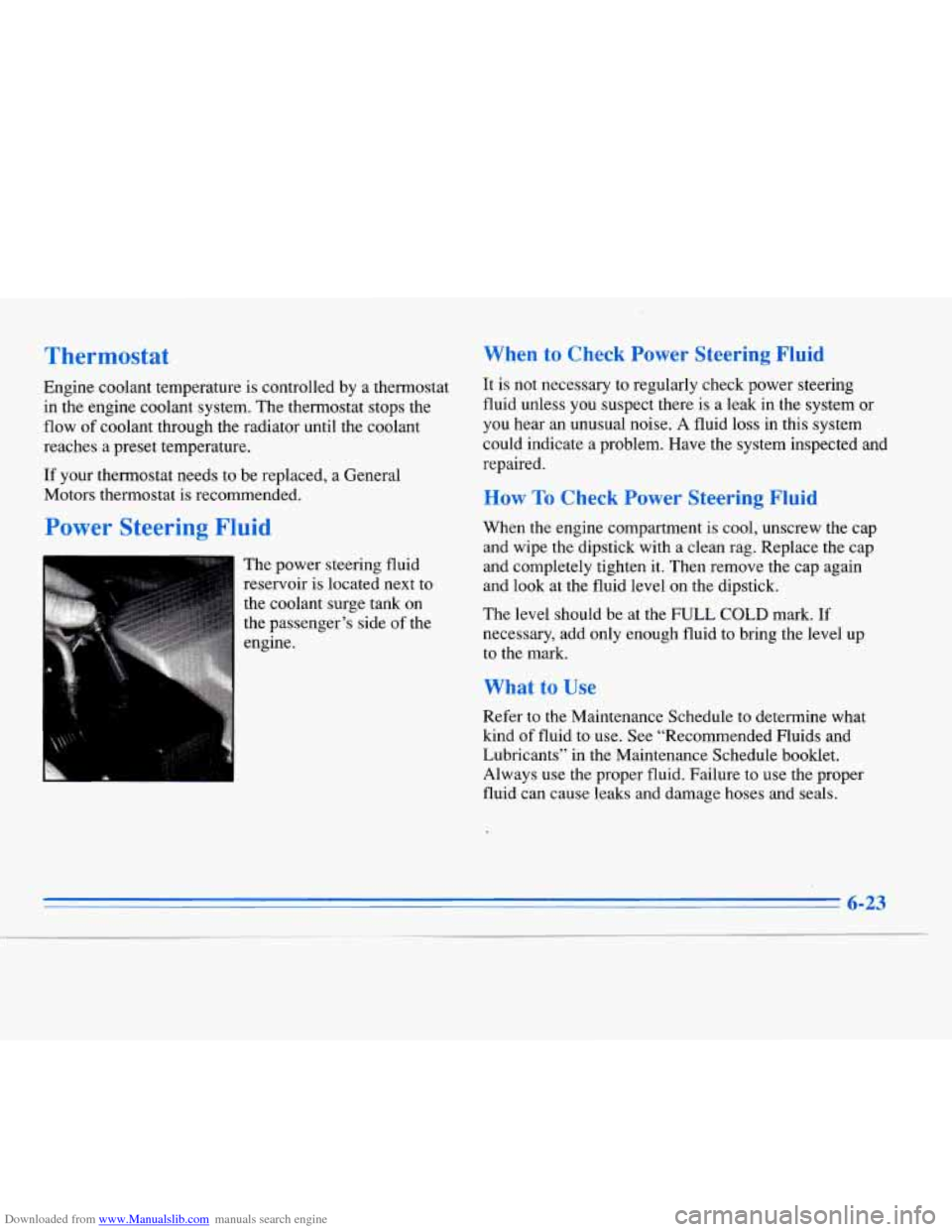
The power steering fluid
reservoir is located next to
the coolant surge tank on
the passenger’s side of the
engine.
When to Check Power Steering Fluid
It is not necessary to regularly check power steering
fluid unless you suspect there is a leak in the system or
you hear an unusual noise. A fluid loss in this system
could indicate a problem. Have the system inspected and
repaired.
How To Check Power Steering Fluid
When the engine compartment is cool, unscrew the cap
and wipe the dipstick with a clean rag. Replace the cap
and completely tighten
it. Then remove the cap again
and look at the fluid level on the dipstick.
The level should be at the FULL
COLD mark. If
necessary, add only enough fluid to bring the level up
to the mark.
What to Use
Refer to the Maintenance Schedule to determine what
kind of fluid to use. See “Recommended Fluids and
Lubricants” in the Maintenance Schedule booklet.
Always use the proper fluid. Failure to use the proper
fluid can cause leaks and damage hoses and seals.
6-23