engine overheat CADILLAC ELDORADO 1996 10.G Owners Manual
[x] Cancel search | Manufacturer: CADILLAC, Model Year: 1996, Model line: ELDORADO, Model: CADILLAC ELDORADO 1996 10.GPages: 354, PDF Size: 19.33 MB
Page 2 of 354
Downloaded from www.Manualslib.com manuals search engine /r”‘ --.
The 1996 Cadillac Eldorado Owner’s Manual
Seats and Kestraint Systems ............................................................. 1-1
FeaturesandControls .................................................................. 2-1
Comfort Controls and Audio Systems ..................................................... 3-1
This section tells you how to use your seats and safety belts\
properly. It also explains the “SIR” system.
This section explains how to start and operate your Cadillac.
This section tells you how to adjust the ventilation and comfo\
rt controls and how to operate your
audio system.
Here you’ll find helpful information and tips about the road\
and how to drive under different conditions.
This section tells you what to do if you have a problem while driving, such as a flat tire or \
overheated
engine, etc.
Here the manual tells you how to keep your Cadillac running p\
roperly and looking good.
This section tells you how to contact Cadillac for assistance \
and
how to get service and owner publications.
It also gives you information on “Reporting Safety Defects”\
on page
7-10.
Here’s an alphabetical listing of almost every subject in th\
is manual. You can use it to quickly find something you want to read.
YourDrivingandtheRoad .............................................................. 4-1
ProblemsontheRoad .................................................................. 5-1
Service and Appearance Care.. .......................................................... 6-1
Customer Assistance Information ........................................................ 7-1
Index ........................................................................\
........ 8-1
i
Page 78 of 354
Downloaded from www.Manualslib.com manuals search engine Engine Coolant Heater (Option)
(Canada
Only)
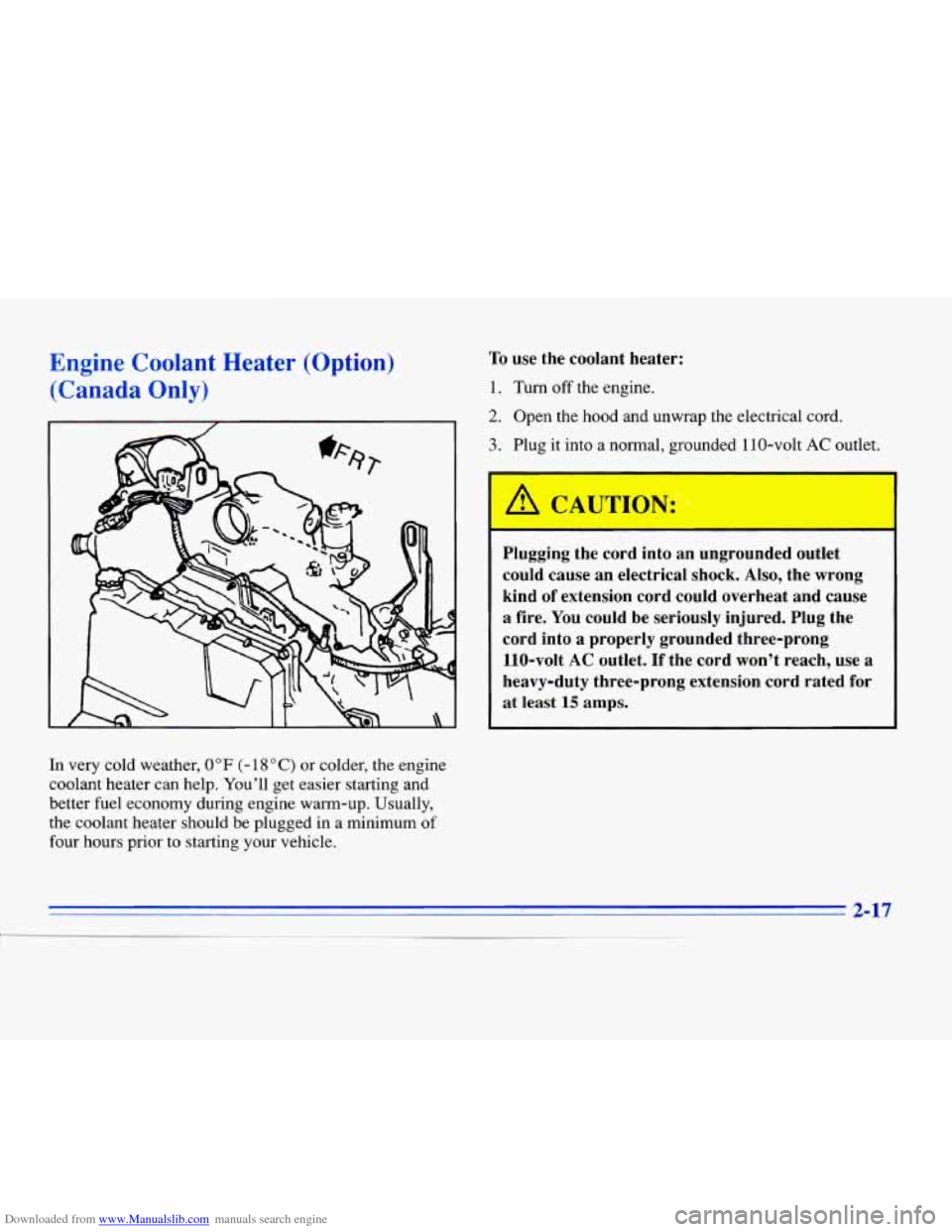
In very cold weather, 0" F (- 18 O C) or colder, the engine
coolant heater can help. You'll get easier starting and
better fuel economy during engine warm-up. Usually,
the coolant heater should be plugged in a minimum
of
four hours prior to starting your vehicle.
To use the coolant heater:
1. Turn
off the engine.
2. Open the hood and unwrap the electrical cord.
3. Plug it into a normal, grounded 1 10-volt AC outlet.
A CAUTION: r1
Plugging the cord into an ungrounded outlet
could cause an electrical shock.
Also, the wrong
kind of extension cord could overheat and cause
a fire. You could be seriously injured. Plug the
cord into
a properly grounded three-prong
110-volt
AC outlet. If the cord won't reach, use a
heavy-duty three-prong extension cord rated for
at least 15 amps.
2-17
I
Page 83 of 354
Downloaded from www.Manualslib.com manuals search engine FIRST (lji This position gives you even more power Parking Brake
than SECOND (2). You can use it on very steep hills,
or
in deep snow or mud. (If the shift lever is put in
FIRST (l), the transaxle won’t shift into gear until the
vehicle is
going slowly enough.)
NOTICE: - --
If your front wheels can’t rotate, don’t try to
dri.ve. This-might happeh if
you were stuck in
very.deep sand or mud
or were up against a solid
object.
You could damage your transaxle.
Also, if you stop when going uphill, don’t hold Hold
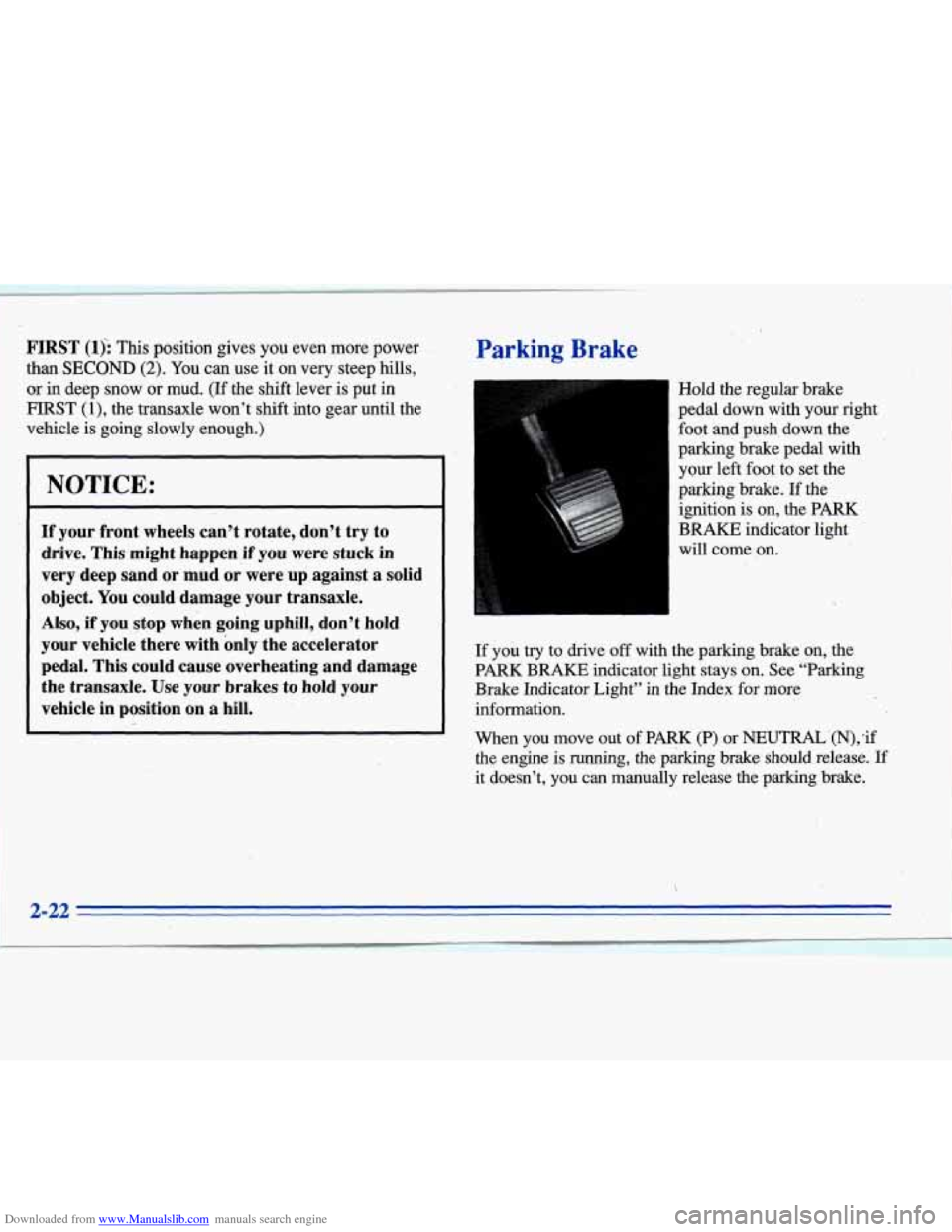
the regular brake
pedal down with your right
foot and push, down the
parking brake pedal with
your left foot to set the
parking brake.
If the
ignition is on, the PARK
BRAKE indicator light
will come ,on.
your vehicle there with only the accelerator
If you try to drive off with the parking brake on, the
pedal.
This could cause overheating and damage PARK BRAKE indicator light stays on. See “Parking
the transaxle. Use
your brakes to hold your
Brake Indicator Light” in the Index for more
vehicle in position on
a hill. information.
When you move out
of PARK (P) or NEUTRAL.(N),*if
the engine is running, the p&king brake should release. If
it doesn’t, you can manually release the parking brake.
Page 84 of 354
Downloaded from www.Manualslib.com manuals search engine Reach under the driver’s side of the instrument panel
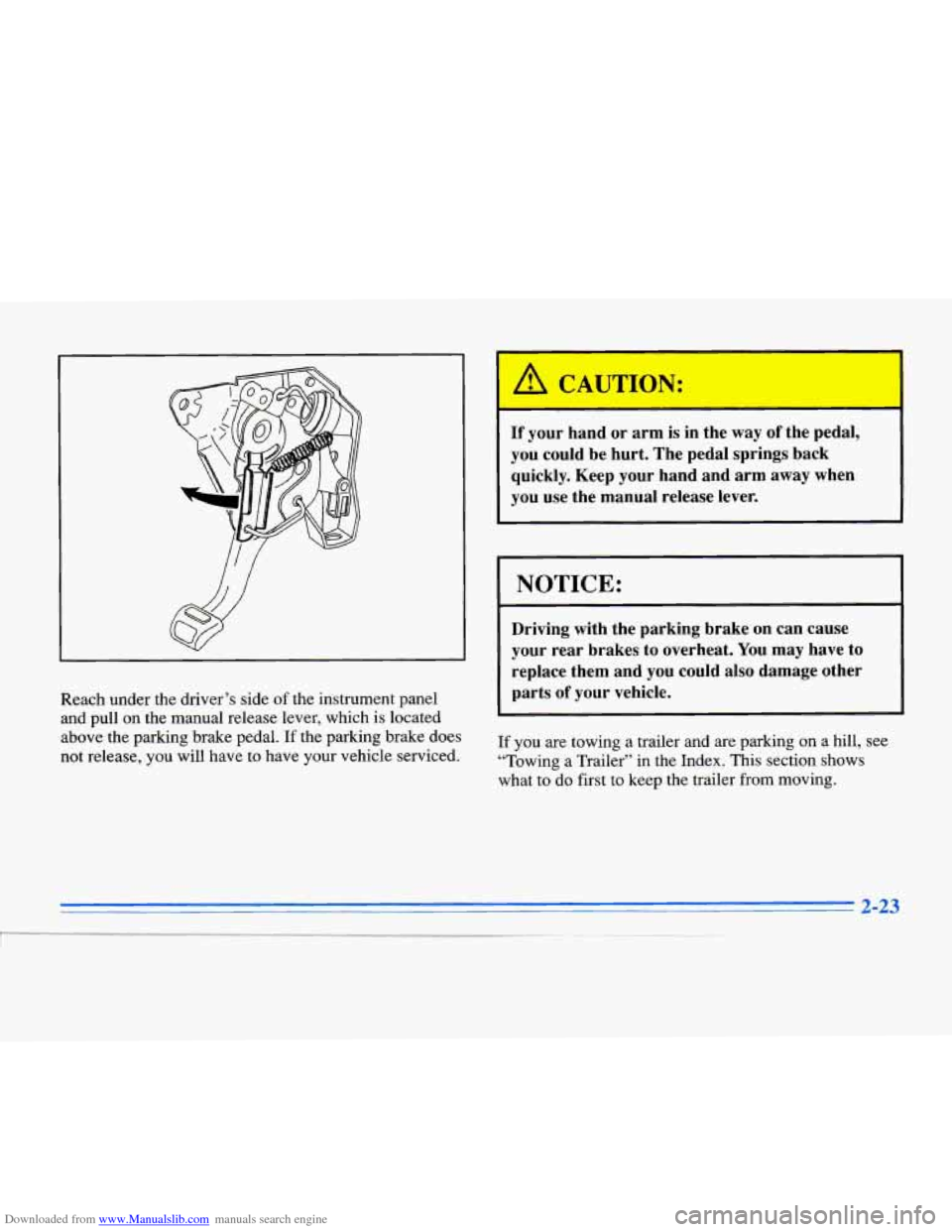
and pull
on the manual release lever, which is located
above the parking brake pedal. If the parking brake does
not release, you will have to have your vehicle serviced.
A CAUTION:
-
If your hand or arm is in the way of the pedal,
you could be hurt. The pedal springs back quickly. Keep your hand and arm away when
you use the manual release lever.
NOTICE:
Driving with the parking brak6 bn’can cause
your rear brakes to overheat. You may have to
replace them and you could also damage other
parts
of your vehicle.
If you are towing a trailer and are parking on a hill, see
“Towing a Trailer’’ in the Index. This section shows
what to do first to keep the trailer from moving.
2-23
Page 87 of 354
Downloaded from www.Manualslib.com manuals search engine Leaving Your Vehicle With the
Engine Running
It can be dangerous to leave your vehicle with the
engine running. Your vehicle could
move
suddenly if the shift lever is not fully in PARK (P)
with the parking brake firmly set. And, if you
leave the vehicle with
the engine running, it could
overheat and even catch fire. You or others
could
be injured. Don’t leave your vehicle with the
engine running unless
you have to.
If you have to leave your vehicle with the engine
running, be sure your vehicle
is in PARK (P) and your
parking brake
is firmly set before you leave it. After
you’ve moved the shift lever into the PARK
(P)
position, hold the regular brake pedal down. Then, see if
you can move the shift lever away from PARK (P)
without first pulling
it toward you (or, if you have the
console shift lever, without first pressing the button).
If
you can, it means that the shift lever wasn’t fully locked
into
PARK (P).
Torque Lock
If you are parking on a hill and you don’t shift your
transaxle into
PARK (P) properly, the weight of the
vehicle may put too much force
on the parking pawl in
the transaxle. You may find it difficult to pull the shift
lever out of
PARK (P). This is called “torque lock.” To
prevent torque lock, set the parking brake and then shift
into PARK (P) properly before you leave the driver’s
seat.
To find out how, see “Shifting Into PARK (P)” in
the Index.
If torque lock does occur, you may need to have another
vehicle push yours a little uphill to take some of the
pressure from the transaxle,
so you can pull the shift
lever out
of PARK (P).
2-26
Page 114 of 354
Downloaded from www.Manualslib.com manuals search engine Note that power to the cigarette lighter will shut off
10 minutes after the ignition is turned off. This helps to
prevent battery drainage. For more information, see
“Inadvertent Battery Saver” earlier in this section.
I NOTICE:
Don’t hold a cigarette lighter in with your hand
while it is heating.
If you do, it won’t be able to
back away from the heating element when it’s
ready. That can make it overheat, damaging the
lighter and the heating element.
Sun Visors
Swing down the visor to block out glare. It can also be
detached from the center mount and moved to the side
to block glare.
The driver’s sunshade is also equipped with a storage
flap that can be used
for maps or toll tickets.
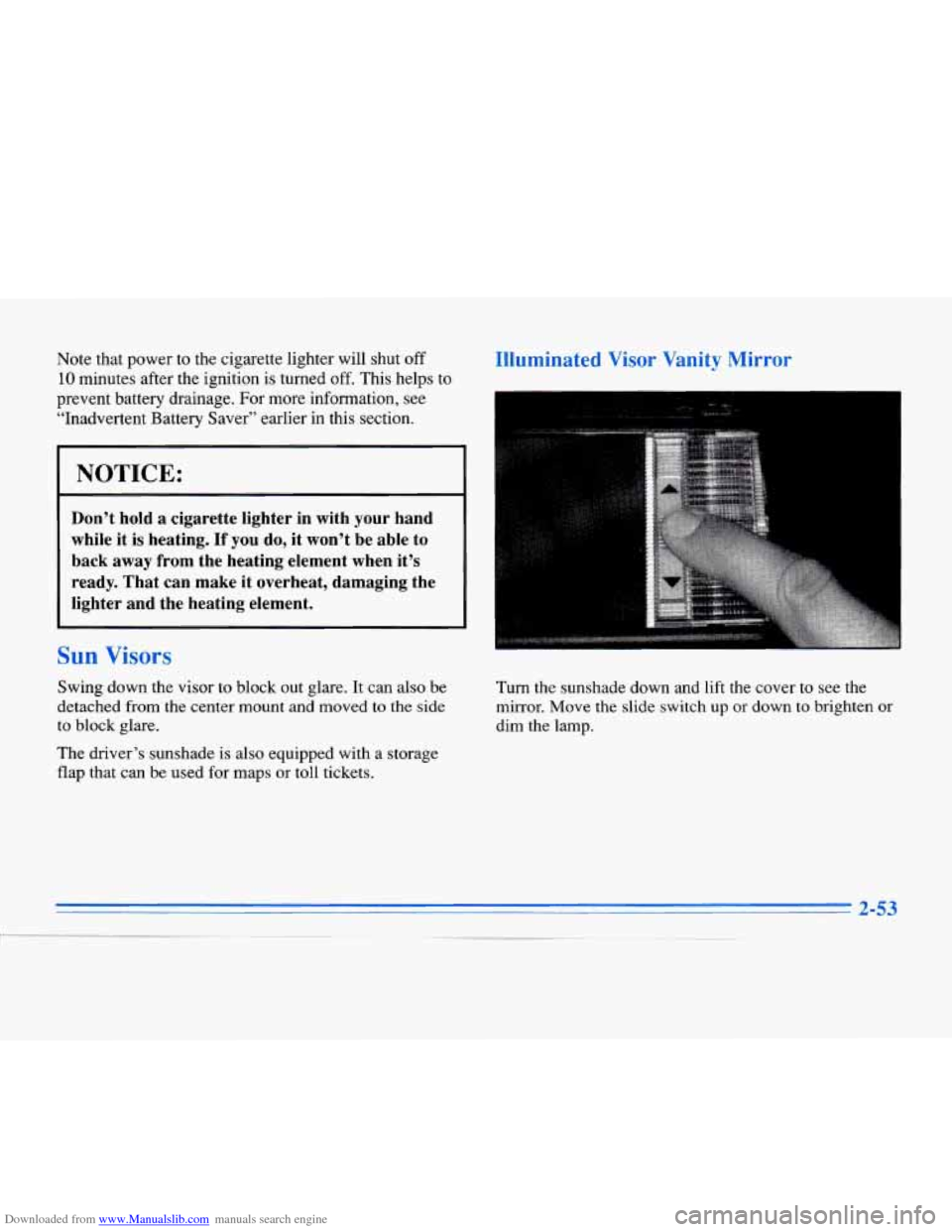
Illuminated Visor Vanity Mirror
Turn the sunshade down and lift the cover to see the
mirror. Move the slide switch up or down to brighten
or
dim the lamp.
2-53
-.
Page 130 of 354
Downloaded from www.Manualslib.com manuals search engine Engine Coolant Temperature
Warning Light Malfunction Indicator Lamp
(Service Engine Soon Light)
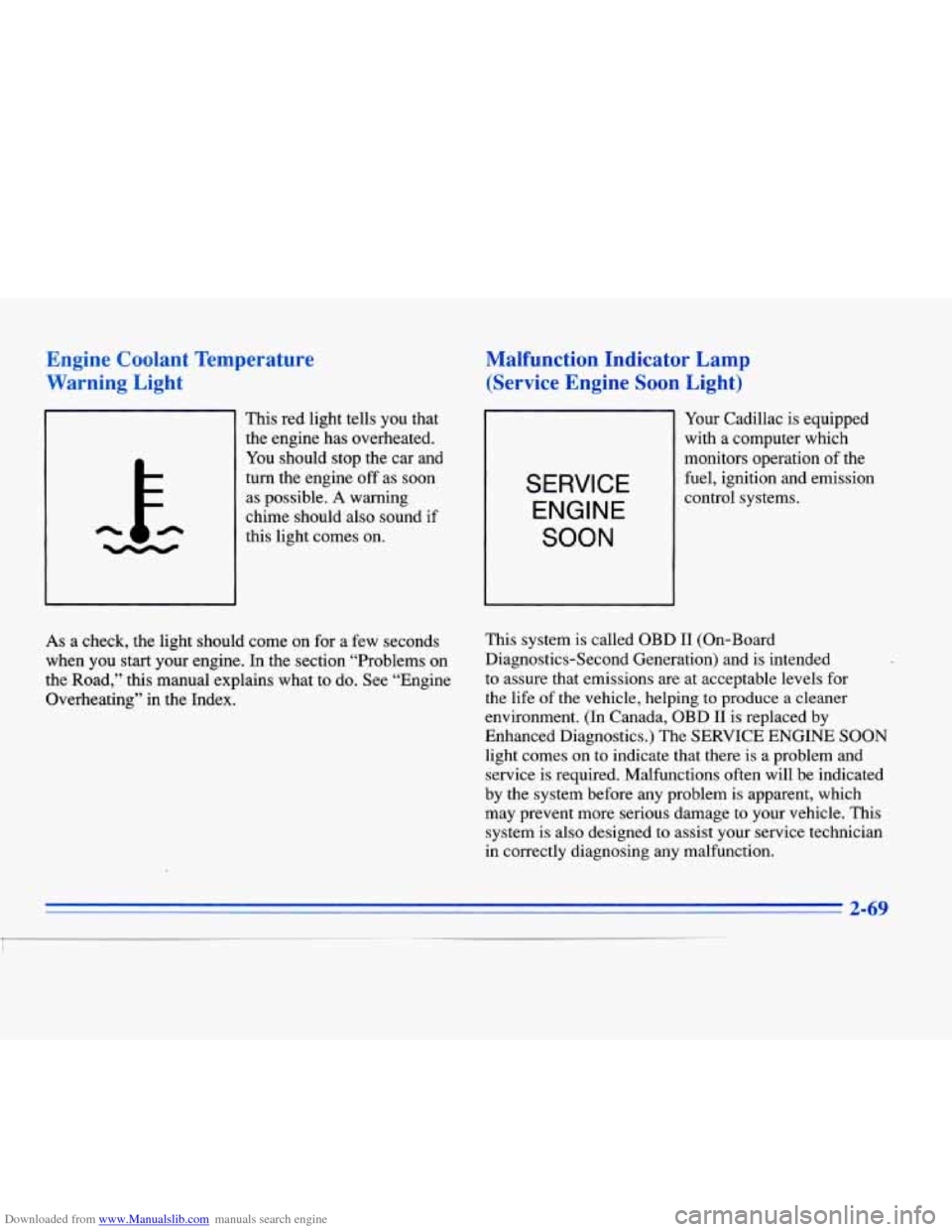
This red light tells you that
the engine has overheated.
You should stop the car and
turn the engine
off as soon
as possible.
A warning
chime should also sound if
this light comes on. SERVICE
ENGINE
SOON
Your Cadillac is equipped
i with a computer which
monitors operation
of the
l fuel, ignition and emission
1 control systems.
As a check, the light should come on for a few seconds
when you start your engine.
In the section “Problems on
the Road,” this manual explains what to
do. See “Engine
Overheating”
in the Index. This
system is called
OBD I1 (On-Board
Diagnostics-Second Generation) and is intended
to assure that emissions are at acceptable levels for
the life of the vehicle, helping
to produce a cleaner
environment. (In Canada, OBD
I1 is replaced by
Enhanced Diagnostics.) The SERVICE ENGINE
SOON
light comes on to indicate that there is a problem and
service is required. Malfunctions often will be indicated
by the system before any problem is apparent, which
may prevent more serious damage to your vehicle. This
system is also designed to assist your service technician
in correctly diagnosing any malfunction.
2-69
Page 142 of 354
Downloaded from www.Manualslib.com manuals search engine ENGINE COOLANT HOT-IDLE ENGINE - 44:
This message will appear when the engine coolant
temperature is over
248 OF (126°C). To avoid added
strain on a hot engine, turn off the climate control
system. Stop and allow your vehicle to idle until it cools
down or
the message is removed. If it does not cool
down, turn off the engine and have it serviced before
driving it again. Severe engine damage can result from
an overheated engine. See “Engine Overheating” in
the Index.
FUEL LEVEL VERY LOW - 11: This message serves
as a warning that the fuel level in the tank is critically
low. Stop for fuel immediately.
MONITORED SYSTEMS OK - 1: This message only
appears in the “recall” mode by pressing the RESET
button. It lets you know that no other messages are
stored or currently active.
PASS KEY NOT PROGRAMMED - 31: This
warning message displays when the PASS-Key pellet
information has not been programmed into your vehicle.
See your Cadillac dealership for service.
PCM FAULT - 110: The circuit in the Powertrain
Control Module (PCM) has shorted or is loose when this
message appears. Have your Cadillac serviced by your
dealership at once.
REDUCED ENGINE POWER - 41: This message
informs the driver that due to wheel slippage your
vehicle is reducing engine power to compensate for the
loss of traction. Accelerating too fast causing the tires to
spin is an example of when this message would display.
REMOVE KEY - 70: This message will appear when
the Personalized Automotive Security System
(PASS-Key
11) is unable to read the pellet on the
ignition key or an improper key pellet has been inserted.
Wait for the DIC to display STARTING DISABLED
DUE TO THEFT SYSTEM REMOVE IGNITION
KEY. The instrument panel cluster will then run a timer
and change the messages to WAIT
3 MINUTES, WAIT
2 MINUTES, WAIT 1 MINUTE and then START CAR.
When the REMOVE KEY message is displayed, remove
the ignition key. Check the ignition key for damage.
If it
is damaged, it may need to be replaced. If you see no
damage, clean the pellet contacts with a soft cloth or
2-81
Page 144 of 354
Downloaded from www.Manualslib.com manuals search engine SERVICE RIDE CONTROL - 84: This message is
displayed to indicate that the suspension system
is not
operating properly. To correct this problem have your
vehicle serviced at your Cadillac dealership.
SERVICE TRANSMISSION - 100: If a problem is
detected with the transaxle, this message will appear.
Have your vehicle checked by your Cadillac dealership.
SPEED SENSOR FAULT - 109: A circuit problem
with the vehicle speed sensor will trigger this message
to appear. Have your Cadillac dealership service your
vehicle.
STARTING DISABLED DUE TO THEFT SYSTEM
REMOVE IGNITION KEY
- 33: This message will
appear when the Personalized Automotive Security
System (PASS-Key
11) senses that an improper ignition
key is being used to try to start the vehicle. Check the
ignition key for damage.
If it is damaged, it may need to
be replaced.
If you see no damage, clean the pellet
contacts with a soft cloth
or napkin. Remove the ignition
key and wait for the DIC to display WAIT
3 MINUTES.
The instrument panel cluster will then run a timer and
change
the messages to WAIT 2 MINUTES, WAIT
1 MINUTE and then START CAR. When the START
CAR message is displayed, try again to start the engine.
STOP ENGINE ENGINE OVERHEATED - 42: This
message will appear when the engine has overheated.
Stop and turn the engine
off immediately to avoid severe
engine damage. See “Engine Overheating” in the Index.
STOP ENGINE LOW OIL PRESSURE - 35: If this
message appears while the engine is running, stop the
engine and do not operate
it until the cause of low oil
pressure is corrected. Severe damage to the engine
can result.
THEFT SYSTEM PROBLEMKAR MAY NOT
RESTART
- 34: This message means there is a problem
in the Personalized Automotive Security System
(PASS-Key 11). A fault has been detected in the system
which means that the PASS-Key I1 system is disabled
and is not protecting the vehicle. The vehicle usually
restarts however, you may want to take your vehicle to
a
proper service center before turning off the engine.
TOP SPEED FUEL CUT-OFF - 111: This message
will appear when the PCM senses that the maximum
speed for your Cadillac has been reached. The speed of
your vehicle will decrease several mph as the fuel
supply is cutoff. This allows your vehicle to stay in a
stable operating range.
2-83
1
Page 219 of 354
Downloaded from www.Manualslib.com manuals search engine Making Turns
NOTICE:
Making very sharp turns while trailering could
cause the trailer to come in contact with the
vehicle. Your vehicle could
be damaged. Avoid
making very sharp turns while trailering.
I
When you’re turning with a trailer, make wider turns
than normal.
Do this so your trailer won’t strike soft
shoulders, curbs, road signs, trees or other objects.
Avoid jerky
or sudden maneuvers. Signal well in
advance.
Turn Signals When Towing a Trailer
When you tow a trailer, your vehicle may need a
different turn signal flasher and extra wiring. Check
with your Cadillac dealer. The green arrows on your
instrument panel will flash whenever you signal a turn
or lane change. Properly hooked
up, the trailer lamps
will also flash, telling other drivers you’re about to
turn,
change lanes or stop. When
towing
a trailer, the green arrows on your
instrument panel will flash for turns even if the bulbs on
the trailer are burned out. Thus, you
may think drivers
behind you are seeing your signal when they are not. It’s
important to check occasionally to be sure the trailer
bulbs are still working.
Driving On Grades
Reduce speed and shift to a lower gear hefor-e you start
down a long or steep downgrade.
If you don’t shift
down,
you might have to use your brakes so much that
they would get hot and no longer work well.
On a long uphill grade, shift down and reduce your
speed to around
45 mph (70 km/h) or less to reduce the
possibility
of engine and transaxle overheating.
4-36