index CADILLAC ELDORADO 1997 10.G Repair Manual
[x] Cancel search | Manufacturer: CADILLAC, Model Year: 1997, Model line: ELDORADO, Model: CADILLAC ELDORADO 1997 10.GPages: 361, PDF Size: 22.85 MB
Page 277 of 361
Downloaded from www.Manualslib.com manuals search engine itives
Don’t add anything to your oil. Your Cadillac dealer is
ready to advise if you tlunk something should be added.
Your Cadillac has an Oil Life Indicator. This feature
will let you
know when to change your oil and
filter
-- usually between 3,000 miles (5 000 km) and
7,500 miles
(12 500 km) since your last oil change.
Under severe conditions,
the indicator may come on
before 3,000 miles (5 000 km). Never drive your vehicle
more than 7,500 miles (12
500 km) or 12 months
(whichever occurs first) without an
oil change.
The system won’t detect dust
in the oil. So, if you
drive
in a dusty area, be sure to change your oil every
3,000 miles
(5 000 km) or sooner if the CHANGE
ENGINE OIL message comes on. Remember to reset
the Oil Life Indicator when the oil has been changed.
For more information, see “Oil Life Indicator”
in
the Index.
After
the oil has been changed, display the OIL LIFE
LEFT message by pressing the INFORMATION (INFO)
button. Then press and hold the RESET (INFO RESET)
button until the display shows “loo.” This resets the oil life
index. The message will remain
off until the next oil
change
is needed. The percentage of oil life remaining
may be checked at any time by pressing the
INFORMATION (INIFQ) button several times until
the OIL LIFE LEFT message appears. For more
information on the Oil Life feature, see “Oil Life
Indicator”
in the Index.
at to
Did you know that used engine oil contains certain
elements that may be unhealthy for your skin and could
even cause cancer? Don’t let used
oil stay on your skin
for very long. Clean your skin and nails with soap and
water,
or a good hand cleaner. Wash or properly throw
away clothing or rags containing used engine oil. (See
the manufacturer’s warnings about the use and disposal
of oil products.)
Used oil can be
a real threat to the environment. If you
change your own oil, be sure to drain all free-flowing oil
from
the filter before disposal. Don’t ever dispose of oil
by putting
it in the trash, pouring it on the ground, into
sewers, or into streams QI- bodies of water. Instead,
recycle
it by takmg it to a place that collects used oil. If
you have
a problem properly disposing of your used oil,
ask your dealer, a service station or a local recycling
center for help.
Page 279 of 361
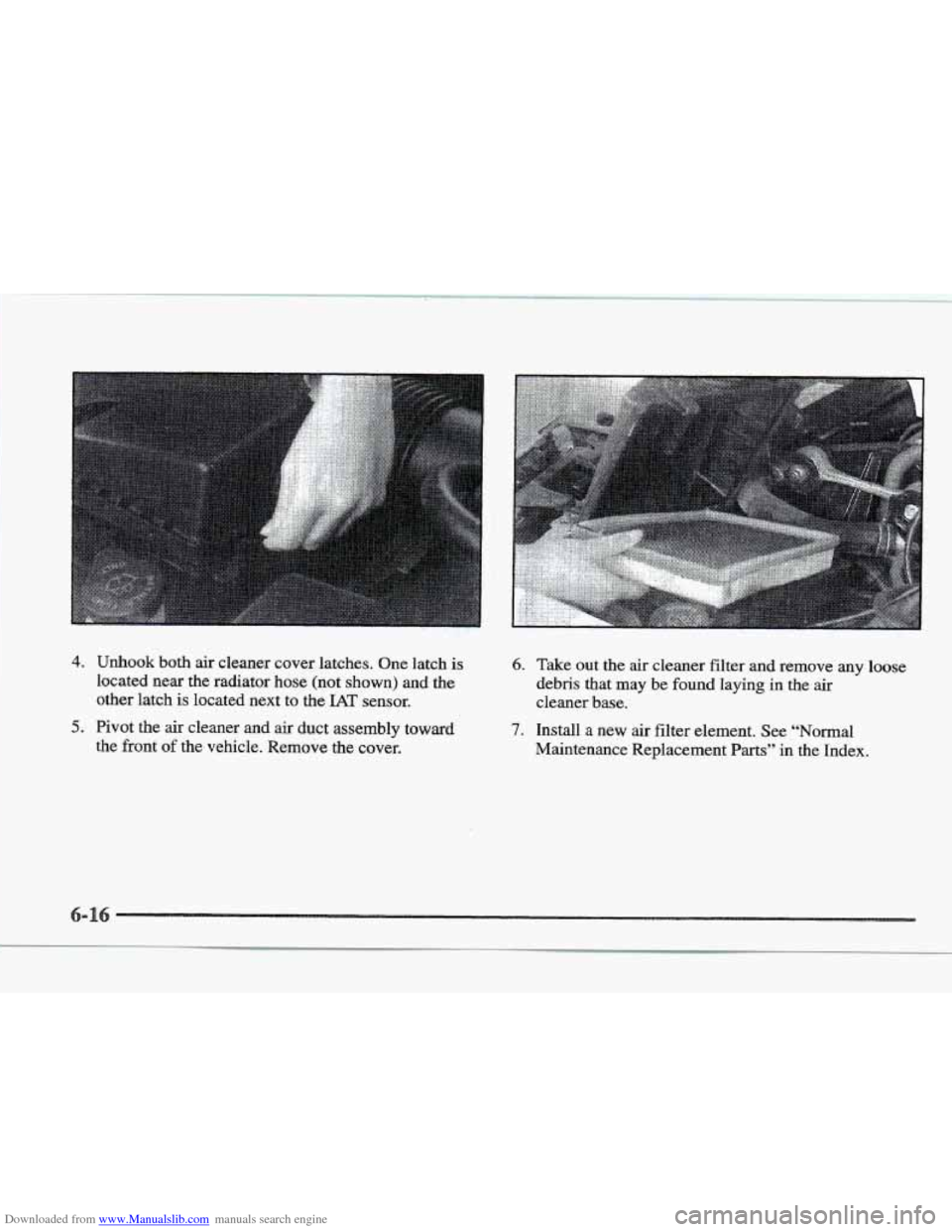
Downloaded from www.Manualslib.com manuals search engine 4. Unhook both air cleaner cover latches. One latch is
located near the radiator hose (not shown) and, the
other latch
is located next to the IAT sensor.
6.
5. Pivot the air cleaner and air duct assembly toward
the front
of the vehicle. Remove the cover.
7.
Take out the air cleaner filter and remove any loose
debris that may be found laying
in the air
cleaner base.
Install a new
air filter element. See “Normal
Maintenance Replacement
Parts” in the Index.
Page 284 of 361
Downloaded from www.Manualslib.com manuals search engine Your vehicle is equipped with a transaxle fluid change
indicator.
A CHANGE TRANS FLUID message will
display on
the Driver Information Center (DIC) when
the powertrain computer determines that the transaxle
fluid needs to be changed or at each
100,080 miles
(160 080 km) interval, whichever occurs first. See your
Maintenance Schedule booklet for more information.
When this message appears, change the transaxle fluid
and reset the transaxle fluid life indicator as follows:
I. Turn the ignition on but do not start the engine.
2. Press and hold the OFF and rear defog buttons on the
climate control at the same time until the
TRANS
FLUID RESET message appears on the DHC.
The cooling s stern in your vehicle is filled with
DEX-COOL engine coolant. This coolant is designed
to remain
in your vehicle for 5 years or 150,000 miles
(240 000 km) whichever occurs first, if you add only
DEX-COOL‘ extended life coolant.
2
The following explains your cooling system and how to
add coolant when
it is low. If YOU have a problem with
engine overheating, see “Engine Overheating”
in
the Index.
A 50/50 mixture of water and DEX-COOL@
coolant will:
@ Give freezing protection down to -34” F (-37°C).
Give boiling protection up to 265 OF (1 29°C).
Protect against rust and corrosion.
Help keep the proper engine temperature.
Let the warning lights and gages work as
they should.
When adding coolant, it is important that you use
only DEX-COOL~ (silicate-free) coolant.
If coolant other than DEX-COOL@is added t~
the system, premature engine, heater core or
radiator corrosion may result. In addition, the
engine coolant
will require change SOQWW 0- at
34b,8(Bo miles (50 000 km) or 24 months,
whichever CD~CUP’S first. Damage caused
of coolant other than
covered
by your new vehicle warranty.
Page 290 of 361
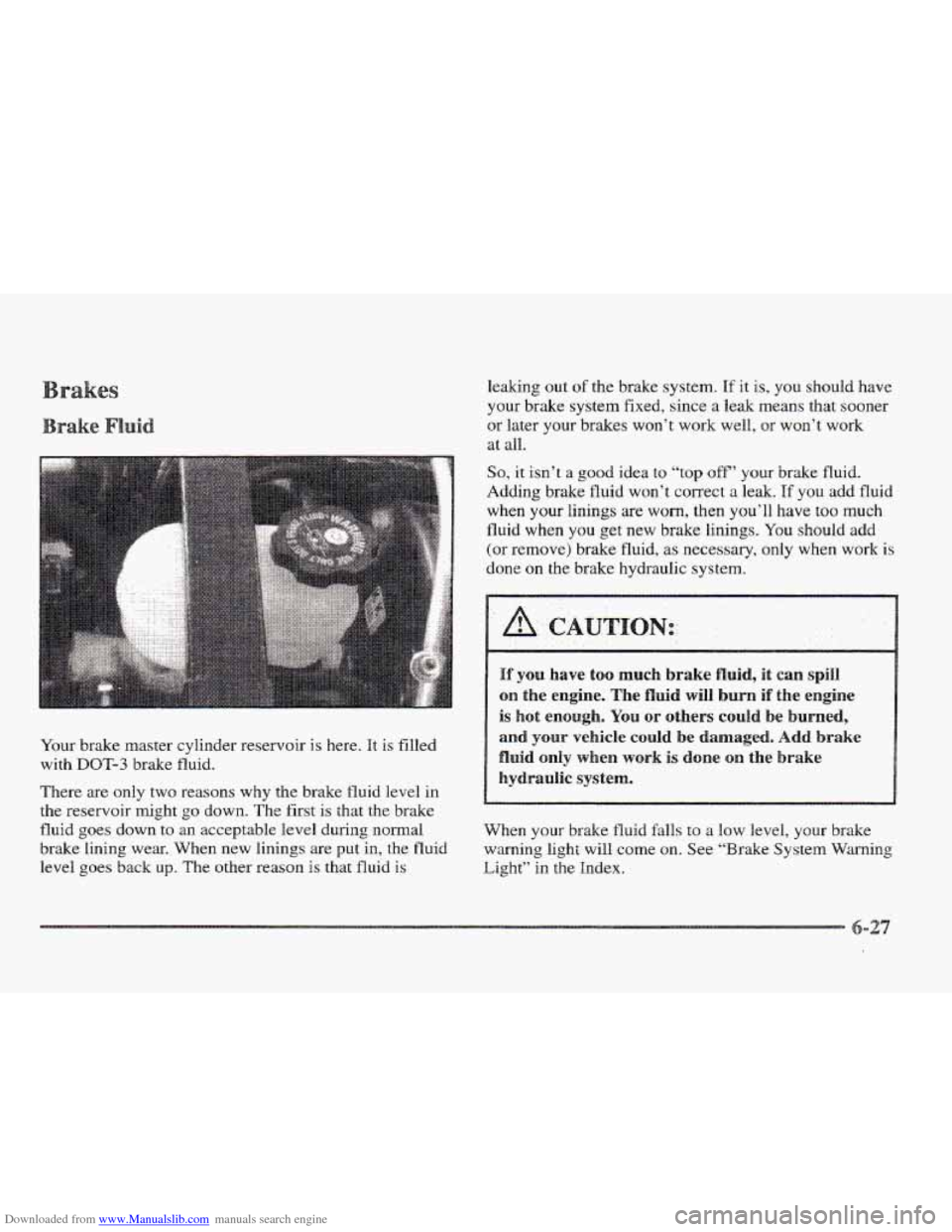
Downloaded from www.Manualslib.com manuals search engine Your brake master cylinder reservoir is here. It is filled
with
DOT-3 brake fluid.
There are only two reasons why the brake fluid level
in
the reservoir might go down. The first is that the brake
fluid goes down to an acceptable level during normal
brake lining wear. When new linings are put in, the fluid
level goes back up. The other reason
is that fluid is
leakng out of the brake system. If it is, you should have
your brake system fixed, since a leak means that sooner
or later your brakes won’t work well, 01- w~n’t work
at all.
so, it isn’t a good idea to “top off’ your brake fluid.
Adding brake fluid won’t correct a leak.
If you add fluid
when your linings are
worn, then you’ll have too much
fluid when you
get new brake linings. YOU should add
(or remove) brake fluid, as necessary, only when work is
done
on the brake hydraulic system.
When your brake fluid
falls to a low level, your brake
warning light will come on. See “Brake System Warning
Light” in the Index.
Page 291 of 361
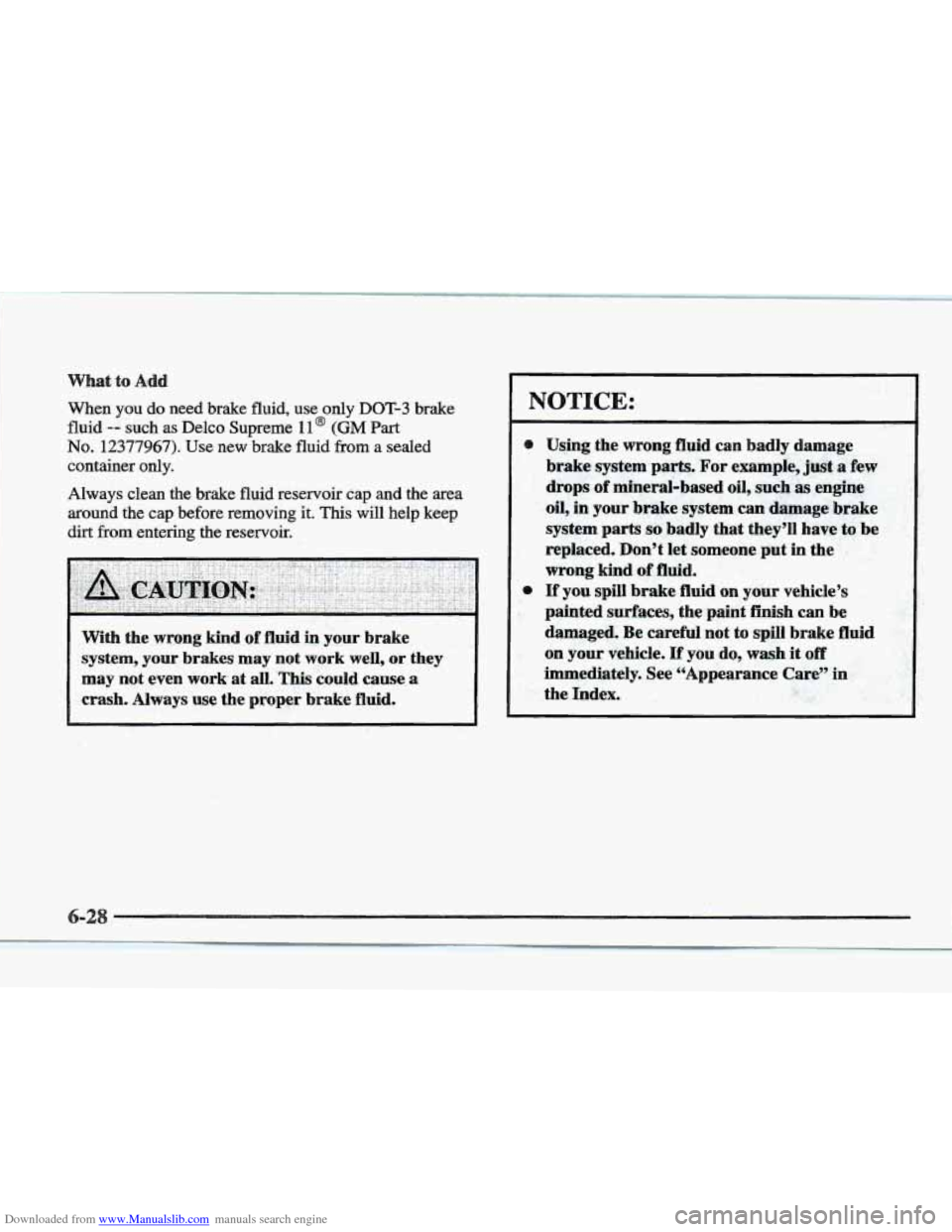
Downloaded from www.Manualslib.com manuals search engine What to Add
When you do need brake fluid, use only DOT-3 brake
fluid,
-- such as Delco Supreme 11 @ (GM Part
No. 12377967). Use new brake fluid from a sealed
container
only.
Always clean the brake fluid reservoir cap and the area
around the cap before removing it. This will help keep
dirt from entering the reservoir. , ..
,.A I , -. ‘8 . ,i I. .. si
With the wrong kind of fluid in your brake
system, your
brakes may not work well, or they
may not even work at all.
‘This could cause a
crash. Always use the proper brake fluid.
NOTICE:
Using the wrong.fluid can badly damage
brake system’parts. For example,
just a few
drops of mineral-based oil, such as engine
oil, in your brake system can damage brake
system pa&
so badly that they’ll have to be
replaced. Don’t let someone put in the
wrong kind
of fluid.
If you spill brake fluid on your vehicle’s
painted surfaces, the paint finish can be
damaged. Be careful not to spill brake fluid
on your vehicle.
If you do, wash it off
immediately. See “Appearance Care” in
the Index.
-2
Page 293 of 361
Downloaded from www.Manualslib.com manuals search engine The braking system on a modem vehicle is complex.
Its many parts have to be of top quality and work well
together if the vehicle
is to have really good braking.
Your vehicle was designed and tested with top-quality
GM brake parts. When you replace parts of your braking
system
-- for example, when your brake linings wear
down and you have
to have new ones put in -- be sure
you get new approved
CM replacement parts. If you
don’t, your brakes may no longer work properly. For
example, if someone puts
in brake linings that are wrong
for your vehicle, the balance between your front and
rear brakes can change
-- for the worse. The braking
performance you’ve come
to expect can change in many
other ways
if someone puts in the wrong replacement
brake parts.
e
Every new Cadillac has a Delco Freedom@ battery. YOU
never have to add water to one of these. When it’s time
for a new battery, we recommend a Delco Freedom
battery.
Get one that has the replacement number shown
on the original battery’s label.
If you’re not going to drive your vehicle for 25 days
or more, take
off the black, negative (-) cable from
the battery. This will help keep your battery from
running down.
Batteries have acid that can burn YOU and gas
aren’t careful. See “Jump Starting’’ in the Index
for tips
on working around a battery without
that
can explode. You can be badly hurt if you
Contact your
dealer to learn how to prepare your vehicle
for longer storage periods.
Also, for your audio system, see “Theft-Deterrent
Feature” in the Index.
Page 301 of 361
Downloaded from www.Manualslib.com manuals search engine Your new Cadillac comes with high-quality tires
made
by a leading tire manufacturer. If you ever have
questions about your tire warranty and where to obtain
service,
see your Cadillac Warranty booklet for details.
..
,A CAUTION:: ..
Poorly maintained and improperly used tires
are dangerous.
Overloading your tires can cause
overheating as
a result of too much friction.
You could have an air-out and
a serious
accident. See “Loading Your Vehicle” in
the Index.
CAUTION: (Continued)
I .CAUTION: (Continued) ’ .. ’ . ..
@ Underinflated tires pose the same danger as
overloaded tires. The resulting accident
could cause serious injury. Check
all tires
frequently to maintain the recommended
pressure. Tire pressure should
be checked
when your tires are cold.
cut, punctured or broken
by a sudden
impact
-- such as when you hit a pothole.
Keep tires at the recommended pressure.
@ Worn, old tires can cause accidents. If your
tread is
badly worn, or if your tires have
been damaged, replace them.
See “Inflation
-- Tire Pressure” in this section
for inflation pressure adjustment for higher
speed driving.
e Overinflated tires are more likely to be
Page 303 of 361
Downloaded from www.Manualslib.com manuals search engine Use a good quality pocket-type gage to check tire
pressure. You can’t tell if your tires
are properly inflated
simply by looking at them. Radial tires may look
properly inflated even when they’re underinflated.
Be
sure to put the valve caps back on the valve stems.
They help prevent leaks by keeping out dirt and moisture.
Tires should
be rotated every 6,000 to 8,000 miles
(10 000 to 13 000 km). Any time you notice unusual
wear, rotate your tires
as soon as possible and check
wheel alignment. Also check for damaged tires
or
wheels. See “When It’s Time for New Tires” and
“Wheel Replacement’’ later in this section for
more information.
The purpose of regular rotation is to achieve
more
uniform wear for all tires on the vehicle. The first
rotation is the most important. See “Scheduled
Maintenance Services” in the Maintenance Schedule
booklet for scheduled rotation intervals.
I
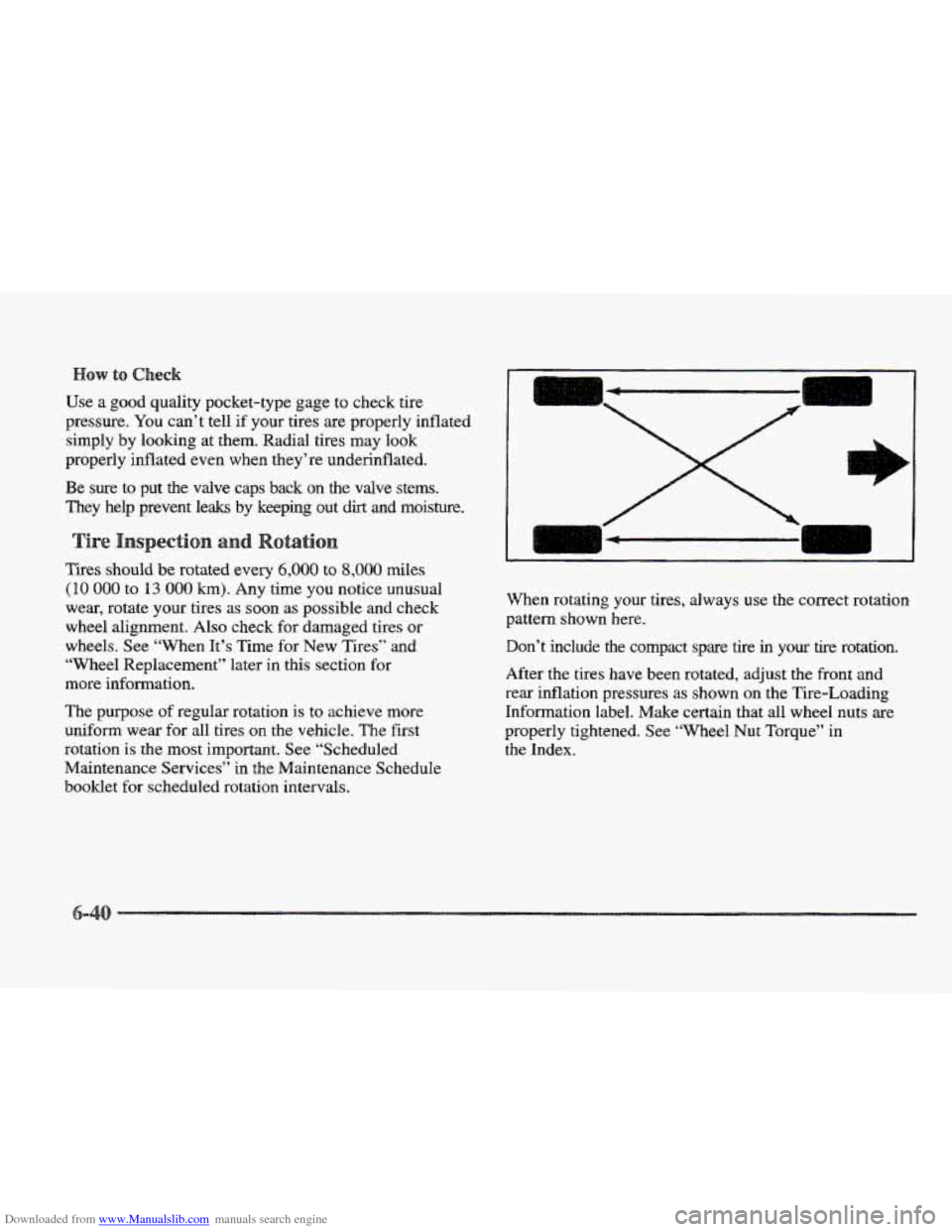
When rotating your tires, always use the correct rotation-
pattern shown here.
Don’t include the compact spare tire
in your tire rotation.
After the tires have been rotated, adjust the
front and
rear inflation pressures as shown on the Tire-Loading
Information label. Make certain that all wheel nuts are
properly tightened. See “Wheel
Nut Torque” in
the Index.
Page 308 of 361
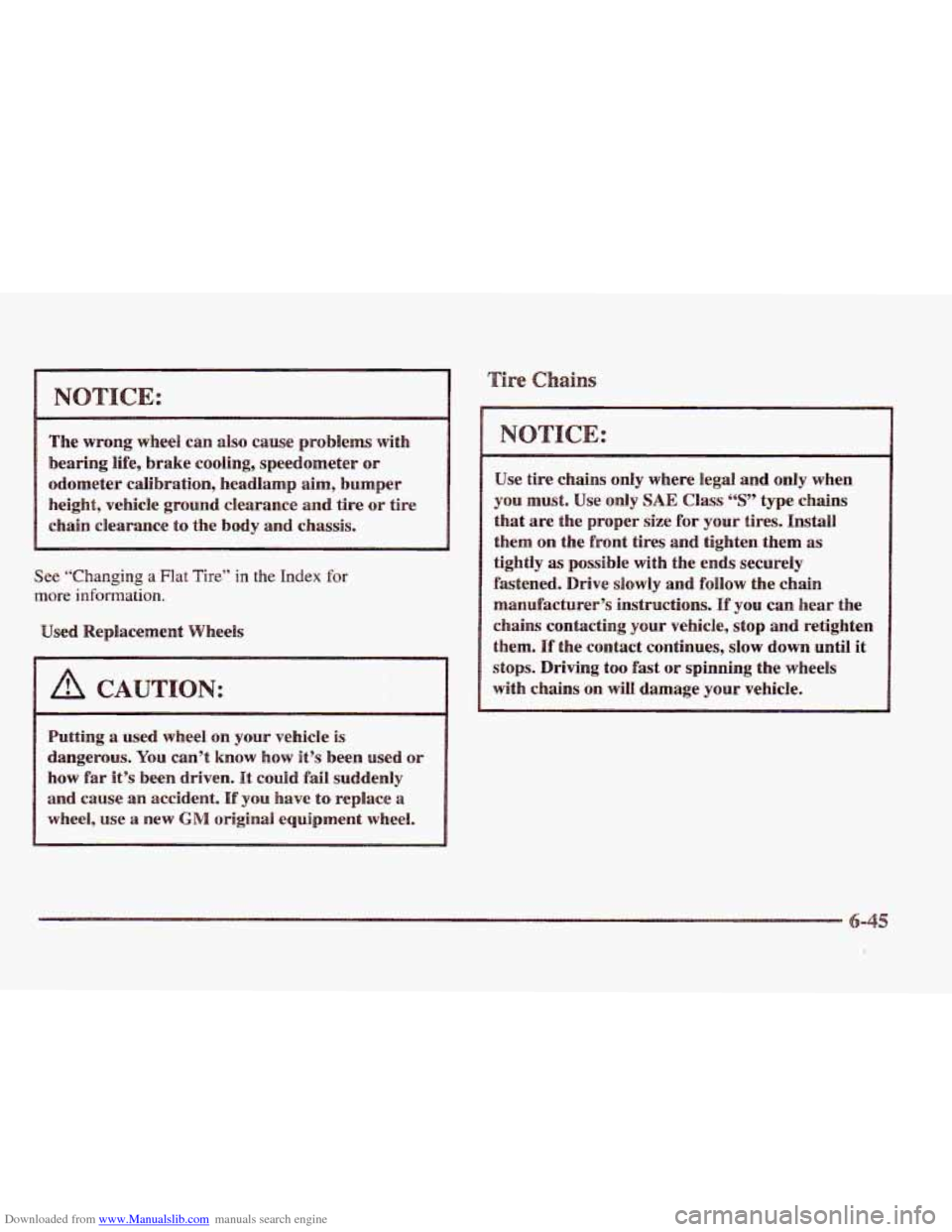
Downloaded from www.Manualslib.com manuals search engine The wrong wheel (can also cause problems with
bearing life, brake cooling, speedometer or
odometer calibration, headlamp aim, bumper
height, vehicle ground clearance and tire or tire
chain clearance $8 the body and chassis.
See “Changing a Flat Tire” in the Index for
more information.
A CAUTI m e
Putting a used wheel on your vehiclle is
dangerous. You can9t know how it9$ been used or
how far it’s been driven. It could fail suddenly
and cause an accident. If you ave to repIace 8
wheel, use a new G original equipment wheel,
e 0
Use tire chains only where %e@ and only when
you must. Use only SAE Class “SS” type chains
that are the proper
size for pur tires. Install
them on the front tires and tighten them ips
ssible with the ends securely
ive slowly and follow the chain
manufacturer9s instructions. If you can hear the
chains contacting your vehicle,
stop and retighten
them.
If the contact continues, slow down until it
stops. Driving
too fast or spinning the wheels
with chains on will damage your vehicle.
Page 314 of 361
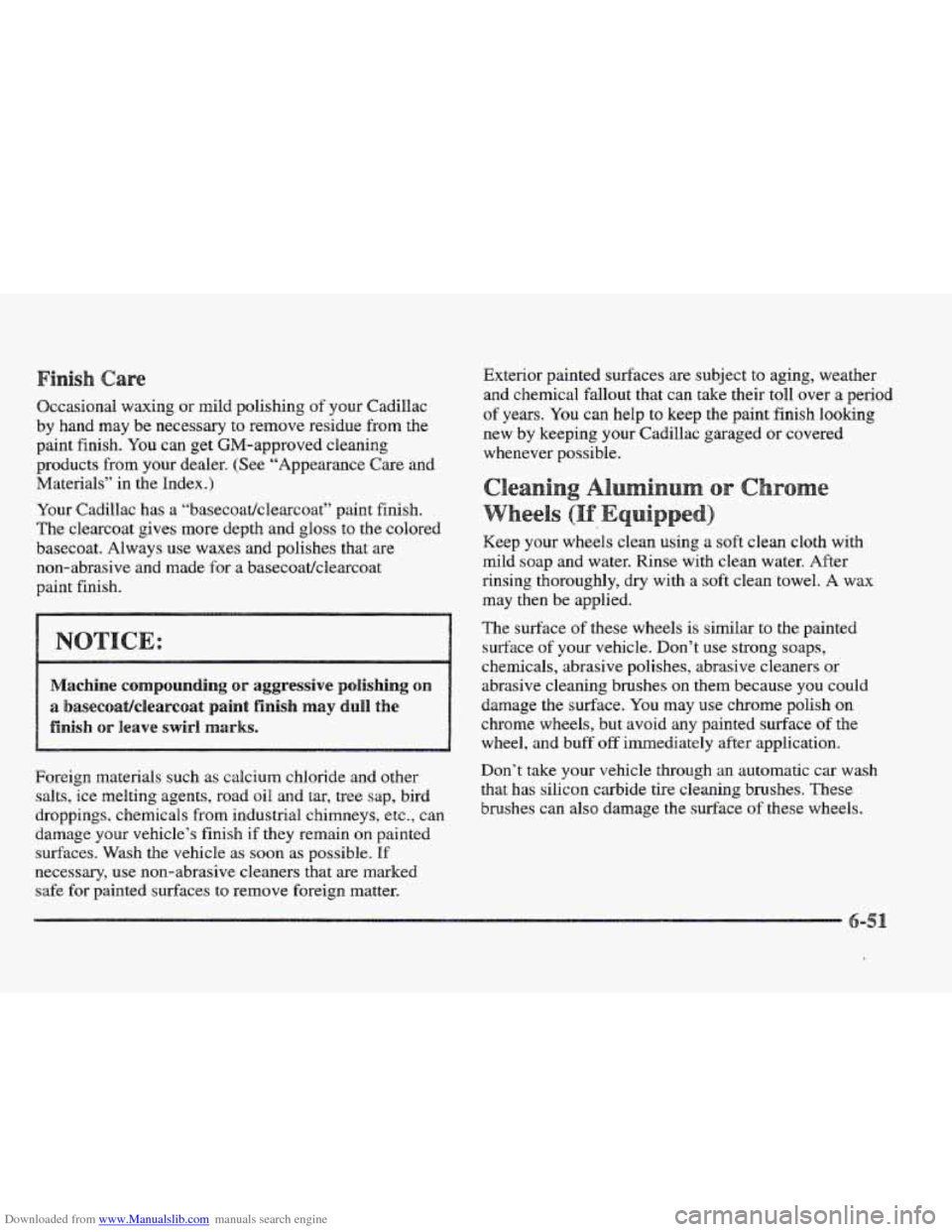
Downloaded from www.Manualslib.com manuals search engine Occasional waxing or mild polishing of your Cadillac
by hand may be necessary to remove residue from the
paint finish.
You can get GM-approved cleaning
products from your dealer.
(See “Appearance Care and
Materials”
in the Index.)
Your Cadillac has a “basecoatklearcoat” paint finish.
The clearcoat gives more depth and gloss to the colored
basecoat. Always use waxes and polishes that are
non-abrasive and made for a basecoatklearcoat
paint finish.
e e
Foreign materials such as calcium chloride and other
salts, ice melting agents, road oil and tar, tree sap, bird
droppings. chemicals
from industrial chimneys? etc., can
damage your vehicle’s finish if they remain
on painted
surfaces. Wash the vehicle as
soon as possible. If
necessary, use non-abrasive cleaners that are marked
safe
for painted surfaces to remove foreign matter. Exterior painted surfaces are subject
to aging, weather
and chemical fallout that can take their toll over a period
of years. You can help to keep the paint finish looking
new by keeping your Cadillac garaged or covered
whenever possible.
Keep your wheels clean using a soft clean cloth with
mild soap and water. Rinse
with clean water. After
rinsing thoroughly, dry with
a soft clean towel. A wax
may then be applied.
The surface
of these wheels is similar to the painted
surface
of your vehicle. Don’t use strong soaps,
chemicals, abrasive polishes, abrasive cleaners or abrasive cleaning brushes on them because you could
damage the surface.
You may use chrome polish on
chrome wheels, but avoid any painted surface of the
wheel, and buff
off immediately after application.
Don’t take your vehicle through an automatic car wash
that has silicon carbide tire cleaning brushes. These
brushes can also damage the surface of these wheels.