light CADILLAC ELDORADO 2002 10.G Manual PDF
[x] Cancel search | Manufacturer: CADILLAC, Model Year: 2002, Model line: ELDORADO, Model: CADILLAC ELDORADO 2002 10.GPages: 365, PDF Size: 2.5 MB
Page 290 of 365
6-30
Brakes
Brake Fluid
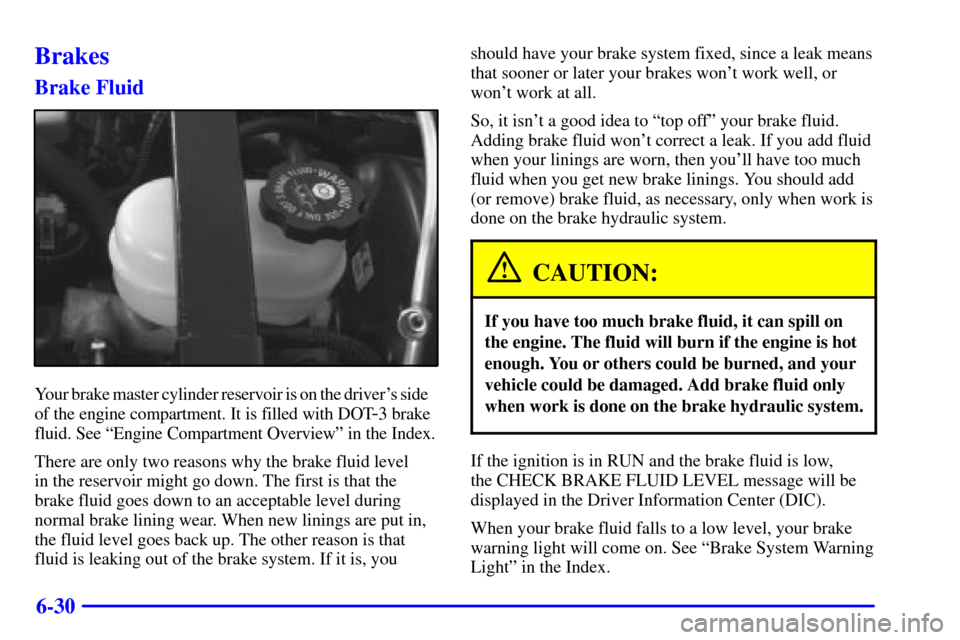
Your brake master cylinder reservoir is on the driver's side
of the engine compartment. It is filled with DOT
-3 brake
fluid. See ªEngine Compartment Overviewº in the Index.
There are only two reasons why the brake fluid level
in the reservoir might go down. The first is that the
brake fluid goes down to an acceptable level during
normal brake lining wear. When new linings are put in,
the fluid level goes back up. The other reason is that
fluid is leaking out of the brake system. If it is, youshould have your brake system fixed, since a leak means
that sooner or later your brakes won't work well, or
won't work at all.
So, it isn't a good idea to ªtop offº your brake fluid.
Adding brake fluid won't correct a leak. If you add fluid
when your linings are worn, then you'll have too much
fluid when you get new brake linings. You should add
(or remove) brake fluid, as necessary, only when work is
done on the brake hydraulic system.
CAUTION:
If you have too much brake fluid, it can spill on
the engine. The fluid will burn if the engine is hot
enough. You or others could be burned, and your
vehicle could be damaged. Add brake fluid only
when work is done on the brake hydraulic system.
If the ignition is in RUN and the brake fluid is low,
the CHECK BRAKE FLUID LEVEL message will be
displayed in the Driver Information Center (DIC).
When your brake fluid falls to a low level, your brake
warning light will come on. See ªBrake System Warning
Lightº in the Index.
Page 292 of 365
6-32 Brake Wear
Your vehicle has four-wheel disc brakes.
Disc brake pads have built
-in wear indicators that make
a high
-pitched warning sound when the brake pads are
worn and new pads are needed. The sound may come
and go or be heard all the time your vehicle is moving
(except when you are pushing on the brake pedal firmly).
CAUTION:
The brake wear warning sound means that soon
your brakes won't work well. That could lead to
an accident. When you hear the brake wear
warning sound, have your vehicle serviced.
NOTICE:
Continuing to drive with worn-out brake pads
could result in costly brake repair.
Some driving conditions or climates may cause a
brake squeal when the brakes are first applied or
lightly applied. This does not mean something is
wrong with your brakes.
Properly torqued wheel nuts are necessary to help
prevent brake pulsation. When tires are rotated,
inspect brake pads for wear and evenly tighten wheel
nuts in the proper sequence to GM torque specifications.
Brake linings should always be replaced as complete
axle sets.
See ªBrake System Inspectionº in Section 7 of this
manual under Part C ªPeriodic Maintenance Inspections.º
Page 306 of 365

6-46 Uniform Tire Quality Grading
Quality grades can be found where applicable on the
tire sidewall between tread shoulder and maximum
section width. For example:
Treadwear 200 Traction AA Temperature A
The following information relates to the system
developed by the United States National Highway
Traffic Safety Administration, which grades tires by
treadwear, traction and temperature performance.
(This applies only to vehicles sold in the United States.)
The grades are molded on the sidewalls of most
passenger car tires. The Uniform Tire Quality Grading
system does not apply to deep tread, winter
-type snow
tires, space
-saver or temporary use spare tires, tires with
nominal rim diameters of 10 to 12 inches (25 to 30 cm),
or to some limited
-production tires.
While the tires available on General Motors passenger
cars and light trucks may vary with respect to these
grades, they must also conform to federal safety
requirements and additional General Motors Tire
Performance Criteria (TPC) standards.Treadwear
The treadwear grade is a comparative rating based on
the wear rate of the tire when tested under controlled
conditions on a specified government test course.
For example, a tire graded 150 would wear one and
a half (1 1/2) times as well on the government course
as a tire graded 100. The relative performance of
tires depends upon the actual conditions of their use,
however, and may depart significantly from the norm
due to variations in driving habits, service practices and
differences in road characteristics and climate.
Traction
-- AA, A, B, C
The traction grades, from highest to lowest, are AA,
A, B, and C. Those grades represent the tire's ability
to stop on wet pavement as measured under controlled
conditions on specified government test surfaces of
asphalt and concrete. A tire marked C may have
poor traction performance. Warning: The traction
grade assigned to this tire is based on straight
-ahead
braking traction tests, and does not include acceleration,
cornering, hydroplaning, or peak traction characteristics.
Page 321 of 365

6-61
MaxiFuse
(8
-Way) Usage
INADVERT Inadvertent Power Relay, Interior
Lamps Fuse, Cigarette Lighter
-1
Fuse, Courtesy Lamp Relay
LAMPS Headlamps Fuse/Relay, High/Low
Beam Control Relay, Fog Lamp
Fuse, DRL Fuse, Hazard Fuse,
Mirror Fuse, Inadvertent Power
Relay, Right and Left High
-Beam
Fuse, Right and Left Low
-Beam
Fuse, Stoplamp Fuse, Fog Lamp
Relay, DRL Relay
IGN 1 Rear Ignition
-1 Relay, Wiper Fuse,
Relay Ignition
-1 Fuse, Supplemental
Inflatable Restraint (SIR) Fuse,
Accessory Relay
WINDOWS Retained Accessory Power
(RAP) Relay
SEATS Horn Relay, Driver and Passenger
Lumbar In/Out Relays, Driver and
Passenger Lumbar Up/Down RelaysMaxiFuse
(8
-Way) Usage
SPARE Spare Fuse
AIR AIR Pump
BATT 3 Steering Column Ignition Switch
BATT 2 Steering Column Ignition Switch
IGN 1 Front Ignition
-1 Relay, Oxygen
Sensor 1 and 2 Fuse, Fuel Fuse,
Cruise Fuse, Fuel Pump Relay
BATT 1 Starter Relay and Solenoid,
Park/Reverse Fuse, Park Relay,
Powertrain Control Module
(PCM) Fuse, AC Compressor
Fuse and Relay, Fan Relays,
Reverse Relay
BRAKES Anti
-Lock Brake System (ABS)
Brake Modulator
COOL FANS Cooling Fan Relays 1 and 3
Page 322 of 365

6-62
Power
Distribution
Block Usage
DRL Daytime Running Lamps (DRL)
HI/LO BEAM High and Low
-Beam Headlamps
HORN Horn
FOG LPS Fog Lamps
ACCESSORY Accessories
HEAD LPS Headlamps
Relays
INADVERT POWER RELAY
IGN 1 RELAY
STARTER RELAY
AIR RELAY
Fuses and Circuit Breakers
The wiring circuits in your vehicle are protected from
short circuits by a combination of fuses and circuit
breakers. This greatly reduces the chance of fires
caused by electrical problems.
Look at the silver
-colored band inside the fuse.
If the band is broken or melted, replace the fuse.
Be sure you replace a bad fuse with a new one of the
identical size and rating.
If you ever have a problem on the road and don't have
a spare fuse, you can ªborrowº one that has the same
amperage. Pick some feature of your vehicle that you
can get along without
-- like the radio or cigarette
lighter
-- and use its fuse, if it is the correct amperage.
Replace it as soon as you can.
There are two fuse blocks in your vehicle: the underhood
fuse block and the rear compartment fuse block.
Page 324 of 365

6-64
Fuse Usage
CIG LTR1 Front and Rear Cigarette Lighters
SPARE Spare Fuse
L HDLP LO Left Low
-Beam Headlamp
R HDLP LO Right Low
-Beam Headlamp
L HDLP HI Left High
-Beam Headlamp
R HDLP HI Right High
-Beam Headlamp
FOG Fog Lamp Relay, Right and Left
Fog Lamps, Headlamp Switch
HDLPS Headlamp Relay, High/Low
-Beam
Control Relay, Right and Left
Low/High
-Beam Fuses
HAZARD Electronic Flasher Module,
Turn/Hazard Switch, Right and
Left Front Turn Lamps, Right and
Left Rear Turn Lamps, Cluster
STOP Stoplamp Switch, Centered
High
-Mounted Stoplamp (CHMSL),
Turn Hazard Switch, ABS Controller,
Stepper Motor Cruise ControlFuse Usage
MIRROR Inadvertent Power Relay, Left
Outside Rearview Mirror Switch,
ALDL, Memory Mirror Module,
Dimmer Switch, Cluster
DRL Daytime Running Lamp (DRL)
Relay, Left and Right Low Beam
in DRL Mode
IGN 0 (ENG) Powertrain Control Module (PCM)
CRANK Powertrain Control Module (PCM)
ABS Anti
-Lock Brake System
(ABS)/Traction Control System
IGN
-1 Rear Ignition-1 Relay, Front Fog
Lamp Relay, Controlled Power
Backup Relay, DRL Relay,
Canister Vent Solenoid
WIPERS Accessory Relay, Wiper Switch
A/C COMP AC Compressor Relay, Cooling Fan
Relays 1, 2, 3, Compressor Clutch
PCM (BAT) PCM
Page 345 of 365

7-16 At Least Twice a Year
Restraint System Check
Make sure the safety belt reminder light and all your
belts, buckles, latch plates, retractors and anchorages are
working properly. Look for any other loose or damaged
safety belt system parts. If you see anything that might
keep a safety belt system from doing its job, have it
repaired. Have any torn or frayed safety belts replaced.
Also look for any opened or broken air bag coverings,
and have them repaired or replaced. (The air bag system
does not need regular maintenance.)
Wiper Blade Check
Inspect wiper blades for wear or cracking. Replace blade
inserts that appear worn or damaged or that streak or
miss areas of the windshield. Also see ªWiper Blades,
Cleaningº in the Index.
Weatherstrip Lubrication
Silicone grease on weatherstrips will make them
last longer, seal better, and not stick or squeak.
Apply silicone grease with a clean cloth. During very
cold, damp weather more frequent application may be
required. See ªRecommended Fluids and Lubricantsº
in the Index.Automatic Transaxle Check
Check the transaxle fluid level; add if needed.
See ªAutomatic Transaxle Fluidº in the Index.
A fluid loss may indicate a problem. Check the
system and repair if needed.
At Least Once a Year
Key Lock Cylinders Service
Lubricate the key lock cylinders with the lubricant
specified in Part D.
Body Lubrication Service
Lubricate all body door hinges. Also lubricate
all hinges and latches, including those for the hood,
rear compartment, interior glove box and console
doors. Part D tells you what to use. More frequent
lubrication may be required when exposed to a
corrosive environment.