child seat CADILLAC ESCALADE 2002 2.G Owners Manual
[x] Cancel search | Manufacturer: CADILLAC, Model Year: 2002, Model line: ESCALADE, Model: CADILLAC ESCALADE 2002 2.GPages: 417, PDF Size: 3.13 MB
Page 4 of 417
ii
Table of Contents
Windows
Keys and Door Locks
Remote Keyless Entry System
Liftgate
Automatic Transmission
Parking Brake
Tilt Wheel
Turn Signal/Multifunction Lever
Windshield Wipers
Cruise Control
Exterior and Interior LampsMirrors
Storage Compartments
Convenience Net
Accessory Power Outlets
OnStar® System (If Equipped)
Sunroof (If Equipped)
HomeLink® Transmitter
Instrument Panel, Warning Lights and Gages
Secondary Information Center (SIC)
Ultrasonic Rear Parking Assist (URPA) Seats and Seat Controls
Safety BeltsAir Bag Systems
Restraint Systems for Children
Section
1
Section
2
Seats and Restraint Systems
Features and Controls
Page 13 of 417

1-
1-1
Section 1 Seats and Restraint Systems
Here you'll find information about the seats in your vehicle and how to use your safety belts properly. You can also
learn about some things you should not do with air bags and safety belts.
1
-2 Seats and Seat Controls
1
-16 Safety Belts: They're for Everyone
1
-21 Here Are Questions Many People Ask About
Safety Belts
-- and the Answers
1
-22 How to Wear Safety Belts Properly
1
-22 Driver Position
1
-28 Safety Belt Use During Pregnancy
1
-29 Right Front Passenger Position
1
-29 Supplemental Restraint System (SRS)
1
-38 Rear Seat Passengers1
-40 Rear Safety Belt Comfort Guides for Children
and Small Adults
1
-43 Center Passenger Position
1
-44 Children
1
-48 Restraint Systems for Children
1
-64 Older Children
1
-67 Safety Belt Extender
1
-67 Checking Your Restraint Systems
1
-67 Replacing Restraint System Parts
After a Crash
Page 34 of 417
1-22
How to Wear Safety Belts Properly
Adults
This part is only for people of adult size.
Be aware that there are special things to know about
safety belts and children. And there are different
rules for smaller children and babies. If a child will be
riding in your vehicle, see the part of this manual called
ªChildren.º Follow those rules for everyone's protection.
First, you'll want to know which restraint systems your
vehicle has.
We'll start with the driver position.
Driver Position
This part describes the driver's restraint system.
Lap-Shoulder Belt
The driver has a lap-shoulder belt. Here's how to wear
it properly.
1. Close and lock the door.
2. Adjust the seat so you can sit up straight.
To see how, see ªSeatsº in the Index.
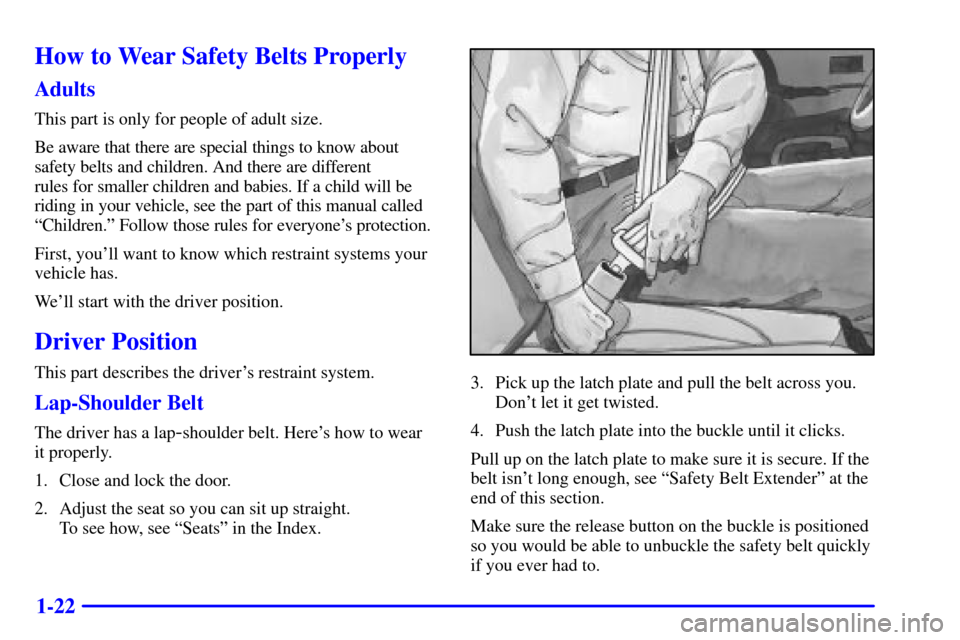
3. Pick up the latch plate and pull the belt across you.
Don't let it get twisted.
4. Push the latch plate into the buckle until it clicks.
Pull up on the latch plate to make sure it is secure. If the
belt isn't long enough, see ªSafety Belt Extenderº at the
end of this section.
Make sure the release button on the buckle is positioned
so you would be able to unbuckle the safety belt quickly
if you ever had to.
Page 52 of 417

1-40
CAUTION:
You can be seriously hurt if your shoulder
belt is too loose. In a crash, you would move
forward too much, which could increase injury.
The shoulder belt should fit against your body.
To unlatch the belt, just push the button on the buckle.
Rear Safety Belt Comfort Guides
for Children and Small Adults
Rear shoulder belt comfort guides will provide
added safety belt comfort for older children who
have outgrown booster seats and for small adults.
When installed on a shoulder belt, the comfort guide
better positions the belt away from the neck and head.
There is one guide for each outside passenger position
in the second and third row seats. To provide added
safety belt comfort for children who have outgrown
child restraints and for smaller adults, the comfort
guides may be installed on the shoulder belts. Here's
how to install a comfort guide and use the safety belt:
1. For the second row, remove the guide from its
storage clip on the trim panel near the side of the
seatback. For the third row, remove the guide from
its storage clip on the side of the seatback.
Page 59 of 417

1-47
CAUTION:
Newborn infants need complete support,
including support for the head and neck.
This is necessary because a newborn infant's
neck is weak and its head weighs so much
compared with the rest of its body. In a crash,
an infant in a rear
-facing seat settles into the
restraint, so the crash forces can be distributed
across the strongest part of an infant's body, the
back and shoulders. Infants always should be
secured in appropriate infant restraints.
CAUTION:
The body structure of a young child is quite
unlike that of an adult or older child, for whom
the safety belts are designed. A young child's hip
bones are still so small that the vehicle's regular
safety belt may not remain low on the hip bones,
as it should. Instead, it may settle up around the
child's abdomen. In a crash, the belt would apply
force on a body area that's unprotected by any
bony structure. This alone could cause serious or
fatal injuries. Young children always should be
secured in appropriate child restraints.
Page 60 of 417

1-48
Restraint Systems for Children
An infant car bed (A), a special bed made for use in a
motor vehicle, is an infant restraint system designed to
restrain or position a child on a continuous flat surface.
Make sure that the infant's head rests toward the center
of the vehicle.
A rear-facing infant seat (B) provides restraint with
the seating surface against the back of the infant.
The harness system holds the infant in place and, in a
crash, acts to keep the infant positioned in the restraint.
Page 61 of 417

1-49
A forward-facing child seat (C-E) provides restraint for
the child's body with the harness and also sometimes
with surfaces such as T
-shaped or shelf-like shields.
A booster seat (F-G) is a child restraint designed to
improve the fit of the vehicle's safety belt system.
Some booster seats have a shoulder belt positioner,
and some high
-back booster seats have a five-point
harness. A booster seat can also help a child to see out
the window.
Page 62 of 417

1-50
Q:How do child restraints work?
A:A child restraint system is any device designed for
use in a motor vehicle to restrain, seat, or position
children. A built
-in child restraint system is a
permanent part of the motor vehicle. An add
-on
child restraint system is a portable one, which is
purchased by the vehicle's owner.
For many years, add
-on child restraints have used
the adult belt system in the vehicle. To help reduce
the chance of injury, the child also has to be secured
within the restraint. The vehicle's belt system secures
the add
-on child restraint in the vehicle, and the add-on
child restraint's harness system holds the child in place
within the restraint.
One system, the three
-point harness, has straps that
come down over each of the infant's shoulders and
buckle together at the crotch. The five
-point harness
system has two shoulder straps, two hip straps and a
crotch strap. A shield may take the place of hip straps.A T
-shaped shield has shoulder straps that are attached
to a flat pad which rests low against the child's body.
A shelf
- or armrest-type shield has straps that are
attached to a wide, shelf
-like shield that swings up
or to the side.
When choosing a child restraint, be sure the child
restraint is designed to be used in a vehicle. If it is,
it will have a label saying that it meets federal motor
vehicle safety standards.
Then follow the instructions for the restraint. You may
find these instructions on the restraint itself or in a
booklet, or both. These restraints use the belt system in
your vehicle, but the child also has to be secured within
the restraint to help reduce the chance of personal injury.
When securing an add
-on child restraint, refer to the
instructions that come with the restraint which may be
on the restraint itself or in a booklet, or both, and to this
manual. The child restraint instructions are important, so
if they are not available, obtain a replacement copy from
the manufacturer.
Page 63 of 417

1-51 Where to Put the Restraint
Accident statistics show that children are safer if they
are restrained in the rear rather than the front seat.
General Motors, therefore, recommends that child
restraints be secured in a rear seat including an infant
riding in a rear
-facing infant seat, a child riding in a
forward
-facing child seat and an older child riding in a
booster seat. Never put a rear
-facing child restraint in
the right front passenger seat. Here's why:
CAUTION:
A child in a rear-facing child restraint can be
seriously injured or killed if the right front
passenger's air bag inflates. This is because the
back of the rear
-facing child restraint would be
very close to the inflating air bag. Always secure
a rear
-facing child restraint in a rear seat.
CAUTION: (Continued)
CAUTION: (Continued)
You may secure a forward-facing child restraint
in the right front seat, but before you do, always
move the front passenger seat as far back as it
will go. It's better to secure the child restraint in
a rear seat.
Wherever you install it, be sure to secure the child
restraint properly.
Keep in mind that an unsecured child restraint can
move around in a collision or sudden stop and injure
people in the vehicle. Be sure to properly secure any
child restraint in your vehicle
-- even when no child
is in it.
Page 64 of 417

1-52 Top Strap
Some child restraints have a top strap, or ªtop tether.º
It can help restrain the child restraint during a collision.
For it to work, a top strap must be properly anchored to
the vehicle.
If the child restraint does not have a top strap, one can
be obtained, in kit form, for many child restraints.
Ask the child restraint manufacturer whether or not a
kit is available.
In Canada, the law requires that forward-facing
child restraints have a top strap, and that the strap be
anchored. In the United States, some child restraints also
have a top strap. If your child restraint has a top strap,
it should be anchored.
Anchor the top strap to one of the following anchor
points. Be sure to use an anchor point located on the
same side of the vehicle as the seating position where
the child restraint will be placed. Raise the head restraint
and route the top strap under it.
Once you have the top strap anchored, you'll be
ready to secure the child restraint itself. Tighten the
top strap when and as the child restraint manufacturer's
instructions say.
A child restraint with a top strap should only be used
in the second row. Don't use a child restraint with a
top strap in the right front passenger's position or in
the third row, because there's no place to anchor the
top strap.