lock CADILLAC ESCALADE 2003 2.G Owners Manual
[x] Cancel search | Manufacturer: CADILLAC, Model Year: 2003, Model line: ESCALADE, Model: CADILLAC ESCALADE 2003 2.GPages: 486, PDF Size: 3.32 MB
Page 343 of 486
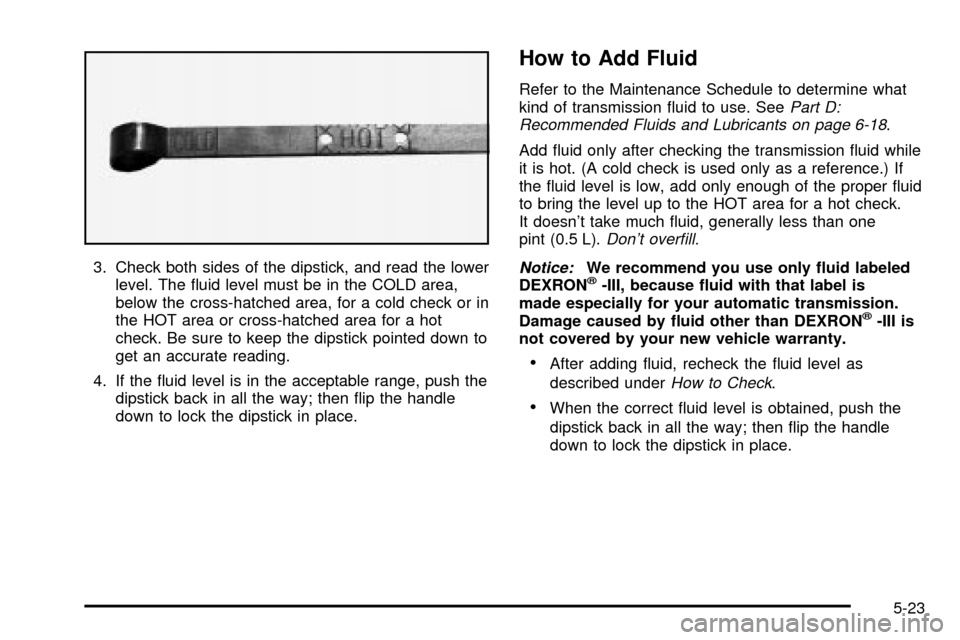
3. Check both sides of the dipstick, and read the lower
level. The ¯uid level must be in the COLD area,
below the cross-hatched area, for a cold check or in
the HOT area or cross-hatched area for a hot
check. Be sure to keep the dipstick pointed down to
get an accurate reading.
4. If the ¯uid level is in the acceptable range, push the
dipstick back in all the way; then ¯ip the handle
down to lock the dipstick in place.
How to Add Fluid
Refer to the Maintenance Schedule to determine what
kind of transmission ¯uid to use. SeePart D:
Recommended Fluids and Lubricants on page 6-18.
Add ¯uid only after checking the transmission ¯uid while
it is hot. (A cold check is used only as a reference.) If
the ¯uid level is low, add only enough of the proper ¯uid
to bring the level up to the HOT area for a hot check.
It doesn't take much ¯uid, generally less than one
pint (0.5 L).
Don't over®ll.
Notice:
We recommend you use only ¯uid labeled
DEXRONž-III, because ¯uid with that label is
made especially for your automatic transmission.
Damage caused by ¯uid other than DEXRON
ž-III is
not covered by your new vehicle warranty.
·After adding ¯uid, recheck the ¯uid level as
described under
How to Check.
·When the correct ¯uid level is obtained, push the
dipstick back in all the way; then ¯ip the handle
down to lock the dipstick in place.
5-23
Page 354 of 486
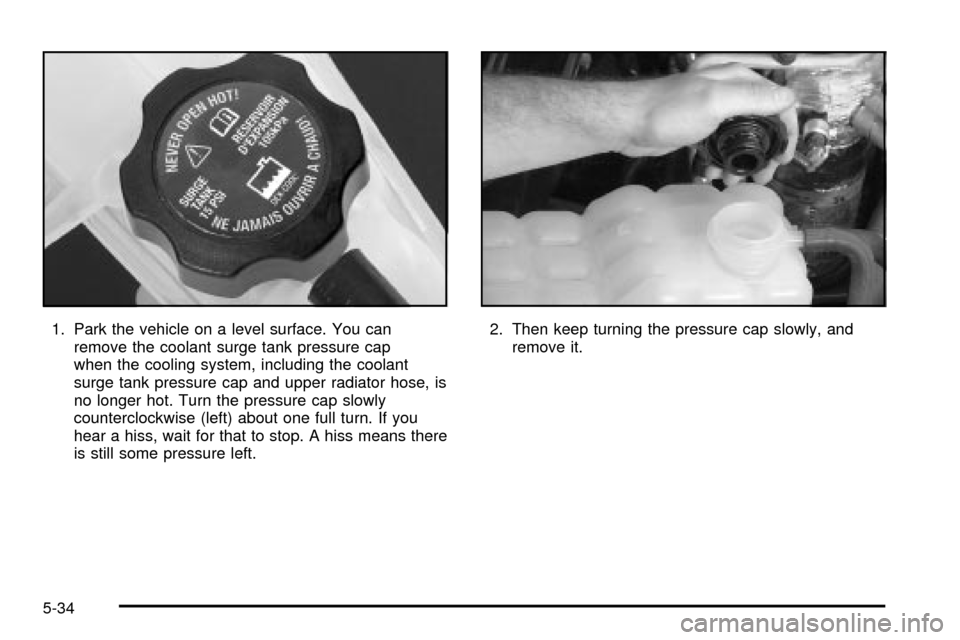
1. Park the vehicle on a level surface. You can
remove the coolant surge tank pressure cap
when the cooling system, including the coolant
surge tank pressure cap and upper radiator hose, is
no longer hot. Turn the pressure cap slowly
counterclockwise (left) about one full turn. If you
hear a hiss, wait for that to stop. A hiss means there
is still some pressure left.2. Then keep turning the pressure cap slowly, and
remove it.
5-34
Page 380 of 486
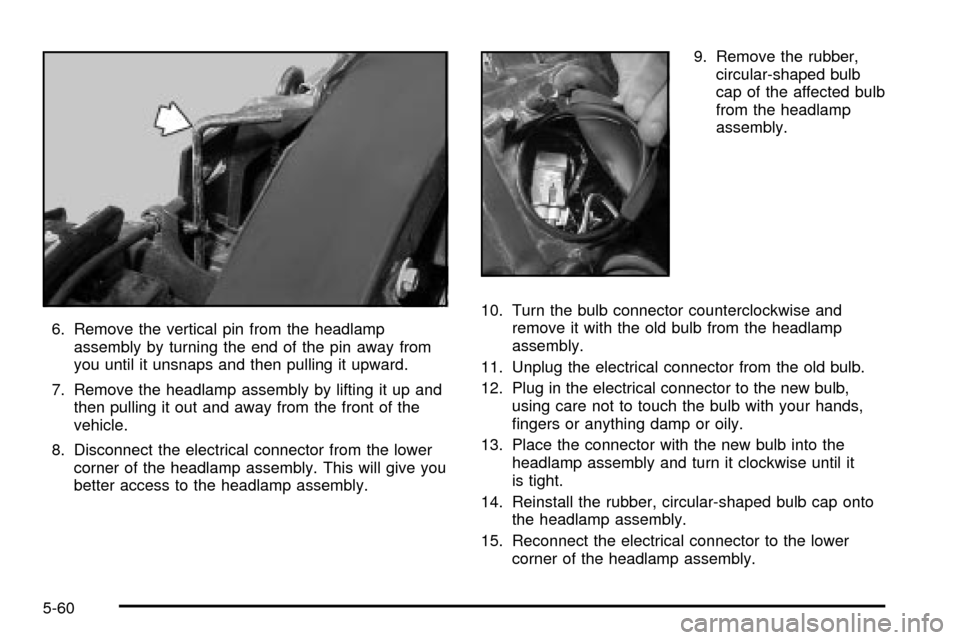
6. Remove the vertical pin from the headlamp
assembly by turning the end of the pin away from
you until it unsnaps and then pulling it upward.
7. Remove the headlamp assembly by lifting it up and
then pulling it out and away from the front of the
vehicle.
8. Disconnect the electrical connector from the lower
corner of the headlamp assembly. This will give you
better access to the headlamp assembly.9. Remove the rubber,
circular-shaped bulb
cap of the affected bulb
from the headlamp
assembly.
10. Turn the bulb connector counterclockwise and
remove it with the old bulb from the headlamp
assembly.
11. Unplug the electrical connector from the old bulb.
12. Plug in the electrical connector to the new bulb,
using care not to touch the bulb with your hands,
®ngers or anything damp or oily.
13. Place the connector with the new bulb into the
headlamp assembly and turn it clockwise until it
is tight.
14. Reinstall the rubber, circular-shaped bulb cap onto
the headlamp assembly.
15. Reconnect the electrical connector to the lower
corner of the headlamp assembly.
5-60
Page 381 of 486
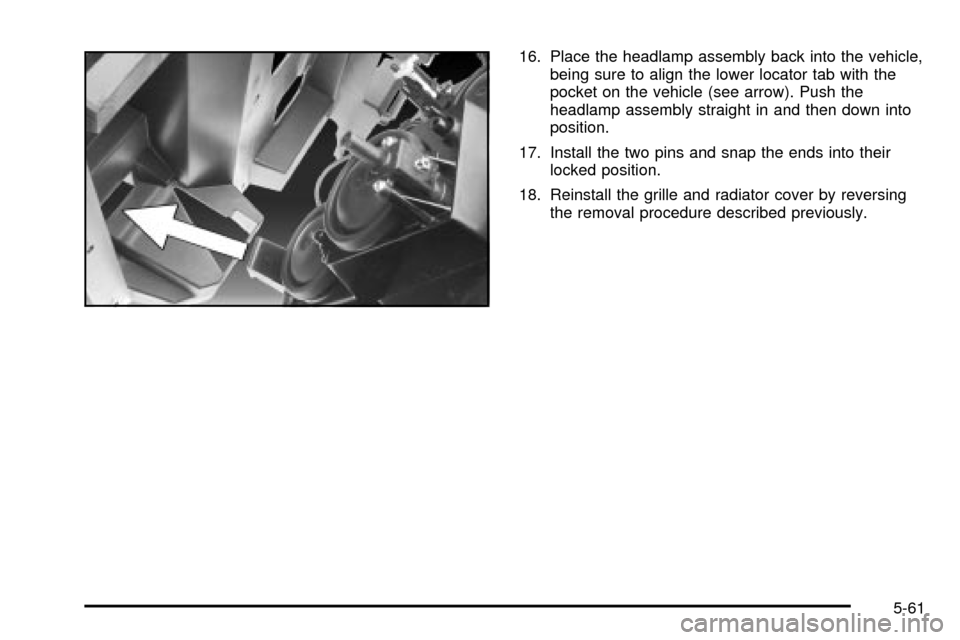
16. Place the headlamp assembly back into the vehicle,
being sure to align the lower locator tab with the
pocket on the vehicle (see arrow). Push the
headlamp assembly straight in and then down into
position.
17. Install the two pins and snap the ends into their
locked position.
18. Reinstall the grille and radiator cover by reversing
the removal procedure described previously.
5-61
Page 382 of 486
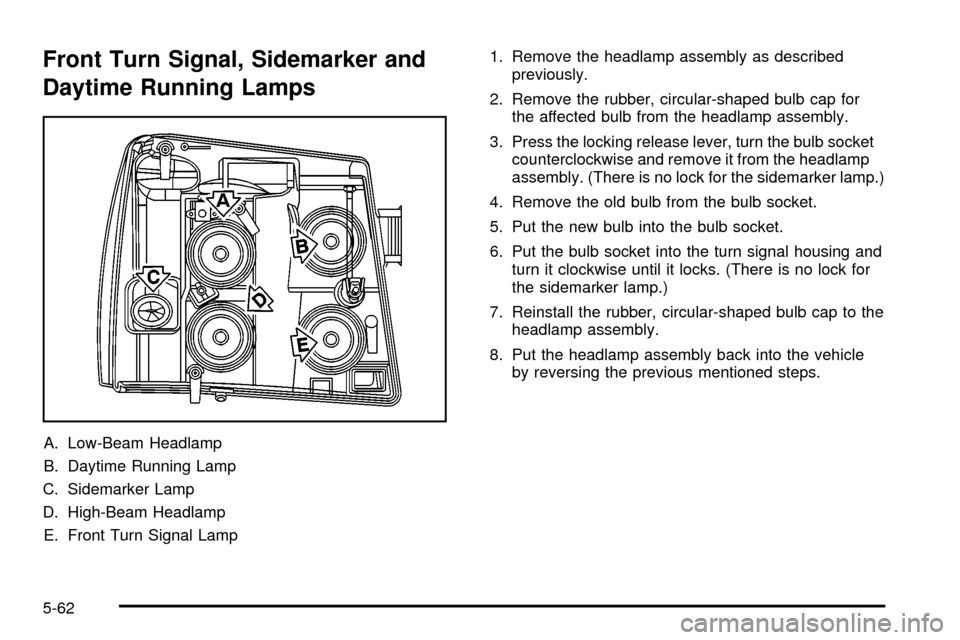
Front Turn Signal, Sidemarker and
Daytime Running Lamps
A. Low-Beam Headlamp
B. Daytime Running Lamp
C. Sidemarker Lamp
D. High-Beam Headlamp
E. Front Turn Signal Lamp1. Remove the headlamp assembly as described
previously.
2. Remove the rubber, circular-shaped bulb cap for
the affected bulb from the headlamp assembly.
3. Press the locking release lever, turn the bulb socket
counterclockwise and remove it from the headlamp
assembly. (There is no lock for the sidemarker lamp.)
4. Remove the old bulb from the bulb socket.
5. Put the new bulb into the bulb socket.
6. Put the bulb socket into the turn signal housing and
turn it clockwise until it locks. (There is no lock for
the sidemarker lamp.)
7. Reinstall the rubber, circular-shaped bulb cap to the
headlamp assembly.
8. Put the headlamp assembly back into the vehicle
by reversing the previous mentioned steps.
5-62
Page 383 of 486
Center High-Mounted Stoplamp
(CHMSL)
It is recommended that this component be replaced as
a unit.
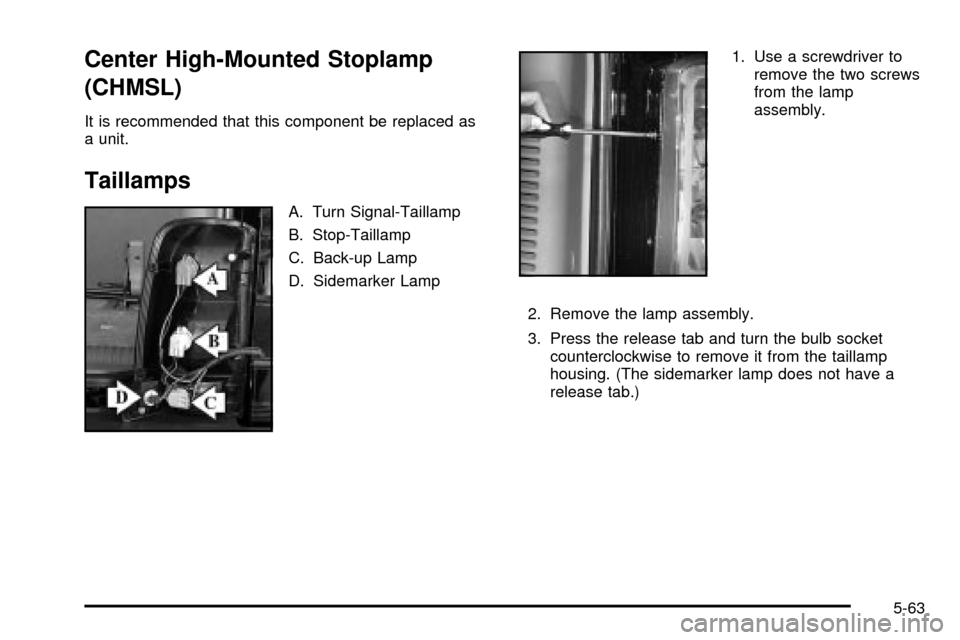
Taillamps
A. Turn Signal-Taillamp
B. Stop-Taillamp
C. Back-up Lamp
D. Sidemarker Lamp1. Use a screwdriver to
remove the two screws
from the lamp
assembly.
2. Remove the lamp assembly.
3. Press the release tab and turn the bulb socket
counterclockwise to remove it from the taillamp
housing. (The sidemarker lamp does not have a
release tab.)
5-63
Page 384 of 486
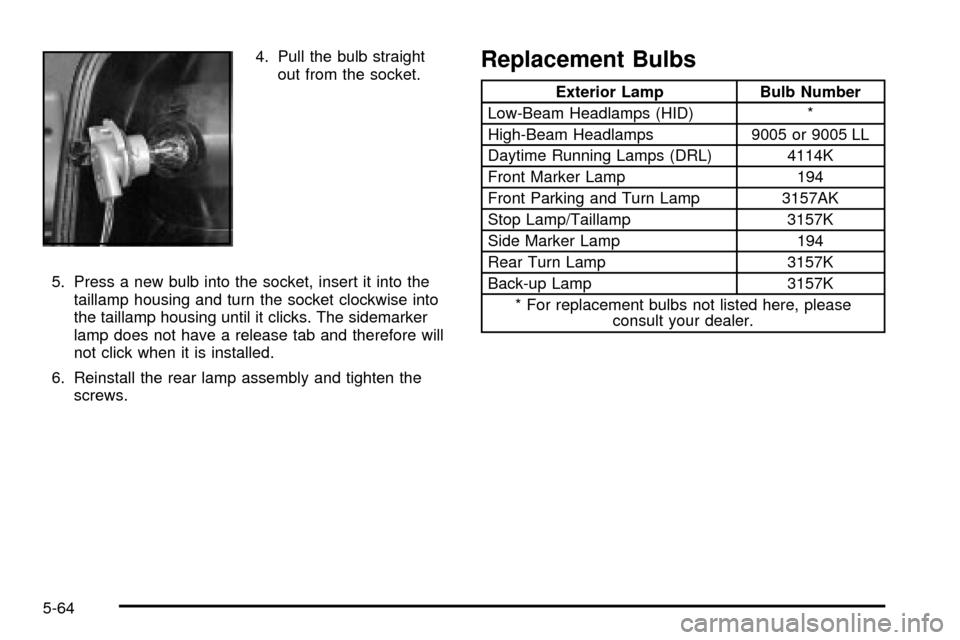
4. Pull the bulb straight
out from the socket.
5. Press a new bulb into the socket, insert it into the
taillamp housing and turn the socket clockwise into
the taillamp housing until it clicks. The sidemarker
lamp does not have a release tab and therefore will
not click when it is installed.
6. Reinstall the rear lamp assembly and tighten the
screws.Replacement Bulbs
Exterior Lamp Bulb Number
Low-Beam Headlamps (HID) *
High-Beam Headlamps 9005 or 9005 LL
Daytime Running Lamps (DRL) 4114K
Front Marker Lamp 194
Front Parking and Turn Lamp 3157AK
Stop Lamp/Taillamp 3157K
Side Marker Lamp 194
Rear Turn Lamp 3157K
Back-up Lamp 3157K
* For replacement bulbs not listed here, please
consult your dealer.
5-64
Page 396 of 486
Changing a Flat Tire
If a tire goes ¯at, avoid further tire and wheel damage
by driving slowly to a level place. Turn on your
hazard warning ¯ashers.
{CAUTION:
Changing a tire can cause an injury. The
vehicle can slip off the jack and roll over you
or other people. You and they could be badly
injured. Find a level place to change your tire.
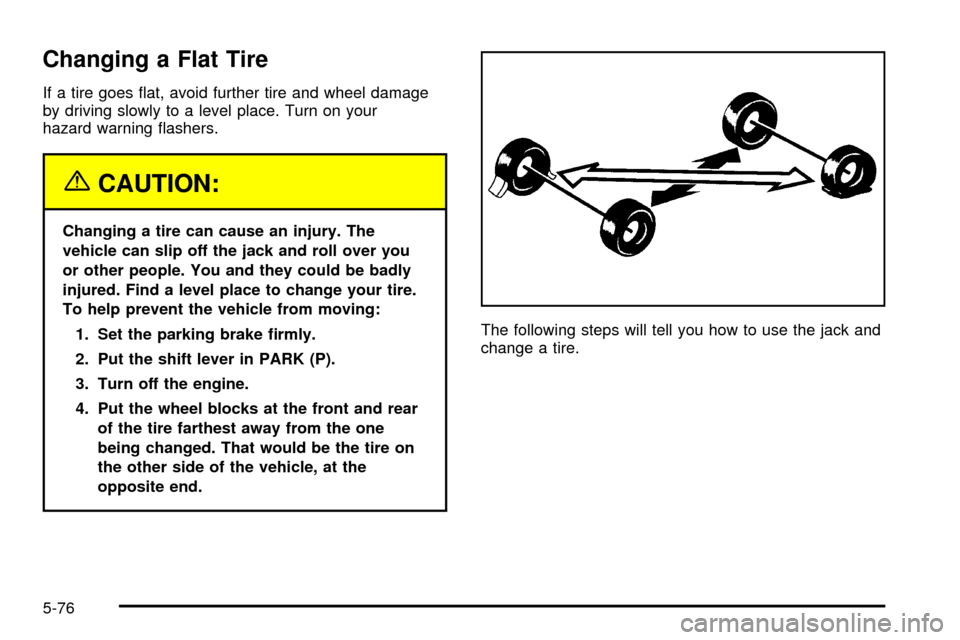
To help prevent the vehicle from moving:
1. Set the parking brake ®rmly.
2. Put the shift lever in PARK (P).
3. Turn off the engine.
4. Put the wheel blocks at the front and rear
of the tire farthest away from the one
being changed. That would be the tire on
the other side of the vehicle, at the
opposite end.The following steps will tell you how to use the jack and
change a tire.
5-76
Page 397 of 486
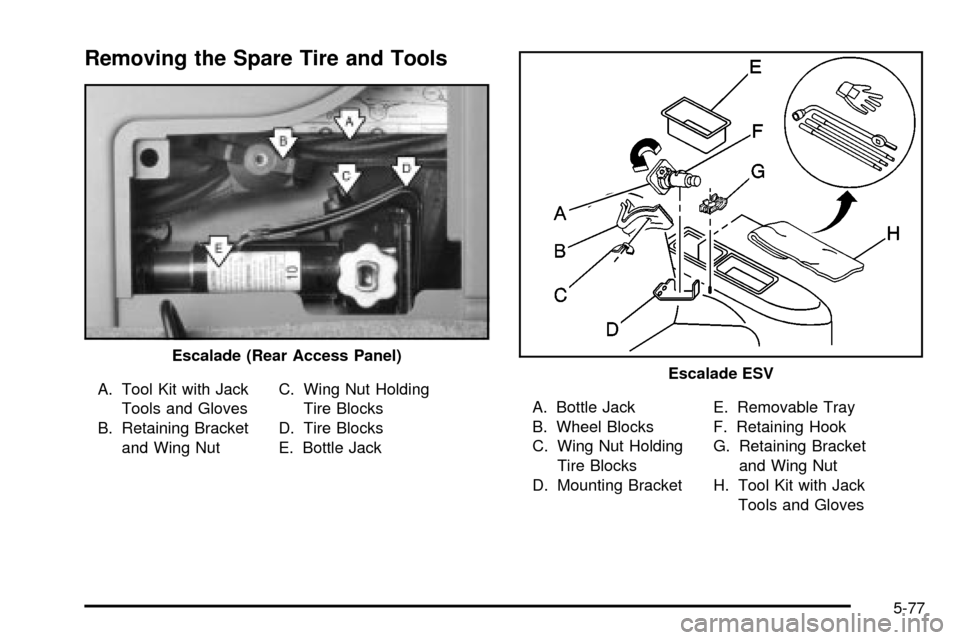
Removing the Spare Tire and Tools
A. Tool Kit with Jack
Tools and Gloves
B. Retaining Bracket
and Wing NutC. Wing Nut Holding
Tire Blocks
D. Tire Blocks
E. Bottle JackA. Bottle Jack
B. Wheel Blocks
C. Wing Nut Holding
Tire Blocks
D. Mounting BracketE. Removable Tray
F. Retaining Hook
G. Retaining Bracket
and Wing Nut
H. Tool Kit with Jack
Tools and Gloves Escalade (Rear Access Panel)Escalade ESV
5-77
Page 398 of 486
For Escalade, the equipment is located behind the left
trim panel in the rear of the vehicle. Unlatch the release
lever to open the trim panel door. Skip the ®rst step
and follow the last three.
For Escalade ESV, the equipment you'll need is under
the storage tray in the left trim panel.
1. Remove the tray to access the tools.
2. To release the bottle jack from its holder, turn the
knob on the bottle jack counterclockwise to lower
the jack head.
3. There is a wing nut used to retain the tool kit. To
remove it, turn the wing nut counterclockwise.
4. The wheel blocks and the wheel block retainer can
be removed by turning the wing nut
counterclockwise.
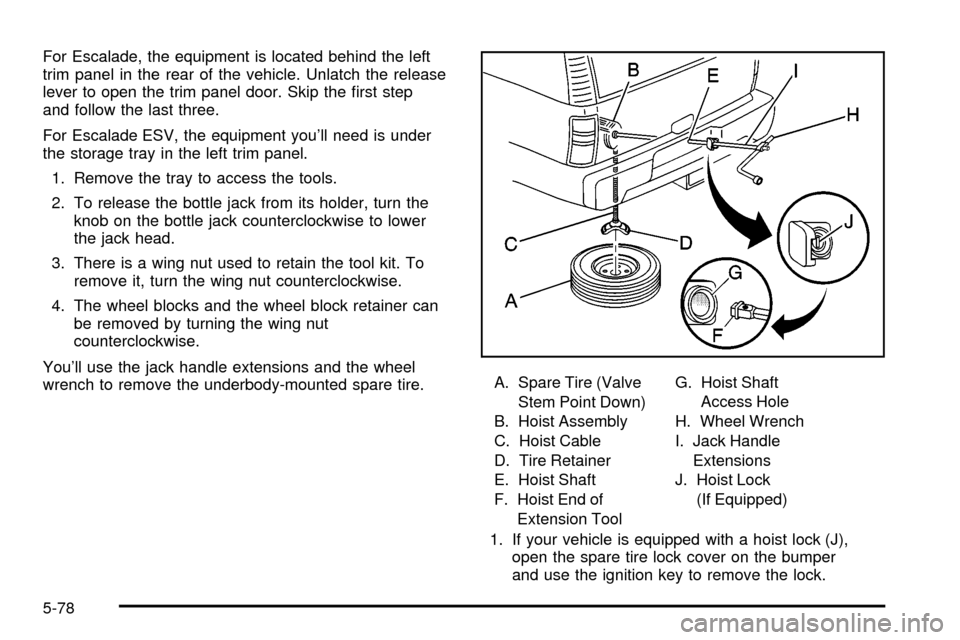
You'll use the jack handle extensions and the wheel
wrench to remove the underbody-mounted spare tire.A. Spare Tire (Valve
Stem Point Down)
B. Hoist Assembly
C. Hoist Cable
D. Tire Retainer
E. Hoist Shaft
F. Hoist End of
Extension ToolG. Hoist Shaft
Access Hole
H. Wheel Wrench
I. Jack Handle
Extensions
J. Hoist Lock
(If Equipped)
1. If your vehicle is equipped with a hoist lock (J),
open the spare tire lock cover on the bumper
and use the ignition key to remove the lock.
5-78